SNH reveals reasons for general licence restrictions on Raeshaw & Burnfoot Estates

Raeshaw Corshope GL restriction map 2015Last week we blogged about the implementation of General Licence restrictions on parts of four properties: Burnfoot Estate & Wester Cringate Estate in Stirlingshire, and Raeshaw Estate & Corsehope Estate in the Borders (see here).

At the time, SNH did not reveal the reasons for the General Licence restrictions, other than to say “There is clear evidence that wildlife crimes have been committed on these properties” [since 1st January 2014, when the new regulations were enacted].

We speculated that the General Licence restrictions at Burnfoot and Wester Cringate in Stirlingshire were related to the poisoning of a red kite (July 2014), a poisoned peregrine (Feb 2015), and the illegal trapping of a red kite (May 2015).

We had no idea why the General Licence restrictions had been implemented at Raeshaw and Corsehope in the Borders, because there hadn’t been any publicity about any recent raptor persecution crimes in this area.

However, last Saturday (7th November 2015), a bit more information was revealed during an interview with SNH Wildlife Operations Manager, Robbie Kernahan, on the BBC Radio Scotland Out of Doors programme.

Amongst other things, the presenter asked Mr Kernahan directly about the reasons for General Licence restrictions on these four properties. Here’s what Mr Kernahan said:

Stirlingshire GL restrictions:Relates to some issues associated with poisoning birds of prey, birds of prey being found poisoned in that location, and illegal use of traps“.

Borders GL restrictions:There are issues about the illegal placement of traps“.

No further explicit detail was provided, although there was a general wider discussion about the use of General Licence Restrictions and their deterrent value in tackling raptor persecution.

The interview can be heard here for the next 26 days (starts at 02:15; ends at 09:06).

Peregrine poisoned in Shropshire blackspot: police appeal 5 months later

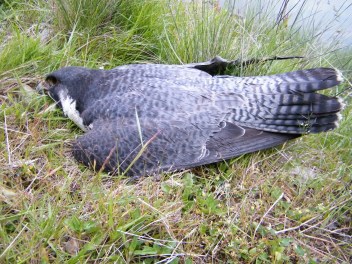
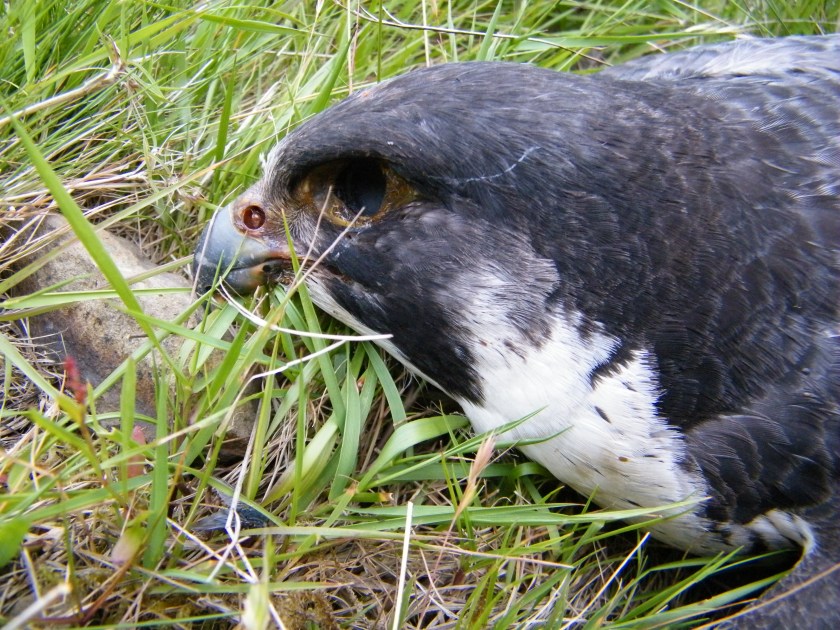
Peregrine male poisoned at Cleehill 2015 Shorrock2 - CopyWest Mercia Police have issued an appeal for information following the discovery of a poisoned peregrine.

The male bird was found dead in a quarry at Clee Hill, Shropshire. This is a well-known persecution blackspot, with two peregrines poisoned there in 2010 and another one poisoned in 2011.

The latest victim was discovered on 15th June 2015. It’s not clear why it has taken five months for the police to issue an appeal for information. This is a recurring and yet avoidable problem, e.g. see here and here for two other recent examples of long delays before the police ask for help with investigations into raptor persecution crimes. It’s just not good enough.

The RSPB and the Shropshire Peregrine Group have offered a £1,000 reward for information leading to a conviction.

Police press release as follows:

West Mercia Police are appealing to the public for information after it was confirmed that a peregrine falcon found dead in a quarry in Clee Hill, Shropshire had been poisoned.

There have been previous problems in this area with two peregrines poisoned in 2010 and another in 2011. Over the last few years the Shropshire Peregrine Group (SPG) has been organising volunteers to keep an eye on the location. On the 15 June this year a volunteer reported a dead adult male peregrine at the base of the breeding cliff. The body was recovered by the RSPB and passed to Natural England in order that toxicology tests could be arranged. These have since confirmed the bird was poisoned by diazinon, the same product as in previous incidents.

Peregrines are fully protected under the Wildlife and Countryside Act 1981 and anyone convicted of killing these birds could receive up to six months in prison and/or a fine.

The RSPB and the SPG have offered a reward of £1000 for information leading to the conviction of anyone involved in this incident.

John Turner of the SPG said: “This is yet another tragic incident at this site. The female parent also disappeared and we are concerned she may have also been poisoned. The situation was made even worse as the two chicks in the nest also died with the loss of the parents.”

Wildlife Crime Officer for West Mercia Police, Constable Julian Ward said: “There have been previous incidents in this area and the illegal use of poison poses a risk to wildlife and to people. We believe somebody in the local community will have information about who is involved and we would urge them to contact police.”

Information can be reported to West Mercia Police on 101 quoting reference 649S of the 15/06/2015. You can also give information anonymously to Crimestoppers UK or 0800 555 111

END

Photos of the poisoned peregrine by RSPB (G Shorrock)

Peregrine male poisoned at Cleehill 2015 Shorrock1 - Copy


Peregrine found shot dead in Halifax, West Yorkshire

A peregrine has been found shot dead in Halifax, West Yorkshire. It’s body was discovered by a maintenance worker at the foot of a 200 ft chimney at a disused carpet mill.

It’s not known if the bird was shot at the mill or whether it had been shot elsewhere and finally succumbed to its injuries at the mill.

Details from the bird’s BTO leg ring identified it as a bird that had fledged from a church steeple in Devon (St Michael’s Peregrine Project, Exeter).

Article in Exeter Express & Echo here

Recently published preliminary results from the 2014 National Peregrine Survey indicate that illegal persecution of peregrines on upland grouse moors is so high it is affecting this species’ national distribution (see here).

Peregrine photo by Martin Eager

General licences suspended on four Scottish grouse moors in response to raptor persecution crimes

Yesterday, SNH published the following press release:

General licences restricted in wildlife crime hotspots

Scottish Natural Heritage (SNH) has restricted the use of general licences on four properties in two wildlife crime hotspots – one in Stirlingshire and one in the Borders – this week. The decision was made on the basis of evidence provided by Police Scotland of wildlife crime against birds.

Nick Halfhide, SNH Director of Operations, said:

“There is clear evidence that wildlife crimes have been committed on these properties. Because of this, and the risk of more wildlife crimes taking place, we have suspended the general licences on these four properties for three years. They may though still apply for individual licences, but these will be closely monitored.

“This measure should help to protect wild birds in the area, while still allowing necessary land management activities to take place, albeit under tighter supervision. We consider that this is a proportionate response to protect wild birds in the area and prevent further wildlife crime.”

General licences allow landowners or land managers to carry out actions which would otherwise be illegal, including controlling common species of wild birds to protect crops or livestock.

The new measure complements other recent actions to reduce wildlife crime, including vicarious liability for offences against wild birds, which was introduced in 2011.

Restrictions will prevent people from using the general licences on the land in question for three years. This period will increase if more evidence of offences comes to light.

END

As promised in earlier correspondence with SNH about potential General Licence restrictions (e.g. see here), SNH has published ‘details’ of the current restrictions on its website. Although when we say ‘details’ we use the term loosely. The names of the estates have not been published (but see below) and the specific reasons (crimes) that triggered the restriction orders are also absent.

Instead, SNH has published two maps showing the areas where the three-year restriction orders will be in place.

Restriction order #1 can be viewed here: GL restriction order 1_ Nov 2015-2018

The map denoting the area relating to Restriction order #1 is here:

Raeshaw Corshope GL restriction map 2015

Having consulted Andy Wightman’s brilliant website Who Owns Scotland to check estate boundaries, we now know that the delineated area shown in Restriction order #1 includes parts of Raeshaw Estate and the neighbouring Corsehope Estate.

This is fascinating. Raeshaw Estate is well known to us and continues to be of interest. It is a mixed upland estate combining driven grouse shooting as well as pheasant and partridge shooting. We have documentary evidence that Mark Osborne’s company is involved in the estate management (more on that in the near future). Raeshaw Estate has been raided by the police at least twice (2004 and 2009 – poisoned and shot raptors and poisoned baits – see here) although nobody has ever been prosecuted for these crimes. However, the General Licence Restriction can only be applied for crimes that have been uncovered since 1st January 2014; it cannot be applied retrospectively for offences that took place prior to 1st January 2014. This means that further raptor crimes have been uncovered here but there has not been any publicity about them. Why not? There was news of a shot buzzard found in the nearby area on 24th July 2015 (see here), but this bird was found AFTER SNH had notified the estate of the intention to restrict the General Licence (see here) so this incident cannot be the one that triggered the General Licence Restriction.

Corsehope Estate has not been on our radar, although we’re told by local sources that gamekeepers from Raeshaw Estate are involved with ‘vermin control’ here so now we’re very interested.

Restriction order #2 can be viewed here: GL retriction order 2_ Nov 2015-2018

The map denoting the area relating to Restriction order #2 is here:
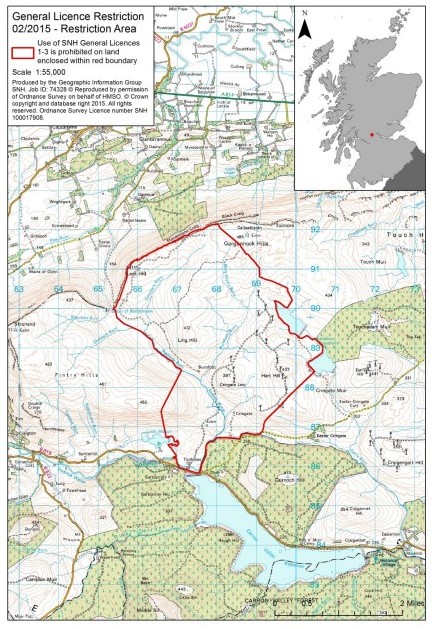
Burnfoot Wester Cringate GL restriction map 2015

Again, consulting Andy Wightman’s excellent website Who Owns Scotland to check estate boundaries, we now know that the delineated area shown in Restriction order #2 includes parts of Burnfoot Estate and Wester Cringate Estate.

This is also interesting. We believe (although it must be stressed that this is educated speculation as SNH has not published the information) that this restriction order probably relates to a series of raptor persecution crimes including a poisoned red kite (July 2014), a poisoned peregrine (February 2015) and an illegally trapped red kite (May 2015) – see here.

So, what do these General Licence Restriction orders mean? Basically, it means that the following activities, usually permitted under General Licences 1, 2 and 3, are now not permitted in the areas shown on the two maps for three years, starting 13th November 2015 and ending 12th November 2018:

The killing or taking of the following species:

Great black-backed gull, carrion crow, hooded crow, jackdaw, jay, rook, ruddy duck, magpie, Canada goose, collared dove, feral pigeon, wood pigeon, lesser black-back gull, and herring gull.

The use of the following methods to kill/take these species are not permitted:

Pricking of eggs, oiling of eggs, destruction of eggs and nests, use of Larsen trap, use of Larsen Mate trap, use of Larsen Pod trap, use of multi-catch crow cage trap, shooting with any firearm, targeted falconry, and by hand.

That sounds great, doesn’t it? But it’s not quite as clear cut as that. As we’ve discussed before, and as is stated in the SNH press release at the top of this blog, although these activities can no longer be carried out in the two denoted areas under the cover of the three General Licences, individuals may still apply for an individual licence to permit these activities, although SNH claims that if granted, these will be “closely monitored”.

What does ‘closely monitored’ actually mean? Closely monitored by whom? Daily inspections by SNH? Police Scotland? That’s hardly going to happen, is it?

Let’s hope that members of the general public, exercising their right to visit these areas under open access legislation, pay close attention to what’s going on around them. If they see a Larsen trap in use, or a crow cage trap in use, or witness any of the above bird species being killed/taken by any of the methods mentioned above, they inform the Police straight away. Actually, let’s hope they forget the police and inform RSPB Scotland and/or the SSPCA instead – they’re more likely to get a quick response from them.

It’ll be interesting to see how this all pans out. On the one hand, we welcome these Restriction orders and applaud the Scottish Government (especially former Environment Minister Paul Wheelhouse for initiating them), SNH and Police Scotland for pursuing what we hope will be the first of many such Restriction orders. But on the other hand, will these restrictions be anything more than a minor inconvenience to the estates involved because they can simply apply for individual licences to continue their game-shooting activities? We’ll have to wait and see.

RSPB Scotland’s response to the two General Licence Restriction orders here

As yet no response from Scottish Land & Estates or the Scottish Gamekeepers’ Association but we’ll post them here if/when they comment.

UPDATE 11.50hrs: The SGA has issued the following statement on their website:

On November 4th 2015, SNH announced general licence restrictions to two areas encompassing four properties.
The SGA has issued the following statement in response to questions.

A Spokesman for The Scottish Gamekeepers Association said: “The SGA cannot condone wildlife crime and has a clear and consistent policy regarding this.
“As regards this case, it is our understanding that legal discussions are taking place regarding the areas affected and, therefore, it is not appropriate for us to comment further.”
END
UPDATE 13.20hrs: Statement from Environment Minister Dr Aileen McLeod:

“The announcement by SNH that the use of general licences has been restricted on specified areas of land in the Borders and in Stirlingshire is a result of work that the Scottish Government commissioned in July 2013 as part of a package of measures to combat wildlife crime.

We welcome the progress that has been made with this work. However we have not been involved in the decision-making and do not have any comment on the individual cases in question. The General Licence system is a light touch form of regulation. It is clearly sensible to apply closer scrutiny to areas where there is good evidence that wildlife crime has taken place, and we believe that this will prove a useful tool in the fight against bird of prey persecution.”

Police appeal for info 5 months after peregrine nest robbery

South Yorkshire Police and the National Wildlife Crime Unit are appealing for information following the theft of a peregrine chick from a nest site in Rotherham.

They have published two photographs of the suspect (caught on an RSPB surveillance camera).

The crime took place over five months ago on Friday 8th May.

Chief Inspector Martin Sims, head of the NWCU said: “The illegal trade in birds of prey is a UK wildlife crime priority….

Really.

The RSPB is offering a £1000 reward for information that leads to a conviction.

Police press release here

CCTV image 1_5

CCTV image 2_4

Further declines of breeding peregrines on grouse moors in NE Scotland

Following on from yesterday’s blog about the preliminary National Peregrine Survey results (see here), an important new scientific paper has just been published on the status of breeding peregrines in NE Scotland:

North East Scotland Raptor Study Group (2015). Peregrines in North-East Scotland in 2014 – further decline in the uplands. Scottish Birds 35(3): 202-206.

We’re not permitted to publish the full paper here, but we are able to publish extracts from it. To read the full paper you’ll either need to subscribe to Scottish Birds (published by the Scottish Ornithologists’ Club) or you can email the authors and ask if they’d be willing to provide a copy for personal use: nesrsg@gmail.com

Here is the abstract:

Peregrines in North-east Scotland were surveyed in 2014. Compared with previous studies there was an increase in coastal breeding Peregrines, but a decline in the uplands, trends persistent since 1991. Overall fewer Peregrines were recorded in 2014, but their breeding performance was relatively high. Low occupancy of nesting ranges, with more singletons than pairs, was associated with intensive management for driven grouse shooting. The results document a further decline in the Peregrine breeding population in the eastern Cairngorms National Park.

Here is the table of data:

Peregrines NE Scotland 2014_NERSG - Copy

And here is the discussion section:

The breeding population of Peregrines in the north-east of Scotland has been monitored in detail since 1975 with changes in both numbers and distribution well documented (summarised in Hardey 2011). Together with the earlier studies, the 2014 survey results suggest Peregrines in North-east Scotland have increased further on the coast and continued to decline in the uplands, particularly on intensively managed grouse moor where in 2014 only two pairs and four singletons were found.

Occupancy could be underestimated if not all alternative nesting sites are visited or if breeding attempts fail early and birds abandon the site. In 2014 this was unlikely because nesting ranges were well known, visits were not tardy, and most observers were both experienced and skilled using observations of faeces and prey remains as well as of birds. The survey’s key result involved fieldwork in areas that were easiest to search. Most nesting ranges on moorland were on relatively small rocks which were easily checked for both birds and prey remains. By comparison, birds on the coast were less easy to locate because of the continuous potential breeding habitat, including nesting sites that could not be viewed from above. That said, birds were often obvious as they perched high on sea cliff buttresses, with both droppings and plucked prey remains evident. The change in numbers on the coast might thus be complicated by birds obscurely shifting nest site, but the numbers inland are difficult to dispute. The decline of breeding Peregrines recorded in earlier studies is endorsed; in 2014 there were simply even fewer Peregrines to be found at traditional breeding places in the uplands, particularly on moorland managed for driven grouse shooting.

Both Hardey et al. (2003) and Banks et al. (2010) suggest the decline of breeding Peregrines on grouse moorland is the result of killing by game keepers in a sustained effort to reduce the numbers of grouse predators. It is difficult to argue otherwise. Amongst alternative explanations, for example, a reduction in Peregrine food supply is unlikely because Red Grouse Lagopus l. scotica (the main prey by weight) are superabundant on these intensively managed moors. Indeed, 2014 saw record-breaking grouse bags on many estates (www.shootinguk.co.uk/news/moorsreport-record-grouse-bags-6860). It is possible that some other aspect of management for grouse might be reducing the numbers of Peregrines, such as protracted muirburn or the persistent long term use of anthelminthic drugs (medicated grit), but such speculation lacks rational foundation; the most parsimonious explanation is that, as has been established for other birds of prey (Scottish Raptor Study Groups 1997, Whitfield et al. 2003, Fielding et al. 2011), Peregrines are killed on a broad scale and persistently, as newcomers repeatedly attempt to colonise untenanted breeding sites. Such killing reduces the chance of re-colonisation, and moreover reduces recruitment in nearby less intensively managed upland.

The history of the killing of Peregrines on grouse moors is well documented (Ratcliffe 1993, Hardey 2007) and the decline in breeding pairs since 1991 is well reported, initially published by Scottish Natural Heritage (Hardey et al. 2003) and several times since. Despite previous publication the results from 2014 show further decline. The context and scale of the decline is alone of major concern, but has further significance because the north-east of Scotland forms around 40% of the Cairngorms National Park designated in 2003, and currently claimed to be “a stronghold for Britain’s wildlife” (cairngorms.co.uk, accessed 13 May 2015). The eastern portion of the National Park has 53 known Peregrine nesting ranges and in 2014, 51 of these were visited, but only 17 were occupied, 12 by pairs and five by singletons. In 2014, the North-east Scotland portion of the park held less than a quarter of the number of Peregrines that bred in 1991.

END

This paper, like many before it, presents compelling evidence about the scale of illegal raptor persecution on driven grouse moors, and in this case, notably in the eastern portion of the Cairngorms National Park. We’ve blogged about this notorious raptor-killing hotspot several times before:

In May 2013 we blogged about the launch of ‘Cairngorms Nature‘ – an ambitious five-year action plan to ‘safeguard and enhance the outstanding nature in the Cairngorms National Park’. The proposals for raptor protection were unbelievable – see here.

In May 2014 the Convenor of the Cairngorms National Park Authority complained to the Environment Minister that continued raptor persecution in the area “threatens to undermine the reputation of the National Park as a high quality wildlife tourism destination” (see here). This resulted in a high-level meeting between the Env Minister and various landowners and their representative bodies in January 2015 – lots of talking and ‘partnership working’, natch – see here – but bugger all else.

Almost 45% of the Cairngorms National Park is covered by ‘managed moorland’. And just look at the damage that ‘management’ is causing. Inside a National Park for christ’s sake!

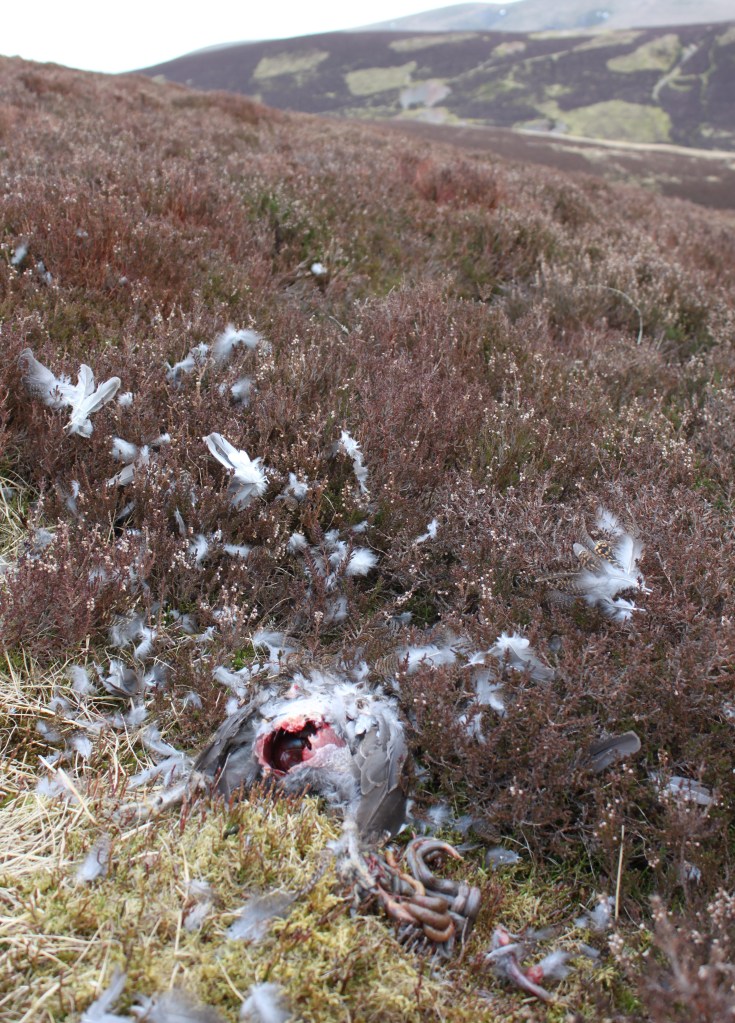
As an aside, on yesterday’s blog somebody asked whether peregrines prey on red grouse. Yes, they do. Below is a photo of a red grouse that was killed by a peregrine on a Scottish grouse moor. We watched the whole spectacular event. It’s what peregrines do and it’s why many grouse moor managers are doing their utmost to eradicate this species, as well as the hen harrier, golden eagle, and anything else with talons, a hooked beak, or sharp teeth that might affect the number of red grouse available to be shot by high-paying customers.

It’s time to ban driven grouse shooting. Please join over 22,000 other voices by signing this e-petition HERE.

IMG_6467 (2) - Copy

National peregrine survey preliminary results: those bloody grouse moors, again

Periodically there are synchronised national surveys for a number of raptor species in the UK, which help to build a picture of national and regional population trends. This year it was the national survey of breeding golden eagles, next year it will be hen harriers, and last year it was the peregrine.

The final results of the 2014 National Peregrine Survey are yet to be published – these things can take time, although we’d hope to see a publication in 2016. In the meantime, the project coordinator, Dr Mark Wilson (BTO Scotland) has written a short piece on the preliminary findings:

2014 National Peregrine Survey

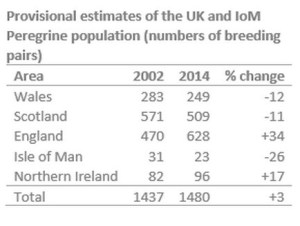
The sixth UK breeding survey of Peregrine was carried out in 2014, providing a provisional estimate of 1480 pairs in the UK and Isle of Man. This initial figure indicates that the Peregrine population in the UK has remained largely stable since the last national survey in 2002. However, this overall stability belies marked variation in the trends of Peregrine populations in different parts of these survey areas over the past 12 years.

Peregrines are now distributed more widely and evenly than ever through the UK, due to decreases in Scotland, Wales and Isle of Man, and increases in England and Northern Ireland (see table). For the first time, the estimated number of breeding Peregrines in England is greater than that in Scotland, though these two countries still hold the majority of the UK’s Peregrines.

Peregrine survey 2014 prelim results - Copy

The country-level changes described above, together with regional trends in peregrine breeding numbers and territory occupancy, suggest that, broadly speaking, Peregrine numbers have decreased in upland areas, remaining stable or increasing in many lowland and coastal areas. The association of Peregrines with wild and remote places in the UK grows increasingly tenuous, as numbers nesting on traditional inland crags decline, and the numbers occupying lowland quarries and man-made structures continue to grow.

This ongoing redistribution of Peregrine numbers across Britain is probably being driven by multiple factors. Food supply is likely to be important; changes in numbers and availability of prey are likely to be having an effect in many areas. Illegal persecution continues to restrict numbers and productivity of breeding Peregrines in some regions, particularly where pigeon racing is practiced and where there is intensive management for red grouse shooting. In contrast, decreases in lowland persecution during the 20th century and the ban on organochlorines have had positive influences on numbers, and allowed Peregrines to expand into many areas where they were previously absent. But more work is needed, particularly on food supply and its role in limiting Peregrine numbers, in order to diagnose the cause of regional declines, and identify measures to halt or reverse them. [Mark Wilson, Research Ecologist, BTO Scotland].

END

So, not many surprises here. It’s been long-established that peregrines are routinely killed on many driven grouse moors but not so much in urban and coastal areas, where they’ve been doing well because, er, they generally aren’t poisoned, shot or trapped there, unless a dodgy pigeon racer happens to live nearby. These latest (preliminary) findings show it’s been business as usual on the grouse moors of northern England and Scotland.

The final sentence of Mark’s article is quite surprising though, and really should have been clarified. Food supply may be an issue for peregrines in some areas but it most definitely is not a limiting factor on driven grouse moors – those moors are heaving with red grouse! A brilliant paper written by Arjun Amar et al (2011 – we blogged about it here) showed pretty conclusively what was happening to peregrines on grouse moors in Northern England and it had absolutely nothing to do with lack of food and everything to do with illegal persecution.

Mark’s suggestion that ‘more research is needed to diagnose the cause of regional declines and identify measures to halt or reverse them’ may be true for some areas but not for areas that are managed as driven grouse moors. Extensive research, over many decades now, has shown exactly what the problem is and it’s high time it was addressed. Here’s the best way to address it – ban driven grouse shooting – please sign the petition here.

Tomorrow we’ll blog about another new paper, just published, that stemmed from the 2014 National Peregrine Survey. It’s about peregrine declines in North East Scotland, particularly in the Cairngorms National Park, and leaves no doubt that grouse moor management is central to the problem.

Peregrine photo by Steve Waterhouse

Two peregrines shot dead

Police in Northern Ireland are appealing for information following the discovery of two dead peregrines.

The birds were found on Sunday 17th May close to Thornyforde Bridge in the Waringstown area, Co. Armagh. A post mortem revealed they had been shot.

Anyone with information please contact the police in Lurgan on 101, quoting ref: 817-170515.

Peregrine photo by Steve Waterhouse

DEFRA’s plans unchanged despite loss of 5 breeding hen harriers

In June, following the news that five breeding male hen harriers had ‘disappeared’ from active nests this year, one of our blog readers submitted an FoI to DEFRA to ask about the Westminster Government’s contingency plans to protect hen harriers and to deal with the criminals who continue to persecute hen harriers and other wildlife:

Sir/ Madam

I am making a Freedom of Information request regarding hen harriers/ illegal persecution of wildlife.

1) With the recent losses of five male birds in northern England, as published in Natural England’s press release (https://www.gov.uk/government/news/five-hen-harriers-have-now-disappeared-from-northern-england), what is the Government’s contingency plan(s) to prevent the species becoming extinct in the wild in England as a direct result of illegal persecution within the next 5 years, i.e. the duration of this Parliament?  If there are no contingency plans, why are there no contingency plans?

2) In a recent court case in Spain (see http://www.venenono.org/?p=2506 with an English summary available here:https://raptorpersecutionscotland.wordpress.com/2015/06/09/now-thats-a-deterrent/, the sanction imposed on an individual found guilty of a wildlife offence was considerably more severe compared with recent similar incidents in England.  Does the UK Government have any plans to introduce similar sanctions that would act as a meaningful deterrent to wildlife criminals?  If not, why not?

3) Does the Government consider the current sanctions available to Magistrates/ Judges sufficiently severe to act as a deterrent to wildlife criminals, within the context of those imposed in the aforementioned Spanish case?

4) As in Spain, is the Government seriously considering introducing ‘sniffer dogs’ able to detect the use of poisoned bait as described in the article published by Raptor Persecution Scotland? If not, why not?

Many thanks,

XXXXX XXXXX

Here is DEFRA’s response:

Dear XXXXX XXXXX

Thank you for your request of 11 June about the illegal persecution of hen harriers. I have been asked to reply.

We share your concerns regarding the recent losses of five hen harriers but are encouraged by the news of several nests this year, following on from four nests in 2014, with 16 fledglings. In 2013, for the first time in over 50 years, there were no known fledglings.

All wild birds are protected under the Wildlife and Countryside Act 1981, which implements the EC Wild Birds Directive in Great Britain. This provides a powerful framework for the conservation of wild birds, their eggs, nests and habitats. I can assure you that we are committed to ensuring the strict protection afforded to wild birds of prey under our wildlife legislation is effectively enforced. There is a robust legal framework for protecting such birds with strong penalties for offenders, which can include imprisonment.

Despite the protection afforded to birds of prey, it is clear that they continue to be persecuted. To address this, senior Government and enforcement officers in the UK identified raptor persecution as a National Wildlife Crime Priority. Raptor persecution is subject to a prevention, intelligence and enforcement plan led by a senior police officer. The National Wildlife Crime Unit, which is part-funded by Defra, monitors and gathers intelligence on illegal activities affecting birds of prey and provides assistance to police forces when required.

It should be noted that despite instances of poisoning and killing of birds of prey, populations of many species, such as the peregrine falcon, red kite and buzzard have increased. While a small minority is prepared to kill birds of prey and where possible these people are brought to justice, this demonstrates that the policies in place to conserve these species are working.

One of our most threatened birds of prey is the hen harrier and we take the decline in hen harrier populations in England very seriously. In August 2012 Defra established the Hen Harrier Sub-Group of the Uplands Stakeholder Forum whose members include representatives from Natural England, the Moorland Association, the National Gamekeepers’ Organisation, the Game and Wildlife Conservation Trust, National Parks UK and the RSPB.

All members of the Hen Harrier Sub-Group have a common interest to protect hen harriers.  They have made concerted efforts to engage and have produced a Joint Action Plan that contains a suite of actions intended to contribute to the recovery of the hen harrier population in England. The commitment shown by the differing organisations involved in the Sub-Group to help the recovery of one of our most iconic birds demonstrates a desire to bring about behavioural change amongst gamekeepers and confidence that this can be achieved through a package of complementary actions.

The Joint Action Plan includes three measures to stamp out illegal persecution, a trial toolkit comprising two measures for land owners to safely accommodate hen harriers on grouse moors and a measure to reintroduce them to suitable habitat in other parts of England. Defra officials are currently working with Sub-Group members to finalise the Plan.

As previously stated there are already strong penalties in place for people committing offences against birds of prey. You have asked if the Government intends to introduce tougher penalties for those convicted of wildlife crimes. I should first point out that Parliament is responsible for deciding the maximum penalties for offences. There are currently no plans to increase the penalties for offences against wildlife. Within the maximum limits, it is up to the court to decide the appropriate sentence in any case, having taken into account all the facts of the case.

We are aware that sniffer dogs are used in other countries, including Italy, Spain and Greece, to detect poisoned bait but are not aware that enforcement bodies in the UK have this resource or are considering it for the future. This would be a matter for individual Police forces to decide upon.

Yours sincerely,
Charlie Coombs
Customer Contact Unit

Shot peregrine found in County Durham has to be euthanised

shot perg june 2015 durham_peregrinefalconjohnolleyThe Police and the RSPB are appealing for information following the discovery of a shot peregrine last month.

The bird was found, still alive, on 4th June at Castle Lake, Bishop Middleham, a local nature reserve managed by Durham Bird Club.

After a veterinary examination the male’s injuries were considered so severe it was decided to put him to sleep.

The RSPB is offering a £1,000 reward for information that leads to a successful conviction.

RSPB press release here

Photo of shot peregrine by John Olley