Peregrine found dead at persecution hotspot, Co. Antrim

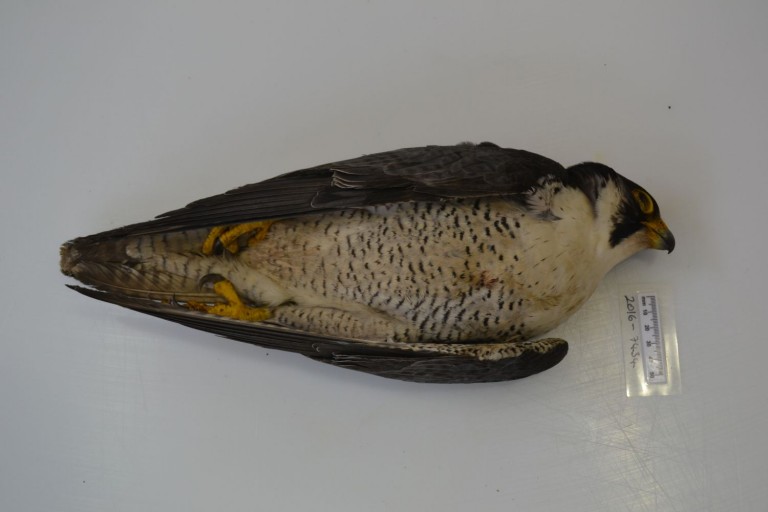
The Northern Ireland Raptor Study Group (NIRSG) has reported the discovery of a dead peregrine at a known persecution hotspot in Glenwherry, Co. Antrim.

In 2012, a recently fledged peregrine was found dead underneath the nest cliff. It had been shot (see here).

The latest dead peregrine (part of a breeding pair) was discovered on Monday 11th April 2016. The bird has been sent for post mortem as it is strongly suspected it has been illegally killed.

Peregrine Glenwherry

Dr Marc Ruddock from the NIRSG, who has monitored peregrines in this area for over a decade, said: “It is deeply frustrating to think that someone might have gone out of their way to target this bird if the post mortem confirms an illegal act. In 2014 there were only 57 successful breeding peregrines across the whole of Northern Ireland. The loss of a breeding adult has the potential to lead to desertion of a historical breeding site and widespread persecution could result in serious implications for the viability of the Northern Ireland population of peregrines.

NIRSG volunteers will be increasing surveillance and monitoring at peregrine sites across the country immediately in order to protect nesting sites at this time of year and will report any suspicious activity to the Police Service of Northern Ireland. I would urge the public to be vigilant and also report any suspicious activity or vehicles in the vicinity of cliffs or quarries immediately to PSNI”.

Dr Eimear Rooney, NIRSG representative on the Partnership for Action against Wildlife Crime (PAW), said: “Disappointingly our fieldworkers detect incidents of raptor crime each year, particularly of peregrines, red kites and buzzards being poisoned or shot. Wildlife crime incidents, particularly where they occur in remote locations, can often go unreported. PAW is working hard to raise awareness both of the law and the protection it affords birds of prey. However, there are clearly still those individuals who are determined to kill birds of prey“.

In March this year, the PSNI and PAW group launched Operation Raptor, a multi-agency initiative aimed at targeting those who continue to kill birds of prey (see here).

Peregrine Glenwherry 2

Pigeon racing men convicted of poisoning peregrines & sparrowhawks

Four men associated with a pigeon racing club in County Waterford, Ireland, have been convicted of illegally poisoning peregrines and sparrowhawks, and other associated wildlife crimes.

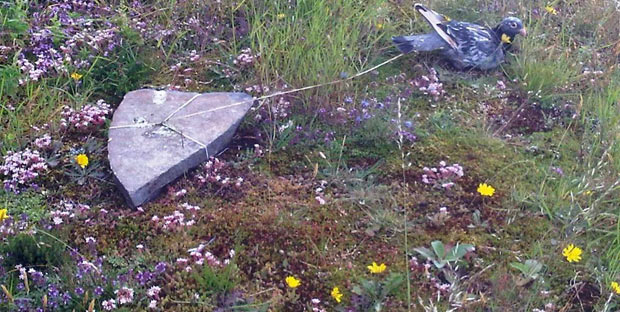
The convictions are the result of surveillance and investigation by conservation rangers from the Irish Republic’s National Parks & Wildlife Service at three quarries in March and April 2014: Cappagh Quarry, Keereen Quarry and Carroll’s Cross Quarry. Live pigeon baits, smeared with poison and tied to stones or stakes had been found on a number of occasions at the top of the quarry cliffs, designed to lure in raptors. Four poisoned peregrines and two poisoned sparrowhawks had also been found.

pigeon poison wales 2012

On March 9th 2016 at Dungarvan District Court, the following individuals were convicted:

Stephen O’Brien, of 58 Congress Villas, Dungarvan, was convicted of 20 offences, including the use of a live decoy on five separate dates. He was fined 1500 Euros for each of the five dates (7,500 Euros in total) and the other 15 charges were recorded as ‘proven’.

Kevin Crotty (Chairman of Dungarvan Premier Pigeon Club) of 16 Lismore Avenue, Dungarvan, was convicted of 10 offences on five separate dates. He was fined 600 Euros for two offences and the remaining eight charges were recorded as ‘proven’.

John Crotty, of 23 Congress Villas, Dungarvan, was convicted of four offences. He was fined 700 Euros for one offence and the remaining three charges were recorded as ‘proven’.

Christopher O’Brien, of 79 Congress Villas, Dungarvan, was convicted of obstructing an Authorised Person during a search of his premises and with the illegal possession of protected wild finches. He was convicted of 16 offences. He was fined 700 Euros for one offence and the remaining 15 charges were recorded as ‘proven’. He was also ordered to forfeit a stuffed peregrine that had been found at his house.

The National Parks & Wildlife Service believes raptor persecution is a significant problem in Co Waterford and said peregrines had been a particular target, resulting in reduced breeding success. They encourage farmers and members of the public to report suspicious incidents, in confidence, to: Tel (01) 888 3242 or email nature.conservation@ahg.gov.ie

The photo shows a live pigeon decoy, smeared in poison and tied to a rock in a similar poisoning case in Wales in 2012 (photographer unknown).

Increase in raptor persecution crimes in 2015

The Partnership for Action against Wildlife Crime (PAW Scotland) has just published the ‘official’ 2015 raptor persecution data, including their annual persecution hotspot maps.

The PAW Scotland press release can be read here and the hotspot maps can be accessed here.

20 crimes against birds of prey were recorded in 2015, which is an increase on the 18 recorded in 2014. The 2015 crimes included six poisoning incidents, five shootings, five disturbance incidents, three trapping or attempted trapping offences and one case of chick theft. The victims included red kite, peregrine, buzzard, goshawk, osprey and hen harrier. Surprisingly, golden eagle isn’t included in the list. We’ll discuss that below.

Having read the press release and looked at the hotspot maps, four things jumped out at us.

First is the increase in recorded raptor persecution incidents in 2015. It’s only a slight increase, from 18 to 20 recorded crimes, but nevertheless it is still an increase. This is important to note, especially in light of a recent statement made by Tim (Kim) Baynes of the Scottish Moorland Group (funded by the landowners’ lobby group Scottish Land & Estates). In December 2015, in response to the publication of the RSPB’s 20-year raptor persecution review, Kim said this:

“Bird of prey deaths……have fallen dramatically over the last five years in particular“.

At the time, Kim didn’t back up this claim with any evidence and as the 2015 data have now been published, it’s clear why he didn’t. Basically, the evidence wasn’t there. As Head of RSPB Scotland’s Investigation team Ian Thomson says in the latest PAW Scotland press release:

These latest figures make it readily apparent that claims of a decline in the illegal killing of raptors are wholly without foundation“.

This time, Kim isn’t claiming that there has been a decline but he still tries to diminish the problem by saying “annual variations [in the number of reported persecution crimes] are now very small“. Another way of putting it, Kim, would be to say that no progress has been made!

The second thing to jump out at us is perhaps the most concerning of all, and that’s the withholding of data relating to a quarter of the recorded 2015 crimes. If you read the PAW Scotland press release, you’ll notice the following caveat written in the ‘Notes to Editors’ section:

Further details of 5 of the 20 bird of prey crimes recorded in 2015 are currently withheld for police operational reasons. It has therefore not been possible to include the locations of these incidents on the hotspot maps‘.

So here’s one of the maps purporting to show all types of raptor persecution crimes recorded over a three-year period in Scotland (2013-2015). Only it doesn’t show them all, as 25% are missing. Not only are 25% missing, but also missing are details of poisoned baits (no victims present) that were recorded during this period – for some reason they’ve been placed on a separate map. So when you look at this map, ignore the misleading title. It isn’t a map of ‘All Recorded Bird of Prey Crimes Scotland – 2013-2015’, it’s a map of SOME Recorded Bird of Prey Crimes 2013-2015, just the ones we’re allowed to know about.

ALL Raptor crimes 2013 to 2015

The purpose of publishing these annual hotspot maps and their associated data is, according to the PAW Scotland website, ‘to allow all the partner organisations to enter into meaningful discussions and work together to eradicate bad or illegal practices in Scotland‘. Presumably, because the maps and data are also placed in the public domain, the purpose is also to increase transparency and thus public confidence. What is the point of publishing a proportion of the data and withholding the rest? It just makes a mockery of the whole process. Why bother publishing at all?

The caveat in the ‘Notes to Editors’ section goes on to say:

The [withheld] incidents are, however, included in the figures provided in the summary tables accompanying the maps. The maps and background data will be updated, where possible, in future publications‘.

Sounds promising, but when you actually look at the summary tables you find large sections still marked as ‘withheld’:

Confirmed poisonings 2015

ALL raptor crimes 2015

These ‘withheld’ incidents, shrouded in secrecy, make it virtually impossible to cross reference known reported persecution crimes with those being touted as the ‘officially recorded’ crimes, which closes off any opportunity to scrutinise these ‘official’ data to ensure that incidents have not been ‘missed’ or ‘forgotten’ (we’re being kind). In other words, we are expected to accept and trust the ‘official’ data from Police Scotland as being accurate. Sorry, but having seen Police Scotland’s shambolic handling of some wildlife crime incidents we have limited confidence in their ability, either intentionally or unintentionally, to get this right.

This leads us nicely on to the third thing to jump out at us. As mentioned above, we were surprised not to see golden eagle listed as one of the 2015 victims. According to our sources, a traditional golden eagle eyrie was burnt out in 2015 – we blogged about it here. Why wasn’t this incident included in the 2015 PAW data? Or was it included and it was categorised in the ‘withheld’ category? Who knows. Do you see what we mean about the difficulty of cross-referencing known incidents?

The fourth thing to jump out was an entry in Table 5c (see above). The second line down tells us that a red kite was poisoned in Tayside in January 2015. That’s news to us. Does anybody remember seeing anything in the media about this crime? Any appeal for information? Any warning to the public that deadly poison was being used in the area? No, thought not.

The reticence of the police to publicise some of these crimes is deeply concerning, and especially when that suppression extends to details of crimes in ‘official’ reports that are supposed to demonstrate openness and transparency. Ask yourselves, in whose interest is it to keep these crimes under wraps?

Hooks attached to pigeon’s legs designed to injure raptors

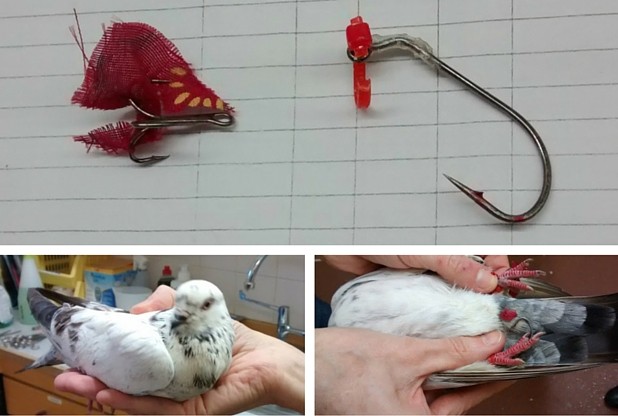
The RSPCA is appealing for information after the discovery of a pigeon that had sharp hooks attached to its legs. The bird was found stuck in someone’s garden in Poolfield Road, Lichfield on Tuesday.

There’s only one reason for attaching hooks like this to a pigeon, and that’s to cause serious damage to any raptor, like a sparrowhawk or a peregrine, that might try to prey on the pigeon.

Pigeon hook 1

pigeon hook 2

Presumably the RSPCA has paid a visit to the local pigeon racing lofts in the Lichfield area as part of their investigation.

Full article in the Lichfield Mercury here

More shameless spin-doctoring from the Gift of Grouse

Gift of GrouseTim (Kim) Baynes, Director of the grouse-shooting industry’s propaganda campaign, The Gift of Grouse, is shameless. He must be to have penned his latest bout of spin-doctoring, this time pointing the finger at raptor workers.

Before we begin, here’s a definition of a spin doctor:

A person whose job involves trying to control the way something is described to the public in order to influence what people think about it“.

Ladies and gentlemen, the spin doctor is IN.

The following article, authored by Tim (Kim) Baynes, appears in today’s Courier and is entitled: ‘Trust needs to develop quickly between raptor groups and land management‘.

Despite the grouse season ending more than a month ago, our moorland continues to fire passions on all sides.

Since Jim Crumley’s last column, The Courier letters’ pages have been alive with debate. Yet, much of the criticism levelled at estates does not reflect what I see on our moors.

The Gift of Grouse campaign demonstrates the benefits of moorland, including species conservation.

Since then, a number of reports have been publicised. One looked at species present on Invermark, the estate cited by Jim Crumley. It found that 81 different bird species were breeding or feeding there, including a range of ‘red-listed’ most at risk birds. Amongst those present were 10 species of raptor including peregrine, golden eagle and hen-harrier.

Similar is happening on many Scottish estates. Yet disappointingly, the politics of the past – pitting raptor enthusiast versus gamekeeper – are still being played. The RSPB’s report uses incidents from two decades ago to influence present-day policymaking.  But, official figures from the past five years demonstrate raptor incidents are now in the teens per annum, with only some linked to land management. There is always work to be done but the law is tough on anyone convicted of wildlife crime, and even higher sentences are likely soon.

At the heart of this is continuing mistrust between some raptor enthusiasts and land managers. There are also internal rivalries within the raptor groups on who monitors which area, and this leads to secrecy. This is a serious issue as land managers need to know which birds are on their land in order to better manage them, but the survey results are often not shared with them, even when funded by bodies such as Scottish Natural Heritage.

To break down mistrust, we must develop ways of maximising both raptors and prey species alongside grouse.  It should not be an either/or scenario. The persecution of raptors is becoming a thing of the past, but there is also a duty on raptor lobby to engage and share information. Trust is developing in some places but it needs to spread – and rapidly.

ENDS

Oh god, where to begin?

For context, perhaps we should begin by pointing out to those who don’t already know, Tim (Kim) Baynes is employed by the lairds’ lobby group Scottish Land & Estates as Director of the Scottish Moorland Group. The Scottish Moorland Group is chaired by the one and only Lord Hopetoun – he of the Leadhills (Hopetoun) Estate – an estate with one of the worst records of illegal raptor persecution in the country.

Tim (Kim) is right in his assertion that there is distrust between some raptor workers and some landowners. Of course there is, and with bloody good reason!

Scottish Land & Estates (SLE) portrays itself as a wildlife-crime-fighting organisation and frequently points to its membership of the Partnership for Action Against Wildlife Crime (PAW Scotland) as evidence of this. SLE has consistently stated that it is working hard to eradicate wildlife crime, and particularly illegal raptor persecution. The thing is, many raptor workers simply don’t believe them. Why not? Well probably because SLE has not sought to expel several member estates that have been implicated, over many years, in raptor persecution crimes. It would be an easy thing for them to do, but they haven’t done it. Until they do, raptor workers (and the general public) are justified to view SLE and their land-owning members with deep suspicion.

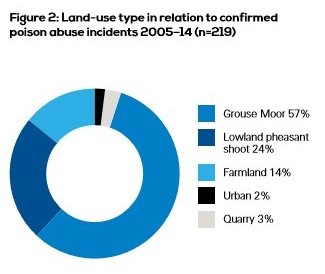
Another good reason for distrusting SLE is their continued denial of the extent of illegal raptor persecution, and their denial that the grouse-shooting industry (some of whom are members of SLE) is in any way implicated with these crimes (e.g. see here and here for just two recent examples). Where clear evidence has been provided, (e.g. 81% of all reported poisoning incidents in Scotland between 2005-2014 were on land used for game-shooting – see here), SLE has simply dismissed the figures and slagged off the RSPB for providing them (here).
RSPB persecution review 1994 2014 land use

In his article for the Courier, Tim (Kim) tries to claim that grouse moors are ‘good’ for species conservation and refers to a recent ‘study’ of breeding birds on Invermark Estate to back up this claim. The problem is, the full details of that ‘study’ (and a couple of others) have not been made available for public scrutiny, despite several requests to see it, and therefore has naff all credibility, especially when the ‘study’ of breeding birds was conducted, er, outside of the breeding season (see here).

But what interested us the most about Tim’s (Kim’s) article in the Courier was his (false) accusations (he’s good at those) about the raptor study groups. He said:

There are also internal rivalries within the raptor groups on who monitors which area, and this leads to secrecy. This is a serious issue as land managers need to know which birds are on their land in order to better manage them, but the survey results are often not shared with them, even when funded by bodies such as Scottish Natural Heritage”.

This is absolute rubbish. The Scottish Raptor Study Group comprises 12 regional branches. These branches organise raptor monitoring within clearly-defined geographic regions, to avoid over-lapping and thus avoid ‘double-counting’ as well as ‘double disturbance’ of sensitive species. All the raptor workers who monitor Schedule 1 species are licensed (by SNH) to do so. These Schedule 1 disturbance licences are issued for specific areas; so if you have a licence to monitor, say, golden eagles in one area, you can’t use the same licence to monitor them in another area unless your licence specifically includes another area. Again, this is to regulate the amount of disturbance to sensitive species. There is no “internal rivalry” – raptor workers simply get on with monitoring in their own patch.

Raptor workers DO share their data – they provide their results to the Scottish Raptor Monitoring Scheme (SRMS) and have been doing so since 2002! Tim (Kim) is obviously annoyed that landowners aren’t given access to those data “in order to better manage” those species. We all know what he means by “better manage” and that is precisely why raptor workers would be reluctant to share location data about highly persecuted species with dodgy landowners. Duh!

Tim (Kim) tries to imply that raptor workers are funded by SNH and as such, the data they collect should be made publicly available. Again, he either misunderstands the system or he’s trying to spin it so that raptor workers look like the bad guys. The truth is, raptor workers are not ‘funded’ by SNH, or by anyone else. SNH does provide SOME funding to the SRSG, but this amounts to a small contribution towards raptor workers’ fuel costs. It certainly doesn’t cover the full fuel costs (the funding is actually well below the commercial mileage rate claimed by consultants) and it does not cover the thousands and thousands of hours of time that raptor workers put in to their monitoring efforts. As such, the data collected by raptor workers belong to the individual raptor worker; not to SNH, not to the SRSG, and not to anybody else. These raptor workers are volunteers – nobody pays for their time, experience and expertise. They can do what they like with their data. That they contribute those data to the SRMS is to their credit, and they do so because they know their data will be useful to conservation and scientific organisations who want to keep tabs on species’ populations. Tim (Kim) Bayne’s inference that raptor workers are the problem is disgraceful.

Trust him and the grouse-shooting industry? Not a bloody chance. Not until we see SLE expelling the estates where persistent raptor persecution continues. Not until we see SLE supporting the work of RSPB Scotland’s investigations team. Not until we see SLE acknowledging the extent of illegal raptor persecution. Not until we see healthy, sustainable breeding populations of raptors such as golden eagles, hen harriers, peregrines, over  a period of years, on driven grouse moors in central, eastern and southern Scotland.

By the way, Kim, you still haven’t provided an explanation for why hen harriers have been absent as a breeding species in the Angus Glens since 2006 (here). Try and spin-doctor your way out of that.

Reward doubled for info on peregrine poisoning at Clee Hill, Shropshire

Peregrine male poisoned at Cleehill 2015 Shorrock1 cropThe reward for information leading to the arrest and conviction of the person(s) responsible for poisoning a peregrine at Clee Hill, Shropshire has been doubled.

The male peregrine was found dead in a quarry on 15th June 2015 (see here). This is a notorious raptor persecution blackspot: two peregrines were poisoned there in 2010 and another one in 2011. All four peregrines (including the latest victim) were poisoned with Diazinon.

A generous donor has contributed to the original reward offered by the Shropshire Peregrine Group and the RSPB, and the reward currently stands at £2000.

If you have any information about this crime please call the police on 101 quoting reference #6495 of 15/6/2015.

Photograph of the poisoned peregrine by Guy Shorrock.

Appalling Police Scotland response to two suspected raptor crimes

BOPwildlifecrimeposter2015 - CopyRegular blog readers will know that we’ve frequently had cause to criticise Police Scotland’s response to suspected wildlife crimes that have been reported to them. Well, we’re about to do it again over their mishandling of two recently reported suspected wildlife crime incidents, one in Dumfries & Galloway and one in South Lanarkshire.
Before we get to the details of the latest fiascos, have a read of the following text that appeared in on page 32 of RSPB Scotland’s recently published 20-year review of raptor persecution:

After the initial finding or reporting of a potential wildlife crime incident, a rapid and properly-directed follow-up is essential to prevent any evidence being removed by the perpetrator, further wildlife falling victim to illegal poisons or traps, removal of victims by scavengers or decomposition of victims. Any of these factors can render obtaining forensic evidence or an accurate post-mortem impossible. In our experience, however, the speed and effectiveness of follow-up investigations and securing of evidence has been highly variable‘.

It is apparent, from the following two incidents, that Police Scotland is still failing to get the basics right.

Incident 1

A member of the public found a decomposing dead buzzard on a grouse moor in an area well-known for its history of raptor persecution. The corpse was found on Saturday 19th December 2015. It was reported to members of the local Raptor Study Group who went to the grid reference provided (just 150 yards from a main road) and confirmed it was indeed a dead buzzard. They reported it to Police Scotland on the morning of Monday 21st December and were told that an officer would attend to collect the corpse and send it for post mortem. Raptor workers went back to the site the next day (Tuesday 22nd) and the corpse was still there. They returned on Wednesday 23rd and the corpse was still there. They returned on Thursday 24th and the corpse was still there. They returned on Saturday 26th and the corpse was still there. They returned on Sunday 27th and the corpse was still there. They returned on Monday 28th December, one week after reporting it to the police, and the corpse had gone. Whether it had finally been collected by Police Scotland or whether it had been scavenged by an animal or removed by a gamekeeper, nobody knows.

Incident 2

On 28th December 2015 a member of the public found a freshly-dead buzzard in a wood, with no obvious cause of death. Previously, snares placed over the entrance of a badger sett had been found in this wood. The nearest grouse moor is approx 1.5 miles away. Because of the history of the location, the member of the public was suspicious and took the buzzard home and called Police Scotland on 101. The member of the public was told by the Police Scotland call operator that the police were unable to help. “In fact at one point he suggested that I take it to a vet or call the ‘RS bird people’. He said that the police could only help if they actually caught the offenders at the scene in which case they would be prosecuted for poaching“. Undeterred, the member of the public found an email address for the local police wildlife crime officer but got an out-of-office reply saying nobody was available until 17th January 2016. Fortunately, a local raptor worker was able to collect the corpse and got in touch with RSPB Scotland who organised for the bird to be sent for post mortem.

The Police Scotland response to both of these incidents was appalling. Now, it may well turn out that in both cases the birds died of natural causes and no crimes had been committed. However, it’s equally plausible, especially given the incident locations, that these birds had been killed illegally. The point is, it’s Police Scotland’s job to investigate these incidents and determine whether a crime has been committed. Their action (and inaction) in these two cases could have severely compromised the outcome.

You may remember a similar incident, not a million miles from these two locations, that happened in 2014. In that case, a dead peregrine had been found by a member of the public but Police Scotland again failed to attend the scene, saying it wasn’t a police matter (see here). The peregrine was collected by RSPB Scotland and the post mortem revealed it had been poisoned with the banned pesticide Carbofuran. Police Scotland’s failure to attend that incident caused quite a stir, with the story being covered in a national newspaper (here) and it also led to questions being asked in Parliament about Police Scotland’s failed response (see here). Police Scotland denied they’d done anything wrong!

In March last year, following the publication of a damning report on the police’s response to various types of wildlife crime incidents over several years, Police Scotland launched an all-singing-all-dancing Wildlife Crime Awareness Campaign, endorsed by the Environment Minister (see here). This campaign (which we welcomed – see here) focused on the six national wildlife crime priorities, including raptor persecution, and included the production of all sorts of campaign material (posters etc) designed to encourage members of the public to report suspected wildlife crimes. That’s all good, but what’s the point if Police Scotland then can’t get their act together to provide a professional response when members of the public report suspicious incidents?

Is it really so hard?

If they’re under-resourced, fine, then they should say so and should be supporting the move to increase the investigatory powers of the SSPCA, not trying to block it. Talking of which, when will Environment Minister Dr Aileen McLeod make a decision on the SSPCA’s powers? It’s now been 16 months since the public consultation closed. Getting to grips with wildlife crime is supposed to be a ‘key priority’ for the Scottish Government. In February, it’ll be five years since the consultation was first proposed!

Peregrine shot dead at edge of grouse moor

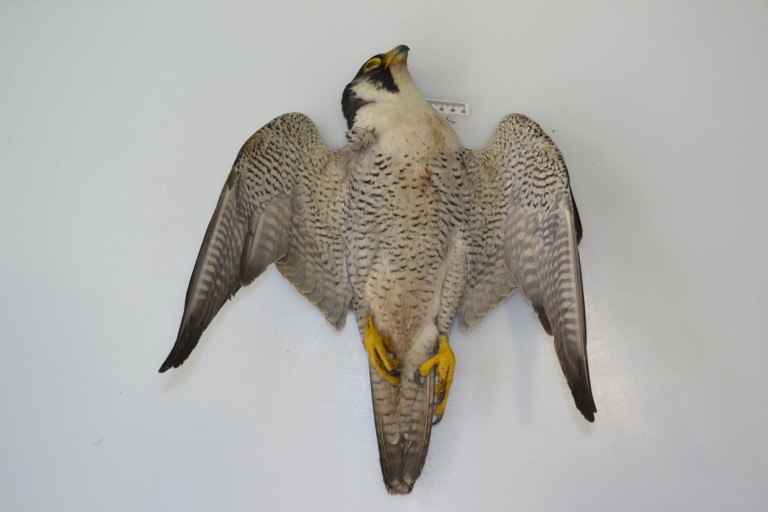
A peregrine falcon has been found shot dead in County Durham.

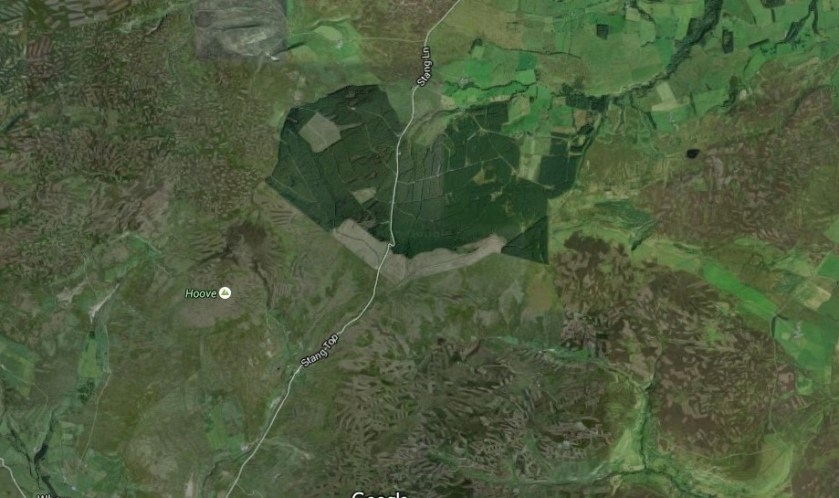
It was discovered on the south east edge of Stang Forest on 23rd August 2015. A post mortem revealed it had been shot.

Stang Forest shot perg - Copy

It’s interesting to look at the land management around Stang Forest. Google maps shows it’s almost entirely surrounded by grouse moors. This shouldn’t come as a surprise to anybody, especially when we recently learned that peregrines are being wiped out on grouse moors across the UK (see here and here).

Durham Constabulary are appealing for information, four months later.

Article on Rare Bird Alert here

Stang Forest - Copy

Bird of prey ‘initiative’ in Peak District National Park fails to deliver

IMG_5764 (2)In 2011, a five-year ‘Bird of Prey Initiative’ was launched which aimed to restore declining populations of some raptor species in the Dark Peak region of the Peak District National Park.
This ‘initiative’ was deemed necessary following years of evidence of wide scale raptor persecution within the region (e.g. see RSPB summary reports here and here).

The members of the ‘Bird of Prey Initiative’ comprised five organisations: The Moorland Association, The National Trust, Natural England, Peak District National Park Authority and the RSPB. Two local raptor study groups (the Peak District Raptor Monitoring Group and the South Peak Raptor Study Group) were also involved.

Targets were set to increase the breeding populations of three key raptor species for which the area had been given Special Protection Area status, i.e. it was considered a nationally important site for these raptors.

The targets were set as follows:

Merlin: increase from 22 breeding pairs to 32 breeding pairs by 2015

Short-eared owl: maintain the average breeding population of 25 pairs to 2015.

Peregrine: increase from 13 breeding pairs to 15 breeding pairs by 2015.

These targets were not unreasonable – they reflected the number of breeding pairs that the SPA should have been able to support.

goshawk-legsInterestingly, the group failed to set any targets to improve the breeding populations of local goshawks and hen harriers; there was just an ‘expectation’ that these species would be encouraged to breed. Sure, neither are an SPA-qualifying species in this area but nevertheless the area used to hold historically important populations which have since been reduced, through illegal persecution, to an occasional successful pair, so why exclude them?
Anyway, the ‘initiative’ has now ended and surprise surprise, the targets set for merlin, short-eared owl and peregrine have not been met. And goshawks and hen harriers are still largely absent with just a couple of exceptions. You can download the project report here for details: PDNP-Birds-of-Prey-Report-2012-15

In response to the report’s findings, Rhodri Thomas, an ecologist with the Peak District National Park Authority, is quoted in this BBC article (here) as saying the report’s findings are “concerning and disappointing“. Mark Avery has described the findings as “entirely predictable and totally unacceptable” (see here).

Rhodri Thomas goes on to say that the decline in peregrine numbers (now at only four pairs) was the hardest to explain as numbers in other parts of the Park were increasing and there was no obvious reason why they were staying away from the Dark Peak. He said he was determined to “bottom-out” what was causing the decline.

Here’s an easy starting point for him – try reading the provisional results of the most recent National Peregrine Survey (see here) as well as the recent paper documenting peregrine declines in another region dominated by driven grouse shooting (see here).

Sorry, Rhodri, but it’s not that difficult to understand.

In a press release from the Peak District National Park (see here), there’s talk of ‘renewed commitment’ from the project partners as well as ‘new rigour and energy’ to restore the breeding success of raptors in the Dark Peak. This is, of course, utter bollocks.

Mark Avery has picked up on this in his blog from this morning (see here), and as he says, it’s just an opportunity for the National Park authorities to hide behind a failing project for a few more years and avoid taking any real action, like, for example, banning driven grouse shooting within the National Park.

We’re so tired of all this ‘talking’ and so-called ‘cooperation’. It hasn’t worked and nor will it work. How do you move on from a conversation that goes something like this:

Conservationists to the grouse shooting industry: “Stop illegally killing raptors”.

Grouse shooting industry to conservationists: “We’re not killing them”.

Meanwhile, the killing continues and The Untouchables remain untouchable. The time for talking is over.

Sign the petition to ban driven grouse shooting here

This dead goshawk (photo above) was found in the Peak District National Park in 2014 – both legs were broken and its injuries were consistent with being caught in an illegally set spring trap.

General Licence restrictions on Raeshaw & Burnfoot Estates last only six days

On 4th November, we blogged about SNH’s intention to restrict the use of General Licences in two areas, in response to alleged raptor persecution incidents. The two areas included parts of the Raeshaw and Corsehope Estates in the Borders (Restriction #1), and parts of the Burnfoot and Wester Cringate Estates in Stirlingshire (Restriction #2) (see here for our earlier blog about these restrictions, and see here for SNH’s explanation for the restrictions).

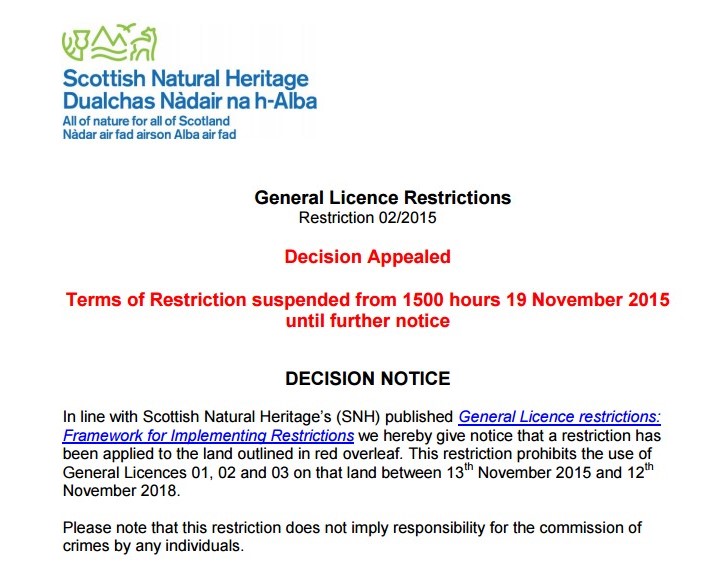
The General Licence restrictions were due to begin on 13th November 2015 and run for three years. They actually only ran for six days.

SNH GL restriction 1 SUSPENSION - Copy

SNH GL restriction 2 SUSPENSION - Copy

On 19th November 2015, the General Licence restrictions were suspended in both areas until further notice, because the Estates have lodged legal appeals, as they said they would last week (see here). While the appeals are underway, the Estates can continue to use the General Licences (i.e. continue to set crow traps and Larsen traps to catch and kill corvids, continue to shoot corvids, and continue to kill lots of other stuff that falls under the remit of activities permitted under the General Licences – see here for a list).

We don’t know what the basis of the appeals are, and nor do we know the procedural process of the appeals system, but presumably SNH now has a fixed period of time to respond. If SNH decides to uphold the appeals then the General Licence restrictions will be removed. If SNH decides to stick to its original decision and impose the three-year restrictions, then the restrictions would be re-instated. However, then these Estates would be entitled to apply for a judicial review to test whether SNH has acted fairly.

Settle yourselves in for a long legal battle.