Misleading conclusions from Scot Gov’s 2014 wildlife crime report

Wildlife Crime in Scotland 2014 reportYesterday the Scottish Government published its latest report on wildlife crime: ‘Wildlife Crime in Scotland: 2014 annual report’ (see here).

It was accompanied by a Government press release (here) with a headline statement claiming ‘ Recorded wildlife crime dropped by 20 per cent in the period 2013-2014‘. This claim has been regurgitated, without real examination, in much of the national press, which will give the public the impression that all’s going swimmingly in the fight against wildlife crime in Scotland. This couldn’t be further from the truth.

Let’s start with the report’s name. It claims to be the ‘2014 annual report’, but actually the period covered by the report is the 2013/14 financial year: April 2013 to March 2014. That means the majority of the data are from 2013 (9 months worth) – these are wildlife crimes that took place as long ago as 2.5 years and the most ‘recent’ took place 18 months ago (March 2014). Many more offences occurred during the nine months between April-Dec 2014 but they are not included in this report. Although the report itself does explain the reasons behind this odd time-frame selection, the report’s title does not, which means anyone just browsing the headline news will be given a false impression of how recent these findings are. It’s a small point, but it’s an important one.

However, there are bigger issues than just a misleading report title.

If you take the report’s data at face value (which we don’t – more on that in a second) and accept that it’s representative of all reported wildlife crime in Scotland between April 2013 and March 2014, you might also accept that the claim of a 20% reduction in recorded wildlife crime is accurate. But if you look at the data (Table 1), you’ll notice that this supposed broad reduction (i.e. reduction of recorded wildlife crimes in general) is actually almost entirely due to a large reduction in one particular area of wildlife crime: specifically, fish poaching. To then apply this reduction of a specific wildlife crime to all other types of wildlife crime in a broad sweeping statement is wholly misleading.

Our main issue with this report, as with previous reports, is the Government’s insistence on only using crime data that has been recorded by the Police. Although this report does attempt to address this problem by including separate sections on data collected by others (e.g. Scottish Badgers, SSPCA), these data are still not included in the overall analysis of wildlife crime trends because these incidents weren’t recorded on the Police national crime database. A good example of this is shown in Table 10, which details the number of wildlife cases investigated by the SSPCA. The report accepts that cases investigated solely by the SSPCA (as opposed to cases where the SSPCA has assisted the Police) are not included in the ‘official’ recorded crime data because ‘they are not recorded on the police national crime database’. So in effect, 69 cases that were investigated solely by the SSPCA during the period covered by the report are absent from the national figures. It seems bizarre that even though these data are available (of course they are, they appear in this report, albeit in a separate section!) they are still excluded from the main analysis. This blatant exclusion immediately reduces our confidence in the robustness of the ‘national’ data.

Another blatant exclusion of data is demonstrated in Table 17 in the Raptor Persecution section. This table identifies only 16 bird of prey victims from the mass poisoning in March 2014 known as the Ross-shire Massacre, excluding the other six victims that were found. The report justifies this exclusion by explaining that evidence of poisoning was not found after examinations of those six raptors. That’s fair enough, but surely we’re not expected to believe that those six victims all died of natural causes, in the same small area, and at the same time, as the 16 confirmed poisoning victims? They don’t appear in the figures because a crime couldn’t be identified, but they still died as a result of this crime and to pretend otherwise is nonsense.

An additional problem that erodes public confidence in the accuracy of the ‘national’ data is the issue of how carefully wildlife crimes are recorded. A report published earlier this year (which includes part of the period covered by this latest Government report) revealed systemic problems with the under-recording of several types of wildlife crime as well as failures by the police to undertake follow-up investigations on reports of suspected wildlife crimes (see LINK report here). If the police don’t follow up with an investigation, the incident is unlikely to be recorded as a crime. Until these issues are suitably addressed, the accuracy of ‘official’ ‘national’ wildlife crime data will inevitably be viewed with suspicion.

So, we don’t have much confidence in this report’s data and we certainly don’t agree with the Government’s claim that (overall) recorded wildlife crime has reduced by 20%, but there are some positives. It’s clear that more thought has been put in to the material contained in this year’s report and there is definitely more clarity about the sources used. That’s good progress.

There are also a couple of things in this report that we are particularly pleased to see.

First, let’s go back to Table 10 (SSPCA data). You may remember (if you have a long memory) that in March 2014, the Government opened its consultation on whether to increase the investigatory powers of the SSPCA. That consultation closed in September 2014 and, over a year later, we’re still waiting for a decision. It’s our understanding that one of the main sticking points is with Police Scotland (who, as you’ll recall, strongly objected to an increase of powers – see here). Apparently, the current sticking point is that Police Scotland are worried that they’ll be excluded from wildlife crime investigations because the SSPCA ‘refuses to work with them’. However, if you look at Table 10, you’ll notice that 50% of all wildlife cases taken by the SSPCA during the period covered by this report were undertaken in partnership with the Police. That’s 50%. Does that look like an organisation that is refusing to work with the Police? It doesn’t to us.

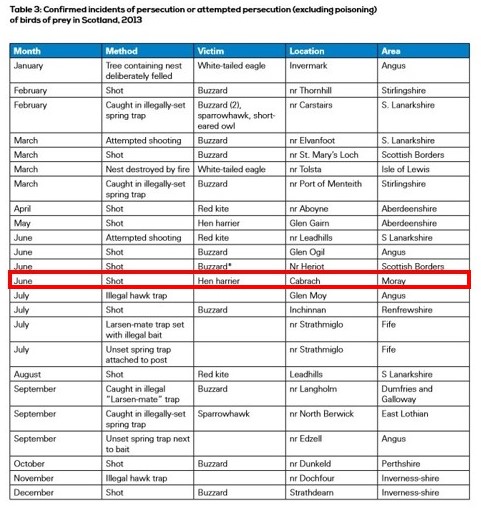
The second point of interest in this report appears in Table 18b. This table provides information about recorded bird of prey crimes between April 2013 and March 2014. Have a look at the 7th entry down:

Species: Hen Harrier

Police Division: Aberdeenshire and Moray

Type of Crime: Shooting

Date: June 2013.

Why is this of particular interest? Well, cast your mind back to January 2014 when we blogged about a vague Police Scotland press release that stated a man had been reported to the Crown Office ‘in relation to the death of a hen harrier’ in Aberdeenshire that took place in June 2013 (see here). So it turns out this hen harrier had been shot. Amazing that it took over two years for this information to be made public. But that’s not the most interesting bit. For this unnamed individual to be reported to the Crown for allegedly shooting this hen harrier means that the Police have some level of evidence that they think links him to the crime. If they didn’t have evidence, he wouldn’t have been reported. So, the alleged crime took place 2.4 years ago. The Crown Office was notified 1.9 years ago. What’s happening with this case? Is there going to be a prosecution? Why such a long delay for a crime that is deemed a ‘priority’ by the Scottish Government?

Natural England to issue guidance on deployment of gas guns on grouse moors

Bird scarer 1 - Copy

Here’s some excellent news….

In early September we encouraged blog readers to contact SNH and Natural England to ask whether they would provide urgent guidance on the deployment of gas gun bird scarers, particularly on grouse moors where we believe these devices have been used illegally to disturb hen harrier breeding attempts (see here).

SNH responded quickly in mid-September and said they would investigate the deployment of gas guns with regard to the law and may provide guidance on their use if it was deemed appropriate (see here).

Natural England has gone further. Their response (from Alan Law, Chief Officer of Strategy and Reform) confirms that the use of gas guns near Schedule 1 breeding birds is unlawful and that their use in Special Protection Areas would likely require written consent from Natural England, depending on the specific feature(s) for which the site has been designated.

Natural England says it is in the process of drafting guidance, which will be available prior to the start of the 2016 breeding season.

That’s brilliant news – well done to everyone who took the time to contact NE about this issue. The grouse shooting industry will be thrilled and will no doubt be wishing to thank us all for our help. No need, it was our pleasure. They’ll be even more thrilled if, come the next breeding season, anybody spots any gas guns being used on grouse moors and reports it to the police. Even better, report it to the RSPB Investigations Team who are more likely to follow up.

Here’s one of several responses we’ve seen from Natural England:

Thank you for your recent email relating to the use of gas guns within Special Protection Areas (SPAs) and expressing your concerns around the potential impact of the use of gas guns upon Schedule 1 birds.

For Schedule 1 species, it is an offence for any person to disturb any wild bird included while it is building a nest or is in, on or near a nest containing eggs or young. As a result, the use of gas guns outside the bird breeding season is not unlawful.

With respect to the use of gas guns within a SPA, depending on the specifics of what interest features the site is notified for, the land manager may be obliged to seek Natural England’s written consent prior to locating and using gas guns. Landowners and managers of SPA land are provided with specific guidance on what activities require a consent and we issue this on a site by site basis.

We have recognised that there is a need for some general guidance on the use of gas guns and are in the process of drafting this in collaboration with the relevant partners. I will arrange for you to be sent this guidance as soon as it becomes available, which will be in advance of next year’s breeding season.

Many thanks again for your interest in this matter.

Your sincerely

Alan Law

Chief Officer, Strategy and Reform

Natural England

Red kite dies after persecution incident ‘near Tomatin’

Reports have emerged this afternoon that a red kite has died after it was found injured ‘near Tomatin’ on 30 August 2015.

According to a BBC news article (here), ‘Police said its injuries did not appear to have been as a result of natural causes’.

According to an article in the P&J (here), ‘Early examinations of the bird have found its death is not due to natural causes’.

In other words, this kite has been illegally killed but apparently Police Scotland is ‘unable to disclose the nature of the bird’s injuries’ (according to the P&J). So the cause of death has not been revealed, and neither has the location where the injured kite was picked up, other than ‘near Tomatin’. Tomatin is in the heart of driven grouse moor country – just put it in to google maps and look at the amount of muirburn strips that surround the village – this region also has a long track record of raptor persecution on a par with other grouse moor regions such as the Angus Glens.

So, another example of an embarrassingly vague Police Scotland statement in relation to the illegal killing of yet another raptor. It’s the latest in a series of similar cryptic police statements relating to the illegal persecution of raptors:

In September 2010 the police issued a vague appeal for information following the discovery of an osprey in the Highlands that died from what they described as “deliberately inflicted injuries“. It was later reported that the bird had been shot (see here).

In June 2013 a similarly cryptic press release followed the discovery of a dead red kite in Aberdeenshire: “After recovery of the carcass, a post mortem was carried out. This revealed that the bird’s death was not by natural causes“. It was later reported the kite had been shot (see here).

In January 2014, we got more of the same after the discovery of a dead buzzard ‘near the village of Tomatin’. Ooh, that sounds familiar, doesn’t it? The press statement said: “Police said an examination of the buzzard suggested it had not died of natural causes” (see here). We still don’t know how it was killed.

In June 2014 there was another one, this time a hen harrier found dead near it’s nest in Muirkirk. The police said: “Whilst at this time we cannot divulge how the bird was killed, we do believe it was the result of a criminal act and we need to establish why this has happened” (see here and here). Guess, what? Turns out it had been shot (see here).

Police Scotland will claim that withholding information about the cause of the death is part of their investigative strategy, because it is ‘specialist knowledge’ that only the perpetrator and any potential witness will know. That’s a legitimate strategy, of course, but given the low likelihood of actually catching anyone for this type of offence it seems like a fairly pointless exercise. It will, though, allow the game shooting lobby to deny all knowledge and refute any suggestion that the bird was killed by anyone associated with that industry.

Marvellous.

So what do you reckon? Is the illegal killing of this red kite going to be the crime that finally jolts the Scottish Government in to taking the oft-promised ‘further action if necessary’? Probably not. We’re still waiting to hear the Minister’s response to a question we posed three weeks ago following the discovery of a shot buzzard in the Borders. We asked her how she defined ‘if necessary’? (see here). Her response should make for an interesting read.

Whatever she says, she really does need to start delivering something tangible, and fast.

Red kite photo by David Tomlinson

Countryside Alliance wants BBC to sack Chris Packham

NEVER-MIND-T-SHIRT-DESIGNThe Countryside Alliance has launched an attack on Chris Packham and is urging the BBC to sack him. The basis of their argument is that Chris, in their opinion, is ‘abusing his position’ as a BBC presenter to ‘promote an extreme agenda’ (see here).

Let’s just be clear. This is less to do with the Countryside Alliance’s concerns about BBC impartiality but more to do with them wanting to silence an articulate, thoughtful, well-informed and popular ‘celebrity’ to prevent him expressing views on wildlife crime (particularly hen harrier persecution) and animal welfare issues that just happen to be the polar opposite views of the CA, and thus are labelled by them as ‘extreme’.

It’s not the first time the Countryside Alliance has tried to silence those with opposing opinions. Last year they complained to the Charities Commission about the RSPB’s 2013 BirdCrime Report, claiming it was ‘deliberately misleading’ and ‘promoting an anti-shooting agenda’. Their complaint backfired spectacularly when the Charities Commission told the CA where to get off (see here).

This time, it’s the public telling the CA where to get off. A petition was launched last night in support of Chris Packham and has already attracted over 11,000 signatures from members of the public who admire and appreciate Chris’s principles. You can sign it HERE

And if you’re in the mood for petition-signing, here’s another one that’s deserving of your support: Ban Driven Grouse Shooting – sign it HERE

There’s a good piece in the Guardian today about why the BBC should treasure Chris Packham, not sack him (see here).

It’s easy to see why the Countryside Alliance is really going after Chris. His latest t-shirt design is the perfect response and can be downloaded here.

The intellectual capacity of a cabbage

There was an article in Country Life magazine recently (26th Aug edition) on the proposed plan (see here) to bolster the golden eagle population in southern Scotland. (Thanks to the contributor who sent us a copy).

The short piece included commentary from Dr Cat Barlow (the new project officer) and also a bit from everybody’s favourite ecological expert, Alex Hogg of the SGA:

Alex Hogg, Chairman of the Scottish Gamekeepers’ Association, believes that the large raptors [golden eagles] could threaten not only grouse, but, ironically, the endangered hen harrier. “Grouse cover a huge area and can stand the pressure of hunting, but hen harriers nest en masse and are thus particularly vulnerable. And white hares, one of the eagle’s favourite prey, only breed well in areas where foxes are controlled”, he points out. He adds: “I’m delighted about the idea of the golden-eagle release, but I’m worried there won’t be enough food supply. My overriding feeling is that if the golden eagle had wanted to settle in southern Scotland, it would have done so“‘.

My ‘overriding feeling’ is that Alex Hogg has the intellectual capacity of a cabbage.

How many “en masse nesting” hen harriers are there in southern Scotland? According to the most recent data available from the Scottish Raptor Monitoring Scheme, in 2013 one hundred hen harrier home ranges were checked across southern Scotland for occupancy. Of those 100, there were only 23 breeding attempts and of those, only 18 nests produced fledglings. Here are the data:

Dumfries & Galloway: 24 home ranges checked, 10 breeding attempts, 8 nests producing fledglings.

Lothian & Borders: 5 home ranges checked, 3 breeding attempts, 2 nests producing fledglings.

South Strathclyde: 71 home ranges checked, 10 breeding attempts, 8 nests producing fledglings.

As for a shortage of food, perhaps if the grouse moor gamekeepers in southern Scotland (and elsewhere) weren’t slaughtering mountain hares in their thousands (e.g. see here), in addition to the mass killing of other eagle prey items such as crows, stoats, weasels, fox cubs etc, Alex’s touching concern could be put to rest.

SGA attacks RSPB on false premise

Annie Langholm harrier shot April 2015Never ones to miss an opportunity to stick the boot in on the RSPB, those wildlife crime-fighting heroes at the Scottish Gamekeepers’ Association have mis-kicked, again.

They’ve been whining in the media (Scottish Farmer, see here) about the timing of the RSPB’s press release relating to the discovery of a shot hen harrier called ‘Annie’ (see here).

As you’ll recall, Annie was a young satellite-tagged hen harrier from the Langholm project whose tag indicated she’d stopped moving in March this year (see here). Her corpse was discovered on a grouse moor in late April after several weeks of intensive moorland searches (by the RSPB) and the news of her death was published on 11th August, the day before the start of the grouse-shooting season, when everyone associated with driven grouse shooting is doing their level best to promote it as a sustainable, conservation-friendly tradition (ahem).

How inconsiderate of the RSPB to break this news on the day before the Inglorious 12th. How dare they inconvenience the grouse-shooting lobby like that. Shame on the RSPB for telling the world about another illegally killed raptor found on a grouse moor.

The thing is, the RSPB wasn’t in control of when the news was released.

When Annie’s body had been found (late April), it was submitted the very next day to the SAC Veterinary lab for post mortem. The post mortem results were not released to the RSPB until early August. The RSPB passed on the results to Police Scotland on 5th August. It was then Police Scotland’s call as to when the news was released. According to the article in Scottish Farmer (see here), the police asked the RSPB to sit on the news so that they (Police Scotland) could “crime” the incident, whatever that means. It was then decided, apparently after discussion with the Scottish Government (since when do they get involved with when crime details are released?!) that the news would be published on 11th August.

Instead of trying to smear and discredit the RSPB for publicising this crime, surely the SGA, as a co- member of the Partnership for Action Against Wildlife Crime, should be (a) praising the RSPB for putting in the time and effort, at their own expense, in extreme weather conditions, to retrieve Annie’s corpse; (b) asking the SAC vet lab why it took over three months for the post mortem results to be made available; (c) praising the RSPB for preparing and publishing the press release; (d) focusing their condemnation on the criminal(s) responsible for killing this bird, who, with all probability, are members of the game-shooting industry; and (e) asking the RSPB and other members of PAW Scotland how they (SGA) can usefully contribute to help stop these killings?

Is that really too much to ask?

Henry the Hen Harrier: video mash up

CLICK HERE FOR A VIDEO MASH UP OF HENRY’S TOUR: https://www.youtube.com/watch?v=qSc2faNGdJo&feature=youtu.be

IMG_5598 (2)

Environment Minister responds to shooting of hen harrier ‘Annie’

Yesterday we blogged about the illegal shooting of Langholm hen harrier ‘Annie’, whose wretched corpse had been found, inevitably, on a Scottish grouse moor in South Lanarkshire (here).

Annie Langholm harrier shot April 2015

We asked blog readers to contact Environment Minister Dr Aileen McLeod to demand further action against the seemingly untouchable raptor killers. The response to that request was overwhelming – many thanks to all of you who took the time to email her and send her tweets. Within a few hours, an official statement was posted on the Scot Gov website: that’s testament to the bombardment of correspondence sent to the Minister: usually it’s met with silence for the maximum 20 working days in which the Gov has to respond.

So what did the Minister have to say? Here’s the statement in full:

Minister comments on bird of prey shooting.

Commenting on the shooting of a satellite tagged hen harrier, Minister for Environment, Climate Change and Land Reform Dr Aileen McLeod said:

“It is extremely disappointing to hear the news that Annie, one of the satellite tagged hen harriers from the Langholm Moor Demonstration Project, has been shot.

“The Scottish Government remains absolutely committed to working with law enforcement and others to bring an end to this outdated criminal activity. I expect all right minded people involved in the countryside, including with shooting, to agree that wildlife crime has no place in a modern Scotland. I would urge anyone with any information on the latest incident to contact Police Scotland as soon as possible.

“We have been taking action, including seeing the first successful vicarious liability prosecution, and the review of penalties will be reporting in the near future. We have committed to an examination of the regulation of the game shooting industry sector elsewhere and have made clear that, though it would be complex and require primary legislation, the licensing of shooting businesses in Scotland remains one of the options that could be adopted.

“The news about Annie is in stark contrast to recent examples of successful PAW Scotland partnership working to actively improve the chances of this magnificent bird which has been in decline in Scotland.”

END

Now, to those who are new to this game, her response might seem satisfactory. For those of us who are not so new to this game, it was anything but. Here’s why…..

Over two years ago (July 2013), the then Environment Minister, Paul Wheelhouse, announced a series of new measures to tackle raptor persecution (see here).

One of those measures was to conduct a review of wildlife crime penalties. Two years on, that review is yet to be completed.

Another measure was to introduce a system of General Licence restriction orders on estates where raptor persecution was suspected (civil burden of proof as opposed to the more difficult-to-achieve criminal burden of proof). Two years on, SNH has yet to announce the implementation of any restriction order, despite there being a number of suitable candidate estates.

Three and a half years ago (1 January 2012), the new law on vicarious liability came in to force. Three and a half years later, there has only been one prosecution (although a second one is due to begin this month – even so, two prosecutions in 3.5 years is hardly impressive).

Four and a half years ago (February 2011), the now former MSP Peter Peacock suggested a public consultation on whether the SSPCA should be given increased investigatory powers. It took just over three years for the Government to actually launch the consultation (March 2014). The consultation closed on 1st September 2014. Almost one year later, we’re still waiting for the Environment Minister to comment, let alone implement any changes.

Meanwhile, the raptor killing continues.

So, sorry, Minister, if we’re not bowled over by your claim that you ‘have been taking action’. Yes, action is being taken, and that is most welcome, but it’s not nearly enough and it’s not being taken nearly fast enough. Yesterday’s news, of yet another illegally persecuted raptor, is clear testimony to that.

You’re the Environment Minister. It’s your job to deal with this issue. If you can’t handle it, then step aside and let someone else have a go.

Langholm hen harrier ‘Annie’ found shot dead on Scottish grouse moor

annie-with-her-sat-tag

A young hen harrier called ‘Annie’ from the 2014 Langholm cohort has been found shot dead on a Scottish grouse moor.

You may recall we blogged about her satellite tag going off the radar in March this year in an area of South Lanarkshire (see here).

Her corpse was retrieved at the end of April after an intensive search by RSPB Scotland Investigations staff and her remains were sent to the SAC Veterinary Lab for post mortem.

The post mortem results have now confirmed that she had been shot.

Stuart Housden, RSPB Scotland Director said: “This case shows very clearly what happens to some of our hen harriers when they leave protected nesting areas and move around the UK’s uplands. This is just the latest incident of criminal persecution of this species, following the confirmed shooting of birds in Aberdeenshire, Moray and Ayrshire in the last two years. It is little wonder these magnificent raptors continue to be absent from large areas of our uplands“.

This news won’t be a surprise to anybody. The chances of bringing anyone to justice for shooting her are nil. She’s yet another victim of the disgusting, vile driven grouse shooting industry. And they will get away with it. Again.

If you share our anger, then turn that anger in to action. Here are two positive things you can do in response:

  1. Send an email to Environment Minister Dr Aileen McLeod, demanding immediate Government action to address the on-going raptor persecution crisis. Don’t be fobbed off by inane platitudes. This Government has repeatedly said that if raptor persecution continues, they would take further action. We want to know what that action will be and when we can expect to see it implemented. Email: ministerforenvironment@scotland.gsi.gov.uk
  2. Sign this e-petition to ban driven grouse shooting and ask others to do the same – HERE

Annie Langholm harrier shot April 2015

UPDATE 13.30hrs: Police Scotland has issued a press statement that identifies the location as ‘remote moorland near to Daer Reservior’ (see here). Where’s Daer Reservoir? Why, it’s right here

SGA Committee Member wouldn’t mind setting Hen Harrier Day protesters on fire

There was an article in the Daily Record on Saturday about the forthcoming grouse shooting season (the Inglorious 12th) which outlined many of the reasons that have triggered a call to ban the ‘sport’. The piece included extensive quotes from Mark Avery (see here).

SGA Committee Member Bert Burnett has obviously thought long and hard about the arguments against driven grouse shooting and he presented them on his Facebook page on Saturday night. Watch out for a new SGA fund-raising drive to purchase some new crayons for Bert.

Bert Burnett Facebook Avery twat - Copy

On a related issue, he also shared his considered views on the Hen Harrier Day protesters who were due to gather in Perthshire the following day:

Bert Burnett Facebook HH Day Perthshire 1 - Copy

On a more serious and sinister note, when one of his Facebook acquaintances suggests that Bert should attend the protest demo, he said this:

Bert Burnett Facebook HH Day Perthshire 2 - Copy

It’s a perfectly illustrated example of why so-called ‘partnership working’ is nothing but a sham. It would also be interesting to know how Police Scotland view his comments when they assess his suitability to hold firearms and shotgun certificates. Threat to public safety springs to mind.