More cock and bull from Ian Botham

shrivelled bananaIan Botham used to be best known for his world-class reputation as an English cricketer. These days he’s better known to some of us as being the grouse-shooting industry’s teller of cock and bull stories [definition: an absurd, improbable story presented as the truth].

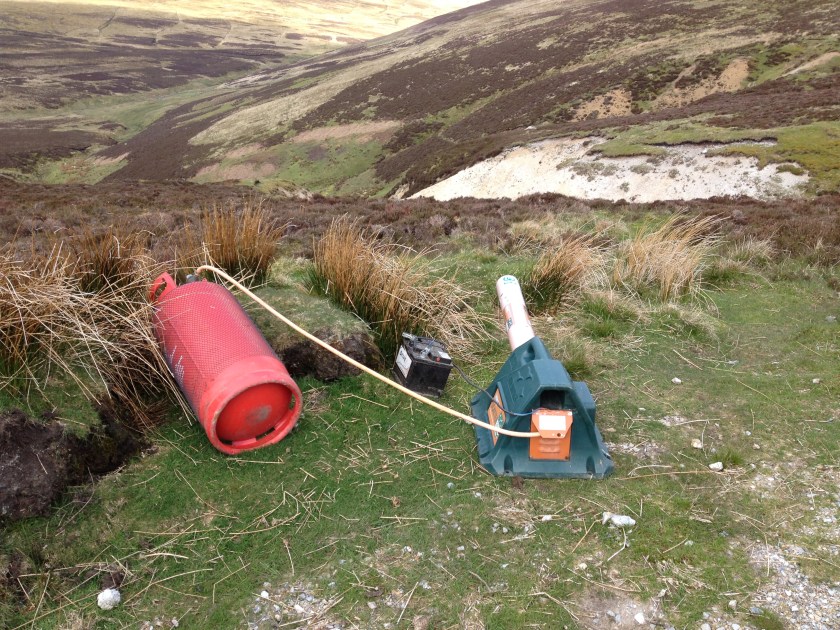
Cock story here (We’ll spare you the repulsive accompanying image but it looked a lot like this picture on the right).

Bull stories here, here, here, herehere and here.

Today’s Mail on Sunday contains another Botham-penned cock and bull story, aimed again, of course, at the RSPB. It’s a long rant that volleys off in as many directions as one of the shotgun cartridges Botham fires at game birds, with pellets spraying everywhere in the hope that one might hit the target.

He seems to think that the RSPB has it in for eagle owls, although the evidence he provides is, well, shaky to say the least. By the way, Beefy, if you’re going to pretend to be a knowledgeable ornithologist, at least learn how to express binomial nomenclature: it’s GCSE-level stuff that the genus always starts with a capital letter. Anyway, he alludes to ‘something he read’ last month about the RSPB wanting to ‘nip the colonisation [of eagle owls] in the bud’ although he doesn’t provide a link to said article. Fortunately, his friends over at the GWCT have provided a link, and it’s to an article published in the Yorkshire Post in March – we’ll come to that.

Incidentally, isn’t it strange that the GWCT blogged about eagle owls today, a Sunday, the same day as Botham’s article was published? It’s almost as if the GWCT knew Botham’s attack was coming and wanted to join in, helpfully loading the cartridges into Beefy’s gun before he squeezed the trigger. Take note, RSPB, the GWCT is one of your so-called ‘partners’.

Anyway, back to that article in the Yorkshire Post (here). In it, the journalist cites an unnamed ‘RSPB Officer’ as saying if there was a significant increase in eagle owl numbers it might be wise to ‘nip the colonisation in the bud’. This, it seems, is the basis for Botham’s rant. Yes, really, that’s it.

But who was this ‘RSPB Officer’? Was it even an RSPB employee? It seems strange that what he/she purportedly said is at odds with the ‘official’ RSPB position on eagle owls, as published on the RSPB website (here).

Now, even Botham, with his questionable judgement, must have realised that this ‘evidence’ was flimsy and nowhere near enough to justify another full-scale attack on the RSPB so he’s padded out his story with some other ‘stuff’. This consists of much of the usual guff, including his oft-repeated claim that gamekeepers ‘are putting their house in order’ and no longer killing raptors. Here’s a nice pie chart that says differently:

gamekeepers prosecuted - Copy

Before today’s article in the Mail on Sunday, many of us had been wondering what this season would hold. There are some, an optimistic few, who thought that with the publication of DEFRA’s Hen Harrier Inaction Plan, things might settle down, the sniping in the media might stop, partnership-working might do what it’s supposed to do, and hen harriers and other upland raptors might just be left alone.

Having read today’s article, many of us (so far over 27,500) believe that’s cock and bull.

Linklater on Langholm: fake facts from a ‘respected journalist’

Following the recent news that the Langholm Moor Demonstration Project (‘Langholm 2’) was winding down prematurely (see here), as predicted it hasn’t taken long for those within the grouse-shooting industry to start claiming it a massive failure.

On Saturday (2nd April), ‘respected journalist’ Magnus Linklater had an article about Langholm 2 published in The Times (see here for paywall version and here for free copy). The inverted commas around ‘respected journalist’ are used deliberately because not everyone agrees with this credibility rating, based on Linklater’s previous musings on raptors and grouse moors (e.g. see here, here and here).

This latest article is littered with what we’ll politely call fake facts; a common theme from Linklater. Either this ‘respected journalist’ has just made stuff up (again), or he hasn’t done the research you might expect from such a feted correspondent (and editor!).

Here are just some of those fake facts.

Linklater says: “Grouse numbers have declined to an unsustainable level” and “There are no longer enough grouse to justify commercial shooting” and “Grouse numbers have never sufficiently recovered” and “Although grouse numbers did revive from their previous low level, there were never enough to justify letting the moor for driven grouse shoots“.

So, four times in this article Linklater mentions that there aren’t enough red grouse to shoot at Langholm. It’s clearly a point he wants to drive home to the reader, but it’s just not true. As we, and others, have previously commented, the red grouse population at Langholm has recovered sufficiently, to a density which previously supported driven grouse shooting activity on this moor (see here, here, here).

Linklater says: “There are currently 14 hen harrier nests on the moor“.

Really? On 2nd April? That would be extraordinary. Blimey, climate change has really kicked in. Or, Linklater is clumsily using last year’s hen harrier breeding status and applying it to this year. But wait! There weren’t 14 hen harrier nests at Langholm in 2015. There were eight, and six of those produced fledglings. How about in 2014? There were 12 hen harrier nests in that year (the highest recorded during the Langholm 2 project) and of those, 10 nests produced fledglings. So from where has Linklater conjured up the “current 14 hen harrier nests“? Has he just made it up?

Linklater says: “More than 100 [hen harrier] pairs were fledged“.

Er, if that were true it would mean that more than 200 birds had fledged during the Langholm 2 project. Again, untrue. More than 100 individuals have fledged – half the number Linklater is claiming. It could be a simple slip of the keyboard or it could be that Linklater wants to give the impression of a moor ‘plagued’ by hen harriers. Note his phrase “uncontrolled birds of prey” earlier in the article and pair it with his repeated referral to a (supposed) lack of red grouse and it becomes apparent what he’s trying to do here.

Linklater says (when describing the results of the earlier Langholm 1 project): “Harriers multiplied until there were more than 20 pairs, and grouse became virtually extinct“.

If there were “more than” 20 pairs, why not give the exact number? Could it be that there weren’t “more than” 20 pairs after Langholm 1? Could it be that there were actually 20, which, incidentally, just happened to coincide with a peak in the cyclical vole population? Why exaggerate? Surely not to try and create an impression that there were more hen harriers than there actually were?

And what’s this about red grouse becoming “virtually extinct“?! This is made up nonsense of the highest order. Red grouse didn’t become ‘virtually extinct’ after Langholm 1. What actually happened was that raptor predation reduced the autumn grouse abundance by 50%. In other words, the ‘surplus’ birds from an artificially-high red grouse population were no longer available to be shot. The red grouse population (and the hen harrier population) dropped back down to what some would call ‘normal’ (natural) densities. That’s a very, very, very different scenario from becoming ‘virtually extinct’.

Perhaps, if you were a grouse moor owner like Linklater (well, he, his wife and their lawyer are trustees of a Trust that owns a grouse moor), you might consider the red grouse population ‘virtually extinct’ because, for all intents and purposes, if there aren’t enough to shoot then they might as well, from the grouse moor owner’s perspective, be ‘virtually extinct’.

Linklater uses two quotes just to ram home the point to any reader who hasn’t yet caught on to his notion that hen harriers need sorting out (legally, of course). The first is from Teresa Dent of the GWCT (an organisation known to promote illegal activities as ‘best practice’ – see here). She says:

There is a lot of work to do…..to find solutions to the conflict between hen harriers and red grouse that can be applied elsewhere“.

Oh, so no mention of the successful use of diversionary feeding of hen harriers during the Langholm 2 project, which has shown that the proportion of red grouse in the diet of diversionary-fed hen harriers was a negligible 0-4% (see here)? How strange. And by the way, Teresa, the conflict isn’t ‘between hen harriers and red grouse’ – it’s between hen harriers and driven grouse shooting; hen harriers and red grouse have survived together for thousands of years, duh!

The final quote is from someone associated with the Langholm 2 project but who prefers to remain anonymous:

If you want ground-nesting birds, including hen harriers, then you need moors to be managed [by game keepers]. The success of the harriers at Langholm has come about because of intensive and expensive management. Unfortunately, the losers are the grouse“.

Actually, the success of the hen harriers at Langholm has come about because the keepers haven’t been allowed to illegally kill them.

Here’s one worthwhile way of responding to ‘respected journalist’ Linklater’s article: Please sign the petition to ban driven grouse shooting HERE

Hen Harrier Day 2016 (Sunday 7th August)

bawc_slider_hen_harrier_day2016

Hen Harrier Day returns for its third year and this time takes place on Sunday 7th August 2016.

Some campaigners are already at an advanced planning stage and have confirmed that Hen Harrier Day events will take place in Dorset, Lancashire and on the Isle of Mull. Other groups are in the early preparation stages and anticipate announcing their venues in the near future.

To keep up to date with the news and to find an event near you, please bookmark the Hen Harrier Day website (here), coordinated by the fine folk at Birders Against Wildlife Crime (BAWC). If you’re planning to hold your own event and you want it listed on the Hen Harrier Day website, please contact phil@birdersagainst.org

BAWC has also been busy producing a new range of Hen Harrier Day merchandise, including a massive array of t-shirts, sweatshirts, hats, and, we’re told, much more to come! If you want to show your support for Hen Harrier Day, and by doing so help raise awareness and contribute vital funds to the campaign, please visit BAWC’s online shop here.

Remember, this is a grassroots campaign, organised entirely by volunteers, and relies on (extra)ordinary people like YOU getting involved in whatever way you can. Please show your support.

The e-petition to ban driven grouse shooting has passed 15,000 signatures in 14 days. If you’d like to sign, please click HERE.

RSPB clarifies position: No media black out on hen harrier persecution

Hen Harrier Holly 2015Further to this morning’s blog where we expressed concerns about what we thought was a new RSPB media policy NOT to release timely information about hen harrier persecution this year (see here), the RSPB has responded.

Martin Harper, RSPB Conservation Director, has written a comment on this morning’s blog but for those who might have missed it we’re repeating it here:

Hi,

There is no ‘media black out’. Transparency is absolutely key. Our approach this season is aimed at avoiding the rather pointless and near unending slanging match which has unfortunately characterised recent breeding seasons and instead giving those on the ground the best possible opportunity to allow our hen harriers to succeed. As I said on my blog, we will, of course, still report something as serious as a persecution incident in the usual way.

Best wishes

Martin Harper, RSPB Conservation Director.

END

Thank you, Martin, for your swift response and reassurance. It wasn’t clear from your blog that you would publicly report instances of 2016 hen harrier persecution (except to the police) so this clarification that you will inform the public is very welcome.

Meanwhile, the e-petition calling for a ban on driven grouse shooting is fast-approaching the 10k signature mark, which will trigger a response from Westminster. If you want to help speed things along, please sign HERE

RSPB news black out on hen harrier persecution? This can’t be right

hh LAURIE CAMPBELLIf we’ve interpreted this correctly, there’s something very odd going on with the RSPB this year.

Two days ago, RSPB Conservation Director Martin Harper wrote a blog entitled ‘Thoughts on this year’s hen harrier breeding season‘ (see here).

Much of the content isn’t new – it’s just reiterating the RSPB’s supportive position of DEFRA’s Hen Harrier Inaction Plan and Martin’s desire to see an improvement in hen harrier breeding success this year. However, there are a few additional sentences in this article, relating to the RSPB’s planned media strategy, that really require close attention and, hopefully, some clarification:

To ensure focus remains on the conservation outcome we want, we won’t be providing day by day updates on the breeding season. Instead, we’ll provide a mid-season update on 6 June and then let everyone know how the season has gone in late August with a detailed update“.

Eh?

Does this mean that if hen harriers are persecuted during this year’s breeding season, we might hear about it on 6th June (although the news could easily be suppressed by the police if the persecution incidents happen just before 6th June – live investigation and all that) but if it happens after 6th June we won’t find out about it until ‘late August’?

If that’s the case, it’s an extraordinary move by the RSPB. It’s like telling the criminals, ‘Wait until after 6th June to bump off the harriers because there won’t be any publicity about it until late August’.

Nobody expects a ‘day by date update’ from the RSPB – we’ve never had that before and we wouldn’t expect it this year, but what we would expect is to be told, in a timely manner, if hen harriers have ‘disappeared’ in suspicious circumstances from active breeding sites, or if they’ve been found killed. That’s what the RSPB did last year, so why is this year so different?

Imagine this scenario. There are 20 breeding pairs of hen harriers across northern England this year (yes, hard to believe). What if one harrier got shot each week during the season. We might hear about the first three or four deaths on 6th June, but then nothing of the other 16 until late August?

How does a news black out “ensure focus remains on the conservation outcome we want“? It makes no sense at all, other than to give the grouse-shooting industry a PR-disaster-free ride in the run up to the Inglorious 12th. How is that in the interests of conservation?

And assuming the RSPB will again be involved in this year’s Hen Harrier Day (7th August 2016), are they really going to turn up with nothing to tell us?

Do they really want us to instead rely on the media propaganda that will inevitably be churned out by You Forgot the Birds throughout the season?

If our interpretation of Martin’s statement is correct, then it sounds very much to us like the RSPB has been knobbled.

What we should expect is a clarifying statement from Martin, something along the lines of ‘If you don’t hear from us during the breeding season, take that as no news is good news’.

It would be an absolute disgrace if hen harriers are persecuted this year and the RSPB stays quiet.

Please, Martin, tell us we’ve misunderstood.

Please sign this e-petition calling for a ban on driven grouse shooting HERE

UPDATE 15.05hrs: Martin Harper replies & says no media black out – see here.

Cairngorms National Park Authority responds to death of hen harrier ‘Lad’

HH Lad July 2015 Dave PullanFollowing on from yesterday’s news about the discovery of a dead hen harrier (suspected shot) on a grouse moor within the Cairngorms National Park (see here), Grant Moir, CEO of the Cairngorms National Park Authority has issued a statement (see here).

We’ve reproduced it here:

It appears likely from the post-mortem carried out by SRUC that a tagged hen harrier has been shot in the National Park. It is a disgrace that there are still people who think shooting a hen harrier is acceptable in the 21st century.

Millions of people visit this incredible Park every year with 12 per cent of visitors coming here for wildlife watching earning millions for the local economy. 43 per cent of people in the Park are employed in tourism and every illegal raptor crime adversely affects this area and Scotland’s reputation. The National Park Authority will work with all our partners to try and ensure that raptor crime is a thing of the past and that populations and ranges recover in the Park.

END

Good on the CNPA for issuing a statement (that’s more than the Environment Minister seems to have done), and this statement is marginally better than the one it issued nine days ago in response to questions about mountain hare massacres taking place on grouse moors within the National Park (see here), but once again it mostly just reads as empty rhetoric.

Pay attention to that last line: “The National Park Authority will work with all our partners to try and ensure that raptor crime is a thing of the past and that populations and ranges recover in the Park“. It’s all very well saying they’ll ‘work with partners’, but how, exactly, will that translate in to action?

The CNPA has talked a lot about partnership working and action, especially to address the issue of illegal raptor persecution on grouse moors within the Park, which it recognises as “threatening to undermine the reputation of the National Park as a high quality wildlife tourism destination” (see here).

For example, in 2013, a new, five-year ‘action plan’ was launched which aimed to ‘restore the full community of raptor species’ and one of the action points was for the SGA and SLE ‘to trial innovative techniques to increase raptor populations’ (see here). How’s that going? Anyone seen an increase in raptor populations? No, of course not. What we’ve actually seen is a long-term decrease of some raptors on grouse moors within the Park: the local hen harrier population has crashed (see here) as has the local peregrine population (see here) and there is no indication that these declines are about to be reversed.

Last year the CNPA hosted a high-level meeting with the Environment Minister and landowners, in which it was stated in a post-meeting CNPA press statement, “Among the topics discussed was raptor persecution and conservation, with a recognition of the progress made in recent years…” (see here).

What progress is that, then?

The last line of the CNPA’s latest statement in response to the death of hen harrier ‘Lad’ could translate as follows: ‘We’re not happy about this, it casts us in a bad light, we wish it would stop but we’re hopeless and helpless to bring about change’.

We’re not. Please sign the e-petition to ban driven grouse shooting HERE.

Photo of hen harrier ‘Lad’ by Dave Pullan

Hen harrier ‘Lad’ found dead on moor in Cairngorms National Park – suspected shot

Lad HHA young satellite tagged hen harrier named ‘Lad’ has been found dead on moorland in the Cairngorms National Park.

He fledged from a nest on an unnamed estate, also within the Park, in 2015, and was sat tagged as part of the RSPB’s Life+ Hen Harrier Project, where his movements were tracked until early September 2015, when he was found dead on moorland ‘near Newtonmore’. Full details can be read here.

The post-mortem results read as follows:

The skin was split open on the left side of the neck parallel with the jugular groove. There was haemorrhage in the subcutaneous tissues in this area and a horizontal split in the trachea. There was damage to three feathers of the right wing consisting of a single groove mark perpendicular to the shaft of each feather.”

It goes on:

Despite the failure to identify metallic fragments within the carcase the appearance of the damage to the wing feathers is consistent with damage caused by shooting. The injury to the neck could be explained by a shot gun pellet passing straight through the soft tissue of the neck. Both injuries could have brought the bird down and proved fatal.”

There’s lots of moorland ‘near Newtonmore’, and lots of it is intensively managed driven grouse moor, as can be seen in this photo taken in the area in July 2015 (photo by Andy Amphlett)

Burning Loch Cuaich 1 - Copy

The name of the estate where Lad’s corpse was discovered has not been given, but if you look at Andy Wightman’s excellent website Who Owns Scotland you’ll see a number of moorland estates that could all be described as being ‘near Newtonmore’. These include:

Pitmain Estate

Glen Banchor & Stone Estate

Cluny Estate

Drumochter & Ralia Estate

Etteridge, Phones & Cuiach Estate

Lynaberack Estate

So, was Lad, a young hen harrier just weeks out of the nest, shot dead on a driven grouse moor within the Cairngorms National Park? The post mortem report suggests he was, although it isn’t wholly conclusive and no doubt, no doubt at all, the grouse-shooting industry will pounce on this as ‘inconclusive evidence’. And if this was the first time it had ever happened to a hen harrier on a grouse moor, we might just give them the benefit of the doubt.

The thing is, as you all know, this isn’t a one-off. This hen harrier is the latest in a long, long miserable history of hen harrier persecution on driven grouse moors. To add further insult to injury, it happened inside the Cairngorms National Park, that so-called ‘jewel’ of Scotland.

In response, you might want to do the following:

  1. Sign this e-petition to ban driven grouse shooting HERE
  2. Email Environment Minister Dr Aileen McLeod and ask her how the Government intends to respond to this latest crime. She may not be in post after the May election but no matter, if she isn’t, the next Minister will still have to reply. Be in no doubt, your emails to the Minister do have an impact. Emails to: ministerforenvironment@scotland.gsi.gov.uk
  3. Email Hamish Trench, Conservation Director of the Cairngorms National Park Authority, and ask him how the CNPA intends to act on this news. Emails to: hamishtrench@cairngorms.co.uk

UPDATE 23rd March 2016: Cairngorms National Park Authority responds here

Increase in raptor persecution crimes in 2015

The Partnership for Action against Wildlife Crime (PAW Scotland) has just published the ‘official’ 2015 raptor persecution data, including their annual persecution hotspot maps.

The PAW Scotland press release can be read here and the hotspot maps can be accessed here.

20 crimes against birds of prey were recorded in 2015, which is an increase on the 18 recorded in 2014. The 2015 crimes included six poisoning incidents, five shootings, five disturbance incidents, three trapping or attempted trapping offences and one case of chick theft. The victims included red kite, peregrine, buzzard, goshawk, osprey and hen harrier. Surprisingly, golden eagle isn’t included in the list. We’ll discuss that below.

Having read the press release and looked at the hotspot maps, four things jumped out at us.

First is the increase in recorded raptor persecution incidents in 2015. It’s only a slight increase, from 18 to 20 recorded crimes, but nevertheless it is still an increase. This is important to note, especially in light of a recent statement made by Tim (Kim) Baynes of the Scottish Moorland Group (funded by the landowners’ lobby group Scottish Land & Estates). In December 2015, in response to the publication of the RSPB’s 20-year raptor persecution review, Kim said this:

Bird of prey deaths……have fallen dramatically over the last five years in particular“.

At the time, Kim didn’t back up this claim with any evidence and as the 2015 data have now been published, it’s clear why he didn’t. Basically, the evidence wasn’t there. As Head of RSPB Scotland’s Investigation team Ian Thomson says in the latest PAW Scotland press release:

These latest figures make it readily apparent that claims of a decline in the illegal killing of raptors are wholly without foundation“.

This time, Kim isn’t claiming that there has been a decline but he still tries to diminish the problem by saying “annual variations [in the number of reported persecution crimes] are now very small“. Another way of putting it, Kim, would be to say that no progress has been made!

The second thing to jump out at us is perhaps the most concerning of all, and that’s the withholding of data relating to a quarter of the recorded 2015 crimes. If you read the PAW Scotland press release, you’ll notice the following caveat written in the ‘Notes to Editors’ section:

Further details of 5 of the 20 bird of prey crimes recorded in 2015 are currently withheld for police operational reasons. It has therefore not been possible to include the locations of these incidents on the hotspot maps‘.

So here’s one of the maps purporting to show all types of raptor persecution crimes recorded over a three-year period in Scotland (2013-2015). Only it doesn’t show them all, as 25% are missing. Not only are 25% missing, but also missing are details of poisoned baits (no victims present) that were recorded during this period – for some reason they’ve been placed on a separate map. So when you look at this map, ignore the misleading title. It isn’t a map of ‘All Recorded Bird of Prey Crimes Scotland – 2013-2015’, it’s a map of SOME Recorded Bird of Prey Crimes 2013-2015, just the ones we’re allowed to know about.

ALL Raptor crimes 2013 to 2015

The purpose of publishing these annual hotspot maps and their associated data is, according to the PAW Scotland website, ‘to allow all the partner organisations to enter into meaningful discussions and work together to eradicate bad or illegal practices in Scotland‘. Presumably, because the maps and data are also placed in the public domain, the purpose is also to increase transparency and thus public confidence. What is the point of publishing a proportion of the data and withholding the rest? It just makes a mockery of the whole process. Why bother publishing at all?

The caveat in the ‘Notes to Editors’ section goes on to say:

The [withheld] incidents are, however, included in the figures provided in the summary tables accompanying the maps. The maps and background data will be updated, where possible, in future publications‘.

Sounds promising, but when you actually look at the summary tables you find large sections still marked as ‘withheld’:

Confirmed poisonings 2015

ALL raptor crimes 2015

These ‘withheld’ incidents, shrouded in secrecy, make it virtually impossible to cross reference known reported persecution crimes with those being touted as the ‘officially recorded’ crimes, which closes off any opportunity to scrutinise these ‘official’ data to ensure that incidents have not been ‘missed’ or ‘forgotten’ (we’re being kind). In other words, we are expected to accept and trust the ‘official’ data from Police Scotland as being accurate. Sorry, but having seen Police Scotland’s shambolic handling of some wildlife crime incidents we have limited confidence in their ability, either intentionally or unintentionally, to get this right.

This leads us nicely on to the third thing to jump out at us. As mentioned above, we were surprised not to see golden eagle listed as one of the 2015 victims. According to our sources, a traditional golden eagle eyrie was burnt out in 2015 – we blogged about it here. Why wasn’t this incident included in the 2015 PAW data? Or was it included and it was categorised in the ‘withheld’ category? Who knows. Do you see what we mean about the difficulty of cross-referencing known incidents?

The fourth thing to jump out was an entry in Table 5c (see above). The second line down tells us that a red kite was poisoned in Tayside in January 2015. That’s news to us. Does anybody remember seeing anything in the media about this crime? Any appeal for information? Any warning to the public that deadly poison was being used in the area? No, thought not.

The reticence of the police to publicise some of these crimes is deeply concerning, and especially when that suppression extends to details of crimes in ‘official’ reports that are supposed to demonstrate openness and transparency. Ask yourselves, in whose interest is it to keep these crimes under wraps?

Lush Skydancer bathbombs raise over £100K for hen harrier conservation

Henry LUSHIn August last year, Lush, the high street cosmetics store, started selling hen harrier-shaped bathbombs as part of their awareness and fundraising campaign to highlight the illegal persecution of hen harriers on driven grouse moors.

Lush is donating all the profits from the sale of these Skydancer bathbombs to the RSPB’s Hen Harrier LIFE+ Project, with the money specifically being used to buy satellite tags to fit on young hen harriers so their movements can be followed when/if they manage to fledge successfully.

A press release published this morning (here) tells us that so far over 30,000 bathbombs have been sold, raising £101,472 so far. That’s amazing!

Lush’s campaign will continue until August this year so there’s still plenty of time to go and buy a Skydancer bathbomb or two or three from your nearest Lush shop or online via their website.

Well done, Lush, for not only raising a huge amount of funds for such a vital project but also for bringing this campaign to the high street, which is exactly where it needs to be.

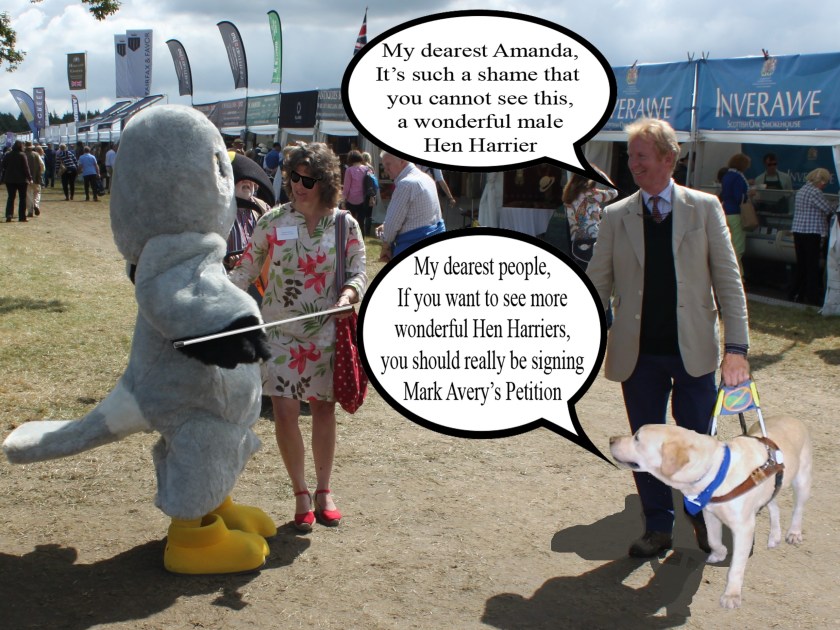
Above photo shows Henry Hen Harrier checking out the Skydancer bathbombs on the RSPB’s stand at last summer’s Birdfair.

There’s a guest blog on the RSPB website today written by Paul Morton from Lush Campaigns – see here.

lush skydancer

Head gamekeeper Simon Lester resigns from Langholm Moor Demonstration Project

Langholm moorThere had been rumours for a few days and now it’s confirmed: Simon Lester, the head gamekeeper at the Langholm Moor Demonstration Project has resigned.

A statement has appeared on the Langholm Project website and is reproduced as follows:

Simon Lester, the LMDP’s headkeeper, has resigned from the project and will be leaving at the end of March 2016. Simon has provided tireless leadership to the five-man keepering team which has undertaken the key management actions for the project. These have resulted in significant improvement of the heather habitat, the effective use of fiversionary feeding of hen harriers each summer and the management of parasites and predators. These measures have increased the numbers of red and black grouse, and breeding raptors, notably hen harriers. This mixture of traditional and novel management has been successfully demonstrated to hundreds of project visitors by Simon in collaboration with the project’s science team.

Despite a larger grouse population than at the start, the project has not been able to produce a sustainably large, harvestable surplus of driven grouse to economically underpin the management. LMDP is now close to its formal end point and the board is reviewing what can and should be achieved in the remaining term of the project. The project board would like to thank Simon for his exceptional contribution.

It’s an interesting time for him to go, eight years in to a ten-year project. The official statement doesn’t explain his reasons, and nor should it as they’re personal, but it will inevitably lead to speculation.

Perhaps it’s because there (supposedly) hasn’t been an opportunity to begin driven grouse shooting on the moor, which is one of the fundamental aims of this project, although it has been argued that the decision not to shoot has been a political one. Grouse densities at Langholm in 2014 had recovered to the same densities that had allowed driven grouse shooting to take place there in the early 1990s, so why the decision not to shoot now? Many of us think it’s so the grouse-shooting industry can claim that the Langholm Project has ‘failed’, in order for them to persist with their argument that driven grouse shooting can’t function with all those pesky raptors around, even though years of research at Langholm have not produced a scrap of scientific evidence to show raptor predation has a large impact on the red grouse population. According to Langholm Project director Mark Oddy (of Buccleuch Estates), what is required now is lethal raptor control at Langholm (see here). Ah, there’s that ‘local knowledge is just as important as scientific evidence’ piece of guff theory.

Given Simon Lester’s view on raptor culling (he thinks it should happen – see here and here), we thought he might have stuck around at Langholm to see his dreams fulfilled. Although perhaps he realises that the chances of licences being issued to kill buzzards, based on no scientific justification whatsoever, are limited.

Scrolling down the Langholm Project website, it’s fascinating to see what else has been mentioned, or more interestingly, what hasn’t been mentioned.

There’s a bit about one of the guest blogs that appeared on Mark Avery’s website (here) that reported on a presentation given at a GWCT seminar about the Langholm Project, but strangely, there’s no mention of the second guest blog (here) where Mark Oddy (Buccleuch Estates) proclaimed lethal raptor control as the next step forward in the Langholm Project. How odd!

Scroll down a bit further on the Langholm Project website and you’ll find a statement about the illegal shooting of hen harrier ‘Annie’, one of the Langholm-hatched birds. Strangely, there’s no mention of where Annie’s corpse was discovered other than “an area over 40km to the north west of Langholm Moor”. The statement is strangely quiet about the fact that Annie’s corpse was found on a grouse moor on, er, Buccleuch Estates, part of the same estate where the Langholm Project is based. Why so coy? Just because her corpse was found there doesn’t mean that’s where she’d been shot, so why exclude this important detail?

All very odd.

It’ll be interesting to see what happens next at Langholm. Will they employ a replacement head keeper and continue for the final two years, or will they decide to close the project early and declare it a failure?