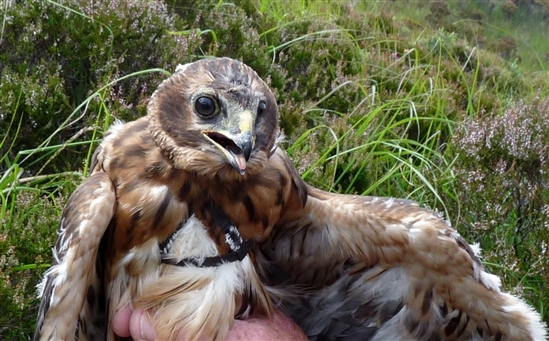
When a satellite-tagged hen harrier dies of natural causes

Question

When a satellite-tagged hen harrier dies of natural causes, what happens next?

Answer

The satellite tag continues to transmit, leading investigators to find the dead bird and determine the cause of death. The tag doesn’t suddenly stop transmitting and the bird’s corpse doesn’t suddenly vanish in to thin air, even several days after death.

– – – – – – –

One of this year’s young satellite-tagged hen harriers, Hermione, has been found dead on the Isle of Mull. She died of natural causes in late September and her body (and sat tag) has been retrieved, just a few kilometres from where she’d fledged in August. Full story on the RSPB Skydancer blog here.

No driven grouse moors on Mull. No mysterious disappearance of Hermione. No sudden cessation of signals from her satellite tag. No suspicious circumstances. Just a straightforward natural death and a straightforward recovery of her body, aided by the signals from her still-fully-functional satellite tag. Amazing, eh?

Photo of Hermione in July by Paul Haworth

hermione_paulhaworth

Heads up for Hen Harriers: the ‘partnership-working’ sham

Last week we blogged (here) about the results from this year’s Heads up for Hen Harriers project, a so-called ‘partnership-working’ initiative aimed at better understanding the threats faced by hen harriers in Scotland.

We were pretty scathing about this project. Everyone knows, thanks to years, in fact decades, of scientific evidence, that the main threat comes from illegal persecution on driven grouse moors so let’s not pretend this is still a big mystery needing to be solved. But we want to re-visit the project again just to drive home some salient points.

Have another look at the press release put out by SNH (here). We learned that this year the number of ‘participating’ estates had risen from five to 13.

Now, according to the SNH press release, “The thirteen estates participating in the project have cameras installed on their land to monitor hen harrier nests“.

This same claim was made in a press release from the Scottish Countryside Alliance (here). They said:

Thirteen participating estates, many of them managed for grouse shooting, installed cameras to capture what exactly was happening on and around hen harrier nests to improve our understanding of why nests fail“.

So, from these two claims, you could be forgiven for thinking that all 13 ‘participating’ estates had hen harrier breeding attempts this year, and that each of the 13 estates had nest cameras installed. That’s what these propagandists would like you to believe, but it isn’t actually what happened.

The term ‘participating’ needs some clarification. Yes, 13 estates had agreed to ‘participate’ in the project –  that just means that 13 estates (8 of which were managed as driven grouse moors) had agreed to host a project nest camera should there be a hen harrier breeding attempt on that estate this year.

What it doesn’t mean is that those 13 estates (including those eight driven grouse moors) all had hen harrier breeding attempts and all had nest cameras installed. They didn’t. Hen harriers attempted to breed on three of the 13 estates, and guess what? None of those breeding attempts was on a driven grouse moor.

So what the SNH press release should have said is something like: ‘Three of the thirteen participating estates had hen harrier breeding attempts this year, and those three estates each hosted a nest camera. None of these three estates is managed as a driven grouse moor‘.

By putting out misleading information suggesting that all 13 estates had hen harrier breeding attempts and that each estate hosted a nest camera, SNH is able to repeat the myth that ‘landowners and conservationists are working together to help the hen harrier’, and this allows other organisations like Scottish Countryside Alliance and Scottish Land & Estates to repeat the same myth and present a wholly inaccurate picture of ‘partnership working’. This perpetual myth then allows the Scottish Government to also pretend that progress is being made and therefore further measures to stamp down on the raptor killers isn’t deemed to be necessary.

It’s a total sham, facilitated by SNH, the Government’s statutory conservation agency, no less.

We also wanted to revisit the BBC’s Landward programme that covered this year’s Heads up for Hen Harriers project. The programme is still available on iPlayer for a limited period but to avoid losing it, we’ve uploaded a clip to YouTube. (NB: the visual quality of the clip is quite poor, thanks to rural broadband, and isn’t a reflection on the BBC, but the sound quality is good, and it’s what was said on that programme that is of interest here).

First to be interviewed was Brian Etheridge of the RSPB who stated that the relationship between failing hen harrier nests and land managed as a driven grouse moor was ‘striking’.

Next came Tim (Kim) Baynes, speaking on behalf of Scottish Land & Estates. The first question he was asked by the presenter was: “How frustrating is it for you that you always seem to be painted as the bad guys?“.

Ah yes, the poor, victimised grouse moor owners, it must be soooooo frustrating for them to be portrayed in such bad light. Let’s just ignore all the wildlife crime statistics from grouse moors, all the poisoned baits that have been found, all the poisoned raptors, all the illegal traps, all the shot raptors, all the burnt out raptor nests, all the trampled chicks, all the disappearing satellite-tagged raptors, all the consistently vacant raptor breeding territories, all the gas guns, all the banger ropes, all the inflating screeching scarecrows….those poor, poor victimised grouse moor owners.

If only the presenter had asked why hen harriers had failed to breed on any driven grouse moor in the Angus Glens for the last ten years.

Tim (Kim) played the victim card with the usual aplomb, agreeing that it was “really, really frustrating‘ to be portrayed in such poor light, especially when “one estate has got 81 bird species, you know, including birds of prey“.

Ah yes, of course, the old 81 species claim again. We’ve blogged about this before (here) but it’s worth reiterating. This is the ‘study’ that was undertaken on Invermark Estate (Angus Glens) in 2015 that claimed there were 81 species of birds ‘either breeding or feeding‘ on the grouse moor. The findings of this ‘study’ were used at a parliamentary reception at Holyrood (see here) to celebrate the so-called conservation value of driven grouse moors. Unfortunately, the study report has never been made public, despite repeated requests to see it, which is a shame because we’d really like to know how a study undertaken at Invermark between June and August could possibly measure the breeding status of many bird species when the usual (proper scientific) survey technique is to conduct a study from March to June…you know, during the actual breeding season. Perhaps the surveyors saw some random birds flying overhead and decided to include them on the list of ‘breeding’ or ‘feeding’ species to boost the numbers. That would be a bit like Bristol claiming that the management of the Severn Bridge was so good it supports Bearded Vultures (here), or the ground keepers at Regent’s Park claiming that their management was so good that the Park supports Cory’s Shearwaters (here).

It’s amazing, isn’t it, how so-called ‘studies’ that apparently show driven grouse moors in a positive light are allowed to be kept secret so nobody can scrutinise the methods or results but can be celebrated by MSPs at a parliamentary reception, and yet studies that are commissioned to assess the illegal persecution of raptors on driven grouse moors are required to include a “robust statistical analysis of all the data to support any conclusion” (see here).

‘Missing’ hen harrier Brian: official responses from Environment Secretary & Cairngorms National Park Authority

Two days after the news that young satellite-tagged hen harrier Brian has gone ‘missing’ in the Cairngorms National Park (see here), we now have official responses from Environment Secretary Roseanna Cunningham and from the CEO of the Cairngorms National Park Authority, Grant Moir.

brian-july16_jennyweston

Well done to journalist Christopher Foote (STV news) for publicising this incident (here) and for managing to get these official responses.

Let’s start with the response from the Environment Cabinet Secretary:

I take this issue very seriously and it shows the need to establish whether the disappearance of these birds is indicative of criminal activity. 

It is clearly suspicious, but we must ensure that a robust statistical analysis of all the data from over 200 tagged birds supports any conclusion. 

I will consider what action to take in the light of the full evidence, and I am not ruling out any options.”

Well, at least she didn’t trot out the usual Ministerial line that we’ve heard repeatedly from successive Environment Ministers over a period of several years (e.g. “I’m very disappointed” and “I will not hesitate to bring in further measures if they are deemed necessary“). And at least she has acknowledged this incident, which is better than remaining silent about it. But other than that, this is just yet another holding statement.

We’re partly sympathetic to her position. She has recently instructed a review of raptor satellite tag data (which we fully support) but that review is not expected to be finished until March 2017. That six month delay is not her fault, and nor is it the fault of the review’s authors. They need to conduct a thorough interrogation and analysis of the data and their methods will need to stand up to potential legal scrutiny depending on the Secretary’s subsequent decision to act. We’re well aware (as Roseanna will be) that the well-financed grouse shooting industry will take whatever legal action it can to prevent any Governmental challenge to its current practices, so this review does have to be robust and that will, inevitably, take time. On that basis, a holding statement at this stage is probably the best we could expect.

However, we’re also partly unsympathetic to Roseanna’s position. As we’ve said before, many, many, times, the evidence of criminal activity on grouse moors is already overwhelming and has been available for several decades. It has built and built and built. We don’t need to wait for yet another study to reach the same conclusion. It’s hugely frustrating that we have to put up with the constant stalling tactics from the Government before any action is taken. Again, Roseanna Cunningham isn’t entirely responsible for the stalling – every other Environment Minister has played their part in that, and some more than others – but eventually, a point is reached where the stalling and inaction is no longer tolerable.

Let’s now look at the statement from Grant Moir, CEO of the Cairngorms National Park Authority:

We are working with Police Scotland, SNH and Scottish Government to look at next steps around wildlife crime in the Cairngorms National Park.”

Really, Grant? 48 hours of thinking time and that’s the best you can offer? You needn’t have bothered. No, really, you needn’t have bothered.

Photograph of hen harrier Brian by Jenny Weston

Heads up for hen harriers? How about heads in the sand?

Last week we were treated to yet another ‘partnership-working’ charade, this time under the guise of PAW Scotland’s ‘Heads up for Hen Harriers’ project.

This project was established in 2013. It aims to ‘better understand the threats facing Scotland’s hen harriers –and ultimately promote recovery of the species – by working in partnership with land managers‘ (see here). The idea is that nobody knows why hen harrier nests are failing in certain areas (yes, really!) but by putting cameras on nests we might learn more about these ‘mystery issues’.

The whole project has been a farce right from the start (we blogged about it here), although, to be fair, it does seem that asking the public for hen harrier sightings has been fruitful in one or two cases. But the part of the project that relies on nest camera evidence is just absurd. It’s going to lead to a huge sampling bias because these cameras are only placed at nest sites with the landowner’s permission. Nobody in their right mind is going to illegally persecute those nesting hen harriers or their chicks with a camera pointing right at them, thus, any subsequent nesting failures documented by the project will be the result of natural causes, not illegal ones, allowing the grouse moor owners to proclaim that illegal persecution isn’t a problem.

Last year we criticised the project (here) because nest cameras were not deployed on any intensively driven grouse moors. Tim (Kim) Baynes, a spokesman for Scottish Land & Estates, disingenuously used those 2015 results (from non-driven grouse moors) to claim that nest failures ‘on grouse moors’ that year were due to the weather and fox predation. We argued that it was pointless, propaganda-fuelling bollocks to place cameras on nest sites in areas where persecution isn’t an issue (walked-up grouse moors) and then use those results to claim that persecution isn’t an issue on driven grouse moors.

Much the same has happened this year. In last week’s media releases (SNH press release here; Landward programme here [available for 27 days]; BBC news here [which is basically a shortened version of the Landward programme]), we were told that there was an increase in project uptake from estates this year (five estates in 2015, 13 this year) and this was seen as huge progress. However, only three estates had successful nests and none of those estates were intensively managed driven grouse moors. Well, one of them was Langholm and as they’re still not shooting grouse there and still not illegally killing hen harriers there, it can hardly be seen to be representative of driven grouse moors.

What was new this year was that some of those 13 signed-up estates ARE intensively managed driven grouse moors – notably some in the Angus Glens and further north in Aberdeenshire. But none of them had breeding hen harriers this year so they didn’t really actively ‘take part’ in the project, as is being claimed. It’s all very well signing up for the project and saying you’re part of it and how much you love hen harriers and want to understand what the issues are; it’s a lot like the grouse moor owners in northern England who claim to have signed up to DEFRA’s Hen Harrier Inaction Plan – it sounds great but has resulted in exactly zero breeding hen harriers on any driven grouse moors in England this year. It’s an easy PR stunt for these estates to pull but when hen harriers haven’t bred in these areas for ten years (Angus Glens – see here) or the hen harrier population has suffered a catastrophic population decline thanks to illegal persecution (Aberdeenshire  -see here), and when you’re still deploying gas guns, banger ropes, and inflatable screeching scarecrows at the critical breeding time for hen harriers, it’s probably a safe bet that you’re not going to have breeding hen harriers this year but hey, you can still say you’re engaged in ‘partnership-working’ and thus score some brownie points.

Of the nests that were successful this year, much has been made of the weather and of fox predation. Again, this is all just another opportunity to hide the known impact of illegal persecution. Yes, weather will affect productivity (as it can for most species) and yes, natural predation will occur (as it does in any ecosystem), but so what? We all know these natural causes of nest failure will occur in places, but we also know that illegal persecution has been identified as the main threat to hen harriers on driven grouse moors across the UK.

These estates, and SNH, need to stop pretending otherwise.

UPDATE 3 October 2016: Heads up for Hen Harriers: the ‘partnership-working’ sham (here)

Too embarrassing for words

Following this morning’s news that satellite-tagged hen harrier Brian has ‘disappeared’ in the Cairngorms National Park just a few weeks after fledging (see here), we’ve been waiting to see what the Environment Secretary and the Cairngorms National Park Authority had to say about it, and more importantly, what they intended to do about it.

This won’t take long……they’ve said absolutely nothing at all.

All as silent as Brian’s satellite tag.

Nothing on the CNPA news website, nothing on their twitter feed, nothing on the PAW Scotland website, and nothing on the Environment Secretary’s twitter feed.

Sorry Brian, you’re just too embarrassing for words.

brian-july16_jennyweston

UPDATE 29 September 2016: Official response from Environment Secretary and CEO of Cairngorms National Park Authority (here)

Satellite-tagged hen harrier ‘disappears’ in Cairngorms National Park

Another of this year’s hen harrier chicks has ‘disappeared’ just a few weeks after fledging, this time in the Cairngorms National Park.

This one was called Brian, after raptor worker Brian Etheridge, and he had hatched in a nest in Perthshire, within the National Park. After fledging, he stayed within the Park boundary until his signal, ‘suddenly and without warning‘, stopped abruptly on 22 August 2016 a few miles from Kingussie. Searches for his body and tag proved fruitless. The details of Brian’s short life can be read here on the RSPB Skydancer blog.

kingussie

brian-july16_jennyweston

This is a photo of Brian taken at the nest in July with his newly-fitted satellite tag (photo by Jenny Weston).

Brian is the second of this year’s cohort to suddenly ‘disappear’ – in early August, hen harrier Elwood also vanished, in the grouse moor ridden Monadhliath mountains just to the NW of the Park (see here).

The area around Kingussie is also ridden with driven grouse moors. In fact, it wasn’t far from here where hen harrier Lad’s corpse was found in September 2015, suspected shot (see here).

So what now? A few weeks ago, following the ‘disappearance’ of eight satellite-tagged golden eagles, as well as hen harrier Elwood, in the Monadhliaths, Environment Secretary Roseanna Cunningham announced a review of the sat tag data of three raptor species – golden eagle, hen harrier, red kite – to ‘look for patterns of suspicious activity‘ (see here). That review is very welcome but the team working on the analysis is not expected to report until March 2017 at the earliest. That’s six months away. And then there’ll be further delays as the Government digests the review’s findings and thinks about how to respond, or not.

And to be frank, we don’t need to wait for the review to detect ‘patterns of suspicious activity’ – the pattern of illegal persecution has been known for years. The cause of these raptor disappearances is not unreliable sat tags (94% reliability in a recent study of Montagu’s harriers – see here), nor is it non-existent wind farms (see here), nor is it ‘bird activists’ killing the birds to smear the grouse shooting industry (see here).

We’ve said this before and we’ll say it again. Endless peer-reviewed scientific papers and government reports on golden eagles, hen harriers, red kites and peregrines have unequivocally linked the illegal killing of these raptors with intensively-managed driven grouse moors. Why pretend nobody knows what’s going on?

The ‘disappearance’ of Brian is bad enough, but for this ‘disappearance’ to take place in the Cairngorms National Park just adds to the ever-increasing catalogue of shame that the Park Authority needs to address. Cue expressions of ‘disappointment’ and more stalling tactics (futile partnership-working and discussions) from the CNPA.

Here’s that catalogue of shame, in full:

2003

Apr: 3 x poisoned buzzards (Carbofuran) + 2 grey partridge baits. Kingussie, CNP

Jun: Attempted shooting of a hen harrier. Crannoch, CNP

2004

May: 1 x poisoned buzzard (Carbofuran). Cuaich, CNP

Nov: 1 x poisoned red kite (Carbofuran). Cromdale, CNP

Dec: 1 x poisoned buzzard (Carbofuran). Cromdale, CNP

2005

Feb: 1 x poisoned buzzard (Carbofuran). Cromdale, CNP

Feb: 1 x poisoned buzzard (Carbofuran). Cromdale, CNP

Mar: 3 x poisoned buzzards, 1 x poisoned raven (Carbofuran). Crathie, CNP

2006

Jan: 1 x poisoned raven (Carbofuran). Dulnain Bridge, CNP

May: 1 x poisoned raven (Mevinphos). Grantown-on-Spey, CNP

May: 1 x poisoned golden eagle (Carbofuran). Morven [corbett], CNP

May: 1 x poisoned raven + 1 x poisoned common gull (Aldicarb) + egg bait. Glenbuchat, CNP

May: egg bait (Aldicarb). Glenbuchat, CNP

Jun: 1 x poisoned golden eagle (Carbofuran). Glenfeshie, CNP

2007

Jan: 1 x poisoned red kite (Carbofuran). Glenshee, CNP

Apr: Illegally set spring trap. Grantown-on-Spey, CNP

May: Pole trap. Grantown-on-Spey, CNP

May: 1 x poisoned red kite (Carbofuran). Tomintoul, CNP

May: Illegally set spring trap. Grantown-on-Spey, CNP

Jun: 1 x poisoned buzzard (Carbofuran) + rabbit & hare baits. Grantown-on-Spey, CNP

Jun: 1 x poisoned buzzard (Carbofuran) + rabbit bait. Grantown-on-Spey, CNP

Jul: 1 x poisoned raven (Carbofuran). Ballater, CNP

Sep: 1 x shot buzzard. Newtonmore, CNP

Sep: 1 x shot buzzard. Grantown-on-Spey, CNP

Dec: 1 x poisoned buzzard (Alphachloralose). Grantown-on-Spey, CNP

Dec: 1 x poisoned buzzard (Carbofuran) + rabbit bait. Grantown-on-Spey, CNP

2008

Jan: 1 x poisoned buzzard (Alphachloralose). Nr Grantown-on-Spey, CNP

Mar: 1 x poisoned buzzard (Carbofuran). Nr Grantown-on-Spey, CNP

Dec: 1 x poisoned buzzard (Alphachloralose). Nr Grantown-on-Spey, CNP

2009

May: 2 x poisoned ravens (Mevinphos). Delnabo, CNP

Jun: rabbit bait (Mevinphos). nr Tomintoul, CNP

Jun: 1 x shot buzzard. Nr Strathdon, CNP

Jun: 1 x illegal crow trap. Nr Tomintoul, CNP

2010

Apr: Pole trap. Nr Dalwhinnie, CNP

Jun: 1 x pole-trapped goshawk. Nr Dalwhinnie, CNP

Jun: Illegally set spring trap on tree stump. Nr Dalwhinnie, CNP

Sep: 2 x poisoned buzzards (Carbofuran) + rabbit bait. Glenlochy, CNP

Oct: 2 x poisoned buzzards (Carbofuran) + rabbit bait. Nr Boat of Garten, CNP

2011

Jan: 1 x shot buzzard. Nr Bridge of Brown, CNP

Mar: 1 x poisoned golden eagle (Carbofuran). Glenbuchat, CNP

Apr: 1 x poisoned buzzard (Carbofuran & Aldicarb). Nr Bridge of Brown, CNP

May:  1 x poisoned buzzard (Carbofuran) + rabbit bait. Glenbuchat, CNP

May: 1 x shot short-eared owl, found stuffed under rock. Glenbuchat, CNP

Jun: 1 x shot peregrine. Pass of Ballater, CNP

Aug: grouse bait (Aldicarb). Glenlochy, CNP

Sep: Satellite-tagged golden eagle ‘disappears’. Nr Strathdon, CNP

Nov: Satellite-tagged golden eagle ‘disappears’. Nr Strathdon, CNP

2012

Apr: 1 x shot short-eared owl. Nr Grantown-on-Spey, CNP

Apr: Peregrine nest site burnt out. Glenshee, CNP

May: Buzzard nest shot out. Nr Ballater, CNP

2013

Jan: White-tailed eagle nest tree felled. Invermark, CNP

May: 1 x shot hen harrier. Glen Gairn, CNP

May: Satellite-tagged golden eagle ‘disappears’. Glenbuchat, CNP

2014

Apr: Satellite-tagged white-tailed eagle ‘disappears’. Glenbuchat, CNP

May: Armed masked men shoot out a goshawk nest. Glen Nochty, CNP

2015

Sep: Satellite-tagged hen harrier ‘Lad’ found dead, suspected shot. Newtonmore, CNP.

2016

May: 1 x shot goshawk. Strathdon, CNP

Jun: Illegally set spring traps. Invercauld, CNP

Aug: Satellite-tagged hen harrier ‘Brian’ ‘disappears’, near Kingussie, CNP

In addition to the above list, two recent scientific publications have documented the long-term decline of breeding peregrines on grouse moors in the eastern side of the National Park (see here) and the catastrophic decline of breeding hen harriers, also on grouse moors in the eastern side of the Park (see here).

And let’s not forget the on-going massacre of mountain hares, taking place annually within the boundary of the National Park (e.g. see here, here).

Let’s see how the Environment Secretary and the Cairngorms National Park Authority respond this time. We’ll add links to any statements if/when they appear throughout the day.

UPDATE 18.40 hrs: Too embarrassing for words (here)

UPDATE 29 September 2016: Official responses from Environment Secretary and Cairngorms National Park Authority (here)

BBC Trust ruling: Chris Packham did not breach guidelines

A year ago, Tim Bonner, Chief Exec of the Countryside Alliance complained to the BBC (see here) about Chris Packham describing various ‘countryside’ organisations as “the nasty brigade” and accused him of other alleged breaches of the BBC’s editorial code.

Earlier this summer, just as the campaign to ban driven grouse shooting was gaining serious momentum, poor Timmy was furious to learn that the BBC Trust would not publish its decision until September. The Countryside Alliance clearly hoped that Chris’s participation in the highly successful ban driven grouse shooting campaign could be curtailed (see here) so they stamped their feet and pressed the BBC Trust to publish its decision without delay.

The BBC Trust gave the Countryside Alliance a metaphorical middle finger and stood firm. Today, the Trust has published its decision: Chris Packham did not breach any BBC guidelines – read the Trust’s full findings here: bbc-trust-ruling-on-chris-packham

v happy Copy

Meanwhile, as the appropriately named nasty brigade have been baying (braying?) for his blood, Chris has remained focused on more important issues. He’s just launched a new e-petition calling for a moratorium on shooting woodcock, snipe and golden plover until the cause of their population declines have been determined by independent scientific assessment – you can sign his petition here.

Oh, and one last thing. A few months ago, Chris was asked to choose a name for one of this year’s satellite tagged hen harriers as part of the Lush Skydancer Bathbomb campaign. Anyone recall the name he chose? Watch the video here and listen carefully! [Cue outraged complaint to the BBC….]

Don’t worry Countryside Alliance, next year, assuming there are some hen harrier chicks around to satellite tag, one can be called Olive and another Ridley, in honour of those marine turtles you know so much about.

Satellite tag reliability: compelling evidence from Montagu’s Harrier study

Satellite-tagged hen harriers regularly ‘disappear’ in the UK uplands, mostly in areas managed as driven grouse moors. Indeed, according to data from Natural England, of 47 hen harriers that were satellite-tagged between 2007-2014, a staggering 78.7% were listed as ‘missing’ (see here). That means a significant and suspiciously high proportion (37 tagged hen harriers) vanished without trace.

And of course it’s not just hen harriers. Last month we learned that eight satellite-tagged golden eagles had ‘disappeared’ on grouse moors in the Monadhliath mountains (see here).

Various unsubstantiated ‘explanations’ for these ‘disappearances’ are routinely trotted out by the persecution apologists, including claims that ‘bird activists’ are killing the birds to smear the grouse shooting industry (here) or that the birds have been killed at windfarms and their bodies removed to avert bad publicity….quite plausible until we discovered that the majority of the windfarms blamed for the disappearance of eight golden eagles hadn’t actually been built (see here).

And then we get the old familiar excuse that it must have been a technical failure with the satellite tag. Again, quite plausible if it happened every so often, but not if it’s happening with the frequency with which the grouse-shooting industry claims. Last month, the credibility of this excuse was blown apart when the Scottish Countryside Alliance published the following statement in response to the news about the eight ‘missing’ sat tagged golden eagles:

Contrary to claims that transmitters are reliable, research papers published in 2013 studied three decades of wildlife radio telemetry and concluded that failure rates could be as high as 49%“.

It turned out that the SCA was disingenuously using data from satellite-tagged Olive Ridley turtles in India where problems with a saltwater switch on the tag is a known and on-going issue and so the SCA’s claim of a 49% failure rate was actually based on a totally irrelevant study and as such was highly misleading (see here). You can make up your own minds about whether this was a case of the SCA’s inability to interpret simple scientific data or whether it was deliberate propaganda pushed out to divert attention from illegal killing in the hope that nobody would check the details.

Wouldn’t it be great if, instead of relying on misrepresentative data from marine turtles in the Indian Ocean, there was a relatively comparative study of satellite tag reliability on, say, a harrier species in western Europe.

Oh, hang on, there is!

Have a look at this blog that has just been published on the RSPB’s website. It’s written by Dr Raymond Klaassen of the Dutch Montagu’s Harrier Foundation. Raymond and his colleagues have been satellite-tagging Montagu’s harriers (67 of them since 2006), using the same make and model as the sat tags being fitted to hen harriers in the UK.

raymond-klaassen-monty-by-mark-thomas

So what does Raymond say about satellite tag reliability in his study? Amongst other things, he says this:

Technical failures generally are rare. We have recorded a few throughout the years (6% of all cases), however failures have always been preceded by irregular transmission periods and, most importantly, a drop in battery voltage (another parameter monitored by the transmitter). This makes it relatively straightforward to distinguish between a likely mortality event and a likely transmitter failure“.

Wow. A six per cent technical failure rate over a ten year period. It turns out that these harrier satellite tags are actually highly reliable. Who knew? Compare that six per cent failure rate with the 78.7% rate of ‘disappearing’ hen harriers over a seven year period, supposedly the victims of satellite tag ‘technical failures’.

We trust this compelling evidence of satellite tag reliability will be included in the Scottish Government’s review of satellite tag data from three raptor species that routinely ‘disappear’ on grouse moors across Scotland (see here).

Photo of Raymond with a satellite-tagged Montagu’s harrier by Mark Thomas.

An open letter to Philip Merricks

rod-copy

There’s not much else to say, is there?

This letter was written before Philip’s incoherent presentation at the Sheffield raptor conference (here) and before Philip moved his, er, “immovable conditions” for participating in DEFRA’s Hen Harrier brood meddling plan (see here).

The forthcoming Hawk & Owl Trust AGM should be interesting….

Illegal raptor killing has to stop, says Angela Smith MP

Here’s another transcript from last week’s Sheffield conference on raptors. This time we feature the deeply personal yet unflinchingly resolute presentation given by Angela Smith MP (Labour, Penistone and Stocksbridge).

Angela is no stranger to the subject of illegal raptor killing on grouse moors. You may remember, way back in 2011, she tabled a Parliamentary question asking whether it was time for England to follow Scotland’s lead and introduce vicarious liability to deal with criminal gamekeepers. The response from Richard Benyon, the then DEFRA minister who also just happened to own a grouse moor, is now legendary (see here).

Here’s what Angela had to say in Sheffield (we’ve excluded some complimentary, but irrelevant here, introductory blurb):

Now I want to start with a comment about my own constituency. Although I’m a Sheffield/Barnsley MP I think that most people in the UK would think that makes me a very urban MP but I’m not. I represent the urban parts of Sheffield and also Barnsley, part of my constituency going right out in to the Peak District so it is actually very rural; 32% of the constituency is in the National Park.

And I’ve walked the hills in my area for many years, in fact going back well well before I became an MP and I love those moors with a passion. Langsett, Midhope and Broomhead, in fact I’ll be out on Langsett on Sunday morning, and it’s partly because I don’t come across, if you don’t mind me saying this, the lycra-clad brigade in large numbers, in that part of the peak. It’s truly a place where one can lose oneself and have a sense of being at one with nature.

But the simple and stark fact is that neither do I see hen harriers on those moors, or even peregrine falcons. I’ve seen just one peregrine falcon in fact in recent years and that was back in the summer of 2013, soaring over Broomhead Reservoir. In fact I think the only known site, I may be wrong on this, for peregrine falcons breeding near Sheffield is the city centre, and that, I think, is indicative of where we are. And it should concentrate our minds more than a little.

Grouse moors aplenty in my constituency, but no hen harriers. No stable populations of other birds of prey. That’s one of the reasons why I feel so passionately about this issue. Not only am I a member of the RSPB, and have been for a long time, but I also know there is something wrong with our moorland habitats. There is something essential missing; healthy populations of our wonderful raptors.

Now, I welcome this conference and hope that it can make a contribution to resolving the deeply embedded conflict that characterises the debate about how best to manage our moorlands. Because one thing I am certain of – for as long as this conflict remains unresolved, the number one loser is the hen harrier, which is in danger of disappearing altogether from our wonderful uplands if we do not sit up and get on with the job of sorting out this problem.

Over the next two days, you will hear a range of presentations from speakers with a wide range of perspectives and who represent different parts of the UK – Scotland, the Peak District and Bowland, for example. The discussions will be detailed and complex, and so they should be. This is not a black and white problem, easily resolved.

Let me just throw in a few, brief comments about what I see as the politics of this debate.

First of all, let’s remember politics is the art of the possible, someone should try telling that to my party, and it is always preferable to act on the basis of consensus and partnership. So, ideally, the best way forward, as far as our moorlands are concerned, would be to see all interested parties agreeing principles and working through differences to establish moorland management plans that balance sporting interests with the need to restore and maintain a healthy habitat, including of course stable and sustainable populations of raptors.

Such plans would vary, of course, because our uplands are themselves wonderfully diverse. The grouse moors in my constituency are part of our precious Peak District blanket bog and are badly degraded, in fact I think it’s amongst the most badly degraded in Europe. That does not mean other parts of our moorland landscape across the UK are the same. Each upland habitat needs its own plan, tailored to its own precious ecology.

But it has to be said that the chances of delivering success with this voluntary approach look increasingly remote. Despite the partnership work still ongoing in places like the Dark Peak, which I know you’re going to hear about later, the events of this summer suggest that relationships between the different parties involved are becoming even more difficult.

The withdrawal of the RSPB in particular from the Hen Harrier Action Plan is indicative and is a consequence of what the charity sees as a failure on the part of the landowners and the shooting interests to combat effectively the illegality that tarnishes the reputation of those who do want to enjoy their sport responsibly.

And for a politician this is very depressing news, for although there are legislative options available to us, the irony is that they become necessary or even more critically necessary at that point when conflict has deepened and become more firmly entrenched.

The first of these legislative options, banning driven grouse shooting, presents an apparently straight forward solution but runs the risk of alienating landowners, who in the final analysis maintain and manage our moorland areas and provide employment for many people living in rural areas. It may well also do little to prevent further persecution – there is no guarantee that making grouse shooting illegal will necessarily lead to a cessation of the illegal killing of birds of prey.

Licensing is the other option available. Now, I understand that for the grouse shooting community this is also an unpalatable option and in many ways I would join with those that say that a voluntary, partnership based approach is preferable.

But let me also say this – the licensing option has to remain on the table. If this conflict continues and if raptors continue to be persecuted, it will have to be considered. Politicians will not be able to stand aside and allow hen harriers, for instance, to disappear from our uplands altogether

Some of you may say, that’s an open invitation to charities like the RSPB in particular not to cooperate with a voluntary approach. But I say this in response. The challenge is clear now. For those who want a voluntary approach to work, and I still do, and I think most politicians would still prefer it, the precursor to progress is that the illegal killing has to stop. It just has to stop.

And, on that basis, all parties, including the RSPB, will have a duty to work together to find a way of delivering healthy, moorland habitats that can sustain the sport of shooting that so many people here today love so much.

So I, over the years, have followed this debate, it particularly impacts on my constituency, and I think we are rapidly getting to what, if you don’t mind me using a cliché, is the last chance saloon, and I think it’s critically important that we maintain every option and keep every option on the table. But as I said before, this killing has to stop.

Enjoy the conference; I can stay for only this morning, but I wish you every success in at least taking a few small steps in the right direction.

END

Ironically, just two days before she gave this presentation, a young peregrine was found critically injured next to a grouse moor in the Peak District National Park. It had been shot. It didn’t survive (see here).