The controversial Heads Up for Harriers project got another airing at the weekend, this time on BBC Radio Scotland’s Out of Doors programme.
For those who missed it, you can listen to it on the BBC iPlayer HERE for the next 27 days (starts at 01.58, ends 07.39).
For the sake of posterity, here’s the transcript, and our comments are below:
Mark Stephen (presenter): Last year we covered the launch of an ambitious project to put cameras in hen harrier nests on grouse moors to see why the bird’s population numbers are so low. Now, we’d best not underestimate the challenge of this project in getting access to some moorland where privacy is treasured. The results are in and one of the main drivers behind Heads up for Harriers is Professor Des Thompson of Scottish Natural Heritage. Des has been talking to Euan.
Des Thompson: The hen harrier is one of our most special birds of prey, it’s a fantastically beautiful, graceful bird. It’s one of our most endangered birds. In the UK we’ve got hardly any birds nesting….[interrupted].
Euan McIlwraith: Is that just because they have a habit of taking grouse and they’re not welcome on the moors? Is that the main reason?
Des Thomson: Well historically that’s certainly been the case Euan, they’ve not been welcome at all on the intensively managed grouse moors. But they’re doing very well in the Outer Isles, we’ve got roughly just under 500 pairs at the moment but not doing anything like as well on the grouse moors.
Euan McIlwraith: So we should have them throughout Scotland or is it just mainly on the moorland?
Des Thompson: No, we should have them throughout Scotland, I mean historically they’ve nested in lowland areas but their best habitat and the best foods for these birds [is] on heather dominated areas.
Euan McIlwraith: The project last year, Heads up for Harriers, what was the idea of the project?
Des Thomspon: Well there’s two things we’re trying to do with Heads up for Harriers, one is just encouraging people to report their sightings of these birds, I mean they’re just so beautiful to see, and we’ve had a fantastic response from people throughout the country, just giving us information on where they’re seeing these birds and we can follow up to see how these birds are faring. But we’ve also recognised that on grouse moor areas they’re either absent or not doing well, so we’ve wanted to work with estates and conservationists to encourage these birds to settle. Where they’ve settled, with the agreement of the estates we’ve put out nest cameras to see what’s happening to the nests. If nests are failing, why? Is it because of foxes, crows, or disturbance or some other factor?
Euan McIlwraith: That was last year, what kind of results have you got?
Des Thompson: Well we’ve been very lucky because we’ve now got more than 20 estates participating.
Euan McIlwraith: Was that a hard thing, to persuade people?
Des Thompson: Yeah, it was actually, if I’m frank with you Euan. We’ve had to develop a very strong partnership involving Scottish Land & Estates, RSPB, Scottish Raptor Study Groups, SNH and other people, bringing them together, having candid conversations, which is sort of code for quite difficult discussions, but in the end we’ve had estates coming forward saying, ‘Ok, bring it on, we want to have hen harriers settle in our areas, we want to show that we can look after them’. Now, we’re not being naive, there are quite a number of estates I’d like to see joining the scheme, they’ve not come forward yet, and I would like to reach into these estates to see if we can get them to come on board.
Euan McIlwraith: So what did you do? Did you put cameras beside the nest and just monitor how many survive?
Des Thompson: Yes, we’ve had some fantastic people working with us, one person in particular, Brian Etheridge, who this year won the Nature of Scotland Species Champion Award, has been brilliant at working with estates, going out working with estate staff, locating nesting hen harriers, finding the nest, cannily putting out the camera and then re-visiting it to see how the birds are faring.
Euan McIlwraith: So what kind of results have you had?
Des Thompson: Well a sort of mixed bag, pretty much what you’d expect across the country. We’ve had some nests being predated by foxes, we’ve had some nests failing for natural reasons, but overall across all of our nest sites we’ve had 37 fledged harriers from the nests which is a great result.
Euan McIlwraith: So that would imply that if it went on, you should be able to re-populate Scotland?
Des Thompson: I don’t know about re-populating Scotland because we’ve still got a lot of estates that we need to reach in to and you’ll know that the Scottish Government has recently set up an expert group to look at the management of driven grouse moors, and there’s still a number of moors that we need to reach in to, to try and influence management.
Euan McIlwraith: What about the success rate of the chicks because they’re normally, I presume, 3 eggs laid and survival would be one?
Des Thompson: Yes, I mean in some cases four, five or even six eggs if we’re lucky, most of the chicks will fledge and that’s where it gets very difficult. Some are predated, some unfortunately are being persecuted, they’re either being poisoned or killed, the females tend to stay on the moor, the males migrate very long distances because they’re feeding on much smaller prey.
Euan McIlwraith: But the results, I’m led to believe, compared to England were much more impressive?
Des Thompson: Well, they are, but you would expect me to say that. Well in England, we’ve got virtually no hen harriers nesting. We don’t have the sort of partnership working we have in Scotland so I think we’re extremely fortunate. But I think its fair to say that raptor conservationists, a number of raptor conservationists are impatient for change, they want to see the fortunes of hen harriers much better, and I think they’re absolutely right, so that’s why I want to really throw down the gauntlet to those remaining estates where there’s intensive driven grouse shooting and to say we really would like to work with you, to see if we can extend the scheme.
Euan McIlwraith: Because it’s in their interests, isn’t it, if you can actually say, ‘I’ve put a camera on the harrier nest, they’re surviving, it’s not us’?
Des Thompson: Well I think it is, Euan, but I think also reputationally, for the wider brand of Scotland, why would we not want to see hen harriers in the wild uplands of Scotland, it’s such a fantastic spectacle, especially in spring when you’re getting males flighting, I mean it’s a wonderful thing to see so it’s in their interests to do so.
ENDS
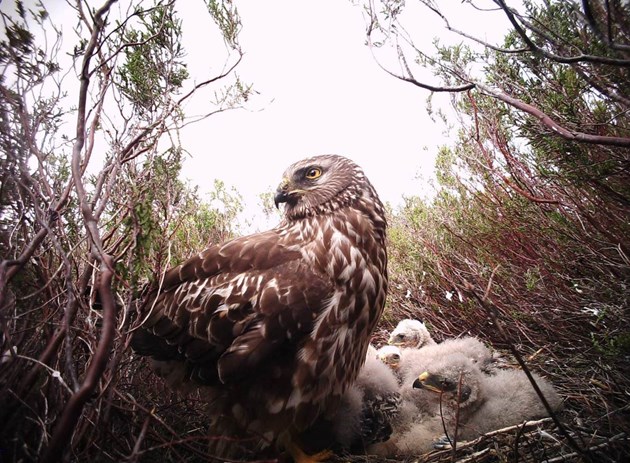
Photograph from a 2017 Heads up for Harriers nest camera:
For God’s sake, when are we going to get some honesty about the Heads up for Harriers project?
Let’s just be clear – the purpose of installing nest cameras is not ‘to find out what’s happening to these birds’ – we already know what’s happening, and Des even alluded to this in his interview. On intensively managed grouse moors, breeding hen harriers are not tolerated. They are illegally killed and this has been going on for decades, in England and in Scotland.
We know that at some nests the breeding attempt can and will fail, from a number of natural causes, but that’s perfectly normal. These types of failures are NOT the cause of the declining hen harrier population, nor the reason behind the persistent absence of breeding hen harriers on driven grouse moors – that is down to illegal persecution. It’s a fact, accepted by Governments, by statutory agencies, by police forces, by conservationists, in fact by everybody except those involved with the driven grouse shooting industry.
So let’s stop pretending that we need the Heads up for Harriers project to determine ‘what is happening to hen harriers’. No, the real reason for wanting these estates to sign up for the Heads up for Harriers project is to prevent them from killing nesting birds. If they know there’s a camera pointing at the nest, the gamekeepers will not touch those birds.
In this interview, when discussing the results from the 2017 breeding season, once again it was glossed over that none of the seven estates with nest cameras were intensively managed driven grouse moors (we’ve blogged about this quite recently, here, and we’ll be saying more in the near future). Those estates with cameras are not known as raptor persecution hotspots and they do not have a reputation for killing hen harriers. These are relatively progressive estates that do tolerate hen harriers and have done for some time, with or without this project. To claim this as a project ‘success’ is wholly misleading.
And while it’s true that of the 21 estates that have signed up for this project, some ARE intensively managed grouse moors (including a number in the Angus Glens), not one of those driven grouse moors has produced a hen harrier breeding attempt. Its all very well signing up for the scheme and using this for a bit of PR value, but until they support a hen harrier breeding attempt, their ‘participation’ is meaningless.
And even if some of those intensively managed grouse estates did manage to support a hen harrier breeding attempt, that wouldn’t stop the illegal killing of the fledglings. As we’ve seen over and over and over again, as well as breeding adults, dispersing young harriers are also illegally killed on driven grouse moors, and this would take place beyond the view of a nest camera.
And please, Des, stop also pretending that there’s ‘a very strong partnership’ between SLE, RSPB, SRSG, SNH and others involved with this project.
There is not!
Sure, there is partnership working with ‘decent’ estates (i.e. those that don’t kill raptors), as there always has been, but the relationship between raptor conservationists and the driven grouse shooting industry has never been worse!
We’ve seen grouse moor estate owners telling raptor workers they’re no longer welcome (here), we’ve seen a Director of the Scottish Gamekeepers Association repeatedly making outrageous and false accusations about raptor workers (here), we’ve seen the Director of the Scottish Moorland Group falsely accuse raptor workers of producing “deeply flawed” peer-reviewed science (here), we’ve seen the Chairman of the Scottish Gamekeepers Association falsely accuse the Scottish Raptor Study Group of ‘driving [gamekeepers’] wives, children and grandchildren from their homes‘ (here), we’ve got the Scottish Gamekeepers Association refusing to attend PAW Scotland Raptor Group meetings through a perceived lack of trust (here), and we’ve got SLE refusing to tell the RSPB (a Heads up for Harriers project partner) the names of the participating estates in this project (here).
Does that sound like ‘a very strong partnership’ to you?
Come on, stop with the spin, stop with the secrecy, stop with the pretence. We’ve had enough. And no, we’re not “impatient for change” – raptor conservationists’ patience has been tested to the limit over several decades – it’s no surprise it has now run out.
Previous blogs about the Heads up for Hen Harriers project: see here, here, here, here, here, here, here, here, here












 Raptor Persecution UK