MSP urges closer cooperation to protect hen harriers – a futile request while illegal raptor killing continues

Following the recent news that yet another hen harrier has been found dead in suspicious circumstances (here), Hen Harrier Species Champion Mairi Gougeon MSP has taken the opportunity to call for conservationists to work in closer cooperation with the game shooting industry.

Here’s an article in yesterday’s edition of The National:

MSP MAIRI GOUGEON URGES CLOSER COOPERATION TO PROTECT HEN HARRIERS

SCOTLAND’S big landowners have backed an SNP MSP’s call for all sides to work together to end persecution of hen harriers.

Species champion Mairi Gougeon spoke out after Police Scotland launched a probe this week into the death of a hen harrier found with “unexplained injuries” near Dunoon in Argyll.

The Angus North and Mearns MSP urged all sides of the debate on raptor persecution to come together to find a long-term way to help the hen harrier flourish.

The death of the satellite-tagged bird, named Kathy, is one of a number of high-profile cases involving hen harrier.

Earlier this year a bird was reportedly shot in Leadhills, while satellite-tagged Calluna went missing near Braemar, Aberdeenshire, and a four-year court case over the alleged shooting of a harrier on Cabrach Estate in Moray was dismissed.

A recent survey showed a 27 per cent fall in Scotland’s hen harrier population – down to 460 pairs – since 2004. Illegal persecution of the bird is thought to be a major factor in its decline. It has been suggested some estate staff kill the birds to protect game-bird species such as grouse.

Heads Up for Harriers is an initiative from the Scottish Government’s Partnership for Action against Wildlife Crime to get land managers to protect harriers.

More than 20 of Scotland’s estates have signed up for the project. It reported its highest number of fledged young hen harriers, 37, in 2017, and Gougeon is keen to do more to bridge the gap between estates and conservationists.

Gougeon said: “I’m under no illusions about how contentious this issue is. I know it won’t be resolved overnight but I take my role as a species champion very seriously.

One of the main reasons why the hen harrier population hasn’t flourished is the fact there has been illegal persecution of this species over a long period.

Almost half of Scotland is capable of supporting a hen harrier population. There are a number of ongoing projects – including Heads Up for Harriers – geared towards trying to sustain and grow the population in the future.

Heads Up for Harriers is not without its critics and may not be an immediate panacea but it is a promising step in the right direction.

More estates need to sign up to the project before we can assess whether or not it is successful.

We also need to look at other potential solutions such as diversionary feeding.

We need to take every available measure to crack down on the serious crime committed against raptors and to tackle the illegal persecution that takes place.

At the same time we cannot tar all estates with the same brush. We must acknowledge the positive steps some estates and gamekeepers are taking to promote the species.

We need conservation groups and shooting interests to set aside their natural distrust and to try to work together“.

‘Species Champion’ MSPs agree to provide political support for Scotland’s wildlife, under a scheme organised by environment groups.

Tim Baynes of landowners’ group Scottish Land and Estates said: “We are committed to playing our part in helping to restore this iconic species.

We support Mairi Gougeon’s call for greater co-operation and collaboration and look forward to working with other organisations with the same objective at heart.

We are concerned about the fate of the hen harrier found near Dunoon.

This bird has been found in area which is heavily afforested and a long way from any grouse moor. We echo the police appeal for information.”

ENDS

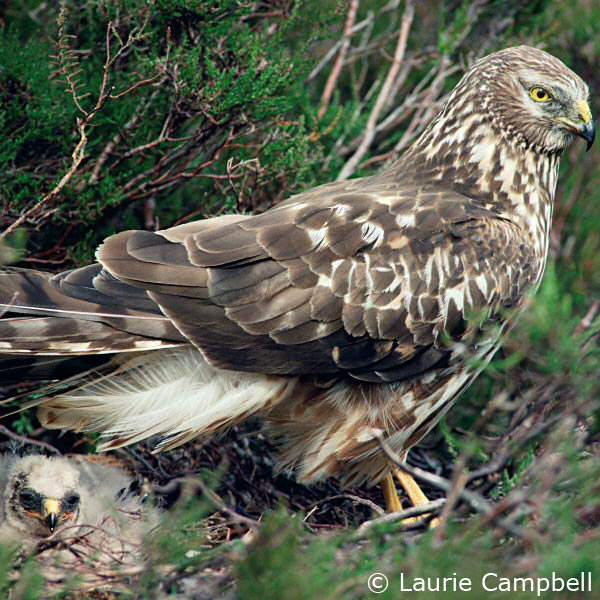
Photo of satellite-tagged hen harrier ‘Annie‘, found shot dead on a Scottish grouse moor in 2015, shortly after the Heads Up for Hen Harriers Project began [photo by RSPB Scotland].

Full credit to Mairi for being quick off the mark and using her position to reiterate in the national press that, “One of the main reasons why the hen harrier population hasn’t flourished is the fact there has been illegal persecution of this species over a long period”. That’s exactly what the Hen Harrier Species Champion needs to be saying and we applaud her for doing so.

But this idea that ‘conservationists need to be working closer with the gameshooting industry to tackle illegal raptor persecution and then everything will get better’ is indicative that Mairi is new to this game – and she is. That’s not her fault and she’s taking the position that every other reasonable person takes when they first join this ‘debate’ – that of thinking that if only both ‘sides’ would sit and talk/cooperate then this whole sorry mess could be resolved. Mark Avery wrote a detailed blog about this earlier in the year (see here), and although it’s slanted towards ineffective long-term talking in England, the same applies to Scotland.

The bottom line is that as long as one ‘partner’ (or in this case, many partners) continues to deny the extent of illegal persecution (e.g. see here) even when the evidence continues to mount that the illegal killing continues, then that ‘partnership’ is doomed to fail.

In the case of hen harriers in Scotland, the so-called Heads up for Harriers ‘partnership’ has been a scam right from the start – we’ve blogged about it a lot (e.g. see hereherehereherehere, here) and only recently this view was aired in Parliament by MSP Andy Wightman (see here). We are currently pursuing an FoI with SNH to expose what we believe is a very serious political cover up about this project (see here) – more on this in the new year.

And all the time this ‘partnership’ has been running, hen harriers have continued to be killed.

Conservationists are tired of the rhetoric, tired of the propaganda, tired of the lies, tired of the ineffective judicial system and tired beyond belief of the never-ending illegal killing.

For hen harriers to start recovering in Scotland (and in England), no amount of ‘closer cooperation’ between conservationists and the game shooting industry will ever work. Only one thing will work – and that is for the raptor killers to stop their criminal activities. And as they can’t (or won’t) do it after 60+ years of self-regulation, then they only have themselves to blame as the strength of public disgust brings about enforced political change.

Have a read of the first comment under the article in The National – nobody’s fooled by this scam anymore and no amount of Xmas goodwill is going to change that:

Bruce Anderson: Scotland’s big landowners have signed up for this because it is just the latest in a long line of window dressing ‘partnerships’ which provide cover and a veneer of respectability for the routine criminal destruction of protected wildlife across nearly all Scottish grouse moors. Mari Gougeon has done some very good work championing hen harriers but she is naive if she thinks that ‘working together’ with Tim Baynes and the grouse industry will have any effect on the organised crime and big money that have left huge ares of Scotland devoid of hen harriers and other protected raptors.

UPDATE 27 December 2017: ‘Closer cooperation to protect hen harriers’ – what does that mean, exactly? (here)

Satellite-tagged hen harrier ‘Kathy’ found dead in suspicious circumstances

Press release from Police Scotland, 20 December 2017:

Police Scotland and RSPB Scotland are issuing a joint appeal for information after a young hen harrier was discovered dead with unexplained injuries on an estate near Dunoon.

“Kathy”, a female bird, was satellite tagged as a chick on the Cowal Peninsula in August this year (2017) as part of the RSPB’s EU-funded Hen Harrier LIFE+ Project.

After fledging in late August, Kathy remained in the vicinity of the nest she hatched in for the next month. RSPB Scotland staff monitoring her tracking device became concerned when data suggested she hadn’t moved on October 3.

A search was carried out on October 5 when Kathy’s body was discovered.

The post-mortem results indicated that the bird had unexplained injuries which may be the result of criminality.

PC Donald Mackay from Police Scotland, said: “I appeal for anyone who knows what happened to Kathy to contact Police Scotland so that we can establish how she may have died. Although this would be an isolated incident in my area, it is concerning that a raptor may have been deliberately killed in Argyll. Hen harriers are a particularly fragile bird of prey in terms of their numbers in the UK, and Police Scotland will work with its partners to thoroughly investigate this incident and robustly deal with any person who may have been involved.”

Will Hayward, Investigations Officer for RSPB Scotland, said: “We are advised that this hen harrier has died from unexplained injuries that may be the result of criminality. If criminal cause of death is confirmed, this incident will sadly be another statistic to add to a catalogue of hen harriers that meet their end in this way. Only through the use of satellite technology are we finally getting an accurate picture of the true scale of a human persecution problem that has been denied by some parties for decades. We look forward to hearing the results of the police investigation into this hen harrier death in due course.”

Hen harriers are one of the country’s most threatened birds of prey with the latest national survey recording only 460 breeding pairs in Scotland, a drop of 27% since 2004. Anyone with information is asked to contact Police Scotland on 101 and ask to speak to a Wildlife Crime Officer.

ENDS

Two and a half months to make an appeal for information? Even allowing for the time it takes to conduct a post mortem and interview estate employees, that’s nowhere near good enough.

A photograph of Kathy has not been made available so here’s a photo of another dead satellite-tagged hen harrier (Caroll) found earlier this year. Photo by Northumberland Police.

UPDATE 24 December 2017: MSP urges closer cooperation to protect hen harriers – a futile request while illegal raptor killing continues (here).

Yorkshire Dales ‘could have too many hen harriers before long’

Clive Aslet is a former Editor of Country Life magazine who boasts of being ‘an acknowledged leading authority on Britain and its way of life‘, whatever that means.

One thing’s for sure, Mr Aslet is no leading authority on the principles of ecology.

He wrote a bizarre comment piece for The Times, published last week in response to DEFRA’s new (not new) raptor persecution maps, as follows:

BIRDS OF PREY NEED PROTECTION FROM HUMAN PREDATORS

The protection of raptors, such as hawks, eagles, buzzards and falcons, is one of the great success stories of the British countryside. When JA Baker wrote his classic The Peregrine fifty years ago, many species were in long-term decline, thanks largely to insecticides used in intensive agriculture and the severe winters of the early 1960s. Numbers have risen sharply since DTT and its like were banned, and raptors were given legal protection. Peregrines now even nest on London skyscrapers.

There have been successful reintroductions, such as that of the red kite: it’s common to see a dozen of these enormous birds now circling over the M40 in Oxfordshire. But successes like these worry country people who know that having too many large carnivores at the top of the food chain means that other species will suffer. Red kites are scavengers (hence their preference for roads, which provide a ready supply of carcasses) but when carrion becomes scarce they turn to living prey.

Grouse moors are a special problem. For the moor owner, grouse are a valuable crop. The bird provides a livelihood to the keepers who control predators such as foxes, stoats and rats that prey on eggs and chicks. Vermin control also allows wading birds like plovers, lapwings and curlews to nest in safety: it’s a wonderful thing to visit a moor teeming with wading birds as well as grouse, whether or not you plan to shoot any of them. But as a report published today shows, many keepers trap or kill hen harriers and sparrow hawks that threaten the viability of the shoot. They deserve to be prosecuted.

At last, landowners are getting the message that this behaviour is unacceptable, and are making greater efforts to conserve raptors. The prospect of the law in Scotland, which targets landowners as well as keepers, being introduced in England has concentrated minds. As has the possibility of a Labour government banning shooting altogether and making grouse moors worthless.

But there remains, as in many areas of conservation, a geographical imbalance. Some areas have too many raptors, others none at all. Exmoor, for example, has no hen harriers; before long, given the male bird’s promiscuity, the Yorkshire Dales could have too many.

Relocating broods from overpopulated areas to underpopulated ones is the answer — opposed, sadly, by the RSPB. Brexit offers a way out of this problem. Freed from the need for a one-size-fits-all approach, we can create the flexible conservation policy our birds of prey deserve.

ENDS

Leaving aside his obvious failure to grasp the simple conventions of predator/prey relationships (we can’t be bothered to turn this in to a lesson on the basics of ecology), we wanted to focus on just the last three paragraphs of his article.

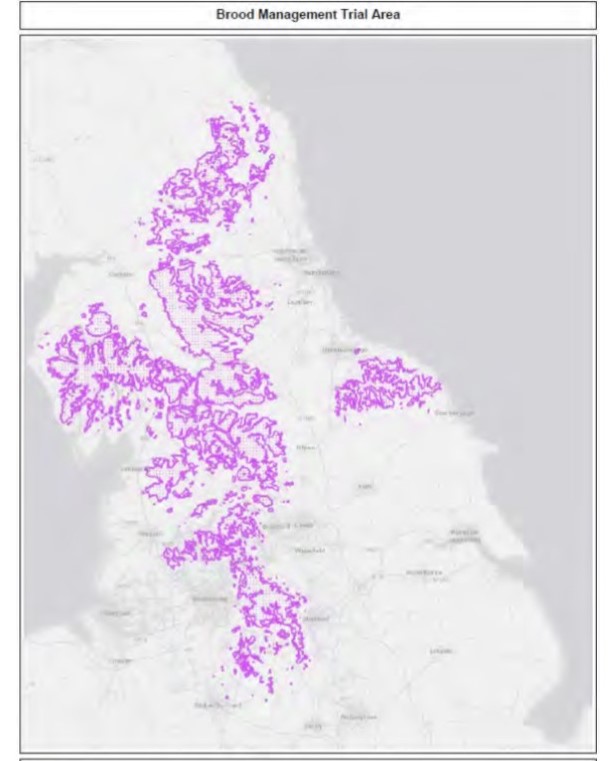
Aslet seems to be muddled about brood meddling. He argues that “Relocating broods from overpopulated areas to underpopulated ones is the answer“. But that’s not what DEFRA’s hen harrier brood meddling is about. It might well be what the grouse shooting industry thought it was about, and wanted it to be about, when they first signed up for it – ‘Yeah, great, let’s get rid of hen harriers from our grouse moors and ship them off down to southern England so they can’t interfere with our shooting days in the northern uplands’, but as we now know, any hen harrier chicks removed from grouse moors and raised in captivity as part of DEFRA’s absurd brood meddling plan, will HAVE to be released back in to the uplands close to where they were first removed, and their release will coincide with the start of the grouse-shooting season. They cannot be used as the source birds for DEFRA’s equally absurd southern England reintroduction plan.

As for Aslet’s claim that “before long, given the male bird’s promiscuity, the Yorkshire Dales could have too many” [hen harriers], chance would be a fine thing! According to this report, there were only three successful hen harrier breeding attempts in the Yorkshire Dales National Park between 2000-2007, and since then, there haven’t been any!

Aslet also claims, “At last, landowners are getting the message that this behaviour is unacceptable, and are making greater efforts to conserve raptors“. Really? Some landowners are, for sure, but how many of those landowners manage driven grouse moors? It’s all very well saying that raptor persecution is unacceptable and pretending to be on board, but the proof, as they say, is in the pudding. There were only three successful hen harrier breeding attempts in the whole of England this year, and for the second year in a row, not one of those was on a driven grouse moor.

Taxpayers’ money used to fund nonsensical questionnaire on Hen Harrier Action Plan

While Natural England is busily keeping secret its plans for hen harrier brood meddling, unbelievably it has funded a new ‘study’ to find out what members of the public think about the Hen Harrier Action Plan!

Some of you may have received an email recently from an academic researcher asking you to fill in an online questionnaire, which is part of a ‘study’ that aims to “understand the different perceptions of hen harriers and examine support for the different measures proposed by DEFRA to recover the hen harrier population“.

The ‘study’ is being undertaken by the Universities of Bangor and Aberdeen, and is “funded by Natural England“. What this actually means is that you, the British taxpayer, has funded it.

We don’t know how much public money has been wasted on this pointless study, but a similar study proposed by researchers at the Universities of Aberdeen and Kent (to guage the opinions of grouse moor owners) was estimated to cost in the region of £50,000 (see here).

It’s kind of hard to see how public opinion of the Hen Harrier Action Plan will be of any genuine research value given that much of the detail about the six action points in this Hen Harrier Action Plan has so far been kept secret!

The questionnaire targets a certain sector of society and the cover letter says, “You have been chosen as a respondent because you are a member of an organisation with an interest in birds in England“. The survey’s question 2 gives an indication about which organisations have been invited to participate:

Many of the questions relate to the respondents’ views on each of the six action points listed in the Hen Harrier Action Plan, such as this one:

It’s a ridiculous question to ask because although in principle the first four of these measures could (and should) increase the number of hen harriers in England, they clearly haven’t worked even though most of the measures have been undertaken for years! For example:

Monitoring (“currently in operation“) hasn’t increased the hen harrier population.

Diversionary feeding (“currently in operation“) hasn’t increased the hen harrier population (and has yet to even be put in to practice by any grouse moor manager in England – see here).

Improving intelligence information and enforcement (“currently in operation“) hasn’t increased the hen harrier population (which is hardly a suprise when you realise that this particular measure is supposedly being led by the Raptor Persecution Priority Delivery Group [RPPDG] – the group that has taken years to produce out of date and inaccurate raptor persecution maps).

Nest and winter roost protection (“currently in operation“) hasn’t increased the hen harrier population.

Here’s another ridiculous question:

Again, none of the first four measures, which have been in operation for years, has resulted in the reduction of illegal hen harrier persecution.

It’s impossible to say whether brood meddling and the southern England reintroduction will reduce illegal killing because we haven’t yet been allowed to see detailed proposals for these two measures.

However, some questions are easier to answer:

We’re not publishing a link to the online questionnaire because undoubtedly it’ll be hijacked by those with a vested interest in making it look like the Hen Harrier Action Plan has widespread public support. Indeed, the questionnaire may already have been hijacked – the respondent is not required to provide any evidence of their identity, but only to indicate from which organisation they received the questionnaire. This will enable false claims that the respondent got the questionnaire from the RSPB or from the Northern England Raptor Forum (two groups that fundamentally oppose the Hen Harrier Action Plan), and thus their views that the Hen Harrier Action Plan is a brilliant thing will be falsely portrayed in the results as coming from members of these two organisations.

What a waste of public funds.

Natural England refuses to release Hen Harrier Brood Meddling Plan

Natural England continues its tirade of a lack of transparency and public accountability in relation to the Hen Harrier Action Plan.

As regular blog readers will know, we’ve spent over a year trying to get details about the most controversial part of the HH Action Plan – the brood meddling scheme. Natural England has point blank refused almost every single FoI request we’ve submitted on this subject, citing concerns about how publication might ‘prejudice’ the on-going licence application for brood meddling (from Natural England, to, er Natural England).

We did, however, manage to get something out of Natural England in late November 2017 – we blogged about it here.

Part of what we learned was that the Brood Meddling Team (including representatives from GWCT, Hawk & Owl Trust, Moorland Association, Natural England, International Centre for Birds of Prey, and Aberdeen University) had held a meeting in June 2017 to discuss the draft Hen Harrier Brood Management Plan.

Naturally, we were keen to see this draft Brood Meddling Plan so we asked Natural England for a copy.

True to form, Natural England has refused:

In many respects Natural England’s refusal to be upfront about anything to do with hen harriers will not come as a surprise to anybody. However, we were surprised at this particular refusal given that the draft brief for the proposed reintroduction of hen harriers to southern England HAS been released after several FoI attempts (see here).

Hmm. What is in the Brood Meddling Plan that Natural England doesn’t want anyone to see?

Silly old us, eh? Wanting to see how Natural England is abusing our taxes to remove hen harriers from grouse moors.

We won’t have to wait long to find out. Natural England has previously told us that the brood meddling licence application, that has been under consideration for about 9 months, should be completed “by the end of the year”. Assuming the licence is approved, Natural England will have to release it, and the associated brood meddling plan, for public scrutiny.

Heads Up for Harriers Project condemned as “greenwashing exercise” in Parliamentary debate

Yesterday evening saw a Members Debate in the Scottish Parliament as a result of MSP Mairi Gougeon’s recent motion in support of the Heads Up for Harriers Project and the Role of Species Champions.

The archive video of this debate can be watched here and the official report of the meeting can be read here:

Heads up for Harriers debate 13Dec2017

The debate centred on two topics: the role of the species champions and the Heads Up for Harriers Project (HuHP). For the purpose of this blog, we’ll just be focusing on the HuHP – that’s not to say the role of the species champion isn’t important – as we’ve blogged before, it’s an incredibly worthwhile initiative and one that we very much support. We are especially pleased that Mairi Gougeon used her position as the Hen Harrier Species Champion to secure this debate – all credit to her, well done.

A number of MSPs spoke specifically about the HuHP and all except one acknowledged that illegal persecution continues to be a threat to the hen harrier and to several other raptor species. The only one who didn’t acknowledge this fact was John Scott MSP (Conservative), who gave a bizarre speech about the lack of fox and “vermin” control on FCS land and suggested that this played a part in the decline of the hen harrier population. He obviously hasn’t been told that just across the Scottish border at Kielder, the ONLY successful breeding pairs (x 3) of hen harriers in England this year were on, er, FC land.

He went on to say, “Notwithstanding the alleged predation of hen harriers by land managers, I still believe that the safest place for hen harriers to raise chicks is on well-managed grouse moors“.  Dear God.

John Scott’s parliamentary colleague Donald Cameron (Conservative) (and the Species Champion for the Merlin) was far better informed, although he did say, “There has been much criticism of people in the grouse industry who actively persecute birds of prey. I think that we all acknowledge that grouse shooting is an important industry for the rural economy of our country. The vast majority of land managers, whether they are owners or employees, use sustainable environmental management practices to a high standard and operate within the law. It is important to note that many estates carry out measures to conserve and preserve raptor populations“.

We agree that some estates do “employ sustainable environmental management practices to a high standard and operate within the law“. We heaped praise on one of them quite recently (see here). But it’s quite clear from the scientific data on several raptor species (e.g. hen harrier, golden eagle, peregrine, red kite) that there are still a large number of estates that do NOT operate within the law, and those landholdings just happen to coincide with areas intensively managed as driven grouse moors.

We’re not talking about the odd nest failure here and there due to predation or poor weather – these are natural causes of failure that you’d expect from time to time, and everybody acknowledges this. What we’re talking about here is the persistent, long-term absence of these species in areas where they should be, and would be, thriving if they weren’t being routinely and systematically persecuted.

The speeches of two Parliamentary members were the most interesting to us – those given by Andy Wightman MSP (Scottish Greens) and Liam McArthur MSP (Lib Dem). You really do need to read them (and/or watch the video). Both of them pointed out that the HuHP does not address the fundamental issue of tackling illegal persecution because none of the participating estates that have had cameras deployed are known raptor persecution hotspots, nor are they operated as intensively managed driven grouse moors. Andy Wightman went further and said,

Indeed, I believe that the project is being used as a greenwashing exercise to hide the criminal activities that are undertaken by some in the driven grouse shooting industry and to promote the misleading impression that it is voluntarily cooperating to clean up its act“.

Bravo!

The claim that many of the estates with nest cameras on them are managed as driven grouse moors is an interesting one, and, we believe, is untrue.

According to the briefing paper from Scottish Land & Estates (SLE), provided to MSPs prior to the debate:

Up to two thirds of the estates where cameras were installed have been driven grouse moors, indicating a strong take-up where the issue of Hen Harrier decline is most relevant“.

See SLE’s briefing paper here: SLE briefing Heads Up for Harriers debate_13Dec2017

Why do we believe this statement to be untrue? Well, we could argue that any information from SLE on raptor conservation issues is quite likely to be misleading. We’ve seen many examples of outright propaganda from this organisation over the years (under it’s own name and also under the name of its subgroups, the Scottish Moorland Group and the Gift of Grouse), e.g. here, here, here, here, here, here, here, here and as a result we don’t trust a word they say.

But in this case our suspicion is based on more than just a natural distrust of SLE; it’s based on some long-term and painstaking investigative research that we’ve been doing to identify the estates involved in this Heads Up for Harriers Project.

We are confident that we’ve identified the three estates that had cameras deployed in 2015, the three estates that had cameras deployed in 2016, and five of the six or seven estates (there seems to be uncertainty about the actual number) that had cameras deployed in 2017. We are also confident that NOT ONE of these areas where the actual cameras were deployed is a known raptor persecution hotspot and we questions how many of them are actually managed for driven grouse shooting.

But before we can publish our findings, we need to verify our conclusions. So we submitted an FoI request to SNH and this is what we got back:

FoI request to SNH: In each year, how many estates had successful nests and of those, how many estates were managed for driven grouse shooting?

SNH response: 2015 – 2 estates with successful nests, 2 of which were driven grouse moor. 1 additional successful nest 100m off the estate boundary of a driven grouse moor.

2016 – 3 estates with successful nests, 2 of which were driven grouse moor.

2017 – 6 estates with successful nests, 3 of which were driven grouse moor.

FoI request to SNH: Please provide the name of each estate, in each year, that signed up to participate.

SNH response: We have considered this part of your request very carefully, and we are unable to provide the estate names. Estates enter into the Heads Up For Harriers project voluntarily. The estate name information in this case was provided voluntarily, there are no other circumstances that entitle SNH to disclose it, and the estates have not consented to disclosure. Making the information publicly available would be likely to prejudice the interests of the estates, for example via negative publicity in the event of harriers not nesting on the estate or in the event of nest/s failing on the estate. We are therefore withholding the estate name details under EIRs Regulation 10(5)(f) (Interests of the individual providing the information).

The Heads Up for Harriers project members’ position is that estate wishes must be respected. Further, members agree the most important aspect of the project is to encourage cooperation and a positive working relationship ‘on the ground’ between estates, Project Officers and other project members to promote survival of hen harriers and enable monitoring if and when hen harriers return to breed. We have therefore concluded that, in this case, the public interest is best served by not releasing the estate names.

Interesting, isn’t it? As Andy Wightman pointed out in his speech, this is a publicy funded project and yet the names of the participating estates are being kept secret. Why is that, do you think?

Given the serious nature of our concern that inaccurate and misleading information is being spewed out, not only by SLE but significantly by SNH, to portray this project as a genuine attempt by the driven grouse shooting industry to support hen harriers, we’ll be challenging SNH about its refusal to release information that would either support or refute our suspicions that the Heads Up for Harriers Project is just a greenwashing exercise.

Watch this space.

Heads Up for Hen Harriers Project: Parliamentary debate today at 5pm

Today in the Scottish Parliament there’ll be a Members’ Debate on the controversial Heads Up for Hen Harriers Project.

The debate has been secured by Mairi Gougeon MSP, the Species Champion for the hen harrier, following her recent motion congratulating the Project on its “intense” and “considerable efforts” to protect the hen harrier:

Heads Up for Harriers Project and the Role of Species Champions

That the Parliament commends the Heads Up for Harriers Project on what it sees as its intense efforts to protect the hen harrier from extinction; underlines what it considers the importance of the role of species champion, with currently over 90 Members signed up to be champions, in promoting and protecting many of the wildlife found across the country; believes that, with specific regard to the hen harrier, there is need for action to protect the species in light of 2016 national hen harrier survey, which suggested that there had been a 9% decline in the number of sightings in Scotland from the previous study in 2010, falling from 505 pairs to 460; understands that this national population decline is further highlighted in Angus North and Mearns and across North East Scotland, where the 2016 study found that the number of hen harrier pairs had plummeted from a peak of 28 in 1998 to just one in 2014; commends the considerable efforts of the Heads Up for Harriers Project in trying to reverse the declining population, with 2017 figures showing that 37 young birds successfully fledging from nests in seven of the 21 estates that have signed up to the project, and recognises both the specific challenges facing all species currently represented by a Member species champion and the pivotal role that it believes the champions play in promoting and preserving Scotland’s wildlife.

We congratulate Mairi on securing this Members’ Debate and thus keeping the issue in the political spotlight. Whilst we disagree with Mairi’s views about the purpose and value of this Project (we consider it nothing more than a greenwashing exercise), getting Parliamentary time to debate the subject will enable alternative opinions to be heard.

The debate will begin shortly after 5pm in the Debating Chamber and can be watched live on Scottish Parliament TV (here).

We’ll post an archive video and the official minutes as soon as they become available.

UPDATE 14th December 2017: Heads Up for Harriers Project condemned as “greenwashing exercise” in Parliamentary debate (here)

2018 start date for reintroduction of hen harrier to southern England?

Further to yesterday’s blog (here), Natural England has released more information in response to our FoI requests in relation to the proposed ‘reintroduction’ of hen harriers to southern England.

NE has established a new ‘internal’ group to advise the wider Southern Reintroduction Project Team on various technical aspects. This new internal group held its first meeting on 21st September 2017 and here is the agenda:

Also released through FoI is a copy of the draft Project Brief (see below).

From this draft Project Brief, it looks like Natural England is much further ahead with this proposed ‘reintroduction’ than we had imagined. The last we’d heard was that the first release of donated (French) hen harriers in to southern England was planned for 2020. It now looks like 2018 is the favoured start date, as directed by Natural England’s Senior Leadership Team (SLT), although this will depend on securing the necessary permissions from the French statutory agencies.

It also looks like Natural England has agreed to underwrite the costs for this whacko scheme, which means that us taxpayers will be footing the bill of at least £1 million if NE can’t attract any external funders.

The draft Project Brief also reveals that Natural England intends to approach Roy Dennis (and his newly named Roy Dennis Wildlife Foundation) to ask if he’ll serve as a consultant to the project. Given Roy’s long track record on managing successful reintroduction projects it’s easy to see why NE would want him on board, not just for his expertise but perhaps also to allow Natural England to use Roy’s good name and reputation to give the impression that this project has a genuine conservation purpose, rather than the purpose we all know is behind it – that is, to draw attention away from the on-going persecution of this species on the upland grouse moors.

We’ve recently spoken to Roy about his potential involvement and how that might backfire on his reputation, in the same way the Hawk & Owl Trust’s former good reputation has now been tarnished by its wilful blindness to the criminal activities of the grouse shooting industry. Roy told us he had indeed been approached and had so far only agreed to visit Salisbury Plain (the proposed release site) in late January 2018. He said he hadn’t yet committed to anything more and would make a decision after meeting with NE on Salisbury Plain.

The draft Project Brief also discusses the importance of gaining RSPB support for this proposed ‘reintroduction’. As we discussed yesterday, the RSPB has so far stated that it does NOT support the project because it didn’t believe the proposed reintroduction complied with IUCN reintroduction guidelines, although this decision was based on pretty sketchy outline feasibility plans and the RSPB was waiting to see more detailed proposals. It’ll be interesting to see what the RSPB makes of this more detailed draft Project Brief.

Here it is:

Hen harrier reintro to southern England: report of fieldtrip to France (potential donor country)

As many of you know, one of the six action points in DEFRA’s Hen Harrier Action Plan is to ‘reintroduce’ hen harriers to southern England.

As you’ll also know, over the last 12 months we’ve been trying to prise details out of Natural England about this ‘let’s divert attention from illegal persecution on driven grouse moors’ plan, and that has proved challenging to say the least.

Here’s what we’ve learned so far from a year’s worth of FoI requests:

28 Nov 2016: Hen harrier reintroduction to southern England: an update (here)

3 Jan 2017: Hen harrier reintroduction to southern England: the feasibility/scoping report (here)

8 Jan 2017: Hen harrier reintroduction to southern England: the project group and their timeline (here)

9 Jan 2017: Hen harrier reintroduction to southern England: who’s funding it? (here)

9 Jan 2017: Hen harrier reintroduction to southern England: a bonkers proposal for Exmoor National Park (here)

12 Jan 2017: Hen harrier reintroduction to southern England: Wiltshire (here)

14 Feb 2017: Leaked email reveals Natural England’s views on Hen Harrier Action Plan (here)

23 Feb 2017: Hen harrier reintroduction to southern England: donor countries (here)

19 July 2017: Hen harrier reintroduction to southern England: new project manager appointed (here)

20 July 2017: Hen harrier reintroduction to southern England: Dartmoor as potential new release site (here)

20 July 2017: Hen harrier reintroduction to southern England: revised costs (here)

21 July 2017: Hen harrier reintroduction to southern England: project team visits France (here)

27 July 2017: RSPB statement on Hen Harrier reintroduction to southern England (here)

15 Aug 2017: Natural England Board making up justification for hen harrier southern reintroduction (here)

In early October 2017 we submitted another FoI request and Natural England asked for more time due to the “complexity and voluminous nature of the request” (it was neither complex nor voluminous, this was just another delaying tactic from NE).

That extra time has now expired and Natural England has released a limited amount of further information (although some has been withheld, for various reasons).

Part of the information NE released was a report from a fieldtrip to France (a potential hen harrier donor country) undertaken in June 2017 by two members of the Southern Reintroduction Project Team (Simon Lees from Natural England and Jemima Parry-Jones from the International Centre for Birds of Prey). Here’s the [redacted] report:

The two French researchers whose names are redacted from the above report are Dr Alexandre Millon and Dr Vincent Bretagnolle. Both of these guys have had long and productive careers studying various harrier species and both are highly respected within scientific conservation circles. Which kind of begs the question why they might be supportive of a plan to remove French hen harriers and take them to England where the species is on the verge of breeding extinction due to the continued & rampant illegal persecution of this species by gamekeepers?

What they should have told Natural England is, ‘Get the grouse moor managers to stop illegally killing English hen harriers and all your problems will be solved. Harriers will recolonise the southern lowlands all by themselves if they weren’t being illegally shot, poisoned, trapped and bludgeoned to death on the upland grouse moors’. Or words to that effect.

But anyway, it’s not their decision to make; that’s for the French statutory authorities to decide and you’ll note that Natural England recognises it could really do with support from the RSPB to present a ‘unified conservation case’. However, according to a statement issued by the RSPB in July this year:

The RSPB has serious reservations about this approach to hen harrier conservation in England, and therefore is NOT supporting the project“.

We’ll come back to Natural England’s need to get the RSPB on board for this project in another blog post (due shortly). Cooperation and support from the RSPB is something that Natural England has identified as a potential hurdle in getting this project off the ground.

More soon….

UPDATE 12 December 2017: 2018 start date for reintroduction of hen harrier to southern England? (here)

Yorkshire Water agrees to hen harrier brood meddling on its landholdings

Further to Tuesday’s blog about Natural England inviting the Ministry of Defence and Yorkshire Water to participate in the highly controversial hen harrier brood meddling plan (see here), we’ve heard back from Andrew Walker, Catchment Strategy Manager at Yorkshire Water (and we thank him for his prompt & courteous correspondence).

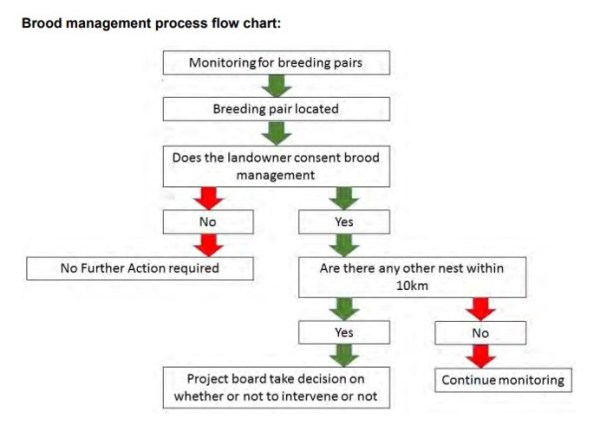
Natural England asked YWS to support the trial of a Hen Harrier recovery plan which comprises a six point plan. The last of these was to scope out feasibility for trialling brood management for which we sought further explanation from Natural England. The explanation we received was that a group, chaired by Natural England, was currently working up a licence application for this trial. The proposal, we understand, is that all nests in the English uplands  – where the land is included within the geographical scope of the licence – could contribute to the density figure (generally expressed as 10km between nests) but that landowners will make the decision as to whether or not they wish a particular nest to be brood managed in this way.

We support hen harrier conservation and, on balance, decided to support the plan because we think that a multi stakeholder approach is more likely to be effective because we don’t see the population we may expect at this moment in time“.

It’s not clear how the temporary removal of protected hen harriers, for the sole benefit of the grouse-shooting industry, fits in with Yorkshire Water’s Biodiversity Action Plan. Nor how the later release of those brood meddled birds back to the same general area will help increase the harrier population, especially as their release will coincide with the peak period of the grouse shooting season (August, September & October) and we know from far too many examples that young harriers are ruthlessly (and illegally) targeted on grouse moors during this period, presumably as they might ‘disrupt’ the grouse drives and so reduce the number of grouse available to be shot.

It’s bad enough that Yorkshire Water permits driven grouse shooting (with highly toxic lead ammunition) on its landholdings, knowing full well the proven links between driven grouse shooting and the criminal persecution of birds of prey, especially in Yorkshire, the raptor killing capital of the UK. But to then sign up to the legal persecution of hen harriers (because effectively that’s what brood meddling amounts to) to appease the grouse shooting industry? Sorry, Yorkshire Water, your environmental credentials have just been flushed down the toilet.