Mark Avery appeals Hen Harrier brood meddling ruling

Last week we learned that Natural England’s decision to licence hen harrier brood meddling had been ruled lawful by Mrs Justice Lang at London’s High Court (see here) following a judicial review instigated by Mark Avery and the RSPB.

Today – some excellent news – Mark Avery has decided to appeal that ruling (see here for his announcement).

We’ve yet to hear whether the RSPB will also appeal.

[UPDATE 27 March 2019: RSPB to appeal hen harrier brood meddling ruling, here]

[A breeding hen harrier as she should be – alive and unmeddled. Photo by Laurie Campbell]

High Court rules decision to licence hen harrier brood meddling was lawful

Mrs Justice Lang has today handed down her ruling on the lawfulness of Natural England’s decision to issue a hen harrier brood meddling licence, after a judicial review was brought by Mark Avery and the RSPB (see here).

Download her judgement here: HH brood meddling judgement_March2019

She has judged Natural England’s decision to issue a brood meddling licence to be lawful as it has been issued for ‘research’ purposes and not for conservation purposes.

Mark Avery (here) and the RSPB (here) have published their initial responses to this judgement.

We won’t say anything further until we hear whether either or both parties intend to appeal the judgement.

[An unmeddled hen harrier, photo by Laurie Campbell]

Gamekeepers’ rep suggests disappearance of hen harrier Vulcan was “set up” by RSPB

At the end of February 2019, the RSPB announced the suspicious disappearance of a satellite-tagged hen harrier called Vulcan who had vanished in January 2019 in an area heavily managed for gamebird shooting in Wiltshire (see here).

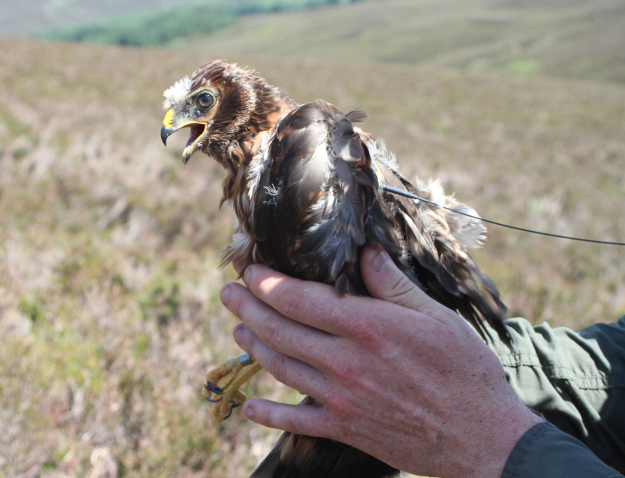
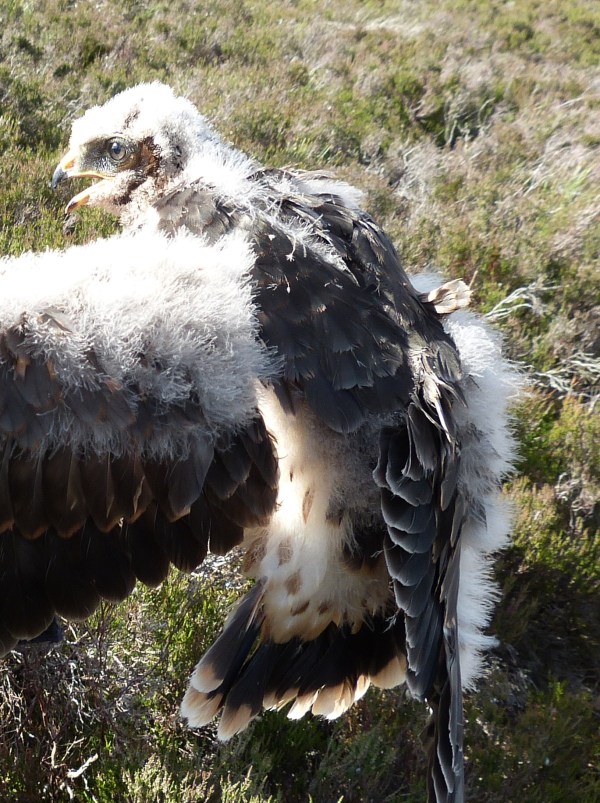
[Hen harrier Vulcan, photo by RSPB]

The suspicious disappearance of any satellite-tagged hen harrier in the UK is significant because the loss of any of these young birds is a reminder of just how precarious the hen harrier population is, and as many of them seem to disappear on grouse moors it’s also usually a repeated reminder of how the authorities have failed to address the rampant criminality associated with this type of land management.

Whilst Vulcan’s disappearance was not on a grouse moor, it was in an area managed for pheasant and partridge shooting and his disappearance was still significant because this area from which he ‘disappeared’ was close to the proposed release site of Natural England’s highly controversial hen harrier reintroduction project, a supposedly raptor persecution free zone.

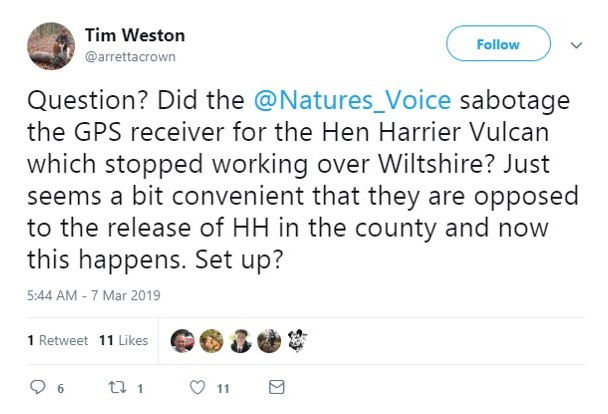
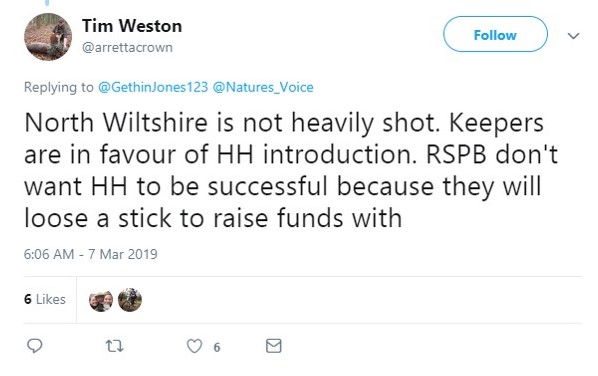
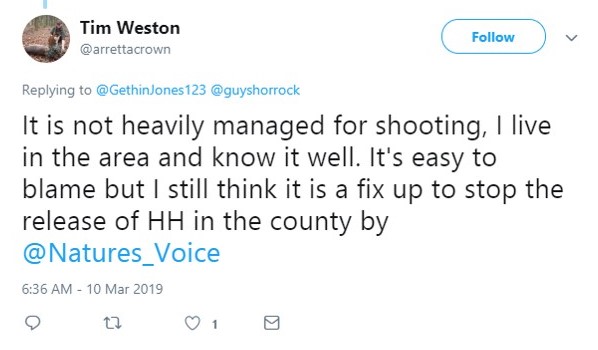
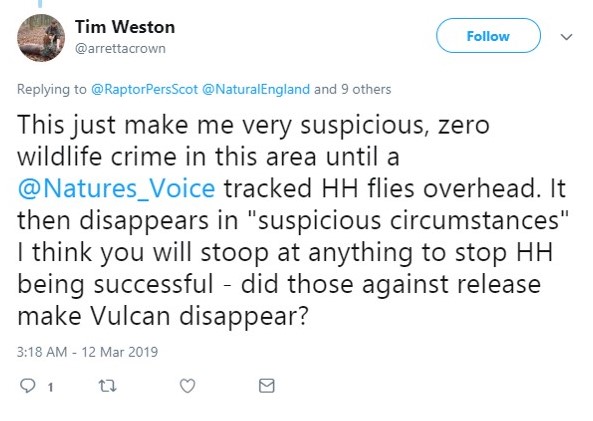
The inevitability of yet another lost hen harrier (the 12th to vanish in suspicious circumstances since last summer) and the significance of Vulcan’s last known location has led Tim Weston, Devlopment Officer for the National Gamekeepers’ Organisation, to accuse the RSPB of a “set up” (or, in more formal legal terms, of perverting the course of justice [by fabricating evidence]).

We’ve come to expect this sort of nonsense from a small number of pro-shooting, anti-RSPB trolls on social media but to see it from a representative of the National Gamekeepers’ Organisation (NGO) was more than a little surprising.

Here are a series of tweets from National Gamekeepers’ Org employee, Tim:

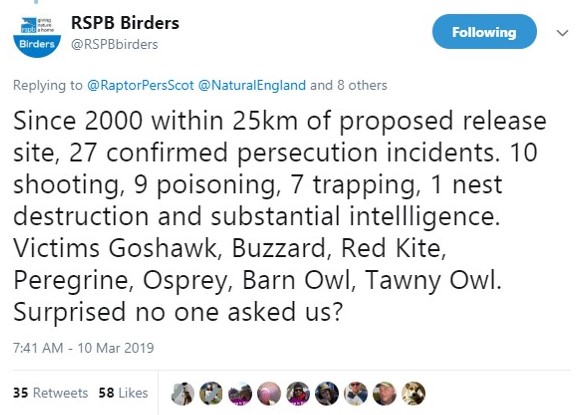
Zero wildlife crime in this area until [RSPB] tracked HH flies overhead“? Tim must have missed the tweet from the RSPB Investigations Team on Sunday night where they outlined some of the confirmed raptor persecution crimes in this area:

Does the National Gamekeepers’ Organisation endorse Tim Weston’s accusations? Not that it matters anymore, since the NGO walked out of the partnership group trying to tackle the illegal killing of birds of prey in England and Wales (the Raptor Persecution Priority Delivery Group, RPPDG). With the gamekeepers gone, hopefully the RPPDG can now focus on the issue at hand instead of being side-tracked and disrupted by distractions like this.

Meanwhile, an organisation which retains its membership of the RPPDG and has played a central role in tackling the illegal persecution of birds of prey in northern England is the Northern England Raptor Forum (NERF). NERF has today issued a statement about the suspicious disappearance of hen harrier Vulcan, because even though Vulcan vanished in southern England, he hatched from a nest in northern England where NERF members helped to protect the site. Read NERF’s statement here

Hen harrier reintroduction to southern England: Natural England suggests persecution not an issue

Natural England has been planning a so-called ‘reintroduction’ of hen harriers to southern England since 2016, as part of DEFRA’s ludicrous Hen Harrier Action Plan.

We’ve blogged about this ‘reintroduction’ for three years (see links at the foot of this blog) and its recently been in the news again as a young satellite-tagged hen harrier called ‘Vulcan’ disappeared in suspicious circumstances close to the proposed reintroduction release site in Wiltshire (see here), indicating that this is not a safe location to rear and release young hen harriers.

This morning on BBC Breakfast News the RSPB again voiced its concerns about the planned reintroduction, citing the loss of hen harrier Vulcan in Wiltshire and arguing that until the issue of illegal persecution has been addressed, any young hen harriers are likely to be killed. You can watch it here (starts at 1:21:08 and ends at 1:23:29; only available until 08.30hrs Monday morning). The RSPB interviewees included Nick Bruce-White (Regional Director RSPB South West) and Tony Whitehead (RSPB Press Officer) who couldn’t have been clearer: “The only limiting factor [for hen harriers], let’s make no mistake about this, is illegal persecution“.

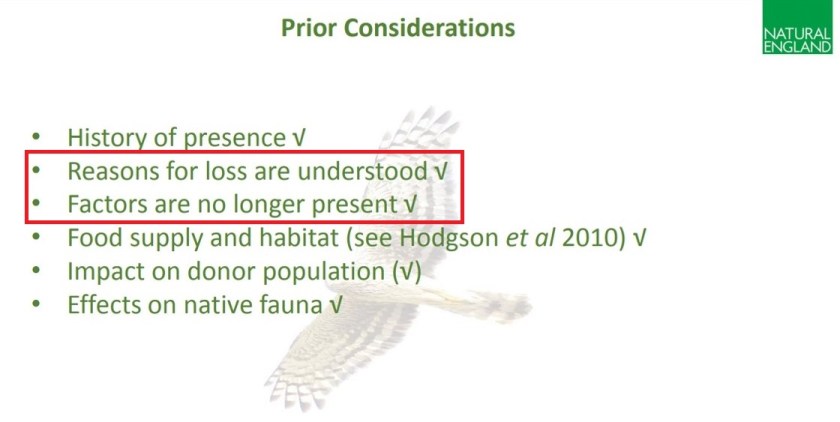
Meanwhile, behind the scenes, Natural England has continued to court favour with potential donor countries and we’ve been sent an unbelievable powerpoint presentation, which we believe was delivered to European harrier experts at an international conference in October 2018 by Natural England’s Hen Harrier Reintroduction Project Manager, Simon Lee. It’s basically a plea for donor birds and an apparent reassurance that donor birds will be safe in England! Honestly, this has to be seen to be believed:

Download the PDF presentation here: Simon Lee presentation HH reintro to southern England

According to Simon, there’s been “a gradual recovery [of hen harriers] across Scotland and Wales in recent decades“. Er, except for the results of the 2016 national HH survey which showed population declines in each country, and a whopping 27% decline in Scotland since 2004. Losing over a quarter of the population in just 12 years isn’t what we’d call “a gradual recovery“.

Also according to Simon, prior considerations [for the proposed reintroduction] included ‘understanding the reasons for loss’ and that those “factors are no longer present“:

So, having earlier noted in his presentation that ‘human persecution’ was a cause of the species’ historical decline, Simon is now suggesting to potential donor countries that illegal persecution is no longer an issue.

You couldn’t make this up. Although it looks like Simon did.

And if this presentation was given in Oct 2018, as we believe, Simon must also have been fully aware of the findings of Natural England’s hen harrier satellite tag analysis, which was completed last summer and is due to be published imminently under the title: ‘Patterns of satellite tagged hen harrier disappearances suggest widespread illegal killing on British grouse moors’.

And now with the suspicious disappearance of hen harrier Vulcan near to the proposed reintroduction location, will Simon / Natural England be updating the potential donor countries about the continuing threat to hen harriers in the UK and advising them that the planned reintroduction won’t be going ahead because its simply not safe to do so?

UPDATE 8pm: The RSPB has tweeted the following information about confirmed raptor persecution crimes within 25km of the proposed reintroduction site:

UPDATE 23rd September 2020: Large police operation investigating raptor persecution near proposed release site for hen harriers (here)

Why did this gunman (+ 2 dogs) visit this hen harrier roost site on this Yorkshire grouse moor?

If you’re new to this blog and you’ve ever wondered what happens to satellite tagged hen harriers that suddenly ‘disappear’ in suspicious circumstances on driven grouse moors in Yorkshire (and elsewhere!), the latest video from the RSPB’s investigations team might just provide a clue. Just a little teeny tiny one.

The video was filmed by two members of the RSPB Investigations team shortly after they’d watched three young hen harriers settle down at the roost site for the night. Just as dusk fell, an armed man turned up with a labrador and a terrier and walked through the roost. He spent a few minutes crouching down amongst the vegetation whilst his dogs ‘worked’ the area. Fortunately none of the harriers flushed and the gunman later left in a vehicle.

The RSPB has published a blog describing the evening’s events (see here) and the blog includes the video footage, which is obviously of low quality given the fading light but clear enough to see what’s going on.

Here is a still from the video and we’ve added a red circle to highlight the gunman:

Who might this have been and what do you think he was doing there? How many implausible explanations will be churned out from the grouse shooting industry?

Didn’t sat tagged hen harrier ‘River‘, ‘disappear’ in this area in November 2018, the day before this video was recorded?

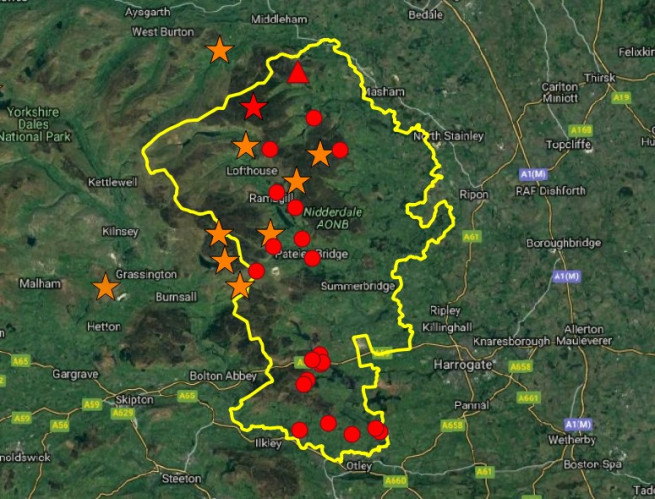
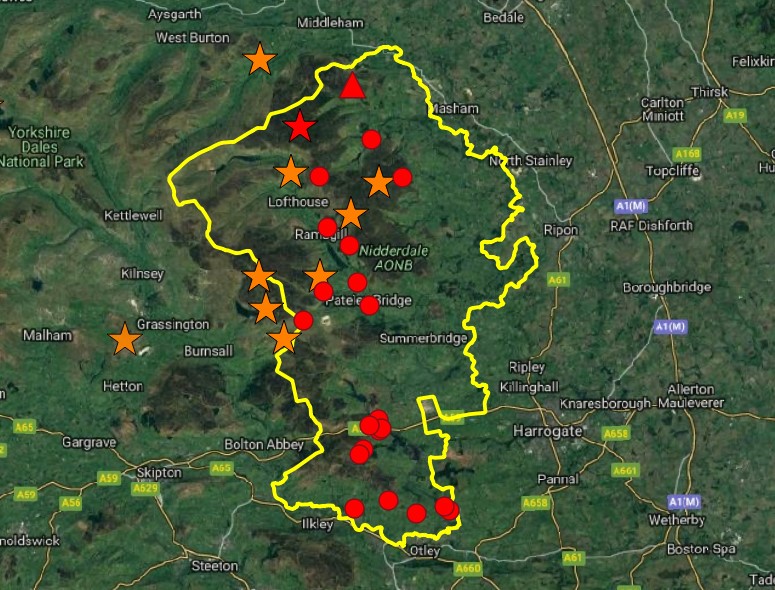
Look how many sat-tagged hen harriers have ‘disappeared’ in the Nidderdale AONB in Yorkshire in recent years, along with illegally killed red kites:

[RPUK map: Nidderdale AONB = yellow boundary. Illegally killed red kites = red circles; sat-tagged hen harriers that have vanished in suspicious circumstances = orange stars & red triangle; illegally shot hen harrier Bowland Betty = red star]

There hasn’t been a single prosecution for any of these incidents.

Do you think the [unnamed] estate has offered its full cooperation to North Yorkshire Police’s enquiries?

Do you think the Moorland Association will publicise this video?

Is anybody still unclear about what happens to hen harriers on driven grouse moors?

Satellite tagged hen harrier ‘Vulcan’ disappears nr proposed reintroduction site in southern England

RSPB press release (28 Feb 2019)

Rare hen harrier vanishes in Wiltshire

A young male hen harrier has disappeared in suspicious circumstances in Wiltshire and is believed most likely to be dead.

The harrier, named Vulcan, was one of five chicks to fledge from a nest in Northumberland last summer. He was fitted with a satellite tag as part of the RSPB’s EU-funded Hen Harrier LIFE project, which enabled the nature conservation charity to track his movements.

[Hen harrier ‘Vulcan’, photo by RSPB]

Vulcan was tracked by the RSPB moving from Northumberland down to the Peak District where he remained throughout September. He then continued to head further south through Hampshire and Dorset. On 16 January 2019, Vulcan’s tag sent out its final transmission, from a location south of Calstone Wellington in Wiltshire.

RSPB Investigations staff searched the area, which is farmland and heavily managed for pheasant and partridge shooting, but there was no sign of Vulcan or his tag. He has not been heard from since and the matter was reported to Wiltshire Police.

Satellite tagging technology is commonly used to follow the movements of birds. Tags continue to transmit regularly, even when the bird dies, and until the tag reaches the end of its lifespan. Vulcan’s tag was providing regular updates on the bird’s location, so the sudden and unexpected ending of transmission is suspicious and could suggest criminal interference. Vulcan is the 11th satellite-tagged hen harrier to disappear since last summer.

Hen harriers are one of the UK’s rarest birds of prey with only nine successful nests recorded in England in 2018 despite sufficient habitat for over 300 pairs. An overwhelming body of scientific evidence suggests that the main reason for their low numbers is illegal killing associated with driven grouse shooting.

Dr Cathleen Thomas, RSPB Hen Harrier LIFE Project Manager, said: “When a bird you’ve been following since it was a chick suddenly disappears without a trace, it’s a crushing blow. Vulcan’s tag had been performing brilliantly, so for it to suddenly stop transmitting makes us very suspicious that something has happened to him.

Wiltshire is not the only place where hen harriers have disappeared in unexplained circumstances. Since last summer 10 other satellite-tagged hen harriers have also vanished suddenly across the UK including in Northumberland, the Peak District, Wales and Scotland. There is a very worrying trend here.”

PC Marc Jackson of Wiltshire Police said: “Wiltshire Police have received a report from the RSPB in relation to the missing harrier ‘Vulcan’, and the Rural Crime Team are working with the RSPB to establish the full circumstances surrounding the incident.

To find no trace of this bird raises obvious concerns about what may have happened to it. If anyone has information please contact Wiltshire Police on 101 or Contact Crime stoppers on 0800 555111 if you would prefer to remain anonymous.”

Vulcan’s suspicious disappearance may prove a hurdle for the proposed southern reintroduction of hen harriers. Natural England is currently looking into the feasibility of introducing hen harriers from the continent to Parsonage Down National Nature Reserve, near Salisbury Plain.

Gareth Cunningham, RSPB Head of Nature Policy, said: “The disappearance of Vulcan raises serious concerns over the safety of any planned reintroduction. The RSPB has serious reservations about this approach to hen harrier conservation in England and we believe ending hen harrier persecution is the key to restoring the UK’s population of these magnificent birds. As such, the RSPB does not support the proposed reintroduction.”

If anyone has any information relating to this incident, please call Wiltshire Police on 101. Alternatively, call the RSPB Raptor Crime Hotline confidentially on 0300 999 0101.

ENDS

As the RSPB points out, this ‘may provide a hurdle’ (read: should be a bloody great big red flashing light) for the proposed reintroduction of hen harriers to southern England as part of DEFRA’s mad hen Harrier (In)Action Plan.

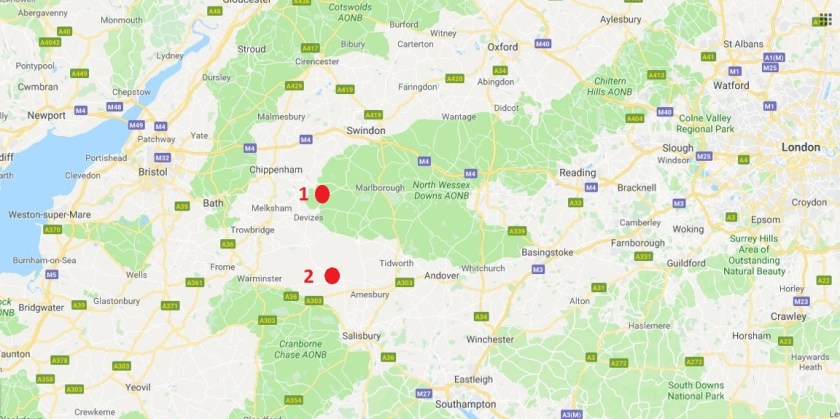
The location of Vulcan’s last known tag signal is less than 20 miles from Natural Engand’s proposed reintroduction site at Parsonage Down National Nature Reserve:

[RPUK map showing 1: Vulcan’s last known location; 2: Natural England’s proposed hen harrier reintroduction site]

We’ve blogged a lot about this proposed ‘reintroduction’ of hen harriers to southern England although technically it’s not a reintroduction because the species is not regionally extinct here and it should more aptly be called the ‘Let’s divert attention from the criminal killing of hen harriers on grouse moors plan’. We have been strong critics of the plan, not least because those young hen harriers tipped out in Wiltshire will likely roam far and wide during their post-fledgling dispersal period (as we know from sat tag data) and if they end up anywhere near a grouse moor they’ll be shot on sight. Releasing birds in to southern England will not solve the cause of the species’ decline in the first place, which undeniably is illegal persecution on driven grouse moors. And now there’s a strong possibility that Vulcan was a victim of illegal persecution, just a few miles from the proposed hen harrier release site. Which country is going to be stupid enough to donate hen harriers to the UK when we can’t even safeguard those birds hatched here, let alone any that are donated for a so-called ‘reintroduction’ project?

For previous blogs on this topic see:

28 Nov 2016 – Hen Harrier reintroduction to southern England: an update (here)

3 Jan 2017 – Hen harrier reintroduction to southern England: the feasibility/scoping report (here)

8 Jan 2017 – Hen harrier reintroduction to southern England: the project group and their timeline (here)

9 Jan 2017 – Hen harrier reintroduction to southern England: who’s funding it? (here)

9 Jan 2017 – Hen harrier reintroduction to southern England: a bonkers proposal for Exmoor National Park (here)

12 Jan 2017 – Hen harrier reintroduction to southern England: Wiltshire (here)

14 Feb 2017: Leaked email reveals Natural England’s views on Hen Harrier Action Plan (here)

23 Feb 2017: Hen harrier reintroduction to southern England: donor countries (here)

19 July 2017: Hen harrier reintroduction to southern England: new project manager appointed (here)

20 July 2017: Hen harrier reintroduction to southern England: Dartmoor as potential new release site (here)

20 July 2017: Hen harrier reintroduction to southern England: revised costs (here)

21 July 2017: Hen harrier reintroduction to southern England: project team vists France (here)

27 July 2017: RSPB statement on hen harrier reintroduction to southern England (here)

15 Aug 2017: Natural England Board making up justification for hen harrier southern reintroduction (here)

24 October 2017: Hen harrier reintroduction to southern England: Natural England delays release of information (here)

11 December 2017: Hen harrier reintroduction to southern England: report of fieldtrip to France (potential donor country) (here)

12 December 2017: 2018 start date for reintroduction of hen harrier to southern England? (here)

14 January 2018: Stop illegal persecution then no need for reintroduction of hen harrier to southern England, says DEFRA Minister (here)

13 March 2018: Hen harrier reintroduction to southern England: has France said “Non”? (here)

We’ve no idea what the latest is as Natural England is being true to form and keeping everything secret, although there are persistent rumours that birds may be donated by Spain, this year. Time for some more FoIs……

UPDATE 11.20hrs: The RSPB has published a blog about Vulcan’s disappearance (here)

UPDATE 12th March 2019: Gamekeepers’ rep suggests disappearance of hen harrier Vulcan was ‘set up’ by RSPB (here)

More on the SGA’s “completely false” claim that hen harrier Saorsa has been re-sighted

Last Friday we blogged about how the Scottish Gamekeepers Association (SGA) had published a statement claiming that a satellite-tagged hen harrier (‘Saorsa’) had been “re-sighted in Perthshire” after the RSPB reported it as having disappeared in suspicious circumstances from the Angus Glens last year.

RSPB Scotland issued a statement in response which said the SGA’s claim was “completely false” (here).

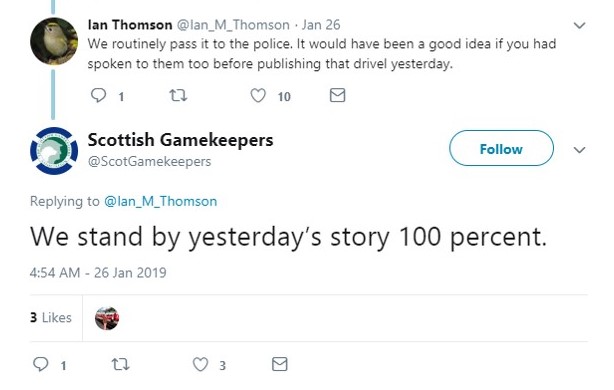
Despite being told “there isn’t a shred of evidence to support the claim that it [Saorsa] has reappeared“, the following day the SGA was still promoting its fake news on Twitter:
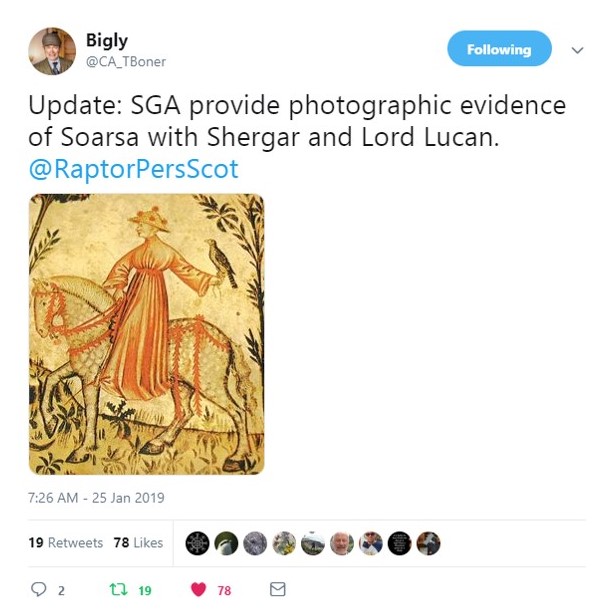
Other Twitter users offered equally conclusive evidence that Saorsa was alive and well, along with Shergar:

It’s also worth revisiting the SGA’s statement made when Saorsa was first reported missing last year, especially an extraordinary claim made by Bert Burnett of the SGA, who suggested that the RSPB had peverted the course of justice by finding Saorsa’s body and ‘secreting it away because it had died of natural causes’ (here).

On last Friday’s blog we said we’d return to the SGA’s latest press release about Saorsa to discuss some of the other inaccurate claims made about the satellite-tagging process. Many of the myths have been dealt with before, on this blog and elsewhere, and yet still the SGA churns out this guff, either too stupid to grasp the basics or deliberately trying to discredit the technology that’s revealing so much about the widespread extent of illegal raptor persecution.

So, here’s the SGA’s original press release (Friday 25 January 2019) and our commentary in italics:

GAMEKEEPERS SEEK ACCOUNTABILITY OVER SATELLITE TAGGED RAPTORS

Scotland’s gamekeepers are calling for accountability regarding satellite tags fitted to wildlife.

The call comes after The Scottish Gamekeepers Association learned that a tagged Hen Harrier, reported as disappearing ‘suspiciously’ in Angus last May, was re-sighted in Perthshire afterwards, according to investigators.

[RPUK: Nope, she hasn’t been “re-sighted” since she vanished in the notorious Angus Glens in Feb 2018].

Anti-grouse moor campaigners who owned the tag’s data publicly blamed the grouse industry, urging Scottish Government to license the sector.

[RPUK: Nope, the RSPB are not “anti-grouse moor campaigners”, they are simply calling for the regulation of grouse moor management. And nope, when Saorsa disappeared the RSPB did not “publicly blame the grouse industry” – the SGA has fabricated this claim – you can read the RSPB’s press statement about Saorsa’s disappearance in Feb 2018 here and you won’t find a single word of accusation against anyone or any industry].

However, no media statements were issued to correct the accusations, leaving local estate employees living with the burden of criminal suspicion.

[RPUK: No media statements were issued (by the RSPB) because, er, Saorsa is still missing from the Angus Glens. And again, to repeat ourselves, the RSPB did not make a single accusation against any industry, estate or estate employee when reporting Saorsa’s disappearance].

The SGA has also learned of a sea eagle currently flying around Grampian with a tag dangling from its body, potentially endangering its welfare.

[RPUK: Are we seriously expected to believe that the SGA is concerned over a sea eagle’s welfare?!! Isn’t this the group that has repeatedly lobbied for licences to enable the legal killing of this and other raptor species in Scotland? Ah yes, here. And isn’t this the group that’s lobbied the Scottish Government in abject hysteria about sea eagles potentially eating babies? Ah yes, here and here. And hasn’t this species been relentlessly persecuted on Scottish grouse moors, notably the victim of illegal poisoning (e.g. here), as well as having its nest tree illegally felled on an Angus grouse moor? Ah yes, here].

The female sea eagle, pegged with yellow wing markings and the letter ‘E’, has been spotted by concerned land managers.

In recent times, four golden eagles have also been independently photographed in the Angus glens with displaced tags; one clearly hanging from a bird’s neck.

Another eagle was observed in Perthshire last week with the bird’s feathers completely obscuring the tag; something manufacturers acknowledge will distort readings.

[RPUK: If a tag’s solar panel has been covered by a feather the tag won’t charge and the steady decline in battery voltage will be revealed in the tag’s engineering data. This means the tag operator can correctly identify battery drainage as the cause of the loss of data rather than the sudden and unexpected loss of data that is caused when someone kills the eagle and destroys the tag and hides the evidence of the crime].

Gamekeepers believe tags are now being deployed by campaigners as political weapons, aware there is no independent scrutiny.

[RPUK: Gamekeepers believe many things, such as white-tailed eagles being a threat to babies and toddlers, but it doesn’t mean there’s any truth in that belief. The SGA needs to read up on the strict regulations governing the deployment of satellite tags in the UK, which includes researchers quite rightly having to provide a proposal to the licensing authority that includes the detailed scientific justification for fitting a tag. Anybody seeking permission to fit tags as “a political weapon” will be laughed out of the door by the, er, independent scientific committee that scrutinises every single application].

Whilst the SGA is not advocating a ban, they believe Scottish Government must act to make fitting and monitoring of the devices accountable.

[RPUK: See above response]

An FOI to Scottish Natural Heritage by SGA revealed that the heritage body currently holds no information from satellite tags in Scotland, despite hundreds being operational.

Similarly, tag reliability cannot be independently verified as there is no duty for tag owners to disclose information regarding malfunction.

[RPUK: Incorrect. There is actually a duty for tag operators to report on tag status. In addition, concientious researchers are publishing data on tag malfunctions to enable tag manufacturers to constantly update and overcome any technical glitches in tag design. In addition, in the interest of transparency details of golden eagle tag malfunction were made publicly available in the Scottish Government-commissioned review in 2017. The number of tags known to have malfunctioned were insignifcant in relation to the number of tags that suddenly stopped and then vanished in suspicious circumstances, the vast majority of those occurring on driven grouse moors].

“At the moment, satellite tags are like the wild west,” said SGA Chairman Alex Hogg. “Anyone with funding can buy one, have it fitted to a protected bird, and retain its data. They can then release interpretations to the media, if the tag stops. We saw this with the choreographed ‘Fred the Eagle’ case near Edinburgh, which remains unexplained despite a concerted attempt to finger a grouse moor.

[RPUK: Incorrect. See above response on the rigorous licensing regulations for tag deployment in the UK. As for golden eagle Fred, we reported that he disappeared in suspicious circumstances right next to a grouse moor, in an area where other raptor persecution crimes had been discovered, just like all the other sat-tagged golden eagles that have disappeared in almost identical circumstances. We did not, at any time, accuse the grouse moor owner or his employees of any involvement. The SGA didn’t like the reports, which incidentally were all published with police approval, because Chris Packham’s involvement in the reports created a media storm. Too bad, the SGA had better get used to that – watch this space].

“Although tag fitters are approved, we have seen basic ‘granny knots’ used to fit tags and we have just heard of two tagged Harriers in Perthshire being killed by foxes within three days, with only one tag and body recovered. A tagged adult Harrier lost on National Trust ground this year was never found, neither was its tag, and a predated youngster was only discovered by chance. These are stories the public never hear and it is a shame they have to come out behind a veil of secrecy.

[RPUK: Could Alex Hogg explain how the SGA has been close enough to a sat-tagged raptor to identify a supposed ‘granny knot’? (The skilled fieldworkers who fit sat tags have had a long laugh about the depth of ignorance revealed by that claim, by the way). And as for Hogg’s claim that the public ‘never hear’ of tagged raptors dying from natural causes (it’s hardly news, Alex), perhaps he should pay more attention to RSPB blogs – here’s one from just a few weeks ago which, again in the interest of transparency, details, er, the natural deaths of several tagged hen harriers, but again these natural losses are heavily outnumbered by those that have vanished in suspicious circumstances on driven grouse moors].

“Despite claims these devices are almost infallible, failure rates and unexplained loss are high and there have been numerous examples of lost birds turning up alive or birds re-appearing miles or days from last tag signals.

[RPUK: These tags have a high rate of proven reliability but of course there will be a few exceptions to the rule  – nobody has ever denied that. The point is, these ARE exceptions to the rule and no matter how hard the SGA tries to deny it, the suspicious clustering of ‘missing’ tagged raptors, as repeatedly shown in the 2017 golden eagle sat tag review, is overwhelming evidence of continued widespread illegal persecution. We expect a similar pattern when the English hen harrier satellite tag data analysis is finally published (any time now?) and when the Scottish hen harrier satellite tag data analysis is finally published (hopefully soon). It’s strange that the SGA isn’t clamouring for these studies to be published].

“If this information was held independently, all this could be scrutinised transparently by experts and the relevant authorities could act accordingly.”

[RPUK: Er, the golden eagle sat tag data WERE scrutinised transparently by independent experts, and the relevant authority (Scot Gov) DID act accordingly by instigating a comprehensive review of grouse moor management and asking for recommended options for regulation, including estate licensing! Has Alex been smoking something?]

Late last year the SGA commissioned a legal opinion of SNH’s report into the fates of satellite tagged golden eagles, a paper which sparked the present review of grouse shooting.

[RPUK: Ah yes, the legal opinion that everybody dismissed, including the Scottish Government, not least because it was written by a lawyer with no scientific expertise].

The opinion, authored by QC Ronald Clancy, made a strong case for independent scrutiny of tags as the report relied entirely on manufacturer data for its conclusions.

“The present tagging system gives rise to accusation but no prosecutions.

“If tags are to be used to identify crime then the information must be held independently so it may lead to court action.

“If independent data monitoring makes things more difficult for people committing wildlife crime, that surely is in everyone’s interest,” added SGA Chairman Alex Hogg.

ENDS

It’s quite clear that the game-shooting industry, and especially the SGA, has spent considerable time and effort in recent years trying to undermine the satellite-tagging of raptors, either by launching disgusting personal & abusive attacks against those involved in the projects, or by arguing that raptor satellite-tagging should be banned because it’s ‘cruel’ and the tag data serve no purpose other than to try and entrap gamekeepers, or by claiming the raptors have been killed by imaginary windfarms, or by claiming conservationists have killed the raptors to set up gamekeepers, or by misapplying scientific results from failed saltwater turtle tags in the Indian Ocean to golden eagles in Scotland in the hope that nobody would notice! The industry knows how incriminating these raptor sat tag data are and so is desperately trying to do everything in its power to corrode public and political confidence in (a) the tag data and (b) the justification for fitting sat tags to raptors.

Fortunately, Scottish Environment Minister Roseanna Cunningham is no fool and neither is the public. Every time another satellite-tagged raptor disappears in suspicious circumstances, another nail gets hammered in to the coffin.

“They can hide the tags. They can hide the bodies. But they can’t hide the pattern“ (Dr Hugh Webster).

UPDATE 30 January 2019: A sketch from Mr Carbo

SGA’s claims about hen harrier Saorsa “completely false”, says RSPB

Further to our lunchtime blog (here) about the Scottish Gamekeepers Association fabricating a story about a supposed “re-sighting” of a satellite-tagged hen harrier (Saorsa) who disappeared in suspicious circumstances in the Angus Glens in February 2018, the RSPB has just issued the following press statement:

Ian Thomson, RSPB Scotland’s Head of Investigations said; “The SGA’s claims about the hen harrier “Saorsa” are completely false and are totally at odds with what the police have informed us today. This bird has been missing since February 2018, when it was reported to the police. There isn’t a shred of evidence to support the claim that it has reappeared, and its tag has not transmitted any data since the date of it vanishing in suspicious circumstances.

The SGA has refused to attend meetings of the Partnership for Action Against Wildlife Crime since the publication of the Scottish Government’s review of satellite tagging in May 2017, and has consistently refused to accept the findings of that review. Their repeated baseless attempts to discredit proven technology and question the reputations of respected scientists and Scottish Government reports are entirely due to the fact that the use of this technology is shining an increasingly bright light on the widespread criminality associated with intensive grouse moor management.”

ENDS

[Hen harrier Saorsa has not been since since she disappeared in suspicious circumstances in the Angus Glens in Feb 2018. Photo by Brian Etheridge]

UPDATE 28 January 2019: More on the SGA’s “completely false” claim that hen harrier Saorsa has been re-sighted (here)

SGA fabricates ‘news’ on missing sat-tagged hen harrier Saorsa

The Scottish Gamekeepers Association has issued a press release today claiming that a satellite-tagged hen harrier (named Saorsa) that disappeared in suspicious circumstances in the Angus Glens last yearwas re-sighted in Perthshire“.

This is a complete fabrication. We’ve spoken to the RSPB (who tagged this harrier) and they’ve confirmed that Saorsa remains ‘missing in suspicious circumstances’ with no reports of either a “re-sighting” or further data from her tag since it stopped working, suddenly and inexplicably, in February 2018 in the notorious Angus Glens. We expect the RSPB will be issuing a press statement to this effect in due course.

[UPDATE 25 Jan 2019: SGA’s claims about hen harrier Saorosa “completely false”, says RPSB (here)]

Later today we’ll be posting the SGA’s press statement in full and taking it apart line by line. As you might expect, it contains many inaccuracies (which is a generous way of saying malicious falsehoods) about the process of satellite-tagging raptors in Scotland and is designed to undermine and discredit the vast amount of damaging evidence these tags provide about the ongoing criminal destruction of birds of prey on Scottish grouse moors.

For now, this blog is a placeholder for those members of the press who have asked us for a comment about Saorsa’s supposed resurrection.

More shortly…..

[Photo of Saorsa as a nestling, by Brian Etheridge]

UPDATE 28 January 2019: More on the SGA’s “completely false” claim that hen harrier Saorsa has been re-sighted (here)

Satellite-tagged hen harrier ‘River’ disappears on grouse moor in Nidderdale AONB, North Yorkshire

RSPB press release (21 January 2019):

Hen harrier ‘River’ disappears in suspicious circumstances

The police and the RSPB are investigating the sudden disappearance of yet another satellite tagged hen harrier in North Yorkshire, the county with the worst reputation for bird of prey persecution.

The bird, named River, was one of several hen harrier chicks in England fitted with a satellite tag as part of the RSPB’s Hen Harrier LIFE project last summer (2018). These lightweight tags allow the RSPB to monitor the birds after they fledge.

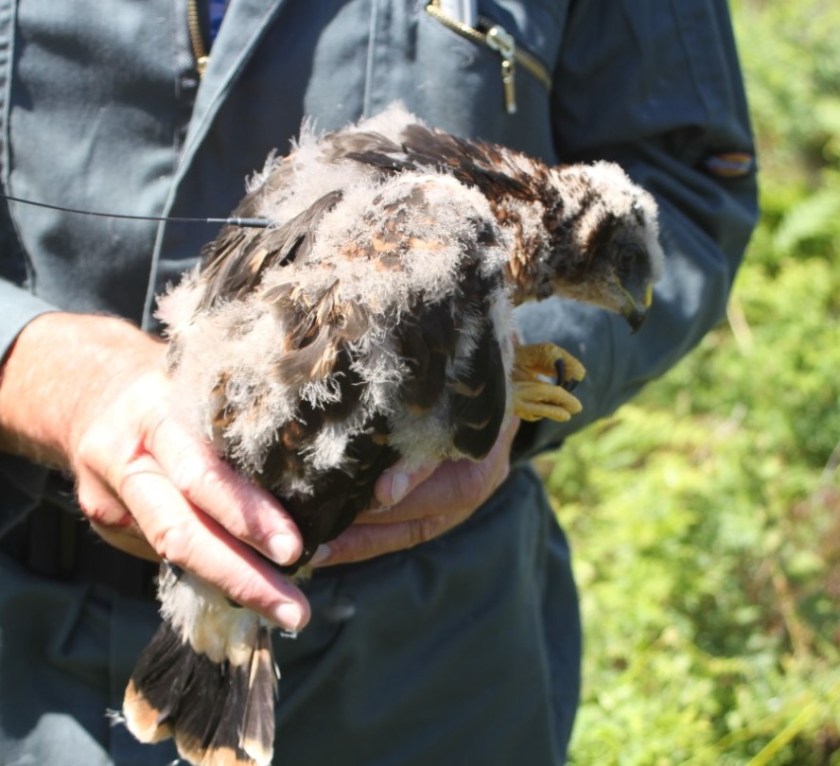
[Photo of hen harrier ‘River’, by RSPB]

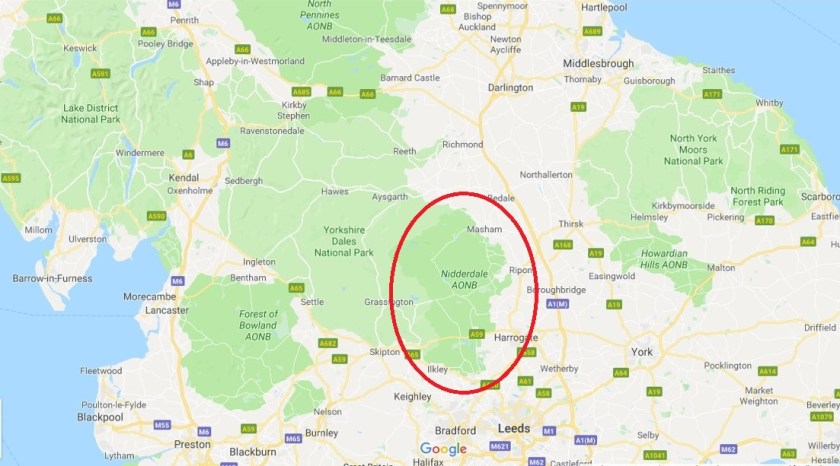
Her tag’s last known transmission came from a driven grouse moor between Colsterdale and Nidderdale – an area with a history of bird of prey persecution – on 14 November. She was known to have been hunting and roosting in the area for several weeks. RSPB Investigations staff and North Yorkshire Police searched the area, but there was no sign of the bird or the tag. She has not been heard from since.

[Google map showing location of Nidderdale Area of Outstanding Natural Beauty (AONB) in North Yorkshire]

All birds of prey are protected by the Wildlife and Countryside Act 1981. To kill or injure one is a criminal offence and could result in an unlimited fine or up to six months in jail. North Yorkshire Police investigated the disappearance, but no information has been forthcoming.

Hen harriers are rare birds which nest in moorland, especially in the uplands of Northern England and Scotland. However just nine nests were recorded in England last year, despite enough prey and habitat to support over 300 pairs. They have not successfully bred in North Yorkshire since 2007.

Over 30 hen harriers were tagged last summer in the UK. Between August and November 2018, nine of these, including a 10th bird tagged in 2017, disappeared at different locations in the UK.

Mark Thomas, Head of RSPB Investigations UK, said: “Again we have news of a disappeared harrier, again in North Yorkshire, and again last known to be on a grouse moor. Hen harriers are barely clinging on as a breeding species in England. They should be a common and joyful sight over the moorlands of North Yorkshire, however the reality is most people only know them as being rare and persecuted.

The idea that this bird may have been deliberately targeted is incredibly worrying, especially in the context of eight others which have vanished in similar circumstances. When a tagged hen harrier dies naturally, we expect the tag to continue transmitting, enabling us to find the body. This was not the case here. Instead, there was no trace of the tag or the bird, which is highly suspicious. When hen harriers disappear like this over an area with a history of raptor persecution, it’s hard not to draw conclusions.”

The RSPB’s latest Birdcrime report showed that North Yorkshire is consistently the worst county in the UK for recorded bird of prey persecution, accumulating significantly more confirmed incidents in the last five years than anywhere else. In 2012, hen harrier ‘Bowland Betty’ was found shot at nearby Colsterdale. A reward was offered but no culprit was identified.

If you have any information relating to this incident, call North Yorkshire Police on 101.

If you know about raptor persecution occurring in your area and wish to speak out in confidence, call the confidential Raptor Crime Hotline on 0300 999 0101.

If you find a wild bird of prey which you suspect has been illegally killed, contact RSPB Investigations on 01767 680551 or fill in the online form here.

ENDS

So, yet another young sat-tagged hen harrier ‘disappears’ in suspicious circumstances on a grouse moor in North Yorkshire. It’s becoming quite the routine, isn’t it?

Here’s an RPUK map showing the approximate last known locations of at least ten satellite-tagged hen harriers that have all ‘disappeared’ in suspicious circumstances inside the Nidderdale AONB (yellow boundary) or neighbouring Yorkshire Dales National Park in recent years. The red triangle represents River’s approximate last known location and the red star represents Bowland Betty, the hen harrier that was found shot here in 2012:

Interestingly, Bowland Betty’s shot corpse was found on a grouse moor on Swinton Estate and it appears that River’s last known tag transmission was from close by.

RPUK map showing approximate last known location of hen harrier River (red triangle) and the approximate location of Bowland Betty’s shot corpse (red star):

And as anyone who has been reading this blog for any length of time will know, Nidderdale AONB is also known as being a hotspot for the illegal killing of red kites. Many of them have been found shot or poisoned on or close to grouse moors throughout Nidderdale (see map below) and those doing the killing are so brazen they don’t even bother to hide the corpses, safe in the knowledge they’ll never be prosecuted.

[RPUK map: Nidderdale AONB = yellow boundary. Illegally killed red kites = red circles; sat-tagged hen harriers that have vanished in suspicious circumstances = orange stars & red triangle; illegally shot hen harrier Bowland Betty = red star]

When you look at these maps, and especially the one that combines hen harriers and red kites, you understand the relentless criminality involved and the impact these crimes can have on local, regional and sometimes national populations of some species.

And yet still, the Westminster Government refuses to acknowledge there’s even a problem, let alone the scale of it.

This year we’re encouraging blog readers to write to/email your local MP every time one of these crimes is reported. If you live in the local area, even better, but even if you live hundreds of miles away, please still take action. These are birds that you will not have the opportunity to see in your area because they’ve been ruthlessly slaughtered, usually on or close to a driven grouse moor. This is a matter of national concern but politicians won’t take notice unless their constituents raise the issue with them.

Do it, it’s easy and will take up little of your time. Just a quick and simple email is enough.

If you don’t know who your MP is, use this website to find them via your postcode HERE

Thanks