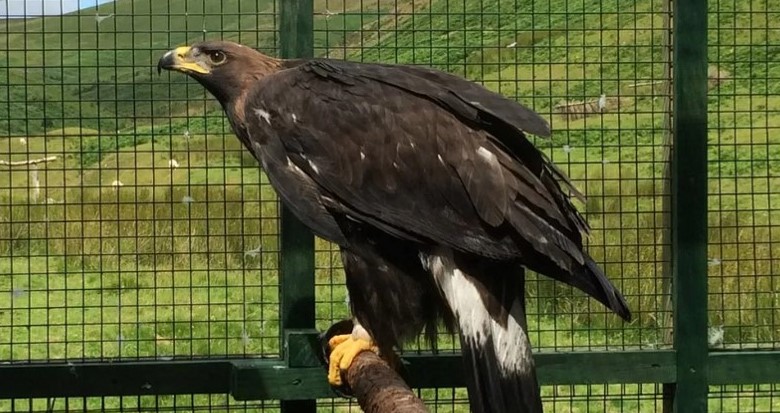
In February this year, prominent falconer and eagle breeder Andrew Knowles Brown from Elvanfoot, Scotland was cleared of all charges at Lanark Sheriff Court in relation to the alleged mistreatment of ten imported White-bellied sea eagles at the Scottish Eagle Centre (see here).
That case was the first of two. For reasons that are unclear to me, charges relating to the welfare of another 90 eagles (here) were split into a second trial, which is now underway.
Andrew Knowles Brown and his associate, Alan Rothery, are alleged to have kept the eagles in enclosures which were too small, failed to provide the birds with natural light, failed to provide them with adequate water, denied them the ability to exhibit natural behaviours such as flying and bathing, and failed to protect the birds from injury, suffering and disease, between June-December 2019. Both have denied the charges.
The Scottish SSPCA started giving evidence at Lanark Sheriff Court on 8th June 2023 and will continue at the next hearing scheduled for 10th and 11th August 2023.
Knowles-Brown is a prominent figure in the falconry world, having served as the Chair of the Scottish Hawk Board and Vice-Chair of the UK Hawk Board. The Hawk Board, which includes a representative from the Countryside Alliance, represents falconers, hawk-keepers and falconry clubs and provides welfare guidelines for those keeping raptors in captivity. It also engages in political lobbying (e.g. it was against the Scottish Government’s decision to afford the Mountain Hare full legal protection) and Knowles-Brown himself has provided evidence to the Scottish Parliament’s Rural Affairs Committee when it was considering its draft Protection of Wild Mammals (Scotland) Bill.
As the second court case is live, comments won’t be accepted on this blog until proceedings have concluded. Thanks for your understanding.
UPDATE 22 January 2024: Trial continues in Scotland for falconer charged with welfare offences relating to 90 eagles (here)
UPDATE 15 October 2024: Prominent falconer & eagle breeder Andrew Knowles-Brown guilty of welfare offences relating to approx 90 eagles in Scotland (here)
In February this year it was reported that a young golden eagle, named ‘Sula’, had been found dead on the Queensberry Estate, an estate within the Buccleuch portfolio in Dumfriesshire (see here).
She was from the South Scotland Golden Eagle Project, where eagles are being translocated from other Scottish regions in an effort to boost the declining population in the south. Sula had been translocated in 2022.
Photo: South Scotland Golden Eagle Project
The Veterinary Investigation Centre at Scotland’s Rural College (SRUC) in Dumfries conducted a variety of tests (toxicology, histopathology, virology, bacteriology and parasitology) and have now reported that the investigation did not find a definitive cause of death, but did conclude that Sula had been in “very fit condition” before her death. Avian flu was ruled out.
The South Scotland Golden Eagle Project website can be found here.
The Cairngorms National Park Authority (CNPA) is advertising a three-year, full time position for a Raptor Conservation Officer, to deliver the actions laid out in the National Park’s latest Partnership Plan (2022-2027) aimed at increasing the home range, occupation and breeding success of golden eagle, hen harrier, merlin and peregrine across the National Park.
This is a promising move by the CNPA, who have previously faced severe criticism for not dealing effectively with ongoing raptor persecution in some areas of the Park, notably on land that’s managed for intensive driven grouse shooting (e.g. see here & here).
Crimes against birds of prey, especially those that take place within the Cairngorms National Park, are often high profile, and quite rightly so. For example the recent poisoning of a golden eagle on a grouse moor within the Park (here) and the poisoning of a white-tailed eagle on another grouse moor within the Park (here) generated widespread outrage and media coverage, as did the sighting of a young golden eagle flying around a grouse moor in the Park with a spring trap clamped to its leg/foot (here).
Last year, the CNPA stated its intention to address intensive gamebird management within the Park as part of its Partnership Plan (here), which was seen as a good move by many of us who know that raptor persecution is disproportionately associated with land managed for gamebird shooting. That, combined with the creation of this new Raptor Conservation Officer post, is indicative of things moving in the right direction.
Make no mistake though, this new post will be a challenging one. There are some fantastic estates in the Cairngorms National Park who have been hosting and protecting breeding raptors (e.g. golden eagles, white-tailed eagles, hen harriers) for some time now, but there are also other estates that stubbornly refuse to tolerate these species and still behave as though it’s the 1890s.
The post is full time for three years, attracting a salary between £33,652 – £40,362. The closing date for applications is Sunday 30th April at 23.59hrs.
A detailed job description and list of essential attributes is provided here:
Further to this morning’s news that Millden Estate in the Angus Glens has been slapped with a three-year General Licence restriction after evidence was found of raptor persecution crimes (see here), it’s worth examining the background to this case.
Millden is one of a number of grouse-shooting estates situated in the Angus Glens that has featured many, many times on this blog (see here for all Millden posts).
Location of Millden Estate in the Angus Glens. Estate boundaries sourced from Andy Wightman’s Who Owns Scotland website
Millden Estate first came to my attention in July 2009 when a young satellite-tagged golden eagle called Alma was found dead on the moor – she’d ingested the deadly poison Carbofuran (here). It wasn’t clear where she’d been poisoned and the estate denied responsibility.
Then in 2012 there was the case of another satellite-tagged golden eagle, believed to have been caught in a spring trap on Millden Estate before moving, mysteriously, several km north during the night-time only to be found dead in a layby with two broken legs a few days later (here and here). The estate denied responsibility and the Scottish Gamekeepers Association conducted an ‘analysis’ (cough) and deduced it was all just a terrible accident (here).
There have been other incidents – former Tayside Police Wildlife Crime Officer Alan Stewart describes ‘a horrendous catalogue of criminality’ recorded on Millden Estate during his time (see here). However, despite this history, nobody has ever been prosecuted for raptor persecution crimes on Millden Estate.
Today’s announcement from NatureScot that a General Licence restriction has been imposed on Millden Estate is the first sanction I’m aware of at this location. It has been imposed after three shot buzzards were found in bags outside two gamekeeper’s cottages during an SSPCA-led investigation into badger-baiting and other animal-fighting offences in 2019.
That investigation led to the successful conviction in May 2022 of depraved Millden Estate gamekeeper Rhys Davies for his involvement in some sickening animal cruelty crimes (see here). Despite his conviction, Millden Estate denied all knowledge of this employee’s criminal activities (here).
There hasn’t been a prosecution for the shooting (or possession) of those three shot buzzards, nor for the six other shot raptors found in a bag just a short distance from the Millden Estate boundary (here), and nor will there be, according to a statement provided to me by the Crown Office (here).
With this long history of un-attributable wildlife crime on and close to Millden Estate, the imposition of a General Licence restriction is welcome news, although in real terms it’s nothing more than a minor inconvenience to the estate. It doesn’t stop their legal killing of so-called pest species (e.g. crows) because all they have to do is apply for an Individual licence, which NatureScot will have to grant (although it can revoke an Individual licence if more evidence of crime emerges – as happened on Raeshaw Estate in 2017 – see here), and nor does it stop the legal killing of red grouse, pheasants or red-legged partridge by paying guests.
This photograph appeared on social media in 2017 titled ‘Team Millden’ and shows a bunch of blokes dressed in Millden tweed grinning inside the estate’s larder after a day’s grouse shooting.
I’ve written about the monumental ineffectiveness of General Licence restrictions many times (e.g. see here, here, here, here, here) and my view hasn’t changed. The only weight that a General Licence restriction carries is a reputational hit for the estate on which it is imposed, which was the Environment Minister’s aim when GL restrictions were first mooted (here).
This is useful from a campaigner’s perspective because it allows us to demonstrate that raptor persecution continues on Scottish grouse moors, despite the absurd denials of senior industry representatives (e.g. see here).
But it doesn’t stop the estate’s business activities. You might think that others in the industry, or even elected politicians, would shun a restricted estate but that simply doesn’t happen (e.g. see here and here).
And nor is it an effective deterrent – Leadhills Estate, a grouse moor in South Lanarkshire, was slapped with a second General Licence restriction after ‘clear evidence’ of wildlife crime was uncovered whilst the estate was still serving its first restriction notice (see here)!
Given the current number of grouse-shooting estates serving General Licence restrictions after ‘clear evidence’ of wildlife crime was provided by Police Scotland: Leadhills Estate (here), Lochan Estate (here), Leadhills Estate [again] (here), Invercauld Estate (here), Moy Estate (here) and now Millden Estate (here), it’s clear that the Scottish Government’s proposed grouse-shoot licensing scheme can’t come soon enough.
There are strong rumours that the Wildlife Management (Grouse) Bill will be presented to the Scottish Parliament before Easter and many of us are eagerly awaiting its publication to see the details of what is proposed and, importantly, how it will be enforced.
One thing’s for sure, it will need to be a lot more robust than the General Licence restriction and any sanctions, which should hopefully include terminating an estate’s ability to continue gamebird shooting during a determined-sanction period, will need to be deployed a lot quicker than the time it takes for a General Licence restriction to be imposed (it’s taken four years for the GL restriction to be placed on Millden Estate).
UPDATE 10th March 2023: Millden Estate says it will appeal General Licence restriction imposed after evidence of raptor persecution (here)
Yesterday, the BBC News website ran a story about the discovery of a dead golden eagle on the Queensberry Estate, an estate within the Buccleuch portfolio in Dumfriesshire.
The eagle had reportedly been discovered on Saturday and is believed to have been one of the young eagles from the South Scotland Golden Eagle Project, where eagles are being translocated from other Scottish regions in an effort to boost the declining population in the south.
Tests are currently underway to establish the cause of death.
It looks to me like this BBC News article was prompted by a press release from Buccleuch and is probably an attempt by the estate to undertake a damage limitation exercise and ‘get its story out first’ before the cause of death has been determined, just in case it turns out to be yet another persecution incident reported in this area. If it turns out that the eagle has died of natural causes then the estate has had a bit of free, positive publicity. It’s win/win for them.
However, if this eagle does turn out to have been killed illegally, the BBC News report will have already alerted the person(s) who killed the eagle that the corpse has been recovered and the authorities are investigating, which provides the culprit(s) every opportunity to hide/destroy any evidence linking them to the crime. Not the brightest move.
The premature release of this news also smacks of hypocrisy. Last year, the Scottish Gamekeepers Association (SGA) went into hysterical meltdown after Police Scotland issued an appeal for information about the discovery of a dead golden eagle on a grouse moor in Strathbraan, because the appeal was issued prior to a post mortem being undertaken (i.e. the cause of death was unknown) and the SGA claimed the appeal was ‘insensitive’ and had caused ’emotional distress’ (see here and here).
Will we see the SGA complaining about a premature press release from Buccleuch? No, thought not.
UPDATE 29th April 2023: ‘No definitive case of death’ for golden eagle found dead on Scottish grouse moor (here)
Back in September, Scottish Environment Minister Mairi McAllan was taken to visit a grouse moor in the notorious Strathbraan area of Perthshire.
Regular blog readers will know that Strathbraan is dominated by a number of estates with driven grouse moors and the area has been identified in a Government-commissioned report as being a hotspot for raptor persecution, particularly golden eagles, of which at least seven have ‘disappeared’ in recent years, including one whose tag was found a few years later, wrapped in lead sheeting (to block the signal) and dumped in the river (here).
[Utterly depressing intensively-managed grouse moor in Strathbraan. Photo by Ruth Tingay]
And then there was the suspicious disappearance of a white-tailed eagle (here), an illegally-trapped hen harrier called Rannoch (here), the suspicious disappearance of a hen harrier called Heather (here), the illegally shot peregrine (here), the long-eared owl held illegally in a trap (here), the ~100 corvids found dumped in a loch (here), the failed raven cull demanded by Strathbraan gamekeepers but thinly-disguised as something else (here), the subsequent illegal shooting of two ravens on two separate grouse moors in Strathbraan, the post mortem of one of them showing that not only had it been shot, it had most likely been stamped on repeatedly (here), and most recently the three-year General Licence restriction imposed on a Strathbraan grouse-shooting estate for wildlife crimes (here), a decision based on evidence provided by Police Scotland.
It’s quite the location, isn’t it? How odd then, that Scotland’s Moorland Forum would chose to take the Environment Minister for a visit. What was the purpose?
Judging by this tweet from Hugh Raven, it was to show the Minister ‘the skilled moorland management‘ at Auchnafree Estate, among ‘the beautiful Perthshire hills‘. Good grief.
I wonder if they talked about the ongoing raptor persecution in the Strathbraan area? And did they discuss the suspicious disappearance of the two satellite-tagged golden eagles, Adam & Charlie, who both vanished without trace on Auchnafree Estate on 18th April 2019?
When challenged about the visit on Twitter by the Scottish Raptor Study Group, Hugh claimed the estate had been “fully exonerated“:
The ‘skilled moorland management’ at Auchnafree Estate was in focus again this morning on the BBC’s Farming Today radio programme. The head gamekeeper was recorded talking about the so-called benefits of grouse moor management on the estate; an opinion that went unchallenged by the BBC presenter accompanying him on the moor.
Funnily enough, I didn’t hear any discussion about illegal raptor persecution on the grouse moors of Strathbraan nor any mention of our two missing golden eagles on Auchnafree Estate.
Fortunately, Max Wiszniewski (Campaign Manager at REVIVE, the coalition for grouse moor reform) was invited on to the second part of the programme and spoke well about the economic, environmental and societal limitations and damage of grouse moor management. Well done, Max!
The programme is available to listen to for 29 days here (starts at 06:15 mins).
RSPB Scotland, co-sponsored by NatureScot, hosted the annual Nature of Scotland Awards on Thursday evening, giving recognition to some of the best people working in nature conservation in Scotland.
HUGE congratulations to Scottish Raptor Study Group member Dave Anderson, who deservedly scooped the RSPB Species Champion Award!
This award is ‘to recognise someone who has achieved something extraordinary to conserve a vulnerable or threatened species‘. If you know anything about raptor research and conservation in Scotland, you’ll have heard of the legendary Dave Anderson.
His citation reads:
‘For over 40 years Dave Anderson has worked at the forefront of birds of prey conservation in Scotland, pioneering new methods to study these much-loved species. His outstanding field skills, determination and sheer force of will have cemented him as one of Scotland’s best birds of prey field workers‘.
He’s all that, and more. There are some outstanding raptor fieldworkers in Scotland whose years of field study have made them accomplished species-specific experts, but very few can match the breadth and depth of Dave’s expertise on so many different raptor species. He’s been involved with so many projects over the years that are frankly too numerous to mention, working in challenging environments in atrocious weather conditions that would defeat even the hardiest of fieldworkers. As well as conducting his own research, he’s always been generous with his time, offering first-class training, advice and support to others, particularly to students and fellow Raptor Study Group members.
His trail camera work has led numerous TV production companies to seek out Dave’s help and his footage has been seen by millions on programmes such as the BBC’s Springwatch, Autumnwatch and Winterwatch, amongst others.
In recent years he’s been at the forefront of satellite-tagging raptors, particularly golden eagles but other species too, using his vast experience of ringing and handling raptors to help refine and improve the tagging techniques and strict protocols that are quite rightly demanded by the licensing authorities to ensure the welfare of the birds. His expertise in this field has led to Dave being appointed as a consultant on numerous, high profile conservation projects, including several overseas projects.
[Dave satellite-tagging a young golden eagle. Photo by Jeremy Sutton-Hibbert]
The data that have been made available from the tags that Dave and a few other experts have fitted to golden eagles in Scotland has transformed our understanding of this species. Or to put it more bluntly, exposed just how little we actually knew. The tag data continue to challenge our long-held theories about the ecology of golden eagles, and this is what I like the most about Dave Anderson – he’s one of just a handful of people who have studied this species in depth for decades and probably knows more than most, and yet he doesn’t brag or blag – he’s still open to learning and embraces new technology and the information it provides with the sole purpose of wanting to help conserve the species.
Of course, his work has brought him to the attention of the raptor-killing gamekeepers who have sought to discredit and smear his reputation with the most appalling and vile online abuse, including attacks on his young family. Dave’s reputation speaks for itself though, and it has been pleasing to see him called as an expert witness in a number of prosecution cases, helping to secure the convictions of these nasty criminals.
I’m sure they’ll be thrilled that his work has now been recognised with this richly-deserved national award. Well done, Dave, long overdue!
Today, the Scottish Government has launched a public consultation as the start of its commitment to introduce a licensing scheme for grouse moor management, following the publication of the Werritty Review in 2019, which was commissioned in 2017 after unequivocal evidence was published of the on-going illegal killing of golden eagles on some Scottish grouse moors.
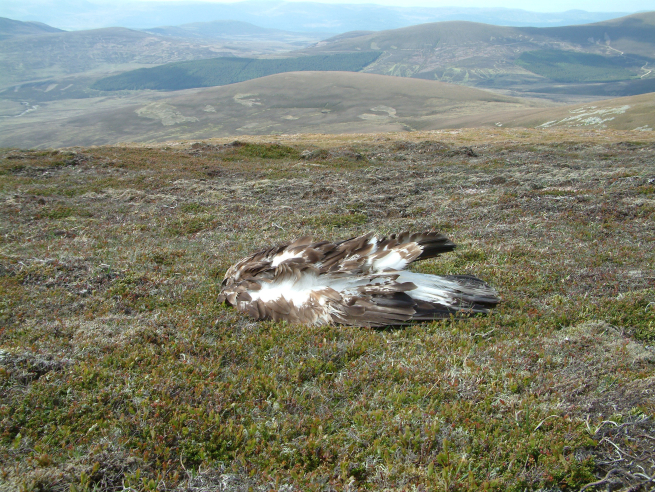
That illegal killing continues, as evidenced by this young golden eagle recently found poisoned on a grouse moor in the Cairngorms National Park laying next to a dead mountain hare that had been used as the poisoned bait (photo by RSPB Scotland).
As is so often the case, nobody has been charged or prosecuted for this hideous wildlife crime, which is a fundamental reason why the Govt is introducing a licencing scheme, presumably as a means of sanctioning an estate (by withdrawing its licence) when evidence of wildlife crime is discovered. Without knowing the exact details of how the licensing scheme will operate, it’s impossible at this stage to predict its effectiveness. There are many sceptics, and I’m one of them, but I’m also certain that the status quo is untenable and so I view licensing as a step in the right direction, but definitely not the end of the road.
The Government’s licensing consultation preamble reads as follows:
‘A Stronger & More Resilient Scotland: The Programme for Government 2022-23 which was published on the 8 September 2022 committed to introducing the following Bill:
Wildlife Management (Grouse)
The Bill will implement the recommendations of the Werritty Reviewand introduce licensing for grouse moor management to ensure that the management of driven grouse moors and related activities is undertaken in an environmentally sustainable manner. The Bill will also include provisions to ban glue traps.
In November 2020, the Scottish Government published its response to the recommendations made by the Grouse Moor Management Group (“Werritty review”). That report was commissioned by the Scottish Government in response to a report from NatureScot (formerly Scottish Natural Heritage), published in May 2017, which found that around a third of satellite-tagged golden eagles in Scotland disappeared in suspicious circumstances, on or around grouse moors.
The Werritty review made over 40 recommendations regarding grouse moor management. The recommendations, which were accepted by the Scottish Government, seek to address raptor persecution and ensure that the management of grouse moors is undertaken in an environmentally sustainable manner.
As well as proposals relating to grouse moor management, this consultation also considers glue traps. A report from the Scottish Animal Welfare Commission, published on 23 March 2021 stated that
‘……the animal welfare issues connected with the use of glue traps would justify an immediate outright ban on their sale and use. This is our preferred recommendation‘.
This consultation is therefore seeking your views on the Scottish Government’s proposals on:
*Grouse moor licensing
*Muirburn
*Trapping (wildlife traps, glue traps, snares)
You can complete all the sections in the consultation or only those sections which are of interest/relevance to you’.
ENDS
The Government’s proposals for its grouse moor licensing scheme are laid out here:
I haven’t yet looked at the consultation paper so I can’t offer any comments or suggested responses yet but I will do very soon. The consultation will close on 14th December 2022.
The link to the consultation questionnaire can be found HERE.
UPDATE 26th October 2022: REVIVE coalition cautiously welcomes Scot Gov’s consultation on grouse moor licensing (here)
UPDATE 27th October 2022: Grouse shooting lobby quietly seething over proposed licensing scheme (here)
UPDATE 10th December 2022: Last chance to have your say on Scottish Government’s consultation on grouse moor reform (here)
In the last blog post where I wrote about the nine shot birds of prey found wrapped in bags on Millden Estate and just over the estate boundary, I included a quote from Tim Baynes of Scottish Land & Estates, who had written the following in a comment piece for The Field, published in August 2022:
“Raptor persecution has been the stick with which grouse moors were beaten for two decades, but the past five years have seen a sea change. In Scotland, recorded crimes have effectively ceased on grouse moors, and raptors of all species have been increasing“.
I said I’d publish his outrageous comment piece in full, so here it is:
I really shouldn’t be surprised that The Field published this nonsense – that particular shooting industry rag has a track record of publishing patently inaccurate comment pieces (e.g. see here).
And I’m definitely not surprised that the author of this latest gibberish is Tim Baynes – his lengthy track record speaks for itself (for a small selection of the masses of examples see here, here, here, here, here, here, here, here).
Needless to say, his latest claim that raptor persecution on Scottish grouse moors has “effectively ceased” is demonstrably untrue. You’ve only got to read my last blog post to understand this. If that doesn’t convince you, have a look at the General Licence restrictions currently imposed on grouse moor estates after Police Scotland found ‘clear evidence of raptor persecution’ – Leadhills Estate (here), Lochan Estate (here), Leadhills Estate [again] (here), Invercauld Estate (here), and Moy Estate (here).
And if you still need convincing, have a read of the Scottish Government’s Environment Minister’s statement in 2020 when she announced that there could be no further delay to the introduction of a grouse moor licensing scheme because:
“…despite our many attempts to address this issue, every year birds of prey continue to be killed or disappear in suspicious circumstances on or around grouse moors“.
Perhaps Tim Baynes’ perpetual denial of the bleedin’ obvious explains why he is no longer employed as ‘Director of Moorland’ at Scottish Land & Estates:
RSPB Scotland has published a blog today calling for ‘action and delivery’ from the Scottish Government on its promised grouse moor licensing scheme.
The Government announced in November 2020 that grouse shooting businesses in Scotland will need to be licensed to operate, under new proposals to tackle raptor persecution.
It also announced that muirburn will also only be permitted under licence, in order to protect wildlife and habitats, regardless of the time of year it is undertaken and whether or not it is for grouse moor management or improving grazing.
The Government stated there will also be a statutory ban on burning on peatland, except under licence for strictly limited purposes, such as approved habitat restoration projects.
Since that announcement in November 2020, there hasn’t been any further action, but there has been plenty more evidence of illegal raptor persecution, including the poisoning of this golden eagle on a grouse moor at Invercauld Estate in the Cairngorms National Park:
RSPB Scotland writes:
“We have been very patient, but nearly 20 months on from this announcement, we want to see some action and delivery on these promises by the Scottish Government. Proposals must be brought forward in the forthcoming Programme for Government in autumn 2022 for the introduction of grouse moor and muirburn licensing legislation in the next Parliamentary year“.