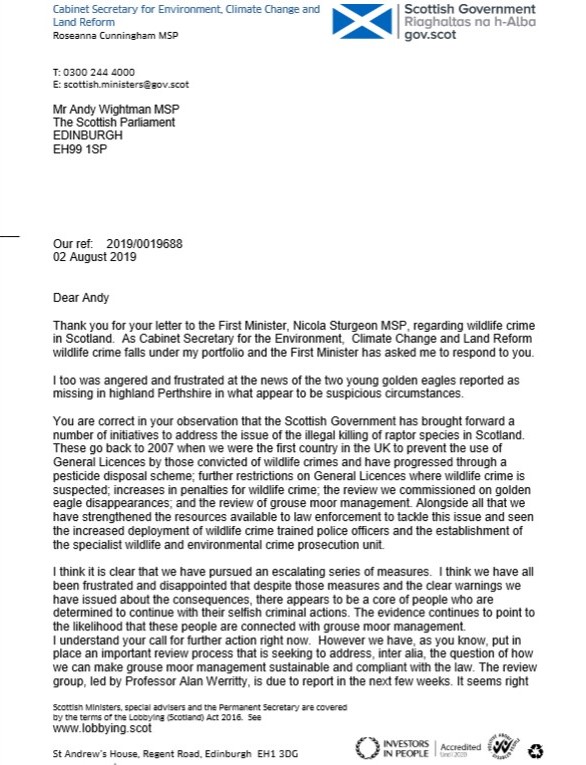
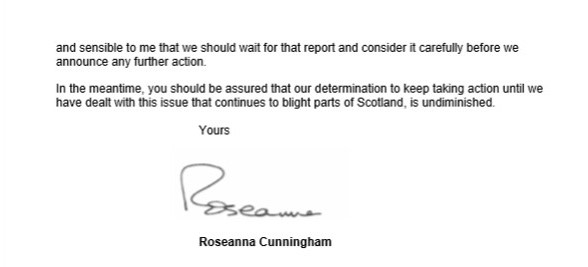
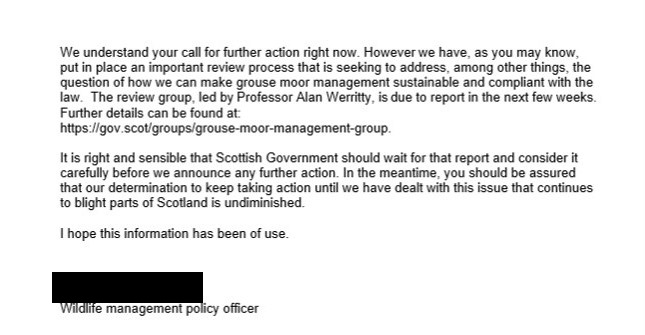
Is Scottish Government’s silence an indication of indifference to illegal raptor persecution?

In the last week there have been two big news stories about the illegal persecution of birds of prey in Scotland.

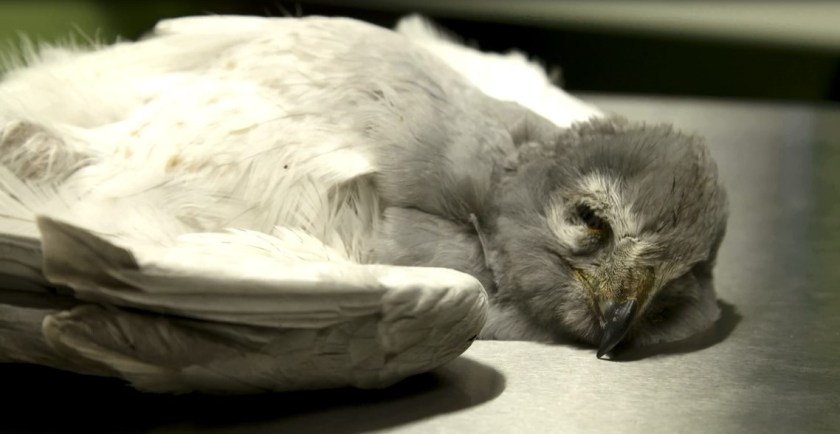
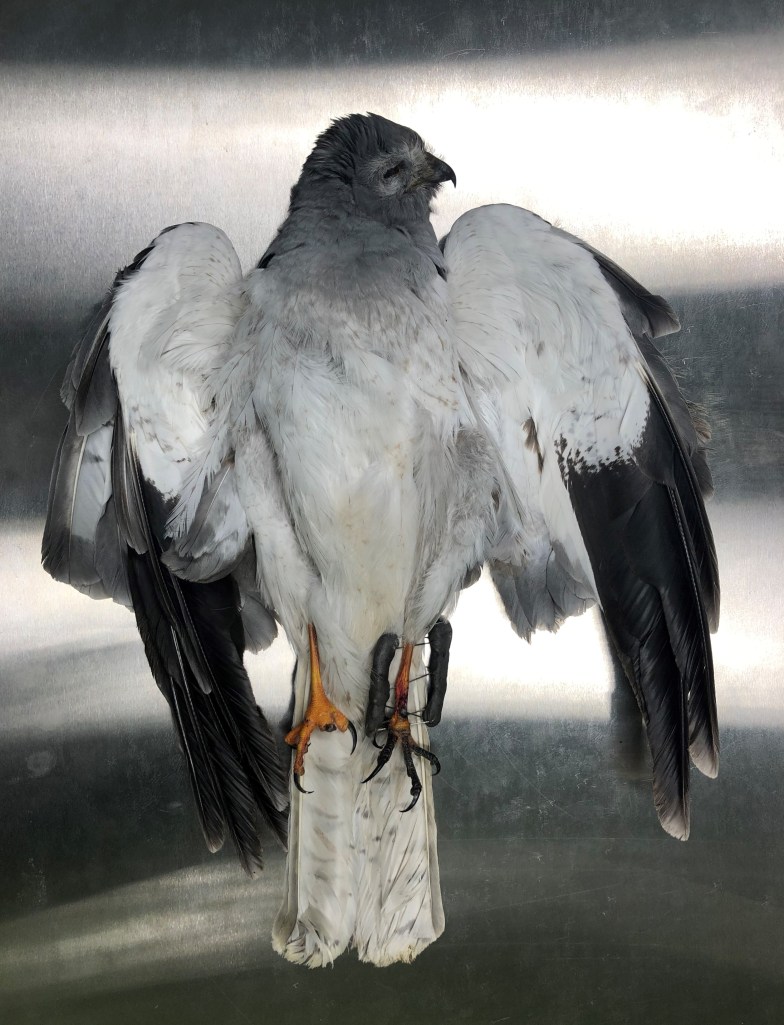
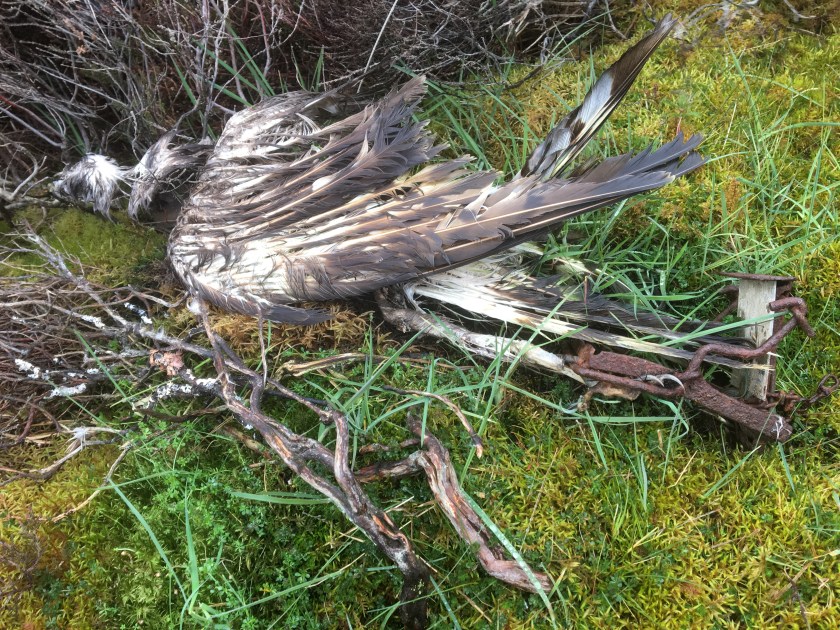
The first was the news that a satellite-tagged hen harrier called Rannoch was found dead on a grouse moor in the Strathbraan raven cull area of Perthshire, with an illegally-set spring trap attached to her leg (see here).

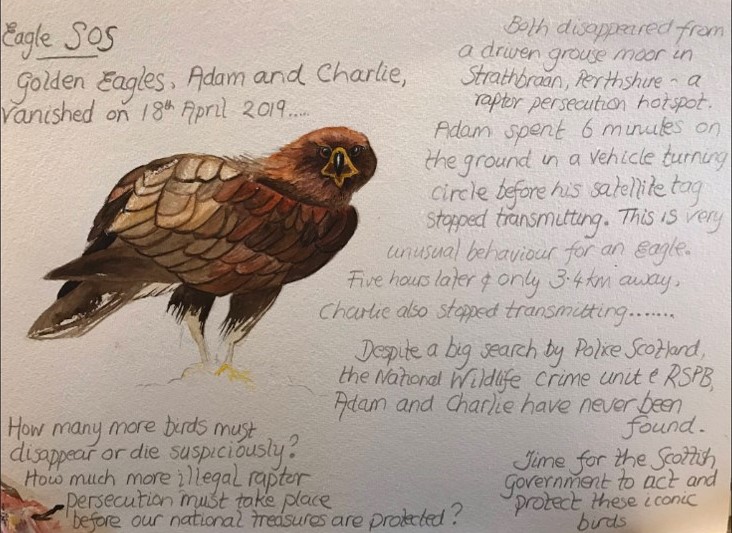
The second was the news of the suspicious disappearance (presumed dead) of satellite-tagged golden eagles Adam and Charlie, who vanished without explanation on the same morning from another grouse moor in the Strathbraan raven cull area (see here).

Both of these news items received massive media interest and coverage, particularly the two missing golden eagles. It was all over social media, mainstream newspapers and websites, radio shows and even a slot on ITN’s News at Ten.

The general public responded to these stories as any decent human being would – with disgust, horror and in some cases, shock that this sort of criminality, both suspected and confirmed, continues within our supposedly progressive society.

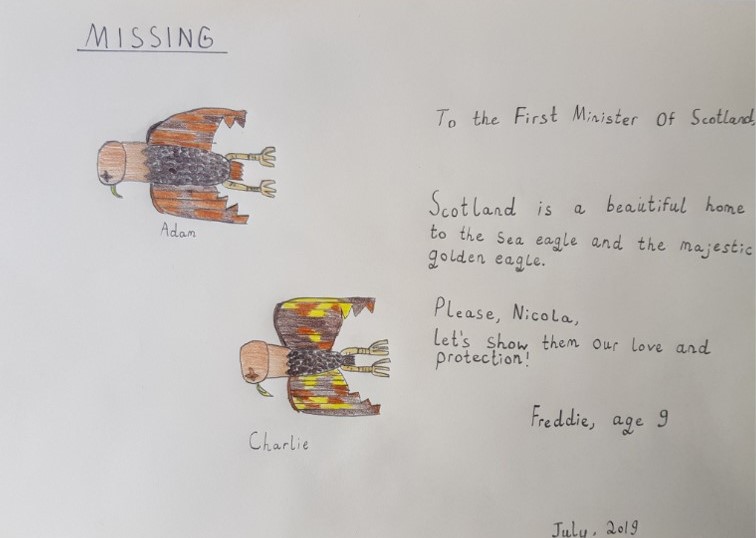
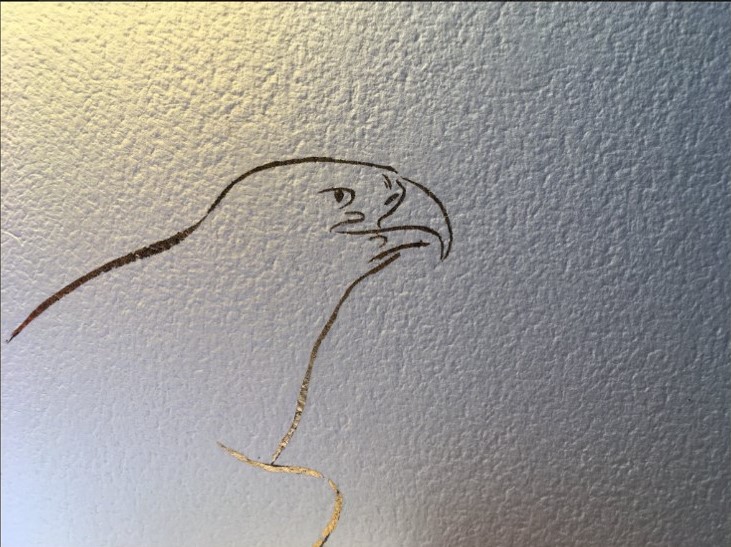
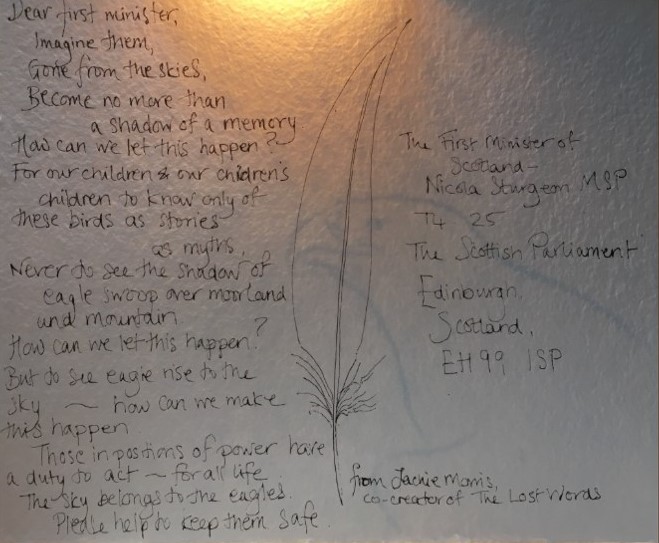
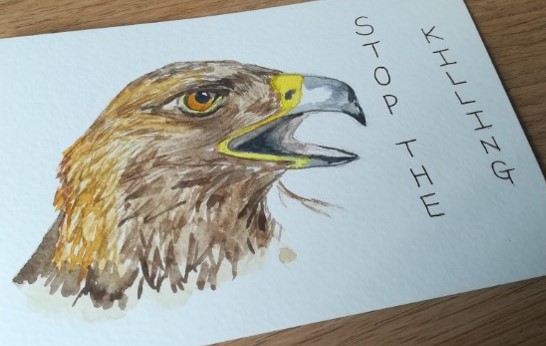
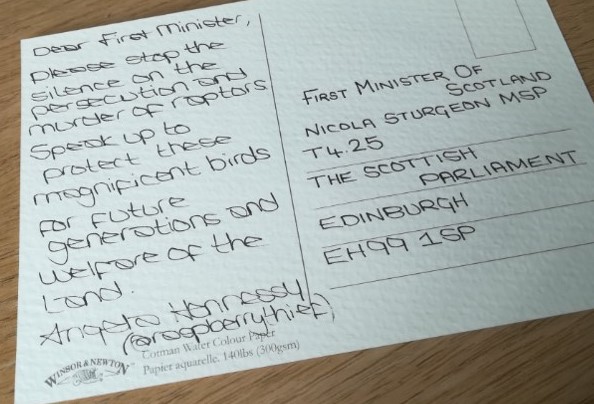
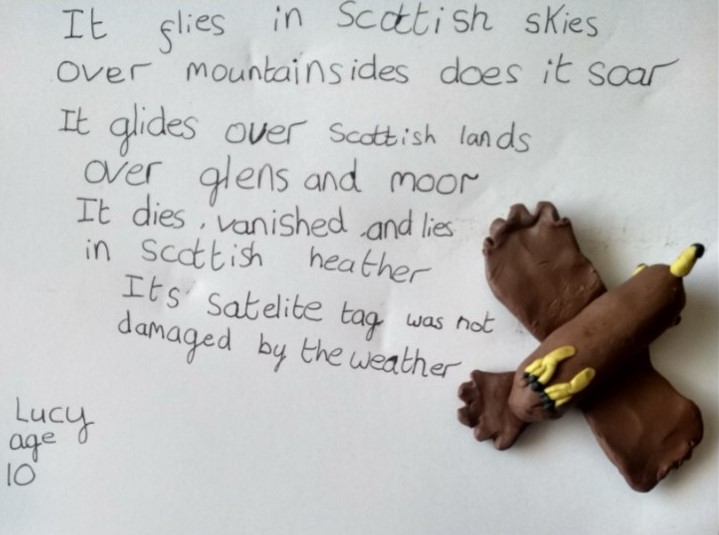
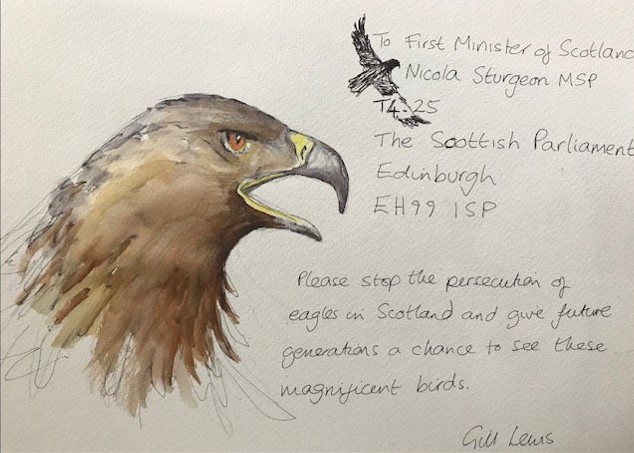
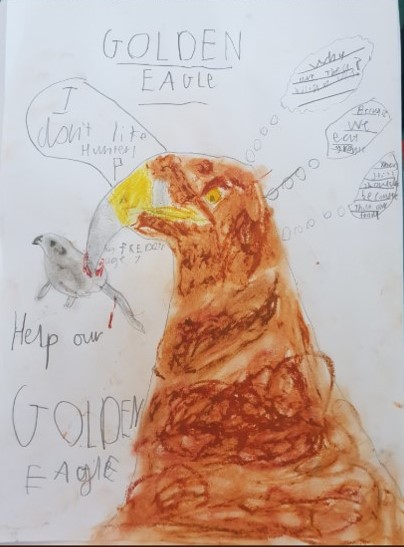
Young kids (and some adults) were sufficiently motivated to draw pictures of eagles, write poetry and even create clay models of dead eagles to send to First Minister Nicola Sturgeon:

We know that many others have been sufficiently angered by the news that they’ve been motivated to follow MSP Andy Wightman’s lead and write to the First Minister, urging her to take action (firstminister@gov.scot).

How come then, with this outpouring of public anger, senior politicians in the Scottish Government, who all routinely use Twitter to engage about their work, have failed to say a single word about either case?

The First Minister, Nicola Sturgeon, has been silent.

The Environment Cabinet Secretary, Roseanna Cunningham, has been silent.

The Minister for Rural Affairs and the Natural Environment, Mairi Gougeon, has been silent.

What’s going on there, then? Should we interpret their collective silence as indifference? That seems pretty unlikely, given that all three politicians have spoken out strongly, passionately and convincingly in the recent past about illegal raptor persecution and their determination to bring it to an end.

So why haven’t they this time? Even the official Twitter channel of the Scottish Government covering the environment and rural economy (@GreenerScotland) has been silent. There was one quote about the two missing eagles, widely used in the media from an unnamed Government spokesman, which simply said:

The disappearance of any bird of prey in suspicious circumstances is of concern and we would urge anyone with information to contact Police Scotland. ‘We are determined to protect birds of prey and have established an independent group to look at how we can ensure grouse moor management is sustainable and complies with the law“.

This was clearly a bog standard response to enquiries from journalists as we could find no formal statement on the Scottish Government’s website. We didn’t find any statement about the illegally-trapped dead hen harrier either.

It seems remarkable that a wide section of society, young and old, has expressed outrage on many different media platforms over the last week, and yet the three politicians who are key to making progress on this issue, have seemingly suppressed what we’d expect to be the normal human reaction to this news (i.e. expressions of anger, horror, determination for change etc) and instead appear to be toe-ing a party political line by saying absolutely nothing. At all.

The Government’s silence is deeply concerning.

Is it, we wonder, part of a strategy to manage expectations on the forthcoming Werritty Review? Will the Werritty Review fall short of expectations? Remember, Werritty was commissioned on the back of a Government-commissioned scientific review that showed satellite-tagged golden eagles were undoubtedly being killed on some Scottish grouse moors. We all expect Werritty’s review to address this issue head on and propose some tangible, meaningful actions to finally get these crimes under control. Are we going to be disappointed? (Expect an almighty firestorm if that is the case).

Why else might the Scottish Government remain silent, on such a high-profile and topical issue? This silence is the sort of response we’ve come to expect from Environment ministers in Westminster, who have shown nothing but wilful blindness to the extent of raptor persecution crimes in England for decades. This silence is not something we expect from the Scottish Government.

It’s worth remembering that the Scottish Parliament has just celebrated its 20th anniversary. Twenty years ago, when the Parliament was established, the then Secretary of State Donald Dewar described illegal raptor persecution in Scotland as “a national disgrace”. He also said:

Although we are all aware of individual incidents of wildlife crime in Scotland, such as theft of eggs and shooting and poisoning of birds of prey, it is less well known that illegal persecution of some species, rather than the lack of suitable habitat, is the reason why in some areas the birds are scarce or non-existent. The government, and no doubt the Scottish Parliament will take all possible steps to eliminate persecution. The government is committed to strengthening protection for wildlife, and in due course the Scottish Parliament will consider proposals from the Partnership Against Wildlife Crime for stronger enforcement measures”.

If you’d like to write to the current First Minister and remind her of the importance of ensuring protection for golden eagles and other birds of prey on the grouse moors of Scotland, please consider sending a polite email to: firstminister@gov.scot

Thank you

[Hen harrier ‘Rannoch’ found dead on a grouse moor with an illegal trap clamped to her leg. Photo RSPB Scotland]

Scottish Gamekeepers Association’s smear campaign re: golden eagle Fred is defamatory shambles

On Monday (1 July), the Scottish Gamekeepers Association (SGA) published a statement on its website in response to the news that golden eagles Adam and Charlie had ‘disappeared’ in suspicious circumstances on a grouse moor in the Strathbraan raven cull area in Perthshire.

It was an astonishingly ill-judged response. It didn’t mention the loss of these two eagles – let alone condemn what looked to be yet another suspicious incident, identical to the loss of so many other sat-tagged eagles on grouse moors. Instead, it focused on the supposed ‘need’ for ‘independent scrutiny’ of satellite tag data (conveniently ignoring the fact that the police now routinely analyse the data of all sat-tagged raptors that have been reported as missing in suspicious circumstances).

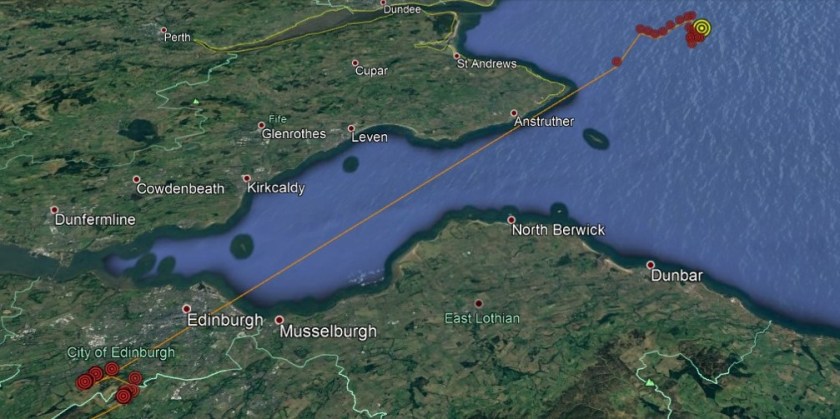
To support its argument, the SGA highlight the disappearance of Fred, one of our sat-tagged golden eagles who vanished from the Pentland Hills just outside Edinburgh in January 2018 and whose tag then sent data from the North Sea, several days later, before finally stopping.

According to the SGA, and some of their clueless members/supporters on social media, we apparently withheld some tag data from Police Scotland. Their ‘evidence’ (ahem) to support this claim seems to be centred on two things:

  1. The fact that two videos were filmed by our team on the same day but published several weeks apart; and
  2. An FoI response from Police Scotland in response to some poorly structured questions.

Here’s part of the SGA’s post on the ‘need’ for independent sat tag monitoring:

And here is a copy of the Freedom of Information response from Police Scotland, also posted on the SGA’s website:

It appears the SGA have even persuaded their ‘legal advisors’ to show this ‘evidence’ to the police.

Good grief. Unsurprisingly, the police haven’t come knocking and here’s why (probably) –

Yes, we did film two videos on the same day, and published them weeks apart. So what? We’ve never tried to deny that, but much has been made of it over the past 18 months, much to our amusement and bemusement. Our time is valuable, our schedules are tight, we had our film crew in place, why not make the most of that situation and film as much as we could in one day, instead of having to organise another filming day sometime later?

What the SGA don’t know is that yes, at that time we had the additional meta data (that showed Fred’s tag pinging against various telephone masts on its route from the Pentlands to the North Sea) but we were still working out what those data actually meant (it’s not the type of data we were familiar with) and we filmed several versions of what we thought the data were showing us at that time. We were still taking advice from a number of independent experts for some weeks afterwards, including the police, and when we were happy that we understood the data and the limitations of the data parameters, that was the version that was published several weeks later, with the full support of the police.

The SGA thinks that Police Scotland received Fred’s tag data from us on 26 January (because that is what is implied in the Police’s FoI response). However, that is absolutely not the case, and is simply a reflection of the poorly constructed FoI question. Fred’s suspicious disappearance was reported to Police Scotland on 26 January, yes, but they did not ask to see Fred’s tag data at that time. Presumably because they had every confidence in us as legitimate, well-regarded researchers not to question our report that Fred’s disappearance was highly suspicious, along with the backing of experienced tag data analysts at RSPB Scotland. Let’s face it – if you look at the map showing Fred’s movements in the Pentlands and then several days later he’s suddenly 10 miles offshore in the North Sea, you don’t need to be a golden eagle expert or to look at raw data to know that something isn’t quite right. The police launched an immediate search in the Pentlands (and, for the record, worked admirably for the duration of this investigation).

The tag data and meta data were eventually requested by Police Scotland during a phone call on 19th February. It wasn’t clear why it was only then that the data were being requested but we suspected pressure was being placed on the police by, let’s call them ‘external forces’. The data request was fine by us. It was agreed that it would be good for us to meet and go through the data together, including the meta data files. The earliest date that was mutually convenient for us all was one week later on Monday 26 February. We met, discussed the data and agreed that it would be better for the police to have a copy of the original raw data files directly from the tag manufacturer, rather than our files, just to avoid any accusations that we may have tampered with the files (unfounded accusations which were, of course, doing the rounds on social media by those seeking to discredit us and to distract attention from the circumstances of Fred’s disappearance – those ‘external forces’ again).

Incidentally, it was at this time that SGA Director Bert Burnett claimed on social media that we’d fabricated the whole incident with Fred (and thus perverted the course of justice), and made another claim that Chris Packham had refused to turn over the tag data to the police. Quite astonishing (and defamatory) accusations based on no evidence whatsoever. Nothing new there, then.

Immediately after our meeting with the police to discuss the tag data we contacted the tag manufacturer, gave permission for our data to be shared with the police, put the two parties in touch with one another and the original raw data files were sent to the police on 1 March (as accurately stated in the police’s FoI response).

Where the SGA’s logic completely falls down is this. Why on earth would we want to withhold evidence (the meta data) from the police, especially when we believed that evidence supported our earlier suspicions that Fred had been killed in the Pentlands and then his tag (and perhaps Fred too) was transported by road to North Berwick and dumped in the North Sea?

Sorry, SGA, your desperate attempts to smear and discredit us can be seen for exactly what they, and you, are. Pathetic.

Next.

Chris Packham responds to Scottish Gamekeepers Association with the contempt they deserve

There has been a massive amount of media coverage on the the suspicious disappearance of two satellite-tagged golden eagles, Adam and Charlie, who vanished from a grouse moor in the Strathbraan raven cull area on the same April morning.

Here’s some of that coverage:

The Guardian

The Times

BBC News

Scotsman

Daily Record

ITV News at Ten

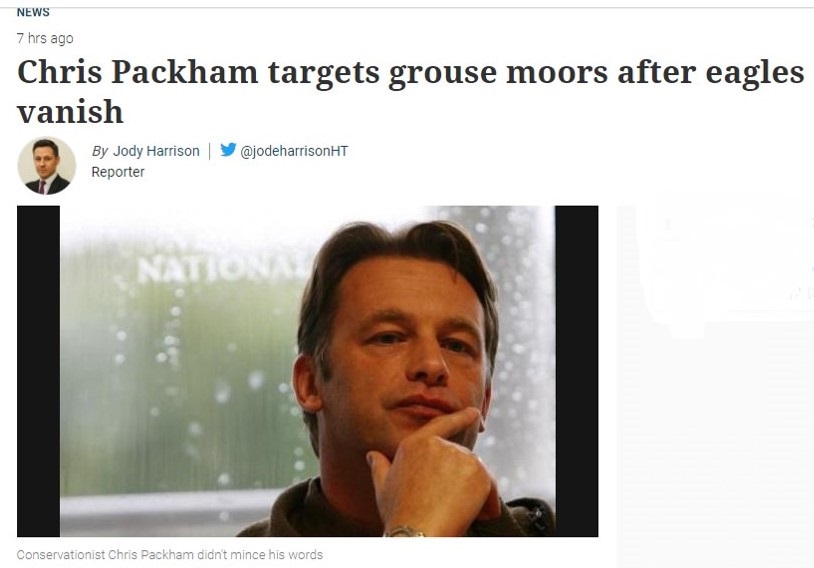
Our favourite one, though, so far, is this one from The Herald:

Journalist Jody Harrison first discusses the disappearances of golden eagles Adam and Charlie, but then moves on to some defensive guff put out yesterday by the Scottish Gamekeepers Association (SGA), who seem to think that satellite-tag data aren’t independently scrutinised by the police in each case of a suspicious disappearance (er, asking for the tag data is the first thing the police do when a sat-tagged raptor is reported as missing under suspicious circumstances).

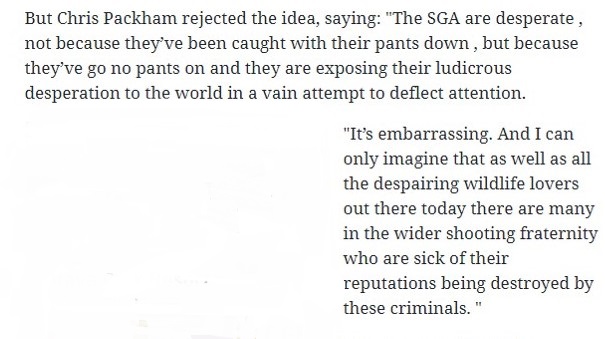
Here’s Chris Packham’s exquisite response to the SGA:

The article also includes a good response from RSPB Scotland’s Ian Thomson, who not only accuses the SGA of trying to “muddy the waters” but also welcomes the idea of independent scrutiny, especially if it’s extended to the amount of wildlife-killing that goes on as part of routine grouse moor management.

We’re not sure who is advising the SGA on its media strategy these days but whoever it is, thanks a lot, you’re handing them to us on a plate.

‘Please Nicola, let’s show eagles our love & protection’ says 9-year-old boy

Following yesterday’s news that two golden eagles have ‘disappeared’ in suspicious circumstances on a Scottish grouse moor (here), schoolchildren are making a direct appeal to First Minister Nicola Sturgeon to protect these birds.

This drawing, sent to Ms Sturgeon, is by nine-year-old Freddie. It was shared on Twitter yesterday by his family @blackerschat

And this one was drawn by Nicola Penfold’s seven-year-old boy, also called Freddie [@nicolapenfold]:

This idea was suggested by award-winning children’s author Gill Lewis. Gill’s latest book is ‘Eagle Warrior‘ and was inspired by the story of golden eagle Fred who vanished under suspicious circumstances from the Pentland Hills last year and whose satellite tag ended up in the North Sea.

In December last year we blogged about some amazing schoolchildren in Glasgow (Sunnyside Primary School) who had drawn ‘missing’ posters as they learned about the disappearance of golden eagle Fred.

Following yesterday’s news of golden eagles Adam and Charlie, Gill posted her own drawing of an eagle and a plea to the First Minister on Twitter to ‘stop the persecution’ and encouraged others to do the same:

So far, the First Minister and the rest of her Cabinet have remained silent about the news of Adam and Charlie. They have also failed to comment about the recent discovery of hen harrier ‘Rannoch‘ who was found dead in May on another Strathbraan grouse moor with its leg caught in an illegal trap, and they’ve remained silent about the suspicious disappearance of hen harrier ‘Marci‘ who vanished from a grouse moor in the Cairngorms National Park in April.

We’ve been encouraging blog readers to email the First Minister [ FirstMinister@gov.scot ], as Andy Wightman did yesterday (see here) to call for action against those who continue to kill birds of prey in Scotland.

But if you’ve got kids who like to draw, sending the First Minister a picture and a plea to help from them cannot be so easily ignored.

“It is long past time for reviews & inquiries”: Andy Wightman’s letter to Nicola Sturgeon

This morning we blogged about two satellite-tagged golden eagles, named Adam and Charlie, who have ‘disappeared’ in suspicious circumstances on a Scottish grouse moor (here).

We published a video about the loss of these eagles and we all watched an emotional Andy Wightman MSP try to retain his composure as he talked to Chris Packham about how he felt when he was told that ‘his’ eagle, Adam, was one of those that had vanished.

Watch the video here:

This afternoon, Andy has written to First Minister Nicola Sturgeon urging her to take action against the ongoing issue of illegal raptor persecution on grouse moors.

Here is a copy of that letter:

Like Andy, you too can write to the First Minister. You can write her an email.

You can talk about how you felt when you heard about these two missing golden eagles.

About how you felt about the 50+ other satellite-tagged golden eagles that have ‘disappeared’ in suspicious circumstances on or near to grouse moors in the last ten years.

About how you feel every time you read another news article about the illegal killing of birds of prey on land managed for game shooting.

About how you feel when what looks like clear cut video evidence of an alleged crime against birds of prey is thrown out of court and the suspect walks free without trial.

About how you feel every time the Scottish Government says ‘raptor persecution won’t be tolerated’ but then it is, time and time again.

Please take the time to contact Nicola Sturgeon. She’ll be delighted to find out just how many people would support her to take action. You don’t need to be a Scottish resident to write to her – in fact the more correspondents from overseas, the better. This is an international embarrassment to Scotland and the time has come for regulation.

Please send your emails to: FirstMinister@gov.scot

Thank you.

The next blog will include some AMAZING eagle illustrations that have been drawn today and sent to the First Minister. If you thought Andy’s interview was powerful, wait until you see these…..

Two more golden eagles go ‘missing’, on the same morning, on the same Scottish grouse moor

Press release from Raptor Persecution UK and Chris Packham (1 July 2019)

TWO GOLDEN EAGLES VANISH IN SUSPICIOUS CIRCUMSTANCES ON THE SAME MORNING, ON THE SAME SCOTTISH GROUSE MOOR

Two young satellite-tagged golden eagles have disappeared in suspicious circumstances, within hours of each other, on the same Scottish grouse moor.

The two eagles, named Adam and Charlie, were being monitored by TV broadcaster Chris Packham and Dr Ruth Tingay of Raptor Persecution UK as part of a wider scientific study in to the movements of young golden eagles in Scotland.

Adam and Charlie vanished from the Auchnafree Estate in the Strathbraan area of Perthshire on the morning of 18th April 2019. The eagles’ satellite tags, which had been working perfectly well for one and two years respectively, suddenly and inexplicably stopped working (Charlie’s at 06.25hrs and Adam’s at 11.39hrs) just 3.4km apart. Both the tags and the eagles have since been untraceable.

A police-led search of the eagles’ last known locations on the grouse moor has failed to yield any further information about their fates. There is no evidence to suggest the estate’s involvement with these disappearances.

One of the eagles, ‘Adam’, had been named and adopted by Andy Wightman MSP in June 2018. Wightman is the Scottish Parliament’s Species Champion for the golden eagle and had visited the eagle’s nest site last year to watch researchers fit the bird’s satellite tag. He’d named the eagle Adam as a tribute to the late ecologist and mountaineer Dr Adam Watson.

[Andy Wightman MSP with golden eagle Adam at approx 9 weeks old in the Loch Lomond National Park. Photo by Ruth Tingay]

Both Adam and Charlie had hatched at separate nests in the Loch Lomond & Trossachs National Park in 2018 and 2017 respectively, and their satellite tags had allowed researchers to follow their movements with incredible precision.

The circumstances of their disappearances, in a region previously identified as a raptor persecution hotspot, are virtually identical to the suspicious disappearances of more than 50 satellite-tagged eagles in Scotland, as revealed in a Government-commissioned report published in 2017.

That report found that almost a third of all satellite-tagged golden eagles have disappeared without trace on or next to a driven grouse moor in known raptor persecution hotspots, giving rise to what Environment Cabinet Secretary Roseanna Cunningham called “legitimate concerns” that high numbers of golden eagles continue to be killed in some areas of Scotland each year.

In response to that report’s findings in 2017, the Cabinet Secretary ordered a review of grouse moor management practices with a view to introducing a licensing scheme for game-shooting estates. The review is due to be published this summer.

Andy Wightman MSP said: “I am shocked and devastated by the disappearance of Adam, a young golden eagle, whom I spent time with when he was nine weeks old. The cold rage that I felt when I heard of the circumstances of his disappearance has now developed into a determination to discover his fate.

This latest outrage should be a wake-up call to the Scottish Government that for all their reviews, inquiries and reforms, rampant criminality remains in place across many of Scotland’s driven grouse moors”.

Chris Packham said: “We can’t prove that harm has come to Adam and Charlie, nor who might have been responsible, but we can look at the circumstances, look at the science, look at the wider evidence and draw plausible conclusions. The Scottish Government has already acknowledged that illegal raptor persecution is an ongoing problem. How many more golden eagles do we have to lose before that same Government takes effective action?

Anyone with information about the suspicious disappearances of Adam and Charlie is urged to contact Police Scotland on 101, or the RSPB’s confidential raptor crime hotline 0300 999 0101.

ENDS

We’ve produced a video about the suspicious disappearances of these two young eagles:

We’d like to thank the National Wildlife Crime Unit (particularly Charlie Everitt and Lou Hubble), Police Scotland and the RSPB Scotland Investigations Team for their significant joint partnership work on this investigation, from analyses of the satellite tag data right through to an especially thorough land search and subsequent follow up work.

We’ll be posting more on this shortly.

So here we are again. Not just another golden eagle lost, but two, on the same morning in the same area. This news is likely to lead to anger, despair, and a sense of impotency and futility.

What can we do?

We can hold the Scottish Government to account. They’ve been promising to deal with this for 20 years, ever since the Scottish Parliament was formed. It’s been noticeable, in recent months, that every time a confirmed or suspected raptor persecution crime has been reported, the Scottish Government has responded with silence.

Please consider writing to both the Environment Cabinet Environment Secretary, Roseanna Cunningham, and First Minister Nicola Sturgeon. Be polite but be clear – this appalling toll on our wildlife must end.

Roseanna Cunningham: cabsececclr@gov.scot

Nicola Sturgeon: firstminister@gov.scot

UPDATE 5pm: NEW BLOG – “It is long past time for reviews & inquiries: Andy Wightman’s letter to Nicola Sturgeon (here)

UPDATE 2 July: NEW BLOG – ‘Please Nicola, let’s show eagles our love and protection’ says 9 yr old boy (here)

UPDATE 2 July: NEW BLOG – Chris Packham responds to Scottish Gamekeepers Association with the contempt they deserve (here)

UPDATE 5 July: NEW BLOG – Is Scottish Government’s silence an indication of indifference to illegal raptor persecution? (here)

BASC’s mask slips again as Director dismisses sat tag evidence as “hysterics”

Have a look at this tweet from Duncan Thomas, a regional director of the British Association for Shooting & Conservation (BASC):

Dear oh dear. And BASC had been trying soooooo hard to convince everyone it accepted the findings of the recently published hen harrier satellite tag paper that showed at least 72% of sat tagged hen harriers were presumed illegally killed on grouse moors.

In response to that scientific peer-reviewed paper BASC’s Executive Director of Conservation had even stated:

We are grateful that this research has been carried out. Satellite tags are a tool in the fight against persecution. We have to make sure there is no place left for criminals to hide“.

This is the second time in recent weeks that Duncan Thomas has caused what should be considerable embarrassment to those at BASC’s head office – last time was when he went on the telly to claim that “there’s a tiny amount of persecution occurring” [in the Peak District National Park] despite overwhelming evidence that’s stacked up over the last two decades that shows otherwise –  see here.

Does this look like an organisation committed to tackling the illegal killing of birds of prey?

Why is BASC still a member of the Raptor Persecution Priority Delivery Group (RPPDG)? It boycotted the last RPPDG meeting and then shortly afterwards claimed it was still “committed to constructive dialogue“.

Does referring to the scientific findings of the hen harrier and golden eagle sat tag papers as “#raptorhysterics” look like constructive dialogue to you?

How will this appalling attitude help progress the work of the RPPDG?

New satellite tag to detect illegal killing of golden eagles in Cairngorms National Park, eagle-killing hotspot

Press release from Cairngorms National Park Authority (23 March 2019)

Cutting edge technology to provide new insight into lives of Scotland’s golden eagles

An innovative new type of satellite tag has been designed to provide a boost to understanding raptor movements and behaviour, as well as help understand the fate of birds which die in the Cairngorms National Park and more widely across Scotland.

Over the next 18 months some young Golden Eagles in and around the Cairngorms National Park will be fitted with a novel ‘Raptor Tracker’ tag, as part of a trial which will provide key information on movements and behaviour, such as whether a bird is feeding or resting. Most importantly, it will provide an instant fix on any birds which die.

Tags in current use are limited in what information they can provide on the exact location of any bird which dies.  This new tag uses the ‘geostationary Iridium’ satellite network and ensures that signal information is always available. Crucially, it has been developed with multiple sensors; these immediately send a ‘distress’ signal, with an exact location, back to base if unusual behaviour is detected. This early warning system has the added benefit of helping to rapidly identify and recover birds which have died.

[An illegally killed satellite-tagged golden eagle, believed to have been trapped on a grouse moor in the Angus Glens resulting in its legs almost being severed, and then dumped in a layby several km away, inside the Cairngorms National Park, where it was left to die an horrific death. Photo by RSPB]

Environment Secretary Roseanna Cunningham said: This is great news for improving our understanding of eagle behaviours, and in the fight against wildlife crime. The tags should make a real difference in deterring would-be criminals, as well as playing a key role in establishing exactly what happened, should any of these magnificent birds of prey disappear or die in unusual circumstances.”

Grant Moir, CEO of the Cairngorms National Park Authority (CNPA) said: “Raptor conservation and tackling wildlife crime is one of the aims of the recently launched Cairngorms Nature Action Plan 2019-2023. This is an exciting breakthrough in the technology around raptor conservation, understanding the birds and combatting wildlife crime.”

Robbie Kernahan, Head of Wildlife Management, of Scottish Natural Heritage (SNH) added: “This exciting new technology will give us new information on the movements of these iconic birds. This should also be a significant deterrent to anyone thinking of persecuting raptors, as we will have detailed information on birds’ movements in the minutes leading up to their death.”

Charlie Everitt, UK National Wildlife Crime Unit commented: “This new tag is a significant step forward in using technology to research further the intriguing ranging behaviour of Golden eagles. However, the implications for preventing wildlife crime and as an aid to enforcement are also very apparent. I look forward to the trial and working closely with colleagues in CNPA and SNH.“

Phil Atkinson, Head of International Research, BTO said: “BTO has been developing new tagging technologies for several years, working to increase the quality and type of information collected. These new ‘Raptor Tracker’ tags have the potential to reveal new aspects of Golden Eagle behaviour, providing fascinating insights into their lives. We are looking forward to the trial and what it reveals.”

The CNPA and SNH have been working on this for over two years, and for the last six months the British Trust for Ornithology has been involved in developing the new tag. The tags will be placed on birds over the next 18 months to trial them. Changes can be made to the tags remotely to ensure that they are working optimally.

If the trial proves successful, the organisations will look at putting these on more Golden Eagles and also the potential miniaturisation of the technology to allow similar tagging of Hen Harriers and other species.

END

Some of what has been written in this press release is absolute nonsense, in terms of the limitations of some of the highly sophisticated satellite tags currently deployed on golden eagles. However, to focus on that would detract from the bigger picture of what is being proposed, and that’s far more important to discuss.

The development of a tag that can potentially send what amounts to a distress signal from the exact location and at the exact time the tagged eagle is being illegally killed is to be warmly welcomed. If this tag works as the manufacturers claim it will, it will provide wildlife crime investigators with high quality evidence of the precise location of the crime, which currently can only be inferred from tag data depending on the tag’s ‘duty cycle’, which determines when it’s programmed to transmit data to the tag operator (this can vary between a matter of hours and a number of days, depending on tag type). That would be a seriously good development.

What it wouldn’t do is to identify the individual criminal, especially if the crime took place on a large grouse moor estate where multiple gamekeepers are employed (which is where most of the golden eagle killing in Scotland has taken place). In those situations, the wildlife crime investigation wouldn’t get any further than the current situation we see playing out so often today –  that is, the body and the tag removed from the scene and destroyed, “no comment” interviews from all suspects and no way for the police to identify the actual individual responsible. Without that identification, a prosecution cannot proceed.

That’s not to say that the estate would get off scot free though, as they currently do. Conservationists have been arguing that the pattern of evidence from the current raptor satellite tags that suddenly and inexplicably ‘disappear’ should be sufficient evidence for SNH to impose General Licence restrictions on the offending estates. For some reason (unexplained, as far as we can tell), this has not been happening, even though the Environment Cabinet Secretary acknowledges the significance of the data pattern (see her editorial in the Government’s annual wildlife crime report). However, if this new tag can do what is claimed it can do, there’s no question that that information should be accepted by SNH and sanctions should be applied to the estate involved.

It’s great that this tag will be trialled in and around the Cairngorms National Park, given that some of the more intensively-managed grouse moors in and at the edge of the Park are well-known golden eagle-killing hotspots, as shown in this map derived from data provided in the golden eagle satellite tag review in 2017. It’s interesting that none of the people quoted in the press release mentioned this fact!

It is though, very pleasing indeed to see such senior figureheads recognise that the deployment of satellite tags on threatened raptor species is an acceptable and important conservation tool and a helpful investigative tool for detecting wildlife crime. It seems the concerted campaign by several meat heads in the gamekeeping world, which has included disgraceful personal attacks and smears on the integrity of those who fit satellite tags, has fallen on deaf ears.

We look forward to hearing about the field trials on this new tag in due course. Well done to all involved.

‘Effective regulation required for excesses of driven grouse shooting in Scotland’

Duncan Orr-Ewing, Head of Species and Land Management at RSPB Scotland, has written a blog discussing the state of raptor conservation in Scotland, how certain species are still suffering due to the ongoing illegal killing associated with land managed for driven grouse shooting, and how the Scottish Government needs to bring about significant change.

Duncan’s blog is reproduced here:

EFFECTIVE REGULATION MUST BE PUT IN PLACE IN SCOTLAND TO TACKLE THE EXCESSES OF “DRIVEN” GROUSE SHOOTING

Most people accept that the conservation prospects for many raptor species in Scotland have improved in recent decades, and since full protection of these birds in the UK from the 1950s. This is most apparent in the rise in the common buzzard population. This bird of prey species has made a welcome return and can now be seen in almost all of the countryside of lowland Scotland, and even in some of our main towns and cities. Like the common buzzard, various other raptor species have re-established their populations naturally,  particularly when the main constraint of human persecution has ceased or been significantly reduced. Red kite and white-tailed eagle have been given a helping hand by conservationists, working with landowners, through well planned reintroduction programmes, and are also on the way back.

Raptor species are now amongst the most studied birds in Scotland, much of this work prompted by the effects of organochlorine pesticides on their populations from the 1960s. We have good information on the population distribution of most raptor species, as well as a clear scientific understanding of the main threats to their conservation status. There are a number of native raptor species whose populations have not recovered, and these include the hen harrier. National surveys of this species have shown that the population of hen harriers in Scotland has declined between 2004 and 2016 from 633 to 460 breeding pairs, or by 27%. When you scrutinise the data more carefully there are significant geographical differences; the breeding hen harrier population is doing relatively well on Orkney and the Western Isles but is struggling in the eastern and central Highlands and southern uplands. The authoritative Conservation Framework for Hen Harriers in the UK (Fielding et al. 2011. JNCC) estimated that the Scottish breeding population of this species should be between 1467 and 1790 breeding pairs based on the availability of suitable nesting habitat. So what is happening?

What is now becoming clearer is that many raptor populations in Scotland are held below their potential population levels and range because of continuing illegal human persecution on land managed for “driven” grouse shooting. For the raptor species that have got commoner, it is clear to those who monitor them that even these species are largely absent from “driven” grouse moor areas as breeding birds. Equally, the raptor populations that hang on in these areas do not behave as you would expect – traditional nesting sites become occupied periodically, and then breeding birds disappear or nesting attempts routinely fail in mysterious circumstances. Young birds attempt to breed that would normally be excluded from good sites by adult birds. For those species, like the hen harrier, where grouse moors are their most suitable breeding habitat, and where populations remain heavily persecuted , it is held that their populations simply cannot increase without changes in land management culture and behaviours. Population “sinks” occur where the best habitats are repeatedly attracting nesting birds and these birds are repeatedly killed illegally. Most recently, new technological advances in the study of the survival and dispersal of birds, in the form of GPS satellite tagging, have reinforced the point that many of these marked raptors simply vanish without trace in grouse moor areas. The report “Analyses of the fate of satellite tagged golden eagles in Scotland” (Whitfield et al. 2017. SNH) highlighted that a third of a large sample of marked golden eagles disappeared in precisely this way.

[RPUK map, derived from data in the golden eagle sat tag review, showing the last known location of satellite-tagged golden eagles that had disappeared in suspicious circumstances on or close to driven grouse moors]

Sadly, it is now clear to many people involved with raptor conservation efforts that progress has stalled. Until now, the Scottish Government has made important, but piecemeal changes, to raptor protection laws. These measures have had the desired impact in large parts of Scotland. However, on land managed for “driven” grouse shooting, it is equally evident that raptor persecution is such an entrenched part of their business model, that tougher measures are now urgently required. Our RSPB Investigations team report that ever more extreme measures are being deployed by grouse moor gamekeepers to kill birds of prey and avoid detection, including the use of thermal imaging gear and night vision equipment to kill raptors at night. Many in the grouse moor community will tell you quite openly that they do not believe that they can manage their estates to deliver high grouse bags for sporting clients without breaking wildlife protection laws. This appalling situation has been further compounded in recent decades by the arrival on the scene of a new breed of sporting manager, and the proliferation of more intensive grouse moor management methods, involving ever increasing grouse bags for clients to shoot. This type of operator has commercialised grouse shooting. They have the resources to disregard public opinion; they have little concern for Scotland’s international reputation; and feel safe in the knowledge that it is very hard for the public authorities to bring the perpetrators of these wildlife crimes to justice.

From a RSPB Scotland perspective, we have put significant investment over many years into working with responsible landowners. We recognise that many landowners understand the harm that is being done to their sector by the more extreme grouse moor interests, but are apparently powerless to stop this momentum. We have engaged with conflict resolution processes, including the Langholm Moor Demonstration Project, designed to investigate ways that grouse moors can be managed both legally and sustainably. However, we have reluctantly concluded that amongst the “driven” grouse moor sector at least, there is little appetite to adapt businesses in line with modern day expectations. We simply do not think that further piecemeal changes to wildlife protection laws will be adequate.

The current independent Grouse Moor Management Review Group, commissioned by Scottish Government, is due to report in May 2019. This could be an important milestone if we are prepared to accept that a significant change must occur if we are to tackle the deeply embedded cultural issues concerning the current model of “driven” grouse moor management. This is also why the RSPB supports the licensing of “driven” grouse moors, including proportionate sanctions to remove such licences to operate, where the public authorities have good evidence of illegal activities taking place.

ENDS

More on proposed reintroduction of golden eagles to Wales

Last month we blogged about conflicting approaches to the proposed reintroduction of golden eagles to Wales (see here).

One group (Eagle Reintroduction Wales Project, ERW) being led by researchers at Cardiff University is part-way through conducting a careful scoping exercise to properly consider all the factors that need to be addressed before permission for a reintroduction would be granted, e.g. biological and environmental considerations, social and political considerations, and comprehensive risk assessments and an exit strategy.

The other group (Wilder Britain) is a newly registered Community Interest Company being led by Dr Paul O’Donoghue of Wildcat Haven and Lynx Trust UK ‘fame’. A press release from Wilder Britain stated that an application to release golden eagles would be submitted this summer, which appears to us to be premature.

Private Eye picked up on this news and have published a piece in their latest edition:

Meanwhile, Dr O’Donoghue wrote to RPUK to complain about last month’s blog. Unfortunately Dr O’Donoghue’s email went straight to the spam folder so it’s only just been discovered but in the interests of transparency it’s published here so that everyone has the opportunity to view his extensive ornithological expertise:

Just a couple of points from us.

When we wrote, “We’re not aware of Dr O’Donoghue’s experience or expertise in ornithology or in the field of raptor research and conservation” in our earlier blog, we did not ‘seek to lead the reader to believe that I [Paul O’Donoghue] have no relevant ornithological experience‘. If that’s what we had wanted to say, that is what we would have said! We said we were not aware of Dr O’Donoghue’s experience or expertise in ornithology or in the field of raptor research and conservation, simply because we weren’t aware of it. His name is not a familiar one in the scientific journals we read.

Having now become aware of Dr O’Donoghue’s ornithological experience and expertise, based on the information he provided, we maintain our support for the Cardiff University ERW Project’s robust approach to assessing the feasibility of a reintroduction of golden eagles to Wales.

Meanwhile, Dr O’Donoghue has been the subject of more media attention, this time at a public meeting to discuss his proposal to reintroduce the Lynx to various sites in Scotland. It didn’t end well, according to the Scottish Farmer (see here).