Lincolnshire Police launch investigation as 7 dead birds of prey found in raptor persecution hotspot

From Lincolnshire Police (11 September 2025)

Officers from Lincolnshire Police Rural Crime Action Team are investigating after a number of dead birds of prey were found in the countryside between Belchford and West Ashby in recent months.

Four birds of prey were previously discovered in the area. As a result of these reports, we carried out a Section 19 search under the Wildlife and Countryside Act today. During this search, a further three dead birds of prey were located.

Also in attendance and assisting with our thanks were members of the RSPB and National Wildlife Crime Unit.

The search team included officers from Lincolnshire Police Rural Crime Action Team, the RSPB and the National Wildlife Crime Unit. Photo via Lincolnshire Police

All of the birds have been recovered and will be sent for specialist testing through the Wildlife Incident Investigation Scheme (WIIS) to establish the cause of death.

The Officer In Charge, Detective Constable Aaron Flint Lincolnshire Police’s Force Wildlife Crime officer, said:

The discovery of multiple dead birds of prey in one locality is deeply concerning. We take all reports of suspected wildlife crime seriously, and our investigation is ongoing. Until we receive toxicology results, we cannot confirm the cause of death, but deliberate harm to birds of prey is a criminal offence and will be fully investigated.

We are appealing for anyone who may have information which could assist our enquiries. Did you see anything suspicious in the area in recent weeks or months? Have you found any other dead wildlife, bait, or unusual items in the countryside locally?

If you can help, please contact Lincolnshire Police on 101, quoting crime number 25000511499, email aaron.flint@lincs.police.uk or alternatively, you can report anonymously via Crimestoppers on 0800 555 111.

ENDS

This isn’t the first police investigation into the illegal killing of birds of prey in this area.

In March this year, gamekeeper John Bryant 40, of West Ashby, Horncastle, Lincolnshire was convicted after a trial at Lincolnshire Magistrates’ Court of four offences in relation to an investigation into the illegal poisoning of a Red Kite and two Buzzards in the Belchford area (here).

Bryant was ordered to pay over £7,000 in fines (see here and here) and he also lost an appeal against the Police’s decision to revoke his shotgun and firearms certificates (here).

The discovery of seven more dead raptors in the same area this year is, as Detective Constable Aaron Flint says, ‘deeply concerning’.

Well done DC Aaron Flint and team for another successful multi-agency raid and a timely press release – this level of transparency is rare and I can think of a number of police forces who could learn lessons from this approach.

Judge rules RSPB covert video surveillance is admissible evidence in prosecution of gamekeeper Racster Dingwall

BREAKING NEWS….AND IT’S EXCELLENT NEWS!

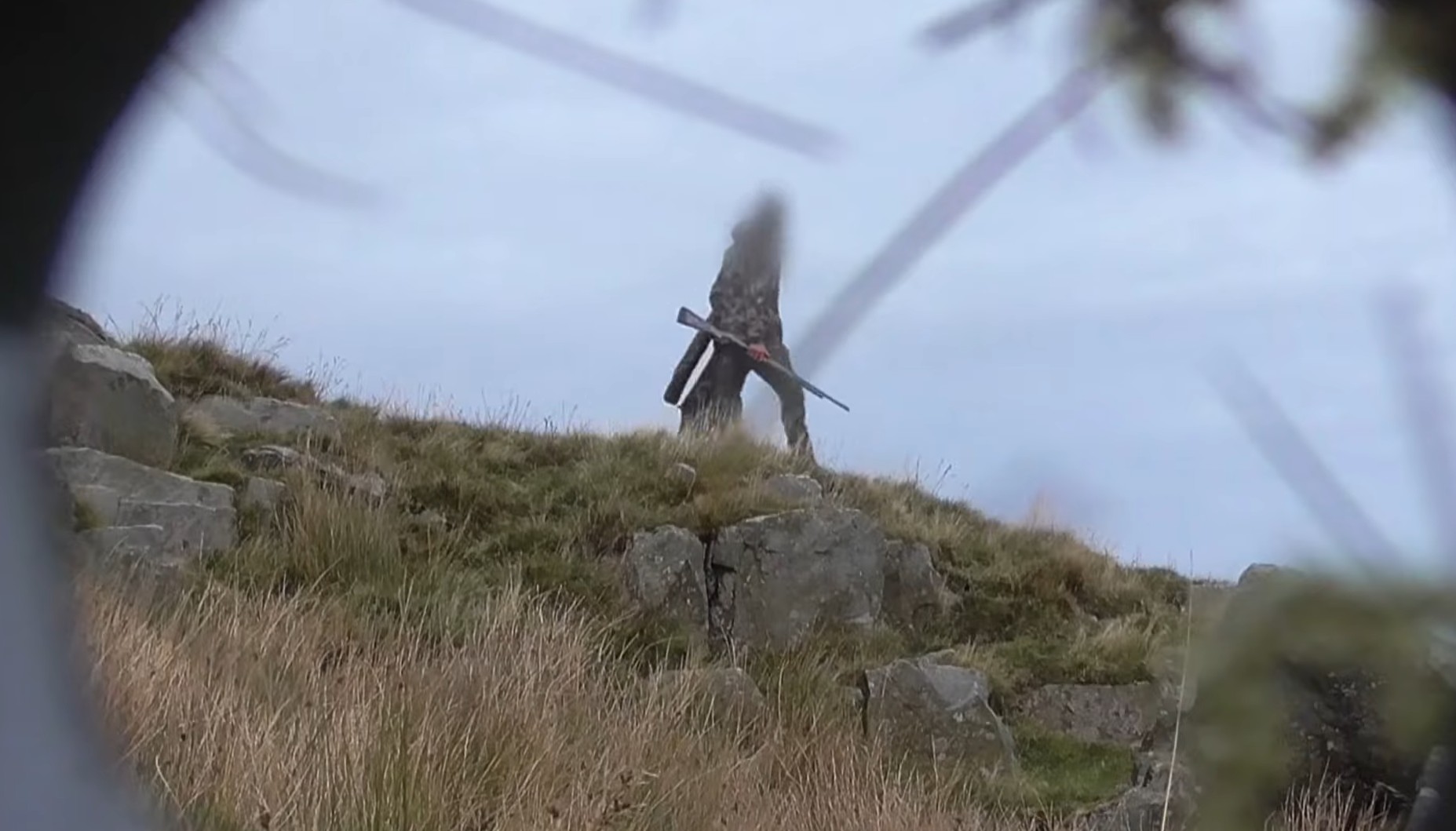
The District Judge presiding at York Magistrates Court has today ruled that the RSPB’s covert video and audio surveillance is to be considered admissible evidence in relation to the prosecution of gamekeeper Racster Dingwall.

He did not accept the defence’s argument that inclusion of the covert surveillance would have an adverse effect on the fairness of proceedings.

Mark Thomas and Ian Thomson from the RSPB’s Investigation Team attended York Magistrates Court today. Photo: Ruth Tingay

The case now moves to trial in January 2026 unless Mr Dingwall changes his not guilty plea in light of today’s ruling.

I’ll write a longer blog in the coming days, setting out the arguments and the Judge’s explanation for his decision.

In haste…

NB: Comments turned off as criminal proceedings are still live.

UPDATE 25 September 2025: More detail on court ruling accepting admissibility of RSPB’s covert surveillance in prosecution of gamekeeper accused of conspiracy to kill a Hen Harrier (here)

Gamekeeper Racster Dingwall back in court today for case relating to Hen Harrier shooting on a grouse moor in Yorkshire Dales National Park

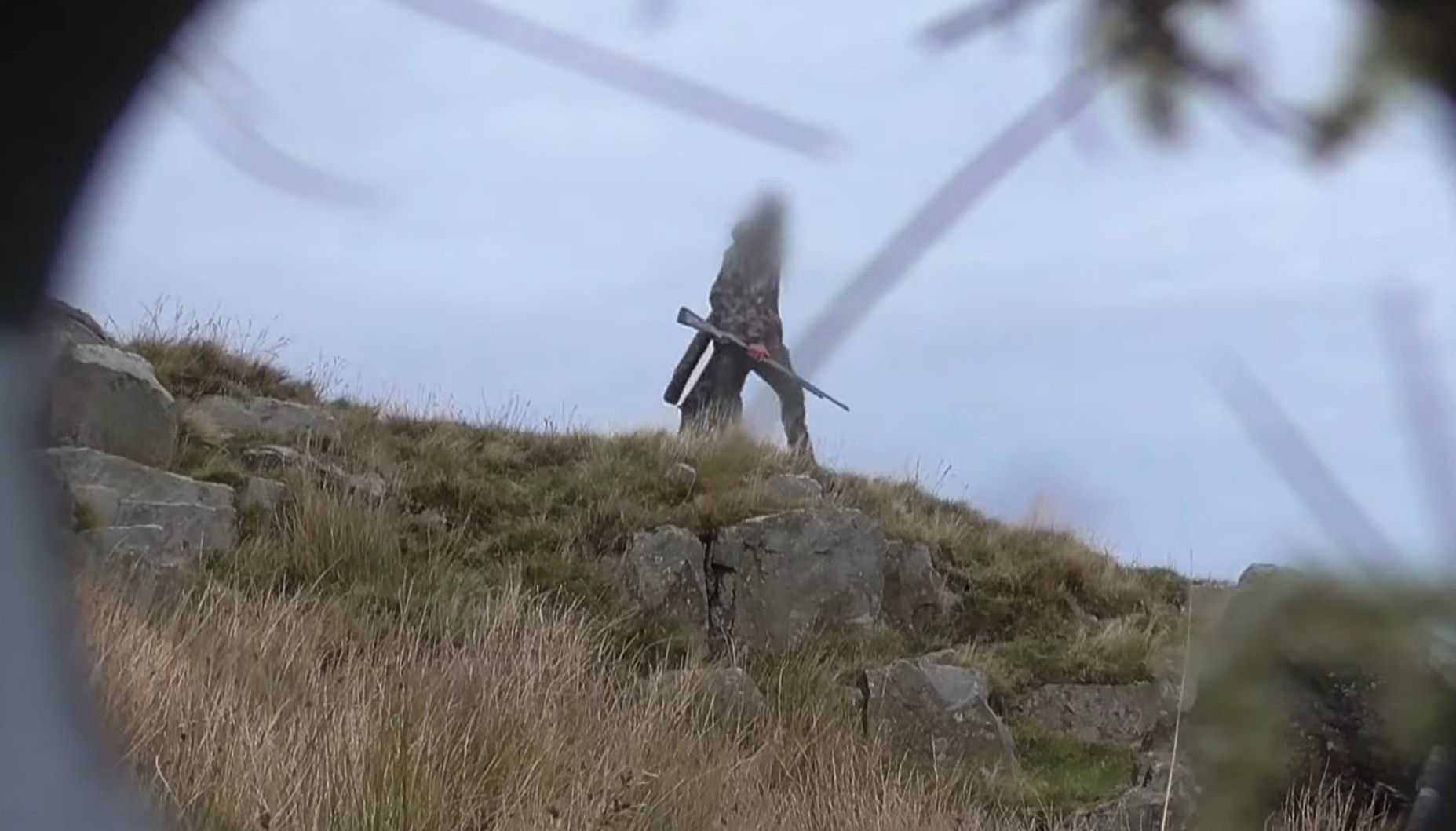
Gamekeeper Racster Dingwall, 34, will appear at York Magistrates Court today for a hearing linked to his alleged involvement with the shooting of a Hen Harrier on a grouse moor (Coniston & Grassington Estate) in the Yorkshire Dales National Park on 2nd October 2024. He has pleaded not guilty.

This prosecution relies on the covert footage filmed by the RSPB’s Investigations team last autumn and later shown on Channel 4 News (here).

York Magistrates Court. Photo by Ruth Tingay

Dingwall faces two charges, according to the court notice:

  1. Possession of an article capable of being used to commit and summary offence under Section 1 to 13 or 15 to 17 of the Wildlife & Countryside Act;
  2. Encourage/assist in the commission of a summary offence believing it will be committed.

Today’s pre-trial hearing is expected to focus on legal arguments about the admissibility of the RSPB’s covert footage.

This was entirely to be expected. The defence team will be doing its best to have the evidence ruled inadmissible because without it, the prosecution will collapse.

We’ve been here many times before in similar cases. The last one I watched where the judge ruled the RSPB’s footage to be inadmissible was back in 2018, in relation to the illegal and brutal killing of two Peregrines on a grouse moor in Bowland. The legal arguments barely got going because the CPS lawyer was monumentally under-prepared, he hadn’t even watched the video footage in question, and was unable to answer the judge’s questions about it. The judge was really left with no other option than to rule the footage inadmissible and the case collapsed as a result (see here for more detailed blogs about that fiasco).

NB: Comments are closed until criminal proceedings have concluded.

Chick success after translocated Golden Eagle breeds with one of ‘our’ wild satellite-tagged birds in south Scotland

One of the translocated Golden Eagles in southern Scotland has bred with one of ‘our’ wild satellite-tagged eagles, resulting in the successful fledging of a male eaglet.

This is the first fledging event from a nest of one of the translocated eagles and marks a major milestone for the South Scotland Golden Eagle Project.

The chick has been named ‘Princeling’ by Sir David Attenborough.

Golden Eagle chick ‘Princeling’ having a satellite tag fitted (Photo copyright Ian Georgeson)

The breeding pair got together in 2024 and built up a nest but didn’t breed. That’s not unusual behaviour for young Golden Eagles who can take up to six years to mature, although in areas where there’s little competition for territories (e.g. through depletion of the population by persecution, as in south Scotland), breeding can happen much earlier.

Emma, the female, had been translocated to south Scotland in 2021 and was named by the Scottish Government’s then Biodiversity Minister, Lorna Slater MSP, in memory of the women’s rights and equality advocate, Emma Ritch.

Keith, the male, fledged from a wild nest in Dumfries & Galloway in 2018 and was named Keith after a member of the local Raptor Study Group. He was satellite-tagged as part of a project run by RPUK and Chris Packham in association with experts from the Scottish Raptor Study Group and we’ve been tracking his movements ever since.

Here he is prior to fledging in 2018 (Keith is on the right, one of his parents on the left). This is footage from a nest camera which are routinely installed (under licence) at nest sites to help researchers monitor young eagles after they’ve been fitted with a satellite tag to ensure the tag/harness is not causing any health or welfare issues.

Photo copyright Scottish Raptor Study Group

After dispersing from his natal territory in November 2018, Keith hung around in Dumfries & Galloway for a few months before then suddenly making a beeline for the border and in to England. He stayed in Northumberland for a while (and was joined by at least one other tagged Golden Eagle that had been translocated to south Scotland) before heading back in to Scotland and heading over to his old haunts in SW Scotland before eventually finding his own territory and settling there in October 2023.

After their unsuccessful breeding attempt in spring 2024, Keith and Emma were photographed together in October 2024 on a camera trap at a food platform provided by the South Scotland Golden Eagle Project. They looked to be in excellent condition:

Keith on the right, with the much larger female Emma. Photo copyright South Scotland Golden Eagle Project

The location of their successful breeding attempt this year has had to remain a secret because, as we’ve seen, (here and here) Golden Eagles, along with many other raptor species, still face the threat of illegal persecution in this region and beyond.

Rural villagers ‘at war’ about commercial Pheasant shoot in Wales

I’ve lost count of the number of times I’ve heard that gamebird shooting, whether it be Red Grouse, Pheasant or Red-legged Partridge shooting, and all its associated ‘management’ is vital for rural community cohesion and it’s only so-called ‘Townies’ that don’t understand and want to protest about it.

As with most things claimed by the gamebird shooting industry, it’s not true.

Over recent years a number of local rural communities in England (particularly across Yorkshire) and Scotland have rejected this fictional romanticism of their lives and have found the courage, often in the face of intimidation from dark powerful forces, to voice their dissent.

Now it’s happening in Wales, too.

The following article was published by The Telegraph last week:

A village is locked in dispute with wealthy tourists who pay more than £3,000 for a day’s pheasant shooting.

Residents in Pennal, a community of 404 in Snowdonia, North Wales, claim the shoots have set “neighbour against neighbour”, and led to claims of intimidation and harassment.

Some villagers have even complained of dead foxes dumped in their gardens.

But others, who support shooting, said “incomers” to the village were behind the complaints, and told them to “move back to where they came from” if they don’t like it.

The shoots, run by Cambrian Birds on the Pennal Estate, are marketed as “the most talked-about in the UK” for their “high-quality driven pheasants and partridges along with top class hospitality”.

Guests are promised at least four drives a day, and a two-course meal or afternoon tea.

But an anonymous survey in the village uncovered anger at what some locals see as a “takeover” by “large commercial shoots”.

One resident said: “Disharmony and division within our once peaceful village. Most people I speak to in the village hate what’s happening but are afraid to publicly voice their concerns for fear of retribution or escalating the division further.

“These fears are evident in that a local lady in her seventies living alone has now had two healthy looking but dead foxes put in her garden with loud bangs on her windows in the night. Police were informed, but little action.”

Another villager said there had been “no consultation with village residents” before it was “taken over”.

The same resident complained of “acts of intimidation towards people who speak up”, alleging there had been “shooting across gardens late at night” and even “dead foxes dumped on one person’s land”.

It is not known who is behind these alleged “acts of intimidation”.

Other residents said they felt pressured to take sides.

Several residents asked me to declare whether I was with or against the shooting,” complained one, adding: “One person even told me who I should talk to and who not.”

They claimed that some villagers were now considering “moving away” as a result of the disputes.

But supporters argued the shoots bring vital income to the rural economy, and accused critics of being “incomers”, and part of the “anti-shooting brigade”.

A lifelong resident, who described themselves as “Pennal born and bred”, said: “Cambrian Birds pays a decent rent to the hill farmers of Pennal, helping in many cases, young families to stay and work the land. Young families move into the area, helping the local school.”

The resident said that if the “anti-shooting brigade” didn’t like it they should “move back to where they came from”.

They likened it to “buying a house next door to a pub and then complaining about the noise of throwing-out time”.

Cambrian Birds has been approached for comment.

ENDS

The Telegraph article was likely inspired by an article in Cambrian News on 23 July 2025 about a village protest held against the Cambrian Birds shoot at Pennal.

Local villagers protest about the Pheasant shoot. Photo supplied to Cambrian News

This isn’t the villagers’ first protest against Cambrian Bird’s game-rearing and shooting business. In January this year they featured in an article in the Powys County Times about how they’d erected banners and sprayed ‘crime-scene’-type silhouettes of Pheasants on village roads as part of their protest:

Image supplied to Powys County Times

Some of you may recognise the name ‘Cambrian Birds’. Its associated business, ‘Cambrian Shooting’, hit the headlines in January 2022 when the League Against Cruel Sports published covert video footage showing someone from the shoot at Dyfi Falls (one of six shoots managed by Cambrian Sporting) chucking at least 45 shot Pheasant and Red-legged Partridge carcasses down a mineshaft (here).

A statement from the company later confirmed that the person filmed was one of their gamekeepers. They said he had been ‘severely reprimanded‘ and that ‘he no longer works for the company‘ (here).

Natural Resources Wales launched an investigation into the possible pollution and contamination of the river close to the site where the mass gamebird dumping took place but as far as I can tell, nothing ever came of it.

To read more about the Dyfi Falls shoot, this blog by Jeremy Moore, a leading Welsh environmental photographer, is fascinating.

For nature & wildlife, grouse shooting creates a vicious circle of destruction. Call that ‘glorious’? Article by Robbie Marsland in The Herald

Robbie Marsland is the Director of the League Against Cruel Sports for Scotland & Northern Ireland. He’s also a founding member of REVIVE, the coalition for grouse moor reform.

Here’s his opinion piece published in The Herald today.

Here we go again. The opening of the grouse shooting season is upon us. It used to be called the “Glorious Twelfth”. More often than not, the name is now preceded by the word, “controversial”.

Why the controversy? For decades, the shooting of wild grouse for entertainment flew under the radar. But now, there’s much better public understanding about what’s going on in our uplands.

No matter what your views are about killing an animal for fun, recent research has revealed the circle of destruction that surrounds grouse shooting in Scotland.

This circle of destruction isn’t just a catchy phrase, it’s a systematic assault on natural ecosystems where each destructive practice enables the next, creating an interconnected web of environmental damage that stretches across the grouse moors, that, in total, comprise around 12% of Scotland’s land.

On this land, hundreds of thousands of grouse are shot in a “good year”. A good year means there’s a high density of grouse on the moor, allowing substantial numbers of birds to be shot while still ensuing a sustainable breeding stock. To achieve a “good year”, then, that population of grouse needs to be “managed” by the shooting estates to be unnaturally high.

Population sizes are naturally increased by access to food and shelter and are decreased by exposure to disease and predators, what is commonly understood to be “the balance of nature”. The balance of nature ensures a sustainable ecosystem that looks after itself. But a balanced ecosystem obviously doesn’t produce an over-abundance of grouse that can produce a “good year” for the annual shooting season. To achieve that “good year”, an imbalance needs to be created; the balance of nature is turned on its head.

Extra food and shelter are provided by burning heather in the winter months. This provides new green shoots for the birds in the spring. It also releases C02 in to the atmosphere, encourages wildfires and stops trees from growing. This systematic burning creates the artificial habitat foundation upon which the entire circle of destruction depends.

Birds of prey perch in trees. Of course, birds of prey are protected species, but breeding pairs are mysteriously absent from many Scottish grouse moors. Their natural diet includes grouse.

Foxes, stoats, weasels and crows also naturally control the numbers of grouse. But as they have no legal protection, they can be killed to ensure there are more grouse to shoot. The largest scientific assessment so far revealed that around 200,000 foxes, stoats and weasels are killed by gamekeepers each year in Scotland to ensure artificially high numbers of grouse.

There are compelling reasons why estates invest so heavily in maintaining those high populations of grouse. A report to the Scottish Government from the Independent Grouse Moor Management Group revealed the capital value of an estate can be increased by £5,000 for every pair of grouse shot. Economic rewards such as these may go some way to explain why landowners will go to such lengths to maintain this artificially imbalanced system.

The natural balance of ecosystems isn’t entirely dependent on predation. A disease that regularly reduces grouse numbers is carried by a small worm, the strongyle worm. To reduce its impact, shooting estates deploy tens of thousands of grit-filled trays medicated with flubendazole in an attempt to kill the worms in the guts of the grouse.

This is despite the medical and veterinary industry’s concerns about the over-prescription of such chemicals. This mass chemical medication completes the circle of destruction. The inflated grouse populations created by habitat manipulation and predator slaughter then require pharmaceutical intervention to remain viable, yet this intensive management system operates without meaningful oversight.

Scotland introduced grouse moor licensing in 2024 under the Wildlife Management & Muirburn Act, supposedly to deter wildlife crime and ensure sustainable management. The reality has proven farcical. The grouse shooting industry threatened legal action against NatureScot’s interpretation of the legislation. Rather than stand firm, NatureScot capitulated, weakening the licences by changing coverage from entire estates to tiny areas around shooting butts. It’s still unclear how this mess will be resolved.

Polling shows that 60% of Scots oppose grouse shooting, with 76% against the predator control that kills hundreds of thousands of mammals annually. Even in the most remote rural areas – the supposed heartland of shooting support – opposition still outweighs support.

Turning the balance of nature on its head goes on year in, year out on Scottish shooting estates. But “good grouse years” do not. When you look at historical trends, the last time there was a “good grouse year” was 2018. Predictions, in Scotland, for 2025 suggest that too will be a “bad year”.

That means, even if you think it’s ok to kill a bird for fun, over that period of time more than a million foxes, stoats, weasels and crows will have been killed for nothing. Thousands of square miles of heather will have been needlessly burned and tons upon tons of chemicals will have been ineffectively strewn across the countryside. The economic incentives that drive this destruction continue to operate regardless of whether or not a “good year” for grouse emerges.

The circle of destruction surrounding grouse shooting reveals the true cost of allowing privileged minorities to treat Scotland’s land as their private playground. Until we break this interconnected system of destruction entirely, Scotland’s uplands will continue to serve private interests rather than the public good, and our wildlife will continue to pay the price for a democracy that has forgotten who it’s supposed to serve.

Meanwhile, the circle of destruction grinds on, crushing Scotland’s wildlife and ecosystems beneath the weight of economic interests that benefit the few while imposing costs on the many. For those of us who think its unethical and cruel to shoot a bird out of the sky – it’s always a crying shame.

ENDS

The grouse shooting industry’s grotesque distortion of reality laid bare on Rod Liddle’s radio show

Journalist, broadcaster and Sunday Times columnist Rod Liddle hosted a 20 minute segment on the pros and cons of grouse shooting during his Saturday morning show on Times Radio last Saturday (9th August 2025), as pre-advertised in a blog here last week.

You can listen back to the discussion via the Times Radio website (here: starts at 02:04.05) and you can read / download the transcript here:

There were three interviewees – conservationist Dr Mark Avery, who was the instigator of the now 11-year old campaign to ban driven grouse shooting as detailed in his book, The Inglorious 12th: Conflict in the Uplands; Ben Macdonald, founder and director of a rewilding organisation called Restore; and Andrew Gilruth, CEO of The Moorland Association, the lobbying organisation for grouse moor owners in England.

I won’t comment much on Mark’s contribution – his thoughts on driven grouse shooting will be well known to regular readers of this blog and were characteristically robust.

It was the first time I’d heard Ben Macdonald speak on grouse shooting and although I found his opening remarks quite condescending towards those of us in the conservation sector who have spent years calling out the criminal elements of the driven grouse shooting industry and their unsustainable practices (does Ben think we should all have turned a blind eye?), I found his comments on restoring the ‘fundamentally depleted two-dimensional grouse moor landscape’ to be thoughtful and interesting.

The comments I really want to focus on, though, are those of Andrew Gilruth.

I’ve written previously about Andrew’s predisposition for what I’d call grossly misrepresenting scientific opinion when he worked for the Game & Wildlife Conservation Trust (GWCT), by cherry-picking information that helped present a favourable view of driven grouse shooting (e.g. see herehere and especially here). Whether he did this deliberately or whether he’s just incapable of interpretating scientific output is open to question.

This behaviour of spreading misinformation has continued, though, since he joined the Moorland Association in 2023, and last year resulted in his expulsion from the police-led Raptor Persecution Priority Delivery Group (RPPDG – a partnership to tackle the illegal killing of birds of prey in England & Wales).

Andrew’s opening line in his conversation with Rod Liddle didn’t bode well if you were hoping for a straight, undistorted conversation:

“… I also welcome, you know, Ben’s point, that Mark could only highlight what’s wrong …”

We don’t know what Rod Liddle asked Mark at the start of the discussion because it wasn’t included in the recording, but given Mark’s response it’s quite likely that he was asked to outline the problems with driven grouse shooting, to set the scene. We don’t know whether Rod asked Mark to speak about how to resolve those issues, but if he did, it wasn’t included in the programme, so for Andrew to argue that, “Mark could only highlight what’s wrong” was the first misrepresentation of many.

Rod moved the conversation swiftly on to the illegal killing of Hen Harriers on grouse moors and Andrew lost his composure within seconds. The sudden increase in his voice pitch was a dead giveaway.

I’ve written before about how the illegal killing of birds of prey is one of the most difficult issues for the driven grouse shooting to defend – because it’s indefensible. And Andrew couldn’t defend the persecution figures so instead he resorted to accusing the RSPB of publishing “unproven, unverified smears“. The irony wasn’t lost on me.

Those so-called “unproven, unverified smears” (actual crime incidents to you and me) have been accepted by everyone, including the Government, Police, Natural England, peer-reviewed journal editors – everyone except the grouse-shooting industry, some of whose members are the ones carrying out these crimes.

There’s now even a dedicated police-led taskforce that has been set-up to tackle these crimes (the Hen Harrier Taskforce), based on clear-eyed evidence, that is specifically targeting certain grouse moor estates in persecution hotspots, because that’s where the crimes are taking place, repeatedly.

To continue to deny that these crimes happen on many driven grouse moors, and to instead claim that they’ve been fabricated by the RSPB, is just absurd, but very, very telling.

Andrew then tried to use some tightly-selected prosecution data (produced by the RSPB – which, er, he’d just accused of being an unreliable source) to demonstrate that gamekeepers weren’t responsible for killing birds of prey. He chose a single year of data (last year’s) that just happened to not include any prosecutions of gamekeepers, and he used that as his sole evidence base to support his argument.

Had he picked any other year from the last fifteen or so, there’d quite likely be a gamekeeper conviction or two in there. However, selecting just a single year of data is wholly misrepresentative when you’re looking at trends, and a trend is exactly what we’re looking at when discussing which profession is most closely linked with the illegal persecution of birds of prey. To reliably identify a long-term trend you need to look at several years worth of data, and when you do that, here’s what the data tell us – it couldn’t be clearer:

From the RSPB’s most recent Birdcrime Report (2023), published Oct 2024

Andrew’s not averse to using long-term trend data when it suits his argument though – he stated that, “Hen Harriers are now at a 200-year high“. The problem with that argument is that he forgot to mention what the baseline was for that trend – Hen Harriers were virtually extirpated (locally extinct) in England as a breeding species by the late 19th Century, primarily due to persecution, so any increase since then is bound to look impressive!

He also forgot to mention that last year the Hen Harrier breeding population in England was in decline again; this year’s figures have not yet been released but the word on the ground is that the numbers have dropped further, and notably on driven grouse moors. The illegal killing continues – at least 143 Hen Harriers have ‘disappeared’ in suspicious circumstances or have been found illegally killed since 2018, most of them on or close to driven grouse moors, with at least 14 more cases yet to be publicised (see here).

I find it endlessly fascinating that the grouse shooting industry will claim ownership of a (short-lived) increase in the Hen Harrier breeding population on driven grouse moors and yet will absolve itself from any responsibility for the illegal killing of Hen Harriers on, er, driven grouse moors.

Rod moved the discussion on to heather burning and Andrew’s contortions were unceasing. He argued that moorland burning has been happening in the UK for 6,000 years, as though a reference to the slash and burn agriculture of the Neolithic period justifies the continued burning of moorland in the 21st Century.

Society, and science, has moved on, and we now know that the repeated burning of blanket bog is inconsistent with the UK’s international responsibilities to maintain/restore blanket bog to favourable conservation status. We know that only 16.4% of the UK’s SAC blanket peatlands are in good conservation condition, and we also know that burning on deep peat grouse moors continues, despite recent legislation that makes it illegal inside protected areas.

In 2023, two grouse moor owners were convicted for burning on deep peat in protected areas, one in the Peak District (here) and one in Nidderdale; embarrassingly, that estate was owned by a Board member of the Moorland Association (here) and that’s perhaps why Andrew failed to mention it.

All in all, I’m thankful that Rod Liddle hosted this discussion. Not because it moved the conversation on – it didn’t, at all – but because I think it demonstrated that The Moorland Association is still utterly incapable of moving with the times. Its grotesque and snide distortion of reality is laid bare for all to see. Negotiation remains futile against such perverse denial.

The campaign to ban driven grouse shooting will continue. Watch this space.

16 months (& waiting) for NatureScot to make decision on General Licence restriction relating to ‘shooting & killing’ of sleeping Golden Eagle called Merrick

Documents released under a Freedom of Information request show that the Scottish Government’s nature advisory agency, NatureScot, has been procrastinating for 16 months on whether to impose a sanction on an estate in relation to the ‘shooting and killing’ of a sleeping Golden Eagle called Merrick.

Merrick was a young satellite-tagged Golden Eagle, released in south Scotland in 2022 as part of the South Scotland Golden Eagle Project, a lottery-funded conservation initiative which translocated young Golden Eagles from various sites across north Scotland to boost the tiny remnants of the Golden Eagle breeding population in south Scotland that had previously been decimated by illegal persecution and had become isolated by geographic barriers.

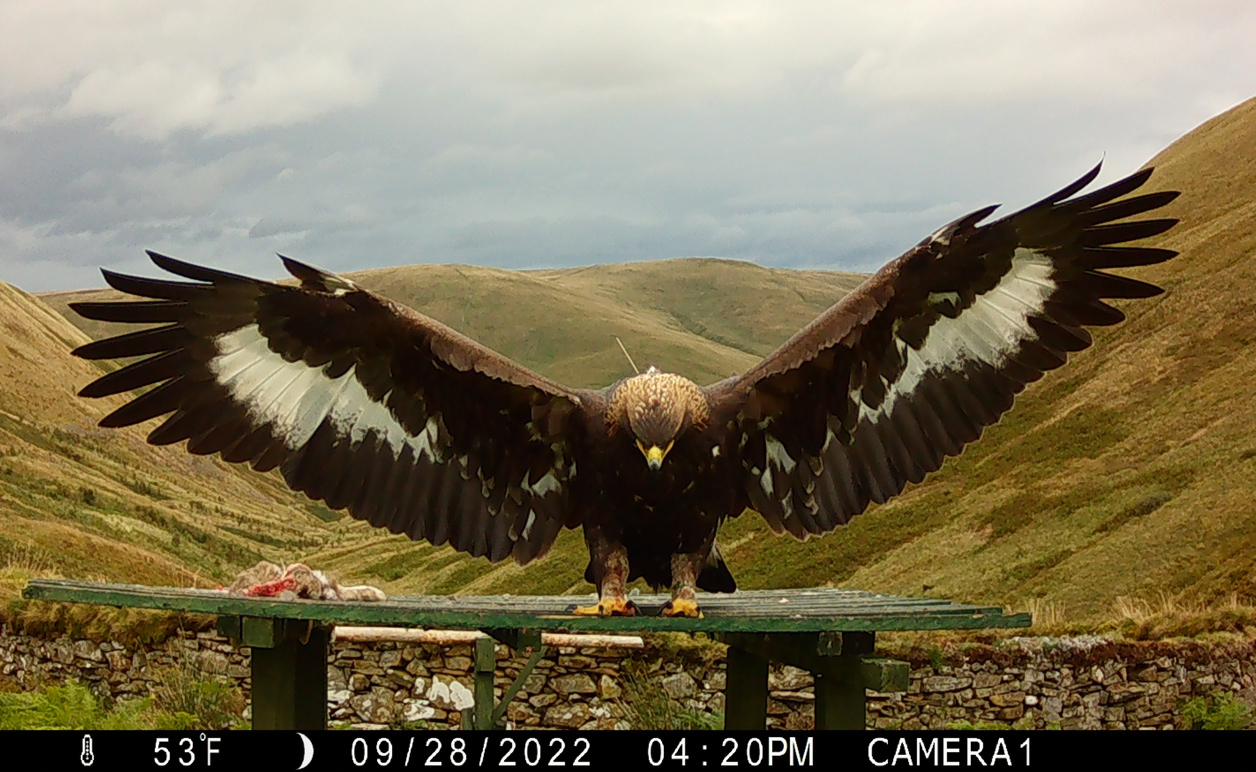
Camera trap photo of golden eagle Merrick in 2022, from South Scotland Golden Eagle Project

A year after her release, which had seen her fly around south Scotland and down into northern England and back, on 12 October 2023 Merrick’s satellite tag suddenly and inexplicably stopped transmitting from a roost site in the Moorfoot Hills in the Scottish Borders where she’d been sleeping overnight.

A project officer from the South Scotland Golden Eagle Project went to her last known location where he found Merrick’s feathers and blood directly below her roost tree. Police Scotland later determined from the evidence that she’d been ‘shot and killed’ and that someone had then ‘removed her body and destroyed her satellite tag’ (see here).

Evidence from the crime scene – photo via South Scotland Golden Eagle Project

As with every single other case of satellite-tagged Golden Eagles whose transmitters had suddenly stopped sending data and who seemingly vanished in to thin air (a Scottish Government-commissioned report in 2017 showed that almost one third of 131 satellite-tagged Golden Eagles had disappeared in such circumstances, most of them on or close to driven grouse moors), the person(s) responsible for ‘shooting and killing’ Merrick and then disposing of her body and her satellite tag was not arrested, charged or prosecuted.

It was this lack of enforcement, largely due to the difficulties of identifying the actual individuals responsible and securing sufficient evidence to meet the threshold for a criminal prosecution, that led to the Scottish Parliament voting to pass the Wildlife Management and Muirburn (Scotland) Act 2024, which introduced grouse moor licences that could be withdrawn by NatureScot if gamekeepers and/or estates were found, based on the lower burden of civil proof (the balance of probability), to have been involved in the illegal killing of birds of prey.

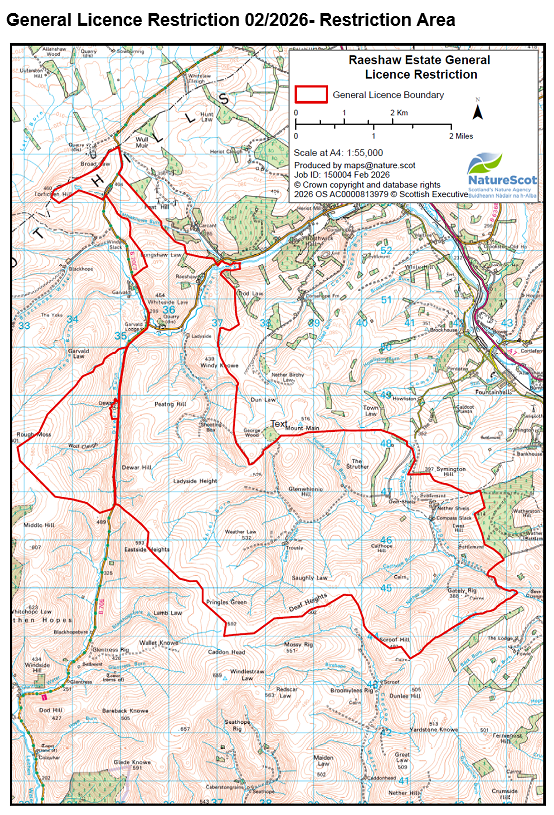
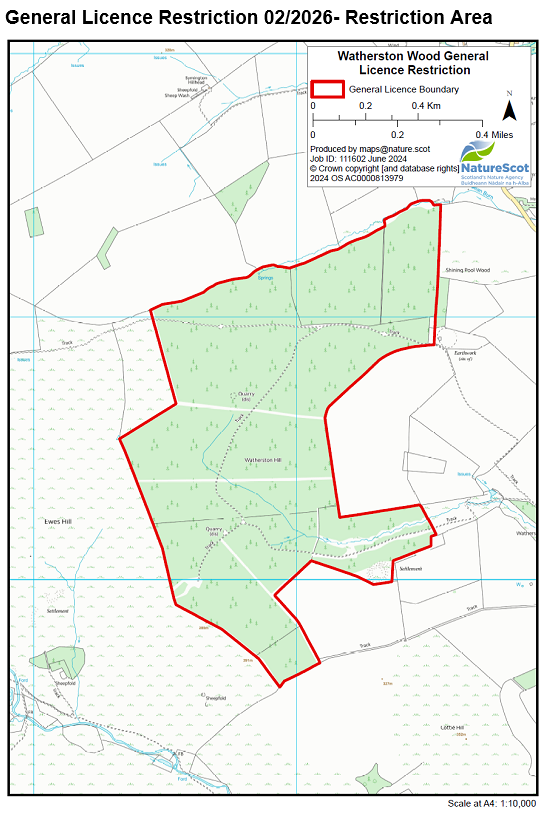
Grouse moor licensing hadn’t been introduced at the time Merrick was ‘shot and killed’ and can’t be applied retrospectively so in the absence of a grouse shoot licence withdrawal, and the absence of a prosecution, that leaves a General Licence restriction as the only possible sanction that NatureScot could impose.

Not that I’d describe a GL restriction as an effective sanction, for reasons that have been explored previously on this blog (e.g. here and here). Nevertheless, it’s still something and, given the high-profile of Merrick’s death, you might think that making a decision on whether to impose a GL restriction would be a high priority for NatureScot.

But apparently, it’s not.

In June this year, I submitted an FoI to NatureScot to find out what was happening in relation to this potential GL restriction, as we head towards the two-year anniversary of Merrick’s killing. NatureScot replied in July with this:

We have received an information package from Police Scotland to this case, and it is currently under consideration‘ (see here for earlier blog).

I submitted another FoI in July and asked Naturescot:

Please can you advise the date on which NatureScot received the information package from Police Scotland?‘.

NatureScot responded this month, as follows:

We can confirm that we received an initial information package from Police Scotland on 18 April 2024, then additional information on 3 May 2024‘.

April 2024?? That’s 16 months (and counting) that NatureScot has been procrastinating on this. It hardly inspires confidence, does it?

And the shooting and killing of a sleeping Golden Eagle isn’t the only raptor persecution case that’s awaiting a potential GL restriction decision. There are at least two others that I’m aware of – I’ll write about those in a separate blog because the cause of the delays in those two cases appears to lie at the feet of Police Scotland.

UPDATE 30 September 2025: 17 months (&waiting) for NatureScot to make decision on General Licence restriction relating to ‘shooting & killing’ of a sleeping Golden Eagle called Merrick (here)

Disappearance of two tracked Pine Martens being treated as ‘suspicious’ – Cumbria Police appeals for information

This all sounds horribly familiar.

A short article appeared on the BBC News website on 5 August 2025 as follows:

The disappearance of two tracked pine martens is being treated as suspicious, police said.

Cumbria Police and South Cumbria Pine Marten Recovery Project are appealing for information to help trace the rare animals that were released near Grizedale Forest earlier this year.

It is believed one of the mammals has two dependent kits.

Tracking them is part of a University of Cumbria-led scheme to reintroduce the species to south Cumbria and the loss “could compromise their recovery”, Cumbria Police said.

Pine martens are protected under the Wildlife and Countryside Act 1981 and it is an offence to intentionally or recklessly kill, injure or take them.

It is also an offence to damage their habitat.

Anyone with information has been urged to contact the force.

ENDS

Pine Marten photo by Pete Walkden

The South Cumbria Pine Marten Recovery Project is a dynamic regional partnership led by the University of Cumbria and includes the Upper Duddon Landscape Recovery Project led by the University of Leeds, Natural England, Cumbria Wildlife Trust, Lake District National Park Authority, Forestry England and the Graythwaite Estate.

The Project is translocating Pine Martens from Scotland to south Cumbria as part of a coordinated national recovery scheme for this species.

Released Pine Martens are fitted with VHF-radio collars for tracking, and the team also uses camera traps, den boxes and scat analysis for monitoring.

Stand by to read the usual excuses for these suspicious disappearances, from the usual suspects – windfarms, faulty tags, it’s all a set up by anti-game-shooting extremists, the Pine Martens never existed in the first place, tag data serve no other purpose than to entrap gamekeepers etc etc.

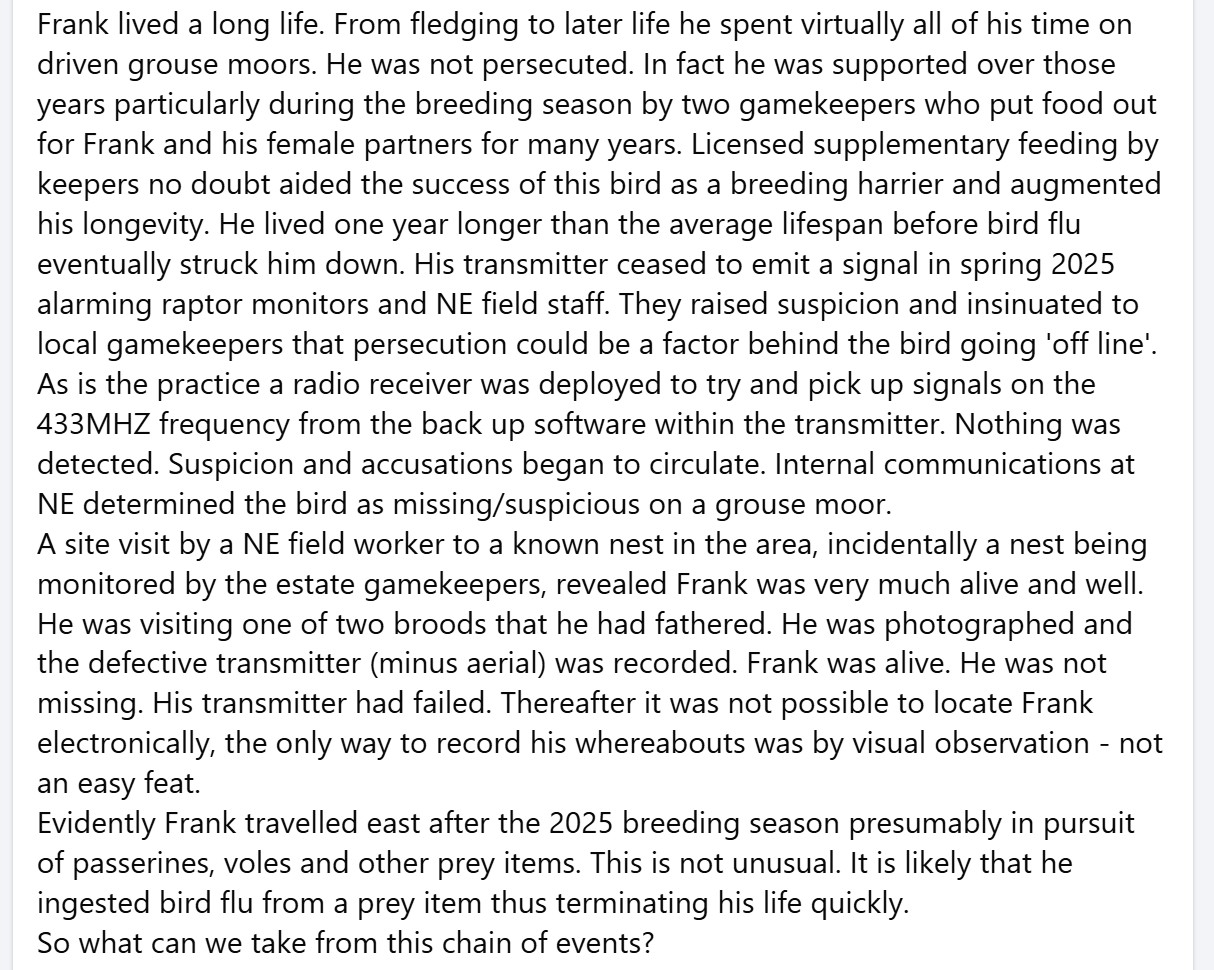
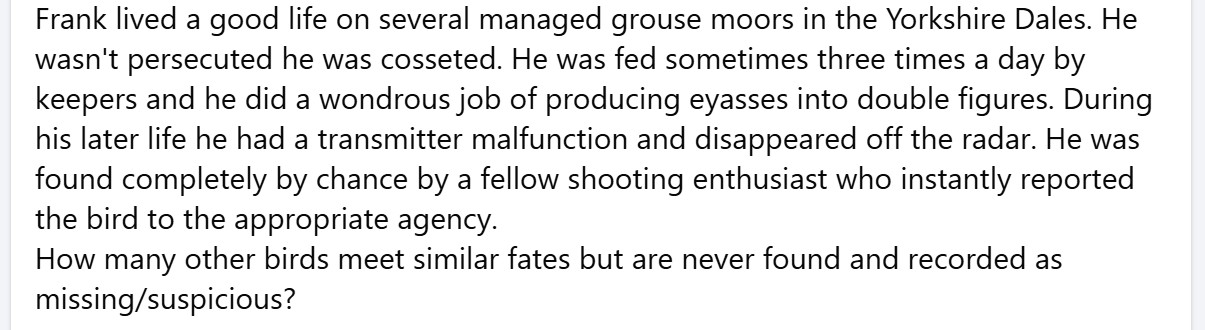
How can the National Gamekeepers Organisation be seen as a credible partner on the Hen Harrier Taskforce after it published this nonsense?

The police-led Hen Harrier Taskforce was launched in 2024 to tackle the ongoing illegal persecution of Hen Harriers on UK grouse moors.

The Taskforce was set up specifically in response to the ‘all time high’ level of Hen Harrier persecution crimes in 2022/2023 (at least 21 known incidents in 2022 and at least 33 known incidents in 2023). The extent of the criminality had become a major source of embarrassment for the police and for the government and they needed to be seen to be doing something.

The main premise of the HH Taskforce is summarised in this excerpt from the press release announcing the launch:

The Hen Harrier Task Force is an initiative led by the UK National Wildlife Crime Unit and supported by seven police forces (Cumbria, Derbyshire, Durham, Northumbria, North Yorkshire, South Yorkshire and West Yorkshire), DEFRA, the RSPB, National Gamekeepers’ Organisation, British Association for Shooting and Conservation (BASC), The Wildlife Trusts, GWCT, national parks, Country Land and Business Association (CLA), Natural England and The Moorland Association to combat the persecution of hen harriers in the UK. The taskforce aims to detect, deter, and disrupt offenders involved in wildlife crime by using technology and improving partnership working’.

You’ll note the heavy over-representation of game shooting organisations in this so-called ‘partnership’, including the National Gamekeepers Organisation and the Moorland Association (lobby group for England’s grouse moor owners).

However, several months after the launch, the Moorland Association (or at least its Chief Executive, Andrew Gilruth) was expelled from the Raptor Persecution Priority Delivery Group (RPPDG) and presumably that includes the Hen Harrier Taskforce, for ‘wasting time and distracting from the real work‘ of the RPPDG (see here).

After reading what I’m about to write in this blog, you might be wondering how the National Gamekeepers Organisation can be viewed as a credible ‘partner’ in the RPPDG and on the Hen Harrier Taskforce.

On 26 June 2025, the RSPB published its latest damning report about the extent of Hen Harrier persecution on driven grouse moors across the UK. Called ‘Hen Harriers in the Firing Line‘, the report demonstrated that record numbers of Hen Harriers were illegally killed or went ‘missing’ in suspicious circumstances during the years 2020-2024.

The following day, the National Gamekeepers Organisation posted this response in the News section of its website:

The article starts off well with a statement of truth. That is, that wildlife crimes are ‘non-notifiable’, in England & Wales at least, which means that wildlife crime figures are not officially collected at a national level by the Home Office. (In Scotland, wildlife crime recording became a statutory obligation under the Wildlife and Natural Environment (Scotland) Act 2011).

Most wildlife crimes in England & Wales are recorded as ‘miscellaneous’ offences and are therefore invisible in police records, with no duty to be reported upon. This problem has been the subject of a long-running campaign by Wildlife & Countryside LINK (e.g. here), and others, who for several years now have been urging the Home Office to make at least certain wildlife crimes (i.e. those associated with the National Wildlife Crime Priorities) notifiable so that there’s a better record of offences, allowing police resources to be applied appropriately. If the scale of a crime isn’t known, Police and Crime Commissioners are hardly going to allocate what are already tight police budgets towards tackling a crime that doesn’t look like it has any significance.

So having recognised and acknowledged that police forces don’t have to keep records of wildlife crime offences, the National Gamekeepers Organisation (NGO) then inexplicably announces that it has sent FoIs to all UK police forces to seek information on Hen Harrier persecution incidents.

Eh??!! Where’s the logic in that??

The stupidity doesn’t end there. It gets worse.

Let’s assume that the NGO did write FoIs to all 48 UK police forces and received responses from all of them (highly unlikely to get a 100% return rate but let’s go with it for now). Take a look at this particular statement in the NGO’s news article:

The NGO states that, ‘Having carried out Freedom of Information requests the NGO can state that from 2020 through to 2023, the police across all UK forces recorded eight Hen Harrier investigations in total. One was in Cumbria and the other 7 in Northumberland. Foul play was not cited by the police in any investigation‘. [Emphasis is mine].

Really? According to my data on Hen Harrier persecution recorded between 2020 – 2023, there were 82 recorded incidents across eight UK regions (North Yorkshire & Cumbria: 45; Northumberland: 12; County Durham: 11; Scotland: 7; South Yorkshire: 3; Lancashire: 3; Isle of Man: 1).

That’s quite a few more incidents, and is far more widespread, than the NGO’s claim of 8 incidents in just two police force areas.

The vast majority of those 82 incidents involved the suspicious ‘disappearance’ of satellite-tagged Hen Harriers. The number doesn’t include tags that have been listed as no longer transmitting as a result of possible tag failure, or birds that are known to have died a natural death. The National Wildlife Crime Unit, which leads the Hen Harrier Taskforce (on which the NGO serves so should be fully aware), explicitly uses satellite tag data to identify crime hotspots, i.e. locations where Hen Harriers repeatedly disappear in suspicious circumstances. Here’s another relevant excerpt from the Hen Harrier Taskforce launch press release:

Rather than purely focusing on the wildlife aspect of the crime, DI Harrison has tasked his team with taking a holistic view of the criminality and considering all types of offences. Criminals will often steal and destroy the satellite tags to conceal their offending. This could constitute criminal damage, theft and fraud. In the last few years alone, £100,000 worth of satellite tags have been lost in circumstances suspected to be criminal. The apparent use of firearms adds a further level of seriousness to these cases’. [Emphasis is mine].

For the NGO to use the line, ‘Foul play was not cited by the police in any investigation‘ is misleading at best.

Further, in amongst those 82 incidents recorded between 2020 – 2023 are a number of Hen Harriers where police investigations and post mortems explicitly detected ‘foul play’ (I prefer to call it crime, because that’s what this is). These are:

  • 10 February 2022: An unnamed satellite-tagged Hen Harrier ‘disappeared’ in a grouse moor dominated area of the Peak District National Park (here). One year later it was revealed that the satellite tag/harness of this young male called ‘Anu’ had been deliberately cut off (see here).
  • 12 April 2022: Hen Harrier ‘Free’ (Tag ID 201121) ‘disappeared’ at a ‘confidential site’ in Cumbria (here). It later emerged he hadn’t disappeared, but his mutilated corpse was found on moorland in the Yorkshire Dales National Park. A post mortem revealed the cause of death was having his head twisted and pulled off while he was still alive. One leg had also been torn off whilst he was still alive (here).
  • 20 June 2022: Hen harrier chick #1 stamped to death in nest on a grouse moor in the Yorkshire Dales National Park (here).
  • 20 June 2022: Hen Harrier chick #2 stamped to death in nest on a grouse moor in the Yorkshire Dales National Park (here).
  • 20 June 2022: Hen Harrier chick #3 stamped to death in nest on a grouse moor in the Yorkshire Dales National Park (here).
  • 20 June 2022: Hen Harrier chick #4 stamped to death in nest on a grouse moor in the Yorkshire Dales National Park (here).
  • 14 December 2022: Hen Harrier female (brood meddled in 2022, #R3-F1-22) ‘disappeared’ from winter roost (same as #R2-F2-20) on moorland in the North Pennines AONB (here). Later found dead with two shotgun pellets in corpse (here).
  • 9/10 May 2023: Hen Harrier male called ‘Dagda’, tagged by the RSPB in Lancashire in June 2022 and who was breeding on the RSPB’s Geltsdale Reserve in 2023 until he ‘vanished’, only to be found dead on the neighbouring Knarsdale grouse moor in May 2023 – a post mortem revealed he had been shot (here).
  • 29 July 2023: Hen Harrier female (brood meddled in 2020, R2-F2-20) ‘disappeared’ at a confidential site in the North Pennines. Later notes from the NE spreadsheet: “Dead. Recovered – awaiting PM results. Final transmission location temporarily withheld at police request“ (here). Later report stated she’d been found dead with 3 shotgun pellets in corpse (here).

So, clearly the police forces that allegedly responded to the National Gamekeeper Organisation’s FoI requests haven’t been accurately recording Hen Harrier persecution crimes (because they don’t have to) but regardless of that, for the NGO to take that misinformation at face value, when (a) it knows that these crimes are not notifiable so individual police force records have to be viewed as unreliable, and (b) the NGO would have been fully aware of these high profile crimes (because they were all over the press and they’d also have been raised at the RPPDG meetings in which the NGO is a participant) can be viewed as either a measure of the NGO’s stupidity or what I see as an indication of its willingness to deceive.

What’s even more revealing is the lengths the NGO will go in its efforts to tarnish the RSPB’s reputation. Why submit FoI requests to 48 UK police forces to ask for Hen Harrier persecution data when you’re already a member of the RPPDG and the Hen Harrier Taskforce, where those persecution data are reliably recorded and readily available?

The whole premise of the NGO’s ‘news article’ seems to me to be using obviously unrepresentative data it received from an unspecified number of police forces to smear and undermine the reputation of the RSPB. You could paraphrase the NGO’s whole article as:

Aha! The RSPB’s Hen Harrier persecution data are clearly fabricated because all UK police forces only recorded eight Hen Harrier persecution incidents in two force areas between 2020 and 2023. There, we told you the RSPB make up the data just to make us gamekeepers look bad. You can’t believe a word the RSPB says. We love all raptors and especially Hen Harriers‘.

It’s half-baked nonsense and exposes the National Gamekeepers Organisation’s real intentions.

The NGO suggests that the RSPB is fabricating persecution data “to damage the public perception of gamekeepers” when actually it’s the NGO mispresenting information to damage the reputation of the RSPB. The NGO is right to suggest that the public’s perception of gamekeepers is poor, but that’s because gamekeepers are consistently linked to raptor persecution crimes. If gamekeepers want to improve their reputation it’s quite simple – stop killing birds of prey.