Crown Office drops third prosecution in two weeks

Two weeks ago, we blogged about how the Crown Office & Procurator Fiscal Service (COPFS – the public prosecutors in Scotland) had dropped a long-running vicarious liability prosecution against landowner Andrew Duncan, who was alleged to have been vicariously liable for the crimes of his gamekeeper, who had killed a buzzard on the Newlands Estate in 2014. When pressed for a reason behind the decision to drop the vicarious liability case, the Crown Office said it was “not in the public interest to continue” but did not provide any further detail of how, or why, that decision had been reached (see here).

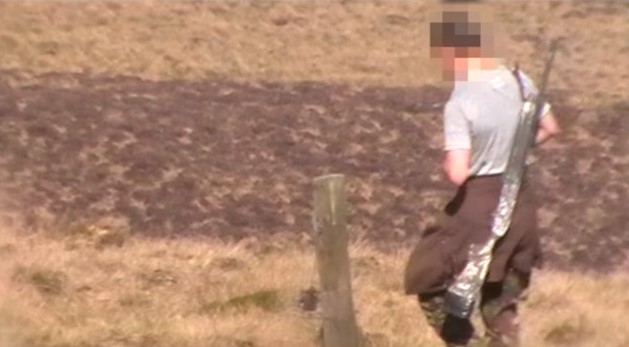
Ten days later, we learned that the COPFS had dropped another long-running prosecution, this time against gamekeeper Stanley Gordon who was alleged to have shot a hen harrier on the Cabrach Estate in 2012. No explanation was given for this decision.

And now today, we have learned that the COPFS have dropped another long-running prosecution, this time against Angus Glens gamekeeper Craig Graham who was alleged to have set and re-set an illegal pole trap on the Brewlands Estate in 2015. Again, no explanation has been given for this decision.

That’s three high profile prosecutions for alleged raptor persecution crimes, dropped within a two week period, with no explanation why.

One long-running case being dropped would raise an eyebrow; a second long-running case dropped a few days later would cause concern, but three long-running cases, all dropped within a fortnight, all on the eve of an actual trial? That is highly suspicious, even for the most unassuming observer.

Was it incompetence on the part of the COPFS? That is surely a possibility, especially as each of these cases has been running for months, at huge cost to the public purse. Why did it take so long to decide to abandon each case? Was it an issue with video evidence? We’ve been there before, although we’ve also seen successful prosecutions based on video evidence. If it was an issue with video admissibility (and we don’t yet know if it was, so this is just speculation), why did it take so long to reach that decision and anyway, wouldn’t admissibility be an issue for the court to decide, not the prosecutor? Was there another reason for discontinuing these cases? We don’t know, because the Crown Office is saying nothing.

Whatever it was, the discontinuing of these three cases will cause huge damage to public confidence in the Scottish criminal justice system. What do you have to do to get someone to stand trial for alleged raptor persecution in Scotland? We know how difficult it is to identify a named suspect, and we know that the evidential threshold is set extraordinarily high for this sort of crime, so when you do manage to secure enough evidence to charge and then prosecute somebody, it is massively frustrating to (a) see the cases dropped and (b) not be told why.

What is clear amongst all this murkiness is that the current system is not fit for purpose. This series of discontinued prosecutions just adds more grist to the mill for the introduction of a licensing system, and for basing that system on the civil burden of proof.

Meanwhile, we’re looking forward to the release of the video footage……

Vicarious liability prosecution abandoned as ‘not in public interest to continue’

Last week we blogged about the Crown Office dropping all proceedings against landowner Andrew Walter Bryce Duncan, who was alleged to be vicariously liable for the criminal actions of his gamekeeper, William (Billy) Dick in April 2014.

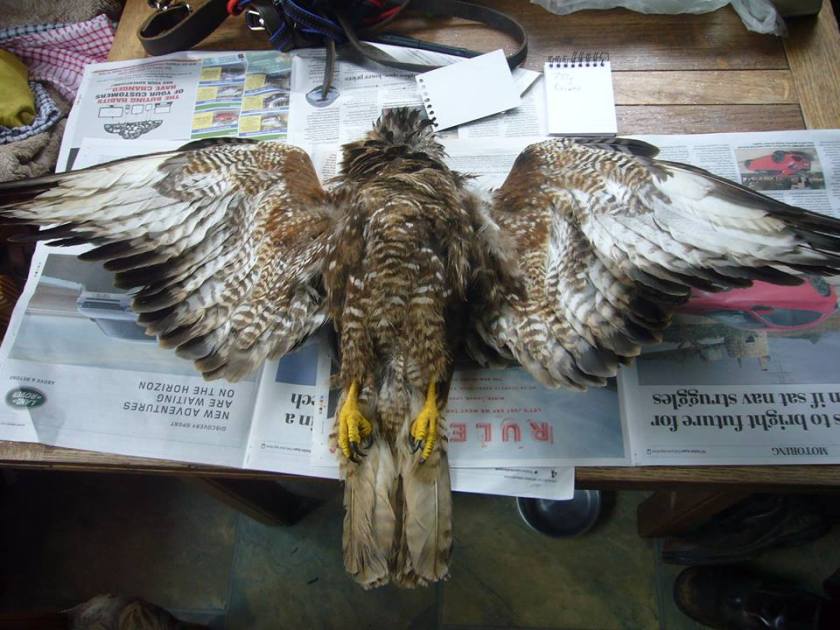
Gamekeeper Dick was convicted in August 2015 of killing a buzzard on the Newlands Estate, Dumfriesshire by striking it with rocks and repeatedly stamping on it (see here). Mr Dick was sentenced in September 2015 and was given a £2000 fine (see here). Mr Dick appealed his conviction but this appeal was rejected on 15 July 2016 (see here).

The Crown Office & Procurator Fiscal Service (COPFS) began vicarious liability proceedings against Mr Duncan in August 2015 but the case was repeatedly adjourned (a total of 13 court hearings) with two trial dates assigned but then later dropped (see here). These repeated delays were due in part to gamekeeper Dick’s appeal against his conviction but in part for other reasons which have not been explained.

As the third trial date (24 April 2017) approached, we were somewhat surprised to learn last week that the case had been abandoned. We asked COPFS why this had happened and this is their response:

All cases are continually kept under review, and after taking consideration of the full circumstances of this case, and all of the available evidence, Crown Counsel concluded that it was not in the public interest to continue the case to trial.

COPFS remain committed to tackling raptor persecution and there is a strong presumption in favour of prosecution of the cases reported to us where there is sufficient evidence and it is in the public interest to do so“.

There is no detail about why proceeding to trial ‘was not in the public interest’ and indeed, the COPFS does not have to disclose this information. We do know that the COPFS Prosecution Code outlines a large number of factors that are to be considered for a public interest test, including:

  • The nature and gravity of the offence
  • The impact of the offence on the victim and other witnesses
  • The age, background and personal circumstances of the accused
  • The age and personal circumstances of the victim and other witnesses
  • The attitude of the victim
  • The motive for the crime
  • The age of the offence
  • Mitigating circumstances
  • The effect of prosecution on the accused
  • The risk of further offending
  • The availability of a more appropriate civil remedy
  • The Powers of the court
  • Public concern

Without knowing the specific details of the evidence in this case it is pointless to speculate about why the case was abandoned (and for anyone commenting on this post, please be careful not to libel Mr Duncan). We just have to accept that it was abandoned, as frustrating as that is, but we do hope that the COPFS will share some detail with the reporting agencies so that lessons can be learned for future cases.

Journalist Rob Edwards has written an interesting piece about the case, published today on The Ferret website (here), which includes some news about the Newland Estate’s membership of Scottish Land & Estates and its accredited membership of the SLE-administered Wildlife Estates Scotland initiative.

In a wider context, this abandoned case is highly significant. Contrary to the COPFS’ decision, there is huge and legitimate public concern and interest about wildlife crime enforcement, particularly in respect to raptor persecution crimes. The Scottish Government is keenly aware of this and has come under increasing pressure in recent years to introduce new measures to tackle the problem. Vicarious liability was one of those new measures (introduced on 1 January 2012) but to date, only two cases have resulted in a conviction: one in December 2014 (see here) and one in December 2015 (see here). Both related to raptor persecution on low ground shoots, not on intensively managed driven grouse moors where raptor persecution is known to still be a common occurrence. One further case in October 2015 did not reach the prosecution stage due, we believe, to the difficulties associated with identifying the management structure on the estate where the crimes were committed (see here).

Given the low success rate of vicarious liability, alongside the continued illegal persecution of raptors on game-shooting estates, it is clear that the Scottish Government needs to do more.

Tomorrow, the Scottish Parliament’s Environment Committee will hear evidence from the Scottish Raptor Study Group (Logan Steele & Andrea Hudspeth) in support of their petition to introduce a state-regulated licensing scheme for all game bird shooting in Scotland. Part of this licensing scheme would include provisions for sanctions against estates where raptor persecution takes place. Evidence will also be heard from various stakeholders including RSPB Scotland (Duncan Orr-Ewing), Scottish Gamekeepers’ Association (Andy Smith), SNH (Robbie Kernahan) and Scottish Land & Estates (David Johnstone). The evidence session begins at 10am and can be watched live on Scottish Parliament TV (here) and we’ll post the transcript when it becomes available later in the week.

Remember those illegal pole traps found set on Mossdale Estate?

Remember those three illegally-set pole traps that were found on the Mossdale Estate in the Yorkshire Dales National Park last year? (Photo: RSPB)

You know, the ones where a Mossdale Estate gamekeeper was filmed by the RSPB as he re-set them on posts on the grouse moor? (Photo: RSPB)

Yes, the gamekeeper who escaped with a police caution after a procedural blunder, instead of facing a full blown prosecution.

Well, guess what? Two of those traps had been used previously to illegally catch birds. How do we know? Because when those traps were seized from the Mossdale Estate, sharp-eyed and forensically-aware RSPB investigators suspected that they’d been used for trapping other birds. The traps were sent for expert examination at the Wildlife Forensics Unit at the SASA labs near Edinburgh and tests revealed the presence of kestrel DNA on one trap, and DNA from another (unidentified) falcon species on the other. (Photo: Guy Shorrock)

Unfortunately a prosecution was not possible as it wasn’t known where the traps had been used previously, when they’d been used, and by whom.

You can read more about this, and other DNA cases, on a fascinating RSPB Investigations blog written by Guy Shorrock and published earlier this afternoon (here).

Vicarious liability prosecution: case dropped (Andrew Duncan, Newlands Estate)

Regular blog readers will know that we’ve been tracking the vicarious liability prosecution of landowner Andrew Walter Bryce Duncan, who was alleged to be vicariously liable for the crimes committed by gamekeeper William (Billy) Dick in April 2014.

Gamekeeper Dick was convicted in August 2015 of killing a buzzard on the Newlands Estate, Dumfriesshire by striking it with rocks and repeatedly stamping on it (see here). Mr Dick was sentenced in September 2015 and was given a £2000 fine (see here). Mr Dick appealed his conviction but this appeal was rejected on 15 July 2016 (see here).

Vicarious liability proceedings against Mr Duncan began in August 2015 and the case has been repeatedly adjourned since then (a total of 13 court hearings) with two trial dates assigned but then later dropped (see here). These repeated delays were due in part to Mr Dick’s appeal against his conviction but in part for other reasons which have not been explained.

The third trial date (24 April 2017) looked set to go ahead but today we’ve learned that the Crown Office & Procurator Fiscal Service has dropped all proceedings. We do not yet know why the prosecution has been dropped.

Whatever the reason for dropping the prosecution, this result does not reflect well on the efficiency of wildlife crime enforcement measures in Scotland.

Vicarious liability in relation to the persecution of raptors in Scotland (where one person may potentially be legally responsible for the criminal actions of another person working under their supervision) came in to effect over five years ago on 1st January 2012 as a provision in the Wildlife and Natural Environment (Scotland) Act 2011. It was introduced as an amendment to the draft WANE Bill in November 2010 by the then Scottish Environment Minister, Roseanna Cunningham. It was a direct response to the unrelenting problem of illegal raptor persecution and the apparent inability/unwillingness of the game shooting lobby to get their own house (grouse moors) in order.

To date there have only been two successful prosecutions/convictions: one in December 2014 (see here) and one in December 2015 (see here). Both related to raptor persecution on low ground shoots, not on intensively managed driven grouse moors. One further case in October 2015 did not reach the prosecution stage due, we believe, to the difficulties associated with identifying the management structure on the estate where the crimes were committed (see here). And now this latest case has failed, for reasons as yet unknown.

Two successful prosecutions in five years is not very impressive, and won’t be much of a deterrent for those who continue to kill raptors safe in the knowledge that the probability of being caught, prosecuted and convicted is still virtually nil.

Court case continues for Angus Glens gamekeeper accused of alleged pole trapping offences

Criminal proceedings continued yesterday (28 March 2017) against Scottish gamekeeper Craig Graham.

Mr Graham, 51, is accused of allegedly setting and re-setting a pole trap, baited with a pheasant carcass, on the Brewlands Estate in the Angus Glens between 9-17 July 2015. He has denied the charges.

This case was first called on 31 March 2016, then on 22 April 2016, then on 12 May 2016 when Mr Graham pleaded not guilty. A provisional trial date was set for 9th September 2016.

This trial date was later dumped (at a hearing on 16 August 2016) and another provisional trial date was set for 5th December 2016. This was also later dumped and a third provisional date (at a hearing on 5 December 2016) was set for 15 May 2017.

At yesterday’s hearing, the case was adjourned, again, for a further intermediate diet scheduled for 25 April 2017. We don’t know whether the third provisional trial date of 15 May 2017 still stands – it depends what happens at the hearing on 25 April 2017.

Previous blogs on this case herehere and here

UPDATE 25 April 2017: The Crown Office has discontinued this case – see here.

Raeshaw Estate loses judicial review on General Licence restriction

In November 2015, the Scottish Government’s statutory conservation agency, Scottish Natural Heritage, imposed a General Licence restriction order on a number of estates where it was believed raptor persecution had taken place but there was insufficient evidence to prosecute any individual (see here).

These restrictions were the first to be imposed since this new enforcement measure became available on 1 January 2014.

Two of the four estates were in Stirlingshire (the grouse shooting Burnfoot Estate and neighbouring Wester Cringate Estate, where several poisoned raptors and an illegally-set trap had been found) and two were in the Scottish Borders (the grouse shooting Raeshaw Estate and neighbouring Corsehope Farm, where illegally-set traps had been placed).

The General Licence restriction on all four estates was to run from 13 November 2015 to 12 November 2018, which meant that certain types of ‘pest’ control were prohibited unless the Estates applied for a specific individual licence that would be subject to tighter controls.

Raeshaw Estate (and neighbouring Corsehope Farm, where ‘pest’ control is undertaken by Raeshaw gamekeepers) made a legal challenge against SNH’s decision and in February 2016 they petitioned for a judicial review.

A judicial review challenges a decision made by a public body (in this case SNH) and examines whether the right procedures have been followed (i.e. with procedural fairness, within the legal powers of the public body, and with rationality).

The judicial review was heard in January 2017 and we have been awaiting the court’s judgement. It was published yesterday and can be read here: Raeshaw judicial review decision

We don’t intend to discuss the details of the court’s judgement – you can read those for yourselves (but do pay attention to the bit about the homemade trap, identical to the illegally-set homemade trap placed out on the hill, found in the possession of one of the gamekeepers – it’s quite interesting), but in summary, the court decided that SNH had acted fairly and with due regard to the stated rationale for imposing a General Licence restriction as laid out in SNH’s framework for implementing restrictions. As we understand it, there is a right to appeal to a higher court so we’ll have to wait and see whether Raeshaw Estate decides to take this option.

For now, this judgement is very, very good news. We, and others, have been highly critical of SNH’s handling of the General Licence restrictions, particularly when they subsequently issued individual licences to Raeshaw and Corsehope which effectively circumvented the supposed sanction of the General Licence restriction (see here, here, here, here). Yesterday’s court judgement does not alter our view on that and we will continue to challenge SNH about the so-called ‘tighter controls’ on these individual licences.

However, what yesterday’s court judgement does (or should) do, is open the floodgates for further General Licence restrictions to be imposed on other estates where there is evidence of raptor persecution. We know that SNH has a backlog of cases, dating back to 2014, and they’ve been sitting on those, justifiably, while the judicial review process has been underway. Now that the Court of Session has validated SNH’s procedures for imposing General Licence restrictions, we hope they will get on with handing out some more.

UPDATE 11.30am: SNH press statement here

UPDATE 30 March 2017: Judgement on Corsehope Farm: Corsehope judicial review decision

Case against gamekeeper Stanley Gordon re: shot hen harrier, part 10

Criminal proceedings continued at Elgin Sheriff Court yesterday against Scottish gamekeeper Stanley Gordon.

Mr Gordon, 60, of Cabrach, Moray, is facing a charge in connection with the alleged shooting of a hen harrier in June 2013. He has denied the charge.

Here is the timeline of court proceedings so far:

Hearing #1 (19 May 2016): Case continued without plea until 16 June 2016.

Hearing #2 (16 June 2016): Case continued without plea until 14 July 2016.

Hearing #3 (14 July 2016): Case continued without plea until 11 August 2016.

Hearing #4 (11 August 2016): Case continued without plea until 1 September 2016.

Hearing #5 (1 September 2016): Mr Gordon enters a not guilty plea. A provisional trial date is set for 19 December 2016, with an intermediate diet set for 18 November 2016.

Hearing #6 (18 November 2016): Case adjourned for another intermediate diet on 2 December 2016.

Hearing #7 (2 December 2016). Provisional trial date of 19 December is dumped. Case adjourned for another intermediate diet on 10 February 2017.

Hearing #8 (10 February 2017). Case adjourned for another intermediate diet on 21 March 2017. New provisional trial date set for 15 May 2017.

Hearing #9 (21 March 2017). Case adjourned due to joint motion from both prosecution and defence to review recent disclosure. Another intermediate diet set for 21 April 2017. The provisional trial date of 15 May 2017 will be dependent on what happens at the hearing on 21 April.

UPDATE 21 April 2017: All proceedings dropped (see here).

RSPB offers £1,000 reward for info on two shot buzzards in North Yorkshire

A week ago we blogged about the discovery of two dead buzzards found in North Yorkshire (see here).

One had been found shot near East Lutton and the other one had been found shot near Helmsley in the North York Moors National Park.

The Northern Echo has now run with an article about these shootings (here) and the RSPB is offering a £1,000 reward for any information which leads to a successful conviction.

Conversely, the Yorkshire Post has published an article about the ‘value’ of gamekeepers in North Yorkshire (see here). One of the gamekeepers, Michael Wearmouth from the Rosedale and Westerdale Estate, is quoted: “Mr Packham and others who don’t understand shooting at all are trying to make everybody hate us“.

Nope, sorry Michael, it’s not Chris Packham et al at whom who you need to be pointing the finger, it’s the criminals from within your own industry who are causing public outrage by continuing to kill birds of prey, over 60 years since it became an offence. Just last year an horrifically injured buzzard was discovered on a Westerdale grouse moor and it wasn’t an isolated crime. North Yorkshire continues to hold the record for the highest number of reported raptor crimes in the UK.

Scarecrow placed at peregrine breeding site on Northumberland grouse moor

An interesting case highlighted in the latest edition of the RSPB’s Legal Eagle newsletter:

1,000 birds killed despite General Licence Restriction at Raeshaw Estate / Corsehope Farm

Regular blog readers will know that in November 2015, SNH issued two General Licence restriction orders on the Raeshaw Estate and neighbouring Corsehope Farm in the Scottish Borders (see here). This was in response to alleged raptor persecution crimes (see here), although there was insufficient evidence to proceed with a prosecution and the estates have denied any responsibility.

The General Licence restriction orders were supposed to last for three years, starting 13 November 2015 and ending 12 November 2018. However, since being implemented, these restriction orders have been on and off as Raeshaw Estate mounted a legal challenge against their use. This legal challenge resulted in a judicial review, which was heard in January 2017, and we await the court’s findings.

Meanwhile, unbelievably, SNH issued two so-called ‘individual licences’ (see here) – one to Raeshaw Estate and one to Corsehope Farm, allowing the gamekeepers to continue the activities they would have undertaken had the General Licence restriction orders not been imposed (i.e. killing so-called ‘pest’ bird species). In our view (here) this was a ludicrous move because it totally undermined the supposed ‘sanction’ of the General Licence restriction. RSPB Scotland shared our view (see here).

SNH responded by saying the individual licences represented “robust regulation” (see here) and argued that the use of the individual licences would be “closely monitored” and that the gamekeepers would be “under tighter supervision” than they would have been if using a General Licence (see here).

As a reminder, here are copies of the two individual licences:

Raeshaw Estate individual licence here (valid 10 June 2016 – 31 December 2016)

Corsehope Farm individual licence here (valid 1 July 2016 – 31 December 2016)

As a condition of each individual licence, the estates had to submit to SNH, within one month of the licence expiry date, a log of all activities undertaken under each licence.

Last month we submitted an FoI to SNH asking for copies of these logs, as well as asking for details of the number of visits SNH staff  had made to the two estates to check for licence compliance (you know, that ‘close monitoring’ and ‘tight supervision’ SNH had been promising). What we discovered validates all our earlier concerns about this so-called ‘sanction’.

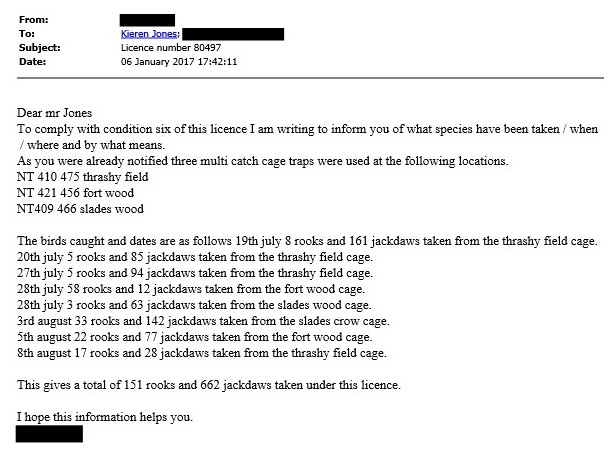
Here are the two logs submitted to SNH by the gamekeepers, detailing what species they’d killed, where, and when. The first log is for three crow cage traps placed on Raeshaw Estate and the second log relates to a single crow cage trap situated on Corsehope Farm (believed to be operated by Raeshaw Estate gamekeepers):

In total 294 rooks and 706 jackdaws were killed between 19 July and 25 August 2016. This amounts to 1,000 birds.

SNH staff undertook one compliance check visit for each estate. Both visits took place on 25 August 2016. The visit to Raeshaw Estate took 2.5 hours and the visit to Corsehope Farm lasted for one hour.

We’ve mapped the position of the four crow cage traps (note that the grouse moor at Raeshaw Estate lies directly to the west of these traps (the dark brown area).

These findings raise a number of questions and further concerns:

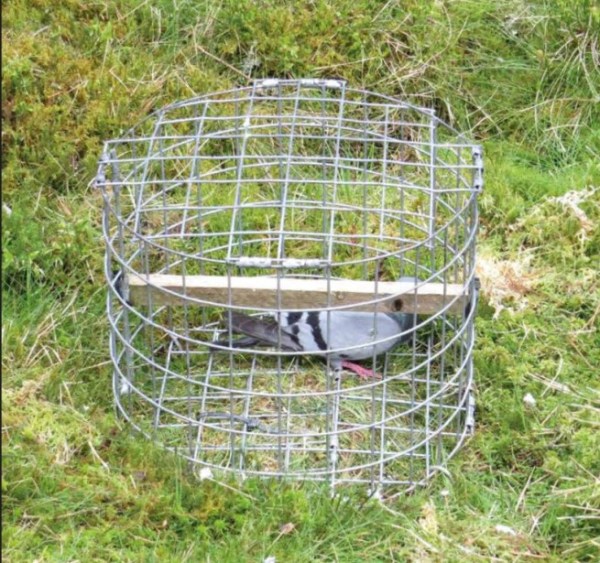
  1. The licence returns only refer to two species of birds that were caught and killed using four crow cage traps. Are we to believe that no other form of avian ‘pest control’ took place on either land holding between 10 June and 31 December 2016 (the duration of the individual licences)?
  2. For what ‘purpose’ were 294 rooks and 706 jackdaws killed? According to the individual licences (see above), the purpose was to “Prevent serious damage to livestock, foodstuff for livestock, crops, vegetables, fruit, growing timber, fisheries or inland water” and in the case of the Corsehope Farm individual licence, also to “prevent the spread of disease“. Can SNH explain the specific purpose of allowing these birds to be lawfully killed (i.e. if it was to protect livestock, what was the livestock and what threats do rooks and jackdaws pose? If it was to protect crops, what sort of crop and what threats do rooks and jackdaws pose? etc etc).
  3. What steps did SNH take to ensure that these 1,000 birds were not killed in order for the estates to produce artificially high densities of gamebirds for shooting? (This would be illegal).
  4. Why were 294 rooks allowed to be killed when this species has suffered a 37% decline in Scotland between 1995-2014, which would trigger a formal Amber listing if the listing criteria were applied at a Scottish level instead of a UK level (as pointed out to SNH by RSPB Scotland here)?
  5. Does SNH believe that one visit (per estate) for the duration of these six-month long individual licences equates to “close monitoring“, “tighter supervision” and “robust regulation“. If so, how?
  6. What did SNH staff do on their 2.5 hour visit to Raeshaw Estate? Did they just visit the three known crow cage traps or did they search the rest of this 9,000 acre estate to search for unlicensed (and thus illegal) traps?
  7. What did SNH staff do on their one hour visit to Corsehope Farm? Did they just visit the one known crow cage trap or did they search the rest of this farm for unlicensed (and thus illegal) traps?
  8. Are we still expected to believe that a General Licence restriction order is an effective sanction for alleged raptor persecution crimes, and if so, how?

We’ll be asking these questions to the SNH licensing team. If you want to join in, here’s their email address: licensing@snh.gov.uk