Whernside Estate retains membership of Moorland Association

Following on from yesterday’s news that gamekeeper Timothy Cowin had been convicted for shooting and then sadistically stamping to death two protected short-eared owls on a grouse moor on the Whernside Estate in the Yorkshire Dales National Park (see here), public anger has been justifiably prominent.

Many have commented on Cowin’s pathetic sentence (a £1,210 fine) but there has also been considerable commentary on social media about why the landowner hasn’t also been prosecuted.

If these crimes had taken place in Scotland, there would have been an opportunity to prosecute the landowner and/or shooting agent for alleged vicarious liability, following the introduction of the WANE Act 2011. Although in Scotland a prosecution may not have followed automatically, especially if the landowner and/or agent was able to show due diligence, or if the landowner couldn’t be identified, or if the prosecutors deemed it wasn’t in the public interest to proceed. Since the legislation was enacted on 1 January 2012, six and a half years ago, there have only been two successful prosecutions for vicarious liability in relation to raptor persecution (here and here); two others have failed (here and here) and others simply haven’t been considered for reasons that haven’t been made clear to us (e.g. see here).

However, as Whernside Estate is in the Yorkshire Dales National Park, not in Scotland, there is no hope that a prosecution for alleged vicarious liability will follow in this case.

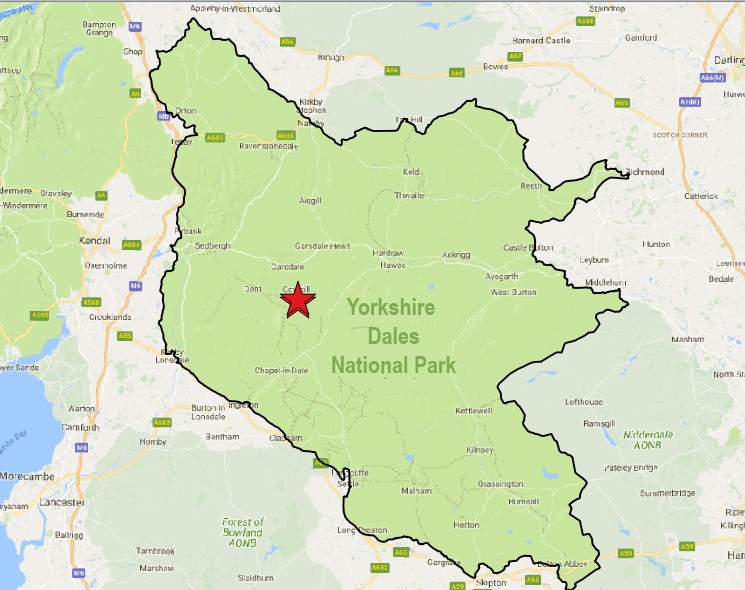
[RPUK Map showing location of Whernside Estate, which is located in the county of Cumbria but also lies within the boundary of the Yorkshire Dales National Park]
So with no prospect of a further prosecution, the least that could be expected would be for the grouse moor owners’ lobby group, the Moorland Association, to expel the Whernside Estate from the ranks of its membership, right?

Well, no. The Moorland Association has done the exact opposite and has instead chosen to publish a statement in support of Whernside Estate and confirmed the estate’s continued membership in the Moorland Association:

Amanda Anderson’s justification for not expelling Whernside Estate rests with the Moorland Association’s “satisfaction” that the estate had taken “all appropriate measures” to ensure its staff acted within the law and this included written correspondence between the estate and gamekeeper Cowin. Without seeing this correspondence it’s impossible to know whether this evidence would have been sufficient to meet the standards of due diligence required as a defence against vicarious liability in Scotland. It’s our understanding that in Scotland, this correspondence may not be enough to demonstrate due diligence, and other measures may also be required such as the landowner and/or agent undertaking spot checks on their employees and having a written record of those checks.

It’s fairly apparent from the detail we do know about Cowin’s case that had adequate spot checks been undertaken, questions would have been raised about Cowin being in possession of a plastic peregrine decoy, and importantly, his possession of a calling device that had been loaded with the calls of several raptor species, presumably to be used to entice raptors, perhaps towards a plastic decoy, where they could then be shot at close range.

Unfortunately we’ll never get to hear about the details of the estate’s claimed supervision of Cowin because, as there’s no provision for a potential prosecution for alleged vicarious liability in relation to raptor persecution in England, the estate doesn’t have to present this information to the authorities for scrutiny. We only have the word of the Moorland Association, which, of course, has a long track record of denying the bleedin’ obvious.

But let’s take the word of the Moorland Association, and the Whernside Estate, at face value and assume that Cowin’s crimes were as abhorrent to them as they are to the rest of us. That leads to a very interesting question. Two questions, in fact.

Firstly, no matter what claims the Moorland Association makes in all these so-called ‘partnership’ meetings trying to combat illegal raptor persecution, the Moorland Association, and its members, have absolutely no control or influence over gamekeepers working on grouse moors. Cowin is a perfect example of this. If, as the MA and the Whernside Estate claims, Cowin had undergone training, refresher training, and had signed an employment contract undertaking to work within the law, he STILL went on to commit these crimes. So what, exactly, is the point of the Moorland Association attending these ‘partnership’ meetings if it can’t offer any guarantees that gamekeepers won’t kill raptors on grouse moors?

[Gamekeeper Cowin, leaving Whernside Moor after shooting and stamping on two short-eared owls and hiding their corpses. Photo by Guy Shorrock]

Secondly, if the Whernside Estate was “dismayed” at Cowin’s actions of shooting and then stamping on those two short-eared owls, and being in possession of a calling device with raptor calls loaded on to it, did the Whernside Estate pay for Cowin’s legal representation?

Cowin’s solicitor was Michael Kenyon. Mr Kenyon was unlikely to have been a random duty solicitor called in to the police station to represent Cowin when he was questioned and later charged. Mr Kenyon is a well known figure in the game shooting world and is considered a ‘leading expert’ in firearms law and wildlife crime and once served as the legal advisor to the National Gamekeepers’ Organisation (see here) so it seems likely that he was chosen specifically to defend Cowin based on his expertise.

We had thought that perhaps Cowin’s legal representation costs had been covered by his presumed membership of the National Gamekeepers’ Organisation, especially given Mr Kenyon’s links, but according to a tweet from the NGO this morning, Cowin “was not and never has been a member of the NGO“. So it would seem unlikely the NGO paid.

Did Cowin himself pay for Mr Kenyon’s legal services? Perhaps, but this seems unlikely given what the court heard yesterday about Cowin’s financial means.

Was Cowin a member of another ‘professional’ group whose membership dues include the cost of legal representation if faced with a prosecution in relation to gamekeeping activities? We don’t know.

Did the Whernside Estate pay for Cowin’s legal representation? We don’t know that either, but we do know that somebody accompanied Cowin to several court appearances and although we cannot identify that person, it was suggested to us that it was Cowin’s boss. It may well have been, as he was certainly chatty with Mr Kenyon, heard discussing the number of grouse available to shoot on Mossdale Estate (remember them?), but equally as plausible is an explanation that it may have been a member of Cowin’s family attending court to support him.

Unfortunately we’ll never get to find out who paid for Cowin’s defence.

We were also interested in what the other ‘countryside’ organisations had to say about Cowin’s conviction. Would they all be condemning his actions and saluting the efforts of the RSPB et al in securing a successful outcome? Here’s what we found, at the time of writing this blog:

GWCT – silence

BASC – silence

NGO – silence, apart from responding to a tweet to confirm Cowin was never a member.

Countryside Alliance – silence on Cowin’s conviction but leading with the news that the prosecution of three hunting group members for alleged hunting and wildlife crime offences had been dropped, and focusing on the “wasted public resources” by “animal rights extremists” in bringing this case to trial. Interesting – we could argue the same point about the amount of wasted public resources spent in Cowin’s case as it was dragged around five different courts in NW England before his eventual guilty plea.

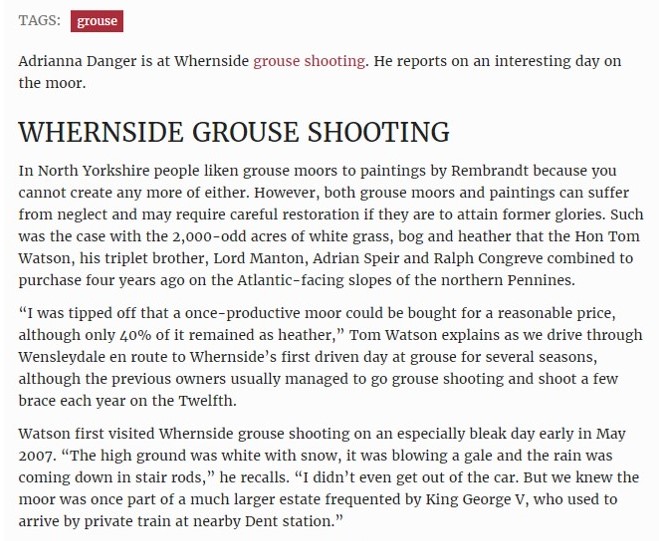
During our searches for commentary from the grouse shooting industry we did stumble across an article about grouse shooting on Whernside Estate that had been published in The Field magazine in 2012. Strangely, the article seems to have been removed from The Field’s website archives but fortunately we were able to find a cached version elsewhere. It makes for an interesting read, especially the bit about Headkeeper Tim Cowin working as a joiner!
UPDATE 31 August 2018: Whernside Estate: more reaction to gamekeeper’s conviction for shooting owls (here)

Gamekeeper convicted for killing two short-eared owls on grouse moor in Yorkshire Dales National Park

A gamekeeper was convicted at Lancaster Magistrates Court this morning for the killing of two short-eared owls on a grouse moor in the Yorkshire Dales National Park.

Timothy David Cowin, 44, pleaded guilty to shooting the owls on the Whernside Estate in Cumbria (inside the Yorkshire Dales National Park boundary) and to being in possession of a calling device that held the calls of several raptor species.

[Gamekeeper Cowin trying to leave the moor after shooting two short-eared owls. Photo by Guy Shorrock, RSPB]

His sentence? A pathetic £1,210, broken down as £400 for killing each short-eared owl, £200 for possessing the calling device, £170 costs and a £40 victim surcharge. The court heard that Cowin was suspended by the Whernside Estate pending the prosecution but then he later resigned and now apparently works as a joiner in Sedburgh.

Cowin committed these offences in April 2017 and was witnessed doing so by three members of the RSPB’s Investigations Team who just happened to be on the moor. The crimes were videoed (from a distance), and Cowin was observed shooting the owls, then stamping on them, and then disposing of the bodies – one hidden inside a stone wall and one stamped in to the peat. The quick-thinking RSPB team called the police, carried on filming, and one of them made his presence known to Cowin as Cowin tried to leave the moor, resulting in a chase across the hills before the police arrived to arrest him and retrieve the corpses.

For full details, have a read of this RSPB blog here.

And then watch this remarkable RSPB video:

We’ve blogged about this case previously (here), as it’s been dragged around five courts in north west England over a six-month period. At several stages it looked as though it was going to be abandoned on a legal technicality (paperwork issues this time, instead of contesting the admissibility of video evidence), as we’ve seen so often with other cases in recent years, and it is testament to the dedication of all those involved in the prosecution (RSPB, North Yorkshire Police Rural Taskforce, and the Crown Prosecution Service, who all put in extra hours) that it stayed on track and resulted in a conviction.

Of course it wouldn’t have got to court in the first place if it hadn’t been for the RSPB’s Investigations Team being on that grouse moor to install a covert camera for what had looked to them like previous suspicious activity. But just being there wouldn’t have been enough. The team was also skilled enough to recognise what Cowin was up to, quick-witted enough to film him, sharp enough to call the Police as the crime was in progress, and fit enough to chase Cowin across the moor when he was trying to escape. Added to their outstanding efforts was the swift response from North Yorkshire Police to get up to the grouse moor in time to arrest him. And then the dedicated, committed efforts of both the RSPB and the police to return early the next day to search for the second owl corpse before Cowin had an opportunity to get back on the moor and remove the evidence. In court, CPS prosecutor Rachel Parker was forensic in rebutting the attempts by the defence solicitor to have the case thrown out.

The actions of all involved in this successful prosecution were exemplary. Will the grouse shooting industry praise their efforts and encourage them to continue routing out the criminal gamekeepers known to be routinely committing these offences?

Unlikely.

We’ll no doubt hear the disingenuous bleating of the Moorland Association, GWCT, National Gamekeepers Organisation, Countryside Alliance etc, all condemning wildlife crime before swiftly returning to their usual criticism of the RSPB and its efforts to fight the continuing illegal persecution of raptors on driven grouse moors.

There are plenty more ‘Cowins’ out there, and despite the efforts of the grouse shooting industry to deny the extent of these crimes and pay for expensive lawyers to defend the criminals responsible, the public is becoming increasingly aware of how big a problem this is, through the efforts of the RSPB and its genuine conservation partners.

Today’s verdict doesn’t help those two short-eared owls; it’s too late for them, but Cowin’s conviction is yet another nail in the coffin of the driven grouse shooting industry. Kudos to all involved.

UPDATE 29 August 2018: Whernside Estate retains membership of Moorland Association (here)

UPDATE 31 August 2018: Whernside Estate: more reaction to gamekeeper’s conviction for shooting owls (here)
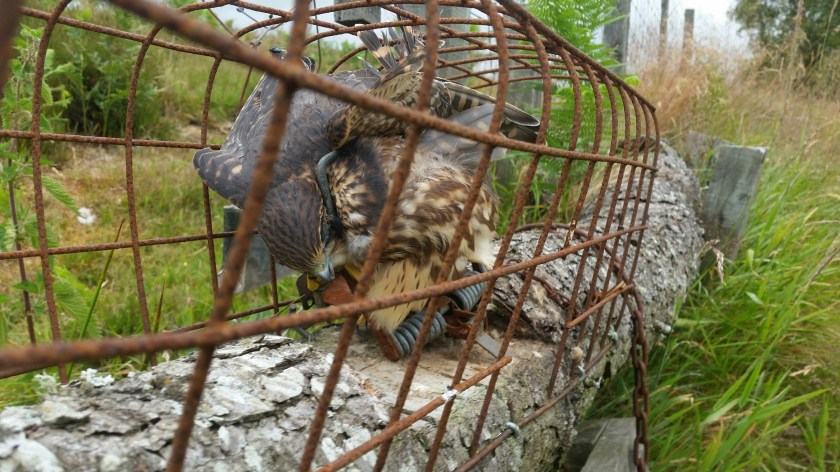
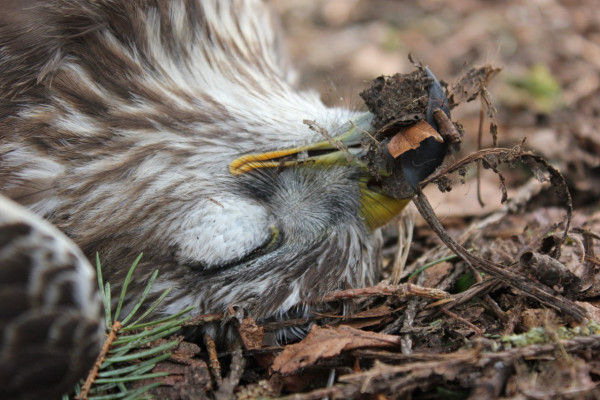
[PC Carr retrieving the pitiful corpse of the second short-eared owl that had been shot then stamped in to the ground. Photo by Guy Shorrock]

Two men charged in connection with wildlife crime investigation in Scottish Borders

A month ago we blogged about a Scottish gamekeeper who had been charged for a series of wildlife crime offences alleged to have taken place in the Scottish Borders (see here).

This morning Police Scotland has issued an official press statement in relation to this case, as follows:

Men charged in connection with wildlife crime investigation, Scottish Borders

Two men have been charged following an investigation into wildlife crime offences committed at a rural estate in the Scottish Borders.

The pair aged 59 and 57 are scheduled to appear in court at a later date.

END

It’s short on detail but it’s very good to see this case progressing.

Thanks to the person from the Police Scotland media team for alerting us to this news.

Gamekeeper cautioned after merlin killed in illegally-set trap on grouse moor

This merlin was found dead in a trap on an un-named driven grouse moor in Northumberland in July this year. A fell runner discovered the bird and reported it to the RSPB.

The RSPB went to the site the next day and realised that this trap had been illegally-set as no attempts had been made to restrict access to the tunnel entrance, meaning non-target species (such as this merlin) could easily access the tunnel, with the inevitable result.

The incident was reported to Northumbria Police and a wildlife crime officer visited the site with an RSPB investigator.

An ‘experienced’ gamekeeper was formally interviewed and admitted setting the trap. Unbelievably, the police decided to issue him with a police caution instead of seeking a prosecution via the Crown Prosecution Service.

Haven’t we been here before? Ah yes, here and here.

Once again, another gamekeeper gets let off for committing a wildlife crime on a driven grouse moor. And before anyone says, ‘A caution isn’t a let off’, it absolutely is if this gamekeeper is permitted to keep his firearms and shotgun certificates, and his job, despite now having a criminal record.

Sure, he probably didn’t intend to trap and kill this merlin but that’s not the point. If he’s employed as a professional gamekeeper he has a responsibility to operate his traps within the terms of the law. With this trap, he chose not to do that, knowing full well that a non-target species could be killed, which it was. That’s an offence and he should have been charged and prosecuted.

Further details about this merlin case can be read on the RSPB Investigations Team blog here

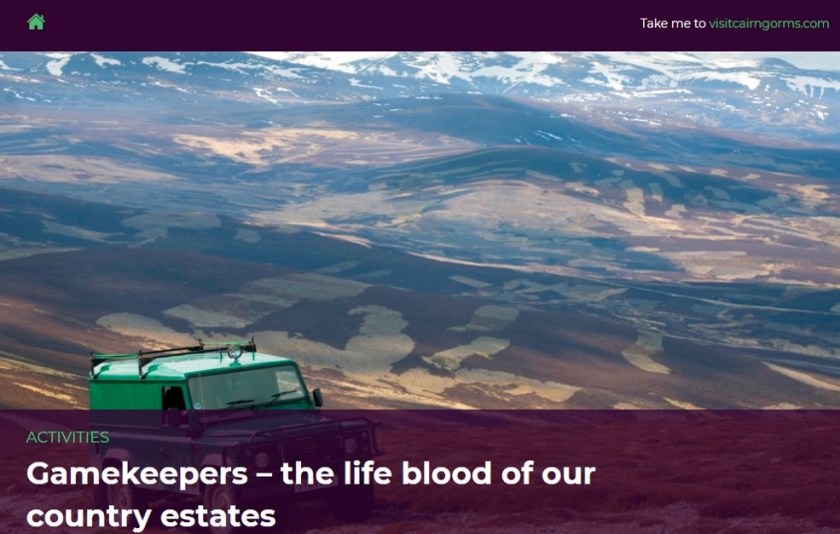
Good grief, Cairngorms National Park!

For those of us hoping to see a progressive move away from intensive grouse moor management inside the Cairngorms National Park, we may have a long wait.

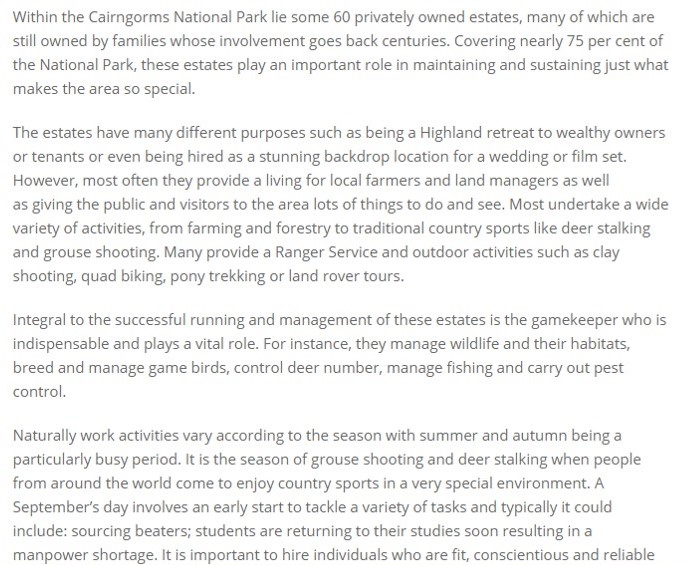
We’ve just found the following written on the VisitCairngorms website (‘the official website for the Cairngorms National Park’). It’s so bad it could have been written by one of the large grouse-shooting estates……..oh, it was.

Good grief! How the hell did that get approved for publication?

A couple of years ago, Will Boyd Wallis, Head of Land Management & Conservation for the Cairngorms National Park Authority wrote an excellent and encouraging blog about how the Park needed to ‘move with the times’, referring specifically to issues associated with intensive grouse moor management within the Park (well worth a read, see here).

He said, “We need to see practical action and clear demonstration that moorland managers are universally responding to modern needs and demands“.

There doesn’t appear to be any evidence of that response in the VisitCairngorms article with talk of Highland retreats for wealthy owners, killing ‘vermin’ (whatever that is), controlling predators by shooting and trapping, protecting game from poachers, and breeding gamebirds for release in to the wild.

A National Park, long considered a jewel in Scotland’s environmental crown? Or just a private playground for shooting parties, where killing wildlife for fun (‘sport’) is celebrated, even by the Park Authority?

Come on Cairngorms National Park, get a grip on this. There are some fantastic, forward-thinking estates within the Park and there are also many conservation-oriented staff at the CNPA. Remove the website guff about how Victorian-styled gamekeepers are the ‘life blood’ of the Park’s estates and let’s hear more about some of the conservation initiatives that some estates, and CNPA staff, are pushing forward.

UPDATE 17 May 2018: We’ve been asked to clarify that the VisitCairngorms website is not run by the Cairngorms National Park Authority and the CNPA has no editorial control. The VisitCairngorms website is run by the Cairngorms Business Partnership (the Chamber of Commerce) on behalf of their business members, and even though the website is adorned with the CNP logo and claims to be the Cairngorms National Park’s ‘official website’, it has its own Board and staff and its views are not neccesarily those of the CNPA. Clear? As mud.

Interestingly, the current Chair of the Cairngorms Business Partnership is Angus McNicol. By coincidence, the Factor of Invercauld Estate is also called Angus McNicol.

Stink pits – the disgusting reality of 21st century grouse moor management

Over the weekend, charities OneKind and the League Against Cruel Sports Scotland released the following video footage, filmed on a Scottish grouse moor earlier this year.

It shows a ‘stink pit’ (also known as a ‘midden’) which is a pile of rotting animal carcasses (including the corpses of native wildlife and sometimes domestic pets) that are dumped in a heap and surrounded by snares. The putrefying stench from the corpses attracts predators to the pit who are then caught in the snares, killed and thrown on to the pile of death.

WARNING – GRAPHIC FOOTAGE:

This is the grisly reality of how the so-called ‘Custodians of the Countryside’ deal with native wildlife, including inside the boundaries of our National Parks. Snared, trapped, shot, killed and then dumped, like a pile of rubbish.

You have to wonder how this is still legal in the 21st Century, especially given the strict regulations imposed on farmers who generally cannot bury dead livestock unless at certain remote, designated locations. Gamekeepers? They can do what they like, even hanging the corpses of dead foxes over tree branches so their stench can be carried further afield.

We’ve blogged about stink pits before, as have others, e.g. see this blog written last year by OneKind and this article published by The Ferret (but beware, both contain more disturbing photographs).

In May 2017, Christine Grahame MSP (SNP) lodged a Parliamentary motion on the continued use of stink pits on game-shooting estates (see here). Her motion received cross-party support and resulted in a Parliamentary debate, in which Environment Secretary Roseanna Cunningham said the use of stink pits would be reviewed as part of the grouse moor management review, which is currently underway.

Case against grouse moor gamekeeper Timothy Cowin: part 3

Criminal proceedings continued on Friday (11 May 2018) against grouse moor gamekeeper Timothy Cowin, who is accused of a series of alleged wildlife crimes, including the shooting of two short-eared owls in April 2017 at Whernside, Cumbria in the Yorkshire Dales National Park. It is further alleged he was in possession of items (a shotgun and an electronic calling device) capable of being used to kill wild birds.

Following a farcical hearing at Preston Magistrates Court in March 2018 (see here), the case was due to be heard last Friday but it was adjourned, again, at the request of the defence.

The next hearing is scheduled for July 2018.

For legal reasons, we won’t be accepting any comments on this post.


Three dogs & two buzzards die after being ‘deliberately poisoned’ in Perthshire

BBC News article (8 May 2018):

DOGS AND BUZZARDS DIE AFTER BEING DELIBERATELY POISONED

Police in Highland Perthshire are appealing for information after three working dogs and two buzzards were deliberately poisoned.

The incidents took place between October 2017 and April this year in and around the Edradynate and Pitnacree Estates area.

The poisons used to kill the dogs and birds are banned in the UK.

[Photo of a poisoned buzzard found in the area in 2015, by RPUK]

A Police Scotland spokesman said the animals’ owners were “understandably upset” at the loss of their dogs.

He said: “Once again, we also find ourselves investigating the illegal killing of raptors and this is extremely disappointing.

We have searched the areas and our investigations to date would suggest that there is not a wider threat to public safety.

However, all members of the public in the area are asked to remain vigilant and report any suspicious behaviour, especially during the hours of darkness.”

ENDS

Hmm. Edradynate Estate has been at the centre of investigations for alleged wildlife crime for a very, very long time. It’s well worth reading an earlier summary we wrote (here) which includes some fascinating commentary about the estate by former RSPB Investigator Dave Dick, who claimed as far back as 2004 that the estate was “among the worst in Scotland for wildlife crime“, and commentary by former Police Wildlife Crime Officer Alan Stewart, who said in 2005, “Edraynate Estate has probably the worst record in Scotland for poisoning incidents, going back more than a decade“. The details involve a disturbingly high number of poisoned birds and poisoned baits that were found over the years, as well as a number of dropped prosecution cases (nobody has ever been convicted for any of the alleged offences). The summary also includes information about links between the estate and the Scottish Gamekeepers’ Association.

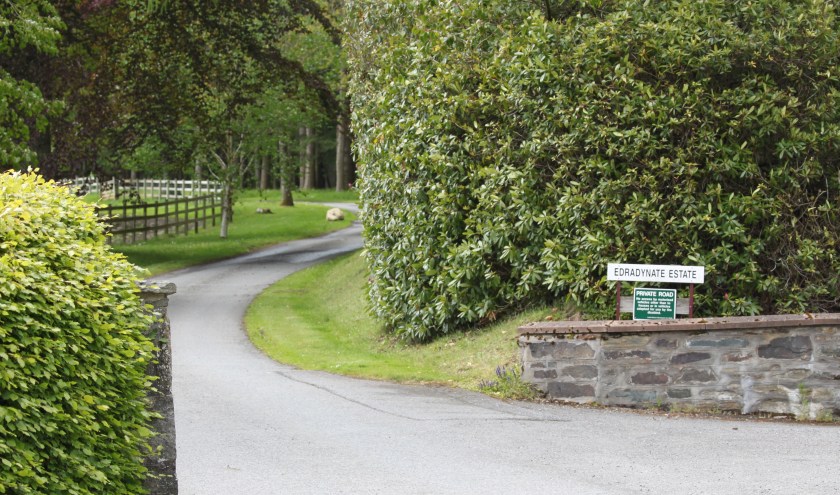
[Edradynate Estate, photo by RPUK]

More recently, in March 2015 two dead buzzards were found near to the estate. Toxicology tests revealed they’d been poisoned with a banned substance (although the name wasn’t revealed). A police raid of the estate uncovered a third dead buzzard. A thorough police investigation followed but in May 2017 the Crown Office rejected a plea from Police Scotland to bring proceedings against an estate gamekeeper (see here). The Crown Office has so far not provided a clear explanation for this decision.

However, in September 2017 SNH imposed a three-year General Licence restriction on Edradynate Estate, presumably in response to the alleged buzzard poisonings in 2015 (see here). Some felt sympathy for the new gamekeeper who would now be subjected to these restrictions even though he’d only just begun his employment following the ‘retirement’ of the previous Head gamekeeper in February 2017.

And talking of that previous Head gamekeeper, you may remember last year he was charged with a number of offences including the alleged malicious damage of crops on Edradynate in April 2017 (it is claimed he poisoned them by spraying with an unknown substance, causing them to rot and perish) and the alleged theft of a thermal imaging spotting scope (see here). This resulted in some court proceedings that were mysteriously shrouded in secrecy (here).

Presumably he has pleaded not guilty as we now know a trial will take place at Perth Sheriff Court on 11 June 2018 for alleged ‘malicious mischief’.

SNH issues licence for mass raven cull in 5-year ‘experiment’

To the utter disbelief of conservationists, statutory conservation agency Scottish Natural Heritage (SNH) has issued a licence authorising the mass killing of ravens in a large area of Perthshire (an area identified as a wildlife crime hotspot where six satellite-tagged eagles have suspiciously disappeared in recent years), as part of a proposed five-year experiment, on the basis of ‘seeing what happens’ to wader populations when ravens are removed.

The licence has been issued to a consortium calling itself the Strathbraan Community Collaboration for Waders (SCCW) which, according to the licence application, ‘represents some of the local land management (farmers, gamekeepers) and private interests in the area who value wading birds for their biodiversity, social and economic value to the area and to Scotland more widely. The application is supported by the Scottish Gamekeepers Association and technical advice and support, notably data gathering and interpretation, is being provided by the Game & Wildlife Conservation Trust (GWCT)‘.

The following has been written by a group of Scottish Raptor Study Group (SRSG) members as a guest blog:

STRATHBRAAN RAVEN LICENCE

The news about the missing white tailed sea eagle disappearing in Glen Quaich on Tuesday 17th April could sadly not have been more timely as Scottish Natural Heritage, (SNH), have issued a licence to several estates in the Strathbraan area in Perthshire, including Glen Quaich Estate, for the killing of 300 ravens in a large scale trial over five years to see if wader productivity and populations can be improved by removing raven predation.

The manner in which the government’s statutory nature conservation agency have conducted themselves has come as a shock and there is grave concern about the mis-application of science, the lack of consultation with key stakeholders, such as the RSPB and SRSG, their choice of estate partners and the lack of transparency, trust and honesty, and even seasoned SNH watchers are aghast.

We have raised our concerns and are unhappy with the response so far and have resorted to writing this blog to make the matters public. Following the “suspicious” disappearance of the white tailed sea eagle and the fact the police are describing this as ‘an illegal act’ we call upon SNH to conduct a review and if the circumstances fulfil what we consider to be the established criteria set out in SNH’s own report then we expect the licence to be withdrawn.

Our concerns focus on three areas, firstly the choice of partners:-

Firstly when selecting a trial area why would you choose an area dominated by driven grouse shooting with a history of illegal raptor persecution? What message does this send out to the many law-abiding estates? Is it that persecution will enable you to ‘cut a deal’ with the statutory nature conservation body? Cynics might suggest this is more about an opportunity to kill ravens in an attempt to protect red grouse stocks and it could also be argued that a licence has been issued to kill one species of bird to enable another bird to be shot for fun.

[Map of proposed cull area in north Perthshire, from the licence application, running from Loch Tay in the west to the A9 in the east]:

Raptor workers over the years have been monitoring the area and can speak with authority on raptor persecution. The Scottish Government’s review of satellite-tagged golden eagles showed that four of these birds have disappeared suspiciously in this area, with a satellite-tagged red kite also disappearing in 2010. In all cases, the tags can be classed as “stopped – no malfunction” as used in the review – ie. highly suspicious.

[Map of north Perthshire showing the last known fixes of five satellite-tagged golden eagles that disappeared in suspicious circumstances. Sea Eagle Blue X also disappeared in Glen Quaich last month]:

In addition, a radio-tagged white-tailed eagle was tracked to this area, but disappeared in January 2012, while a further satellite-tagged white-tailed eagle recently similarly disappeared in Glen Quaich. An illegal clam trap was found in November 2012, while a buzzard was spring-trapped in January 2012. A red kite was found poisoned in January 2015. A raven was poisoned in 2017. In addition, licenced raptor study group members have noted a number of cases of suspicious failure of nesting attempts by hen harrier, red kite and buzzard across the area. They have also recorded a higher than usual turnover of red kites and a loss of breeding pairs at nearby sites. All of which indicates on-going illegal persecution.

Even bearing in mind these detected incidents represent an unknown proportion of actual persecution taking place, this is an area where land management practices have displayed a proven criminal intolerance to protected species, stretching back for many years. All this has been in the public domain so why did SNH press on knowing that their partners in this initiative have such a dubious record, and what level of confidence can we have in their honesty and integrity?

Secondly, science and key questions that remain unanswered:-

  • What monitoring is in place to assess that this cull will not affect the raven population status?
  • How will SNH be able to differentiate from other factors affecting the decline of waders such as other predatory pressures, the loss of suitable habitat and changes in agricultural practices?
  • What criteria will be used to differentiate between breeding and non-breeding birds? This year we have noticed that the breeding season is later than usual.
  • What allowance has been made for the immigration of immature flocks into the proposed licence area?
  • Why has the licensing decision been taken in the absence of the raven population modelling report, as it was commissioned with the sole, or at least the main, purpose of underpinning raven licensing decisions with sounder background information?
  • What is the nature and extent of the independent scrutiny that has been carried out?
  • If any raven roosts are located during the period of the licence, can we be assured that any Schedule 1 non-breeding species and other protected species (possibly also using the same roosts) will not be disturbed?
  • What safe guards are in place to ensure the numbers killed will remain within that permitted?

Thirdly, the lack of engagement

SNH are always keen to trumpet words such as ‘trust’, ‘building relationships’, ‘shared objectives’ ‘working collaboratively’ but we have seen none of this.

  • There has been no communication with SRSG workers who have been active in the proposed licence area and have many years of breeding data on ravens and raptors.
  • We understand that not all landowners/managers within the area of licence have been contacted about this licence, contrary to reassurances provided.
  • This proposed application was developed outside the much lauded ‘Working for Waders’ initiative and we only became aware of this by accident; hardly working together or building trust!
  • Under the Scottish Raptor Monitoring Scheme raven data are submitted to SNH (who is a key partner), yet it seems this information was not included in the licence considerations, (we know this as under the permission sharing protocols raptors workers who collected the information in the first place would have had to have been consulted).

We are deeply suspicious that the lack of engagement was deliberate as SNH knew their proposal was weak and would not stand up to the rigour of an independent scientific review.

We again call upon SNH to withdraw the licence.

ENDS

It’s well known that SNH issues a number of licences every year to cull ravens where they are considered a ‘serious threat’ to livestock (e.g. see here, here) but these are apparently for a limited cull, not related to game management and supposedly based on sound scientific evidence of a perceived local problem.

It’s also well known that gamekeepers have long wanted ravens to be added to the General Licence (e.g. see here, here) because they are seen as a perceived threat to grouse stocks.

It’s also well known that ravens are routinely demonised in the press, including this outrageous piece published by the BBC (see here, and well worth a read to understand the hysteria whipped up around this protected species).

However, this latest licence authorising a multi-year mass culling of ravens over a large area for spurious reasons (and apparently very little, if any, scientific justification) is unprecedented. That it also happens to be a well-known raptor persecution hotspot just adds to the lunancy of this situation.

If you share the concerns of the SRSG members, please consider sending an email to Mike Cantlay, SNH Chair, calling on him to withdraw the licence with immediate effect. Emails to: chair@snh.gov.uk

UPDATE 14.20hrs: Thanks to the blog reader who brought this article to our attention, reporting on the results of a scientific study that dispels many of the myths associated with ravens and wader population declines. And here is the scientific peer-reviewed paper by Amar et al that specifically warns against making predator control licensing decisions without a thorough evaluation of the evidence.

UPDATE 21 April 2018: A quote from SNH Head of Wildlife, Robbie Kernahan:

We understand the concerns over wildlife crime in Strathbraan, but we are also clear that the granting of this licence is wholly unconnected to the issues concerned.

This licence is about a pressing and complex conservation issue. It  is a large-scale collaborative trial which will help improve our understanding of factors affecting key wader species, populations of which are declining at an alarming rate. We are satisfied this licence will not affect the population of ravens overall, and is over a five year period.

The licence places significant responsibility and expectations on all those involved – to be able to show that this approach can work and will help deliver what are essentially shared objectives.

Trust is a key element of this and this presents a great opportunity to develop that trust and relationships with all involved. If it becomes apparent that actions are not being carried out in accordance with the terms of any licence then we will have no hesitation in removing the licence“.

UPDATE 21 April 2018: A quote from RSPB Scotland Head of Species & Land Managament, Duncan Orr-Ewing:

We are extremely concerned about the likely scale on impact of this research licence on the local raven population in the Strathbraan area of Perthshire. We are also very surprised that SNH have issued such a research licence  in the vicinity of Strathbraan, which has an appalling  and well documented track record of illegal persecution of raptors, noting also the very recent “suspicious” disappearance of a satellite tagged white-tailed eagle in this very same area.

We, together with local raptor workers who have been monitoring ravens in the area for decades, could have helped SNH with this background detail to the licence application if we had been consulted.

We will be seeking a high level meeting with SNH shortly to discuss. We will be pressing for the research licence to be revoked on the back of the white-tailed eagle incident, and instead consideration given by SNH to removing the use of the Open General Licence in this area, as is within their powers“.

UPDATE 22 April 2018: Raven cull update and what you can do to help (here)

UPDATE 23 April 2018: Article published in The National (here)

UPDATE 23 April 2018: Article published in The Herald (here)

UPDATE 23 April 2018: RSPB Scotland blog in response to raven cull licence (here)

UPDATE 25 April 2018: OneKind blog in response to raven cull licence (here)

UPDATE 25 April 2018: Chris Packham’s response to raven cull licence (here)

UPDATE 26 April 2018: Is the raven cull licence still active whilst SNH review takes place? (here)

UPDATE 26 April 2018: SNH refuses to say whether raven cull licence has been suspended (here)

UPDATE 27 April 2018: Green MSPs seek urgent meeting with SNH re: raven cull licence (here)

UPDATE 27 April 2018: ‘No justification’ for raven cull licence, says RSPB Scotland Director (here)

UDATE 28 April 2018: Raven cull licence: SGA evasive on benefits to grouse moors (here)

UPDATE 1 May 2018: Strathbraan Community Collaboration for Waders: who’s involved? (here)

UPDATE 4 May 2018: Raven cull: next steps to take as SNH blunders on (here)

UPDATE 7 May 2018: “Let’s have more trials [culls] whether it’s about ravens or other things” says SNH (here)

UPDATE 8 May 2018: Parliamentary questions lodged on raven cull licence (here)

UPDATE 9 May 2018: Alison Johnstone MSP lodges Parliamentary motion on raven cull licence (here)

UPDATE 12 May 2018: Raven cull: please ask your MSP to support this Parliamentary motion (here)

UPDATE 23 May 2018: Raven cull update: scientific advisory committee not being asked to repeal licence (here)

UPDATE 23 May 2018: Raven cull: Parliamentary questions and answers (here)

UPDATE 20 May 2018: Raven cull: latest update (here)

UPDATE 5 June 2018: Legal challenge to raven cull licence: your help needed! (here)

UPDATE 6 June 2018: Raven cull: legal challenge crowdfunder smashes £10k target on day one! (here)

UPDATE 19 June 2018: Raven cull: a few updates (here)

UPDATE 20 June 2018: #Justice4Ravens fundraising merchandise now available (here)

UPDATE 22 June 2018: Preston man receives warning for raven cull death threat (here)

UPDATE 1 July 2018: Last push on #Justice4Ravens crowdfunder (here)

UPDATE 1 July 2018: #Justice4Ravens crowdfunder target smashed! (here)

UPDATE 5 July 2018: #Justice4Ravens: application lodged for judicial review (here)

UPDATE 23 July 2018: Surprise! Gamekeeper in raven cull area declares cull a success (here)

UPDATE 30 July 2018: Raven cull licence: scientific rigour ‘completely inadequate’ says SNH’s scientific advisory committee (here)

UPDATE 30 July 2018: Voluntary suspension of raven cull is meaningless greenwash (here)

UPDATE 7 August 2018: #Justice4Ravens: judicial review update (here)

UPDATE 20 August 2018: Raven cull: application for judicial review withdrawn, for now (here)

UPDATE 30 April 2019: SNH reluctant to discuss licensed raven cull in Strathbraan this year (here)

UPDATE 2 May 2019: SNH rejects 2019 licence application for Strathbraan raven cull (here)

UPDATE 30 May 2019: Scottish Gamekeepers Association’s pity party in response to failed Strathbraan raven cull bid (here)

UPDATE 10 November 2022: Ravens illegally shot on two Strathbraan grouse moors (here)

Grouse-shooting industry’s reaction to the failed Bleasdale Estate prosecution

The prosecution of a gamekeeper, employed by the Bleasdale Estate in Bowland to manage a grouse moor, collapsed recently on a series of legal technicalities (see here, here and here).

We’ve been wondering how the grouse-shooting industry would react to this failed case. Would they condemn the alleged illegal killing of two breeding peregrines at a nest site on a driven grouse moor? And, seeing as all charges against the defendant were dropped, would the industry put out a public appeal for information to help find the alleged perpetrator?

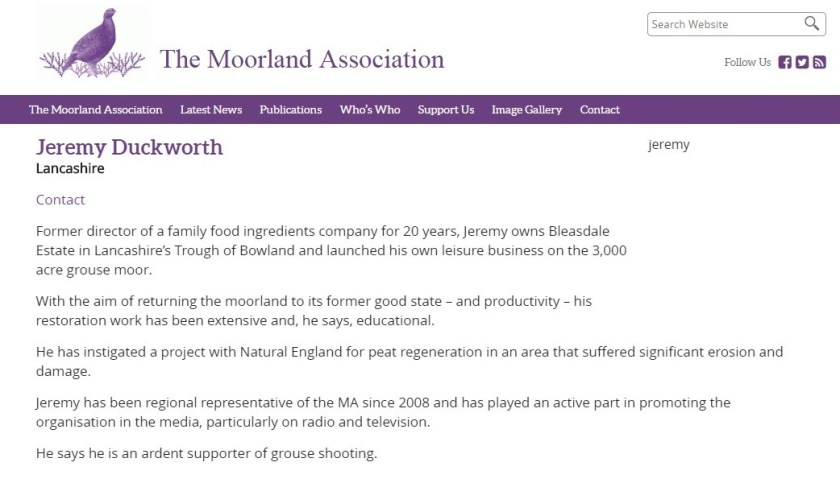
So far we haven’t seen any public commentary from the owner of the Bleasdale Estate, Mr Jeremy Duckworth. This is a bit surprising. At the time of the alleged offences (April 2016), Mr Duckworth was a Director and a regional representative of the Moorland Association (a group representing the interests of grouse moor owners in England):

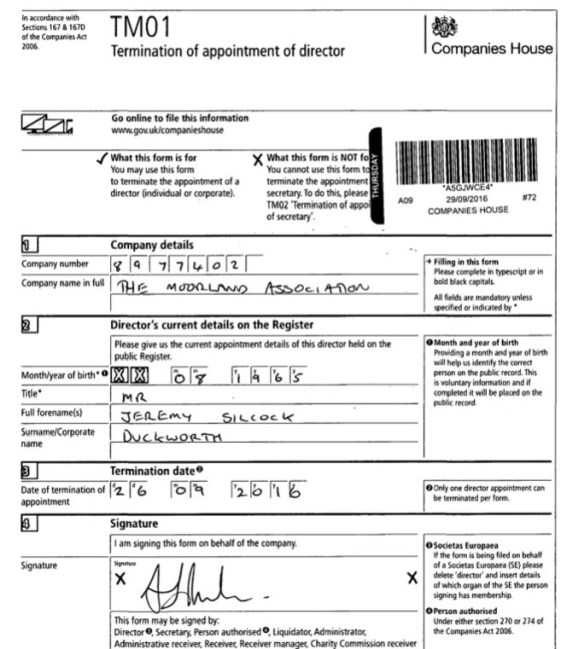
According to documents lodged at Companies House, Mr Duckworth resigned his Directorship of the Moorland Association in September 2016. The timing of his resignation coincided with the early stages of the police investigation in to the alleged offences on his grouse moor – obviously nothing to do with damage limitation and purely and simply coincidental, of course:

As well as silence from Mr Duckworth, nor have we seen any commentary from the Moorland Association (MA) itself. As a member of PAW (Partnership for Action against Wildlife Crime), it’s not unreasonable for us to expect the Moorland Association to have provided comment. Surely the MA must be concerned that an unidentified individual appears to have repeatedly visited the grouse moor nest site of a specially protected species and allegedly killed two peregrines, no?

What we have seen though, is a press release issued by You Forgot The Birds (YFTB), an astroturfing lobby group funded by the grouse shooting industry.

Perhaps this press release from YFTB was issued on behalf of the Moorland Association, or with the MA’s blessing, or funded by members of the MA? No, that can’t be right, because the YFTB press release wasn’t concerned at all about the alleged killing of two peregrines on a grouse moor, but instead, just like all its other press releases (funded by the grouse-shooting industry) this press release was focused entirely on attacking the RSPB and attempting to undermine its credentials.

The press release was sent out to media journalists last Friday, embargoed until one minute past midnight on Saturday morning, obviously designed to hit the weekend papers. We’re grateful to the journalist who sent us a copy. It read as follows:

Judge accuses RSPB of ‘deliberate circumvention’ of law

A judge in Lancashire has accused the RSPB of “deliberate circumvention” of the law regarding covert surveillance. In a case concerning alleged wildlife crime the judge said the RSPB had “effectively taken on the role of a police officer” and that wildlife crime police officers were “turning a blind eye” to how the RSPB was seeking to avoid complying with the law.

Sitting in Preston last month District Judge Jane Goodwin examined the use of covert videoing by the RSPB of a peregrine falcon nest in the Forest of Bowland. James Hartley, a gamekeeper, had been accused of persecuting the birds.

The judge ruled that the RSPB investigators – who were both former police officers – should have informed the police about their proposed videoing but did not because that would have triggered the safeguards of the Regulation of Investigatory Powers Act.

In her decision Judge Goodwin said that “the deliberate circumvention of the RIPA legislation… leaves an air of disquiet.” The RSPB had also “trespassed… without justification [and] breached the PACE Codes of Practice…The RSPB have acted improperly and out with their remit”.

The judge noted two previous occasions when RSPB evidence had been deemed inadmissible by prosecutors because of irregularities.

Last month an FOI response revealed that national police officers had been highly critical of the RSPB’s attempts to dominate the investigation of bird crime. The Defra official in charge of wildlife crimes had written that the charity’s approach could “prejudice the integrity of investigations.”

Commenting on the latest case Ian Gregory of the pro-grouse moor group You Forgot The Birds said: “The RSPB is facing a crisis of trust. It should reflect on why so many find it difficult to work with it. Only through good relations with the justice system and gamekeepers can it help to reduce bird crime.”

ENDS

Interestingly, two contacts were provided for editors who wanted more information. One was Ian Gregory (the usual YFTB contact) but the second contact was none other than the Bleasdale defendant’s solicitor, Tim Ryan! Imagine that!

Blog readers who have been following this case and have read the farcical court proceedings (see here, here & here) will see how YFTB has cherry-picked all of District Judge Goodwin’s criticisms of the RSPB and then tried to present them as a coherent representation of what happened in court, completely ignoring the ridiculous legal technicalities which caused the collapse of this case. YFTB’s intentions are clear: ignore the details of the horrific alleged peregrine persecution and instead besmirch the integrity and reputation of the RSPB’s Investigations Team.

Unfortunately for YFTB, this attempted smear against the RSPB didn’t really go to plan. We saw two articles in the weekend press that were clearly informed by YFTB’s press release (one in The Times on Saturday [behind a paywall] & one in the Mail on Sunday [not behind a paywall]) but neither of those articles presented the case as YFTB had intended. Instead, those two papers took a rather more balanced view and as well as mentioning the judge’s criticism of the RSPB, they also both focused on the alleged crimes, particularly the Crown’s case that one of the peregrines had been caught in a trap for over ten hours, and that peregrine DNA had been found on a knife and a hammer recovered from the defendant’s home/outbuildings. They both also included a response from the RSPB which said similar evidence [to the Bleasdale Estate case] had been accepted in other court cases.

Blimey, is this an indication that mainstream journalists have finally got the measure of YFTB and understand that YFTB press releases require detailed scrutiny to get beyond the spin?

It certainly looks that way.