42 badgers killed on or next to Scottish grouse moors between 2018-2022

42 badgers have been found killed (baited, mauled, snared, shot, trapped, dug) on or next to grouse shooting estates between 2018-2022, according to the charity Scottish Badgers.

This figure, considered to be an under-estimate relying on accidental discoveries, was revealed in correspondence to the Rural Affairs & Islands Committee, written by the charity to correct information that had previously been given to the Committee by a representative of BASC (British Association for Shooting & Conservation) during an evidence session on the Wildlife Management & Muirburn (Scotland) Bill in June 2023.

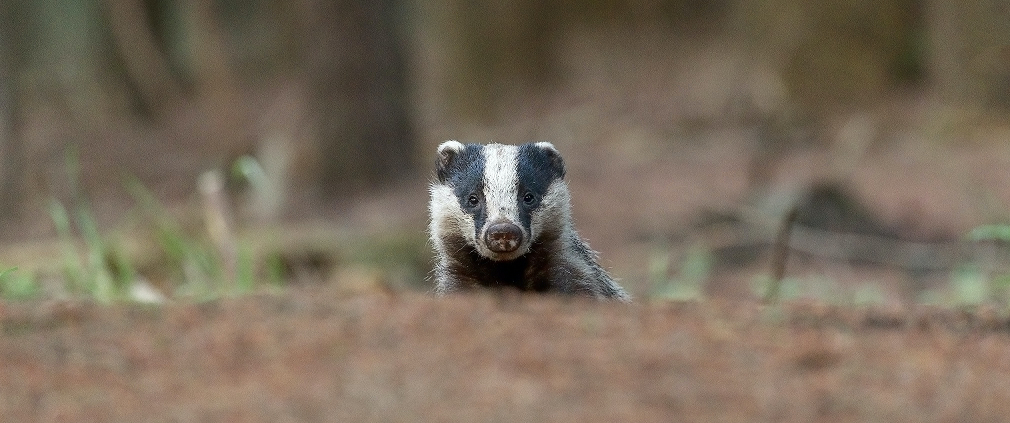
Badger. Photo: Chris Packham

During the third evidence session on 21st June 2023, Rural Affairs Committee member Rachael Hamilton MSP asked the witnesses whether there was evidence linking grouse moor ‘operators’ with the illegal persecution of badgers.

Dr Marnie Lovejoy, Head of Environmental Law Research at BASC told the Committee, “Badgers do not tend to live on grouse moors…They are simply not there“.

The Scottish Badgers charity wasn’t represented at the oral evidence session so it has now written to the Committee to provide expert evidence on this issue.

In its letter addressing the claim made by BASC, Scottish Badgers wrote:

On the contrary, there is documented evidence that relentless criminal persecution of badgers on grouse moors takes place linked to estate employees and is carried out by the same persons who kill raptors“.

The letter goes on to provide examples, including the recent cases of the sadist gamekeeper employed by Millden Estate in the Angus Glens (currently sanctioned after evidence of raptor persecution) who was jailed for his role in a badger-baiting gang (here), and the gamekeeper employed by Longformacus Estate in the Scottish Borders who was convicted for multiple wildlife crime offences, including the illegal killing of badgers and raptors (here).

You can read the letter from Scottish Badgers to the Rural Affairs & Islands Committee here:

Moorland Association Chair claims: “Clearly any illegal [hen harrier] persecution is not happening”

Just how stupid/arrogant do you have to be to go on record saying, “Clearly, any illegal [hen harrier] persecution is not happening“, when it so demonstrably is?!

This is what Mark Cunliffe-Lister, Chair of the grouse moor owners’ lobby group, the Moorland Association, told BBC Radio 4’s Farming Today programme this morning.

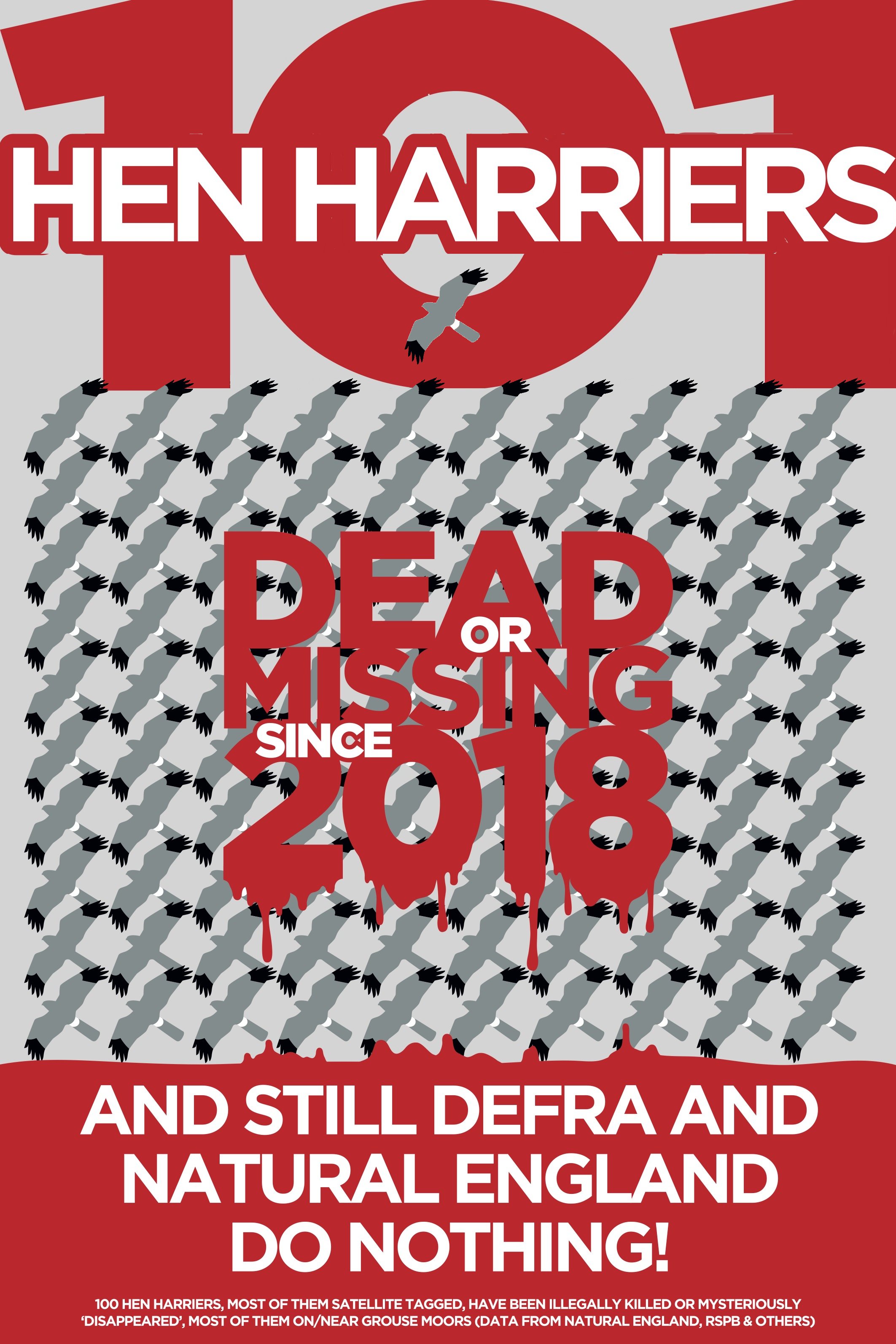
It’s an astonishing claim to make when the evidence to refute such a claim is so readily available, and even more so on the day when we learned that at least 101 hen harriers have now gone ‘missing’ / been illegally killed since 2018 (see here).

Although Cunliffe-Lister does have a history of ‘forgetting’ to mention things when it comes to hen harrier persecution (see here). Oh, and he also forgot to mention this morning the poisoned red kite that was discovered on his estate (Swinton) in 2021 – the one that North Yorkshire Police refused to investigate (see here).

When Cunliffe-Lister was called out on his claim by the interviewer Caz Graham, he had the brass neck to argue that there “do seem to be isolated incidents“. Does he think that 101 missing/killed hen harriers are ‘isolated incidents’?? Oh, and some of those 101 include brood meddled hen harriers.

Also interviewed on this morning’s programme was John Holmes, Director of Strategy at Natural England and who oversees the hen harrier brood meddling sham. Holmes was questioned at length about Wild Justice’s criticisms of the hen harrier brood meddling sham, including the unimpressive scientific approach to the trial. Holmes argued that Natural England was being advised by an independent panel of ornithologists and statisticians. What he didn’t say, as Mark Avery pointed out on Twitter, is that the identities of those ornithologists and statisticians is being kept a secret, as is their scientific advice.

Holmes also argued that Natural England has ‘expert social scientists’ to examine whether brood meddling has changed the opinion of grouse moor owners and managers towards hen harriers. NE don’t need ‘expert social scientists’ to find an answer, the illegal persecution statistics tell us all we need to know.

The interview is available on BBC iPlayer for the next 29 days (here, starts at 4.59 mins) but I’ve produced a transcript for posterity:

Presenter Caz Graham: Hen harriers are beautiful birds that live in the uplands across the UK but their numbers are precariously low, particularly in England.

These low numbers are blamed on predation and on persecution by gamekeepers who illegally target birds of prey because they feed on grouse eggs and chicks. Most hen harrier nests in England are on land managed as grouse moor.

To try and rebuild the population a Government-led Hen Harrier Recovery Plan began in 2016. One element of it is a trial of what’s called ‘brood management’, where eggs and chicks are taken from hen harrier nests, raised in captivity and re-released later back in to the wild so their parents take fewer grouse chicks to feed them.

The Moorland Association, one of several partners in the brood management trial say that this year has been a real success with 24 chicks released. The population of hen harriers in England is now at the highest it’s been for 100 years, they say.

The wildlife campaign group Wild Justice welcomes the increase in hen harrier numbers but is critical of brood management. I put some of their points to Mark Cunliffe-Lister, the Chair of the Moorland Association who first gave me his response to these latest figures.

Chair of Moorland Association Mark Cunliffe-Lister: It’s been a fantastic success, we’ve shown that as a dedicated team we can take the chicks from the nest, we can breed them in captivity, we can re-release them on another site and they can live a perfectly good wild life going forwards.

Caz Graham: How have the birds that have been reared this way in previous years fared? Presumably they’re all tagged, they’re all tracked, you know how they’re doing?

Mark Cunliffe-Lister: Yep, no, absolutely. So, I mean like everything in the wild, they look around for different territories, they move about. I think one of the interesting things has been when we release them is they’re not necessarily, quite a lot of hen harriers will come back to exactly where they were born and bred, these ones will look around for other territories so that’s been very successful as they’ve taken on different territories and gone to different areas.

Caz Graham: Have they bred themselves?

Mark Cunliffe-Lister: Yes, they’ve bred themselves as well so they’ve shown breeding technique,sadly some of them have died but that’s the same in the wild, you have mortality going on in the wild.

Caz Graham: Wild Justice is very critical of brood management, in fact they call it brood meddling rather than management and they published a report last week saying it is a waste of money. They argue that that money could be spent in other conservation areas and that there isn’t really robust scientific evidence to prove that it’s doing any good.

Mark Cunliffe Lister: The figures speak for themselves in terms of how successful it’s been, so going from hardly any hen harriers now to having hundreds of hen harrier chicks that have been bred through the scheme and through the wild, so in terms of Wild Justice, clearly they’re anti-grouse shooting and that’s their agenda and that’s fine, but as a conservation programme I’d say it’s been an incredible success and very happy to sit down and go through the numbers and compare that with other schemes and we can see, can compare that.

Caz Graham: How would you respond to their claim that really this is just a delaying tactic to put off more stringent and effective measures against those gamekeepers who break the law by either shooting or poisoning birds of prey?

Mark Cunliffe-Lister: Yeah, well it’s clearly not about that and clearly it’s dealing with any conflict there so we’re seeing birds every day flying around grouse moors, with keepers, we’re seeing them on, by tag data, we’re seeing them in the air so clearly any illegal killing is not happening. They would like to say it is but you can see that for your own eyes that it isn’t happening.

Caz Graham: Oh well there is evidence that illegal killing happens, we do report on cases where gamekeepers have been convicted, even, for shooting or for poisoning birds of prey.

Mark Cunliffe-Lister: Yeah, there, sadly do seem to be isolated incidents.

Caz Graham: And where do you see brood management going in the future because some would say it’s not a very sustainable kind of way forward is it?

Mark Cunliffe-Lister: Oh I’d say it’s very sustainable. As I say, we’re clear that there is a conflict between hen harriers and grouse, we’re not hiding away from that and this allows it to be managed, so it’s a job that people came together, decided what the best way forward was, brood management was the way they thought would work best, we put that in to practice, we’ve shown it does work and yeah, I’d say it’s very sustainable moving forwards.

Caz Graham: Mark Cunliffe-Lister from the Moorland Association. We asked Wild Justice to come on this morning’s programme but without seeing more extensive data from Natural England, they declined. Well, Natural England, the Government’s advisor on nature is also a partner in the brood management trial project. John Holmes, a strategy director for Natural England oversees it.

Natural England Strategy Director John Holmes: The purpose of the brood management trial is to test the significance of the availability of brood management to moorland managers in achieving that increase.

Caz Graham: And Natural England lead the monitoring for this project. The Moorland Association tell us that they have reared and released 24 chicks this year, does that figure tally with what you have?

John Holmes: That’s absolutely right, we work alongside them in that work and that’s spot on.

Caz Graham: Can you explain to us who funds this project and how much it’s cost so far?

John Holmes: Part of it is funded by the industry itself through the Moorland Association so actually all the practical work to do brood management is funded by them, release aviaries, buying tags for monitoring and things. Natural England we estimate has spent around £800,000 since the trial started but that will be on things like staff to undertake sound assessment of the science that underlines the licences to allow it to happen and alongside that some work on persecution and investigations.

Caz Graham: £800,000, that sounds like an awful lot really.

John Holmes: Well I would say that sounds good value for recovering of a species that’s been completely extinct. Years and years of way more money than that being spent on investigation but no successful prosecutions whatsoever. We know that illegal persecution goes on and we’re continuing to investigate it. We certainly know that it would cost hundred of thousands for protection of a single nest by the police year round so actually in terms of the increase we’ve got that’s really good value for money.

Caz Graham: Isn’t just cracking down on the criminal element who persecute raptors, birds of prey, isn’t that really where the focus should be?

John Holmes: The simple answer is it hasn’t worked, you know, enforcement was tried and it still goes on, you know, we absolutely back enforcement and work with the police to try and find those criminals but it simply didn’t work. The other thing is to say cracking down on criminals assumes that everybody who manages a moor, or owns a moor, is a criminal and the simple fact is that if landowners and gamekeepers come to us and say, ‘Look, we want to have hen harriers, we want to look after hen harriers’, we’re gonna work with them because the results are clear.

Caz Graham: A point that Wild Justice might well make though is that you’re dealing with a criminal act by perhaps just removing the temptation rather than arresting the perpetrators, you know it’s a bit like ignoring car thieves in an area but paying for a few cars to be stuck in a garage.

John Holmes: I think a better analogy would be to assume that if you’re having your car stolen you’re assuming everyone you meet near your car is gonna steal it and that’s simply not the case.

Caz Graham: I want to put to you another questions as well about Wild Justice’s claims. They say they’re really unimpressed by the standard of scientific enquiry that’s evident in Natural England’s brood management study. How would you respond to that?

John Holmes: Well we’ve got an independent panel that advises us on that science, made up of ornithological and statistical experts, it is a trial, things aren’t always perfect in both the planning and execution, you have to react to real situations on the ground. One of the things we’re trying to measure is how the availability of brood management has influenced people’s opinions of hen harriers and may have resulted in less persecution. That’s really hard to do, it’s not easy to figure out what questions you ask but we’ve got expert social scientists who know how to ask those sorts of questions and we’re still part way through the trial.

Caz Graham: I mean the trial’s been going on for five years, it’s had an extra two years added to it, I mean, gosh, is it still a trial, can you still call it a trial at that length?

John Holmes: It’s still a trial because we don’t actually know the answer to the significance of brood management in achieving the outcome that we’ve got so far.

Caz Graham: So how many years can the trial go on? When will you be able to say whether it does work?

John Holmes: Well it’ll go on until we get a scientifically robust answer. We’re hoping that these next two years will significantly increase our information and lead to some better answers and where we might take hen harrier management in the future.

ENDS

Grouse shooting industry’s claim of having ‘zero tolerance’ of raptor persecution is just not credible

I wrote an opinion piece for The National which was published yesterday (here) about the grouse shooting industry’s supposedly sincere claim of having ‘zero tolerance’ for the illegal killing of birds of prey.

It’s reproduced below:

It is widely acknowledged that the illegal killing of birds of prey has long been synonymous with driven grouse shooting in Scotland, even though raptors have had supposed legal protection for almost 70 years. Birds of prey such as buzzards, red kites, hen harriers and golden eagles are perceived to be a threat to red grouse and thus are ruthlessly shot, poisoned or trapped to protect the estates’ lucrative sporting interests.

Prosecutions are rare given the remoteness of the vast, privately-owned shooting estates where these crimes are committed; there are few witnesses and gamekeepers go to great lengths to hide the evidence, as demonstrated when a ‘missing’ golden eagle’s satellite tag was found wrapped in lead sheeting and dumped in a river, presumably in an attempt to block the transmitter.

The Scottish Government has tried various sanctions to address these crimes over the years, including the introduction in 2014 of General Licence restrictions, which are based on a civil burden of proof if there is insufficient evidence for a criminal prosecution. These restrictions don’t stop the sanctioned estates from shooting grouse but do partially limit their moorland management activities and were specifically designed to act as a ‘reputational driver’. Unfortunately they have been proven to be wholly ineffective.

In 2017 a scientific report into the fate of satellite-tracked golden eagles in Scotland highlighted the extent of the ongoing killing on some grouse moors (almost one third of 141 tracked eagles disappeared in suspicious circumstances, none of which resulted in a prosecution). In response, the Government commissioned a review (the Werritty Review) of the sustainability of grouse moor management, which led to the Government finally committing to introducing a full licensing scheme for grouse shooting in 2020. The threat of having an estate licence completely revoked if raptor persecution is detected may now act as a suitable deterrent, as long as the law is adequately enforced.

This long-awaited legislation is currently on passage through Parliament as the Wildlife Management and Muirburn (Scotland) Bill. Unsurprisingly, the grouse shooting lobby is working hard to influence proceedings and minimise the Bill’s impact, questioning its legality and proportionality, even making threats to take the Government to the European Court of Human Rights. Instead of welcoming legislation that should protect the innocent and rid the industry of those who continue to bring it into disrepute, industry representatives maintain that a voluntary approach is sufficient and deny that persecution is even an issue, despite the suspicious disappearance of at least 35 more satellite-tagged hen harriers and golden eagles since the 2017 report was published.

Grouse-shooting representatives maintain they have a ‘zero tolerance’ stance against illegal raptor persecution and argue that they can’t do anything more. But talk is cheap and this industry should be judged by its actions, not by superficial pronouncements from its leaders.

I would argue that there is much more the industry could, and should, be doing if it wants to be seen as a credible force for change.

For example, let’s look at the Moy Estate in Inverness-shire. Two estate gamekeepers have been convicted for raptor persecution offences here (one in 2011 and one in March this year) and the estate has been at the centre of multiple police investigations many times in between. Indeed, it is currently serving a three-year General Licence restriction imposed by NatureScot in 2022 on the basis of police evidence of wildlife crime against birds of prey, including the discovery of a poisoned red kite and various trapping offences.

Moy Estate is believed to be a member of the Scottish landowners’ lobby group, Scottish Land & Estates (SLE). Has SLE expelled the estate from its membership? If it hasn’t, why not? If it has, why hasn’t it done so publically?  

Why are SLE, the Scottish Gamekeepers Association and others from the shooting industry, still attending the Moy Country Fair held annually on the Moy Estate? Why hasn’t this estate been boycotted and blacklisted by industry representatives? Surely that would send a strong message of ‘zero tolerance’ for raptor persecution?

Screen grab from SLE website, August 2023

It’s not just Moy Estate, either. There are a number of other grouse-shooting estates, some very high profile and often described as ‘prestigious’ in the shooting press, that are also either currently, or have previously, served three-year General Licence restrictions.

How many of those estates and/or their sporting agents have been blacklisted by industry organisations? None of them, as far as I can see.

Zero tolerance should mean exactly that. Anything less simply isn’t credible.

Dr Ruth Tingay writes the Raptor Persecution UK blog and is a founder member of REVIVE, the coalition for grouse moor reform.

ENDS

Strange activities on Ruabon Moor, the ‘grouse capital’ of North Wales

Ruabon Moor, the so-called ‘grouse capital’ of North Wales, has featured on this blog a few times in recent years.

Three satellite-tagged hen harriers ‘mysteriously vanished’ there (Heulwen in 2018; Aalin in 2018; Bronwyn in 2019) and a poisoned raven was discovered there in 2018 (here).

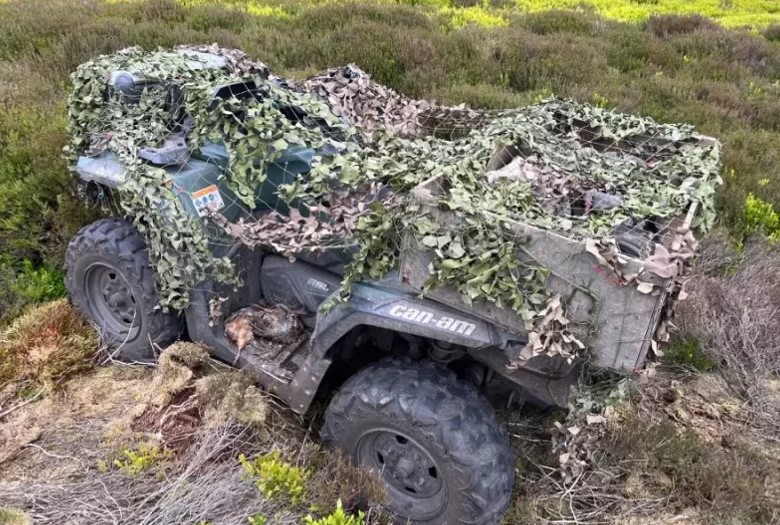
It seems that some other odd things have been happening on the moor, including the discovery of this quad bike, covered in camouflage netting ‘strewn with dead birds’ and an armed gamekeeper crouching in the heather nearby:

Photo: Wildlife Guardian

This, along with a dodgy-looking trap set near to a pigeon coop on the moor, have been discovered by a team called Wildlife Guardian and they’ve blogged about it all here.

Well worth a read.

Disturbing footage of gamekeeping activities at Grimwith Reservoir in Yorkshire Dales National Park

A group of activists called the Moorland Monitors has posted some video footage on social media showing disturbing gamekeeping activities at some pheasant rearing pens at Grimwith Reservoir in the Yorkshire Dales National Park.

Screengrab from Moorland Monitors’ video of gamebird rearing pens at Grimwith Reservoir, Yorkshire Dales National Park

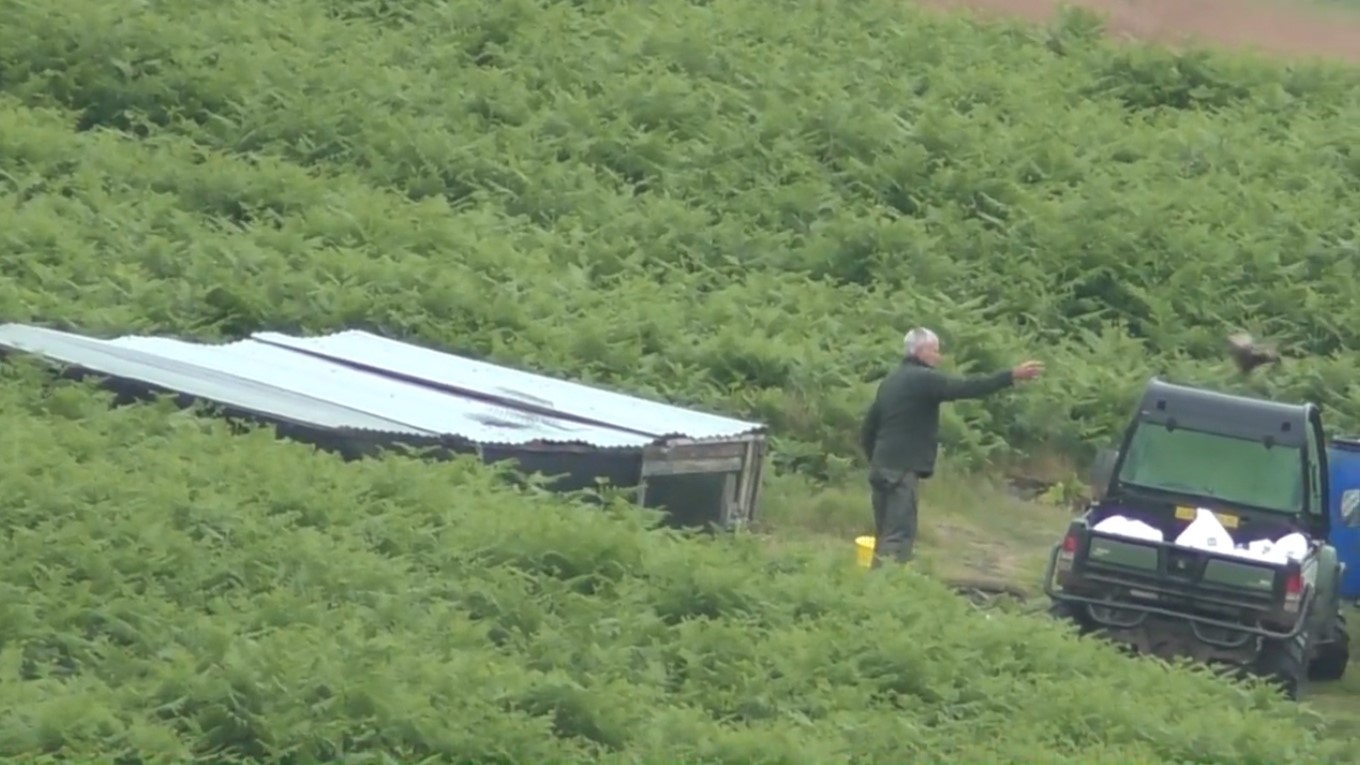
The video footage (which can be viewed below) was reportedly filmed in June 2023 and shows a gamekeeper attending the rearing pens and removing what look like dead pheasants and then tossing them into the surrounding bracken and into the stream. This stream feeds directly into Yorkshire Water’s Grimwith Reservoir.

Screengrab from Moorland Monitors’ video showing a gamekeeper tossing a dead pheasant towards a stream at Grimwith Reservoir, Yorkshire Dales National Park

The Moorland Monitors say they reported the incident to the ‘authorities’ (I don’t know who that was or when the report was made) but that they hadn’t received a reply.

You can read more about this incident on the Moorland Monitors’ website (here) and the video footage posted on the Moorland Monitors’ twitter account can be viewed here:

More detail emerges about McKellar twins who buried cyclist’s body in stink pit on Auch Estate

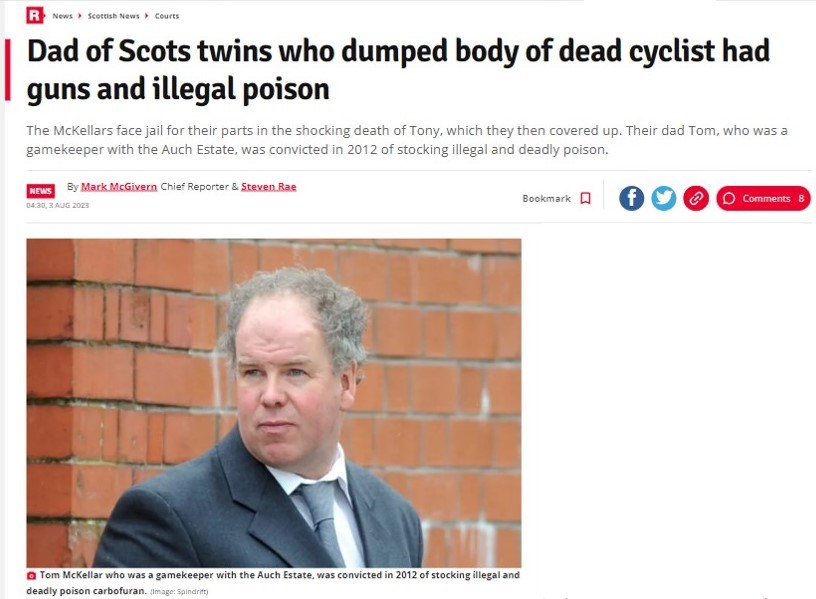
Further to the horrific story about how charity cyclist Tony Parsons had been killed and then subsequently buried in a stink pit by the McKellar twins on the infamous Auch Estate near Bridge of Orchy in the Scottish highlands (see here), more information has emerged in this grisly case.

The Daily Record has reported that the McKellar twins’ father was Tom McKellar, who was convicted in 2012 for the illegal possession of a banned pesticide (Carbofuran) and two hand guns at his home on the Auch Estate where he worked as a farm manager (also described in some publications as a gamekeeper)- see here and here for some background to that case.

The article in the Daily Record (here) also includes comments made by locals about the McKellar twins and it reports that the brothers ‘worked as stalkers on a hunting estate‘ and ‘had been exposed to the killing of animals for much of their lives‘.

The article continues:

The boys had grown up in a life where shooting animals, trapping them was a way of life, part of the running of a shooting estate that protected the game bird and deer stocks. They were both working on the land from a young age and soon working as deer stalkers. Their father was said to be highly regarded in the local community but the fact he had illegal guns and hugely toxic, illegal poison at his property didn’t exactly make him look like the best role model‘.

The article also states: ‘The men eventually buried Tony’s body in a “death hole” that was full of the rotting remains of foxes, grouse and other animals that had been killed on the estate‘.

I’m not sure that grouse shooting takes place on the Auch Estate – the habitat doesn’t look as though it would support commercial driven grouse shooting at any rate. The estate is best known for offering deer stalking and fishing, although the estate agent’s brochure from the 2020 sale does say that walked-up shooting is available and mentions rough shooting for woodcock:

Further information about the site where Tony’s remains were found was reported in an STV article (here) published last September when the case moved to trial at the High Court in Glasgow. The article reports that Tony’s body was ‘hidden under animal remains with bleach also poured on his remains‘. (Thanks to a blog reader for sending the STV link).

There has been a lot of online commentary about this gruesome case, which isn’t surprising given the shocking crimes committed by the McKellar twins. Some have questioned why I’m reporting the case on this blog. I don’t feel the need to justify what gets reported on here but in this case I thought it would have been obvious given the estate’s history as a raptor persecution crime scene, the relationship of the McKellar twins to Tom McKellar, and the use of a stink pit to bury a body.

I think it’s also interesting to highlight that a crime as serious as this one can remain hidden on large estates like Auch for years. We often refer to raptor persecution crimes on vast, privately-owned sporting estates as being the ‘tip of the iceberg’ because inevitably estate employees have every opportunity, and of course the motive, to hide the evidence of their criminal activity. The crimes that are uncovered are usually only discovered by chance.

The killing of Tony Parsons and his burial in a stink pit on the Auch Estate by two individuals who lived and worked there only came to light because someone had the courage and decency to report it to the police when Alexander McKellar confessed to her what he and his brother had done.

I see a lot of parallels.

The McKellar twins are due to be sentenced later this month.

UPDATE 25th August 2023: McKellar twins from Auch Estate sentenced for killing cyclist & burying his body in a stink pit (here)

UPDATE 13 AUGUST 2025: New BBC documentary provides shocking insight into appalling crimes on Auch Estate, Bridge of Orchy (here)

No prosecution after police investigate gamekeeper for allegations relating to ‘poisoned baits’ at a pheasant release pen in Shropshire

This is a strange case.

Last week, the Hunt Saboteurs Association (HSA) posted a video and accompanying commentary on its website about a police investigation into a gamekeeper alleged to have been caught on camera placing ‘poisoned-laced pheasant carcasses’ next to a pheasant release pen in Berrington, Shrewsbury in 2022 (see here).

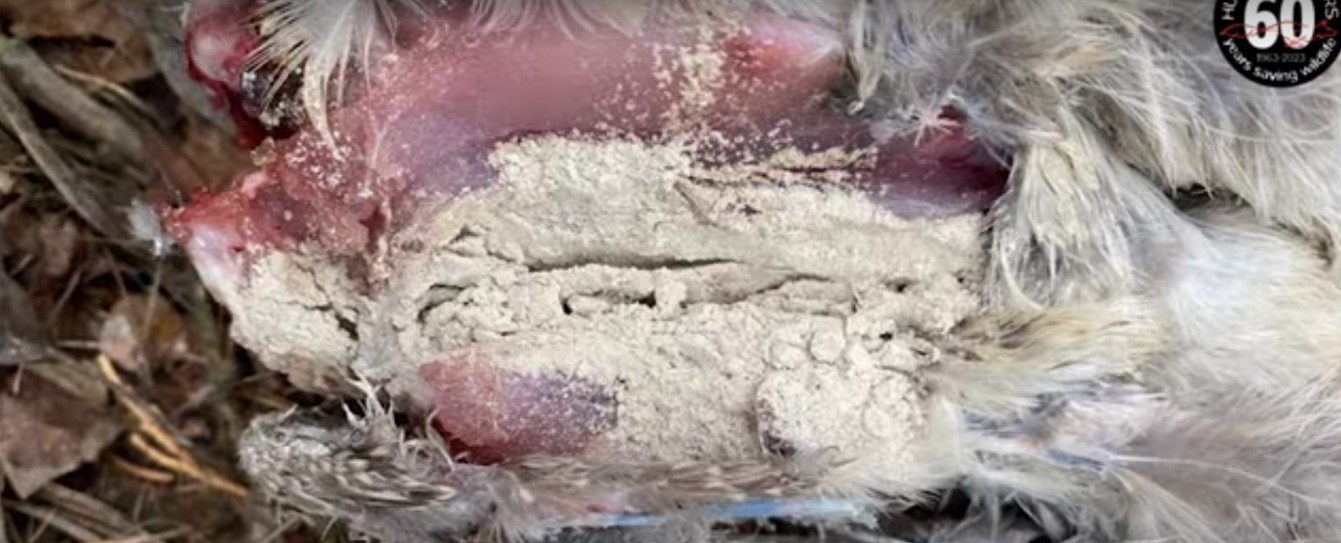
The HSA reports that its fieldworkers collected some of the pheasant carcasses and sent them to the Wildlife Incident Investigation Scheme for toxicology analysis and the findings were reported to West Mercia Police for investigation.

Screen grab from the HSA video showing one of the pheasant carcass baits slit open and containing an unidentified white powder substance.

The report on the HSA website states:

The gamekeeper’s house was raided by the authorities, and despite poisonous substances being found, there was insufficient evidence to prove these were the same substances found on the bird carcasses. Sadly this meant there was no chance of a conviction in this case. This does mean that we are now able to share this footage with you to highlight the grim reality of the shooting industry‘.

The HSA report doesn’t identify what substance was found on the pheasant carcasses during the toxicology analysis, nor does it identify the ‘poisonous substances‘ alleged to have been found by West Mercia Police at the gamekeeper’s house, so it’s difficult to draw conclusions about any alleged criminality.

However, I did find an entry on the Wildlife Incident Investigation Scheme (WIIS) database referring to an incident involving ‘pheasant baits’ in Shropshire in 2022. This is likely to be the same incident as the HSA is reporting but beware, there is a small element of uncertainty because the WIIS database isn’t always kept up to date and some incidents are known to be held back from publication whilst investigations are still live.

Let’s assume the WIIS database entry refers to the HSA case. Here is what the WIIS entry says:

Ref: 107/367: Shropshire, September 2022, categorised as ‘abuse’, 2 x pheasant baits & 8 pesticide samples. The narrative is given as follows:

2 pheasant baits found with white/grey powder inside them. Residues of permethrin were found on the pheasant baits. Analysis confirmed a mixture of pesticides which were found during a visit to a pesticide store. This incident has been assigned to permethrin abuse. There were also failings in the storage of a range of pesticides, some of which are no longer approved‘.

That last sentence is key. If banned substances were found during the police raid AND there were ‘failings in the storage‘ of them, this would normally be sufficient evidence for a prosecution for failing to comply with the regulations relating to the possession and storage of various banned chemicals, and associated health & safety regulations, as we’ve seen in other recent cases (e.g. here), even if there was insufficient evidence to charge for placing poisoned baits.

Hmm. I’ll try and find out more detail…

Snares banned in Wales after historic parliamentary vote – Scotland next?

Press release from League Against Cruel Sports (27th June 2023):

CELEBRATIONS OUTSIDE THE SENEDD AS WALES BANS BRUTAL WILDLIFE TRAPS

Members of the Senedd joined animal welfare campaigners from the League Against Cruel Sports this evening to celebrate a historic vote to ban snares in Wales.

It followed the unanimous passing of the Agriculture (Wales) Bill in the Senedd earlier today which contained measures to outlaw these cruel and indiscriminate wildlife traps.

Will Morton, head of public affairs at the League Against Cruel Sports, said:

The Welsh Government deserves huge credit for banning snares, inherently inhumane traps, which are completely incompatible with high animal welfare standards.

Wales is leading the way in protecting wildlife from cruelty and we’re calling on the UK and Scottish Governments to follow their lead and ban these brutal devices.”

The attendees included 13 members of the Senedd as well as animal welfare campaigners from across Wales.

Up to 51,000 snares lie hidden in the countryside at any one time according to UK government figures. Defra figures

They are used predominantly by shooting industry gamekeepers on pheasant and partridge shoots to trap wildlife.

The same Defra research show almost three quarters of the animals caught are not the intended target species. So, this will include hares, badgers and people’s pets.

This snared badger found in Wales suffered for several days and had to be euthanised due to the extent of her injuries. Photo: RSPCA

Polling carried out by YouGov in Wales in January 2021 showed 78 per cent of the Welsh public wanted snares to be made illegal.

The ban will come into force two months after receiving royal assent so snares should become illegal in Wales later this year.

Will Morton added: “Today we are celebrating the move to end the cruelty inflicted on animals by the use of barbaric snares, something that will have the support of the vast majority of the Welsh people.

It’s a fantastic move for animal welfare and we look forward to snares being banned in the rest of the UK soon.”

ENDS

As many of you will know, the Scottish Government is currently considering a ban on snares as part of its Wildlife Management and Muirburn (Scotland) Bill.

In December 2022 the Scottish Animal Welfare Commission recommended that ‘the sale of snares and their use by both public and industry are banned in Scotland, on animal welfare grounds‘ (see here). As part of that report, evidence provided by the Scottish SPCA demonstrated that 75% of tagged snares were set illegally but even legally-set snares caused catastrophic injuries to both target and non-target species (see here).

In April 2023, Scottish charity OneKind published a new report also exposing the cruelty of snares and called for a complete ban (see here).

Some evidence on snaring has been heard by the Scottish Parliament’s Rural Affairs & Islands Committee as part of their Stage 1 scrutiny of the Wildlife Management & Muirburn (Scotland) Bill but the Government’s provisions won’t be heard until the Bill reaches Stage 2 in the autumn.

During the evidence session, discussion centred on a new type of snare, cynically called a ‘Humane Cable Restraint’. However, as OneKind’s Policy Officer, Kirsty Jenkins points out (here), “There is no design alteration or method of use that can make snares humane – the fundamentals of the method cause suffering“.

Chairman of the Scottish Gamekeepers Association (SGA), Alex Hogg, gave evidence at Stage 1 of the Bill and claimed that the new snare design is “almost like a dog collar” (see here), implying that its use doesn’t cause the snared animal any suffering.

Interestingly, he used a similar analogy in another Parliamentary committee evidence session back in 2010 when the Wildlife & Natural Environment (Scotland) Bill was under consideration, including an option to ban snaring. Here’s what he had to say about snaring then:

Those snares are set at certain times of the year to try to protect ground-nesting birds and lambs from foxes. Nine times out of 10, the animal will go into the snare in the hours of darkness. When it enters the snare, its instinct is to lie like a dog or hide, especially in the hours of darkness. When we check our snares first thing in the morning, which we normally do—we have a snaring round; we check the snares at daylight and onwards through to breakfast time—we will dispatch the animals that have been held in them. The snare must close to a certain tightness to be able to hold the animal. The old-fashioned snares locked, so the tighter they got, the more the animal was strangled. However, the snares that we now have are non-locking; they can slip back again. They will hold the animal in the same way as a choke lead on a dog that is pulling too hard” (see here).

Presumably these non-locking snares that Alex implied were virtually harmless are the same snares that the SGA are now calling to be phased out on welfare grounds?!

During the most recent evidence sessions scrutinising the Wildlife Management & Muirburn (Scotland) Bill, Alex Hogg also refers to the new, so-called Humane Cable Restraint (i.e. the ones that the Scottish Animal Welfare Commission recommends are banned) as follows:

The other important thing that I forgot to say was that scientists are using them. They are using them to catch foxes, tag them with radio collars then let them go. That proves to me that the fox has never been damaged” (see here).

I’ve heard this justification for snare use several times, and I’m aware that the GWCT has been using snares to trap foxes so that radio collars can be fitted before the fox is then released, but so far I’ve been unable to find any peer-reviewed scientific paper referring to the snaring method used. I’d be utterly amazed if the approved scientific method used by the GWCT involved leaving the snared fox for up to 24 hours before attending to it, as a gamekeeper is permitted. Any ethical committee overseeing this research method would undoubtedly raise an objection, so Alex’s comparison is somewhat disingenuous, in my opinion.

2nd red kite found shot nr Westerdale in North York Moors National Park in recent weeks, with suspicions of a third one

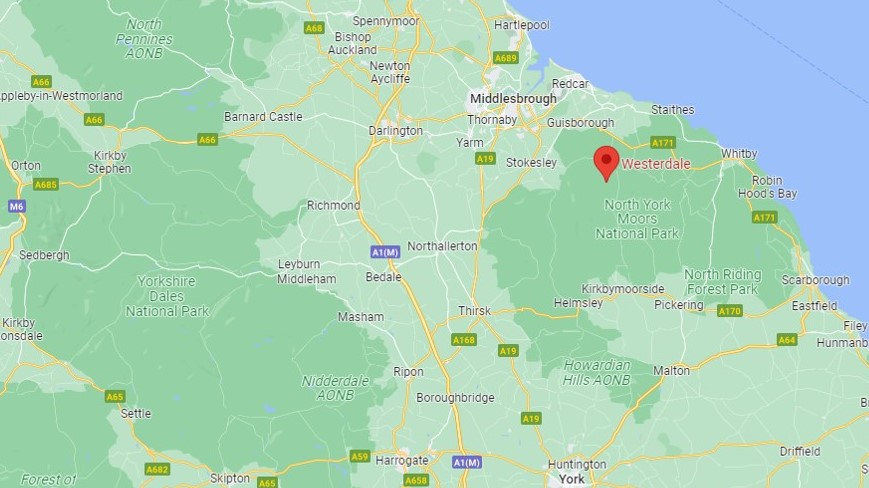
A couple of weeks ago, North Yorkshire Police appealed for information after a red kite was found with shotgun injuries near Westerdale in the North York Moors National Park on 13th June 2023. It didn’t survive (see here).

Red kite. Photo by Ben Hall (RSPB Images)

Today, North Yorkshire Police has issued another appeal for information after the discovery on 26th June 2023 of a second shot kite in the same area (which also didn’t survive its injuries) and suspicions that a third kite has also been shot, based on photographs taken on 23rd June 2023 provided to the police by walkers.

The appeal for information by North Yorkshire Police’s Rural Task Force is a bit bizarre, to say the least. Here it is:

NORTH YORK MOORS: APPEAL FOR INFORMATION ABOUT THE SHOOTING OF A RED KITE

North Yorkshire Police’s Rural Task Force is appealing for witnesses and information about the shooting of a Red Kite on the North York Moors near Westerdale.

The Red Kite, suffering with gunshot wounds, was found by a local farmer at 9.30pm on Monday 26 June in Westerdale. Sadly, despite being taken to a vet it did not survive its injuries.

This incident follows another recent shooting of a Red Kite in the area on Tuesday 13 June. North Yorkshire Police have also received information that there may be a third injured Red Kite, photographed by walkers on Friday 23 June, on the opposite side of the valley.

We believe that these incidents are linked. This disturbing criminal behaviour and persecution of innocent birds of prey will not be tolerated and must cease immediately.

Police are renewing their appeal for any information in relation to raptor persecution. Anyone with information that could assist our investigation should email Jack.donaldson@northyorkshire.police.uk

If you spot a dead or injured bird, poisoned bait or a pole trap, please note the location, take a photo and call North Yorkshire Police on 101 to report it.

If you wish to remain anonymous, you can pass information to Crimestoppers on 0800 555 111.

Please quote police reference 12230107850 when passing on information.

Red kites were saved from national extinction by one of the world’s longest-running protection programmes and have been successfully reintroduced to England and Scotland. Red kites are listed under Schedule 1 of The Wildlife and Countryside Act.

North Yorkshire Police in collaboration with the British Association of Shooting and Conservation (BASC), Countryside Alliance, Moorland Association and the National Gamekeepers Association take a zero-tolerance approach to raptor persecution. All agencies agree that ‘there is no excuse for illegally killing of any bird of prey and unreservedly condemn all such acts. Any individual convicted of a crime against a bird of prey will be expelled from the organisation’.

Police are aware that local gamekeepers will come under suspicion, however we will investigate with an open mind, gathering information from a variety of sources, and not be led by assumptions.

In response to the ongoing persecution against birds of prey in the North Yorkshire Moors, North Yorkshire Police Rural Taskforce Officers have increased marked and unmarked patrols in target areas to protect wildlife and deter offenders.

ENDS

This looks very much like North Yorkshire Police has been ‘got at’ by the shooting lobby. How else do you explain the police including what is blatant propaganda in their own press release, from an industry responsible for the vast majority of raptor persecution crimes?!

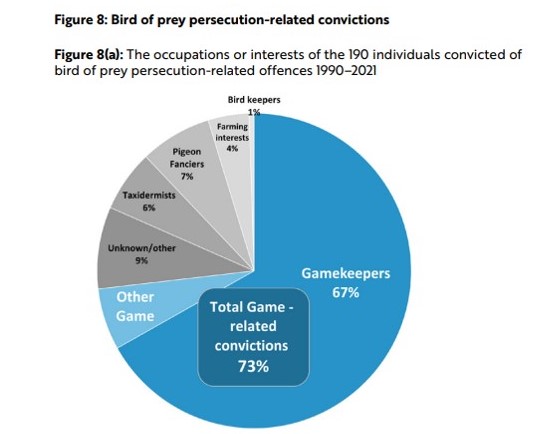
Data from the RSPB’s latest Birdcrime Report

How many members of the public are wandering around this grouse-moor dominated landscape with shotguns, taking pot shots at birds of prey?

How many members of North Yorkshire Police’s Rural Taskforce have links to the game-shooting industry?

Meanwhile, supposedly protected birds of prey continue to be targeted and killed in what is supposed to be a National Park.

UPDATE 7th July 2023: Red kite shootings: statement from North York Moors National Park (here)

UPDATE 9th October 2023: Buzzard shot & critically injured in North York Moors National Park (here)

Criminal gamekeepers Addison & Stroud both linked to Fengate Farm in Weeting, Norfolk

Yesterday, gamekeeper Francis Addison was convicted for multiple offences linked to the discovery of five shot goshawks that were found in a public carpark next to King’s Forest near Thetford in January this year (see here).

The five shot goshawks. Photo: Suffolk Police

Addison lives in the village of Weeting in Norfolk.

Weeting also just happens to be where another gamekeeper, Matthew Stroud, was convicted in October 2022 for multiple wildlife crimes on land he managed for pheasant shooting at Fengate Farm, including the killing of six buzzards and a goshawk and the laying of poisoned baits (see here and here).

Weeting is a small village. There are a few farms there, according to Google maps, some or all of which could be hosting pheasant shooting, but I was curious about whether Addison and Stroud were associated with the same pheasant shoot at Fengate Farm.

So I asked Suffolk Police this morning:

Interesting.

Fengate Farm is owned by Richard Norman Parrott, who also happens to be a director of Weeting Steam Engine Rally Ltd, according to Companies House (here).

The Weeting Steam Rally and Country Show is scheduled to take place at Fengate Farm on 14-16th July 2023 – see the rally website here – where overnight camping is offered (here) and the rally is described on the website as follows:

A fun family day out filled with nostalgia of steam. We have plenty for all the family to enjoy, from the large range of steam engines to the fairground, gundogs to chainsaw carving, there’s something for everyone, whatever your age – across our 170 acre site! Our large trade area has a vast array of stalls, we also have a craft tent and a food hall, along with many other things to see and do‘.

Now, I’m not suggesting for one minute that Mr Parrott had any involvement with, or knowledge of, the criminality associated with the Fengate Farm pheasant shoot. For all I know, he leases out the land used for the shoot and has nothing to do with it (it’s worth noting that criminal gamekeeper Stroud was described as ‘self-employed’ and criminal gamekeeper Addison has been described as being ‘part-time’ and ‘retired’ – there is no indication that either were employed by Mr Parrott).

But given the discovery of poisoned baits and poisoned birds of prey, shot birds of prey, unsecured poisons, the illegal use of animal traps, and the unlawful use and storage of shotguns associated with this pheasant shoot, I’d suggest that visitors to the steam rally and country show might want to consider the risks to their health and safety and that of their children and dogs.