Poisoned sea eagle: Scottish Ministers under increasing pressure to act

There has been an unprecedented response from the general public to the news that a young white-tailed eagle has been found illegally poisoned on a grouse moor in the world-famous Cairngorms National Park (see here and here).

The Scottish Government published a pathetically inadequate tweet yesterday (here) designed to fob everyone off but actually generating even more fury at its continued wilful blindness and refusal to tackle this head on.

Public anger is palpable. Social media is still FULL of the death of this eagle, 48hrs after the news first broke, and hundreds of ordinary members of the public have been so incensed they’ve taken to writing emails to the very top of the pile, First Minister Nicola Sturgeon.

Here are some examples of those emails, here are some more, here are some more, here are some more, here are some more, and here and here are some more and another one here.

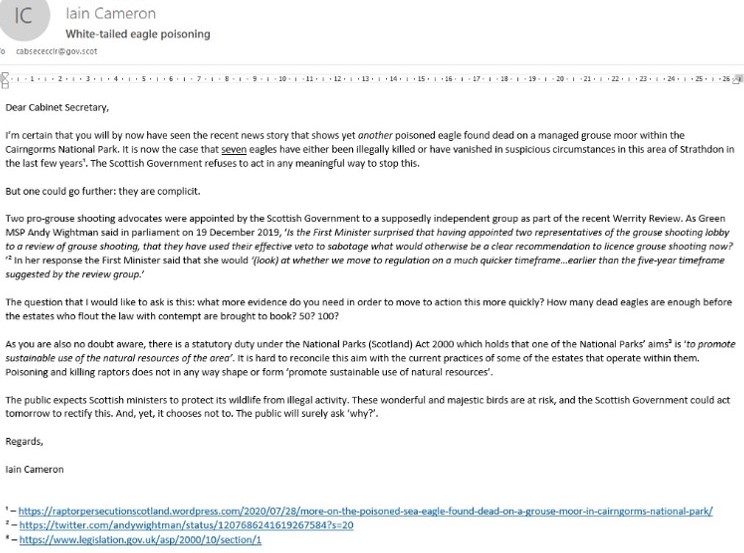
This one, from Iain Cameron (@theiaincameron) is a masterclass in reasoning:

But so far this one is my favourite (from anon):

Ladies, I know your inboxes are full and getting fuller so I will be brief;

Prompted by the recent poisoning of a white-tailed eagle in the Cairngorms National Park I note;

1) That none of the measures put in place to protect Scotland’s birds of prey seems to have any effect

2) No one has ever been convicted of killing an eagle in Scotland

3) Satellite-tagged eagles can be killed with impunity right up to the Edinburgh bypass

4) The Werritty Review’s outcome of a five year period of self-regulation is infuriating and futile

5) Your party appears not to have the stomach to take on serious, organised crime by landed interests in Scotland

6) Indeed your appointment of Richard Scott’s financial adviser Benny Higgins (a former colleague of mine) as an economic advisor suggests the opposite – that you regard these people as trustworthy or reputable in some way

7) Lots of people (including me) are extremely angry about your hand-wringing and inaction

8) I expect action from you. Driven grouse shooting is a moral disgrace, drives out productive land use, wrecks our uplands and depends on rampant criminality. It needs to be banned right now.

9) The Cairngorms National Park should either become an actual nation park with no sport shooting or it should come to an end. If it has no power to tackle this carnage there’s little point in it existing.

Thanks for reading.

ENDS

Thank you to all of you who have written to the First Minister (Nicola Sturgeon) and Environment Cabinet Secretary (Roseanna Cunningham) expressing your disgust and urging immediate action. It is clear that their inboxes have been deluged. Good, they need to be.

Here are their email addresses for those who would still like to comment:

To email Nicola Sturgeon, please use this address: firstminister@gov.scot

To email Roseanna Cunningham, please use this address: CabSecECCLR@gov.scot

Thank you.

UPDATE 29th July 2020: Poisoned sea eagle: Chris Packham’s letter to Scottish Ministers (here)

Poisoned sea eagle: strong response from Scottish Greens

In sharp contrast to the pathetically inadequate Scottish Government’s response (see here) to the news that a poisoned sea eagle has been found on a grouse moor in the Cairngorms National Park, the Scottish Greens’ response is spot on:

POISONING OF WHITE-TAILED EAGLE REVEALS NEED FOR REFORM

The revelation that a White-Tailed eagle found dead in the Cairngorms is found to have been poisoned shows the Scottish Government must go further to tackle wildlife crime around grouse moors, Scottish Green MSP Mark Ruskell has said.

Police Scotland have confirmed the satellite tracked bird had been poisoned with pesticide as they investigate the crime.

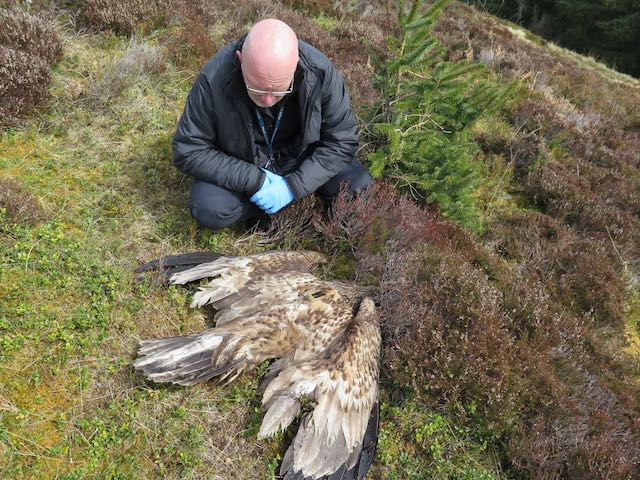
[A police officer retrieving the poisoned corpse from a grouse moor in the Cairngorms National Park. Photo by Police Scotland]

Greens environment spokesperson Mark Ruskell is the species champion for the White-Tailed eagle, also known as the sea eagle, of which there are only around 150 breeding pairs in Scotland.

This is a very serious crime against a species reintroduced into Scotland 40 years ago after it became extinct. Sadly, this is only the latest in a long list of raptors found near Scotland’s grouse moors and I’m afraid recent tweaks to wildlife crime maximum sentences fail to address the central problem around detection and prosecution of these crimes.

There needs to be real action to address this war against wildlife. Land managers need to get a grip of this, but we’ve seen from the reaction to the Scottish Greens win on protection for mountain hares that the driven grouse shooting industry is resistant to even the mildest of reforms.

It’s time for the Scottish Government to ignore vested interests and respond to the Werrity review with a commitment to shut grouse moors down. The stark reality is Scotland is monumentally failing to meet its obligations in the middle of a global nature emergency.

ENDS

Thank you to all of you who have written to the First Minister (Nicola Sturgeon) and Environment Cabinet Secretary (Roseanna Cunningham) expressing your disgust and urging immediate action. It is clear that their inboxes have been deluged. Good, they need to be.

Here are their email addresses for those who would still like to comment:

To email Nicola Sturgeon, please use this address: firstminister@gov.scot

To email Roseanna Cunningham, please use this address: CabSecECCLR@gov.scot

Thank you.

More on the poisoned sea eagle found dead on a grouse moor in Cairngorms National Park

It’s fair to say that there has been public uproar at the news that yet another eagle has been found illegally killed in Scotland, this time a young sea eagle, found poisoned on a grouse moor inside the Cairngorms National Park (see here). The police have not named the estate on which the poisoned corpse was found, nor the name of the banned pesticide used to kill this eagle.

Some of that public outrage has been from people who previously had no idea that such filthy, barbaric crimes are still taking place in the 21st Century, whilst others are infuriated that this keeps happening and yet time and time and time again the Scottish Government keeps dodging the opportunity to act.

To many of us, it’s no longer a shock to learn that an eagle has been found illegally killed on a grouse moor. And in this particular case, it’s certainly no surprise to learn of the location.

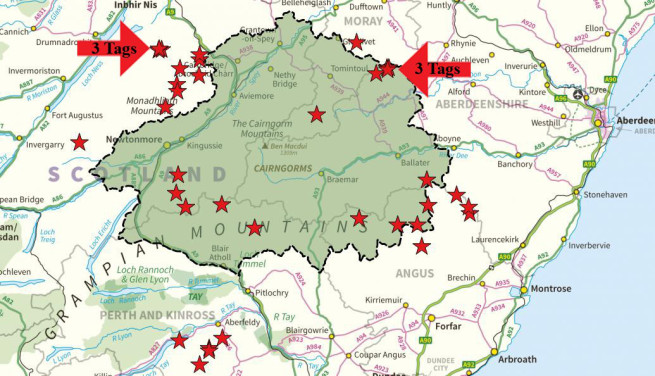
The Strathdon area of the Cairngorms National Park has long been recognised as a raptor persecution hotspot, as this map demonstrates. These are raptor persecution incidents, 2005-2018, including cases recorded by the RSPB, incidents featured in the golden eagle satellite tag review, and other data in the public domain. Geographic clusters are clear to see – in the Angus Glens to the SE of the National Park, in the Strathdon area in the NE (circled), and in the Monadhliaths to the NW of the National Park:

Those incidents in Strathdon include a poisoned raven (2006), a poisoned common gull (2006), multiple poisoned baits (2006), a shot buzzard (2009), a poisoned golden eagle (2011), a poisoned buzzard (2011), poisoned bait (2011), a shot short-eared owl (2011), two satellite-tagged golden eagles ‘disappearing’ (2011), another satellite-tagged golden eagle ‘disappearing’ (2013), a satellite-tagged white-tailed eagle ‘disappearing’ (2014), a goshawk nest shot out by masked men (2014), a shot goshawk (2016), another satellite-tagged golden eagle ‘disappearing’ (2017), a satellite-tagged hen harrier ‘disappearing’ (2018), another satellite-tagged hen harrier ‘disappearing’ (2019), and another satellite-tagged hen harrier ‘disappearing’ (2020).

It’s quite the persecution hotspot, isn’t it?

Nobody has been prosecuted in any of these cases.

If you want to see the full shocking list of reported raptor persecution incidents inside the Cairngorms National Park, the supposed ‘jewel in the crown’ of Scotland’s wildlife areas, see here. Take note again of the lack of prosecutions.

Strathdon was also identified as a golden eagle persecution hotspot in the 2017 Government-commissioned report on the fates of satellite-tracked golden eagles in Scotland. You can read that report here.

With the illegal poisoning of this latest white-tailed eagle we now know that seven eagles have either been illegally killed or have vanished in suspicious circumstances in this area (4 x ‘missing’ golden eagles, 1 x ‘missing white-tailed eagle, 1 x poisoned golden eagle, 1 x poisoned white-tailed eagle), as well as three satellite-tagged hen harriers that have vanished in suspicious circumstances since the golden eagle report was published.

Many new blog readers have been surprised to learn that not only have there been zero prosecutions for raptor crime dating back for years in this part of the National Park, but that managing grouse moors for shooting is not a licensed activity. Comments from newcomers on social media immediately call for ‘licences to be revoked’ because they assume that a relatively progressive country like Scotland will have all this stuff regulated and under control. It’s been a shock for them to find out that in parts of Scotland it’s the armed criminals in control, brazenly and repeatedly sticking up two fingers to the law-makers and the rest of society.

Newcomers also ask why there hasn’t been any targeted action in these known persecution hotspots? It’s not like nobody knows what’s been going on there! It’s a good question – what is the point of all this mapping and recording and reporting if the bleedin’ obvious is still allowed to continue, uninhibited, unrestricted and unpunished?

The Scottish Government did implement a farcical trial scheme of having a bunch of part-time volunteer special constables deployed in the National Park in 2018, to focus on tackling wildlife crime. Despite the undoubted good intentions of those volunteers, the scheme was a predictable waste of time and money (see here) and simply a can-kicking exercise so the Government could pretend it was doing something tangible to tackle these crimes.

And so here we are again. Yet another victim, on yet another grouse moor, in yet another National Park.

And yet again, the Scottish Government has remained silent.

It’s important that we don’t.

If you haven’t already done so, please consider sending an email to the First Minister (Nicola Sturgeon) and her Environment Cabinet Secretary (Roseanna Cunningham) to express your strength of feeling that this disgraceful criminality has been allowed to continue for far too long. The Government must be held to account for its inaction.

You don’t need to be resident in Scotland to email these politicians. In fact, the more correspondence from outside of Scotland, all the better to demonstrate the extent of the country’s embarrassing reputation. Please be polite.

To email Nicola Sturgeon, please use this address: firstminister@gov.scot

To email Roseanna Cunningham, please use this address: CabSecECCLR@gov.scot

It’s clear that many of you have already written to them. Thank you.

UPDATE 29 July 2020: Poisoned sea eagle: inadequate response from Scottish Government (here)

Cairngorms National Park Authority statement on hen harrier persecution

Hen harrier persecution is a National Wildlife Crime Priority and the population in Scotland has suffered a 27% decline in the last 12 years. Losing over a quarter of the population in such a short period is a significant conservation concern and as such, we expect a strong response from the authorities whenever these crimes are exposed.

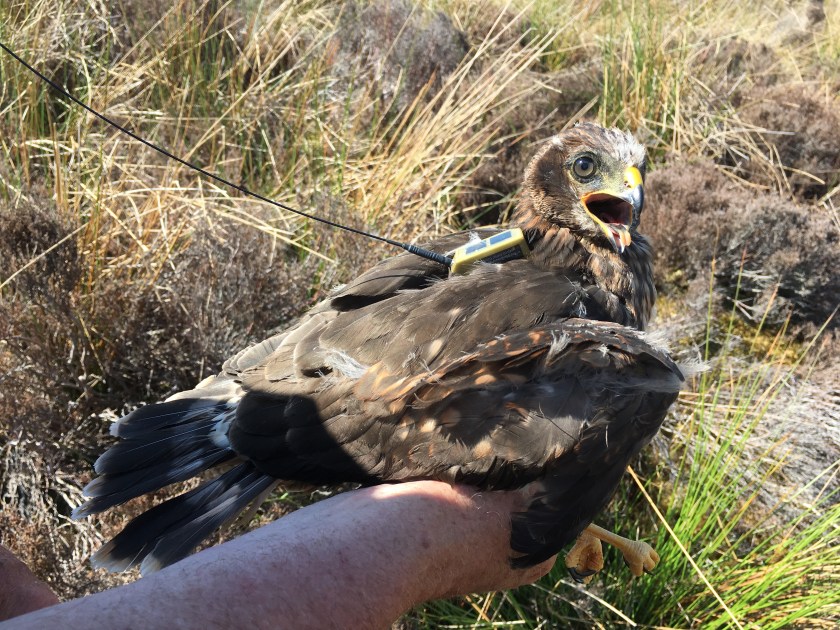
Earlier this month we learned that two satellite-tagged hen harriers (Wildland hen harrier 1 and Wildland hen harrier 2) had ‘disappeared’ in suspicious circumstances on two grouse moors in September 2019, one within the Cairngorms National Park and one right on the Park boundary (see here). We don’t recall seeing any statement from the Cairngorms National Park Authority.

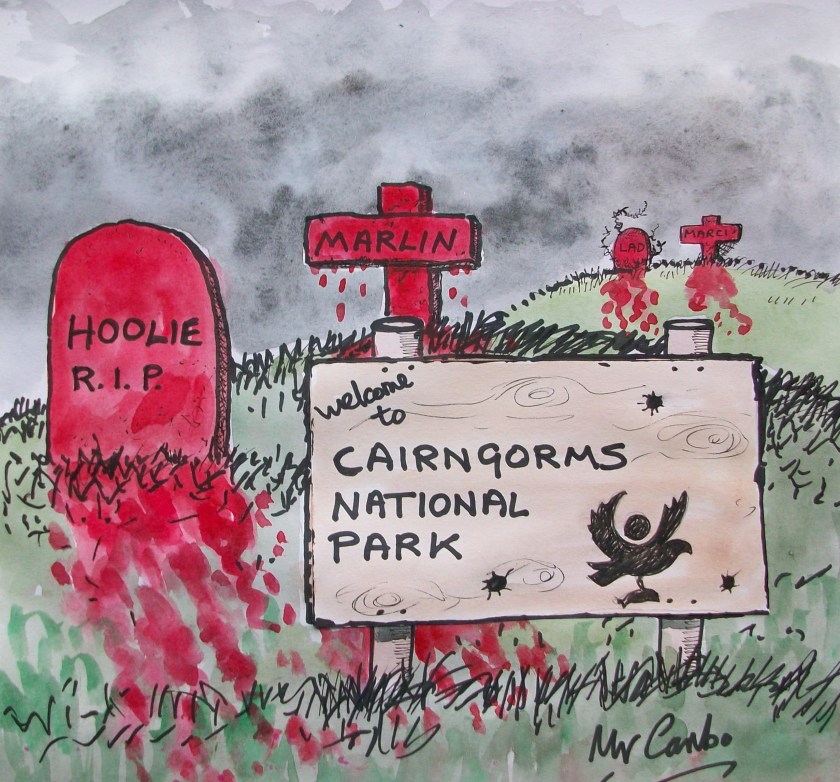
Yesterday we learned that two more satellite-tagged hen harriers, Hoolie and Marlin, had both ‘disappeared’ in suspicious circumstances from grouse moors in the Cairngorms National Park in April 2020 (see here). We also learned that they both vanished on exactly the same grouse moors from where two other satellite-tagged hen harriers had also disappeared without trace (Hen harrier ‘Lad‘ in 2015 and Hen harrier Marci in 2019).

It’s bad enough that these birds continue to be persecuted even though they’ve had legal protection in the UK for 76 years, but when this keeps happening inside a so-called National Park and nobody is ever held to account, you have to wonder, in terms of species conservation, what’s the point of National Park status?

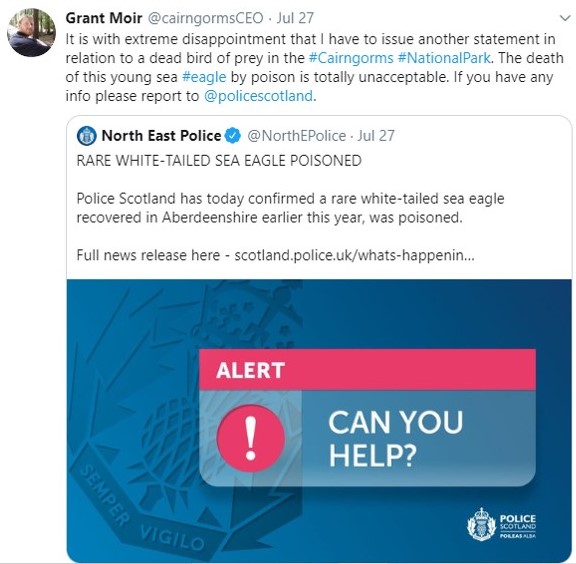
We asked Grant Moir, CEO of the Cairngorms National Park Authority, for a statement about these latest two suspicious disappearances and this is what he provided this afternoon:

It’s a strong statement in as much as the CNPA CEO recognises and fully accepts that these wildlife crimes continue in some areas of the National Park, which is in stark contrast to statements made by the grouse shooting industry reps today (more on this later) but it doesn’t offer a solution. It’s more of an exasperated shrug of the shoulders and a heavy reliance on the Scottish Government to respond well to the Werritty Review.

Is that it, then? Is the CNPA so impotent it can do nothing more than bemoan the persistent criminality within its boundary? This has been going on since 2002 (the Park wasn’t formally established until 2003 but we’ve included 2002 data as the area had been mapped by then). This list includes just the crimes we know about. How many more went unreported/undiscovered? How many more will we have to read about before the criminals are held to account?

ILLEGAL RAPTOR PERSECUTION INCIDENTS CAIRNGORMS NATIONAL PARK

2002

Feb: 2 x poisoned buzzards (Carbofuran) + rabbit bait. Tomintoul (No prosecution)

Mar: 2 x poisoned buzzards (Carbofuran) + 2 rabbit baits. Cromdale (No prosecution)

2003

Apr: 3 x poisoned buzzards (Carbofuran) + 2 grey partridge baits. Kingussie (No prosecution)

Jun: Attempted shooting of a hen harrier. Crannoch (Successful prosecution)

2004

May: 1 x poisoned buzzard (Carbofuran). Cuaich (No prosecution)

Nov: 1 x poisoned red kite (Carbofuran). Cromdale (No prosecution)

Dec: 1 x poisoned buzzard (Carbofuran). Cromdale (No prosecution)

2005

Feb: 1 x poisoned buzzard (Carbofuran). Cromdale (No prosecution)

Feb: 1 x poisoned buzzard (Carbofuran). Cromdale (No prosecution)

Mar: 3 x poisoned buzzards, 1 x poisoned raven (Carbofuran). Crathie (No prosecution)

2006

Jan: 1 x poisoned raven (Carbofuran). Dulnain Bridge (No prosecution)

May: 1 x poisoned raven (Mevinphos). Grantown-on-Spey (No prosecution)

May: 1 x poisoned golden eagle (Carbofuran). Morven [corbett] (No prosecution)

May: 1 x poisoned raven + 1 x poisoned common gull (Aldicarb) + egg bait. Glenbuchat (No prosecution)

May: egg bait (Aldicarb). Glenbuchat (No prosecution)

Jun: 1 x poisoned golden eagle (Carbofuran). Glenfeshie (No prosecution)

2007

Jan: 1 x poisoned red kite (Carbofuran). Glenshee (No prosecution)

Apr: Illegally set spring trap. Grantown-on-Spey (No prosecution)

May: Pole trap. Grantown-on-Spey (No prosecution)

May: 1 x poisoned red kite (Carbofuran). Tomintoul (No prosecution)

May: Illegally set spring trap. Grantown-on-Spey (No prosecution)

Jun: 1 x poisoned buzzard (Carbofuran) + rabbit & hare baits. Grantown-on-Spey (No prosecution)

Jun: 1 x poisoned buzzard (Carbofuran) + rabbit bait. Grantown-on-Spey (No prosecution)

Jul: 1 x poisoned raven (Carbofuran). Ballater (No prosecution)

Sep: 1 x shot buzzard. Newtonmore (No prosecution)

Sep: 1 x shot buzzard. Grantown-on-Spey (No prosecution)

Dec: 1 x poisoned buzzard (Alphachloralose). Grantown-on-Spey (No prosecution)

Dec: 1 x poisoned buzzard (Carbofuran) + rabbit bait. Grantown-on-Spey (No prosecution)

2008

Jan: 1 x poisoned buzzard (Alphachloralose). Nr Grantown-on-Spey (No prosecution)

Mar: 1 x poisoned buzzard (Carbofuran). Nr Grantown-on-Spey (No prosecution)

Dec: 1 x poisoned buzzard (Alphachloralose). Nr Grantown-on-Spey (No prosecution)

2009

May: 2 x poisoned ravens (Mevinphos). Delnabo (No prosecution)

Jun: rabbit bait (Mevinphos). nr Tomintoul (No prosecution)

Jun: 1 x shot buzzard. Nr Strathdon (No prosecution)

Jun: 1 x illegal crow trap. Nr Tomintoul (No prosecution)

2010

Apr: Pole trap. Nr Dalwhinnie (No prosecution)

Jun: 1 x pole-trapped goshawk. Nr Dalwhinnie (No prosecution)

Jun: Illegally set spring trap on tree stump. Nr Dalwhinnie (No prosecution)

Sep: 2 x poisoned buzzards (Carbofuran) + rabbit bait. Glenlochy (No prosecution)

Oct: 2 x poisoned buzzards (Carbofuran) + rabbit bait. Nr Boat of Garten (No prosecution)

2011

Jan: 1 x shot buzzard. Nr Bridge of Brown (No prosecution)

Mar: 1 x poisoned golden eagle (Carbofuran). Glenbuchat (No prosecution)

Apr: 1 x poisoned buzzard (Carbofuran & Aldicarb). Nr Bridge of Brown (No prosecution)

May:  1 x poisoned buzzard (Carbofuran) + rabbit bait. Glenbuchat (No prosecution)

May: 1 x shot short-eared owl, found stuffed under rock. Glenbuchat (No prosecution)

Jun: 1 x shot peregrine. Pass of Ballater (No prosecution)

Aug: grouse bait (Aldicarb). Glenlochy (No prosecution)

Sep: Satellite-tagged golden eagle ‘disappears’. Nr Strathdon

Nov: Satellite-tagged golden eagle ‘disappears’. Nr Strathdon

2012

Apr: 1 x shot short-eared owl. Nr Grantown-on-Spey (No prosecution)

Apr: Peregrine nest site burnt out. Glenshee (No prosecution)

May: Buzzard nest shot out. Nr Ballater (No prosecution)

2013

Jan: White-tailed eagle nest tree felled. Invermark (No prosecution)

May: 1 x shot hen harrier. Glen Gairn (No prosecution)

May: Satellite-tagged golden eagle ‘disappears’. Glenbuchat

2014

Apr: Satellite-tagged white-tailed eagle ‘disappears’. Glenbuchat

May: Armed masked men shoot out a goshawk nest. Glen Nochty (No prosecution)

2015

Sep: Satellite-tagged hen harrier ‘Lad’ found dead, suspected shot. Newtonmore (No prosecution)

2016

May: 1 x shot goshawk. Strathdon (No prosecution)

Jun: Illegally set spring traps. Invercauld (No prosecution)

Aug: Satellite-tagged hen harrier ‘Brian’ ‘disappears’. Kingussie

2017

Mar: Satellite-tagged golden eagle #338 ‘disappears’. Glenbuchat

Aug: Satellite-tagged hen harrier ‘Calluna’ ‘disappears’. Ballater

2018

May: Satellite-tagged white-tailed eagle Blue T ‘disappears’. Ballater

Aug: Satellite-tagged hen harrier ‘Athena’ ‘disappears’. Nr Grantown on Spey

Aug: Satellite-tagged hen harrier ‘Margot’ ‘disappears’. Nr Strathdon

Sept: Satellite-tagged hen harrier ‘Stelmaria’ ‘disappears’. Ballater

2019

April: Satellite-tagged hen harrier ‘Marci’ ‘disappears’. Nr Strathdon

April: Four geese poisoned and Carbofuran bait found on an estate nr Kingussie (no prosecution)

August: Golden eagle photographed with a spring trap dangling from its foot, nr Crathie, Deeside

September: Satellite-tagged hen harrier Wildland 1 ‘disappears’ on a grouse moor nr Dalnaspidal

September: Satellite-tagged hen harrier Wildland 2 ‘disappears’ on a grouse moor at Invercauld

2020

April: Satellite-tagged hen harrier Hoolie ‘disappears’ on grouse moor nr Newtonmore

April: Satellite-tagged hen harrier Marlin ‘disappears’ on grouse moor nr Strathdon

In addition to the above list, two recent scientific publications have documented the long-term decline of breeding peregrines on grouse moors in the eastern side of the National Park (see here) and the catastrophic decline of breeding hen harriers, also on grouse moors in the eastern side of the Park (see here).


Two more satellite-tagged hen harriers ‘disappear’ on grouse moors in Cairngorms National Park

Press release from RSPB Scotland (25 June 2020)

Two rare hen harriers disappear in suspicious circumstances

RSPB Scotland is calling on the Scottish Government to move quickly to introduce the licensing of grouse shooting, following the disappearance of two more satellite-tagged hen harriers on moors in the Cairngorms National Park revealed on BBC Scotland’s Landward this evening. 

As detailed in the programme, Marlin, a young male, fledged from a nest at the National Trust for Scotland’s Mar Lodge Estate in Aberdeenshire in 2018, while Hoolie, another male, came from a nest in Easter Ross in the same year.  

Before they left their nests, both birds were fitted with a satellite tags as part of the EU Hen Harrier LIFE project which have allowed experts to track their movements ever since. Marlin flew south after fledging and spent the last two winters in North Yorkshire. Hoolie crossed the sea to Ireland, returning there for the last two winters, where his movements have been closely followed by Irish ornithologists. 

In March 2020 Hoolie returned to Scotland, most likely with a view to finding a mate and raising chicks of his own. However, a month later his tag suddenly stopped transmitting. His last transmitted location was on 5 April and showed he was over an area of moorland intensively managed for grouse shooting near Newtonmore, in the Cairngorms National Park. He disappeared close to where another tagged hen harrier Lad was found dead, with injuries consistent with being shot, in 2015. 

[Hen harrier Hoolie, photo by RSPB Scotland]

Just three days later, on 8 April, Marlin’s tag also stopped suddenly. He too had returned to Scotland, and his last transmitted position was over a driven grouse moor near Strathdon, West Aberdeenshire, in the Cairngorms National Park. Last April, another Mar Lodge hen harrier, Marci, also disappeared suspiciously, less than a kilometre away, on the same grouse moor.  

[Hen harrier Marlin, photo by Shaila Rao]

When a tagged hen harrier dies of natural causes the tag continues to transmit its location allowing for the body to be recovered. Police Scotland carried out searches for the birds but neither the tags or the bodies were found, and neither tag has transmitted further data.  

Ian Thomson, RSPB Scotland’s Head of Investigations, said:

 “Scotland had only just been put into lockdown in early April and yet protected birds of prey equipped with highly reliable technology have disappeared on land managed for driven grouse moors. The fact that these two birds have disappeared very close to where other similar incidents have occurred only heightens suspicions that these birds can be added to the very long list of protected birds of prey killed on grouse moors. 

The Scottish Government’s independent review of grouse moor management, published at the end of last year accepted the need for regulation of grouse shooting but proposed a five year probationary period to allow populations of hen harriers and other birds of prey on or near grouse shooting estates to recover to a ‘favourable’ conservation status. We believe that this approach is unworkable in practice and urge the introduction of a licensing scheme as soon as possible.” 

ENDS 

More on this news tomorrow.

Two more hen harriers ‘disappear’ in suspicious circumstances on grouse moors in & next to Cairngorms National Park

News has emerged that another two satellite-tagged hen harriers have ‘disappeared’ in suspicious circumstances on two separate grouse moors, one in the Cairngorms National Park and one right next to it.

The source of this news is unusual, in that it isn’t in the form of a police appeal for information, it doesn’t come from the RSPB’s Hen Harrier LIFE Project and nor does it involve hen harriers tagged by Natural England south of the border.

This time the news is from an organisation called Wildland (see website here). This is a collection of estates in the Cairngorms and Sutherland, bought by the Polvsen family and being managed with an impressive vision for conservation. Wildland is also a pivotal partner in the wider conservation project called Cairngorms Connect (see website here) which ambitiously aims to restore ecological processes, habitats and species across an enormous area of the National Park.

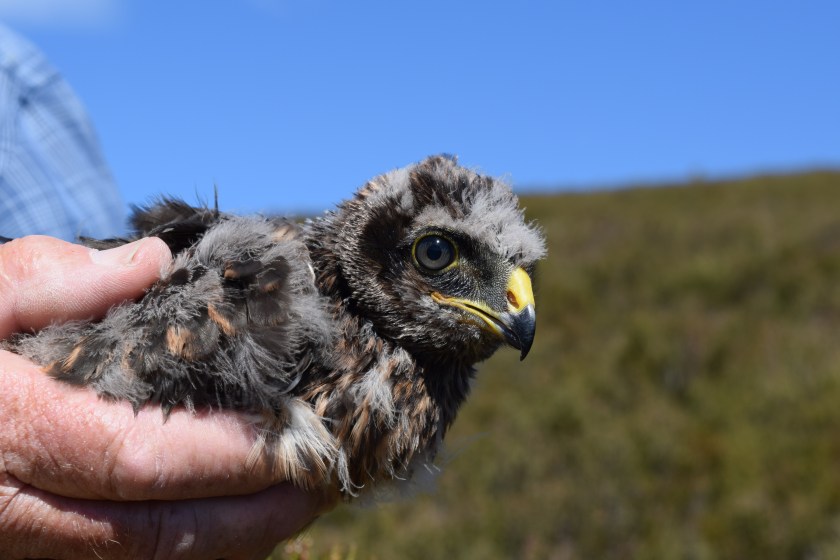
Wildland has been involved with satellite-tracking golden eagles for a while now, and last year it also fitted tags to hen harriers that had hatched on its estates. In a beautifully-produced blog that was published on Friday, the fates of three of those hen harriers have now been publicised.

You can read the blog here

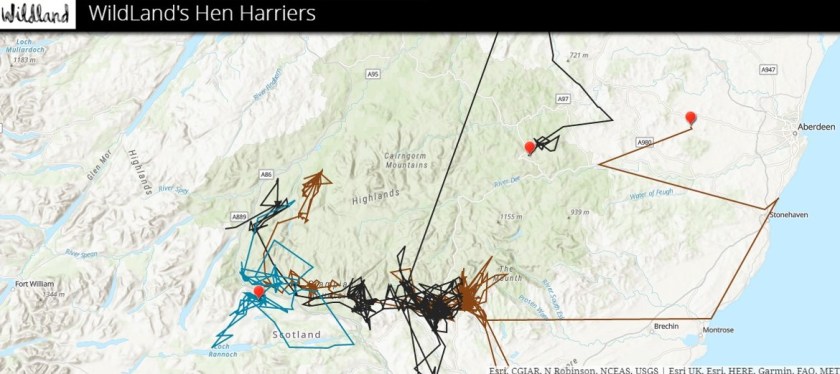
Anyone who knows anything about hen harriers in the UK uplands will not be surprised to learn that two of the three young hen harriers have since ‘disappeared’ and the last known transmission locations of the tags were both on driven grouse moors – one at Dalnaspidal on the SW edge of the National Park (last signal on 5 September 2019) and the other one at Invercauld, Royal Deeside, on the east side of the park (last signal on 24 September 2019). Regular blog readers may be familiar with these areas.

The third hen harrier didn’t disappear in suspicious circumstances over a grouse moor – this one was found dead in a field in Aberdeenshire although the cause of death has not been published.

[An overview of the movements of the three satellite-tracked hen harriers and their last known locations]

Interestingly, the Wildland blog also provides information about the functionality of the three tags with details given about the tags’ battery status (all working perfectly well) – this is a key indication that the ‘sudden stop no malfunction’ scenario of the two tags/hen harriers that vanished is indeed suspicious and not simply a predicted engineering malfunction, which researchers can identify by a steady decline in battery charge (e.g. see here).

The Wildland blog doesn’t provide any information about a police investigation in to the suspicious disappearances of the two young hen harriers, and nor have we seen any publicity about these disappearances even though the birds vanished nine months ago in September 2019. That’s disappointing, especially as the RSPB was publishing information about a suspected shot hen harrier and two others that had vanished on Scottish grouse moors in autumn 2019 (see here).

Nevertheless, now the news is out we can add these two Wildland hen harriers to the ever-expanding list of hen harriers (at least 33 now) believed to have been illegally killed since 2018, the year when grouse shooting industry reps would have us believe that hen harriers were welcomed back on the grouse moors:

February 2018: Hen harrier Saorsa ‘disappeared’ in the Angus Glens in Scotland (here). The Scottish Gamekeepers Association later published wholly inaccurate information claiming the bird had been re-sighted. The RSPB dismissed this as “completely false” (here).

5 February 2018: Hen harrier Marc ‘disappeared’ on a grouse moor in Durham (here)

9 February 2018: Hen harrier Aalin ‘disappeared’ on a grouse moor in Wales (here)

March 2018: Hen harrier Blue ‘disappeared’ in the Lake District National Park (here)

March 2018: Hen harrier Finn ‘disappeared’ near Moffat in Scotland (here)

18 April 2018: Hen harrier Lia ‘disappeared’ in Wales and her corpse was retrieved in a field in May 2018. Cause of death was unconfirmed but police treating death as suspicious (here)

8 August 2018: Hen harrier Hilma ‘disappeared’ on a grouse moor in Northumberland (here).

16 August 2018: Hen harrier Athena ‘disappeared’ on a grouse moor in Scotland (here)

26 August 2018: Hen Harrier Octavia ‘disappeared’ on a grouse moor in the Peak District National Park (here)

29 August 2018: Hen harrier Margot ‘disappeared’ on a grouse moor in Scotland (here)

29 August 2018: Hen Harrier Heulwen ‘disappeared’ on a grouse moor in Wales (here)

3 September 2018: Hen harrier Stelmaria ‘disappeared’ on a grouse moor in Scotland (here)

24 September 2018: Hen harrier Heather ‘disappeared’ on a grouse moor in Scotland (here)

2 October 2018: Hen harrier Mabel ‘disappeared’ on a grouse moor on the edge of the Yorkshire Dales National Park (here)

3 October 2018: Hen Harrier Thor ‘disappeared’ next to a grouse moor in Bowland, Lanacashire (here)

26 October 2018: Hen harrier Arthur ‘disappeared’ on a grouse moor in the North York Moors National Park (here)

10 November 2018: Hen harrier Rannoch ‘disappeared’ on a grouse moor in Scotland (here). Her corpse was found nearby in May 2019 – she’d been killed in an illegally-set spring trap (here).

14 November 2018: Hen harrier River ‘disappeared’ on a grouse moor in the Nidderdale AONB (here). Her corpse was found nearby in April 2019 – she’d been illegally shot (here).

16 January 2019: Hen harrier Vulcan ‘disappeared’ in Wiltshire close to Natural England’s proposed reintroduction site (here)

7 February 2019: Hen harrier Skylar ‘disappeared’ next to a grouse moor in South Lanarkshire (here)

22 April 2019: Hen harrier Marci ‘disappeared’ on a grouse moor in the Cairngorms National Park (here)

11 May 2019: A male hen harrier was caught in an illegally-set trap next to his nest on a grouse moor in South Lanarkshire. He didn’t survive (here)

7 June 2019: A hen harrier was found dead on a grouse moor in Scotland. A post mortem stated the bird had died as a result of ‘penetrating trauma’ injuries and that this bird had previously been shot (here)

5 September 2019: Wildland Hen Harrier 1 ‘disappeared’ on a grouse moor nr Dalnaspidal on the edge of the Cairngorms National Park (this post)

11 September 2019: Hen harrier Romario ‘disappeared’ on a grouse moor in the Cairngorms National Park (here)

24 September 2019: Wildland Hen Harrier 2 ‘disappeared’ on a grouse moor at Invercauld in the Cairngorms National Park (this post)

10 October 2019: Hen harrier Ada ‘disappeared’ on a grouse moor in the North Pennines AONB (here)

12 October 2019: Hen harrier Thistle ‘disappeared’ on a grouse moor in Sutherland (here)

18 October 2019: Member of the public reports the witnessed shooting of a male hen harrier on White Syke Hill in North Yorkshire (here)

November 2019: Hen harrier Mary found illegally poisoned on a pheasant shoot in Ireland (here)

January 2020: Members of the public report the witnessed shooting of a male hen harrier on Threshfield Moor in the Yorkshire Dales National Park (here)

There are two more satellite-tagged hen harriers (Tony & Rain) that are reported either confirmed or suspected to have been illegally killed in the RSPB’s Hen Harrier LIFE Project Report but no further details are available.

And then there were last year’s brood meddled hen harrier chicks that have been reported ‘missing’ but as they’re carrying a new type of tag known to be unreliable it’s not known if they’ve been illegally killed or if they’re still ok. For the purposes of this mini-analysis we will discount these birds.

So that makes a total of at least 33 hen harriers that are known to have either ‘disappeared’ in suspicious circumstances or have been witnessed being shot or have been found illegally killed in the last two years. And still we’re expected to believe that everything’s perfect, that the grouse shooting industry is not riddled with armed criminals and that hen harriers are doing just fine, thriving even, according to the shooting industry’s propaganda.

Angus Glens landowner loses appeal over unauthorised vehicle track

Last October an Angus Glens landowner was ordered to remove a controversial vehicle track that was visible for miles around in the Cairngorms National Park (see here).

The landowner had argued the track was to support forestry works and thus he didn’t need permission for it but campaigners had argued that the track appeared to be being used to support gamebird management and fieldsports (e.g. see here) and thus was unauthorised.

The Cairngorms National Park Authority agreed with the campaigners and issued an enforcement notice requiring the landowner to remove the track.

The landowner appealed this decision in December 2019.

[The unauthorised hilltrack in Glen Clova. Photo by Scottish Ramblers]

A couple of days ago a Scottish Government reporter agreed with the Cairngorms National Park Authority and dismissed the landowner’s appeal. She ordered the land to be restored “so far as is reasonably practicable” within one year.

Scottish Environment LINK’s Hilltracks Group, long-time campaigners on this issue, have welcomed the decision with the following press release:

CAMPAIGNERS HAIL ‘LANDMARK’ DECISION OVER UNAUTHORISED TRACK IN GLEN CLOVA

A Scottish Government reporter has today dismissed a landowner’s appeal against an order forcing the removal of a controversial vehicle track in scenic Glen Clova, Cairngorms NP.

The decision ends a long-running battle over the 1.5km track, which is visible for miles around and features spoil mounds up to 10 metres wide.

The landowner had launched an appeal in December 2019 against Cairngorms National Park Authority’s enforcement notice ordering him to remove the vehicle track, as it appears to be used to support field sports.

But today Allison Coard, a reporter appointed by Scottish Ministers, has dismissed the appeal and ordered the land to be restored “so far as is reasonably practicable” within one year.

Scottish Environment LINK Hilltracks Group, which continues to campaign for stronger public oversight of upland vehicle tracks, commended the reporter and the national park authority for their decisive action.

Helen Todd, who is Ramblers Scotland’s policy manager and co-convener of the LINK Hilltracks group, said: “This is a landmark result, and sadly one of very few examples of an authority feeling able to commit enough time and money to retrospectively tackle unauthorised tracks.

This ugly track is scarring the landscape in this historic, protected glen – and we look forward to seeing the hillside restored within the coming year.

All Scottish landowners should take note of today’s decision, and the expensive restoration job that the landowner will now need to carry out.”

Beryl Leatherland, of Scottish Wild Land Group and co-convener of the LINK Hilltracks group said: “The case highlights the urgent need for the Scottish Government to introduce stronger controls over vehicle tracks in our hills – to boost local democracy, improve construction standards and protect precious environments from further damage.”

The Scottish Government has made hilltracks one of the top priorities in its forthcoming review of ‘Permitted Development Rights’, which governs which types of developments can bypass the full planning permission process.

Currently, landowners simply need to tell authorities before building tracks which are said to support ‘agriculture or forestry’ – and full planning permission is generally not required. Campaigners believe these tracks are often created to support shooting activities and therefore should be subject to a planning application.

Research published in 2018 by the Scottish Environment LINK Hilltracks group found that vehicle tracks continue to expand further into Scotland’s mountain landscapes, and that weak planning processes can lead to them being badly-sited and designed.  Some tracks have even been built over the top of narrow, low-impact trails and historical routes, with little chance for the public to comment in advance.

You can view the full appeal decision and history here.

ENDS

Well done to the campaigners at Scottish Environment LINK Hilltracks Group and also to Nick Kempe who writes the campaigning Parkswatchscotland blog – well worth subscribing to for detailed and interesting commentary. Also well done to the Cairngorms National Park Authority for issuing the enforcement notice in the first place.

Revive, the coalition for grouse moor reform in Scotland also has unauthorised hilltracks in its sights and you can read more about this in Revive’s report here.


Scottish Government ‘actively considering’ additional enforcement action on wildlife crime

On Tuesday (17 December 2019) the Scottish Rural Affairs & Environment Minister, Mairi Gougeon, gave evidence to the cross-party Environment, Climate Change & Land Reform (ECCLR) committee which is currently considering Stage 1 of the Animals and Wildlife (Penalties, Protections and Powers) (Scotland) Bill.

The transcript can be read here (wildlife crime discussed from page 20 onwards): ECCLR report_17December2019

The archived video can be watched here

We’ve already blogged about one aspect of that evidence, where rather than committing to a mandatory custodial sentence for possession of banned deadly poisons, just as there is for those caught in possession of illegal firearms, yet another poisons amnesty was being considered instead (see here).

The rest of the session covered a lot of ground with some well-informed questions posed by some members of the ECCLR committee, especially Mark Ruskell MSP and Claudia Beamish MSP. In addition to an increase in penalties for wildlife crimes, which is part of the core text of the proposed Bill, other topics discussed included the Werritty review (due before the end of the year), the Government’s annual wildlife crime report (apparently due to be published ‘by the end of the year’ and we expect it will show an increase in confirmed raptor persecution crimes), vicarious liability, increasing SSPCA powers to tackle wildlife crime, the ineffectiveness of General Licence restrictions because estates can simply apply for Individual licences instead, covert video surveillance, the failure of the Police Special Constables pilot scheme in the Cairngorms National Park and a question about why the General Licence restriction at Leadhills Estate, imposed after Police Scotland provided ‘clear evidence of wildlife crime’, has been reinstated during the appeals process. Government officials committed to submitting a written response to Claudia Beamish’s question on this legally complicated issue.

The discussion on increasing powers for the SSPCA during Stage 2 of the Bill was quite telling. The Minister said the SSPCA had approached the Government in recent weeks to request additional powers to help tackle wildlife crime but she seemed to go to great lengths to argue that although she is committed to considering options she didn’t forsee anything happening in this particular Bill because the Government ‘needs the chance to fully discuss the issue’ and to ‘assess the ramifications of increasing those powers’.

Yeah, she’s right, so far the Government has only taken six years and five different Environment Ministers to fully discuss the issue and consider the ramifications – see here for a jaw-dropping timeline. And after all that it then concluded that accepting the offer of free resources from an expert and experienced reporting agency like the SSPCA wasn’t the right option for tackling serious organised crime and, inexplicably, chose instead to launch a £28k pilot scheme for five part-time voluntary Police Special Constables to potter around in the Cairngorms National Park and ‘meet stakeholders’; a scheme which, unsurprisingly, has been a complete flop. Even though Mairi Gougeon wasn’t in post as one of those five Environment Ministers during that six-year stalling exercise, her advisors should know all about those shenanigans. Honestly, the extent of the feet dragging is astonishing.

Mark Ruskell MSP again raised the issue of the ineffectiveness of General Licence restrictions and other sanctions, and asked the Minister if other sanctions were available? She responded by saying that she thought it was ‘important that other deterrents are available‘ and “We are actively considering the need for an additional level of enforcement, which would not require referral to the procurator fiscal or involvement of the Scottish courts but would still provide a penalty that would act as a deterrent. We will be happy to consider the evidence and consider whether measures are as effective as they can be“.

When Mark asked her whether she would be interested in discussing with the Westminster Government the withdrawal of a firearms certificate as a potential sanction, she responded,

Absolutely. I know that there were two recommendations around that in the Poustie review, so we will happily engage in discussions with the UK Government. I believe that the matter falls under the justice portfolio, so I would also be happy to raise it with justice colleagues and see how we can get some movement on the recommendations with the UK Government“.

Good, but if this was in the Poustie review on wildlife crime penalties published in 2015, why haven’t those discussions already taken place? That’s not Mairi Gougeon’s fault – she wasn’t in post then – but come on Scottish Government, five years on and discussions haven’t even started? This is like pulling teeth.

It’s not clear what other potential sanctions the Scottish Government is ‘actively considering’ to tackle wildlife crime but the long-awaited Werritty review should have some suggestions.

Special Constables pilot scheme in Cairngorms National Park a waste of time & money

Two and a half years ago, Environment Cabinet Secretary Roseanna Cunningham announced a pilot scheme whereby Police Special Constables would be deployed in the Cairngorms National Park to tackle wildlife crime.

This initiative was one of a number of measures announced in May 2017 in response to the findings of the golden eagle satellite tag review which showed clear evidence of deliberate and sustained illegal raptor persecution, particularly on some driven grouse moors in and around the Cairngorms National Park (CNP).

This RPUK map shows the last known location of satellite-tagged golden eagles that were either found illegally killed or had disappeared in suspicious circumstances in and around the CNP (data from the golden eagle satellite tag review):

Golden eagles are not the only victims of wildlife crime in and around the CNP. This RPUK map below, based mostly on RSPB data, shows raptor persecution incidents between 2005-2016. Only one of these (just outside the CNP boundary on Kildrummy Estate) has resulted in a successful prosecution. With such clear evidence of wildlife crime it’s easy to see why the CNP was chosen as the first location for this pilot scheme.

This pilot scheme was the Government’s alternative to extending the powers of the SSPCA to allow it to investigate a wider suite of wildlife crime (including raptor persecution) – a decision made after six years of Governmental deliberation under five different Environment Ministers.

It also emerged in 2018 that this pilot scheme was an alternative to the Government’s 2016 manifesto pledge to establish a Wildlife Crime Investigation Unit as part of Police Scotland – a pledge on which it has now reneged (see here).

The idea was that the police special constable scheme could be rolled out across Scotland “if judged to be successful” in the CNP, but we weren’t told the criteria that would be used to judge this ‘success’.

The scheme was formally launched in March 2018 (see here) and nothing more was heard of it.

Just over a year later in April 2019 we asked the Cairngorms National Park Authority the following questions about the scheme:

Here’s the response:

So basically after a year of operation, one of the main project partners couldn’t tell us anything about the scheme.

Fast forward six months to November 2019 and Scottish Greens MSP Mark Ruskell thought it was time more questions were asked. Here are his two Parliamentary questions and Roseanna Cunningham’s answers:

S5W-26349 Mark Ruskell (Mid Scotland and Fife) (Scottish Green Party): To ask the Scottish Government how much funding (a) it and (b) the Cairngorms National Park Authority allocated each year to the Wildlife Special Constables pilot project.

Roseanna Cunningham: The Scottish Government agreed to contribute £18,000 and the Cairngorms National Park Authority agreed to provide £10,000 for the Wildlife Special Constables pilot project.

S5W-26346 Mark Ruskell (Mid Scotland and Fife) (Scottish Green Party): To ask the Scottish Government what the outcome was of the Wildlife Special Constables pilot project; how many constables participated each month in this, and how many suspected crimes they reported, also broken down by how many led to subsequent (a) arrests, (b) charges, (c) prosecutions and (d) convictions.

Roseanna Cunningham: a)The Scottish Government is currently undertaking an evaluation of the Special Constable Pilot Project in conjunction with Police Scotland and the Cairngorms National Park Authority. We will announce a decision on the future direction of the project in due course.

b) There were five special constables in the project, employed on a part-time basis.

c) and d) From the information gathered in the review conducted by Police Scotland, there were no recorded crimes reported by the Special Constables during their patrols in the 12 month trial period. However, Special Constables were involved in meeting stakeholders and partners operating within the Cairngorms National Park to build relationships and understand the needs and demands of National Park users which will aid future intelligence gathering.

Gosh, it’s easy to see why the Scottish Government’s evaluation of the pilot scheme is taking so long, what with having to count ZERO reported wildlife crimes.

Meanwhile satellite tagged raptors continue to disappear in suspicious circumstances in the Cairngorms National Park (white-tailed eagle here; hen harrier here; hen harrier here and hen harrier here); birds are still being illegally poisoned in the Cairngorms National Park (here) and birds of prey are still being caught by illegally-set traps in the Cairngorms National Park (golden eagle here).

But it’s ok, nothing to worry about because £28K has just been spent on ‘building relationships and understanding the needs and demands of National Park users’.

FFS.

Angus Glens landowner ordered to remove unauthorised vehicle track

Press release from Scottish Ramblers, working on behalf of Scottish Environment LINK Hilltracks Group

7 October 2019

Landowner told to remove track scarring Cairngorms hill

A landowner in the Cairngorms National Park has been ordered to remove a controversial vehicle track that is visible from miles around in scenic Glen Clova, Angus.

Campaigners have welcomed Cairngorms National Park Authority’s enforcement notice against the ugly vehicle track, which appears to be used to support field sports.

The landowner – registered to Pitlivie Farm in Carnoustie – has been given until October 2020 to restore the upper part of the track, which is 1.5km long and has created spoil mounds up to 10 metres wide. They have also been told to seek retrospective permission by 23 December 2019 for changes to a separate section of track lower down the hillside.

[The unauthorised track in Glen Clova. Photo from Ramblers Scotland]

Such tracks made national headlines this year when the Scottish Parliament voted against Planning Bill amendments from Scottish Green Party MSP Andy Wightman which would have closed loopholes and introduced stricter controls over their construction.

Helen Todd is Ramblers Scotland’s policy manager and co-convener of the LINK Hilltracks group, which continues to campaign for stronger public oversight of upland vehicle tracks.

Ms Todd: “We commend the Cairngorms National Park Authority for taking decisive action against this ugly and unauthorised track, which is a scar upon the landscape in this historic, protected glen.

It is one of very few examples of an authority being able to spend the time and money required to retrospectively tackle inappropriate tracks, which for too long have been creeping further and further into wild landscapes.

I hope that other landowners across Scotland will take notice of the Glen Clova order, which will force the person who built this track to pay for an expensive restoration job.”

Beryl Leatherland, of Scottish Wild Land Group and co-convener of the LINK Hilltracks group said: “The case highlights the urgent need for the Scottish Government to introduce stronger controls over vehicle tracks in our hills – to boost local democracy, improve construction standards and protect precious environments from further damage.”

The Scottish Government last week announced that hill tracks will be one of the top priorities in its forthcoming review of ‘Permitted Development Rights’, which governs which types of developments can bypass the full planning permission process.

Currently, landowners simply need to tell authorities before building tracks which are said to support ‘agriculture or forestry’ – and full planning permission is generally not required. Campaigners believe these tracks are often created to support shooting activities.

Research published last year by the Scottish Environment LINK Hilltracks group found that vehicle tracks continue to expand further into Scotland’s mountain landscapes, and that weak planning processes can lead to them being badly-sited and designed.

Some tracks have even been built over the top of narrow, low-impact trails and historical routes, with little chance for the public to comment in advance.

ENDS

How refreshing to see a landowner held to account for causing environmental damage apparently in pursuit of fieldsports. Well done to Scottish Environment Link’s Hilltracks Group for its campaigning work and well done to the Cairngorms National Park Authority for issuing an enforcement notice. More of this, please!

Helen Todd and Beryl Leatherland gave a compelling presentation at the Revive conference in Perth in August (see video below). Unauthorised hilltracks are part of Revive’s campaign for grouse moor reform and you can read more about this in Revive’s report here.