Pilot study to examine impact of releasing non-native gamebirds in Cairngorms National Park

A pilot study to examine the impacts of releasing non-native gamebirds (pheasants & red-legged partridges) into the Cairngorms National Park is due to begin this spring, according to an article published by The Ferret.

Captive-bred non-native pheasants in pretty poor condition being transported for release into the UK countryside. Photo by Ruth Tingay

The pilot study looks to be the start of a wider and long-overdue assessment of the impact of these releases across Scotland, based on FoI documents from NatureScot compiled by journalists at The Ferret (well worth reading those documents, here).

The Ferret suggests that the Game & Wildlife Conservation Trust (GWCT) will be undertaking the study. This is a charity that relies heavily upon funding from the gamebird shooting industry. Talk about marking your own homework!

A GWCT spokesperson is quoted in The Ferret article:

The pilot project to begin looking at the numbers of gamebirds released within the Cairngorms National Park has not yet taken place, but is due to start this spring once the plan for it has been finalised“.

I’ll be looking forward to seeing the GWCT’s proposed methods and justification for undertaking a pilot study in the spring – a time of year when gamebird numbers will be at their lowest after the end of the winter and the end of the shooting season, instead of planning to do it in the autumn when these birds are released in their millions and thus at their most abundant / causing the most damage.

There’s also a hilarious quote from NatureScot:

Currently, there is little evidence to show that gamebirds are causing damage to protected areas in Scotland, but we will continue to monitor the situation closely“.

‘We will continue to monitor the situation closely’ can be translated as, ‘We’ve ignored this issue for years so of course we don’t have any evidence of damage, because we haven’t been looking!’.

The issue of releasing non-native gamebirds into the Cairngorms National Park has been the subject of a number of blogs on the excellent ParkswatchScotland website over the years (e.g. here in 2017 and here in 2020). Nick Kempe, the blog’s author, has repeatedly questioned why this issue hasn’t featured in the Cairngorms National Park’s Management Plans.

It was, finally, included in the latest Management Plan (2022-2027) despite objections from some members of the Park Authority’s Board in 2021 who just happened to have strong links to the game-shooting industry (see here – and if you’ve got the time it’s worth watching the video of that Board Meeting).

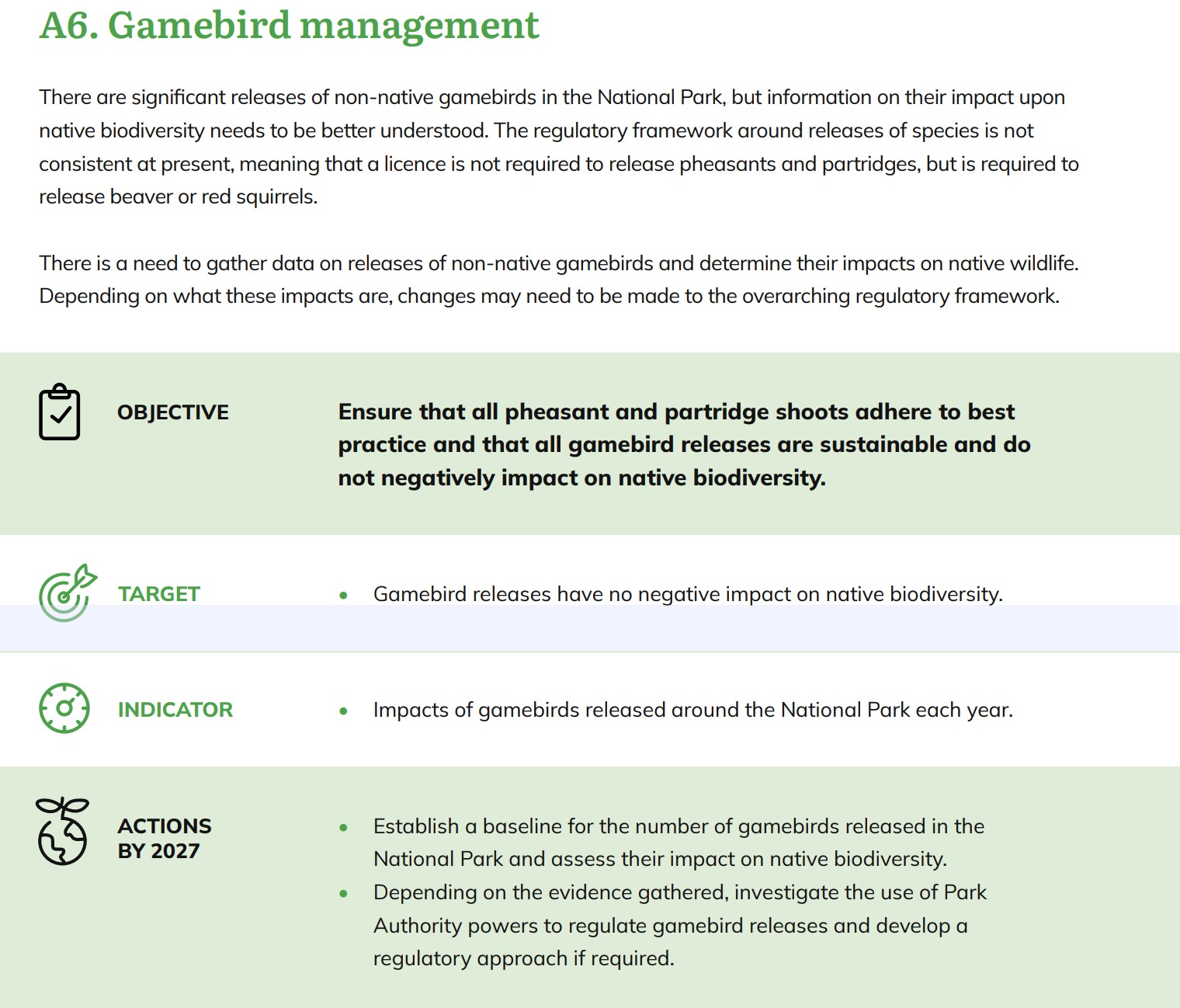
Here’s what the current CNP Management Plan says about gamebird management:

The Management Plan points out:

The regulatory framework around releases of species is not consistent at present, meaning that a licence is not required to release pheasants and partridges, but is required to release beavers and red squirrels‘.

Isn’t it about time this inequity between the release of millions of non-native gamebirds and the restoration of a few native species was addressed?

UPDATE 21 November 2025: New report on gamebird releases in Cairngorms National Park doesn’t tell even half the story (here)

Cairngorms National Park Authority condemns latest shooting of red kite

Following yesterday’s news that a red kite has been found shot dead in the Glenbuchat area of Strathdon (here), the Cairngorms National Park Authority has issued the following statement:

STATEMENT ON RED KITE

28th February 2025

The Cairngorms National Park Authority has issued the following statement in relation to the death of a red kite in the Glenbuchat area of Strathdon:

“The Park Authority have been informed by Police Scotland that a red kite was found dead in the Glenbuchat area of Strathdon earlier this month. Police Scotland have confirmed that the red kite had been shot.

The shot red kite. Photo by RSPB Scotland

“The Park Authority condemns the illegal killing of raptors in the strongest possible terms. Raptor persecution has no place in 21st century Scotland but sadly incidents such as this are still taking place. It is an unacceptable crime that not only harms our raptor populations, but also damages the reputation of those land managers that act lawfully and work hard to care for wildlife.

“We are committed to working with partners to make sure the National Park is a safe haven for raptors and to establish the full circumstances of this incident. Anyone with information is asked to contact Police Scotland on 101, quoting incident number 0846 of Thursday 27 February. Alternatively, you can contact Crimestoppers on 0800 555 111 where information can be given anonymously”.

ENDS

Red kite found shot dead in Strathdon area of Cairngorms National Park – Police Scotland appeals for information

Press release from Police Scotland (28 February 2025):

APPEAL FOR INFORMATION AFTER BIRD OF PREY SHOT NEAR STRATHDON

Officers are appealing for information after a bird of prey was shot near Strathdon.

On Wednesday, 26 February 2025, we received a report of a red kite having being shot sometime between Monday, 3 and Tuesday, 4 February in the Glenbuchat area of Strathdon after being found by a member of the public.

The bird was recovered with the assistance of the Royal Society for the Protection of Birds (RSPB) where the cause of death was not apparent at that time. Following further investigations, it has been established that the bird had been shot and police were contacted.

Detective Constable Danny Crilley of the Wildlife Crime Unit said: “Red kites are protected under the Wildlife and Countryside Act and it is illegal to kill any protected species.

Enquiries are ongoing and we are working with our partner agencies to establish the full circumstances of this incident.

I would appeal to anyone with any information that may assist our investigation to contact us. Your information could be vital in in establishing what has happened. If you were in the Glenbuchat area on Monday, 3 or Tuesday, 4 February, and saw anything suspicious or have any information about shooting activity in the area, please contact us.

Anyone with information is asked to contact Police Scotland on 101, quoting incident number 0846 of Thursday, 27 February.  Alternatively, you can contact Crimestoppers on 0800 555 111 where information can be given anonymously.”

ENDS

First of all, well done to Police Scotland for issuing a speedy appeal for information, just two days after being notified about this shot red kite.

It’s not clear from the press release whether this shot raptor was found on or next to a grouse moor. However, the ‘Glenbuchat area of Strathdon’ is certainly in close proximity to land managed for driven grouse shooting.

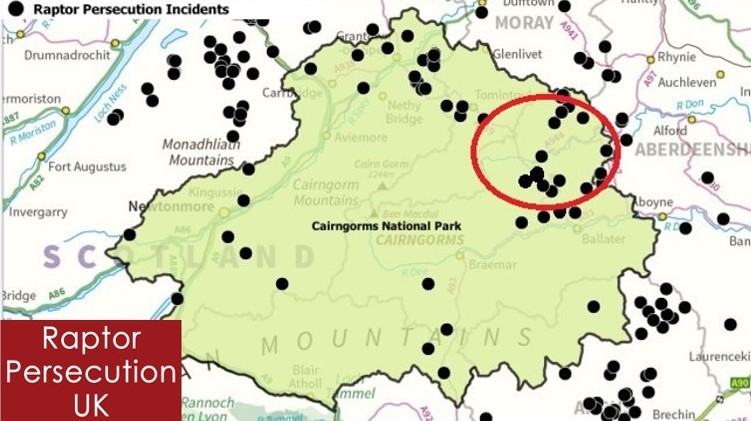
The Strathdon area of the Cairngorms National Park has long been recognised as a raptor persecution hotspot, as this map demonstrates:

This is a map I published in 2020 following the discovery of a poisoned White-tailed eagle on an unnamed grouse moor in the area (here).

The black dots on the map represent raptor persecution incidents recorded between 2005-2020, based on data from the RSPB, the golden eagle satellite tag review, and other data in the public domain. The Strathdon area is circled.

Those incidents in Strathdon include a poisoned raven (2006), a poisoned common gull (2006), multiple poisoned baits (2006), a shot buzzard (2009), a poisoned golden eagle (2011), a poisoned buzzard (2011), poisoned bait (2011), a shot short-eared owl (2011), two satellite-tagged golden eagles ‘disappearing’ (2011), another satellite-tagged golden eagle ‘disappearing’ (2013), a satellite-tagged white-tailed eagle ‘disappearing’ (2014), a goshawk nest shot out by masked men (2014), a shot goshawk (2016), another satellite-tagged golden eagle ‘disappearing’ (2017), a satellite-tagged hen harrier ‘disappearing’ (2018), another satellite-tagged hen harrier ‘disappearing’ (2019), and another satellite-tagged hen harrier ‘disappearing’ (2020).

Nobody was prosecuted in any of these cases.

The Strathdon area was also identified as a golden eagle persecution hotspot in the Scottish Government-commissioned scientific report, Analyses of the fates of satellite-tracked golden eagles in Scotland, published in 2017 and eventually leading to the introduction of the grouse moor licensing scheme in 2024:

It would be interesting to know whether this shot red kite was found on or next to a grouse moor and if it was, whether an associated grouse moor licence will be revoked as a consequence, which was the clear intention of the Scottish Parliament when it voted through the Wildlife Management & Muirburn (Scotland) Act 2024 almost a year ago last March.

My guess is that it won’t lead to a licence revocation, even if the red kite was found on or close to a grouse moor, because it will be virtually impossible to connect its death to the management of the grouse moor (as the new, shambolic and unenforceable licence condition now specifies).

Just like the shot osprey found in the Angus Glens on the opening day of the grouse-shooting season in August 2024 (here) and the shot peregrine, also found in the Angus Glens, in September 2024 (here), there won’t be any consequences for those responsible.

The raptor killers are still at, and they’re still getting away with their crimes.

For those who think the grouse moor licensing scheme is failing, and that the Scottish Government hasn’t shown any signs of intending to fix it even though it acknowledges there are issues (e.g. see here), there’s an alternative option – and that is to ban driven grouse shooting.

Wild Justice currently has a live petition calling for such a ban. It’s been supported by 67,432 members of the public so far but needs 100,000 signatures to trigger a Parliamentary debate. Please sign here to support it.

UPDATE 1st March 2025: Cairngorms National Park Authority condemns latest shooting of red kite (here)

UPDATE 2 May 2025: Two men charged in relation to illegal killing of Red Kites in Cairngorms National Park (here)

UPDATE 9 December 2025: Two Scottish gamekeepers on trial today in relation to alleged killing of Red Kites in Cairngorms National Park (here)

UPDATE 9 December 2025: Alleged killing of Red Kites in Cairngorms National Park – trial of two gamekeepers adjourned as Sheriff recuses himself due to RSPB membership (here)

‘Why are birds of prey still being killed in Scotland despite new legislation?’ – special report in The National

The National newspaper published a special report on Monday 16 December 2024 entitled, ‘Why are birds of prey still being killed in Scotland despite new legislation?’, with a particular focus on the Cairngorms National Park.

It’s reproduced below.

SCOTLAND passed the Wildlife Management and Muirburn (Scotland) Bill earlier this year, introducing a licensing scheme for the grouse shooting industry in a bid to end the illegal killing of birds of prey.

The first licenses were issued this past summer, and while considered a blueprint for tougher legislation across the UK – people are still killing birds of prey on grouse moors, which is not an easy thing to do.

Guilty parties must have access to a vehicle, equipment such as a firearm, opportunity and motive.

This isn’t people traveling from towns and cities going up onto our hills and randomly killing birds of prey. These are targeted offences,” Ian Thomson, investigations manager for the RSPB, told The National.

But why? And who would do this?

Why are grouse moor shootings still taking place?

A Hen Harrier disappeared in February. A buzzard was shot in Perthshire in mid-May. An osprey was shot in the Glen Doll area in August. A dead golden eagle was found in a plastic bag near Loch Rusky in November.

In the last 15 years, more than 1500 birds of prey have been killed, with 57 convictions. However, the majority of these sentences are suspended, and only one person has been jailed.

Most of the evidence gathered by investigators is from satellite tags, fitted to allow conservationists to monitor the movements around the country.

The technology is estimated to be about 97% reliable, and “very rarely suffers some sort of technical function”, according to Thomson.

Often we believe that there is strong evidence that supports the fact that these birds are being shot often at night, the tags destroyed, and the carcass is disposed of,” Thomson said.

The RSPB investigations team assists Police Scotland by speaking to local land managers and liaising with the community if a tag stops working. When asked why anyone would target the birds, even with the new legislation in place, Thomson said: “The killings are being undertaken by people who are working on the land.

That’s the reality, and the vast majority of raptor persecution offenses occurring in Scotland are linked to management for kind of game bird shooting and particularly grouse shooting.

There are many layers of evidence that support that.

First of all, the location of the incidents that are found. Whether its birds shot, birds poisoned, or nests destroyed, these are all subject to police investigations.

A significant proportion of people convicted for raptor persecution offenses have been gamekeepers,” Thomson shared.

RSPB data shows that at least 54% of all confirmed incidents in the last 10 years (2014-2023) have been linked to land managed for pheasant, partridge and grouse shooting.

The association of these crimes with the gamebird industry is also evidenced by criminal court records. Of all individuals convicted of bird of prey persecution related offences from 2009 to 2023, 75% were connected to the gamebird shooting industry and 68% were gamekeepers.

The Angus Glens crime hotspot

Angus Glens in the Cairngorms is a hotspot for the number of raptor persecution in Scotland, with the Highlands having 69 since 2009.

There have been multiple confirmed incidents occurring on several estates in the area. This includes many poisoning incidents using chemicals whose possession was long banned, repeated illegal misusing abuse of crow traps and pole traps, shootings and destruction of nests.

Earlier this year, NatureScot placed restrictions on an estate on the edge of the Cairngorms National Park for three years following evidence of bird poisoning on the property.

Thomson said there had been 10 suspicious disappearances of satellite tags on birds of prey in the Angus Glen in the last 15 years.

There has been a peregrine, and an osprey shot since the start of the shooting season in Angus Glens this year, which Thomson described as “worrying”.

The law as it has stood since 2012 has been serious liability, which means landowners are responsible for the actions of their employees and the land.

So are landowners aware of the circumstances surrounding raptor persecutions on their land?

A wall of silence

The first licenses under the new bill were approved this past July, but Thomson noted there would have been no need for it had the industry “taken possession of this problem decades ago”.

He added: “I think had the industry rooted out criminals, then we wouldn’t have needed this sort of legislation moved on.

We are in a situation where some Victorian management practices towards birds of prey persist. It really is time that the shooting industry got into the 21st century.

Thomson said it was rare for estates to report raptor persecutions.

When asked whether estates may be protecting or turning a blind eye to those who target birds of prey, Thomson said he could not confirm but he and his team frequently hear of peer pressure within estates to keep reporting low, adding that crimes are rarely reported by the industry.

The problem is the game keeping industry is used to operating a bit like a closed shop,” Thomson said.

It’s very difficult. There is no whistleblowing culture, and it would be fantastic if organizations representing gamekeepers set up a scheme where people could report incidents taking place and those are passed on to the police.

But that just never seems to happen. Exceedingly rare truths are told.”

Thomson revealed that gamekeepers come to the team sharing their worries and are “terrified” to come forward.

They say to us this information can’t come from me because I may lose my job and I may lose my friends and I may lose my hobby. People are under considerable pressure to keep their mouths shut,” he said.

Either people won’t see anything or there is just a culture of denial.”

Thomson described “efforts to deny or downplay” incidents, and said that when satellite tags start to disappear, people blame “imaginary wind farms” or factors, dismissing science and evidence of crimes.

It’s a mix of cultural misinformation, a wall of silence and complete denial”, Thomson added.

ENDS

For those who are sick to the back teeth of birds of prey being illegally killed on grouse moors, you might want to sign this new petition from Wild Justice calling for a ban on driven grouse shooting – HERE.

Goshawk nest abandoned in Cairngorms National Park after shotgun attack – Police Scotland appeal for information

Press release from Police Scotland (28 June 2024):

APPEAL FOR INFORMATION AFTER GOSHAWK NEST FOUND ABANDONED NEAR LOCH GYNACK

Police are appealing for information after a suspected attempt to target birds of prey in the Strathspey area.

On Saturday, 8 June, 2024, officers received a report of an active Goshawk nest having been found abandoned in suspicious circumstances, within a forest near Loch Gynack.

Goshawk photo by Pete Walkden

Enquiries were carried out at the site, in partnership with RSPB Scotland, showing the nest had been deliberately targeted with a shotgun. The nest and damaged branches were taken for x-ray with the assistance of staff at the Kincraig Highland Wildlife Park.

Police Constable Daniel Sutherland, Highland and Islands Wildlife Crime Liaison officer, said: “All birds of prey are fully protected under the Wildlife and Countryside Act 1981 and it is illegal to kill them. I am asking anyone in the local community who may be able to help with our enquiries to come forward.

The area is close to popular walking paths from Newton More. If you were walking in the area during May or early June, and may have seen or heard anything suspicious, then please get in touch.”

Anyone with information is asked to contact Police Scotland on 101, quoting reference CR/0211821/24, or make a call anonymously to the charity Crimestoppers on 0800 555 111.

ENDS

UPDATE 24 October 2025: BBC’s Highland Cops programme features investigation into shot out Goshawk nest in Cairngorms National Park (here)

Poisoned baits and dead raven found on Invercauld Estate in Cairngorms National Park: Police Scotland appeals for information

Police Scotland has issued the following press statement:

RAVEN FOUND DEAD IN ABERDEENSHIRE

An investigation is under way after a raven was found dead in an area of the Invercauld Estate in Aberdeenshire.

On Friday, 12 May 2023, game keepers at the Estate contacted police after they found a dead raven next to a number of broken eggs. Officers attended and removed the bird and the egg shells.

The egg shell and matter has been analysed and has tested positive for pesticide. Officers are awaiting toxicology results for the raven.

Constable Hannah Corbett said: “We take wildlife crime extremely seriously and a number of lines of inquiry are being followed up. However, I would like to appeal to the local community for any information they may have about this matter. Did you see anything suspicious, have you overheard anyone talking about this? Any small piece of information could prove significant in investigating the cruel and callous death of the raven. Please do contact us.”

Anyone with information is asked to call Police Scotland via 101, quoting incident number 1307 of 12 May 2023. Alternatively, you can contact Crimestoppers on 0800 555 111 where information can be given anonymously.

ENDS

Many of you will know that one part of Invercauld Estate is currently serving a three-year General Licence restriction, imposed by NatureScot after the discovery of an illegally poisoned golden eagle and illegal poisoned baits on an estate grouse moor in March 2021 (see here).

It’s not yet clear on which area of Invercauld Estate the latest poisoned baits were discovered – it’s a massive grouse-shooting estate that covers a large area of the Cairngorms National Park. It’ll be interesting to find out if these baits were found on the same shooting ‘beat’ as before or on another shooting ‘beat’ managed by a different party on a different part of the estate.

I applaud Police Scotland’s decision to publicise the discovery of the poisoned baits – not least to warn members of the public who might venture into the National Park and on to the estate with children and dogs, putting them at potential risk of great harm.

The early publicity is a welcome change to what had become a standard practice of complete silence from Police Scotland on raptor poisoning crimes (e.g. here, here, here).

Job vacancy: Raptor Conservation Officer, Cairngorms National Park

The Cairngorms National Park Authority (CNPA) is advertising a three-year, full time position for a Raptor Conservation Officer, to deliver the actions laid out in the National Park’s latest Partnership Plan (2022-2027) aimed at increasing the home range, occupation and breeding success of golden eagle, hen harrier, merlin and peregrine across the National Park.

This is a promising move by the CNPA, who have previously faced severe criticism for not dealing effectively with ongoing raptor persecution in some areas of the Park, notably on land that’s managed for intensive driven grouse shooting (e.g. see here & here).

Crimes against birds of prey, especially those that take place within the Cairngorms National Park, are often high profile, and quite rightly so. For example the recent poisoning of a golden eagle on a grouse moor within the Park (here) and the poisoning of a white-tailed eagle on another grouse moor within the Park (here) generated widespread outrage and media coverage, as did the sighting of a young golden eagle flying around a grouse moor in the Park with a spring trap clamped to its leg/foot (here).

Last year, the CNPA stated its intention to address intensive gamebird management within the Park as part of its Partnership Plan (here), which was seen as a good move by many of us who know that raptor persecution is disproportionately associated with land managed for gamebird shooting. That, combined with the creation of this new Raptor Conservation Officer post, is indicative of things moving in the right direction.

Make no mistake though, this new post will be a challenging one. There are some fantastic estates in the Cairngorms National Park who have been hosting and protecting breeding raptors (e.g. golden eagles, white-tailed eagles, hen harriers) for some time now, but there are also other estates that stubbornly refuse to tolerate these species and still behave as though it’s the 1890s.

The post is full time for three years, attracting a salary between £33,652 – £40,362. The closing date for applications is Sunday 30th April at 23.59hrs.

A detailed job description and list of essential attributes is provided here:

To apply, please visit the CNPA website HERE

RSPB wants ‘action & delivery’ from Scottish Government on grouse moor licensing scheme

RSPB Scotland has published a blog today calling for ‘action and delivery’ from the Scottish Government on its promised grouse moor licensing scheme.

The Government announced in November 2020 that grouse shooting businesses in Scotland will need to be licensed to operate, under new proposals to tackle raptor persecution.

It also announced that muirburn will also only be permitted under licence, in order to protect wildlife and habitats, regardless of the time of year it is undertaken and whether or not it is for grouse moor management or improving grazing.

The Government stated there will also be a statutory ban on burning on peatland, except under licence for strictly limited purposes, such as approved habitat restoration projects.

Since that announcement in November 2020, there hasn’t been any further action, but there has been plenty more evidence of illegal raptor persecution, including the poisoning of this golden eagle on a grouse moor at Invercauld Estate in the Cairngorms National Park:

RSPB Scotland writes:

We have been very patient, but nearly 20 months on from this announcement, we want to see some action and delivery on these promises by the Scottish Government. Proposals must be brought forward in the forthcoming Programme for Government in autumn 2022 for the introduction of grouse moor and muirburn licensing legislation in the next Parliamentary year“. 

You can read the full RSPB blog here.

EVENT: Walk for Harriers, Cairngorms National Park, 6th August 2022

Invercauld Estate in Cairngorms loses appeal against General Licence restriction imposed for wildlife crime

Invercauld Estate in the Cairngorms National Park has lost its appeal against a General Licence restriction that was imposed on the estate in February 2022 (see here) after Police Scotland provided the licensing authority (NatureScot) with evidence of wildlife crime against birds of prey on the estate, notably the discovery of a ‘deliberately poisoned’ golden eagle lying next to a poisoned hare bait in March 2021 (see here).

[Photo of the poisoned eagle & hare bait found on a grouse moor on Invercauld Estate in the Cairngorms National Park. Photo by RSPB Scotland]

Regular blog readers will know that the three-year General Licence restriction on the Gairnshiel & Micras part of Invercauld Estate took effect on 9th February 2022, prohibiting the use of General Licences 01, 02 and 03 on the estate until 9th February 2025 (see here).

The estate submitted a formal appeal against NatureScot’s restriction decision on 25th February 2022 and the official ‘restriction notice’ was removed from NatureScot’s website. I looked today and the notice has been reinstated, which I take to mean that the estate’s appeal has failed, in the same way that Lochan Estate’s recent appeal against restriction also failed (see here).

Here is the map from Naturescot showing the area of restriction on the Gairnshiel & Micras area of the estate:

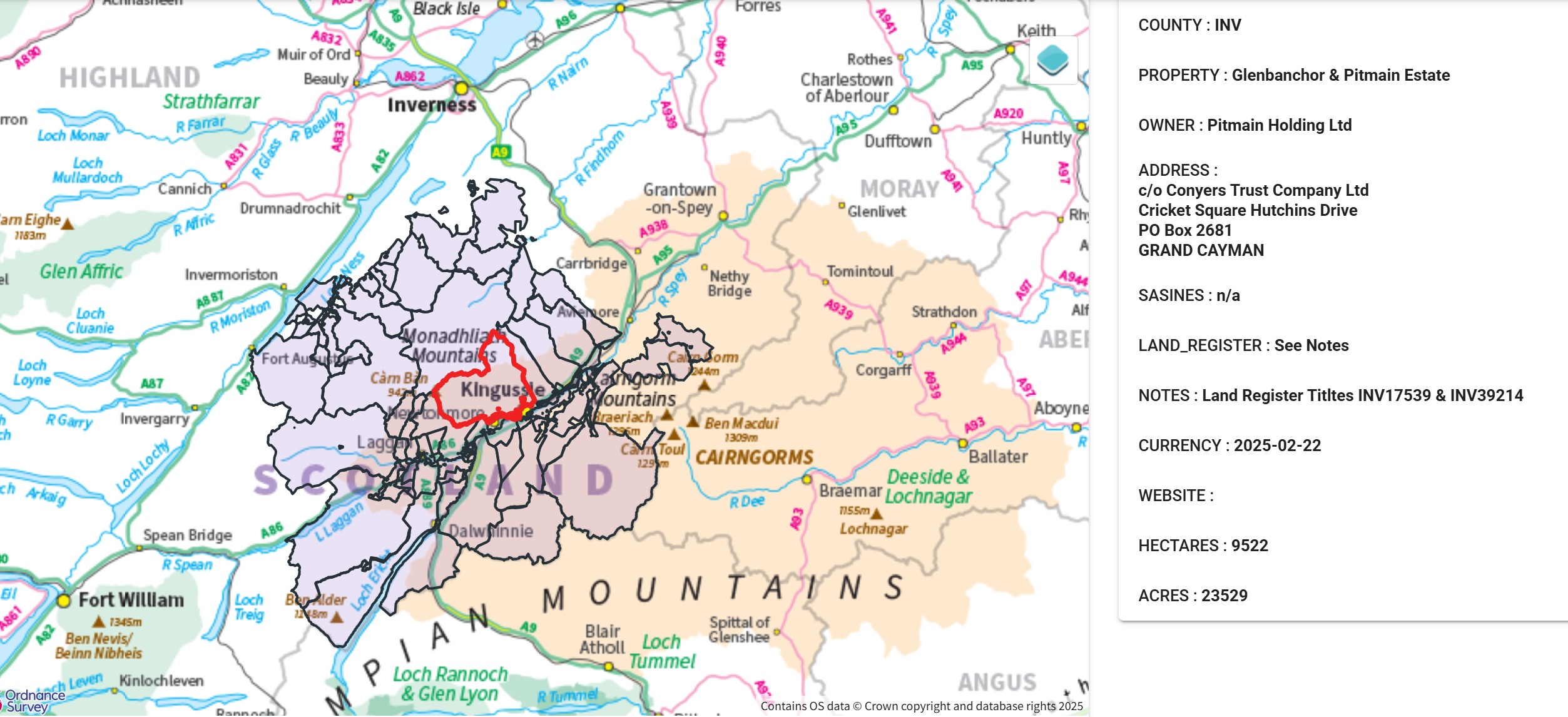
If you’re at all familiar with Invercauld Estate you’ll recognise that this restriction area is only a small part of what is a massive grouse-shooting estate in the Cairngorms National Park (data from Andy Wightman’s excellent Who Owns Scotland website) rather than the restriction being applied across the entire estate, as seems to have been the case with other sanctioned estates:

I was curious about why the General Licence restriction was, well, restricted for want of a better term, to just the small area of Garnshiels and Micras, so I asked the licensing team at NatureScot about that decision.

The response from NatureScot was prompt (thank you!) and went like this:

‘…The decision was made on the basis that the evidence of crime provided [by Police Scotland] related to this one beat, rather than across the whole estate; and that the separate beats on this estate are managed independently of each other. Hence, the ultimate decision was to restrict to the beats where the evidence of crime occurred‘.

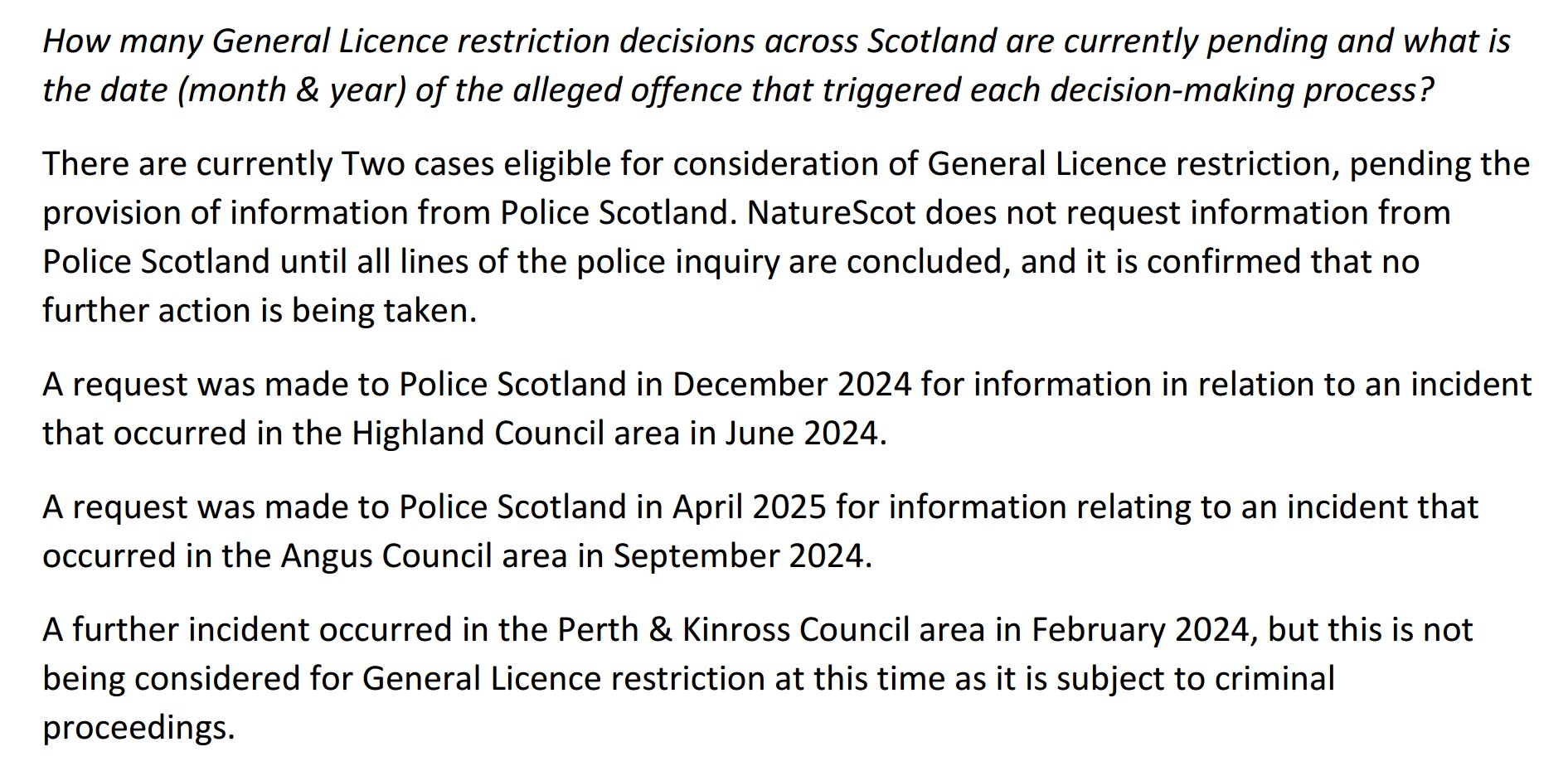
As many of you already know, the three-year General Licence restriction is barely worth the paper it’s written on because the estate can simply apply for ‘Individual licences’ (instead of relying on the General Licences) to continue its activities as before, albeit with the minor inconvenience of having to have a bit of a paper trail. This has been a major criticism of the General Licence restriction process ever since it began in 2014. This, combined with the shooting industry’s apparent reluctance to shun any estates where restrictions have been imposed for wildlife crime, means that the General Licence restriction is an utterly ineffective sanction (e.g. see here).

We were even provided with first-hand evidence of its ineffectiveness when further evidence of suspected wildlife crime was detected on two estates that were already serving a General Licence restriction for wildlife crime! Raeshaw Estate in the Scottish Borders had its Individual licences revoked (here) and Leadhills Estate was given a three-year extension to its original three-year General Licence restriction (here), a decision which it subsequently appealed and lost (here).

You may remember that in February, Scottish Greens MSP Mark Ruskell asked Parliamentary questions about this absurd so-called sanction (see here); more on that shortly.