‘Gamekeeper pleads guilty after illegally killed raptors & poisons found on Dorset estate’ – RSPB press release

RSPB press release:

*Multiple illegally killed birds of prey, six of which were confirmed shot and one poisoned, were uncovered by Dorset Police and the RSPB on the Shaftesbury Estate near Wimborne St Giles

*The recently published RSPB Birdcrime report identified Dorset as the second worst county in the UK for confirmed bird of prey incidents in 2021

*The conservation charity is calling for greater regulation of larger scale pheasant shoots in order to help address the climate and nature crises and to reduce these appalling crimes against birds of prey

At Weymouth Magistrates’ Court today (4 January 2023), Paul Allen, 64, of Brockington Down, Wimborne St Giles, pleaded guilty to multiple charges of raptor persecution and related offences.

The Dorset gamekeeper will be sentenced on 16 February.

Dorset Police were first alerted in November 2020 when a member of the public found a dead red kite lying close to a dead rat on a private pheasant shoot on the Shaftesbury Estate, near Wimborne St Giles. Toxicology examinations confirmed the presence of the highly toxic pesticide bendiocarb in both species. Bendiocarb, which in some forms has now been banned, has been persistently abused for the illegal poisoning of birds of prey and other animals for years. It is believed the rat was laced with the poison and deliberately placed as a poisoned bait.

A multi-agency search of Allen’s home and surrounding land was undertaken in March 2021, led by Dorset Police and assisted by the National Wildlife Crime Unit (NWCU), Natural England and RSPB Investigations. Officers discovered six dead buzzards (which, following official post-mortem, were confirmed to have been shot) near the remains of a bonfire, including one that was suspected as having been shot within the preceding 24 hours. Tragically, this bird also contained shot from two previous shooting incidents, which it had survived.

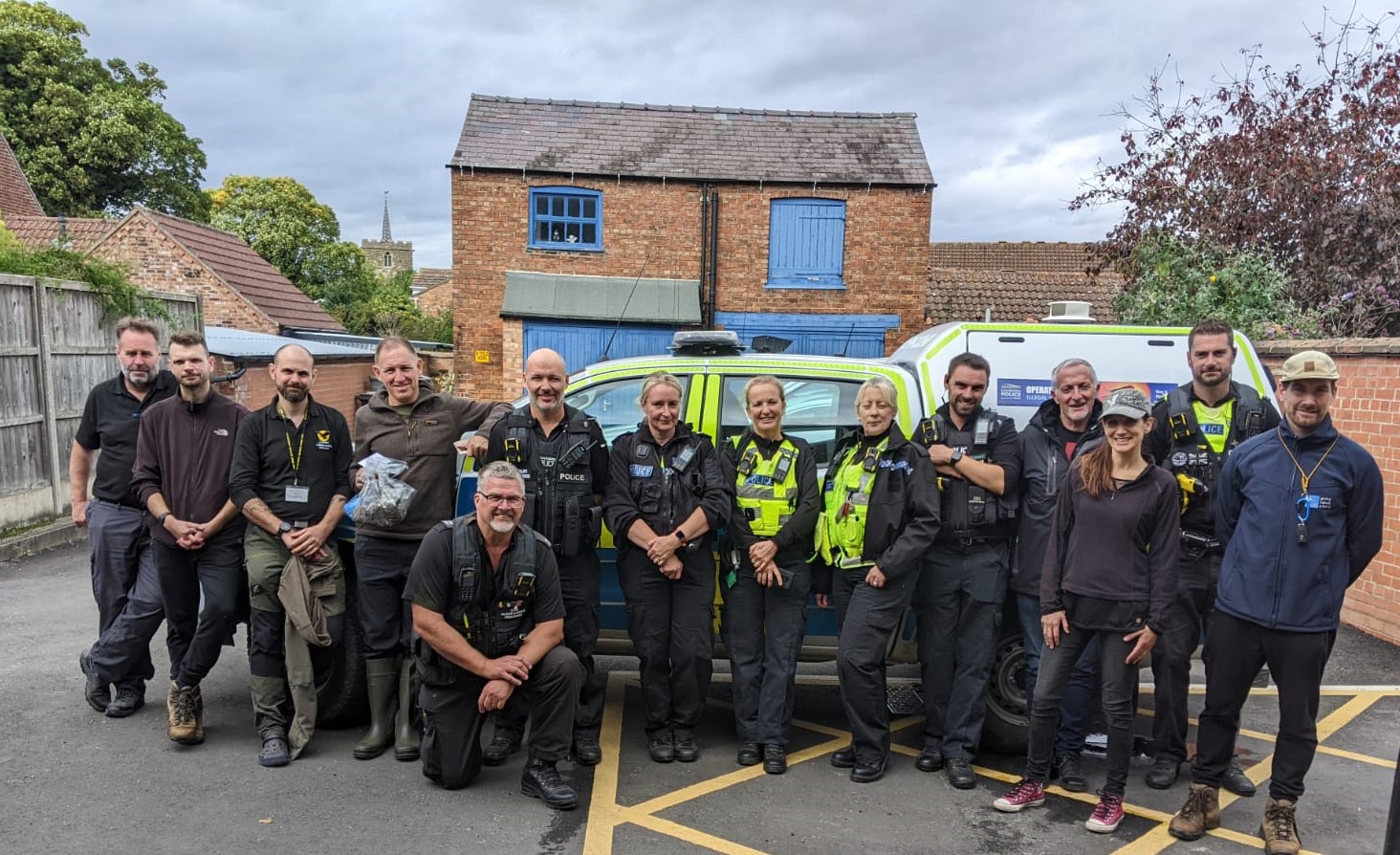
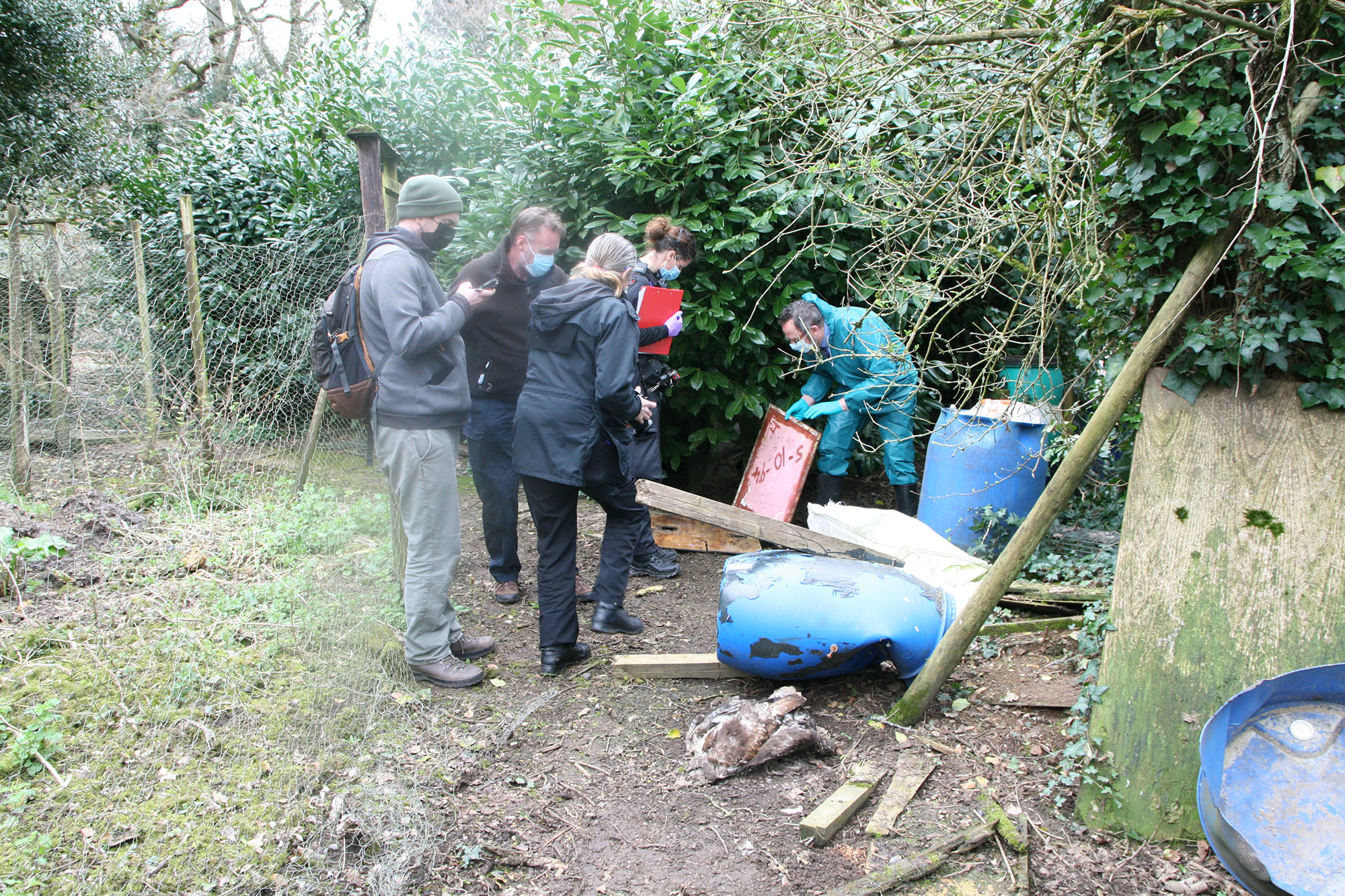
Dorset Police, NWCU, Natural England & RSPB investigators at the scene where four of the nine buzzards were found. Photo: RSPB
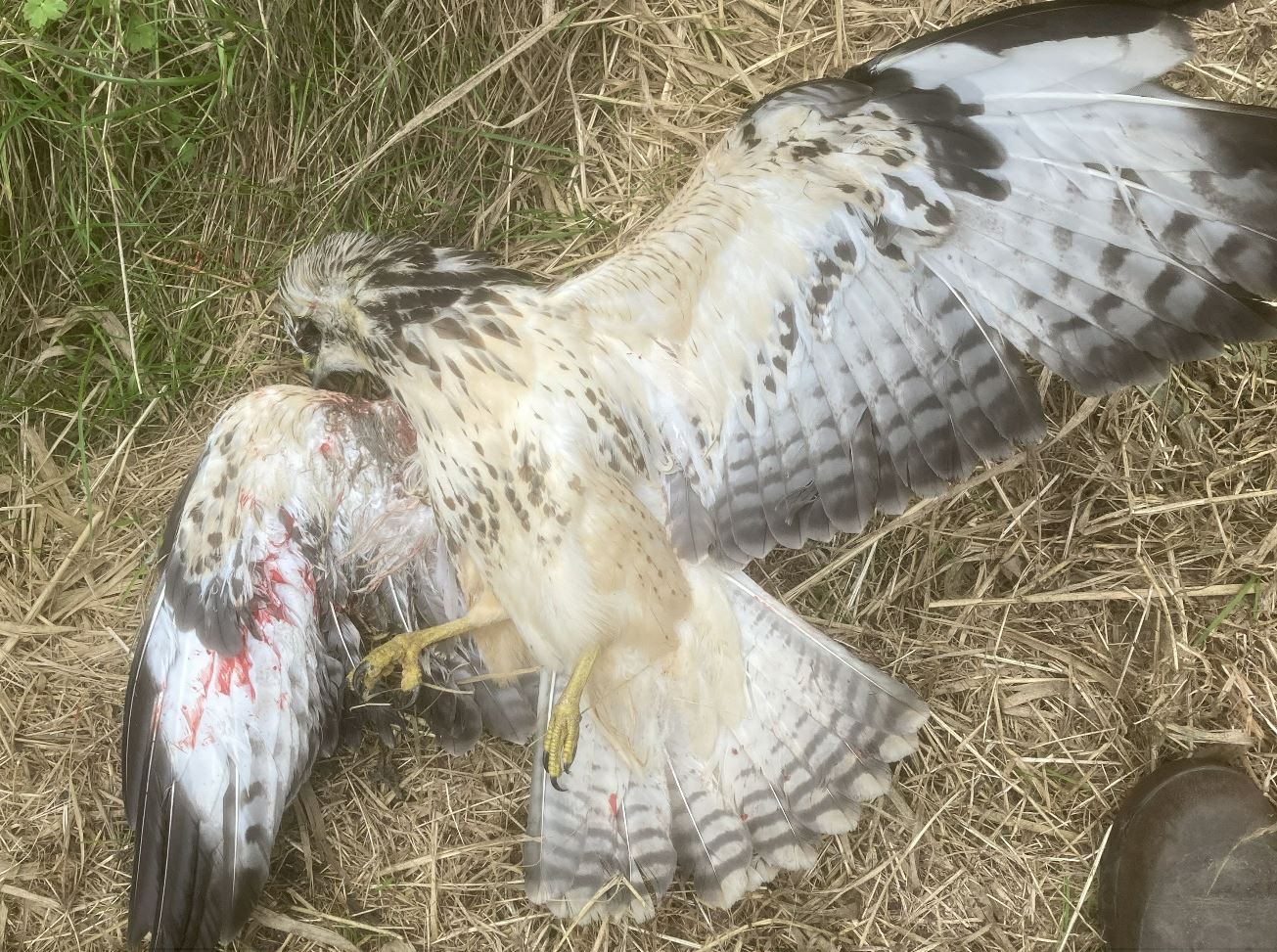
Four of the six shot buzzards found by investigators. Photo: RSPB
Two more shot buzzards found during the search. The buzzard on the top was believed to have been shot less than 24 hours before being found. Photo: RSPB

An avian specialist at the Natural History Museum examined the remains of the fire, which was collected by investigators and confirmed the presence of at least three further buzzards.

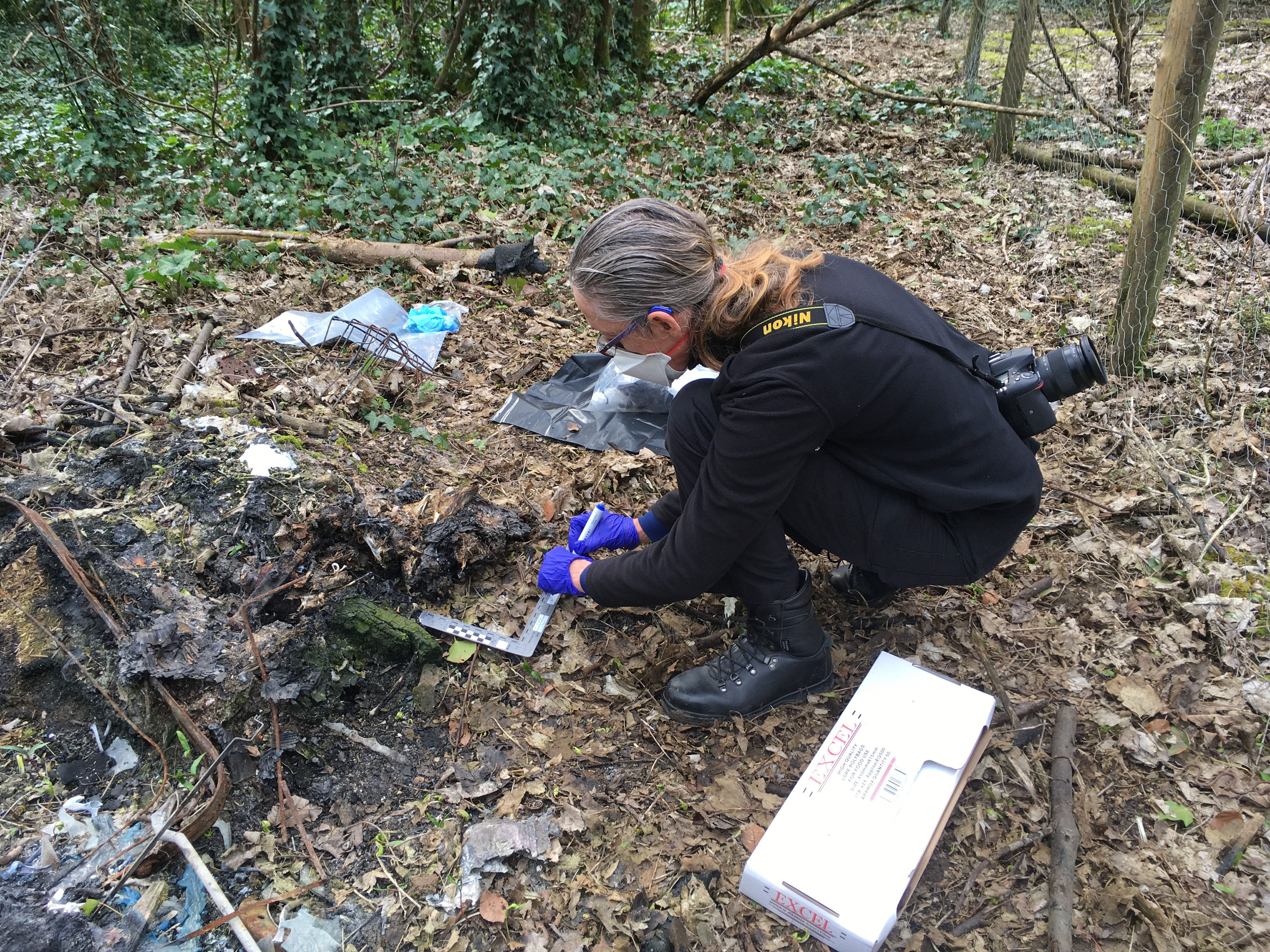
CSI officer from Dorset Police examining the remains of three buzzards on a bonfire. Photo: RSPB

A banned product containing the pesticide bendiocarb was found in Allen’s vehicle and in an insecure outbuilding, along with two bottles of strychnine: another deadly poison banned in 2006. Two full tins of Cymag – a lethal fumigant pesticide banned since 2004 – were also found outside under an upturned pond liner.

Officers from Dorset Police & Natural England with two containers of Cymag. Photo: RSPB
Sachet of banned pesticide Ficam W (Bendiocarb) found in unlocked outbuilding. Photo: RSPB

All birds of prey are protected under the Wildlife and Countryside Act 1981 and killing them is against the law, punishable by an unlimited fine and/or jail.

Thomas Grose, RSPB Investigations Officer, said: “Finding so many illegally killed buzzards was truly shocking. This is yet another example of a gamekeeper being prosecuted in connection with raptor persecution offences on land managed for gamebird shooting.

“In addition to all the agencies involved in this case, we would particularly like to thank Claire Dinsdale, formerly of Dorset Police, and currently with the NWCU, an exemplary officer who has devoted her career to tackling wildlife crime.”

Nationally, the RSPB’s recently published Birdcrime report for 2021 found that over two-thirds of confirmed raptor persecution incidents were in relation to land managed for gamebird shooting and identified Dorset as the county with the second-highest number of confirmed raptor persecution incidents in the UK that year.

Mark Thomas, UK Head of Investigations at the RSPB, said: “Tragically, only days into the New Year, we already have yet another highly significant bird of prey persecution case before a court. This is a national problem which requires urgent Government attention and solutions, as identified in their own report published in December 2021.

“In the time of a climate and nature emergency there can be no place for raptor persecution. We are therefore calling on Government to better enforce existing regulations relating to pheasant shoots, and to consider the introduction of new sanctions to act as a meaningful deterrent to such appalling crimes.”

The guilty pleas were –

· Two charges of possession of six dead common buzzards and remains of three more in March 2021

· Three charges of the keeping of banned pesticides (strychnine, bendiocarb and Cymag) in March 2021

· Two charges of failing to comply with conditions of shotgun and firearms certificates in March 2021

Charges relating to the killing of a red kite were dropped.

ENDS

The RSPB has also released a few minutes of video footage from the search – well worth viewing. You can find it on the ITV News website here

Dorset gamekeeper Paul Allen guilty of multiple raptor persecution, poisons & firearms offences

Further to my blog post on January 1st 2023 (here), this morning gamekeeper Paul Scott Allen, 54, of Baileys Hill, Brockington, near Wimbourne in Dorset, has pleaded guilty to seven charges of raptor persecution, poisons and firearms offences whilst he was working on a privately-run gamebird shoot located on the Shaftesbury Estate in March 2021.

Following the discovery of a poisoned red kite on the estate in November 2020, a multi-agency raid led by Dorset Police’s (now former) wildlife crime officer Claire Dinsdale took place in March 2021 (see here) where the corpses of six dead buzzards were found by a pen behind his house (tests later showed they had all been shot, including one that was was estimated to have been shot in the last 24hrs). Officers also found the remains (bones) of at least three more buzzards on a bonfire.

A loaded shotgun was found propped up behind a kitchen door (!) and 55 rounds of ammunition were found in a shed. Both the gun and the ammunition should have been inside a locked cabinet, by law. The ammunition was not covered by Allen’s firearms certificate.

Officers also found a number of dangerous, and banned, chemicals, including two bottles of Strychnine, two containers of Cymag and a packet of Ficam W (Bendiocarb) in various locations, including in a vehicle used by Allen.

Four of six illegally shot buzzards found during the police raid. Photo by RSPB

The seven guilty pleas included two counts of possessing a live or dead bird, or parts thereof, one charge of failing to comply with the conditions of a shotgun certificate, one charge of failing to comply with the conditions of a firearms certificate, one count of possessing a regulated substance without a license, one count of failing to comply with  regulations in accordance with the Plant Protection Products (Sustainable Use) Regulations 2012 and one charge of contravening a health and safety regulations.

A number of charges were dropped prior to the hearing. More on that shortly.

Sentencing was adjourned for reports and Allen is due back in court on 16th February 2023.

There is plenty to discuss about this case and I will do that over the coming days. In the meantime, press attendance at court was strong so I’ll add the links to the various reports as they come out, below.

MEDIA COVERAGE

DorsetLive here

Bournemouth Echo here

BBC News here

Daily Telegraph here

ITV News (includes RSPB video footage from the crime scene) here

The Times here

RSPB press statement (includes crime scene photos) here

UPDATE 4th January 2023: The estate that Dorset Police refused to search after discovery of poisoned eagle is the same location where gamekeeper was today convicted of multiple raptor persecution crimes (here)

UPDATE 16th February 2023: Convicted Dorset gamekeeper Paul Allen due to be sentenced today (here)

UPDATE 16th February 2023: Criminal Dorset gamekeeper Paul Allen receives suspended custodial sentence despite committing multiple wildlife, poisons and firearms offences (here)

Dead buzzard found hanging from a tree in County Down

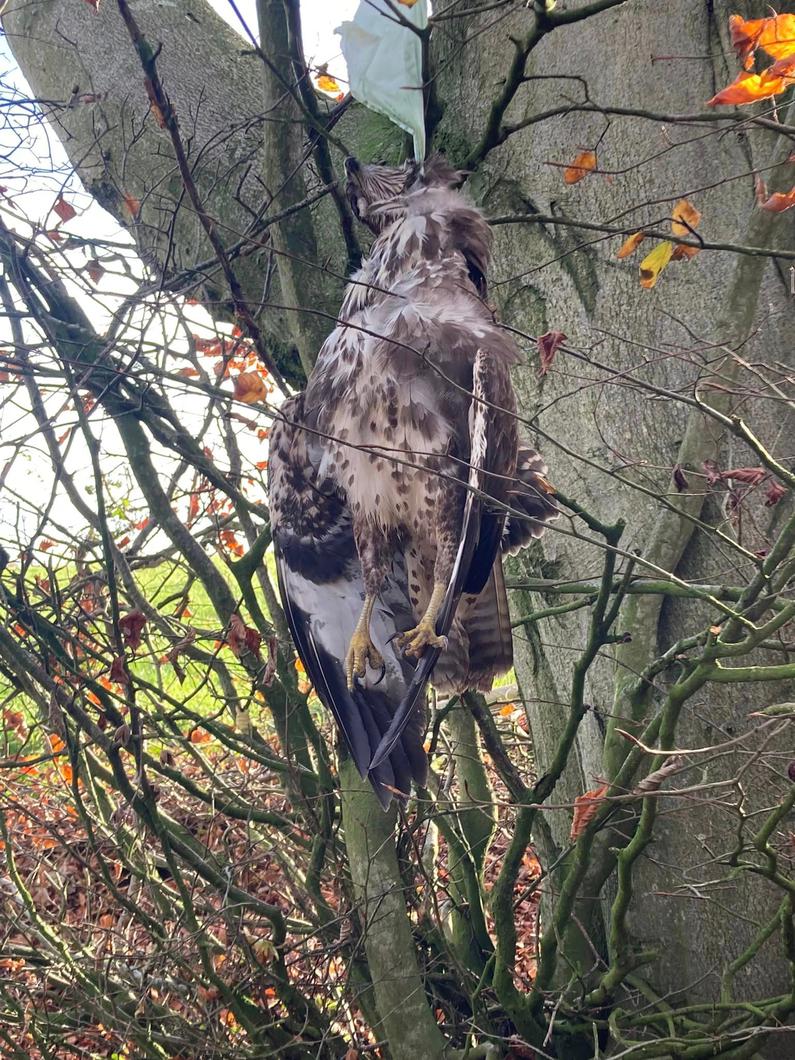
A dead buzzard has been found hanging from a tree in County Down.

The bird was discovered last Saturday (19th November 2022) in woodland near Clandeboye on the Ulster Way by independent unionist Alex Easton MLA, who was walking his dog. He notified the Police Service of Northern Ireland (PSNI) who sent out a forensic team the next day.

Photographs from the scene show the dead buzzard, tied by its neck to the tree by what looks like a plastic bag:

There’s some very odd media coverage of this story in the Belfast Telegraph, where Alex Easton is quoted as saying:

The PSNI forensic guys think it was poisoned and put there to attract other birds of prey who would themselves be poisoned when they fed from it.

They told me they had seen the same sort of incident elsewhere in Northern Ireland. They removed the buzzard and are carrying out an investigation. I hope those responsible are caught.

This beautiful bird should have been left alone to enjoy its life. Other animal life was also put at risk, as the poison could easily have killed a dog.

I’d never seen a buzzard before. I would have much preferred to view this stunning creature in full flight, not hanging dead from a tree. As a wildlife lover, I believe we should be protecting such birds, not poisoning them.”

To be clear, there isn’t any evidence yet that the buzzard has been poisoned and even if it had, hanging it from a tree ‘to attract other birds of prey who would themselves be poisoned when they fed from it’ is the oddest suggestion and demonstrates a complete lack of understanding of how raptors forage.

The statement from a PSNI spokesperson, as quoted in the paper, is much more circumspect and appropriate under the circumstances:

“Police in Bangor recovered a dead buzzard from the Ulster Way area, Clandeboye Road, on Saturday, November 19, following a report from a member of the public.

The bird has been sent for a post-mortem examination and other tests to determine its cause of death. Enquiries are ongoing.”

Alex Easton did the right thing by notifying the police to investigate. If anyone has any information that could assist the inquiry the PSNI crime reference number is 695/19/11/22.

RSPB Investigations Officer reflects on conviction of Norfolk raptor-killing gamekeeper Matthew Stroud

Last month, Norfolk gamekeeper Matthew Stroud, 46, of Fengate in Weeting was convicted of multiple offences including:

  • Three counts of using poisoned bait on or before 19 August 2021 and 14 September 2021.
  • Six counts of killing a Common Buzzard (a non-Schedule 1 wild bird) at Weeting between 10 August and 14 September 2021.
  • One count of intentionally killing a Northern Goshawk (a Schedule 1 wild bird) at Weeting on or about 10 August 2021.
  • One count of possessing a regulated substance – Strychnine Hydrochloride – without a licence on 14 September 2021.
  • One count of possessing 4 shotguns to kill a Schedule 1 wild bird on 14 September 2021.
  • One count of releasing 3,400 Common Pheasants into the wild between 1 June and 14 September 2021 contrary to the Wildlife and Countryside Act 1981.
  • One count of incorrectly storing a biocidal product – Rentokil Phostoxin – on 14 September 2021 contrary to the Health and Safety at Work Act 1974.

Even though Stroud’s crimes easily passed the threshold for a custodial sentence, he received a 12-month Community Order and was ordered to do 200 hours of unpaid work, fined ÂŁ692 and ordered to pay costs of ÂŁ145, compensation of ÂŁ288.72 and a victim surcharge of ÂŁ95. The court also ordered the forfeiture and destruction of all Stroud’s firearms, mobile phones and any chemicals (see here and here for previous blogs on this).

Stroud’s prosecution and conviction was the result of a well-run multi-agency investigation involving Norfolk Constabulary, Natural England, National Wildlife Crime Unit, Crown Prosecution Service and the RSPB Investigations Team.

Today, the RSPB has published a blog written by RSPB Investigations Officer Tom Grose, reflecting on the investigation and the subsequent sentence. You can read it here. [UPDATE: This link has since broken – the RSPB blog has been copied and pasted at the foot of this blog]

UPDATE 29th June 2023: Another Weeting gamekeeper convicted – Gamekeeper Francis Addison receives suspended jail sentence in relation to five shot goshawks (here)

COPY AND PASTE OF RSPB BLOG:

Reflections on a poisoning, by Tom Grose, RSPB Investigations Officer

On 5 October 2022 gamekeeper Matthew Stroud was convicted of a litany of offences at Norwich Magistrates Court. He pleaded guilty to the killing six buzzards and a goshawk, placing poisoned baits, possession of the banned poison strychnine hydrochloride and the illegal release of gamebirds onto a Special Protection Area (SPA), along with sundry other offences.

Previous cases of this nature have been acknowledged to have crossed the custody threshold by the court (see John Orrey and Allen Lambert). So it was expected that Stroud was facing at the least a suspended prison sentence. The 200-hour community work order and financial penalties totalling £1220 he was given were accompanied by a sense of frustration by those involved in the case, and by shock and outrage by those who learned about it in the media or on social media. Not for the first time….

The long-running investigation that led to Stroud’s prosecution was a shining example of partnership working in action. Initial painstaking fieldwork by RSPB Investigations Officers sparked swift and decisive action by Norfolk Police upon the discovery of a suspected poisoned bait. A combined operation involving the National Wildlife Crime Unit and Natural England alongside the RSPB ensued. A warrant was executed and vital evidence recovered. Then came months of meticulous work involving a long list of dedicated professionals. X-rays, post-mortems, poison testing, feather analysis and police interviews all had to be carried out before the case file could be passed to the Crown Prosecution Service (CPS) and the charges laid. The CPS themselves provided guidance and were of enormous help in the run up to court.

On the day of the hearing itself, the prosecution was able to lay the stark facts of the case before the magistrates. In 2022 a man was jailed for 16 weeks for killing two gulls. So why did Stroud receive far less?

Unfortunately, it seems that the lack of sentencing guidelines available to the courts is at the heart of the matter. We’ve encountered this issue before, with magistrates and judges left without clear principles to follow when deciding how to sentence these relatively rare and complex cases. Each time a raptor killer is in court, it turns into a sentencing lottery. Clearly these guidelines must be put in place to deal with wildlife offences. The killing of so many protected birds, including a Schedule 1 species (the goshawk), and the deliberate use of a banned poison as dangerous as strychnine surely warranted a heavier punishment. This is hardly a deterrent to other wildlife criminals.

Another issue that keeps rearing its head is the lack of any consequences for Stroud’s employers. When a gamekeeper is found to be killing birds of prey it is normally due to pressure to produce enough gamebirds to shoot, and indeed Stroud admitted his motivation was to protect the pheasants in his care. In most other sectors the employer would face repercussions for the actions of staff. This isn’t the case in the English and Welsh shooting industries. Whilst vicarious liability has been introduced into Scotland, we need to see it implemented across the UK. 

More positively, Stroud was the first person convicted of illegal gamebird release. The impact of non-native pheasants is poorly understood but of increasing concern. To illegally release them on the Breckland SPA, supposedly an area of international conservation importance, showed a callous disregard for the environment. Alongside the potentially harmful effects of over 60 million gamebirds released into our countryside annually, it’s clear that raptor persecution is a serious issue for lowland shooting. 

It’s certainly not the case that raptor persecution is an issue confined to upland grouse moors. Cases like this one (and there are others ongoing), coupled with concerns over the release of non-native gamebirds, are why the RSPB is now calling for greater regulation of large-scale pheasant and partridge shoots. Clearly, self-regulation is not working, and current legislation is not enough. We also call on the courts to make full use of the sentences available to them.

We would like to thank all of those involved in securing this conviction, and particularly PC Chris Shelley of Norfolk Police for his hard work in leading the investigation. Although we are disappointed by the outcome, it has been heartening to work alongside officers and organisations who remain committed to stopping raptor persecution.

ENDS

Raptor persecution crime fighters win national awards

I attended the UK Wildlife Crime Conference over the weekend, where law enforcers, statutory agencies and NGOs gather to hear the latest views, approaches, successes and challenges of combating wildlife crime in the UK. 

A feature of this annual event is the WWF-sponsored awards given to those whose work deserves national recognition.

This year, I was delighted to see two of those awards being won by teams whose work has focused on tackling the illegal persecution of birds of prey.

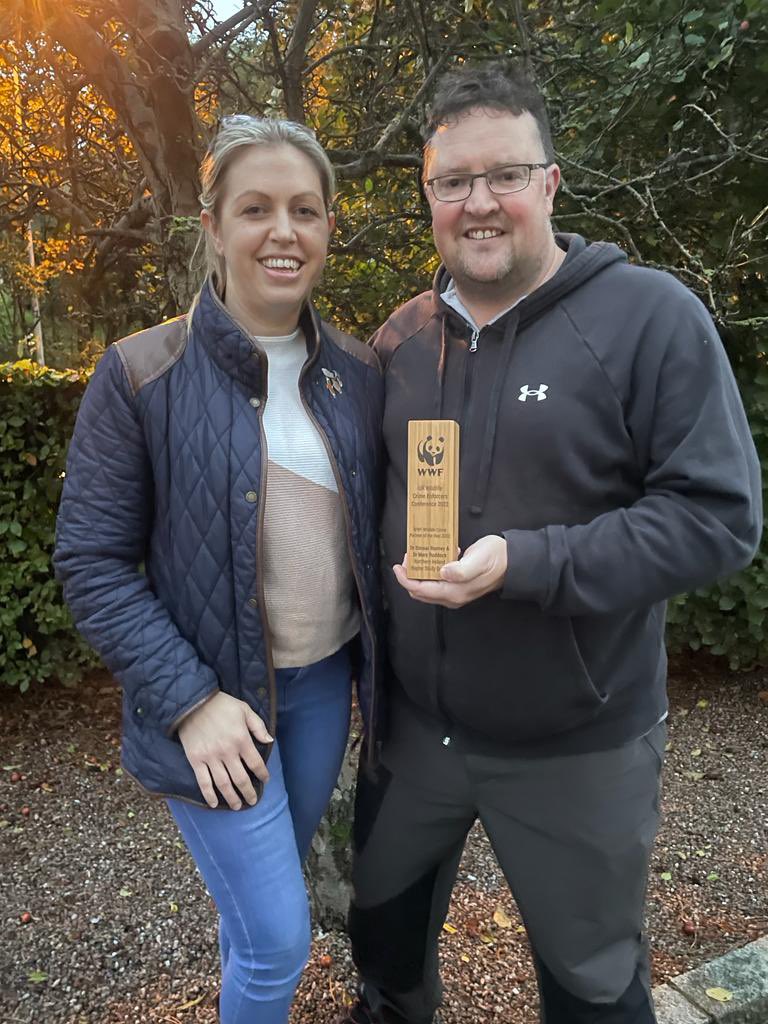
First up was Dr Eimear Rooney and Dr Marc Ruddock from the Northern Ireland Raptor Study Group, who won WWF Wildlife Crime Partner of the Year 2022:

To say their award was richly deserved is a massive understatement. I’ve watched them pour their hearts and souls into raptor conservation in Northern Ireland for many, many years and I can’t think of more deserving recipients.

Without their efforts, providing help, advice and training to an army of raptor monitoring volunteers, as well as doing their own fieldwork, as well as writing grant applications, as well as writing reports, as well as producing educational material, as well as fundraising, as well as hosting conferences, as well as political engagement, as well as engaging in multi-partner initiatives to tackle raptor persecution, often at the expense of spending time with their young families, and still managing to be the most upbeat and fun-loving people to be around, then raptors in Northern Ireland would be in a far more perilous state than they are currently.

I’m thrilled to see their efforts recognised at long last; well done Eimear & Marc!

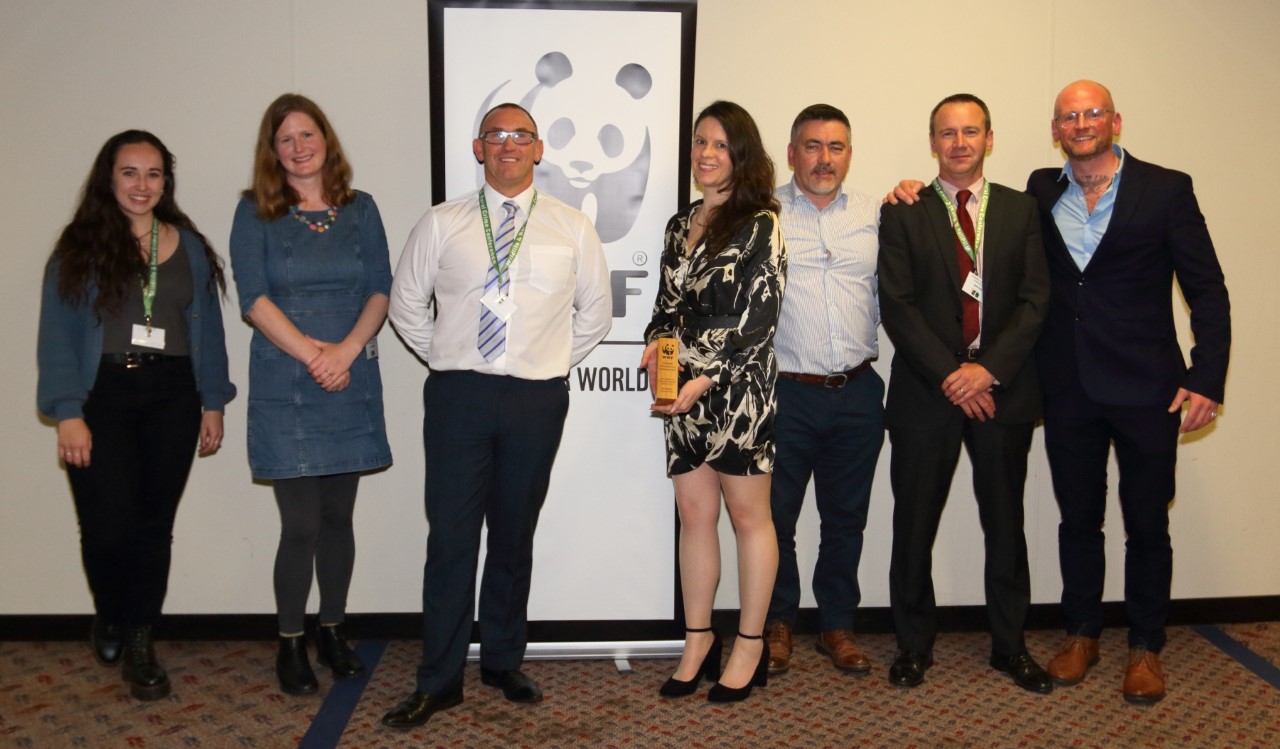
The second team to win an award for its work tackling raptor persecution was a multi-agency team working on ‘Operation Tantallon’, which is a huge, ongoing investigation into the alleged theft and laundering of wild peregrines in Scotland and northern England.

This investigation team includes Police Scotland, Scottish SPCA, NWCU and SASA, with additional support from members of the Scottish Raptor Study Group. So far three people have been charged with offences, including a serving police officer (see here) and a part-time gamekeeper (here).

Members of Operation Tantallon received the Wildlife Crime Operation of the Year Award 2022 from Megan McCubbin (photo by Guy Shorrock):

The case is ongoing, the defendants are reportedly facing over 100 charges, and a wide range of investigative techniques have been deployed including surveillance, peregrine DNA analysis, searches under warrants, bankers warrants, cyber crime and the Proceeds of Crime Act.

The scale of this effort to bring a prosecution in a raptor persecution case is virtually unheard of in the UK and the ramifications, should the defendants be found guilty, will be huge. Further details of the case will be made available as the case progresses through the courts.

The dedication and determination of those involved in the multi-agency investigation has been outstanding and it’s good to see their hard work recognised. Well done, all!

UPDATE 16 December 2023: Part-time gamekeeper & son plead guilty to peregrine laundering charges; serving police officer cleared (here)

Multi-agency raid in Lincolnshire after suspected poisoning of three birds of prey

Press release from Lincolnshire Police (6th October 2022):

Bird of prey poisoned, Horncastle

Our Rural Crime Action Team (RCAT) are investigating the suspected poisoning of three birds of prey in the Belchford area of Horncastle. 

On 4 October, the team conducted multi agency searches in the area along with officers from the National Wildlife Crime Unit (NWCU), the RSPB and Natural England. During the searches we recovered various items which we believe are linked to the offences under investigation. The offences include the suspected poisoning of three birds, two Buzzards and one Red Kite. 

Inspector Jason Baxter, from Lincolnshire Special Operations Unit, said: “Lincolnshire police will not tolerate the persecution of our wildlife and any offences reported to us will be thoroughly and expeditiously investigated and offenders will be dealt with robustly.”

Investigations are ongoing and we have identified one male suspect who will be interviewed in due course.

Investigating officer, Detective Constable Aaron Flint said: “A number of Birds of Prey appear to have been poisoned in the Horncastle area.

We would appeal for anyone with any information to contact us.”

If any members of the public have information that could assist with the investigation please call 101, email force.control@lincs.police.uk or through crime stoppers. Please remember to quote incident number 22000367672.

ENDS

Well done Lincolnshire Police, Natural England, RSPB and the National Wildlife Crime Unit for yet another excellent example of partnership-working between specialist agencies, and especially for issuing a statement/appeal for information just two days after the raid. I hope some of the other regional police forces are taking note.

This latest multi-agency raid is the latest in a surge of similar investigations in response to raptor persecution crimes over the last couple of years, including a raid in Wiltshire on 23rd September 2020 (here), a raid in Suffolk on 18th January 2021 (here), a raid in January 2021 in Nottinghamshire (here), on 15th March 2021 another raid in Lincolnshire (see here), on 18th March 2021 a raid in Dorset (here), on 26th March 2021 a raid in Devon (see here), on 21st April 2021 a raid in Teesdale (here), on 2nd August 2021 a raid in Shropshire (here), on 12th August 2021 a raid in Herefordshire (here), on 14th September 2021 a raid in Norfolk (here), a raid in Wales in October 2021 (here) a raid in Humberside on 10th December 2021 (here), a raid in North Wales on 8th February 2022 (here), another raid in Suffolk on 22nd April 2022 (here), and another raid in Norfolk on 29th April 2022 (here).

The majority of these cases are ongoing, or have progressed to impending court hearings, but a few have concluded, resulting in the conviction of criminal gamekeepers. These include:

*The Nottinghamshire case (from January 2021) where gamekeeper John Orrey was sentenced in January 2022 for battering to death two buzzards he’d caught inside a trap (here);

*The Suffolk case (also from January 2021) where gamekeeper Shane Leech was convicted of firearms and pesticides offences in November 2021 after the discovery of a poisoned buzzard found close to pheasant-rearing pens in Lakenheath (here);

*The Wales case (from October 2021) where gamekeeper David Matthews was convicted in June 2022 for pesticide offences following the discovery of a poisoned red kite and a shot red kite at a pheasant release pen on the McAlpine Estate in Llanarmon Dyffryn Ceiriog, North Wales (see here);

*The Wiltshire case (from September 2020) where gamekeeper Archie Watson was convicted in June 2022 after the discovery of at least 15 dead buzzards and red kites were found dumped in a well on a pheasant shoot on Galteemore Farm in Beckhampton (here);

*The Norfolk case (from September 2021) where gamekeeper Matthew Stroud was convicted in October 2022 for the poisoning of at least five buzzards and a goshawk, amongst other offences, on a pheasant shoot at Weeting, near Thetford (here).

Conviction of gamekeeper Matthew Stroud: statement from Norfolk Constabulary

Following yesterday’s news that 46-year-old gamekeeper Matthew Stroud had been convicted, amongst other things, of shooting and poisoning at least five buzzards and a goshawk on a pheasant shoot in Norfolk (see here), Norfolk Constabulary has issued a press statement which provides a bit more detail about the case.

[One the buzzards that gamekeeper Matthew Stroud shot dead]

Press release from Norfolk Constabulary:

Gamekeeper admits killing birds of prey

A Weeting gamekeeper appeared in court today (Wednesday 5 October 2022) and admitted shooting and poisoning several birds of prey.

  • Three counts of using poisoned bait on or before 19 August 2021 and 14 September 2021.
  • Six counts of killing a Common Buzzard (a non-Schedule 1 wild bird) at Weeting between 10 August and 14 September 2021.
  • One count of intentionally killing a Northern Goshawk (a Schedule 1 wild bird) at Weeting on or about 10 August 2021.
  • One count of possessing a regulated substance – Strychnine Hydrochloride – without a licence on 14 September 2021.
  • One count of possessing 4 shotguns to kill a Schedule 1 wild bird on 14 September 2021.
  • One count of releasing 3,400 Common Pheasants into the wild between 1 June and 14 September 2021 contrary to the Wildlife and Countryside Act 1981.
  • One count of incorrectly storing a biocidal product – Rentokil Phostoxin – on 14 September 2021 contrary to the Health and Safety at Work Act 1974.

He received a 12-month Community Order and was ordered to do 200 hours of unpaid work, fined £692 and ordered to pay costs of £145, compensation of £288.72 and a victim surcharge of £95. The court also ordered the forfeiture and destruction of all Stroud’s firearms, mobile phones and any chemicals.

The court heard how the investigation started when RSPB officers found a young pheasant dead in Belvedere Wood, Weeting, on 19 August 2021. Tests later confirmed the pheasant had been poisoned with Strychnine Hydrochloride.

Further intelligence led Norfolk Police to execute a warrant at Stroud’s home, Belvedere Wood and Oisier Carr Wood on 14 September 2021 where the following discoveries were made:

  • Three dead buzzards were found at two release pens in Oisier Carr Wood. Tests later confirmed they had been shot.
  • Two pheasant carcasses with extremely high levels of Strychnine Hydrochloride and a poisoned Common Buzzard were found in Belvedere Wood – a Site of Special Scientific Interest because of its internationally important population of Stone Curlews
  • Two bottles of Strychnine Chloride were found in the glovebox of Stroud’s all-terrain vehicle, and a bottle of Phostoxin discovered by officers in a lean-too style shed attached to his house.

In addition, Stroud’s mobile phone contained photos of a dead Goshawk and five dead Common Buzzards. He later confessed to officers that all the photos were of birds he had killed.

PC Chris Shelley, Norfolk Constabulary’s Rural Crime Officer, said: “This investigation is one of the biggest cases of its kind that we have dealt with in Norfolk.

“Stroud actions were dangerous and inhumane – he shot and poisoned birds of prey as he saw fit, and at will, because it suited him to do so. He also used a highly dangerous poison – one that has been banned in the UK for the last 15 years – indiscriminately, which could have had a disastrous effect on other local wildlife and showed a scant disregard for the safety of others.

“We’re committed to working with all partners to tackle rural crime and have worked closely with colleagues from the RSPB, the National Wildlife Crime Unit and Natural England throughout this investigation. It is because of this close collaboration with them that we have been able to bring this case to court.”

Tom Grose, RSPB Investigations Officer, said: “Laying poison baits out in the open is not only illegal but extremely dangerous and irresponsible. Baits like those being used present a deadly risk to any animal or person that might come across it.

“It is particularly troubling that this was happening on an SPA, a designated area where wildlife and nature should have the highest legal protection.

“We would like to thank Norfolk Police for leading such a thorough investigation, and to Natural England, the National Wildlife Crime Unit and Crown Prosecution Service for their support.”

Ashley Petchey of the Crown Prosecution Service said: “This was a case where Mr Stroud has, whilst in his position as a gamekeeper, killed wild birds by shooting and poisoning. He has also released non-native species into a SSSI.  

“The scale of the offences in this case demonstrates the lengths people will go to in order to persecute raptors.   

“The Crown take all cases of raptor persecution seriously and where the full code test is met, bring offenders to justice.”

ENDS

UPDATE 4th November 2022: RSPB Investigations Officer reflects on conviction of Norfolk raptor-killing gamekeeper Matthew Stroud (here)

Norfolk gamekeeper convicted after shooting & poisoning multiple birds of prey

Press release from the RSPB today (5th October 2022):

Gamekeeper escapes jail after killing birds of prey

*Six buzzards and a goshawk were found illegally killed on a gamebird shoot near Thetford, along with lethal poison baits.

*Gamekeeper Matthew Stroud pleads guilty to multiple offences

*The RSPB is increasingly concerned about raptor persecution linked to pheasant and partridge shoots, and the impact of large-scale gamebirds releases.

Today (5 October 2022) at Norwich Magistrates’ court, gamekeeper Matthew Stroud received a 200 hour community order and was fined £692 for offences connected with raptor persecution. Stroud was ordered to pay £145 costs, £288.72 compensation and a £95 victim surcharge.

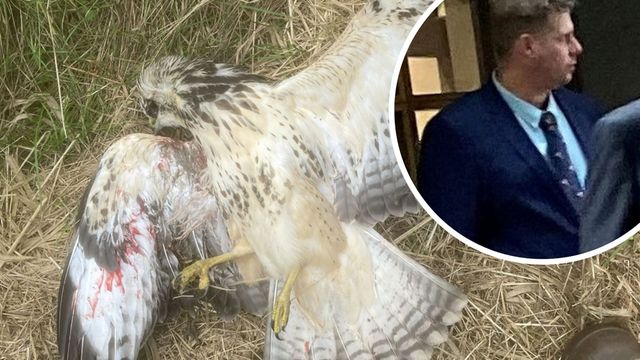
[Convicted criminal gamekeeper Matthew Stroud and one of his victims, a shot buzzard. Photos via RSPB and Eastern Daily Press]

Offences included shooting five buzzards and one goshawk, the poisoning of another buzzard, the laying of poison baits and illegal possession of poisons including strychnine.

Stroud also became the first person convicted for the unauthorised release of gamebirds on a Special Protection Area (SPA) – an internationally important site for conservation under the Habitats Regulations.

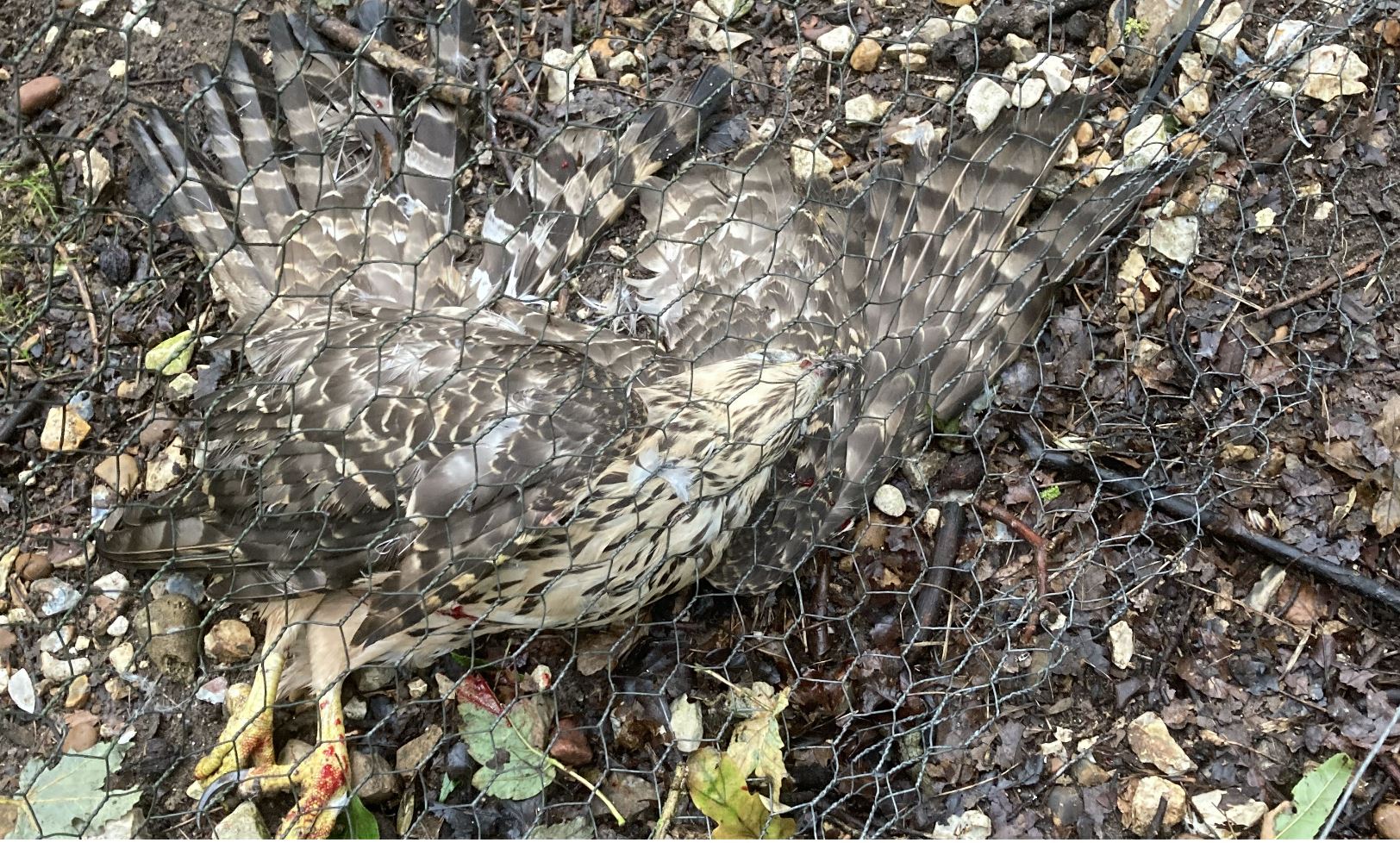
[Another of Stroud’s victims – he shot this goshawk. Photo via RSPB]

[Two containers of the banned poison strychnine found in the glovebox of Stroud’s all-terrain vehicle]

Sentencing Stroud, Magistrates said that he was lucky to escape jail today.

The court heard from the defence that Stroud was under pressure to produce game birds for the shoot after two poor years, that he had taken no pleasure in killing the buzzards and that he should have been informed that the law had changed around pheasant releases.

This is one of many incidents of raptor persecution identified on lowland pheasant and partridge shoots, which the RSPB says is an area of increasing concern. There is also evidence that large-scale releases of pheasant and partridge for shooting is having a detrimental impact on native wildlife.

The RSPB Investigations team conducted lengthy enquiries on an area of land managed by Stroud for pheasant shooting at Fengate Farm in Weeting, within the Breckland SPA. Following a number of visits, on 19 August 2021 they discovered a pheasant carcass – later found to contain the banned toxic chemical strychnine. The use of a poison bait such as a pheasant, laced with pesticides, is one of the most common methods of illegally killing birds of prey.

A subsequent search with Norfolk Police and partners uncovered further poison baits plus shot and poisoned raptors. Stroud’s phone also contained the photo of a goshawk and several buzzards which he admitted to shooting. They also found the deadly banned poison strychnine and phostoxin, a dangerous fumigant which was stored improperly.

In 2021 it became illegal to release gamebirds on or adjacent to an SPA without a licence, which Stroud had not sought, making him the first person to be prosecuted and convicted for this offence.

In 2020, Wild Justice issued proceedings in the High Court challenging the annual release of millions of non-native pheasants and red-legged partridges into the countryside and their potential impact on sites designated for nature conservation. DEFRA conceded the case and introduced General Licence 43 in an attempt to ensure that the impacts of those birds on those sites would be regulated.

Mark Thomas Head of RSPB Investigations UK, said:

“It is difficult not to be disappointed with the outcome today considering the significance of the offences and combined efforts of the agencies involved. Laying poison baits out in the open is not only illegal but extremely dangerous and irresponsible. Baits like those being used at Fengate Farm present a deadly risk to any animal or person that might come across it. It is particularly troubling that this was happening on an SPA, a designated area where wildlife and nature should have the highest legal protection.

The RSPB’s most recent Birdcrime report in 2020 made clear that raptor persecution is not just an issue confined to grouse shooting estates: it is increasingly correlated with pheasant and partridge shoots.”

Mark added: “We would like to thank Norfolk Police for leading such a thorough investigation, and to Natural England, the National Wildlife Crime Unit and Crown Prosecution Service for their support”.

Guilty pleas were entered to the following charges:

· Six charges in relation to killing of six different buzzards (five by shooting and one poisoned) during August and September 2021

· One charge in relation to killing a goshawk listed under schedule 1 of the Wildlife and Countryside act 1981 in August 2021

· Three charges in relation to laying poison baits in August and September 2021

· One charges in relation to the possession of the banned pesticide, strychnine in September 2021

· A charge in relation to a firearm being an item capable of committing an offence in September 2021

· A charge in relation to the usage of the chemical phostoxin in September 2021

· One charge in relation to releasing pheasants illegally during 2022

ENDS

UPDATE 6th October 2022: Conviction of gamekeeper Matthew Stroud – statement from Norfolk Constabulary (here)

UPDATE 4th November 2022: RSPB Investigations Officer reflects on conviction of Norfolk raptor-killing gamekeeper, Matthew Stroud (here)

Scottish Land & Estates still refusing to acknowledge extent of raptor persecution on grouse moors

In the last blog post where I wrote about the nine shot birds of prey found wrapped in bags on Millden Estate and just over the estate boundary, I included a quote from Tim Baynes of Scottish Land & Estates, who had written the following in a comment piece for The Field, published in August 2022:

Raptor persecution has been the stick with which grouse moors were beaten for two decades, but the past five years have seen a sea change. In Scotland, recorded crimes have effectively ceased on grouse moors, and raptors of all species have been increasing“.

I said I’d publish his outrageous comment piece in full, so here it is:

I really shouldn’t be surprised that The Field published this nonsense – that particular shooting industry rag has a track record of publishing patently inaccurate comment pieces (e.g. see here).

And I’m definitely not surprised that the author of this latest gibberish is Tim Baynes – his lengthy track record speaks for itself (for a small selection of the masses of examples see here, here, here, here, here, here, here, here).

Needless to say, his latest claim that raptor persecution on Scottish grouse moors has “effectively ceased” is demonstrably untrue. You’ve only got to read my last blog post to understand this. If that doesn’t convince you, have a look at the General Licence restrictions currently imposed on grouse moor estates after Police Scotland found ‘clear evidence of raptor persecution’ – Leadhills Estate (here), Lochan Estate (here), Leadhills Estate [again] (here), Invercauld Estate (here), and Moy Estate (here).

And if you still need convincing, have a read of the Scottish Government’s Environment Minister’s statement in 2020 when she announced that there could be no further delay to the introduction of a grouse moor licensing scheme because:

“…despite our many attempts to address this issue, every year birds of prey continue to be killed or disappear in suspicious circumstances on or around grouse moors“.

Perhaps Tim Baynes’ perpetual denial of the bleedin’ obvious explains why he is no longer employed as ‘Director of Moorland’ at Scottish Land & Estates:

Nine raptors found shot & dumped in bags outside gamekeeper’s houses on Millden Estate and at the nearby River Esk in the Angus Glens

News has emerged that a total of nine birds of prey (eight buzzards and a sparrowhawk) have been found shot dead and dumped in bags in the Angus Glens.

We already knew about three of those shot buzzards (see here and here). They were found in bags outside two gamekeeper’s residences during a joint Scottish SPCA/Police Scotland raid on Millden Estate in October 2019 as part of an investigation into the criminal activities of depraved gamekeeper Rhys Owen Davies, who was convicted in May this year for vile animal abuse and received a custodial sentence in August 2022 (here).

Nobody was charged for the killing or possession of those three shot buzzards (although Police Scotland had identified a suspect, the Crown Office chose not to pursue a prosecution – see here) and the news about those three shot buzzards only emerged this year after I’d spent two and a half years asking Police Scotland for details. For unknown reasons, Police Scotland chose not to issue a public appeal for information about those three illegally-killed raptors.

I can now reveal that those three shot buzzards weren’t the only ones found dead in the Angus Glens that Police Scotland was keeping out of the news.

Rumours have been circulating for a while that even more dead raptors had been found in connection to the raid on Millden Estate so last month I submitted another FoI to Police Scotland to request confirmation and this is the response I’ve just received:

So that’s a total of nine shot raptors, all found in bags. Note Police Scotland’s careful wording that the third bag containing six shot raptors was found at ‘a second location‘. I understand that this bag wasn’t found on Millden Estate but was discovered nearby on the bank of the River Esk, beyond the estate’s boundary.

This is a shocking story for a number of reasons.

Firstly, the number of dead raptors found shot and dumped in bags in this area of the Angus Glens, but secondly the decision of Police Scotland to keep quiet about them all for almost three years.

Whose interests are served by such silence? Not the public’s interest, that’s for sure, but the interests of the grouse-shooting industry, whose representatives are busily claiming that, “In Scotland, recorded [raptor persecution] crimes have effectively ceased on grouse moors” (Tim Baynes of Scottish Land & Estates writing in the August 2022 edition of The Field – I’ll publish his outrageous opinion piece shortly).

It’s just not good enough from Police Scotland. And this isn’t an isolated case either. More on another case shortly….