Lying in wait: gamekeepers trying to lure raptors to within shotgun range in Peak District National Park?

Some of you may remember the footage of an armed man, believed to be a gamekeeper, lying in wait close to a decoy hen harrier on a grouse moor in the Peak District National Park, back in 2016 (see here).

The footage was so disturbing, and the public reaction so strong, it prompted the National Trust (the landowner) to pull the shooting lease early and replace the shooting tenant with someone else (see here). Incidentally, that new tenant hosted a successful hen harrier breeding attempt last year (see here), even though some of the offspring didn’t survive for very long after leaving the safety of this moor (e.g. Arthur, see here and Octavia, see here).

We’ve also blogged before about what was believed to be the use of a tethered live eagle owl as a decoy on a grouse moor in the Lammermuirs (see here), although the suspected gamekeeper took off pretty sharpish once he realised he’d been spotted.

Well, it seems this method of using to decoys to lure in birds of prey to within close range of a shotgun is more prevalent than we’d thought.

Today the RSPB Investigations Team has published a video of several armed men (identified as gamekeepers by the RSPB) over a period of months spending hours and hours and hours of their time sitting in specially-dug holes in close proximity to a plastic peregrine and a plastic hawk, believed to have been used as decoys to attract other birds of prey. The location? A grouse moor in the Peak District National Park.

Hmm, it’s really no surprise that the Peak District National Park was identified in the recent scientific analysis of hen harrier sat tag data as one of the grouse moor areas where hen harriers were most likely ‘disappear’ in suspicious circumstances (see here).

The RSPB has also written a blog about this footage, and similar evidence of decoy use that has been recorded on other grouse moors in the north of England. Read the eye-opening blog here.

Fantastic investigative work from the RSPB to get such close and clear footage and there’s a strong chance that these gamekeepers won’t be using those particular decoy sites again in the near future!

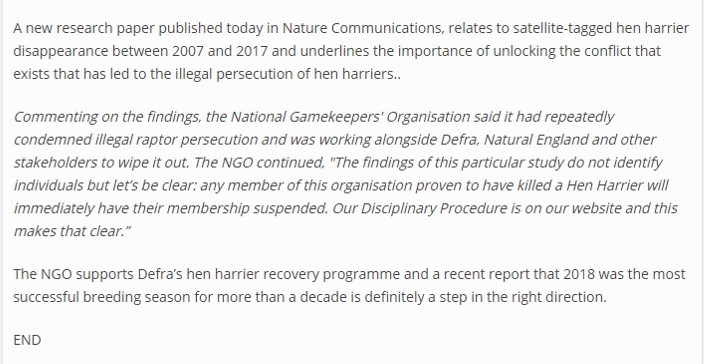
Responses to hen harrier satellite tag paper: BASC

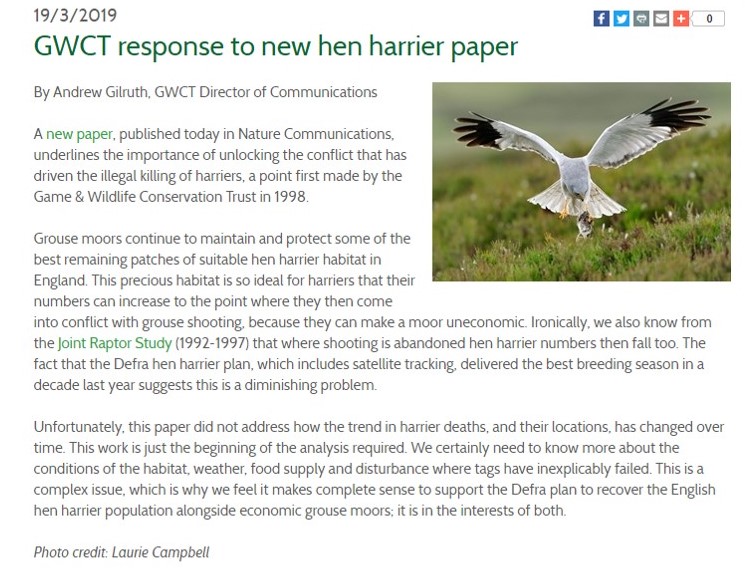
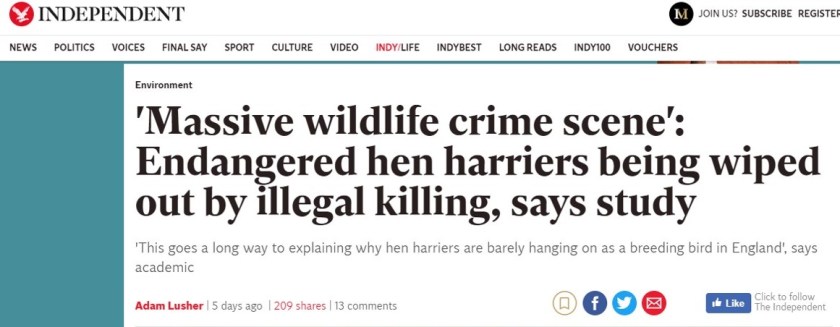
The publication of the hen harrier satellite tag paper on Tuesday (here) that provided compelling evidence to highlight, yet again, the link between grouse moors and the illegal killing of hen harriers, has resulted in a flurry of responses from various individuals and organisations.

We’ll be looking at these responses in turn.

Yesterday we looked at the response of Supt Nick Lyall, Chair of the Raptor Persecution Priority Delivery Group (here).

Today we’re examining the response from the British Association for Shooting & Conservation (BASC).

BASC was quick to publish a lengthy statement on its website and at first glance it looks convincing. BASC accepts that raptor persecution is a problem and calls for its members to help stamp it out:

The statement starts off very strongly but the message gets progressively lame as you scroll down the page, with BASC feeling the need to justify the ‘benefits’ of grouse shooting and then make some incredulous claims about the so-called ‘success’ of last year’s hen harrier breeding season, which actually looks like something that’s been cut and pasted from the Moorland Association’s website.

Nevertheless, we could forgive BASC its small piece of propagandist nonsense because hey, the main message (about stamping out illegal raptor persecution) is clear and it looks like it’s based on sincerely held views.

But wait a minute! Some of the phraseology in BASC’s statement looks awfully familiar.

There are criminals among us“, “Terminal damage“, “We must all take personal responsibility“, “Ensuring the criminal minority do not ruin it for the lawful, ethical majority“, “I want my grandchildren to enjoy shooting“.

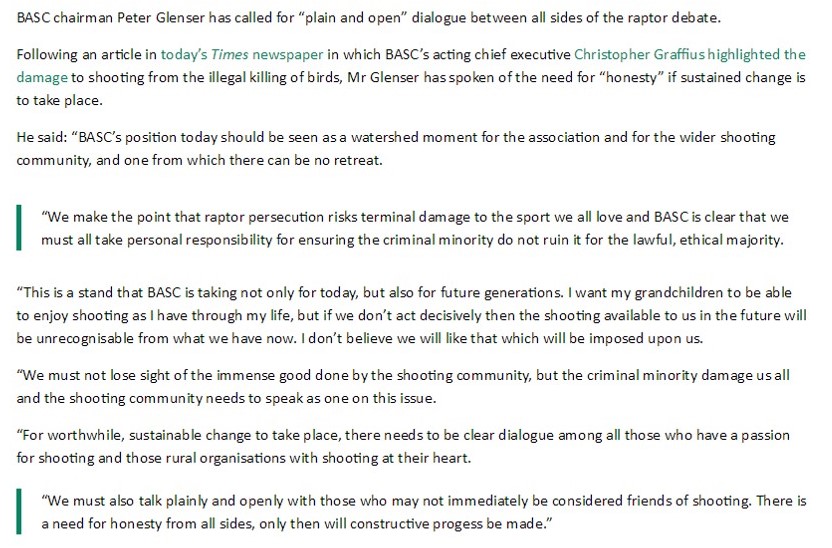
Haven’t we heard this before? Ah yes, 16 months ago in November 2017 in response to the RSPB’s Birdcrime report, BASC published a strong position statement in The Times (here) (for which BASC earned well-deserved credit) using some of these very same phrases and then a further piece for the BASC website (here) again using some of these very same phrases. For example, here’s what BASC Chairman Peter Glenser wrote for the BASC website at the time:

Sorry, BASC, but it’s just not as convincing when you can’t respond spontaneously to the results of the hen harrier satellite tag paper but instead rely upon regurgitating a previous media statement just because it got you some good press the first time around, and just attribute it to a different member of staff each time.

To be fair to BASC, it is seen by many in the conservation community as the most progressive of the game-shooting organisations although let’s be honest, the bar is set pretty low and some of its individual staff members need to attend a ‘how not to behave in a way that will embarrass your employer and alienate the public on social media and in real life’ course.

But words are just words and they’re easy to churn out (especially if you’re simply cutting and pasting from an earlier piece). What about actions? What action has BASC taken to demonstrate a commitment to rooting out the criminals amongst its membership and wider industry since what it called the “watershed moment” to do exactly that back in November 2017?

Errrrr……boycotting the first meeting of the RPPDG chaired by Nick Lyall in January (see here, here and here)?

Or perhaps appearing to accept a significant donation from a company owned by somebody long-involved with the sporting management of various estates throughout the UK, some of which are notorious for their appalling record of confirmed and alleged raptor persecution crimes?

BASC’s rhetoric might be fooling some, but……

Poisoned raven found on Peak District grouse moor: Natural England & Police fail to investigate

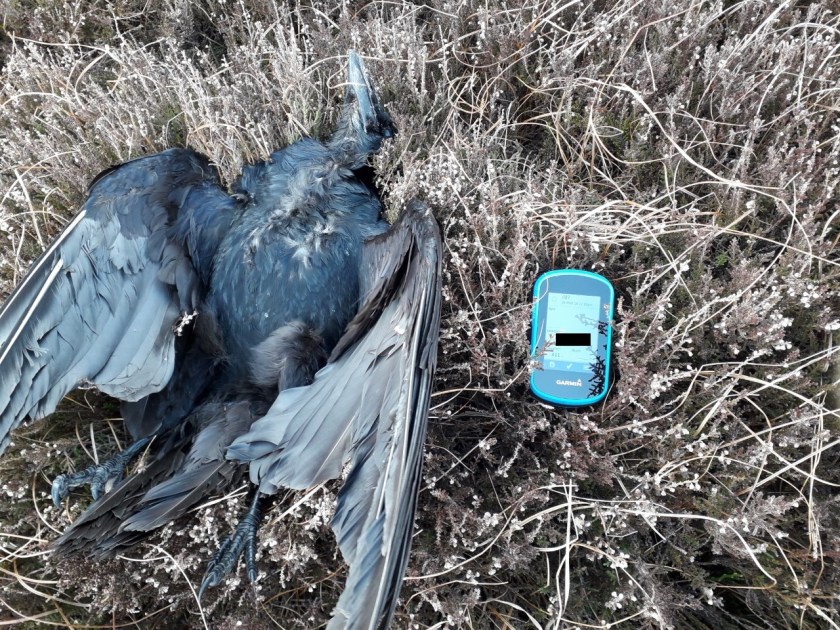
A year ago in March 2018, a dead raven was found on a grouse moor in the Peak District National Park.

The member of the public who found it, Bob Berzins, was savvy enough to call the RSPB Investigations Team, who collected the corpse.

[Dead raven, photo by Bob Berzins]

Given the location, and the area’s long history of the illegal persecution of birds of prey (e.g. see here), the RSPB asked Natural England to run toxicology tests on the corpse, as is routine when animals have been found dead in suspicious circumstances or risky locations. According to the RSPB, Natural England refused to test the bird.

Instead, the RSPB paid to have the corpse privately tested, first in a post-mortem at the SRUC lab in Scotland and then for toxicology tests at the Science & Advice for Scottish Agriculture (SASA) labs, who have an excellent track record for conducting these forensic examinations.

SASA confirmed that this raven had been poisoned by Aldicarb, a toxin so dangerous that in Scotland if you’re caught even being in possession of it, let alone using it, you’ve committed an offence.

The RSPB reported these lab results to South Yorkshire Police and, according to the RSPB, nothing else has happened since, not even a police search of the grouse moor to look for further poisoned baits or victims.

You can read the details of this pathetic response to a criminal act on the RSPB’s blog here.

The RSPB Investigations Team has also produced a video about this case, here:

What the hell is going on? Why did Natural England refuse to test this raven for banned pesticides when it had been found in an area notorious as a raptor persecution hotspot?

And why did South Yorkshire police fail to investigate further? They should have been all over this, not least with a publicity campaign alerting members of the public, who visit this National Park in their millions, to the dangers of touching any dead animal or suspected poisoned bait. A year has passed and South Yorkshire police appear to have done absolutely nothing.

Disgraceful.

Well done Bob Berzins and well done to the RSPB, not just for paying to have this bird privately tested but also for submitting a formal complaint to South Yorkshire police and for alerting the public to the very serious threat of toxic poisonous baits being laid out on the ground inside this so-called National Park.

Gamekeepers’ rep suggests disappearance of hen harrier Vulcan was “set up” by RSPB

At the end of February 2019, the RSPB announced the suspicious disappearance of a satellite-tagged hen harrier called Vulcan who had vanished in January 2019 in an area heavily managed for gamebird shooting in Wiltshire (see here).

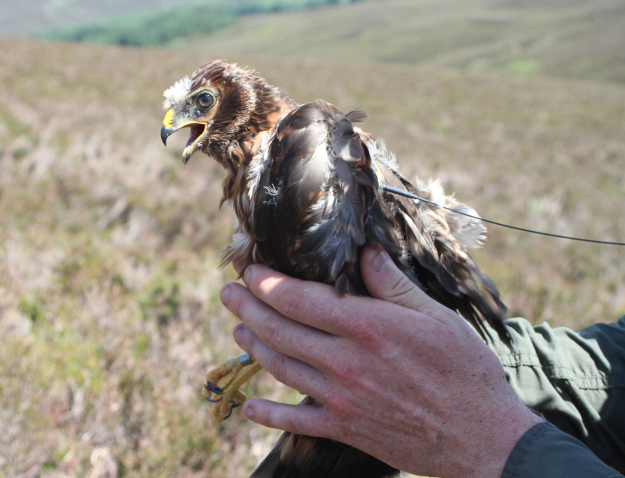
[Hen harrier Vulcan, photo by RSPB]

The suspicious disappearance of any satellite-tagged hen harrier in the UK is significant because the loss of any of these young birds is a reminder of just how precarious the hen harrier population is, and as many of them seem to disappear on grouse moors it’s also usually a repeated reminder of how the authorities have failed to address the rampant criminality associated with this type of land management.

Whilst Vulcan’s disappearance was not on a grouse moor, it was in an area managed for pheasant and partridge shooting and his disappearance was still significant because this area from which he ‘disappeared’ was close to the proposed release site of Natural England’s highly controversial hen harrier reintroduction project, a supposedly raptor persecution free zone.

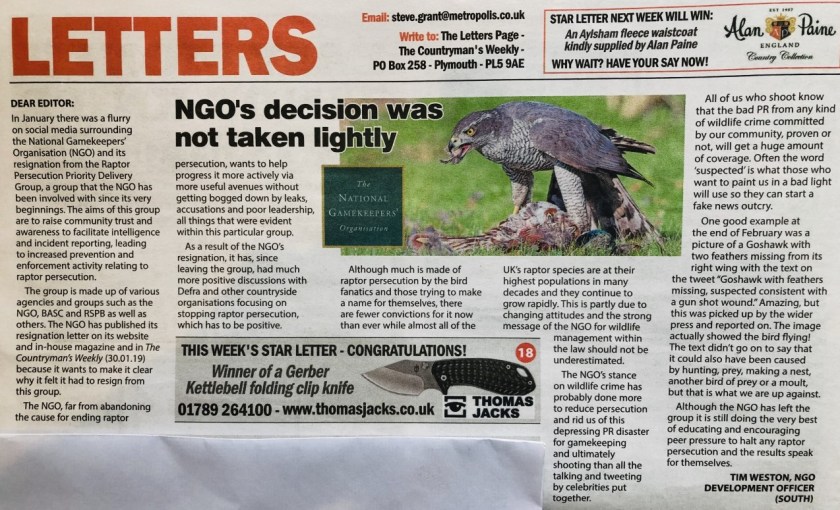
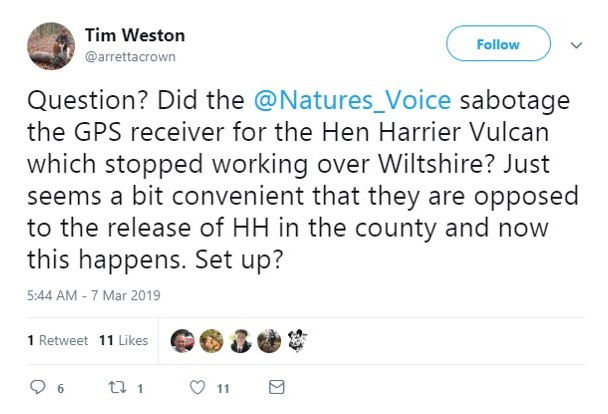
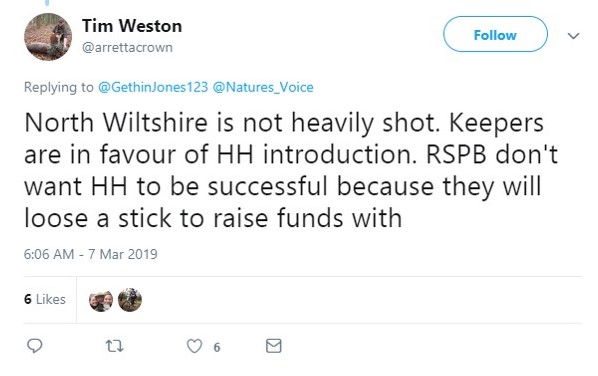
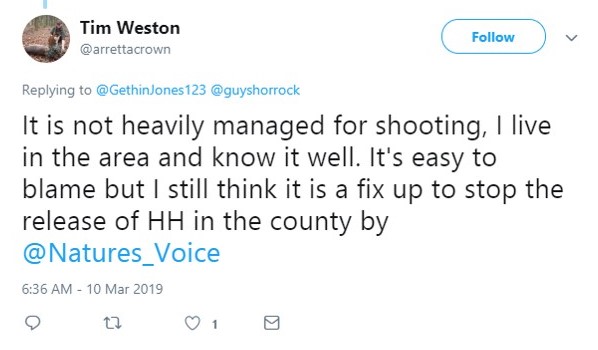
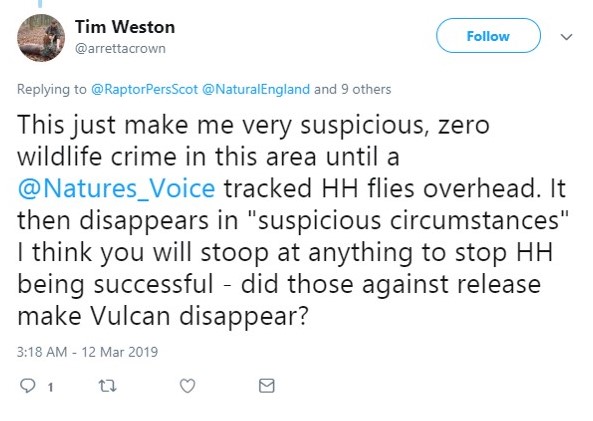
The inevitability of yet another lost hen harrier (the 12th to vanish in suspicious circumstances since last summer) and the significance of Vulcan’s last known location has led Tim Weston, Devlopment Officer for the National Gamekeepers’ Organisation, to accuse the RSPB of a “set up” (or, in more formal legal terms, of perverting the course of justice [by fabricating evidence]).

We’ve come to expect this sort of nonsense from a small number of pro-shooting, anti-RSPB trolls on social media but to see it from a representative of the National Gamekeepers’ Organisation (NGO) was more than a little surprising.

Here are a series of tweets from National Gamekeepers’ Org employee, Tim:

Zero wildlife crime in this area until [RSPB] tracked HH flies overhead“? Tim must have missed the tweet from the RSPB Investigations Team on Sunday night where they outlined some of the confirmed raptor persecution crimes in this area:

Does the National Gamekeepers’ Organisation endorse Tim Weston’s accusations? Not that it matters anymore, since the NGO walked out of the partnership group trying to tackle the illegal killing of birds of prey in England and Wales (the Raptor Persecution Priority Delivery Group, RPPDG). With the gamekeepers gone, hopefully the RPPDG can now focus on the issue at hand instead of being side-tracked and disrupted by distractions like this.

Meanwhile, an organisation which retains its membership of the RPPDG and has played a central role in tackling the illegal persecution of birds of prey in northern England is the Northern England Raptor Forum (NERF). NERF has today issued a statement about the suspicious disappearance of hen harrier Vulcan, because even though Vulcan vanished in southern England, he hatched from a nest in northern England where NERF members helped to protect the site. Read NERF’s statement here

Hen harrier reintroduction to southern England: Natural England suggests persecution not an issue

Natural England has been planning a so-called ‘reintroduction’ of hen harriers to southern England since 2016, as part of DEFRA’s ludicrous Hen Harrier Action Plan.

We’ve blogged about this ‘reintroduction’ for three years (see links at the foot of this blog) and its recently been in the news again as a young satellite-tagged hen harrier called ‘Vulcan’ disappeared in suspicious circumstances close to the proposed reintroduction release site in Wiltshire (see here), indicating that this is not a safe location to rear and release young hen harriers.

This morning on BBC Breakfast News the RSPB again voiced its concerns about the planned reintroduction, citing the loss of hen harrier Vulcan in Wiltshire and arguing that until the issue of illegal persecution has been addressed, any young hen harriers are likely to be killed. You can watch it here (starts at 1:21:08 and ends at 1:23:29; only available until 08.30hrs Monday morning). The RSPB interviewees included Nick Bruce-White (Regional Director RSPB South West) and Tony Whitehead (RSPB Press Officer) who couldn’t have been clearer: “The only limiting factor [for hen harriers], let’s make no mistake about this, is illegal persecution“.

Meanwhile, behind the scenes, Natural England has continued to court favour with potential donor countries and we’ve been sent an unbelievable powerpoint presentation, which we believe was delivered to European harrier experts at an international conference in October 2018 by Natural England’s Hen Harrier Reintroduction Project Manager, Simon Lee. It’s basically a plea for donor birds and an apparent reassurance that donor birds will be safe in England! Honestly, this has to be seen to be believed:

Download the PDF presentation here: Simon Lee presentation HH reintro to southern England

According to Simon, there’s been “a gradual recovery [of hen harriers] across Scotland and Wales in recent decades“. Er, except for the results of the 2016 national HH survey which showed population declines in each country, and a whopping 27% decline in Scotland since 2004. Losing over a quarter of the population in just 12 years isn’t what we’d call “a gradual recovery“.

Also according to Simon, prior considerations [for the proposed reintroduction] included ‘understanding the reasons for loss’ and that those “factors are no longer present“:

So, having earlier noted in his presentation that ‘human persecution’ was a cause of the species’ historical decline, Simon is now suggesting to potential donor countries that illegal persecution is no longer an issue.

You couldn’t make this up. Although it looks like Simon did.

And if this presentation was given in Oct 2018, as we believe, Simon must also have been fully aware of the findings of Natural England’s hen harrier satellite tag analysis, which was completed last summer and is due to be published imminently under the title: ‘Patterns of satellite tagged hen harrier disappearances suggest widespread illegal killing on British grouse moors’.

And now with the suspicious disappearance of hen harrier Vulcan near to the proposed reintroduction location, will Simon / Natural England be updating the potential donor countries about the continuing threat to hen harriers in the UK and advising them that the planned reintroduction won’t be going ahead because its simply not safe to do so?

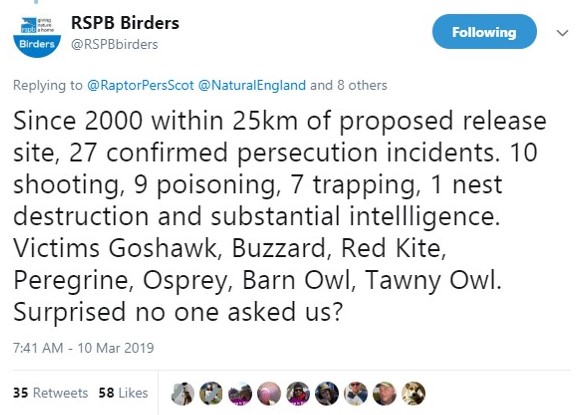
UPDATE 8pm: The RSPB has tweeted the following information about confirmed raptor persecution crimes within 25km of the proposed reintroduction site:

UPDATE 23rd September 2020: Large police operation investigating raptor persecution near proposed release site for hen harriers (here)

Buzzard found with shotgun injuries at Ryton, North Yorkshire

An injured buzzard was found on Ryton flood bank in North Yorkshire last week.

The bird was still alive but unable to fly – its broken humerus was sticking through the skin (see the x-ray below) and the wound site was infected.

Unfortunately the bird had to be euthanised.

If anyone has any information about this crime please contact Police Wildlife Crime Officer Jez Walmsley at Malton Police Station (Tel: 101) or the RSPB’s Raptor Crime Hotline (Tel: 0300 999 0101).

[Photos via Jean Thorpe]

Why did this gunman (+ 2 dogs) visit this hen harrier roost site on this Yorkshire grouse moor?

If you’re new to this blog and you’ve ever wondered what happens to satellite tagged hen harriers that suddenly ‘disappear’ in suspicious circumstances on driven grouse moors in Yorkshire (and elsewhere!), the latest video from the RSPB’s investigations team might just provide a clue. Just a little teeny tiny one.

The video was filmed by two members of the RSPB Investigations team shortly after they’d watched three young hen harriers settle down at the roost site for the night. Just as dusk fell, an armed man turned up with a labrador and a terrier and walked through the roost. He spent a few minutes crouching down amongst the vegetation whilst his dogs ‘worked’ the area. Fortunately none of the harriers flushed and the gunman later left in a vehicle.

The RSPB has published a blog describing the evening’s events (see here) and the blog includes the video footage, which is obviously of low quality given the fading light but clear enough to see what’s going on.

Here is a still from the video and we’ve added a red circle to highlight the gunman:

Who might this have been and what do you think he was doing there? How many implausible explanations will be churned out from the grouse shooting industry?

Didn’t sat tagged hen harrier ‘River‘, ‘disappear’ in this area in November 2018, the day before this video was recorded?

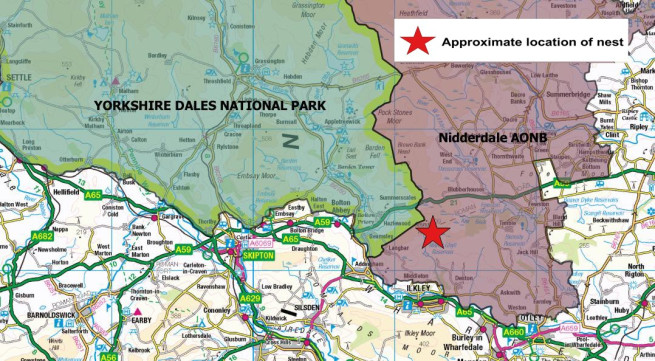
Look how many sat-tagged hen harriers have ‘disappeared’ in the Nidderdale AONB in Yorkshire in recent years, along with illegally killed red kites:

[RPUK map: Nidderdale AONB = yellow boundary. Illegally killed red kites = red circles; sat-tagged hen harriers that have vanished in suspicious circumstances = orange stars & red triangle; illegally shot hen harrier Bowland Betty = red star]

There hasn’t been a single prosecution for any of these incidents.

Do you think the [unnamed] estate has offered its full cooperation to North Yorkshire Police’s enquiries?

Do you think the Moorland Association will publicise this video?

Is anybody still unclear about what happens to hen harriers on driven grouse moors?

Kestrel shot in North Yorkshire

A kestrel has been euthanised after being found shot in North Yorkshire.

It’s a kestrel, FFS. You’d have to be a gun-toting psychopath to shoot one of these. Unsurprisingly, it’s not the first kestrel to have been shot in North Yorkshire, England’s raptor-killing capital (see here here and here).

News of this latest shooting appeared on Twitter yesterday. We’ve been unable to find any more details:

Satellite tagged hen harrier ‘Vulcan’ disappears nr proposed reintroduction site in southern England

RSPB press release (28 Feb 2019)

Rare hen harrier vanishes in Wiltshire

A young male hen harrier has disappeared in suspicious circumstances in Wiltshire and is believed most likely to be dead.

The harrier, named Vulcan, was one of five chicks to fledge from a nest in Northumberland last summer. He was fitted with a satellite tag as part of the RSPB’s EU-funded Hen Harrier LIFE project, which enabled the nature conservation charity to track his movements.

[Hen harrier ‘Vulcan’, photo by RSPB]

Vulcan was tracked by the RSPB moving from Northumberland down to the Peak District where he remained throughout September. He then continued to head further south through Hampshire and Dorset. On 16 January 2019, Vulcan’s tag sent out its final transmission, from a location south of Calstone Wellington in Wiltshire.

RSPB Investigations staff searched the area, which is farmland and heavily managed for pheasant and partridge shooting, but there was no sign of Vulcan or his tag. He has not been heard from since and the matter was reported to Wiltshire Police.

Satellite tagging technology is commonly used to follow the movements of birds. Tags continue to transmit regularly, even when the bird dies, and until the tag reaches the end of its lifespan. Vulcan’s tag was providing regular updates on the bird’s location, so the sudden and unexpected ending of transmission is suspicious and could suggest criminal interference. Vulcan is the 11th satellite-tagged hen harrier to disappear since last summer.

Hen harriers are one of the UK’s rarest birds of prey with only nine successful nests recorded in England in 2018 despite sufficient habitat for over 300 pairs. An overwhelming body of scientific evidence suggests that the main reason for their low numbers is illegal killing associated with driven grouse shooting.

Dr Cathleen Thomas, RSPB Hen Harrier LIFE Project Manager, said: “When a bird you’ve been following since it was a chick suddenly disappears without a trace, it’s a crushing blow. Vulcan’s tag had been performing brilliantly, so for it to suddenly stop transmitting makes us very suspicious that something has happened to him.

Wiltshire is not the only place where hen harriers have disappeared in unexplained circumstances. Since last summer 10 other satellite-tagged hen harriers have also vanished suddenly across the UK including in Northumberland, the Peak District, Wales and Scotland. There is a very worrying trend here.”

PC Marc Jackson of Wiltshire Police said: “Wiltshire Police have received a report from the RSPB in relation to the missing harrier ‘Vulcan’, and the Rural Crime Team are working with the RSPB to establish the full circumstances surrounding the incident.

To find no trace of this bird raises obvious concerns about what may have happened to it. If anyone has information please contact Wiltshire Police on 101 or Contact Crime stoppers on 0800 555111 if you would prefer to remain anonymous.”

Vulcan’s suspicious disappearance may prove a hurdle for the proposed southern reintroduction of hen harriers. Natural England is currently looking into the feasibility of introducing hen harriers from the continent to Parsonage Down National Nature Reserve, near Salisbury Plain.

Gareth Cunningham, RSPB Head of Nature Policy, said: “The disappearance of Vulcan raises serious concerns over the safety of any planned reintroduction. The RSPB has serious reservations about this approach to hen harrier conservation in England and we believe ending hen harrier persecution is the key to restoring the UK’s population of these magnificent birds. As such, the RSPB does not support the proposed reintroduction.”

If anyone has any information relating to this incident, please call Wiltshire Police on 101. Alternatively, call the RSPB Raptor Crime Hotline confidentially on 0300 999 0101.

ENDS

As the RSPB points out, this ‘may provide a hurdle’ (read: should be a bloody great big red flashing light) for the proposed reintroduction of hen harriers to southern England as part of DEFRA’s mad hen Harrier (In)Action Plan.

The location of Vulcan’s last known tag signal is less than 20 miles from Natural Engand’s proposed reintroduction site at Parsonage Down National Nature Reserve:

[RPUK map showing 1: Vulcan’s last known location; 2: Natural England’s proposed hen harrier reintroduction site]

We’ve blogged a lot about this proposed ‘reintroduction’ of hen harriers to southern England although technically it’s not a reintroduction because the species is not regionally extinct here and it should more aptly be called the ‘Let’s divert attention from the criminal killing of hen harriers on grouse moors plan’. We have been strong critics of the plan, not least because those young hen harriers tipped out in Wiltshire will likely roam far and wide during their post-fledgling dispersal period (as we know from sat tag data) and if they end up anywhere near a grouse moor they’ll be shot on sight. Releasing birds in to southern England will not solve the cause of the species’ decline in the first place, which undeniably is illegal persecution on driven grouse moors. And now there’s a strong possibility that Vulcan was a victim of illegal persecution, just a few miles from the proposed hen harrier release site. Which country is going to be stupid enough to donate hen harriers to the UK when we can’t even safeguard those birds hatched here, let alone any that are donated for a so-called ‘reintroduction’ project?

For previous blogs on this topic see:

28 Nov 2016 – Hen Harrier reintroduction to southern England: an update (here)

3 Jan 2017 – Hen harrier reintroduction to southern England: the feasibility/scoping report (here)

8 Jan 2017 – Hen harrier reintroduction to southern England: the project group and their timeline (here)

9 Jan 2017 – Hen harrier reintroduction to southern England: who’s funding it? (here)

9 Jan 2017 – Hen harrier reintroduction to southern England: a bonkers proposal for Exmoor National Park (here)

12 Jan 2017 – Hen harrier reintroduction to southern England: Wiltshire (here)

14 Feb 2017: Leaked email reveals Natural England’s views on Hen Harrier Action Plan (here)

23 Feb 2017: Hen harrier reintroduction to southern England: donor countries (here)

19 July 2017: Hen harrier reintroduction to southern England: new project manager appointed (here)

20 July 2017: Hen harrier reintroduction to southern England: Dartmoor as potential new release site (here)

20 July 2017: Hen harrier reintroduction to southern England: revised costs (here)

21 July 2017: Hen harrier reintroduction to southern England: project team vists France (here)

27 July 2017: RSPB statement on hen harrier reintroduction to southern England (here)

15 Aug 2017: Natural England Board making up justification for hen harrier southern reintroduction (here)

24 October 2017: Hen harrier reintroduction to southern England: Natural England delays release of information (here)

11 December 2017: Hen harrier reintroduction to southern England: report of fieldtrip to France (potential donor country) (here)

12 December 2017: 2018 start date for reintroduction of hen harrier to southern England? (here)

14 January 2018: Stop illegal persecution then no need for reintroduction of hen harrier to southern England, says DEFRA Minister (here)

13 March 2018: Hen harrier reintroduction to southern England: has France said “Non”? (here)

We’ve no idea what the latest is as Natural England is being true to form and keeping everything secret, although there are persistent rumours that birds may be donated by Spain, this year. Time for some more FoIs……

UPDATE 11.20hrs: The RSPB has published a blog about Vulcan’s disappearance (here)

UPDATE 12th March 2019: Gamekeepers’ rep suggests disappearance of hen harrier Vulcan was ‘set up’ by RSPB (here)

Buzzard shot and poisoned in East Yorkshire: police renew appeal for info

Press release from Humberside Police (20 Feb 2019)

Poisoned buzzard East Yorkshire, renewed appeal for information

On the 2nd October 2018 Humberside Police appealed for information regarding the discovery of a dead Common Buzzard, which x-rays showed as having three shotgun pellets within its body [Ed: see RPUK blog here]. These were old injuries but the bird also had more recent injuries to its head, which at that time were suspected to have possibly come about by having been confined within a cage trap.

A detailed examination of the body and its food content has now revealed that the Buzzard had ingested food containing the highly toxic pesticide aldicarb. This substance has been banned for use and possession for over 10 years. It is one of several highly toxic pesticides which are abused by adding them to a bait like a dead rabbit to kill scavengers such as crows and foxes. Carrion eating birds such as Red Kites and Buzzards often become victims.

Several birds of prey including Red Kites and Buzzards have been recorded as being killed by the use of aldicarb in previous years at various locations within the East Riding of Yorkshire including near Market Weighton and Pocklington.

The bird involved in this incident during 2018 was discovered between Millington and Huggate in the East Riding of Yorkshire which is very popular with walkers. The exact circumstances of the bird’s death and how exactly it sustained all its injuries are unclear which is often the case with these offences. What is clear is that it had been shot previously and then ingested a banned toxic substance at a later date. Offences such as this are crimes under the Wildlife and Countryside Act 1981 which are punishable by up to 6 months imprisonment, an unlimited fine or both.

Wildlife and Rural Crime lead Chief Inspector Paul Butler said: ”Enquiries have so far failed to identify who is responsible for this particular crime but are ongoing. The continued use of these chemicals is highly irresponsible and there is no excuse for it whatsoever. Anyone undertaking any form of pest or predator control should ensure they operate within the law and best practice guidance. Those disregarding it for whatever reason should be aware that it is not acceptable and that my Wildlife Crime Team officers are actively seeking them out”.

Anyone with information about who is using these chemicals or involved in the persecution of birds of prey by any means are encouraged to come forward with this information which will be treated with the utmost confidentiality. Raptor persecution is a national wildlife crime priority which Humberside Police takes very seriously and works alongside other agencies to investigate offences.

If you think you have found a poisoned victim or bait do not touch them, cover them over if possible, warn others to keep away, note the exact location, take photos and report it to the police straight away.

Guy Shorrock, Senior Investigations Officer at the RSPB, stated: “There have been a number of incidents in the East Riding area involving the poisoning of buzzards by this highly toxic banned pesticide. We are grateful for police enquires into this latest case and would urge anyone with information to contact them. You can also contact the RSPB in strictest confidence on 0300 999 0101 if you have any information about birds of prey being illegally killed in your area”.

Anyone with information regarding this investigation should call Humberside Police on the non-emergency number 101 quoting investigation number 16/99978/18 which is being dealt with by WCO PC 1529 Day.

ENDS

The RSPB has also written a blog about this case, here