A pre-trial case management hearing due to take place at Lincoln Magistrates’ Court on 29 January 2026 has been delayed.
Brian Chorlton, 87, of Morkery Lane, Castle Bytham, Lincolnshire, was summoned to court in April 2025 following reports that birds of prey were being poisoned in the Castle Bytham area.
Photo by Ruth Tingay
In May 2025, Chorlton appeared at Lincoln Magistrates’ Court and pleaded not guilty to 11 charges relating to the unapproved or unlawful storage of the chemical Aldicarb, possession of a poisoner’s kit, and possession and use of four pole traps. The trial was set to take place in October 2025.
However, on 18 September 2025 a pre-trial case management hearing took place at Lincoln Magistrates’ Court where the defence submitted three separate legal arguments calling for the case to be dismissed.
The District Judge rejected all three legal arguments and the application to dismiss the case was rejected.
The District Judge said he intended for the trial to proceed in October but offered a further case management hearing, due to take place one week later, to allow the defence time to consider the ruling.
That second case management trial took place on 25 September 2025 and the defence announced its intention to apply to the High Court for Judicial Review of the judge’s earlier ruling.
This meant the October 2025 trial date was vacated and the judge ordered a further case management hearing for 29 January 2026 where the defence was expected to provide an update on its application for judicial review.
That case management hearing has now also been vacated as the defence is still waiting for a decision from the High Court on whether its application for judicial review can progress to a full hearing.
This could take some time.
NB: As criminal proceedings are still live, comments have been switched off.
UPDATE 23 April 2026: Update on prosecution of 87-year-old William Brian Chorlton, accused of 11 offences relating to alleged raptor persecution in Lincolnshire (here)
The RSPB has today issued a press release documenting the suspicious disappearance of six of its satellite-tagged Hen Harriers in 2025, as well as one that had been illegally poisoned. All seven incidents were either on, or close to, grouse moors in England.
These seven birds are in addition to the Hen Harriers that had been satellite-tagged by Natural England and had ‘disappeared’ or were illegally killed in 2025. I’ll publish the updated combined tally list later today.
SIX MORE RARE HEN HARRIERS VANISH ON OR NEAR GROUSE MOORS WITH ANOTHER CONFIRMED POISONED
Seven RSPB satellite tagged Hen Harriers are suspected or confirmed to have been illegally killed in England on or near land managed for grouse shooting in 2025 – with three in just thirteen days.
Hen Harriers are a protected, Red-listed species of high conservation concern with illegal killing widely recognised as the main cause for their vulnerable status.
To prevent and deter these crimes and ensure the recovery of Hen Harriers in England the RSPB is urgently calling for the introduction of licensing of all gamebird shooting across the UK.
In 2025, it is suspected that a total of seven RSPB satellite-tagged Hen Harriers were illegally killed on or near grouse moors in northern England, with one Hen Harrier confirmed poisoned and six more disappearing in suspicious circumstances – all sending their final transmission on or near land managed for grouse shooting.
All incidents were quickly reported to the police and National Wildlife Crime Unit’s Hen Harrier Taskforce. Obtaining evidence of Hen Harrier killing and bringing prosecutions is extremely difficult but Police investigations continue.
To monitor Hen Harrier movements and survival, RSPB and Natural England have been tagging Hen Harrier chicks for over 15 years. These highly reliable satellite tags normally continue to transmit even when a bird dies. However, as multiple incidents have shown, many tags have suddenly and suspiciously stopped transmitting on or near grouse moors without sign of malfunction.
Evidence – including peer reviewed data, intelligence reports and forensic analysis – indicate that it is highly likely that in these circumstances the Hen Harrier’s tag has been intentionally damaged or destroyed after the bird has been illegally killed. Despite strong indication that a crime has been committed, in the absence of substantive evidence the perpetrator cannot be brought to justice.
In England, in the last 10 years (2016-2025), 72 satellite tagged Hen Harriers – monitored by the RSPB and Natural England – have suddenly and suspiciously disappeared. With 85% of these vanishing on or near land managed for grouse shooting. These incidents indicate a much wider scale of killing as only a fraction of the total Hen Harrier population is fitted with tags.
All six of the satellite tagged Hen Harriers that suddenly disappeared in 2025 sent their final transmission from hotspots – these being areas with previous bird of prey incidents in northern England, all dominated by grouse moors. Intelligence suggests that these crimes are committed in an attempt to maximise the number of grouse available to be commercially shot for profit during the grouse shooting season.
Tragically, three of the six sat-tagged Hen Harriers which disappeared in 2025 all sent their final transmissions in September – just weeks after fledging the nests and within thirteen days of each other. Recent scientific research has shown that human persecution – the main cause for Hen Harriers vulnerable status – has reduced the lifespan of this rare species, with young birds surviving on average for only four months after leaving the nest.
In addition to the six, one Hen Harrier named Ataksak, was confirmed poisoned after its body was recovered close to a grouse moor in North Yorkshire in early January 2025. Toxicological testing revealed that it had died after being exposed to a lethal pesticide mixture, known as the ‘Nidderdale Cocktail’. Since 2011 this poison has been connected to the deaths of 15 birds of prey and one dog, all in North Yorkshire.
Mark Thomas, RSPB UK Head of Investigations said:“Although the suspected persecution of six of our satellite tagged Hen Harriers in one year is extremely concerning, these birds are sadly just the latest in a long trend. Since 2010 over one hundred satellite tagged Hen Harriers are suspected to have been illegally killed in the UK, with the majority disappearing on or near land managed for grouse shooting. As satellite tagged Hen Harriers represent a small proportion of the UK’s total Hen Harrier population the true number of Hen Harriers that are being illegally killed across the uplands of the UK is likely to be significantly greater. What we’re seeing is just the tip of the iceberg“.
The RSPB has been continuously calling for the introduction of a robust licensing system for all gamebird shooting in the UK. Introduced in Scotland for grouse shooting in 2024, this proportionate, low-cost measure would only penalise those shooting estates where crimes are being committed and help ensure that this rare and vulnerable species receives the protection it so urgently needs.
James Robinson, RSPB Chief Operating Officer said: “These latest incidents paint a desperate picture for Hen Harrier recovery in England. To prevent this pattern of killing, and give this vulnerable species a realistic hope of recovery, we urgently need licensing of all gamebird shooting to be introduced in England.
“Under this proportionate legislation if a crime is suspected to have taken place, based on a civil burden of proof, the shooting estate can have their licence to shoot revoked – creating a meaningful deterrent against this type of wildlife crime. Scotland took this welcome step in 2024 when it introduced licensing for grouse shooting. We need to follow their lead and give Hen Harriers in England the safety they desperately need“.
Members of the public are urged to report any suspected incidents of bird of prey persecution by contacting the police on 101 and by submitting a report to the RSPB. This can be done via the RSPB’s online reporting form at www.rspb.org.uk/report-crimes or by calling the RSPB’s confidential Raptor Crime Hotline on 0300 999 0101. Reports via the RSPB’s reporting form and Raptor Crime Hotline can be made anonymously.
ENDS
The RSPB also provided the following additional detail as footnotes to the press release:
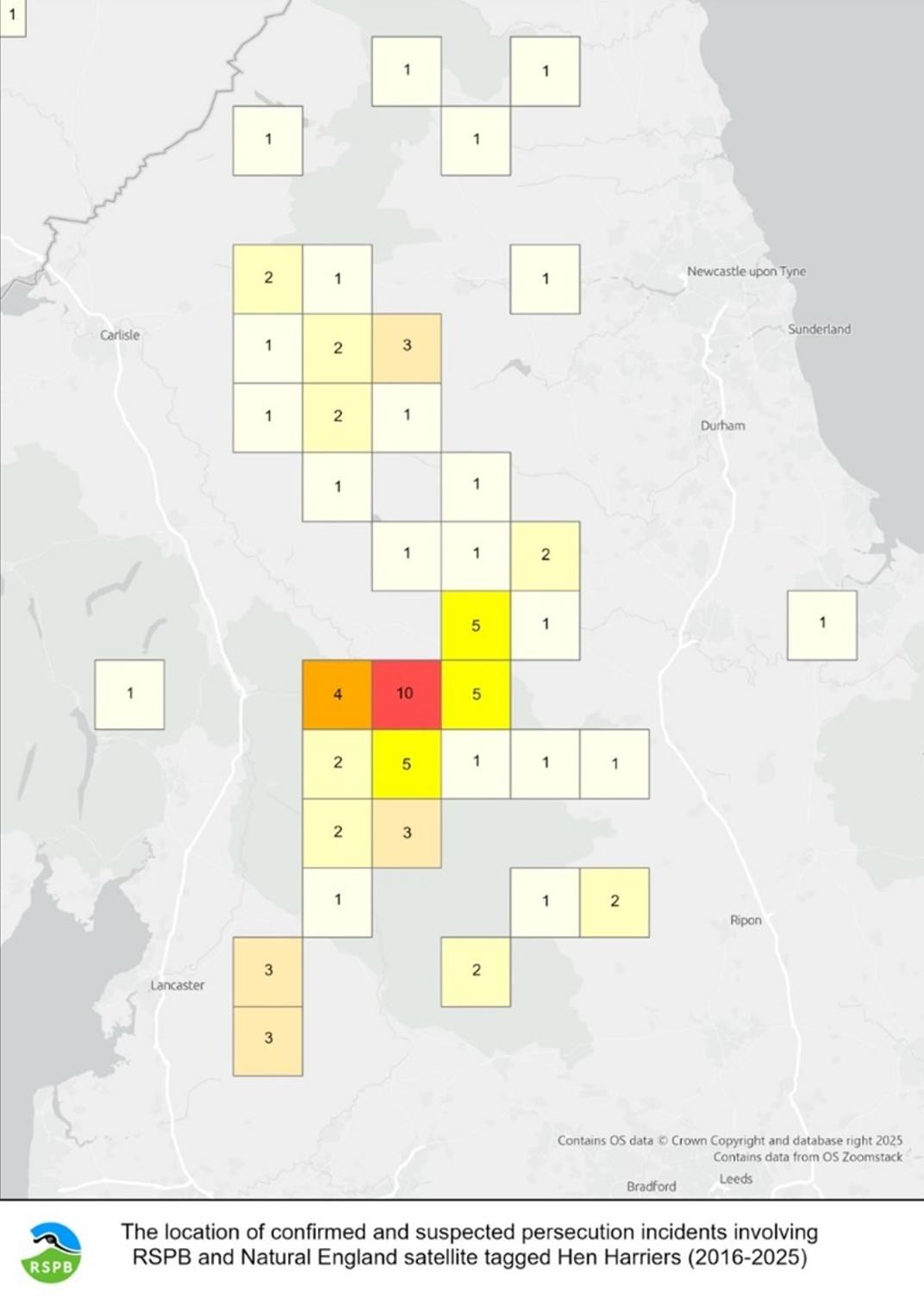
Of the 85 confirmed and suspected satellite tagged Hen Harrier persecution incidents recorded in England in the last ten years (2016-2025), 79 (93%) occurred in the area of Northern England shown in the map below.
In total, these include 35 RSPB satellite-tagged Hen Harriers and 44 Natural England satellite-tagged Hen Harriers. All were either confirmed to have been illegally killed or disappeared in suspicious circumstances.
The number in each square on the map is the total number of confirmed and suspected persecution incidents involving RSPB and Natural England satellite tagged Hen Harriers recorded in that area alone.
The RSPB also provided details of the seven tagged Hen Harriers either missing or illegally poisoned in 2025. I blogged about a number of these individuals in 2025 although the RSPB’s new commentary provides additional context. For those individual Harriers previously reported on this blog, I’ve marked them with an asterisk and provided a link to the specific blog.
*Ataksak was found poisoned close to a grouse moor in North Yorkshire – poisoned with the Nidderdale Cocktail (January 2025). The area where Ataksak’s body was found is recognised as a bird of prey persecution hotspot. In the last ten years 25 confirmed bird of prey persecution incidents have been recorded in this area, including Ataksak. These included four Hen Harriers, 13 Red Kites and five Buzzards. A satellite tagged Hen Harrier also disappeared in this area in 2024. [Previous RPUK blog on Ataksak, here].
*Sita disappeared on 27 February 2025. Her tag sent its final transmission from a moor south of Reeth, in the northeastern area of the Yorkshire Dales National Park. [Previous RPUK blog on Sita, here].
*Dynamo was a six-year-old RSPB satellite tagged Hen Harrier which suspiciously disappeared whilst provisioning a nest in the Forest of Bowland in Lancashire in May 2025. He was one of four breeding male Hen Harriers that disappeared in northern England over a period of eight days – two from RSPB Geltsdale Nature Reserve in Cumbria, and a further two from the Forest of Bowland in Lancashire. All of these birds vanished whilst foraging for food away from their nest. [Previous RPUK blog on Dynamo, here].
Wadrew was one of three chicks that successfully fledged from RSPB Geltsdale in the summer of 2025, raised with the assistance of RSPB staff and volunteers. When the male parent suddenly disappeared whilst foraging off the reserve (suspected to have been illegally killed) reserve staff and volunteers provided emergency supplementary food under licence. On 27 September 2025, just weeks after fledging, Wadrew disappeared whilst on a grouse moor near Birkdale, in the north-west of the Yorkshire Dales National Park. Based on incident data, this area – dominated by grouse moors – is the epicentre for Hen Harrier persecution in the UK. Since 2016, in this area four confirmed persecution incidents involving RSPB and Natural England satellite tagged Hen Harriers have taken place and 13 satellite tagged Hen Harriers have suspiciously disappeared (including Wadrew) – all suspected to have been persecuted (2016-2025).
Morrigan suddenly disappeared on 30 September 2025 just three days after Wadrew’s final transmission and 17 km away, in the southern area of the North Pennines National Landscape – a notorious bird of prey persecution hotspot. In the same area in 2022, concerns were raised when irregular tag data was sent from a satellite tagged Hen Harrier named Asta. A search of the area led to the discovery of Asta’s satellite tag, found fitted to a dead Carrion Crow. The harness was intact. As a tag harness cannot be removed intact without inflicting significant harm to the bird it was clear that Asta had been illegally killed. In the last ten years 13 confirmed and suspected bird of prey persecution incidents have been recorded in this area including one confirmed incident (the sat-tagged Hen Harrier Asta) and the suspicious disappearance of 10 satellite tagged Hen Harriers, including Morrigan, between 2016 and 2025.
Beatrix: Just 10 days before Wadrew and Morrigan disappeared, another young RSPB satellite tagged Hen Harrier, Beatrix, also vanished. Beatrix fledged from the Tarras Valley Nature Reserve in Scotland in the summer and dispersed south into the North Pennines, settling in an area dominated by grouse moor near Allendale. Her sat-tag sent its final transmission from this location on 17 September 2025. This area is another recognised persecution hotspot for Hen Harriers with four satellite tagged Hen Harriers confirmed to have been persecuted and six satellite tagged birds (including Beatrix) suspiciously disappearing in the area (2016-2025).
*Red: In January 2025, eight months earlier, a one-year-old Scottish Hen Harrier that had also fledged from the Tarras Valley Nature Reserve, named Red, disappeared in another part of the North Pennines in County Durham. Another satellite tagged Hen Harrier, named Sia, disappeared in the same area in 2022. [Previous RPUK blog on Red, here].
The RSPB has provided a good amount of detail here, although I note that grid references have not been provided, which is disappointing.
However, the persecution hotspot map covering part of northern England is of particular interest to me. It’s striking that the RSPB has recorded ‘repeat’ incidents in certain areas, whereas Detective Inspector Mark Harrison from the National Wildlife Crime Unit (NWCU), who leads the National Hen Harrier Taskforce, is on record (several times) saying that since the Taskforce began its work in 2024, there hasn’t been a single ‘repeat’ incident in any of the Taskforce’s persecution hotspots.
This discrepancy demands more scrutiny and I’ll blog about it soon.
In the meantime, I’ll update the rolling list of missing/dead Hen Harriers since 2018…
UPDATE 21 January 2026: 147 Hen Harriers confirmed ‘missing’ or illegally killed in UK since 2018, most of them on or close to grouse moors (here).
On Monday this week, former gamekeeper Thomas Munday appeared at Scarborough Magistrates’ Court where he was convicted of killing a Buzzard in March 2024 on land owned by the Hovingham Estate in North Yorkshire and was fined £1,215 (see RSPB press release here).
The case drew wide media attention, not least because it centered on disturbing footage captured on an RSPB covert camera showing Munday brutally beating to death the Buzzard that had been captured inside a Crow cage trap. The violence was appalling, and according to a piece on ITV news, even Munday’s solicitor told the court that his client had done “an incredibly cruel thing, it wasadisgusting aberration“.
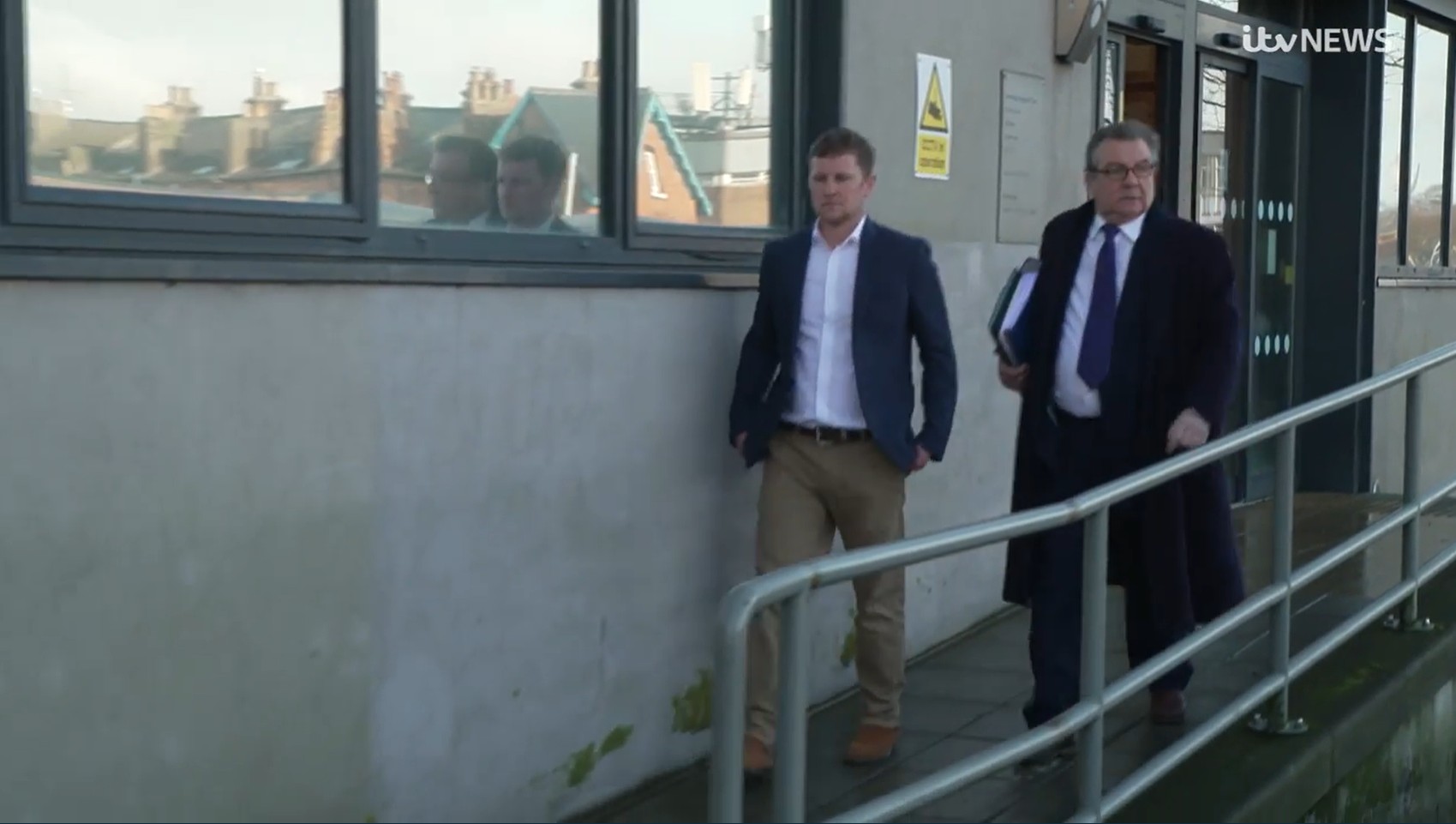
Thomas Munday (on the left) leaving court with his solicitor (screengrab from ITV News footage)
I said I’d return to this case to provide some commentary. I’m interested in three different aspects of the case: the charge against Munday, the sentence he received, and the location of the crime.
THE CHARGE
Munday was charged with intentionally killing a protected wild bird, a Buzzard. That’s an obvious offence and was clearly evidenced by the RSPB’s video footage. Munday pleaded guilty at the first available opportunity.
But to my mind there were other charges that could have been brought against Munday. For example, using a cage trap to kill or take a protected wild bird, possession of an article (the stick) capable of being used to commit an offence, and perhaps even going equipped (the ATV) to commit an offence.
However, the main additional charge I would have expected to see, based on the video footage, was that of causing unnecessary suffering to the Buzzard (Section 4 of the Animal Welfare Act 2006).
It’s beyond doubt, to me, (and apparently to Munday’s solicitor – see above) that that Buzzard suffered unnecessarily due to the two bouts of inhumane and cruel beating caused by Munday.
The courts are expected to treat animal cruelty seriously, as evidenced by the guidelines provided by the Sentencing Council – see here.
If you follow the step-by-step process outlined by the Sentencing Council, Munday’s actions could be determined as being of either High Culpability or Medium Culpability, and the harm caused (death) falls under Category 1 (the most serious level of harm caused).
Sentencing guidelines for offences determined to be High Culpability Category 1 start at two years’ custody. For Medium Culpability Category 1 offences, the starting point is 26 weeks’ custody.
I wonder why the CPS chose not to bring any charges other than that of intentionally killing a protected wild bird (the Buzzard)? Or maybe the CPS did bring other charges and there was a plea bargain? Along the lines of, ‘My client will plead guilty if the other charges are dropped’? That’s a common and legitimate feature of many criminal prosecutions but if that did happen in this case, why did the CPS accept? Was it a case of getting a quick and easy conviction in the bag and let’s move on to the next case?
This is all conjecture, of course, and until there’s better (any!) transparency about charging decisions then we’ll never know.
THE SENTENCE
Munday was fined a total of £1,215 for killing the Buzzard. This amount was broken down as follows:
£807 – fine
£323 – surcharge
£85 – costs
Some people, and I’m one of them, will consider that this level of fine does not reflect the seriousness of the offence and is at the lower end scale available to the courts. As the RSPB stated in its press release after Munday’s conviction, ‘This penalty provides little deterrent to others who may consider committing similar crimes and fails to reflect the casual and callous acts of cruelty involved‘.
I’ve seen some argue that the other consequences Munday faced (i.e. losing his firearms and shotgun certificates, losing his job, losing his home), in addition to the fine, is sufficient penalty for him. I disagree. Losing a job and home is no different to someone being made redundant, through no fault of their own, and having to relocate to find work.
According to media reports, Munday has re-trained (now a tree surgeon, apparently, so need for firearms/shotgun certs), is employed and has moved away from the house he was renting. Paying off a £1,215 fine shouldn’t be too much of a burden to him.
In addition, this case utilised forensic expertise (including examination of the bloodied stick to identify Buzzard DNA, and swabs taken from the vehicle in to which the bludgeoned Buzzard had been thrown). This work was conducted by the Wildlife DNA Forensic Unit at SASA in Scotland, paid for by the Forensic Analysis Fund (to which organisations like Wild Justice, Northern England Raptor Forum, Tayside & Fife Raptor Study Group, Devon Birds, Rare Bird Alert and many individual donors, including this blog’s readers, have contributed – see here).
One of the conditions of using the Forensic Fund for raptor persecution cases is that if the case progresses to court and costs are recoverable, an application must be made to the court to recover those costs, and any amounts recovered must be reimbursed back into the Forensic Fund to be used for other cases.
In this case, an application was made to the court to recover the costs of the forensics work but the magistrates said that a reimbursement wasn’t possible because the forensics work ‘wasn’t necessary’ to the case.
To explain – Munday committed his offence in March 2024. The RSPB passed on the video evidence to North Yorkshire Police who executed a search warrant (date unknown) at an address and retrieved several items for forensic examination. However, Munday wasn’t interviewed at that time (for reasons best known to North Yorkshire Police).
Munday was only interviewed by North Yorkshire Police in December 2025, some 21 months after the crime was committed. Had he been interviewed in 2024, Munday’s solicitor told the court that his client would have held up his hands and pleaded guilty. Hence, in the magistrates’ opinion, the forensics work wouldn’t have been needed.
THE LOCATION OF THE CRIME
If you’ve read a lot of the media reports about this case, including the RSPB’s press release and North Yorkshire Police’s press release, you might have noticed that the name of the estate where this crime took place has not been reported. It’s invariably been described as ‘near Hovingham’ and ‘near Malton’ – even the CPS charge apparently described the location as being ‘near Ripon’, which is unusual as typically the exact location is included in the charge. The exception was an article on the BBC’s website, which stated, ‘Thomas Munday was filmed killing the buzzard on land which is part of the Hovingham Estate, in North Yorkshire, in March 2024‘.
The court was told that Munday was employed by a ‘management company’ (un-named) who leased the land on an estate for a Pheasant shooting syndicate. According to an observer in court, Munday’s solicitor ‘spent a long time’ telling the court that the estate had nothing to do with the Pheasant shoot, and that as soon as the estate found out about the Buzzard being killed, it terminated the lease. Apparently he went as far as to say he hoped the press would report this sensitively. That’s bizarre – it’s almost as though the solicitor was acting for the estate.
I was intrigued by this apparent reluctance to name the estate and did some digging.
Hovingham Estate (also known as Hovingham Hall) has been in the ownership of the Worsley family for over 450 years. Sir William Worsley (6th Baronet) apparently resides there with his family. He’s big into forestry and conservation, according to Wikipedia, being the former Chairman of the National Forest Company, the former Government’s National Tree Champion, and is the current Chair of the Forestry Commission.
The estate has won awards for its woodland management, including winning a silver award in the 2023 Bede Howell Award for Excellence in Silviculture (the year before the Buzzard was beaten to death in the woods). The judges commented:
“We were impressed by the co-ordination achieved between the several estate departments. For example, the woodlands present an attractive landscape of high amenity and biodiversity character. They also host an important pheasant shoot by paying especially close attention to the character of woodland edges. The result is a profitable woodland enterprise containing excellent stands of timber. this integrates effectively with sporting and other estate priorities“.
I can see why a man of this standing would want to distance the estate from the disgusting and barbaric crime committed by gamekeeper Thomas Munday, and the estate deserves full credit for immediately terminating the shooting lease. I wish more landowners would follow this example and act so quickly and decisively when dealing with sporting agents.
But that Bede Howell awards committee statement about Hovingham Estate made me pause for thought. “They also host an important pheasant shoot….” (emphasis is mine).
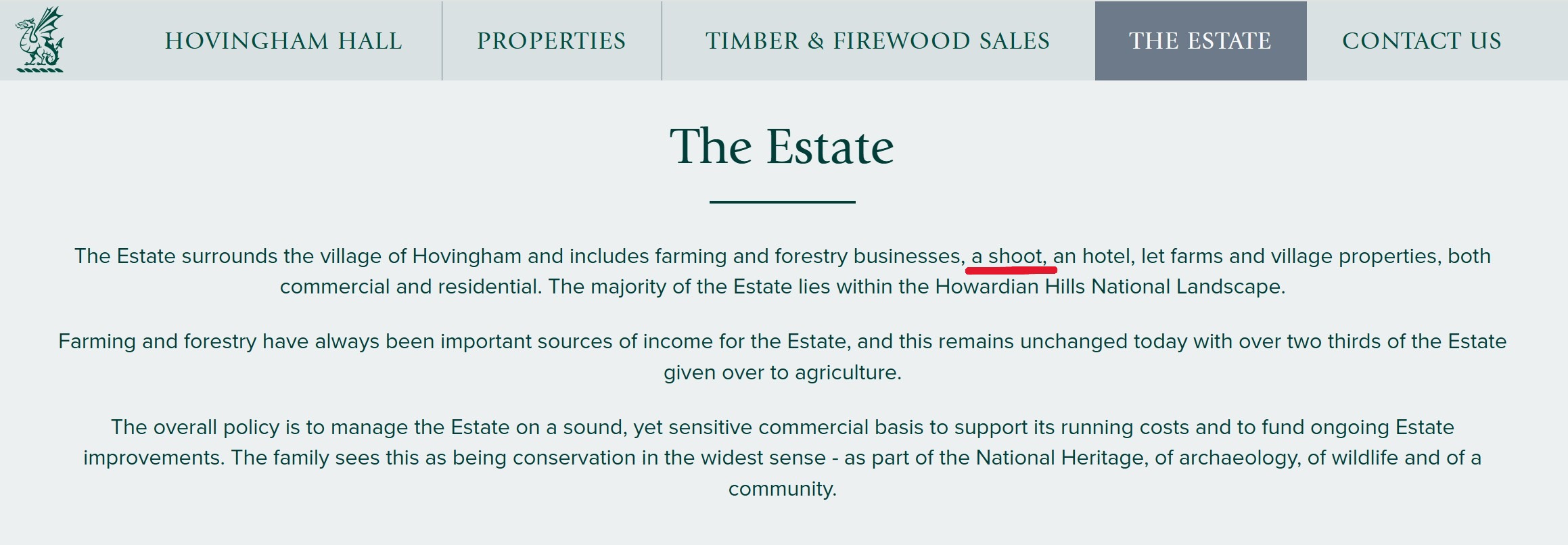
If you look on the Hovingham Hall website, it includes a statement about what goes on at the estate:
It says the estate includes ‘a shoot’, which suggests to me that the estate may be more involved in Pheasant shooting than simply renting the land to a tenant sporting agent.
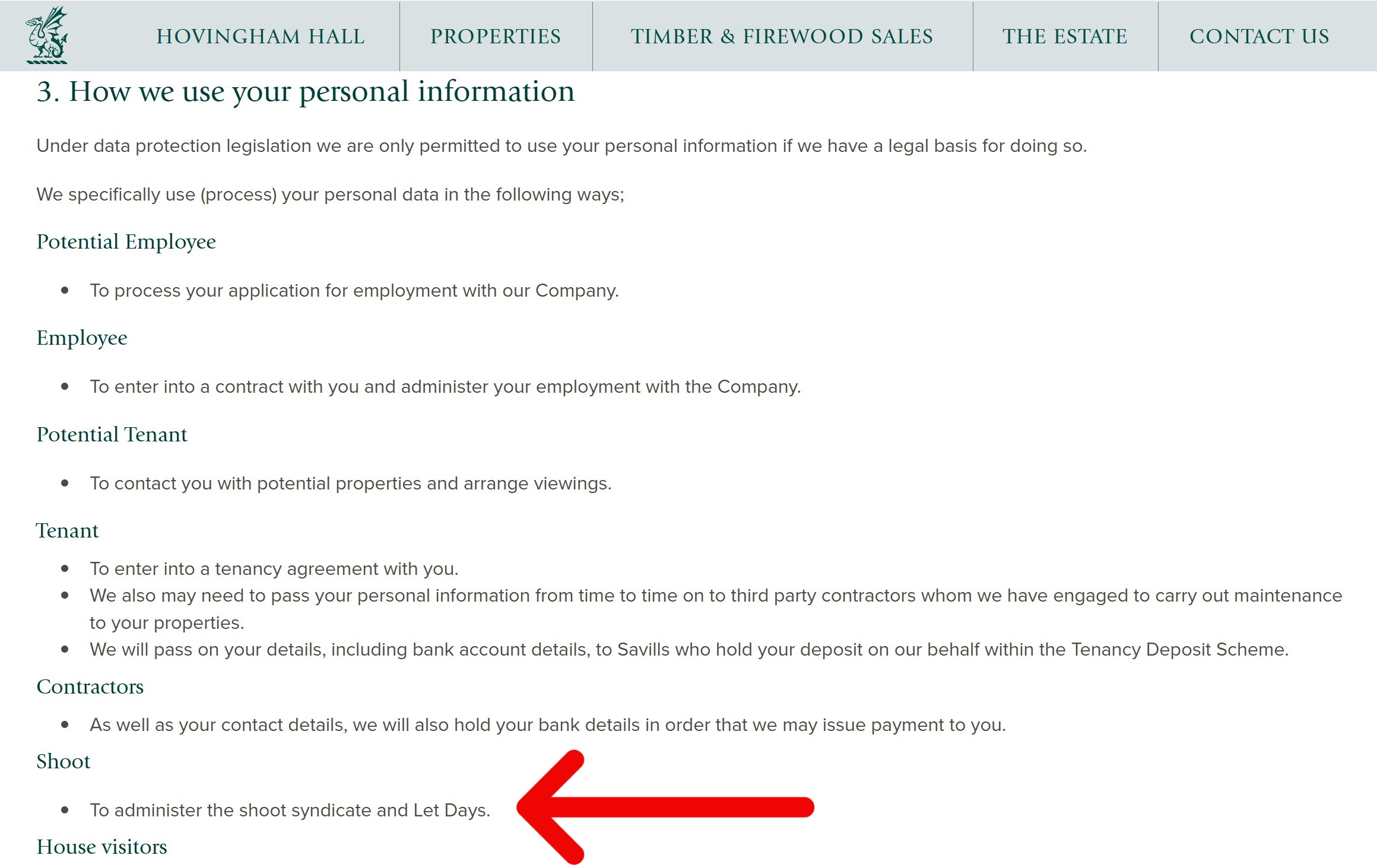
However, when I looked around the rest of the website, I couldn’t see any further mention of ‘a shoot’, until I looked at the estate’s privacy policy (dated 2024).
This privacy policy lays out how the estate handles its responsibilities under the Data Protection Act and how personal information is used. There’s an interesting entry under the header ‘Shoot’, which suggests the estate is involved in the administration of the ‘shoot syndicate and Let Days’.
Hmm.
I decided to phone the estate and ask them about their involvement in Pheasant shooting and whether they still had a Pheasant shoot after terminating the shoot lease in 2024.
I spoke to a nice lady in the main office who gave me a prepared statement, as follows:
“Hovingham Estate is aware of an incident involving one of our tenant’s employees. We take a zero tolerance approach to issues of this kind and therefore we took immediate action to terminate the tenant’s lease. We must emphasise that none of our employees are involved in any way“.
That’s pretty clear, but didn’t answer my questions. I asked the questions again and the nice lady told me:
“I’m sorry, I’m not at liberty to comment“.
To be absolutely clear, there is no evidence to suggest that Hovingham Estate knew about the criminal activity of gamekeeper Thomas Munday, and when it did become aware, it acted responsibly and terminated the lease.
If this estate is still hosting Pheasant (or Partridge) shooting, whether leased to another tenant or managed by the estate, I hope that lessons have been learned and close attention is paid to what might be going on in those award-winning woodlands.
Kudos again to the RSPB’s Investigations Team for securing the evidence that led to this conviction.
Further to last week’s blog about a gamekeeper being due to appear in court charged with killing a Buzzard on a Pheasant shoot at Hovingham, North Yorkshire (here), the case was heard today at Scarborough Magistrates’ Court and Thomas Munday pleaded guilty.
In March 2024, secret RSPB filming caught gamekeeper Thomas Munday brutally killing a protected Buzzard whilst it was caught in a cage trap on a pheasant shoot near Hovingham, North Yorkshire.
Today, at Scarborough Magistrates Court, Munday pleaded guilty to killing a Buzzard and was fined £1,215.
Although cage traps can be legally operated under government licences, they have a history of being repeatedly used in unlawful ways to catch and kill birds of prey on land managed for gamebird shooting. These incidents are generally related to attempts by the operator to remove any potential threat to gamebird stocks, reared for commercial shooting.
The RSPB is urging the UK Government to introduce a licensing scheme for all gamebird shooting to deter bird of prey persecution and to promote better practices.
On 30 March 2024, a covertly deployed RSPB camera caught a gamekeeper brutally beating a protected Buzzard to death inside a cage trap set in woodland near Hovingham, North Yorkshire.
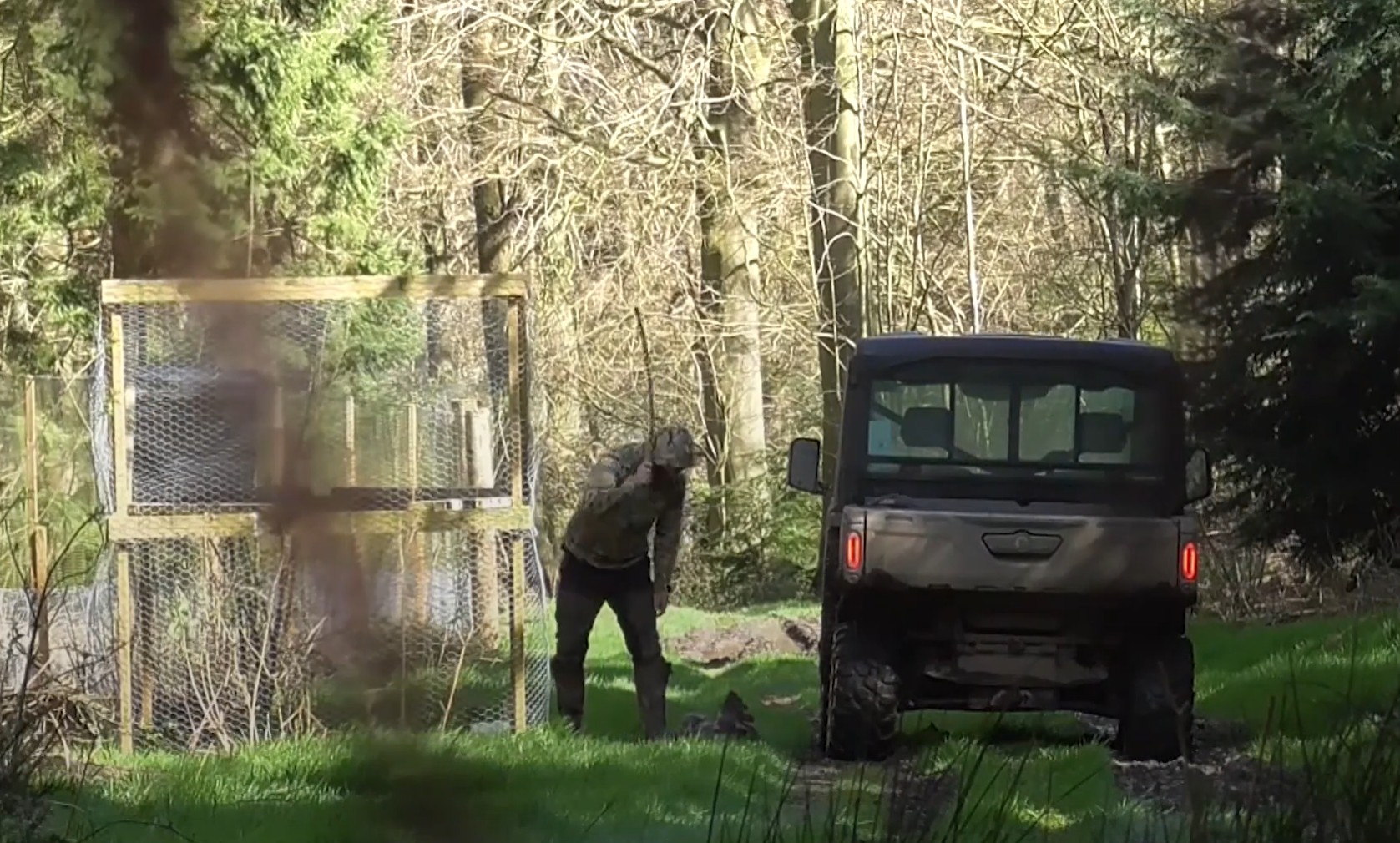
Screengrab from the RSPB’s covert footage showing gamekeeper Thomas Munday clubbing the Buzzard to death, having already bludgeoned it inside the crow cage trap. The casual level of brutality and the suffering he caused is very disturbing.
The footage shows a Buzzard entering the crow cage trap. Four hours later, a masked and hooded individual arrives at the trap in an all-terrain vehicle. He enters the trap and is seen repeatedly striking the Buzzard with a stick. The injured and incapacitated Buzzard is then removed from the trap – clearly still alive – and beaten several more times with the same stick. The individual then picks up the bird by its wing and throws it into the vehicle before driving away from the site.
The RSPB shared the footage with North Yorkshire Police, who later identified the individual in the footage as Thomas Munday – employed as a gamekeeper.
Of all individuals convicted of bird of prey persecution-related offences between 2009 to 2023, 75% were connected to the gamebird shooting industry and 68% were gamekeepers.
A police-led search of the land, assisted by the National Wildlife Crime Unit (NWCU), resulted in a number of items being seized including the stick used to kill the Buzzard. Forensic testing by the Scottish Agricultural Science Agency (SASA) funded by the Partnership against Wildlife Crime (PAW) Forensic Analysis Fund found traces of Buzzard DNA on the stick. Munday was subsequently charged with the illegal killing of the Buzzard, an offence under the Wildlife and Countryside Act 1981.
On 12 January 2026, at Scarborough Magistrates Court, Thomas Munday pleaded guilty to killing a Buzzard and was fined £1,215.
Crow cage traps can be legally used under Government General Licence, issued by Natural England, to control corvid species such as Carrion Crows or Magpies, on condition that licence conditions are adhered to. Under these conditions, if a bird of prey or any other non-target species is caught in the trap, on discovery the bird must be released at point of capture without undue delay.
Sadly, this method of targeted killing of birds of prey is a persistent problem in the UK particularly on land managed for gamebird shooting. In a period of ten-years (2015-2024), 30 confirmed incidents of birds of prey being caught and/or dying in unlawful crow cage traps were recorded in the UK. 97% of these incidents were associated with land managed for gamebird shooting. 34 birds of prey were involved in these crimes with Buzzards, Goshawks and Sparrowhawks the most common victims associated with these crimes.
Howard Jones, RSPB Senior Investigations Officer: “The casual and brutal killing of the Buzzard is extremely upsetting to watch and it’s clear that Munday has a complete disregard for the law, and the legislation that protects these birds. Frustratingly, this incident isn’t a one off but is just the latest example of the cruel and disturbing lengths some individuals will go to in order to illegally kill birds of prey.
“These crimes and the wider issue of bird of prey persecution is significantly linked to the gamebird shooting industry. Without long overdue regulation of gamebird shooting we expect to see these crimes continue.”
James Robinson, RSPB Chief Operating Officer said: “Although we welcome Defra’s recent announcement of a review of corvid traps, this latest incident underlines a far wider and deeply entrenched issue for our protected birds of prey.
“For decades, these species have been illegally killed on land managed for pheasant, partridge and grouse shooting. More than half of all 1,529 confirmed persecution incidents recorded from 2009-2023 were linked to gamebird shooting. These crimes will continue without meaningful legislative change.
“Through the introduction of a robust licensing system for all gamebird shooting across the UK, the illegal killing of birds of prey could be effectively deterred. Scotland took this welcome step in 2024 when it introduced licensing for grouse shooting. We need the Government to take action, now.”
Though we welcome the guilty verdict in today’s case, we are disappointed that the sentence imposed is at the lower end of the provisions available to the court. This penalty provides little deterrent to others who may consider committing similar crimes and fails to reflect the casual and callous acts of cruelty involved.
The RSPB thanks the North Yorkshire Police, the NWCU and the Crown Prosecution Service for their vital role in investigating and prosecuting this case.
Members of the public are urged to report any suspected incidents of bird of prey persecution by contacting the police on 101 and by submitting a report to the RSPB.
This can be done via the RSPB’s online reporting form at www.rspb.org.uk/report-crimes or by calling the RSPB’s confidential Raptor Crime Hotline on 0300 999 0101. Reports via the RSPB’s reporting form and Raptor Crime Hotline can be made anonymously.
ENDS
The RSPB covert footage can be viewed here, but BE WARNED, it includes animal cruelty, suffering and death.
My commentary:
I’ll keep this brief because I’m short of time today but I’ll be returning to this particular case later in the week as there are several important points that were not covered in the RSPB’s press release.
For now, the RSPB deserves huge credit for capturing this horrific crime on camera and ultimately securing a conviction. It’s interesting that the defence did not challenge the admissibility of the RSPB’s video footage and the court accepted it without question.
More soon…
UPDATE 16 January 2026: Commentary on the conviction of gamekeeper Thomas Munday (bludgeoned Buzzard to death on Hovingham Estate, North Yorkshire) here
Gamekeeper Thomas Munday is due to appear at Scarborough Magistrates’ Court next week after being charged with killing a Buzzard on a Pheasant shooting estate at Hovingham, North Yorkshire in April 2024.
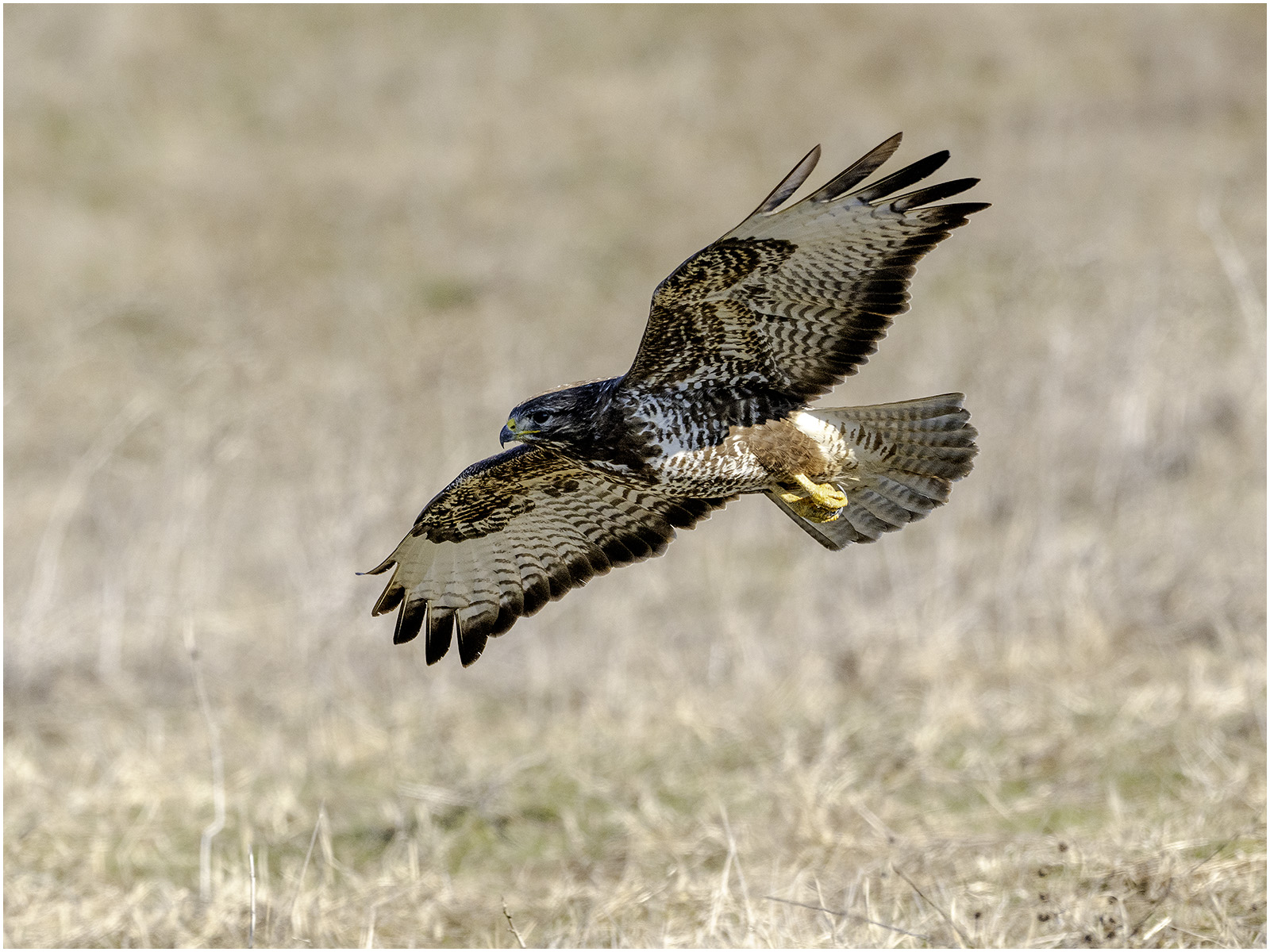
Buzzard photo by Ronnie Gilbert
No plea has been entered yet and this will be the first hearing in this case.
NB: As criminal proceedings are live, comments have been turned off.
UPDATE 12 January 2026: Gamekeeper Thomas Munday convicted after brutally clubbing trapped Buzzard to death on a Pheasant shoot at Hovingham, North Yorkshire (here)
UPDATE 16 January 2026: Commentary on the conviction of gamekeeper Thomas Munday (bludgeoned Buzzard to death on Hovingham Estate, North Yorkshire) here
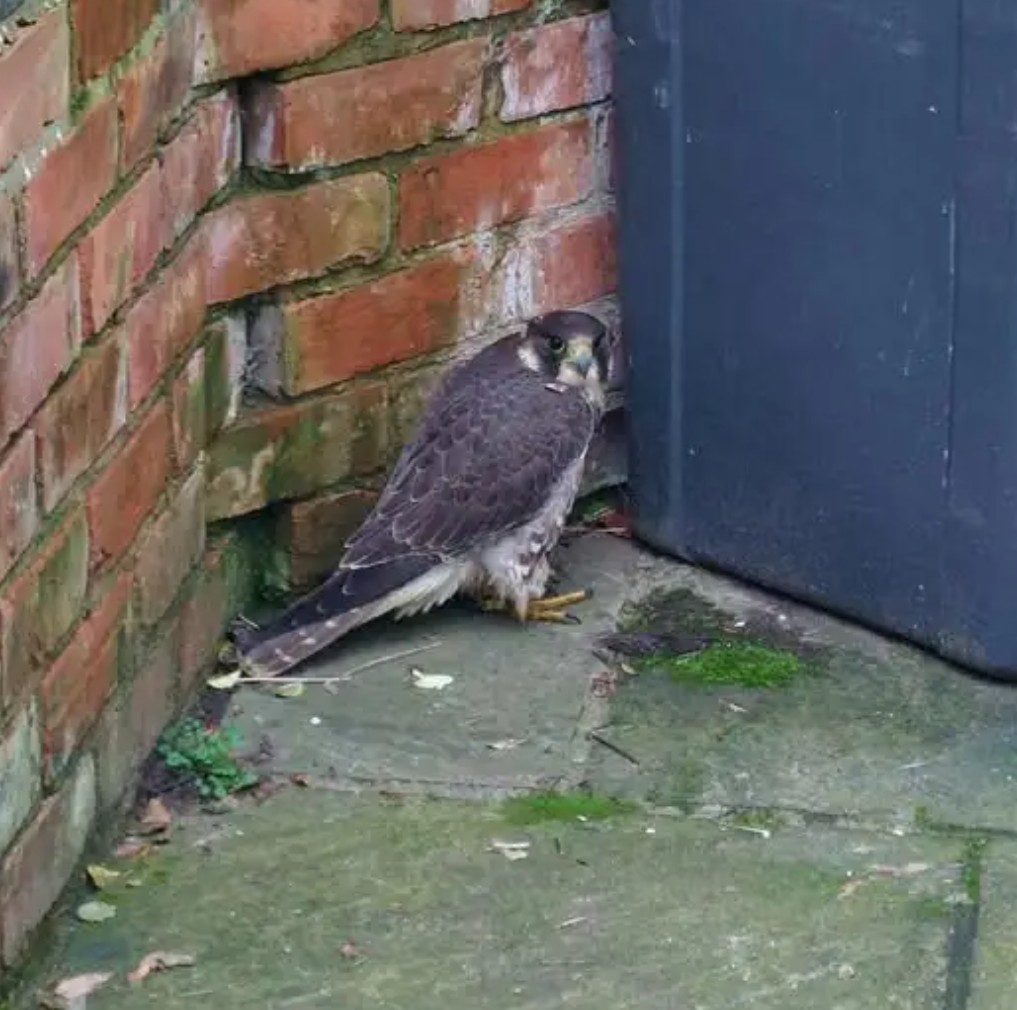
Further to this morning’s blog about a Peregrine being euthanised after being found with gunshot injuries in Leicestershire (see here), the Leicestershire Wildlife Hospital has released more details and has issued an appeal for information, as follows:
APPEAL FOR INFORMATION
Yesterday we admitted a peregrine falcon that was found grounded in a garden on Smeeton Road, Kibworth.
Our team collected the peregrine and her assessment found that she had been shot [suspected to have been an air rifle]. This could have happened any time between the 21st and 23rd December.
Peregrine falcons are a schedule 1 bird in the UK. It is an illegal act to intentionally harm or kill them.
This crime has been reported to the police and we are now appealing for any information you may have.
Have you seen anything suspicious?
Have you heard any gunshots?
Did you see this crime take place?
If you have ANY information, please contact the police [call 101] on with reference number 25000748549.
The peregrine sadly had to be put to sleep as she was suffering from a severe break to her right humerus – likely as a result of the fall after being shot. She was this years young, from Leicester cathedral, known as X6F (her ring number).
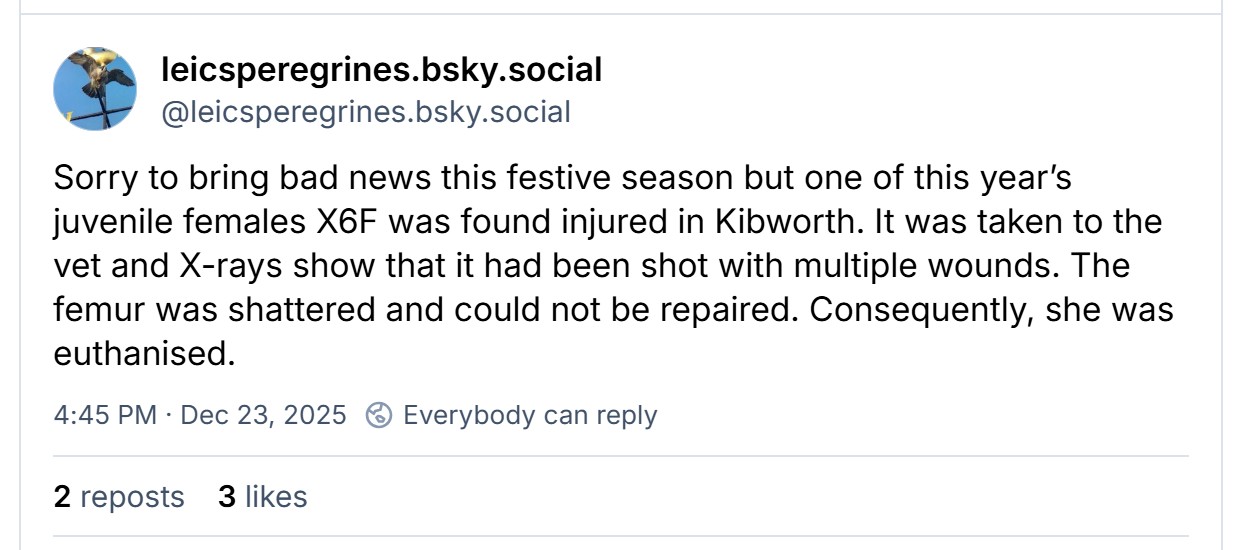
A young peregrine that fledged from Leicestershire Cathedral this summer has been euthanised after being found with gunshot injuries in nearby Kibworth.
A post on social media yesterday by the Leicestershire Peregrine Project, an initiative run by the Leicestershire & Rutland Ornithological Society in collaboration with Leicester City Council and Leicester Cathedral, reads as follows:
Juvenile female Peregrine X6F shown here with her sibling. Photo from the Leicester Peregrine Project website.
In happier news for Peregrines in Leicestershire, Market Harborough District Council’s planning committee has recently approved the installation of a Peregrine nest platform on the council’s Grade II listed Symington Building.
Leader of the council Phil Knowles said the Peregrines “are a much-loved feature of Market Harborough”, and added: “We are delivering what we believe our community wants.”
The work will take place in time for the 2026 breeding season and is being sponsored by WW Brown & Sons, the local building contractor carrying out restoration work on the historic landmark.
Press release from Forestry England (17 December 2025)
THREE WHITE-TAILED EAGLES DISAPPEAR IN SUSPICIOUS CIRCUMSTANCES
The public are being asked to help the police investigate the suspicious disappearance of three white-tailed eagles. The cases include a chick born in the wild earlier this year in Sussex, one of the first white-tailed eagles to fledge in England for hundreds of years.
White-tailed Eagle G842 on the nest with its sibling in Sussex prior to fledging earlier this year (Photo: Forestry England)
The missing birds are part of a project led by Forestry England and the Roy Dennis Wildlife Foundation to reintroduce this lost species to England. Their disappearance is being investigated by several police forces and the National Wildlife Crime Unit.
The return of white-tailed eagles to England is one of the country’s key conservation successes over recent years. Since 2019, 45 white- tailed eagles have been released. Several breeding pairs have formed with six chicks being born in the wild for the first time since the 1780’s. Any targeting of the birds will potentially impact the long-term success of the project.
All of the released birds are tagged with satellite trackers allowing the team to closely follow their location and movements. In September the trackers of two eagles were found dumped close to the birds’ last recorded location. Both had been cut off the birds using a sharp instrument. In the case of another eagle, its tag has stopped sending data. The last message received from the device was on 8 November and no sightings of the bird have been recorded since then.
Tim Mackrill from the Roy Dennis Wildlife Foundation said: “We monitor the satellite data, showing the bird’s minute-by-minute movements, on a daily basis and always investigate any suspicious or unusual data. It was devastating to find the stolen and dumped tags, particularly for the chick in Sussex who fledged this summer and had only just begun its life. So many people in the area had shared the joy of seeing these birds breed again after hundreds of years and our ongoing monitoring has shown how well they were fitting into the landscape. To have that destroyed just a few months later is deeply shocking“.
Steve Egerton-Read, White-Tailed Eagle Project Officer for Forestry England, said: “We are returning this lost species to the English landscape and have had so much support from the public. These special birds are helping people connect with natural world and showing how with a little bit of help nature can thrive. We are asking the public to show this support again by encouraging anyone who has information that may help the police investigation to come forward“.
There was tremendous public support and local pride this summer when two white-tailed eagle chicks fledged from a nest in Sussex. Both were the offspring of eagles released by the project in 2020 and the first pair to successfully breed in England for over 240 years. The two chicks had spent the first few months of their lives exploring the local West Sussex area.
On 26 September, a satellite tag belonging to one of the chicks (G842) was recovered from the River Rother, near Petersfield. It had been removed from the bird using a sharp instrument. Searches in the area to try and locate the body of the bird have so far been unsuccessful.
Sussex Police are appealing for information from anyone who was in or around Harting Down and Petersfield on the evening of 20 September 2025. Any members of the public who may have seen the bird or any suspicious behaviour can contact them on 101 or 0800 555 111 quoting incident number 769.
Dyfed Powys Police are investigating a similar incident on 13 September, where a satellite tag belonging to white-tailed eagle G615 was recovered in remote moorland. The tag had been removed with a sharp instrument before being hidden in an attempt to dispose of it. Searches in the area to try and locate the body of the bird have so far been unsuccessful.
The force is interested in hearing from anyone who was at or around the Gwgia Reservoir, Tregynon between 11am and 1pm or on access land near Bryn y Fawnog between 12 noon and 3pm on 13 September. Callers should quote crime reference number 137.
In a third incident, concerns are growing for G819 after its tag, which usually transmits the data daily, has stopped working. The last transmission was sent on 8 November in the Moorfoot Hills area. Police Scotland are treating the disappearance as suspicious and asking anyone with information to contact them on 101 or 0800 555 111 quoting incident number PS-20251215-1347.
The reintroduction of white-tailed eagles is conducted under licence from Natural England, the Government’s wildlife licensing authority. White-tailed eagles are a protected species under the Wildlife and Countryside Act (1981). Disturbing, destroying or interfering with them and their nests are criminal offences.
ENDS
My commentary:
Hands up, who’s surprised?
No, me neither.
These reports are so depressingly familiar these days, we’ve pretty much come to expect them. Although there’s something particularly sickening about killing a White-tailed Eagle. It’s no lesser crime, in the eyes of the law, than killing a more common species like a Buzzard or a Sparrowhawk – the offence is the same and the available penalty is the same. But these eagles, the UK’s largest raptor, have been brought back from the brink through intensive conservation efforts by many people over many decades. Progress has been hard-won, because these birds are slow to mature (between 4-6 yrs) and when they do eventually reproduce they generally only manage to rear one or two chicks per season, on rare occasions three, and they don’t necessarily breed every year, which means that population recovery is slow. Any illegal killing, on top of natural mortality, is obviously going to hamper that reestablishment.
And there’s no doubt whatsoever that at least two of these eagles were the victims of illegal persecution, given the clear evidence that their satellite tags had been cut off and crude attempts were made to hide them. Given the area in south Scotland where the third White-tailed Eagle has vanished, a well-known persecution hotspot, it wouldn’t be a surprise to learn that that bird has also been killed illegally, most likely shot.
Kudos to the White-tailed Eagle Reintroduction team (Roy Dennis Wildlife Foundation & Forestry England) for putting out an appeal for information after three months of silence from Dyfed-Powys Police and Sussex Police.
UPDATE 18 December 2025: More detail on the ‘missing’ White-tailed Eagle in south Scotland (here)
UPDATE 19 December 2025: More detail about the missing White-tailed Eagle in mid-Wales (here)
UPDATE 19 December 2025: Fourth White-tailed Eagle ‘disappears’ & RSPB offers £10,000 reward for information leading to a conviction (here)
Over the last few weeks I’ve blogged about a number of illegally-killed Hen Harriers whose deaths have been barely publicised by the authorities, but instead have been quietly entered onto a Government spreadsheet, months, and sometimes over a year later, with little effort to draw the public’s attention to this ongoing criminality.
There was Hen Harrier ‘Susie’ who was found dead with gunshot injuries on a grouse moor in the North Pennines, here; and Hen Harrier ‘254843’ who was found dead on moorland in the Northumberland National Park with shotgun damage to her satellite tag, here; and a Hen Harrier (ref # HSE 107/913) who was found poisoned on a grouse moor in North Yorkshire having ingested a lethal combination of toxic chemicals known as the ‘Nidderdale Cocktail’, so called due to the frequency it is used as a poisoned bait in the Nidderdale National Landscape, killing multiple birds of prey and even a pet dog, here.
Well, here’s another one.
This time its a young Hen Harrier named Margaret, who was fitted with a satellite tag (Tag ID 254844) by Natural England fieldworkers just prior to her fledging from a nest in Northumberland on 5 July 2024.
Natural England staff ‘lost contact’ with Margaret just three months later on 19 October 2024.
The first we knew about this was in Natural England’s intermittent spreadsheet update in December 2024 about the fate of the Hen Harriers that had been satellite-tagged using public funds. Margaret’s entry read as follows:
‘Lost contact 19 October 2024, Northumberland. Missing Fate Unknown, site confidential – ongoing investigation‘.
Whether that meant her tag had suddenly and inexplicably stopped transmitting, or whether the data showed an unusually long period of being static in one place, wasn’t clear.
We didn’t hear anything more until Natural England quietly updated its spreadsheet in October 2025. Margaret’s entry now reads:
‘Missing Fate Unknown. Suspected illegally killed. Tag found removed. Carcase not found. Grid ref NY878497‘.
So, a year after Natural England ‘lost contact’ with this Hen Harrier, we’re finally given a few more details.
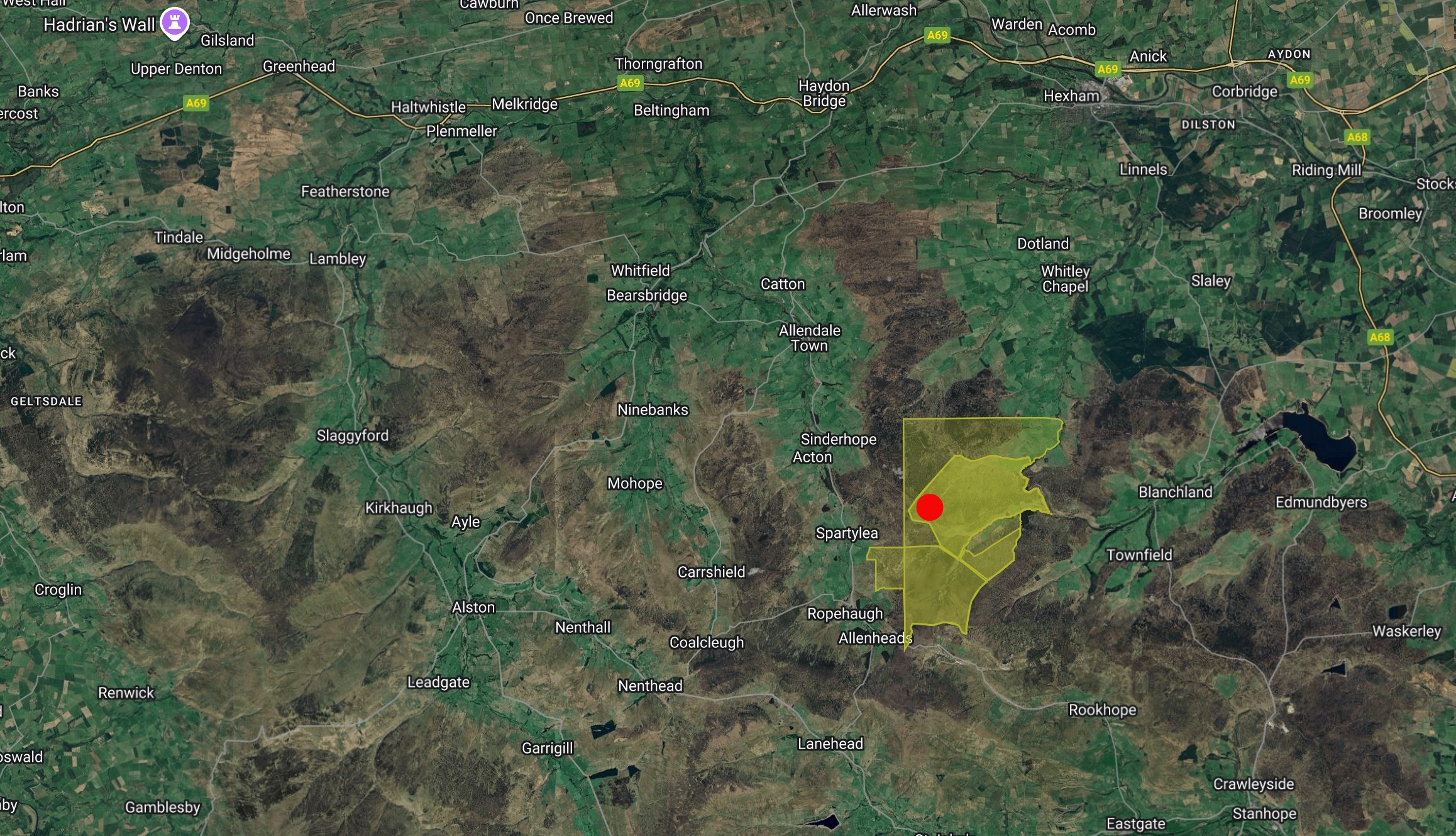
This grid reference is in the North Pennines National Landscape (formerly called an AONB), a region that has long been identified as a Hen Harrier persecution hotspot (e.g. see the RSPB’s damning 2025 report, Hen Harriers in the Firing Line, here).
When you zoom in on this map, you’ll be unsurprised to see it is an area dominated by moorland intensively-managed for driven grouse shooting (as demonstrated by the obscene expanse of geometric strips).
According to Guy Shrubsole’s excellent website, Who Owns England?, this grid reference (approximately marked as a red dot on map below) sits on property described as part of the Allendale Settled Estates:
There’s no suggestion that anyone connected to the Allendale Estate is responsible for ‘removing’ Margaret’s satellite tag and/or killing this Hen Harrier. It’s simply a fact that her ‘removed’ satellite tag was found on a grouse moor at this location without any sign of her carcass.
I haven’t seen ANY appeal or press release from Northumbria Police about the suspected illegal killing of this Hen Harrier or the circumstances that led the police to believe her satellite tag had been ‘removed’, presumably cut, over a year ago in October 2024. Not a single word.
I haven’t seen ANY publicity from the National Wildlife Crime Unit-led Hen Harrier Taskforce. This is the specialist group set up explicitly to tackle the ongoing illegal killing of Hen Harriers in England. Not a single word.
I haven’t seen ANY publicity from the police-led national Raptor Persecution Priority Delivery Group (RPPDG), one of whose functions is apparently ‘awareness raising‘ and ‘raising the profile [of illegal raptor persecution] via media exposure‘. Not a single word.
Natural England, who used public funding to pay for the tag, public funding to pay for the fieldworkers to fit the tag to the bird, and public funding to monitor the tag’s subsequent data output, chose not to draw attention to this suspected illegal killing and instead just quietly updated its tag spreadsheet a year later, probably hoping nobody would notice.
I’ve been told by a number of sources that the decision about whether to publicise a crime lies solely with the investigating police force (in this case, Northumbria Police). I’m told that nobody else (e.g. Natural England, National Wildlife Crime Unit’s Hen Harrier Taskforce, the RPPDG) can do this until, or unless, the investigating police force agrees.
That’s understandable in the immediate period after the police have become aware of the crime. They’d want (you’d hope) to be launching an immediate investigation and wouldn’t want the suspects to be alerted because evidence could be removed/hidden before the police have turned up to do a search.
What’s utterly farcical though, is that the investigating police force can ‘sit’ on a case for months, sometimes for over a year, and do nothing, either because (a) their officers are overstretched and don’t have the resources to investigate, (b) their officers are inexperienced or even incompetent, or (c) their officers are corrupt with direct vested interests. Meanwhile, no other organisation, including a specialist police unit, is allowed to mention the suspected crime or appeal for information.
This happens again and again and again with some police forces tasked with investigating raptor persecution on private sporting estates (and some other wildlife crime offences, too, notably fox-hunting). It’s not all police forces by any means – some of them are exemplary and their wildlife crime officers routinely push the limits to try and bring offenders to justice, but some other forces simply aren’t up to the job, for any of the reasons described above.
If it is a ‘rule’ that the investigating police force has supremacy over media output, and other agencies have to sit and wait for a green light that might never come, then this needs to be challenged and changed, especially when there’s a specialist police team waiting on the sidelines ready to act but is effectively handcuffed, blindfolded and gagged. What’s the point of having a specialist team if it doesn’t have the authority to lead on an investigation?
But hang on, Natural England has ‘published’ some details about some of these incidents, albeit very quietly in a spreadsheet that most people don’t even know exists. I suspect they have a duty to do this because public funds are involved.
So why then, in those cases, can’t Natural England accompany that spreadsheet update with a blog, or a press release, or something/anything that would alert the media/public to the ongoing criminality faced by Hen Harriers?
And what’s to stop the other agencies doing likewise? Hen Harrier Margaret ‘disappeared’ and her tag was ‘removed’ over a year ago – you can’t tell me that any publicity now is going to hinder a police investigation!
And besides, I’m blogging about the case, legitimately, using information that’s in the public domain. There’s no reason whatsoever that those agencies can’t do the same.
You’ll be unsurprised to know that Margaret isn’t the last Hen Harrier I’ll be writing about that has ‘disappeared’ in suspicious circumstances in recent months.
I’m also aware that I haven’t recently updated the running ‘death list‘ of missing/dead Hen Harriers…I plan to do this soon but may not get to it quickly as there’s a lot going on right now.
Derbyshire Police Rural Crime Team posted the following on Facebook on 3 December 2025:
WILDLIFE CRIME AWARENESS – INJURED PEREGRINE
Between 01/09/25 – 08/09/25, we received a report from the Youlgrave [Youlgreave] area that a peregrine falcon had been sadly shot.
After x-rays it showed that the incident caused the bird’s wing to shatter.
X-ray provided by Derbyshire Police Rural Crime Team. Annotated by RPUK
Thankfully, this story doesn’t end in tragedy — the peregrine is alive and currently undergoing rehabilitation.
This post is a reminder that peregrines are legally protected, and it is a criminal offence to intentionally injure or kill them under the Wildlife and Countryside Act 1981.
If you witness wildlife crime or anything suspicious:
If you have any information relating to this incident, please quote 25*580157
Together, we can protect our wildlife
ENDS
It’s not known where or when this Peregrine was shot, but given the extent of its injuries it’s unlikely to have been able to fly far from that location.
I don’t know why it’s taken Derbyshire Constabulary three months to appeal for information on a supposed priority wildlife crime.