Natural England is maintaining its silence about the gruesome fate of one of its satellite-tagged hen harriers whose wings were torn off in an act of inconceivable violence in March last year.
I first blogged about this criminal investigation in December 2021 (here), where I discussed how Natural England had remained silent about it for months and months and months, even when the grouse shooting industry was wheeling out its annual propaganda-fest claiming to be the hen harrier’s best friend. Natural England, knowing full well what had happened to this young harrier, said nothing to challenge the shooting industry’s claims.
On 20th December 2021 Natural England tweeted that the incident (crime) was the subject of a police investigation so refused to comment further at that stage. I argued that this was a cop-out by Natural England because this particular investigation had begun over 9 months ago but nobody had been interviewed, let alone arrested or charged, and the likelihood of a prosecution was precisely zero, just as in the 60 other police investigations relating to hen harrier persecution in the last three years alone (see here).
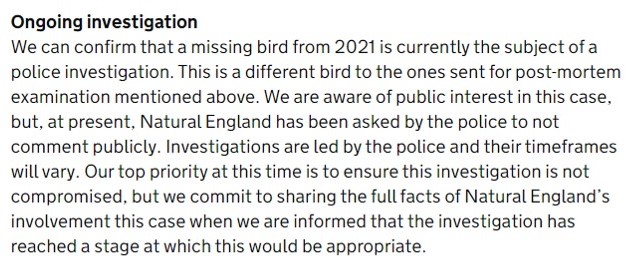
Nothing further was heard until Natural England published a hen harrier update blog last Friday (4th March 2022) which included the following statement about this crime:
I still think this is a cop out by Natural England, backed up by the police – commentary could easily be given that would not compromise the supposedly ‘ongoing investigation’.
At the end of this month it’ll be one year since this crime was committed. Unless there is a significant statement from the police that somebody has been charged (there won’t be, believe me), I intend to blog about some of the details of this case in early April because I believe it’s in the public interest to do so.
UPDATE 25th August 2022: Hen harrier’s ‘wings removed’ & its satellite tag fitted to a crow in sick ploy to disguise the crime (here)
Press release from South Yorkshire Police & RSPB (4th March 2022)
Buzzard found shot dead in Peak District
South Yorkshire Police and the RSPB are appealing for information after a buzzard was found shot dead in the Peak District National Park.
The body of the bird was discovered in woodland at Flouch, near the popular visitor hotspot of Langsett in the Peak District National Park, in March 2021. The finder, a volunteer for the Peak District Raptor Monitoring Group, reported it to the police. Post-mortem examination revealed that the bird had been shot by a shotgun.
[The shot buzzard found on land owned by Yorkshire Water. Photo by Peak District Raptor Monitoring Group]
[RPUK map showing woodland areas around Langsett Reservoir in the Peak District National Park and its proximity to land managed for driven grouse shooting. The woodland where the corpse was found is believed to be owned by Yorkshire Water]
There have been several incidents of raptor persecution in this area, including a raven poisoned with the banned substance Aldicarb found on a nearby grouse moor in 2018. And recently, in February 2022, South Yorkshire Police, the RSPB and the National Wildlife Crime Unit conducted a search for a missing hen harrier in the Stocksbridge area. An investigation is ongoing.
Buzzards and all other birds of prey are legally protected by the Wildlife and Countryside Act 1981. To intentionally kill or injure one is a criminal offence and could result in an unlimited fine or up to six months in jail.
Tom Grose, RSPB Investigations Officer said: “Here is yet another bird of prey which has been found shot dead within the National Park. This area of the Peak District is a place where people come to enjoy nature, yet it is one of the UK’s number one raptor crime hotspots. This simply cannot continue. Bringing persecution to an end inside and outside these landscapes will require government action, and we echo the recommendations found in the recently published UN wildlife crime report including the implementation of licences for driven grouse shooting, which can then be revoked if raptor persecution is found to have occurred“.
The RSPB’s most recent Birdcrime report showed that 2020 was the worst year in 30 years for the illegal killing of birds of prey, and that two-thirds of confirmed incidents were in connection with land managed for gamebird shooting.
In 2018, a paper published in the scientific journal British Birds proved a statistically significant association with land burnt for driven grouse shooting and persecution of birds of prey in the Peak District National Park. This, along with police intelligence and population studies of key raptor species, shines a bright light on the systematic killing of birds of prey in the Dark Peak.
Police Wildlife Crime Officer Liz Wilson said: “Raptor persecution is a national wildlife crime priority and we will endeavour to ensure that those responsible for such heinous crimes are brought before the courts.
“We are lucky to have beautiful areas to enjoy, but these areas are home to wildlife and animals, and must be respected.
“We are now appealing for information following the death of a buzzard near to Langsett Barn and urge anyone with information to come forward. If you can help please call 101“.
Steve Davies of the Peak District Raptor Monitoring Group added: “Here is yet another case of illegal raptor persecution tainting the image of the Peak District National Park. Wildlife Crime enforcement needs more teeth to enable it to be a successful deterrent. Licencing of shooting estates and the introduction and effective implementation of vicarious liability legislation, including suspension and clawback of any associated agricultural subsidies, would directly impact on the shooting estate landowners or shooting tenants and estate managers who are ultimately responsible and benefit directly from game shooting.”
Alternatively, if you have sensitive information about raptor persecution which you wish to tell us about in confidence, please ring our confidential raptor crime hotline on 0300 999 0101. This is for reporting information relating to birds of prey only.
ENDS
Once again we have a very late appeal for information, this time one year after the discovery of the shot buzzard. On this occasion it appears the delay is not the fault of South Yorkshire Police, who submitted the corpse for a post mortem soon after the discovery was made. The delay appears to be the result of an over-stretched and under-resourced laboratory, snowed under by the number of raptor corpses that require examination.
Sharp-eyed blog readers will note that the location of this wildlife crime is not a million miles from where a satellite-tagged hen harrier ‘disappeared’ in suspicious circumstances just a few weeks ago (see here).
YET ANOTHER satellite-tagged hen harrier has ‘disappeared’ in suspicious circumstances, this time in the Peak District National Park.
The unnamed harrier hatched in 2021 and was being tracked by the RSPB. It was reported missing on 10th February 2022.
South Yorkshire Police have issued the following appeal for information today:
Disappointingly, the last known location of the bird has not been given other than ‘in the Stocksbridge area of Sheffield’. However, it can be narrowed down somewhat by a tweet published by a member of the RSPB’s Investigations Team, who said the harrier had vanished ‘in the Peak District’.
If you look on Google maps, Stocksbridge [red marker] is just outside the boundary of the Peak District National Park. If you cross the park boundary into the National Park, surprise, surprise, you’ll find a massive area of land managed for driven grouse shooting. A scientific study published in 2019 showed that hen harriers are ten times more likely to disappear/be killed over areas of land managed for grouse shooting relative to other land uses.
This area of the National Park is no stranger to reports of raptor persecution (see here) and another satellite-tagged hen harrier, called Octavia, also ‘disappeared’ here in 2018 (see here).
It looks like it’s time to update that ever-increasing list of ‘missing’ and ‘confirmed dead’ hen harriers….
UPDATE 26th February 2022: 61 hen harriers confirmed illegally killed or ‘missing’ since 2018, most of them on or close to UK grouse moors (here)
UPDATE 17th March 2023: Hen harrier goes ‘missing’ from a Peak District grouse moor – police confirm his satellite tag had been deliberately cut off (here)
Yesterday, Dorset MP Chris Loder’s Twitter notifications must have been off the scale as hundreds of angry people took him to task for his shocking comments (here) about not wanting Dorset Police to investigate the suspicious death of a white-tailed eagle, found dead on a Dorset shooting estate in January (here).
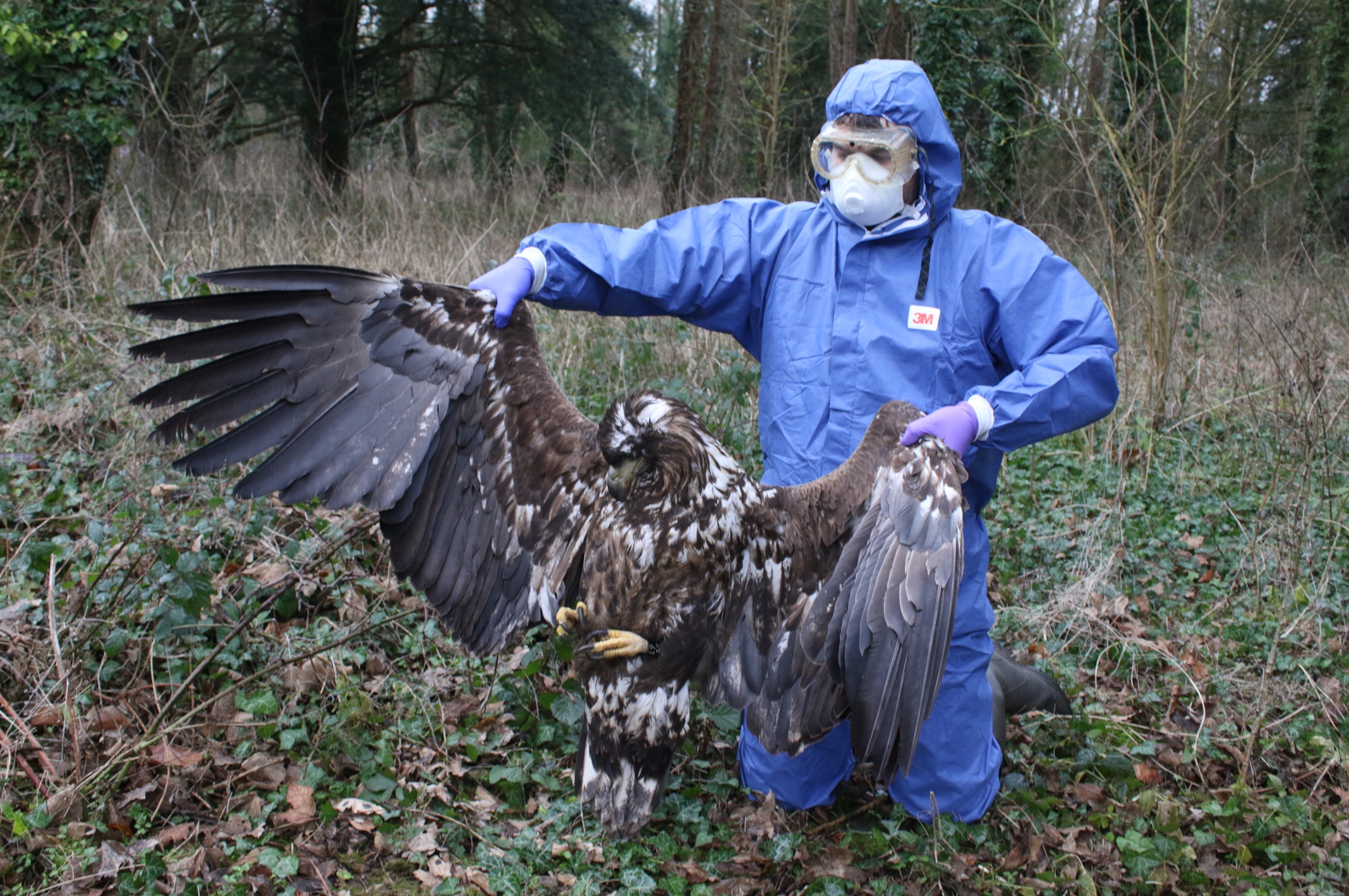
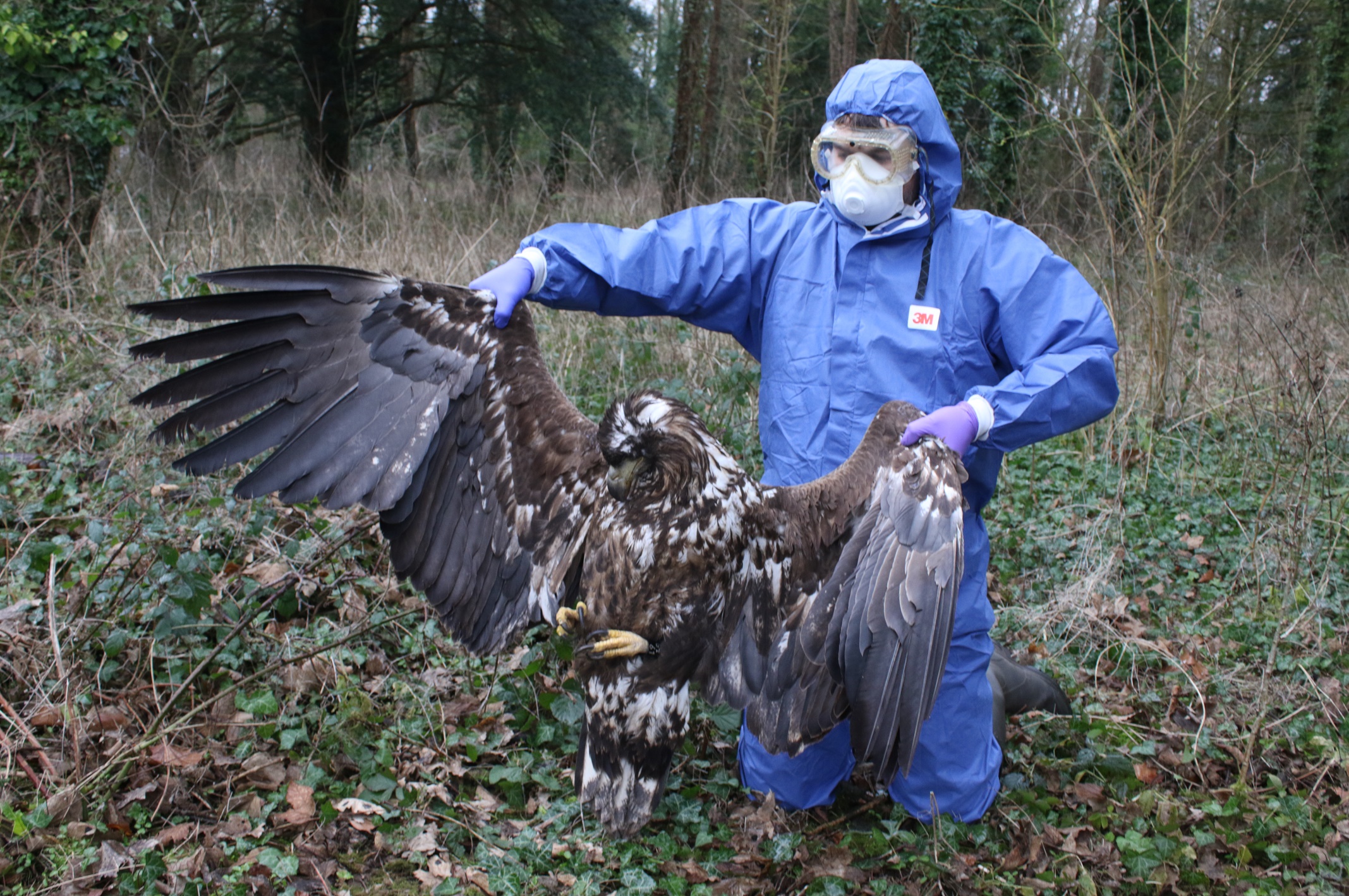
[The dead white-tailed eagle being collected for post mortem. Photo by Dorset Police]
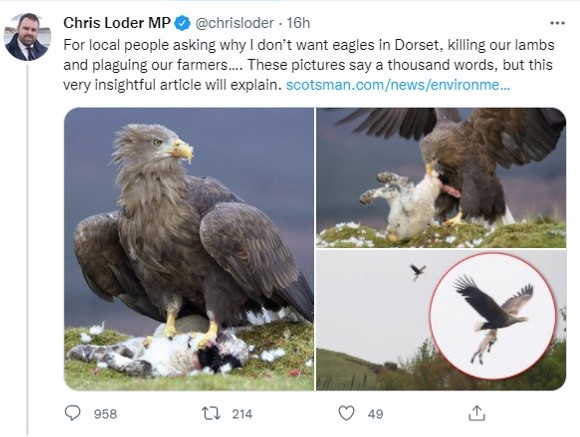
Last night Chris Loder added fuel to the fire by posting this on Twitter:
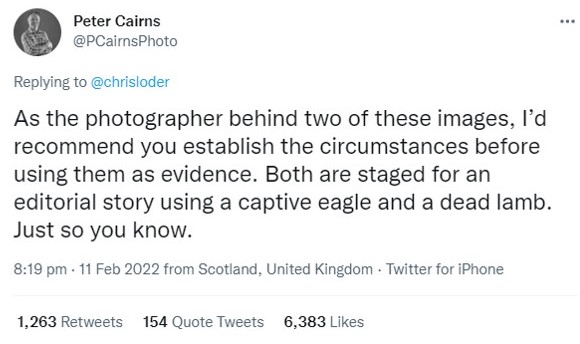
This ridiculous statement (“plaguing our farmers“, FFS!) attracted plenty of well-deserved ridicule but it also generated even more anger and in some cases, unfortunately, personal abuse towards Mr Loder. But even when photographer Pete Cairns pointed out that the two photos of the eagle with a lamb had been staged, by Pete, for a separate project and then mis-used to illustrate the Scotsmanarticle to which Mr Loder was referring, (this was a captive eagle with an already-dead lamb placed in front of it), Mr Loder was not for backing down.
It’s a familiar argument, of course, to those of us who have listened for years to prejudicial-driven hysteria about white-tailed eagles, although typically this has come from the Scottish Gamekeepers Association (who remembers them writing to the Scottish Government warning that sea eagles might not be able to distinguish small children from prey?!) but to hear it from an elected MP in southern England was quite a shock, especially a Conservative MP whose senior Ministers keep pretending that bird of prey conservation is important to them (e.g. see here and here).
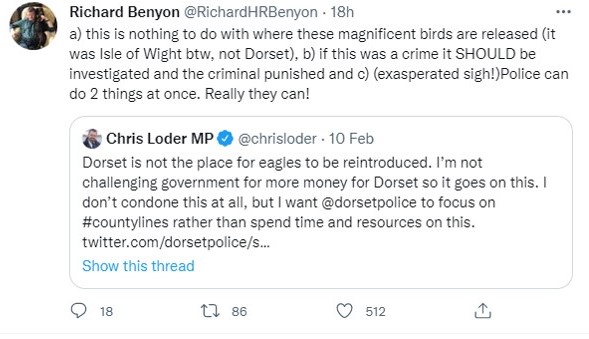
However, even DEFRA Minister Richard Benyon could read the room on this one and yesterday typed a suitably-exasperated tweet to Chris Loder, which was probably code for, ‘Shut up, you’re not doing us any favours here’:
I’d speculated yesterday that perhaps Chris Loder’s dissatisfaction that Dorset Police’s time and resources were being put towards an investigation into the suspicious death of the sea eagle might have something to do with the fact that the Conservatives have received substantial local party donations, over a number of years, from a prominent Dorset estate that just happens to be owned by a very wealthy landowner who appears to be part of the hunting set and whose spouse appears to have played a prominent role with the Countryside Alliance (here).
That may well be part of the story, but it’s also clear from his posts last night and from online information about his farming background that he’s susceptible to, and believes in, the anti-eagle propaganda routinely pumped out by the National Farmers Union, an organisation who refused, formally, to support the Isle of Wight Eagle Reintroduction Project because of a perceived fear of the impact the eagles would have on livestock, despite extensive consultation and evidence-based assurances by the project team that live sheep would not be at high risk. [But note that not all farmers agreed with the NFU’s stance and a number are supportive of the project].
This morning I’ve been sent some more information that suggests Chris Loder’s position may also be influenced by his family’s farming connections. Detailed research undertaken by Guy Shrubsole (author of the brilliant website Who Owns England) has revealed that Chris Loder’s family appears to run a tenanted farm on a large Dorset estate (a different estate to the one that’s been making donations to the local Conservative party) and on that estate there’s also a sizeable pheasant shoot.
As before, there is no suggestion whatsoever that either Chris Loder, his family, or the estate on which his family runs a tenanted farm, has anything whatsoever to do with the death of the white-tailed eagle in Dorset. What I am suggesting is that it is worth bearing in mind that when Chris Loder is proclaiming eagles as the farmers’ enemy and pronouncing that the police shouldn’t be spending time and resources on investigating the suspicious death of one of those eagles, found dead on a Dorset game-shooting estate, it’s worth remembering these vested interests of his.
And as interesting as this all is, I think it’s also a distraction from the main topic of interest here, and that is, when are we going to see the toxicology report of the dead eagle found on a game-shooting estate in Dorset in January and the dead eagle found on a game-shooting estate in Sussex last October?
And on that same subject, when will Natural England release the post mortem results of the two satellite-tagged hen harriers found dead in October last year (see here)? Or tell us about the investigation into the satellite-tagged hen harrier that probably had its wings pulled off 11 months ago (see here)?
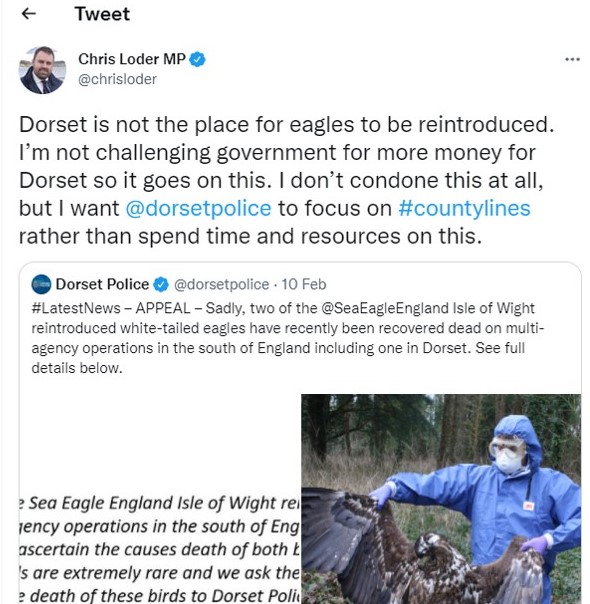
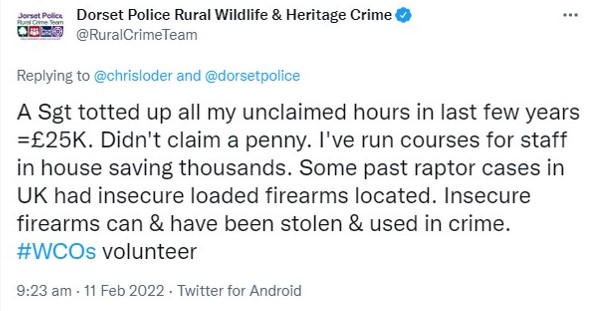
Further to yesterday’s news that two reintroduced white-tailed eagles have been found dead in suspicious circumstances on game-shooting estates in southern England and that Dorset Police are investigating the circumstances of the one found in Dorset (here), local conservative MP Chris Loder has made an extraordinary statement on Twitter this morning.
[The dead white-tailed eagle found in Dorset. Photo from Dorset Police]
Here’s his tweet:
Is this guy for real?
This is a suspected wildlife crime of a very serious nature. The three most common methods for killing birds of prey on UK game-shooting estates are shooting, trapping (and then clubbing to death) and poisoning. We don’t know which of these methods, if any, have been deployed in this case but all are potential features of the case. The fact that Dorset Police have stated the eagle has gone for toxicology analysis suggests that poisoning is a possibility.
The poisons most frequently used to kill birds of prey in this country are highly toxic substances – banned in many countries because they’re so dangerous that just a tiny amount is enough to kill a human. The effects of using poisonous baits are indiscriminate. Not only may the baits kill the target species but any other species that happens to come into contact with it, or any pet dog, or any inquisitive human, including a child.
If the eagle has been shot, there’s a dangerous armed individual on the loose in Dorset.
If the eagle has been trapped and clubbed to death, there’s a dangerous psychopath on the loose in Dorset.
Why on earth wouldn’t Mr Loder MP want Dorset Police to spend time and resources investigating this incident?
It wouldn’t have anything to do with the local conservative party receiving donations from a prominent Dorset estate, would it? [Note: I am not in any way suggesting that the donor estate is linked to the death of this eagle, I’m pointing out that on the Parliamentary register of interests Mr Loder has listed substantial party donations from a Dorset estate whose owner appears to be linked to ‘country sports’].
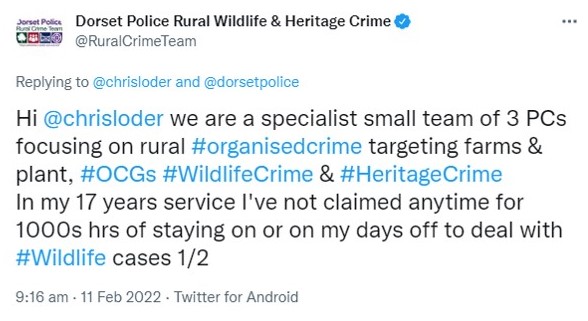
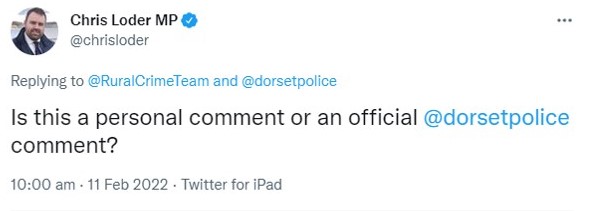
Dorset Police’s Rural Crime Team have hit back at Mr Loder:
Mr Loder’s response:
FFS. As if it isn’t difficult enough for under-staffed, under-resourced police officers to investigate wildlife crime. Imagine being on this rural crime team, which, by the way, has a deserved reputation for being diligent and sincere when dealing with alleged raptor persecution crimes, trying to get to the bottom of what will be one of the highest profile cases this year, under huge public pressure to deliver results (quite rightly, IMHO), and the local MP publishes demoralising tosh like this.
Well it took longer than I expected but it’s happened.
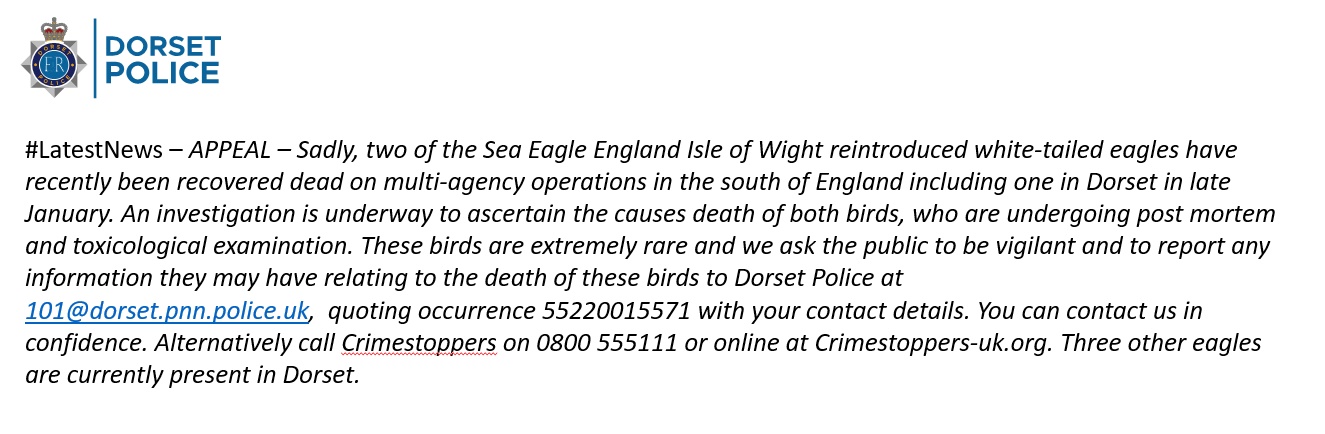
Two of the reintroduced white-tailed eagles from the Isle of Wight Project have been found dead in suspicious circumstances on game-shooting estates in southern England.
The fact they were discovered during multi-agency searches is a clear indication that criminality is suspected. One was found in Dorset in January and the other one is believed to have been found in Sussex last October.
Toxicology results are awaited for both eagles, although why it’s taken four months for the results from the first bird is not yet clear.
[The dead white-tailed eagle found on a game-shooting estate in Dorset. Photo by Dorset Police]
There is huge concern for the safety of three other white-tailed eagles currently in Dorset, which I imagine is why the police have decided to issue this statement:
UPDATE 11th February 2022: Dorset MP Chris Loder doesn’t want Police to investigate suspicious death of white-tailed eagle (here)
UPDATE 12th February 2022: Dorset MP Chris Loder’s farming connections may explain his anti-eagle hysteria (here)
UPDATE 15th February 2022: Police investigate after sudden death of white-tailed eagle on Isle of Wight (here)
UPDATE 27th April 2022: White-tailed eagle poisoned with banned pesticide on a game-shooting estate in West Sussex (here)
Gamekeeper John Orrey’s conviction was secured in December 2021 when he pleaded guilty to five wildlife crime offences and four firearms offences. Sentencing was deferred until yesterday when he was handed a suspended custodial sentence and a small fine (see here) – nowhere near as severe as he deserved for deliberately baiting a trap to attract buzzards and then casually but brutally beating those buzzards to death with a stick as if it was part of his daily routine.
[Screengrab from the RSPB’s covert footage of criminal gamekeeper John Orrey killing buzzards at Hall Farm, Kneeton, Nottinghamshire]
At the time of his guilty plea I checked around the websites of the five game-shooting organisations that claim to have a ‘zero tolerance’ for raptor persecution to read their statements of condemnation and see what efforts they’d made to distance themselves from this criminal gamekeeper, e.g. expelled him from membership (if he is a member) or blacklisted him to prevent future membership, blacklisted the pheasant shoot at Hall Farm in Kneeton, Nottinghamshire where Orrey is employed etc.
I found absolutely nothing about his conviction on any of the shooting org websites.
Perhaps they were waiting for sentencing before they took action?
Well let’s see. At the time of writing this blog, 24 hours after Orrey was sentenced, and with the story being covered widely online and in local, regional and national press, of the five shooting organisations claiming zero tolerance of raptor persecution, the National Gamekeepers Organisation has remained silent, the Countryside Alliance has remained silent, the Moorland Association has remained silent, and the CLA has remained silent. So has the GWCT. How telling is that?
The only shooting organisation to have published a statement is BASC, although it’s so weak and heavily disguised it really needn’t have bothered.
Here it is:
Note there is no mention of gamekeeper John Orrey or that he’s just been convicted of committing 5 wildlife crimes and 4 firearms offences on a pheasant shoot in Nottinghamshire. There are just generic statements suggesting, as BASC always does, that it’s a ‘tiny minority’ responsible for the wide ranging criminality found within the game-shooting industry, even though the most recent report shows the number of raptor persecution crimes is at a 30-year high.
Any casual visitor to the BASC website will struggle to know what the article is even about, and I’d argue that that is exactly what the BASC press team intended when it decided on what the headline and text would be. ‘Yeah, let’s make it look as though we’re condemning this gamekeeper’s actions without actually referring to him or his case or providing any details, because that would be too embarrassing/damaging for our industry‘.
BASC has added a link at the foot of its statement but this is a link to an article in the Newark Advertiser! No disrespect to the Newark Advertiser, but why on earth didn’t BASC include a link to the RSPB blog and the RSPB video? BASC even mentions in its statement its so-called partnership work with the Raptor Persecution Priority Delivery Group (RPPDG), a group on which the RSPB is also present, so why not share the work of an RPPDG partner that’s been at the centre of this criminal investigation, if BASC is genuinely interested in dealing with raptor persecution?
I’ll tell you why. Because the publicity about gamekeeper John Orrey’s criminality is highly damaging to the game-shooting industry’s reputation. BASC even admits this in its own press statement. BASC needs to be seen to be condemning the criminality because otherwise it looks to be supportive of the crime at best, complicit at worst, but it will go out of its way to avoid providing the abhorrent details that a casual visitor to its website will rightly associate with the game-shooting industry.
Orrey is the 4th gamekeeper to be convicted of wildlife crimes/raptor persecution since November 2021. The three others were gamekeeper Shane Leech (33) in Suffolk (here), gamekeeper Peter Givens (53) in the Scottish Borders (here) and gamekeeper Hilton Prest (58) in Cheshire (here). I didn’t see any publicity/condemnation from any of the shooting organisations in relation to these other convictions.
So why has BASC responded to Orrey’s conviction and not the others? Simply pressure to be seen to be doing the right thing, because Orrey’s case has been high profile and drawn plenty of media attention due to the brutality of his crimes that were laid bare in the RSPB video. That footage is shocking and has caused revulsion amongst the general public. How else do you explain BASC’s silence (and all the other shooting organisations’ silence) about these three other convictions?
I’ve asked whether Orrey was/is a member of these organisations and if so, whether he’s been expelled. I haven’t received any responses.
And what now of John Orrey?
We know that his firearms were removed from him by Nottinghamshire Police back in January 2021 when his house was raided but there is no indication that he lost his job at that time. Indeed, in court his defence solicitor highlighted the fact that Orrey had managed to go a whole year without killing any more buzzards (see here).
Orrey was (is still?) employed by Hill Farm in Kneeton, Ruchcliffe, Nottinghamshire. This is a working farm with an ancillary pheasant shoot. It’s been reported that Orrey’s role is a mixture of farm labourer and gamekeeper. His firearms certificates have now been revoked for an indeterminate period (it’ll be up to the Chief Constable to decide whether Orrey is fit to have them returned) and as a result of his fine and suspended sentence, it seems he will not be allowed to use the General Licences for two years until his conviction is considered ‘spent’ and he is considered to have been ‘rehabilitated’ (in the eyes of the law, at least).
This should restrict Orrey’s gamekeeping activities considerably assuming he’ll abide by the law (and if he doesn’t he’ll find himself in jail because the suspension on his custodial sentence will no longer apply). If anyone happens to be walking in the Kneeton area and particularly in the vicinity of Hall Farm (there are public footpaths) it will be worth keeping a look out to see whether any traps are being deployed to catch and kill so-called ‘pest’ birds such as crows, magpies, rooks, jays, woodpigeons etc. If you find anything that looks suspicious please report it to Nottinghamshire Police immediately.
Further to today’s news that gamekeeper John Orrey, 63, of Hall Farm, Kneeton, Nottinghamshire was sentenced today at Nottingham Magistrates Court for battering to death two buzzards he’d caught inside a trap (see here), here’s a piece from BBC journalist Simon Hare on East Midlands Today. Hare door-stepped Orrey as he left the court today but Orrey refused to comment.
Tom Grose from the RSPB Investigations team deserves credit for his poise and professionalism in what must have been a harrowing case.
Unfortunately this short video will expire at 7pm tomorrow (Saturday 29th Jan 2022) so watch it while you have the chance. Starts at 04.40 min:
A gamekeeper has been sentenced to a total of 20 weeks’ imprisonment suspended for 12 months and fined £1000 after pleading guilty to killing two buzzards on land managed for pheasant shooting after an investigation by Nottinghamshire Police and the RSPB.
Shocking footage was played in court, showing John Orrey, 63, of Hall Farm, Kneeton, brutally killing two healthy buzzards inside a cage trap, into which they had been lured.
The court heard how, early in January 2021, members of the public reported a live buzzard caught in a cage trap in Kneeton, Nottinghamshire. Following up the report, an RSPB Investigations Officer located the trap on a pheasant shoot. There was a live buzzard inside – later confirmed to be a different bird than the one first reported – along with the carcasses of a pheasant and two stock doves, used as bait to attract the buzzard.
Cage traps can be used legally under license for certain reasons to catch corvids such as crows and magpies. However the law states that traps must be checked at least every 25 hours, and anything caught accidentally must be released unharmed.
The buzzard was released due to concerns for its welfare and the RSPB Officer installed a remote camera.
A review of the footage revealed that the trap had been visited on several occasions by a man – later identified as John Orrey – driving a green 4×4. Two buzzards entered the trap on separate, consecutive days, no doubt attracted to the carrion in the harsh weather. On both occasions Orrey entered the trap and bludgeoned the buzzards to death with the long handle of a slash hook.
[Ed: A five-minute video of these offences has been produced by the RSPB’s Investigations Team. WARNING – it contains distressing footage]
Nottinghamshire Police were notified and swiftly identified the suspect as John Orrey, a gamekeeper on a pheasant shoot on the land in question. A warrant was obtained to search his premises. In a barn near his home was the same green 4×4 with a long-handled slash hook in the boot. The bodies of the buzzards had likely been disposed of. A forensic examination of the two stock doves confirmed they had been illegally shot.
Buzzards and stock doves are legally protected by the Wildlife and Countryside Act 1981. To intentionally kill or injure one is a criminal offence and could result in an unlimited fine or up to six months in jail.
Orrey pleaded guilty to all charges in December 2021 and was sentenced today (28 January) at Nottinghamshire Magistrates’ Court. In relation to the killing of the buzzards, for each bird he received an 18-week suspended sentence to run concurrently and a £500 fine for each bird. He was also ordered to pay £650 costs and £50 victim surcharge, and £180 compensation to the Wild Justice Raptor Forensics Fund.
District Judge Grace Leong remarked: “This was a shocking and unnecessary act of cruelty and violence.”
Tom Grose, RSPB Investigations Officer, said: “When I first saw the footage I was shocked and sickened. The birds were subject to a repeated torrent of blows before being thrown into the boot of a vehicle. This was clearly a premeditated operation and yet again illustrates that the shooting industry has a serious problem that needs to be sorted. Killing birds of prey has been illegal for decades, and yet it is still commonplace. Why? Clearly the punishments are no deterrent and the courts must look at using the full range of sentences available – including jail – to signal clearly that this sort of behaviour is simply not acceptable.
“Better regulation is needed too. The RSPB has repeatedly asked for the conditions on cage traps to be tightened. The UK Government must follow the recommendations of the recent
UN assessment, which calls for stronger regulation of the shooting industry and to allow for the removal of licences to use these traps.”
Chief Inspector Heather Sutton, Nottinghamshire Police’s lead for rural crime, said: “This sentencing is extremely significant and I hope it demonstrates just how seriously Nottinghamshire Police takes reports of rural crime and how we will work together with our partners to bring anyone committing these horrific offences to justice. It is unacceptable that any wildlife should experience the kind of ordeal John Orrey subjected them to.”
Orrey pleaded guilty to 5 x WCA and 4 x firearms charges:
• Possession of two dead stock doves.
• Intentionally killing a common buzzard on 8/1/21
• Intentionally killing a common buzzard on 9/1/21
• Using a cage trap to kill or take a wild bird
• Possession of an article (slash hook) capable of being used to commit an offence
• Failure to comply with condition of shotgun certificate (weapon not securely stored)
• Failure to comply with condition of firearms certificate (ammunition not securely stored)
• Failure to comply with condition of firearms certificate (weapons and ammunition not securely stored)
• Possessing ammunition for a firearm without a certificate
I understand a blog from the RSPB is imminent, providing more detail and commentary than this press release.
I’ll post both as soon as they become available.
UPDATE 15.20hrs: An article in the Newark Advertiser provides more detail about the case and states that Orrey’s shotgun licence has been revoked (see here).
UPDATE 15.50hrs: The blog by the RSPB’s Investigations Team can be read here
UPDATE 18.50hrs: Photo of buzzard-killer John Orrey from BBC News:
UPDATE 19.10hrs: Wild Justice Raptor Forensic Fund helps secure conviction of buzzard-killing gamekeeper John Orrey (here)
UPDATE 21.00hrs: “A shocking and unnecessary act of cruelty and violence” says Judge sentencing gamekeeper John Orrey (here)
A gamekeeper will be sentenced at Nottinghamshire Magistrates Court today after he pleaded guilty to beating to death two buzzards that he caught inside a crow cage trap in Nottinghamshire in January 2021 (see here for previous blog). There are additional offences, including a firearms offence.
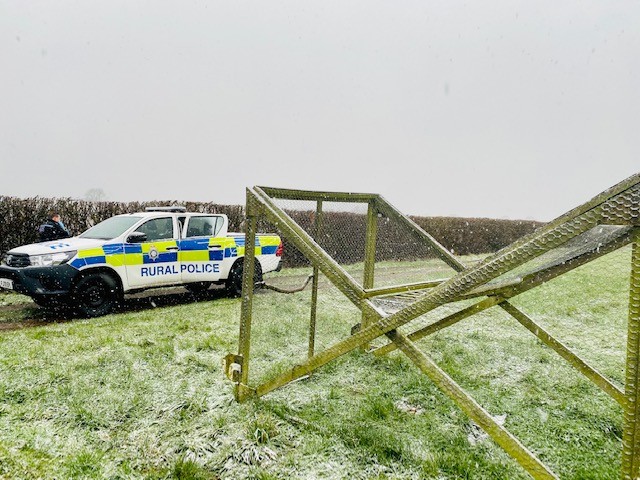
[Nottinghamshire Police visited the crime scene to collect evidence with the RSPB Investigations Team in January last year. Photo via Nottinghamshire Police Rural Crime Team].
I think we can expect to see extensive coverage of this case from the RSPB, including the video of the so-far-unnamed gamekeeper killing the buzzards, once sentencing has been handed down. I also understand there may be coverage on Channel 4 News this evening.