Gamekeeper pleads guilty to killing buzzards in Nottinghamshire

Further to the blog post on 4th January 2022 (here), a gamekeeper has pleaded guilty to five offences committed in Nottinghamshire in January 2021, including the illegal killing of two buzzards, the unlawful use of a trap, the unlawful possession of two stock doves and a firearms offence.

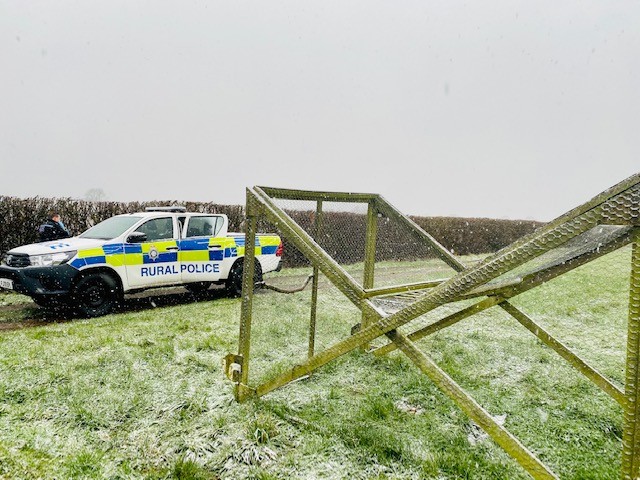
[Nottinghamshire Police visited the crime scene to collect evidence with the RSPB Investigations Team in January last year. Photo via Nottinghamshire Police Rural Crime Team]

His guilty plea means he has avoided a trial (and thus saved the court time) for which he’ll no doubt be rewarded when it comes to sentencing.

Sentencing has been deferred until later this month. I expect the full horror of his crimes, and his identity, to be publicised at that time. It’ll be interesting to see whether he has any ‘professional’ affiliations to any of the shooting organisations that claim to operate a ‘zero tolerance’ policy on raptor persecution.

A Raptor Forensic Fund, established in 2020 by Wild Justice to help provide financial support to police investigations into alleged raptor persecution crime, has played a part in this conviction.

This is the 4th gamekeeper to be convicted of wildlife crimes/raptor persecution since November 2021. The three others were gamekeeper Shane Leech (33) in Suffolk (here), gamekeeper Peter Givens (53) in the Scottish Borders (here) and gamekeeper Hilton Prest (58) in Cheshire (here).

Kudos to Nottinghamshire Police Rural Crime Team, the RSPB Investigations Team and the CPS for their hard work in securing this result. Excellent partnership working in action!

UPDATE 28th January 2022: Gamekeeper to be sentenced for beating to death two buzzards in a trap (here)

Trial due to start for gamekeeper accused of killing buzzards

The trial of a gamekeeper accused of killing buzzards is due to begin this week almost a year to the day of the alleged offences.

On 12th January 2021 Nottinghamshire Police, working in partnership with the RSPB Investigations Team, attended a location in the Kneeton area following reports of concern (see here). A gamekeeper was later arrested and charged with the alleged killing of buzzards (here).

[Police attending the scene of a crow cage trap in January 2021. Photo via Nottingham Police]

The gamekeeper appeared in court in August and entered a plea of not guilty (see here) so a trial date was set for January 2022.

The trial is due to begin on Thurs 6th January 2022.

This is the 4th gamekeeper to be brought before the courts since November 2021 – the three others were all convicted of various offences including gamekeeper Shane Leech (33) in Suffolk (here), gamekeeper Peter Givens (53) in the Scottish Borders (here) and gamekeeper Hilton Prest (58) in Cheshire (here).

Please note, as this is a live case no further detail will be provided here until the case has concluded or there is official commentary from the court reporter. Comments on this particular blog also won’t be accepted until the case concludes so as not to prejudice proceedings. Thanks for your understanding.

Three more satellite-tagged hen harriers go missing in suspicious circumstances

Three more satellite-tagged hen harriers have gone missing in suspicious circumstances, according to the most recent data published by Natural England just before Xmas.

One went missing in July 2021, one in August and one in September. Neither the police or Natural England have issued any media press releases or made any public appeals for information about any of them. Instead, the grouse-shooting industry was given free-rein to publish propaganda all summer and autumn about ‘how hen harriers are thriving in the English uplands’, without any of the regulatory authorities challenging this rhetoric with any vigour.

[A young hen harrier. Photographer unknown]

Periodically Natural England publishes a table showing the fates of hen harriers it has satellite-tagged. These updates are infrequent and typically occur two to three times a year. In the latest (December) update, the following three hen harriers are listed as ‘missing, fate unknown’:

Hen Harrier Asta (female), tagged on 10th July 2020 at ‘Northumberland 3’ site. The date of last contact is given as 24th July 2021 in the North Pennines. The site location is given as ‘Site confidential’.

Hen Harrier Josephine (female), tagged on 30th June 2021 at ‘Northumberland 2’ site. The date of last contact is given as 14th August 2021 in Northumberland. The site location is given as ‘Site confidential – ongoing’.

Hen Harrier R2-F-1-21 (female), a brood meddled chick tagged on 20th July 2021 from site location ‘BM R2 Cumbria’. The date of last contact is given as 24th September 2021 in Northumberland. No specific site information is given and the comments section states ‘searches ongoing’.

These disappearances were mentioned in a Natural England blog which was published at the same time as the December data update. The blog is attributed to Dave Slater, Director for Wildlife Licensing and Enforcement Cases at NE, although I don’t think he wrote it – it’s quite a different style when compared with his previous missives. Anyway, these three missing hen harriers are mentioned in the blog, although they’re not exactly given headline prominence – this paragraph appears towards the end of the blog:

You’ll also note that the tags on three of this year’s seven brood meddled hen harrier chicks have stopped transmitting. One of these (Hen Harrier R2-F-1-21) is one of the three ‘missing fate unknown’ harriers I mentioned at the top of this blog. The other two brood meddled chicks have been found dead and their corpses retrieved and sent for post mortem. Those two are:

Brood meddled male Hen Harrier R2-M2-21, tagged on 20th July 2021 from nest site ‘BM R2 Cumbria’. The date of last contact is given in NE’s data table as 27th October 2021 and the location is given as ‘Cumbria, site confidential, hen harrier roost site’. The notes section says, ‘Recovered dead 28th October 2021, awaiting PM results’.

Brood meddled male Hen Harrier R2-M3-21, tagged on 20th July 2021 from nest site ‘BM R2 Cumbria’. The date of last contact is given as 27th October 2021 and the location is given as ‘County Durham’. The notes section says, ‘Recovered dead 28th October 2021, awaiting PM results’.

These two dead brood-meddled hen harriers are also mentioned in Natural England’s blog as follows:

It seems strange that the post-mortem results were not yet available by the time the Natural England blog was published on 15th December, given that both corpses were retrieved some seven weeks earlier.

I was also surprised to see the statement, ‘The finding circumstances did not suggest that the birds were illegally killed‘. Yeah, I think the same was said about Bowland Betty, the hen harrier found dead on a grouse moor at Swinton Estate, where the cause of death was only revealed after a pioneering forensic examination by scientists at the University College London Institute of Orthopaedics and Musculoskeletal Science, which found a tiny fragment of lead at the site of a leg fracture, confirming that she had been shot (see this scientific peer reviewed paper published in the journal Veterinary Record in 2015: hopkins-et-al-2015_bowlandbetty_vetrecord and see here for a good laugh at the Countryside Alliance’s ‘expert’ opinion).

I might be wrong of course, but this latest statement from Natural England looks suspiciously like yet another damage-limitation exercise. I’ll be following up on those two mortem results.

In the meantime, it just leaves me to update the very long list of hen harriers that have been confirmed as illegally killed or suspected to have been killed since 2018, mostly on or close to driven grouse moors. A pattern of criminality that has been obvious to many of us for years – and has been demonstrated scientifically with Natural England’s own data – see here.

I’ll add the link here when I’ve written that blog.

UPDATE 2nd January 2022: 60 hen harriers confirmed illegally killed or ‘missing’ since 2018, most of them on or close to UK grouse moors (here)

Job vacancy: ‘Engagement Trainee’ (peregrine protection), Derbyshire Wildlife Trust

The Derbyshire Wildlife Trust (DWT) is pretty proactive when it comes to birds of prey, which is just as well given the appalling levels of raptor persecution in the county, not least those associated with the grouse moors of the Dark Peak area of the Peak District National Park (e.g. see here).

Enthusiastic supporters of, and contributors to, Hen Harrier Day, DWT also runs the Upland Skies Bird of Prey Project which is supported by funding from the National Lottery (here) and earlier this year DWT announced the recruitment of a member of staff dedicated to peregrine protection thanks to funding from the Government’s Green Recovery Challenge Fund (here).

Now the Trust is advertising a position for a part-time Engagement Trainee (£19,047 per annum) to work within the Wilder Communities Team to help deliver a programme of work to inspire people to take action for wildlife.

In this role, you’ll:

• Support the Derby City Peregrine Project.

• Work on a Peregrine protection project in Derbyshire.

• Raise awareness and education of raptor persecution.

To be successful you will:

• Be passionate about inspiring people to care and act for nature.

• Have great communication and engagement skills.

• Be able to work with partners to deliver a project.

Responsibilities

In this role, you’ll receive training and support to:

• Assist in the planning and delivery of DWT’s Wilder Engagement work, specifically to develop and deliver an awareness raising programme of Derbyshire’s peregrines and other birds of prey.

• Recruit and coordinate volunteers for watch points and monitoring of sites.

• Develop an excellent understanding of bird of prey persecution in the UK for further educational awareness to the public.

About you

This role might be right for you if:

• You would like to deliver activities that are engaging and informative.

• You’ve had some experience working with volunteers.

• You have a good understanding of ecology and the wildlife of the British Isles.

• You have strong organisational skills and enjoy managing changing priorities.

This role will be based at DWT’s office in Middleton but candidates will be expected to work at various locations around the county. A balance of home and on site working will be allowed.

Interviews are planned for Monday 31st January 2022.

This is a part-time position of 25 hours per week and will involve working regular Saturdays.

The successful applicant will be required to undergo an enhanced DBS check as this role involves working with people under 18 year old.

Closing date is 16 January 2022. Interviews are planned for Monday 31st January 2022.

To apply please click here

Natural England refuses to comment on whether hen harrier had its wings ripped off in horrific persecution incident

On 17th December 2021, I blogged about how Natural England (NE) had been keeping a terrible, terrible secret about the gruesome fate of one of its satellite-tagged hen harriers earlier this year (see here), preferring instead to sit back and watch its so-called ‘partners’ in the grouse-shooting industry claim false credit for ‘protecting’ this species.

I guess that’s what happens when NE accepts a £10K bung from grouse-shooting industry reps on condition that NE doesn’t publicly criticise them (see here). So much for NE being an independent regulator, eh?

In that pre-Xmas blog I asked NE to make a statement about this particular crime and I suggested they may like to include a comment about whether they thought the hen harrier’s wings had been ripped off while she was still alive, based on the evidence in NE’s possession.

You’ll note I was careful not to reveal any information in that blog that could potentially affect a police investigation, i.e. tag number, bird’s name, location of incident, habitat type, etc.

Natural England didn’t respond directly on the blog but instead published a comment on Twitter on 20th December in response to Chris Packham’s request for information:

This is a complete cop-out by Natural England.

Yes, there is indeed an on-going police investigation but it’s going nowhere, just like the other 57 police investigations into the illegal killing of hen harriers in the last three years (see here).

This particular investigation began over 9 months ago. Nobody has been interviewed, let alone arrested or charged, and the likelihood of a prosecution is precisely zero. That’s not necessarily the result of police ineptitude; as regular blog readers will be all too painfully aware, these crimes are notoriously difficult to prosecute given the remoteness of the location and the lack of witnesses, although in this case the police do have some explaining to do – details on that will be forthcoming in due course.

Saying nothing by hiding behind the excuse of a live police investigation is simply a convenient cover for Natural England not to have to admit that its hen harrier brood meddling trial is a conservation sham because hen harriers are still being brutalised by the industry with which NE has jumped in to bed.

There is absolutely no reason whatsoever why NE cannot make a statement about this latest horrific crime – it can easily be done without compromising the police investigation.

Instead, we got this from NE Chairman Tony Juniper on Xmas Eve:

I intend to write more about this latest persecution crime in the near future.

UPDATE 7th March 2022: Natural England still silent, apparently on police orders, about hen harrier whose wings were torn off (here)

UPDATE 25th August 2022: Hen harrier’s ‘wings removed’ & its satellite tag fitted to a crow in sick ploy to disguise the crime (here)

Hen harrier update – Natural England has been keeping a terrible, terrible secret

Natural England has been keeping a secret.

A terrible, terrible secret about one of its satellite-tagged hen harriers.

I’ve been waiting all year for Natural England to inform the public about what has happened.

I waited in the spring, but there was no news.

I looked at Natural England’s summer update on its satellite-tagged hen harriers, published in July, but Natural England said nothing was amiss with this bird.

I watched in August as the grouse-shooting industry paraded its hen harrier propaganda throughout the media, claiming that hen harriers were being worshipped by gamekeepers or something equally as implausible. Natural England said nothing to challenge that view, despite knowing the grisly fate of one of its tagged hen harriers.

I read an article in the Guardian a couple of weeks ago where gamekeepers were being ‘lauded’ as the hen harrier’s ‘friend’ by a straight-faced Natural England employee (Stephen Murphy), who also claimed that hen harrier Bowland Betty, who had been found dead with shotgun injuries on a grouse moor, had been shot away from the grouse moor, not on it – a statement for which he has absolutely no evidence whatsoever!

Now its December and two days ago Natural England published another update about its satellite-tagged hen harriers. Several more have apparently vanished this year, which is no surprise given we know that at least 57 have been killed/vanished in the last three years, but I’ll come back to an analysis of these latest victims in the New Year.

Right now I’m more interested in whether Natural England would say anything about the fate of this particular bird.

It hasn’t.

Sorry, but I am not prepared to sit and watch this pantomime any longer.

The authorities need to come clean and admit what has happened here. Cover-ups don’t instil confidence and besides the public has a right to know what is happening to these hen harriers, and especially to those that are fitted with public-funded tags.

Over to you, Natural England, and you might want to include a statement about whether you believe this harrier’s wings were pulled off, perhaps when she was still alive, based on the evidence you have.

UPDATE 29th December 2021: Natural England refuses to comment on whether hen harrier had its wings ripped off in horrific persecution incident (here).

UPDATE 7th March 2022: Natural England still silent, apparently on police orders, about hen harrier whose wings were torn off (here)

UPDATE 25th August 2022: Hen harrier’s ‘wings removed’ & its satellite tag fitted to a crow in sick ploy to disguise the crime (here)

Multi-agency raid following suspected raptor persecution in Humberside

Humberside Police led a multi-agency raid on 10th December 2021, executing a warrant in relation to suspected raptor persecution crimes after a number of dead buzzards were found with unusually high levels of rat poison.

The police were joined by staff from Natural England, National Wildlife Crime Unit and RSPB Investigation’s team.

The investigation is ongoing.

Photos from Humberside Police Rural Crime Team:

This is one of many multi-agency searches in the UK this year, all in response to raptor persecution crimes. On 18th January 2021 there was a raid in Suffolk (here), on 15th March there was a raid in Lincolnshire (see here), on 18th March a raid in Dorset (here), on 26th March a raid in Devon (see here), on 21st April a raid in Teesdale (here), on 2nd August a raid in Shropshire (here), on 12th August a raid in Herefordshire (here), on 14th September a raid in Norfolk (here), and a raid in Wales in October (here).

That’s a lot of raids in a relatively short space of time, in comparison to recent years. It’s testament to the agencies involved that they are being so proactive and working well together in a genuine multi-agency partnership, which is brilliant to see. It’s also testament to the fact that raptor persecution continues in many locations across the UK, despite what the game-shooting organisations would have us believe.

Whether these investigations result in prosecutions is another matter entirely (although we’ve already seen two successful convictions in recent weeks – here and here), but personally I’m delighted that at least this early part of the criminal justice process appears to have been re-energised after a long period of stagnation. Well done to all those involved.

Another gamekeeper convicted as another bird of prey starves to death in illegally-operated trap

A couple of weeks ago I blogged about the conviction of a 53-year-old gamekeeper in the Scottish Borders, Peter Givens, who was responsible for an illegally-operated trap in which a barn owl and a goshawk had starved to death (see here). I’ll be blogging more about that case shortly as some interesting things have come to light.

Fast forward two weeks and today another gamekeeper, 58-year-old Hilton Prest, has been convicted for an almost identical offence, this time causing a sparrowhawk to starve to death inside an illegally-operated trap in Bosley, Cheshire, in February this year.

[The dead sparrowhawk inside the crow cage trap. Photo by RSPB]

The RSPB has published a press release about this latest conviction, which I’ll reproduce below, and then I’ll add some commentary at the end.

RSPB press release, 16th December 2021:

Man fined after sparrowhawk starves to death in trap

An amateur gamekeeper has received an £800 fine after a sparrowhawk starved to death in a trap in Cheshire.

At Manchester Magistrates’ court today (16 December 2021), Hilton Prest pleaded guilty to unlawfully using a trap on or before 10/2/21 contrary to Sec 5(1)(b) of the Wildlife and Countryside Act. He was fined £800 (plus £85 costs and £80 victim surcharge). A charge against a second man was discontinued. 

On 10 February 2021, a member of the public found a sparrowhawk alive in a cage trap on land managed for gamebird shooting near Bosley. Cage traps are large mesh traps designed so a bird can get in but not out. They can be used legally, under license, to control crows, and must be checked every 25 hours. Any non-target birds caught accidentally must be released unharmed during daily inspections. When not in use the doors on such traps must be removed or secured open so birds cannot be caught.

There was snow on the ground and no shelter or water for the bird. The door to the trap was closed, so the member of the public opened it slightly, hoping the sparrowhawk would escape. Concerned for the bird’s welfare, they later provided the trap’s location to the RSPB.

[The juvenile sparrowhawk caught inside the trap during freezing weather in Feb 2021. Photo by RSPB]

RSPB Investigators attended the following day, 17 February, however they found the sparrowhawk (later confirmed as the same bird) dead inside the trap. There were also the remains of a blackbird, which had presumably attracted the sparrowhawk inside, and some grain, which had presumably attracted the blackbird. Despite the door being ajar, it appeared the sparrowhawk had been unable to escape and starved to death.

Cheshire Police were notified and the body of the bird sent for post-mortem examination. A veterinary pathologist confirmed the bird had died of starvation and would have experienced considerable unnecessary suffering inside the trap. (The veterinary work was funded by money from Wild Justice’s Raptor Forensic Fund, provided to support such cases, and administered by the PAW Forensic Working Group.) Two men were later interviewed by the police and reported for offences in relation to the unlawful use of the trap. 

District Judge Mr Jack McGarver said that he accepted that the act was careless rather than reckless or intentional, but that the degree of carelessness was high, and that it was well below the standard that was expected.

He added: “The sparrowhawk is a beautiful native creature which is entitled to be protected.”

Tom Grose, RSPB Investigations Officer, said: “An unattended set trap in sub-zero temperatures was a death sentence for both birds.

If a trap is no longer in operation, it must be disabled in such a way that no bird can become caught. The operator has a duty of care to ensure that this happens, and that no birds can become caught inside. This duty of care was not met.

This is yet another example of why Natural England must improve the general license conditions for disabling these traps, in line with conditions in Scotland. We are aware of a number of other birds, including buzzards and a goshawk, that have starved to death inside cage traps which appear not to have been properly disabled. In this case, a simple padlock securing the door wide open would have saved the life of this blackbird and this sparrowhawk. This needs to be addressed to ensure no more birds perish in this sad and wasteful way.”

If you find a wild bird of prey which you suspect has been illegally killed, or a trap with a bird of prey caught inside, phone the police on 101, email RSPB Investigations at crime@rspb.org.uk or fill in the online form: https://www.rspb.org.uk/our-work/our-positions-and-campaigns/positions/wildbirdslaw/reportform.aspx

ENDS

First of all, well done to the RSPB’s investigations team, working with Cheshire Police, to bring this case to court and secure a conviction.

The penalty given to gamekeeper Prest (£800 fine plus £85 costs and £80 victim surcharge) is higher than that given to gamekeeper Givens (£300 fine plus £20 victim surcharge) even though two Schedule 1 species had died as a result of Givens’ offence so once again sentencing consistency is lacking.

What’s really interesting though is the difference in the trapping rules between Scotland and England. In the Scottish case, it could be shown quite easily that Givens was operating an unlawful trap because (a) in Scotland the General Licence requires that the trap user be identified by a code attached to each trap (this is not a requirement in England because statutory agency Natural England hasn’t bothered to introduce it), and (b) in Scotland, when the trap is not in use the trap operator MUST do the following, as a condition of the General Licence:

Any trap not in use must be immobilised and rendered incapable of use. For multi-catch cage traps, the access doors must be removed from the site or securely padlocked open so that no bird can be confined‘.

This is a clear instruction – you either padlock the door open or you remove it completely if the trap is not in use. It’s unambiguous.

However, the equivalent General Licence condition in England is nowhere near as clear cut and can lead to all sorts of ‘accidents’ and excuses.

In England, the General Licence condition says this:

When you are not using a trap, it must not be capable of holding or catching animals.

You must secure trap doors in a fully open position, or remove the doors completely from the site‘.

Then there’s an add-on bit of ‘advice’ underneath, that says:

Padlocks are the most secure way to secure trap doors open, but cable ties or wire may also be suitable‘.

Crucially, this ‘advice’ is not legally binding, so a trap operator in England could legally use a rock or a piece of baler twine to ‘secure trap doors in a fully open position’ but both these techniques, and others, are not bomb proof and a door could ‘accidentally’ close, preventing a trapped bird from a means of escape. Padlocking the door or removing the door completely provides a trapped bird with a route to escape.

Quite why Natural England hasn’t incorporated this very simple but effective condition into its General Licence is a matter of bemusement for many of us. It’s really not that difficult, is it?

And if game-shooting organisations were as interested in protecting birds of prey as they claim to be, they’d be pushing for this very simple measure, too.

Police appeal following theft of adult barn owl & five chicks in South Tyneside

Northumbria Police posted the following appeal for information on their Facebook page on 9th December 2021:

#APPEAL:

We want to identify these two men after a protected wild barn owl and its nestlings were stolen by thieves. An investigation has been ongoing since the early hours of October 27 after it was reported two men had been seen trespassing at farm off Follingsby Lane, West Boldon. It was reported that the offenders stole an adult barn owl and five chicks from their habitat before making off. We have been carrying out a range of enquiries into the theft, which has caused significant upset. All those targeted are wild birds who are protected by law. Now, as part of our investigation, we have released the images of two men who we would like to identify. They were seen in the area at the time of the offence and could have valuable information that could assist with the investigation.

The men, or anyone who recognises them, can contact us via the ‘Tell Us Something’ page of our website or by calling 101 quoting log NP-20211027-0182.

Alternatively, you can email 3070@northumbria.police.uk.

ENDS

Shot red kite successfully rehabilitated and released in Essex

Last month I blogged about a red kite that had been found injured with shotgun injuries in Galleywood Lane, Chelmsford, Essex (see here and here).

The kite was picked up by concerned members of the public and taken to the South Essex Wildlife Hospital for treatment.

[Photo of the kite by South Essex Wildlife Hospital]

After four weeks of expert care and rehabilitation, this red kite was released back to the wild last week. Well done to all the team at South Essex Wildlife Hospital.

Essex Police are still investigating the circumstances of this illegal shooting and if anyone has any information please contact Wildlife Crime Officer PC Jed Raven on Tel 101 and quote reference number 42/265786/21.

Please note, this police investigation is one of two separate incidents concerning dead red kites. The other one relates to the discovery of a dead red kite that had been found in suspicious circumstances in the Uttlesford area of Essex earlier in November (here).