sea eagles have ‘minimum impact’ on lamb survival – new research findings

Take note, crofters and farmers – the results of the SNH-funded study to examine the effects of white-tailed sea eagles on lamb survival have just been published – less than 2% of lamb deaths in Gairloch, Wester Ross, were directly linked to the sea eagles.

The study was undertaken last year, in response to crofters’ claims that sea eagles ate 200 lambs at Gairloch. The crofters should have gone to Specsavers, and saved the taxpayer over £100,000.

The politicians considering the crofters’ latest petition to remove the legal protection of sea eagles and golden eagles so that crofters can kill them, had also better take note.

Download the full report here: B603609_WTElambstudyGairloch_2010

BBC news story here: http://news.bbc.co.uk/1/hi/scotland/highlands_and_islands/8672303.stm

crofter petition asks for licences to kill sea eagles & golden eagles

A crofter from Glenelg  has submitted a petition to the government to ask for the removal of legal protection for sea eagles (and other predators, including golden eagles, and inexplicably, badgers) so that he and his fellow crofters may kill them. The petition (#1309) was submitted in February 2010 by crofter Farquhar Macbeath.

The petition comes after SNH sponsored a research study in 2009 about the effects of sea eagle predation on lambs at Gairloch, Wester Ross. Local crofters and farmers had claimed that sea eagles at Gairloch were eating over 200 lambs a year. The subsequent research demonstrated that they weren’t (no surprise there then!). After the study was completed, the Gairloch farmers claimed the research was “flawed”, because the sea eagles were “put off” taking the lambs by the big plastic tags attached to them as part of the research study. (There’s your solution then, farmers – in future, just attach plastic tags to your lambs!!). Here is the link to that story: http://thescotsman.scotsman.com/birdsofprey/Sea-eagles-39not-taking-lambs.5788299.jp

Farquhar Macbeath’s petition was heard by Holyrood’s Public Petitions Committee on 20 April 2010. It really is worth a read – it includes his and his family’s sightings of pumas and he refers to eagles as ‘vermin’ and ‘vultures’ – hideously out-dated and uneducated views but then Farquhar is 85 years old, bless him.

You can also watch the discussion surrounding this petition on Holyrood TV by clicking here: http://www.holyrood.tv/library.asp?iPid=3&section=43&title=Public+Petitions Scroll to the petitions heard on 20/4/2010. The video is 4 hours long, but you can fast forward to this particular petition at 2.17hrs – 2.38hrs. It is worth watching!

In response to the petition, the Committee agreed to write to the Scottish Government, SNH, National Union of Farmers Scotland, Scottish Gamekeepers Association, Scottish Wildlife Trust, SSPCA and RSPB to ask for their views. No prizes for guessing what those will be.

Click here to read Farquhar’s amazing petition: PE1309

msps told illegal killing is threatening raptor populations in Scotland

Yesterday, Holyrood’s Public Petitions Committee was told that the illegal killing of raptors on Scottish sporting estates is jeopardising raptor populations. The Committee was hearing the details of the RSPB petition, signed by over 220,000 people in the UK (including nearly 22,000 people in Scotland) and submitted to the government in March 2010. The petition (#PE1315) calls for an increase in government efforts to clamp down on illegal raptor persecution.

You can watch the proceedings on ‘Holyrood TV’ – the first 43 minutes of the video concern the raptor discussion: http://www.holyrood.tv/library.asp?iPid=3&section=43&title=Public+Petitions Look for the category 4/5/2010.

The MSPs agreed to pursue the petition by writing to the government, police chiefs and landowners’ groups. Whilst this may appear to be a step in the right direction, the status quo remains. We already know what the responses will be:

The government will trot out the same old lines about how determined they are to stamp out raptor persecution and will point towards their involvement with PAW to demonstrate their concern. The police will say they are working hard to catch the perpetrators and cannot discuss on-going cases. The landowners’ groups will say that the persecution will only stop if they are given licences to kill predators legally. Yaddah yaddah yaddah. You only have to read this blog to know that persecution continues relentlessly, the police are ineffective and PAW hasn’t acheived anything of significance since it was established.

The key question is – what ACTION will be taken to stop raptor persecution on Scottish sporting estates?

Click here to read the details of the petition: PE1315

Click here for the news story: http://www.pressandjournal.co.uk/Article.aspx/1721155?UserKey=

spate of recent poisonings kills eagles, kites, buzzards & peregrine

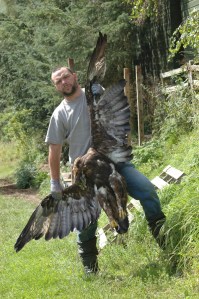
One of the dead white-tailed sea eagles undergoing post mortem

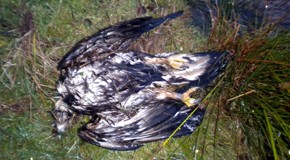
A disgraceful spate of recent poisonings in Ireland has resulted in the death of 2 white-tailed sea eagles, 1 golden eagle, 3 red kites, 3 buzzards and a peregrine.

The sea eagles were poisoned by the illegal pesticide carbofuran. The golden eagle, kites, buzzards and peregrine were killed by alphachloralose, a pesticide still manufactured and legally available in Ireland.

Police investigations are underway.

For the full sorry story: http://www.goldeneagle.ie/news_viewnews.php?x=6&z=132&news_id=11&article=267

estate owner gets apology after being called an “arrogant old bastard” by wildlife crime officer

The Police Complaints Commissioner for Scotland, John McNeill, has told Tayside Police that they must deliver an ‘unreserved apology’ for derogatory comments made about an estate owner during an alleged wildlife crime incident.

The investigation centred around allegations from two former gamekeepers that their employer had instructed them to kill any buzzards that were caught in crow traps on the estate. During the investigation, the estate owner became aware that Tayside Police’s civilian wildlife crime officer had referred to the estate owner as an “arrogant old bastard”. The estate owner made a formal complaint to the Police Complaints Commissioner, and also complained about his arrest, which he said caused “unneccesary distress” to his family.

Alan Stewart

The civilian wildlife crime officer in question might be Alan Stewart, a high-profile former police inspector who has been investigating wildlife crime in Tayside for a number of years and is the only one listed on the Tayside Police website: http://www.tayside.police.uk/wildlife/officers.php

To read the Police Complaints Commissioner’s report in full: PCCS_-_1004-2010-00491-PF-TP_-_Final_report

Of course, while all this name-calling and crying to the police has been going on, the real issue of importance (the alleged illegal killing of buzzards on this estate) has been conveniently buried.

This is not the first time that Tayside Police’s effectiveness has been called into question. Earlier in 2010, the RSPB launched a stinging attack on Tayside Police for its apparent ‘lack of follow up’ on several alleged wildlife crimes in the region. The most prominent of these was the incident involving a poisoned white-tailed sea eagle that had been found dead on Glenogil Estate in August 2009. Tayside Police did not make an appeal for information until 6 months later, and only then because a local newspaper began to ask questions: http://news.scotsman.com/birdsofprey/RSPB-claims-police–less.6012566.jp

police investigation underway as six buzzards found poisoned

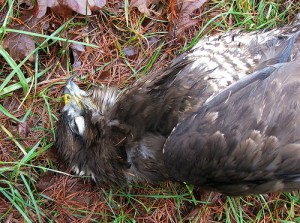
Derbyshire dead buzzards 2010A police investigation is underway in Derbyshire after the recent discovery of six dead buzzards. All had been poisoned.

On February 22nd 2010, two dead buzzards were found in Jebbs Lane, Idridgehay, near Ashbourne. Tests showed they had been poisoned.

On April 7th 2010, a farmer discovered 4 dead buzzards to the north of Kirk Ireton, near Ashbourne – just a few miles north of the Idridgehay poisonings.  The 4 dead buzzards were found next to the body of a dead pheasant and tests showed that the pheasant had been used as a poisoned bait.

Full story: http://news.bbc.co.uk/1/hi/england/derbyshire/8634955.stm

another gamekeeper convicted of illegal poisoning

26 year-old Ben Walker, a gamekeeper on the Sufton Estate, Herefordshire, has been convicted of 17 (yes, 17) charges relating to killing protected species with poisonous baits.

After a tip off, an undercover team from the RSPB spent several weeks in October and November 2009 making covert surveillance videos of Walker tending to his illegal baits on the Estate. He killed two buzzards and five ravens and told police he did it because they were a ‘threat’ to the birds he was rearing for a commercial shoot.

Walker received a £1,000 fine at Hereford Magistrates Court on 21 April 2010.  Once again, a judge has not imposed a custodial sentence, even though this option is available for these types of wildlife crime.

Well done to the Sufton Estate though, who sacked Walker for these offences. A second former employee is currently under investigation for wildlife crimes on this Estate.

Full story: http://news.bbc.co.uk/1/hi/england/hereford/worcs/8635231.stm

scotland’s red kites under threat from illegal killing

The red kite population in Scotland is under severe threat from illegal poisoning a new RSPB study has revealed.

An equal number of red kites were released in the Chiltern Hills in southern England and in The Black Isle near Inverness as part of a reintroduction project which began in 1989

The birds in the Chiltern Hills have flourished and numbers of breeding pairs had reached 320 pairs by 2006. In stark contrast the Black Isle birds have struggled to establish a viable breeding population and had only reached 46 pairs over the same period. Both populations of red kites have been closely monitored and productivity from successful nests in both studies were found to be similar and amongst the highest in Europe.

Red kites are mainly scavengers and their diet of carrion makes them extremely vulnerable to illegal poisoning. Although they pose absolutely no threat to game shooting interests they are all too often killed by gamekeepers illegally targeting other species.

Between 1989 and 2009, 64 red kites have been found poisoned in Scotland. Naturally considering the remote locations where these birds live, only a small proportion of poisoned birds will ever have been found.

Scottish Environment Minister Roseanna Cunningham said,

“Poisoning is an arbitrary method of killing which poses serious risks to other wildlife, and potentially people, in our countryside.

“The protection of Scotland’s wildlife has never before occupied such a prominent position politically or in terms of the law. I hope that our continued joint action to tackle raptor persecution across Scotland will reduce this threat to red kites.”

With sentences such as we have recently seen in the Redmyre Estate case, where gamekeeper Graham Barclay Kerr was fined a derisory £400 for shooting a buzzard with a high velocity rifle and admonished for possession of illegal and deadly poisons I don’t think Roseanna’s words will have the perpetrators of these crimes quaking in their plus fours.

Full story. http://news.bbc.co.uk/1/hi/scotland/highlands_and_islands/8629284.stm

Roseanna Cunningham claims government is committed to tackling wildlife crime

Labour MSP Elaine Murray asked the Scottish government on 25 March 2010 what action it is taking to tackle wildlife crime.

Roseanna Cunningham, Scottish Environment Minister, claimed the government was committed to tackling wildlife crime and used four examples to support her assertion:

1. Strengthening and re-structuring the Partnership for Wildlife Crime (PAW) to improve its effectiveness. [Presumably this ‘strengthening’  includes supporting the words of Sheriff Kevin Drummond, Paw Chair, who recently told a wildlife crime investigator to “Get a life” after he dared to suggest that sentencing for wildlife crime was too lenient].

2. Establishing a fund aimed at supporting innovations in combating wildlife crime. [This is good – is there a report available to show what innovations have been funded?].

3. Taking action to reduce the single farm payments made to five claimants in cases connected with poisoned birds. [Excellent. Is there a report available to show which five claimants have had their subsidies withdrawn? We are only aware of two –

  • James McDougal (Blythe Farm near Lauder, Scottish Borders) who had £7,919 withdrawn in January 2008 after his gamekeeper, George Aitken, was convicted of wildlife crimes – see blog entry 6 March 2010.
  • John Dodd (Glenogil Estate, Angus) who had £107,000 withdrawn in September 2008 after poisoned baits were found strewn across his estate. Dodd is apparently contesting this decision – see blog entry 3 March 2010.

So who are the other three claimants who have had their subsidies withdrawn? The two we know of happened in 2008, during the tenure of the previous Environment Minister, Michael Russell. How many withdrawals happened in 2009 when Roseanna Cunningham took office?]

4. The recent appointment of a special lawyer to act as Crown Council for Wildlife Crime. [Excellent – we look forward to seeing an increase of successful prosecutions in the very near future].

Full report: http://www.theyworkforyou.com/spwrans/?id=2010-03-25.S3O-9994.h

Call to control poison in Ireland after more red kite deaths

Another poisoned red kite

Pressure to control the poison Alphachloralose, available over the counter in Ireland, is intensifying following the poisoning of two more red kites in County Wicklow. The young birds were part of an Irish reintroduction project and had only been released in July 2009.

Alphachloralose has been used to kill red kites, golden eagles and white-tailed eagles across Ireland in recent years. The Golden Eagle Trust, a local NGO attempting to re-introduce all three species back to ireland, have lodged a formal complaint with the European Commission over the State’s failure to protect the birds.

Full story: http://www.irishtimes.com/newspaper/ireland/2010/0329/1224267276974.html

Golden Eagle Trust website: http://www.goldeneagle.ie/