Questions for the Environment Minister

Following yesterday’s announcement by Environment Minister Paul Wheelhouse on his proposed further measures to tackle the illegal persecution of Scottish raptors (here), we’d like to follow up by asking him for some clarifications on the latest measures, and for some updates on previously-promised measures. If you want to cut and paste these questions and send them yourself, or adapt them in your own letter, or simply cut and paste this blog’s URL to your own letter, please feel free. His email address appears at the foot of this page.

Question 1.

Please can you clarify whether the Lord Advocate has instructed COPFS to accept covert video footage as admissible evidence in prosecutions for alleged raptor persecution incidents?

Question 2.

Please can you clarify the timescale for SNH’s review for introducing potential restrictions on the use of General Licences in areas where they have good reason to believe crimes against wild birds have been committed? In other words, when can we expect the review to be completed? Also, will their review be made publicly available?

Question 3.

Please can you advise whether there will be a prosecution under the new vicarious liability legislation following the recent conviction of gamekeeper Peter Bell, found guilty of poisoning offences on the Glasserton and Physgill Estates (here)? If you don’t know the answer (which would be surprising, given that you said in March 2013 that you would be “keeping an eye on this particular area [i.e. vicarious liability] with interest“, see here), please can you provide the contact details of someone who can answer the question?

Question 4.

Please can you tell us the status of the Scottish Government’s first annual report (2012) into wildlife crime? As you know, under the Wildlife and Natural Environment (Scotland) Act 2011, there is a now a requirement (under section 26B) that ‘Scottish Ministers must, after the end of each calendar year, lay before the Scottish Parliament a report on offences relating to wildlife’ (see here for copy of the WANE Act 2011). You mentioned in March 2013 that your policy officials ‘are currently working on’ this report (see here). When can we expect this report to be available?

Question 5.

Please can you tell us when, exactly, will you open the consultation regarding the increase of SSPCA powers to broaden the range of their work  investigating wildlife crime? As you know, this consultation was first suggested by former MSP Peter Peacock as an amendment during the WANE Act debates, way back in February 2011. The then Environment Minister Roseanna Cunningham rejected it as an amendment but suggested a consultation was in order (see here). Seven months later in September 2011, MSP Elaine Murray lodged a motion that further powers for the SSPCA should be considered (see here). In November 2011, Elaine Murray MSP formalised the question in a P&Q session and the next Environment Minister, Stewart Stevenson, then promised that the consultation would happen in the first half of 2012 (see here). Nothing happened so in September 2012 we asked you, as the new Environment Minister, when the consultation would take place (see here). In response to one of our blog readers in October 2012 your policy officer said: “The consultation has been delayed by resource pressures but will be brought forward in the near future“. Nine months later and we’re in July 2013 – almost 2.5 years after Scottish Ministers committed to undertaking the consultation. Where is it?

Email: ministerforenvironment@scotland.gsi.gov.uk

Environment Minister announces ‘further measures’ to tackle raptor persecution

The Environment Minister Paul Wheelhouse has today announced what he calls ‘further measures’ to tackle the on-going problem of illegal raptor persecution in Scotland. Here is his statement in full:

Since I took on responsibility for this portfolio, I have been clear that one of my priorities is to bear down on the illegal persecution of raptors that continues to blight the Scottish countryside and tarnish Scotland’s reputation.  These outdated, barbaric and criminal practices put at risk the conservation status of some of our most magnificent wildlife.  They also harm our reputation as a country which values its environment and wildlife and undermine the growing tourism sector that is built on that reputation.

We have achieved much since 2007. We have a robust legal framework that protects birds of prey and their nests, including the new vicarious liability provisions.  We have dedicated resources in Police Scotland and the Crown Office and Procurator Fiscal Service (COPFS).  We are leading the way in the UK in the development of wildlife crime forensics work, and we continue to work at building a broad-based alliance through the Partnership for Action Against Wildlife Crime (PAW Scotland).  

In 2012 we saw a very welcome reduction in poisoning cases.  However a number of recent reports, some of which are in the public domain and some of which are still subject to police enquiries, suggest that there is still a problem with the use of poison as well as cases involving illegal trapping and shooting.  I have decided therefore that the time is right to bring forward some further measures which I hope will deter those involved in illegal activities. 

Wildlife crime, and raptor persecution in particular, often takes place in remote locations or in the dark of night.  By its very surreptitious nature, the likelihood of being seen by a member of the public who can report the matter to the authorities is small.

I have spoken with the Lord Advocate, who maintains a close personal interest in all wildlife crime.  We are both keen to maximise the opportunity for offences to be detected and offenders to be tracked down.

The Lord Advocate has instructed the specialist prosecutors in the Wildlife and Environmental Crime Unit to work with Police Scotland to ensure that law enforcement utilises all investigative tools at their disposal in the fight against wildlife crime.

This work will take place within the National Wildlife Crime Co-Ordinating Forum – a group attended by police Wildlife Crime Liaison Officers from across Scotland and the police’s full-time Scottish Wildlife Crime Co-Ordinator, as well as senior police officers, the National Wildlife Crime Unit, Scottish Government officials and the specialist prosecutors from the Wildlife and Environment Crime Unit within COPFS.

Secondly, in my capacity as Chair of PAW Scotland, I intend to establish a group to carry out a review and report to me on how wildlife crime is treated within the criminal justice system, including examining whether the penalties available for wildlife crime properly reflect the seriousness of the damage caused to vulnerable wildlife and fragile habitats and ecosystems.  

Thirdly, I will be asking Scottish Natural Heritage in their capacity as the authority for licensing decisions under section 16 of the Wildlife and Countryside Act to examine how and in what circumstances they can restrict the use of General Licences to trap and shoot wild birds on land where they have good reason to believe that crimes against wild birds have taken place.  These General Licences allow the holders to carry out actions that would otherwise be unlawful if undertaken, without any reference to SNH.  We regard the use of General Licences as a privilege that should not be extended in circumstances where there is evidence that their use may be facilitating illegal activities. 

In putting together these measures I have sought to focus only on those individuals and businesses where there are very good reasons to believe they are involved in illegal practices.  I am very keen to avoid anything that places an unfair burden on the majority of shooting businesses that are law-abiding and responsible members of the rural community.  I should also say that I think it is important that wildlife crime is treated in exactly the same way as other types of crime. This means information about cases should be handled in the same way as in other types of crime and that the police and prosecutors are allowed the time and space to carry out whatever investigations they believe to be necessary according to their own professional judgement. We should not descend into allowing trial by leak and accusation. There is a responsibility on us all to avoid that. 

In conclusion I wish to reiterate that eradicating raptor persecution in Scotland remains a high priority for the Scottish Government.  It is not however the sole responsibility of the Scottish Government.  Law enforcement clearly has a key role to play and I am confident that we are ratcheting up the pressure on those committing acts of illegal persecution. However,  everyone involved in the Scottish countryside, and in particular those involved with shooting, should make abundantly clear their disapproval to the minority whose actions are tarnishing the reputation of Scotland’s country sports”.

So, this is the much anticipated ‘action’ against illegal raptor persecution that’s been promised since last autumn when Paul Wheelhouse was appointed. Whilst we welcome his willingness to engage with the issue (in stark comparison to his English counterpart who won’t even admit there’s a problem), we see these latest measures as tiny baby steps in the right direction, and not the decisive hefty stamp that could have been delivered.

The first four paragraphs of his statement are just introductory comments with the usual rhetoric, such as, “We have achieved much since 2007”. Actually, we haven’t. Raptors are still being illegally killed on land managed for game-shooting and more often than not the criminal(s) involved are not being prosecuted. In the few instances where they are prosecuted, there is evidence of extensive plea-bargaining resulting in convictions only for the minor offences, not for the major crimes.

In 2012 we saw a very welcome reduction in poisoning cases. No, we didn’t. What we saw was a reduction in the number of reported poisoning cases; that’s a very important distinction. Members of the game-shooting industry (and government, it seems) have made much of this claim, using it as an example of how the industry is cleaning up its act. They won’t be able to make the claim for much longer – we understand that there have been several poisoning incidents already in 2013 and we’re only half-way through the year. Naturally, once again the public haven’t (yet) been informed about these poisonings even though they took place several months ago. We’ll come back to this issue.

The first ‘new’ measure that Wheelhouse is introducing is this:“The Lord Advocate has instructed the specialist prosecutors in the Wildlife and Environmental Crime Unit to work with Police Scotland to ensure that law enforcement utilises all investigative tools at their disposal in the fight against wildlife crime.

This is interesting, particularly because it immediately follows this paragraph:

Wildlife crime, and raptor persecution in particular, often takes place in remote locations or in the dark of night.  By its very surreptitious nature, the likelihood of being seen by a member of the public who can report the matter to the authorities is small.

Does this mean that prosecutors in Scotland are being told by the Lord Advocate that they should now accept covert video surveillance as admissible evidence? If this is the case then it would be a very welcome step indeed. Covert film footage is routinely accepted as admissible evidence in England, but in Scotland it continues to be blocked by the Crown Office prosecutors. Why? We don’t know – we’ve never heard a satisfactory explanation. If our assumption is correct (and of course it may not be) and covert footage is to be accepted, then Wheelhouse deserves a good deal of credit for this single measure. We’ll be watching this potential development with great interest.

His second measure is to establish (yet another) group within the framework of PAW Scotland, “to carry out a review and report to me on how wildlife crime is treated within the criminal justice system, including examining whether the penalties available for wildlife crime properly reflect the seriousness of the damage caused to vulnerable wildlife and fragile habitats and ecosystemsWe’re not so impressed with this plan; it seems to be reinventing the wheel. A similar review was carried out in 2008 (Natural Justice 2008) following the poisoning of the last remaining breeding female golden eagle in the Scottish Borders in 2007. That review made many recommendations to improve the efficiency of detecting and prosecuting wildlife crime in Scotland, some of which have since been implemented but many have not. It would perhaps have been a good opportunity for Wheelhouse to critically evaluate the implementation of those recommendations made five years ago, rather than start off the process again from scratch, which just leads to further delays in addressing the actual problem.

The third and final new measure is what we would call a fig-leaf approach to tackling illegal raptor persecution. Wheelhouse says: “I will be asking Scottish Natural Heritage in their capacity as the authority for licensing decisions under section 16 of the Wildlife and Countryside Act to examine how and in what circumstances they can restrict the use of General Licences to trap and shoot wild birds on land where they have good reason to believe that crimes against wild birds have taken place.  These General Licences allow the holders to carry out actions that would otherwise be unlawful if undertaken, without any reference to SNH.  We regard the use of General Licences as a privilege that should not be extended in circumstances where there is evidence that their use may be facilitating illegal activities

At a superficial level, a restriction on the use of the General Licence sounds like a positive action. But let’s just think about the practicalities. First of all, Wheelhouse suggests that the General Licence may be restricted where SNH have “good reason to believe that crimes against wild birds have taken place”. That sounds like SNH would require a lower burden of proof to show that crimes against wild birds have taken place than say, for example, a criminal conviction. In real terms, how would that work? What would constitute ‘good reason’? The discovery of a poisoned or shot bird on a particular piece of land? In legal terms that’s not enough evidence for a conviction because the estate in question could legitimately argue (no matter how implausible) that the dead bird had been planted by someone with a grudge against them, or that the bird had been poisoned/shot elsewhere and just happened to fly on to their estate where it finally succumbed to its injuries. We can be certain that if SNH tried to use such evidence as giving them ‘good reason to believe that crimes against wild birds have taken place’ they would face a strong legal challenge by the estate’s lawyers. So then we’re back to the current situation whereby a conviction in a court of law is the only acceptable proof that the crime was committed by someone associated with the estate where the dead bird was found and those convictions are, as we all know, almost as rare as rocking horse shit.

But even if SNH could use a lower burden of proof as reason to believe a crime had been committed, there would still be difficulties. The use of General Licences is barely monitored or enforced due to the high volume of people operating under their terms. By their very nature, a General Licence is not actually issued to an individual – you don’t have to apply to use one and there isn’t even a competency test that you must first pass – it’s an open ‘licence’ that anyone can use to carry out what would otherwise be unlawful activities, such as the killing of so-called ‘pest species’ such as crows. We occasionally see a prosecution for an offence relating to a General Licence, e.g. when the operator of a crow cage trap has failed to meet the licence’s terms and conditions, but these prosecutions are rare and incidental. No statutory authority is regularly monitoring the use of General Licences (e.g. SNH don’t do it, the police don’t do it)  – we don’t even know how many people are operating under the General Licences because the operators are not required to submit annual returns. So, if SNH did ‘restrict the use’ of a General Licence on a particular piece of land, who would be enforcing that restriction? How would we know whether a restriction was in place? Would the location and name of the estate be published? For how long would the restriction be in place? What would be the penalty if an estate was found to be flouting the restriction?

All in all, this proposed new measure has glaring loopholes that in practical terms would be very difficult to close. It’s hugely disappointing that the Minister has taken this route instead of another option that is already available to him in the provisions of the Wildlife & Countryside Act – that is, the ability to enforce a (temporary) ‘closed season’ on the hunting of a particular game bird species in a particular area (or in this case, a specific estate). For example, in exceptional circumstances a Minister can impose a temporary moratorium on shooting specific species during periods of prolonged severe weather. The authority to impose such restrictions is already there in the legislation – it wouldn’t require the lengthy drafting of new legislation – if he wanted to enforce a temporary ban on, say, driven grouse shooting on a particular moor, he could do so. This measure would fit with his approach of only targeting the criminals, not the ‘law-abiding majority’ (his words, not ours) so why isn’t he pursuing it? Just another missed opportunity.

One final point about the Minister’s statement – the bit in his penultimate paragraph where he says this:

I should also say that I think it is important that wildlife crime is treated in exactly the same way as other types of crime. This means information about cases should be handled in the same way as in other types of crime and that the police and prosecutors are allowed the time and space to carry out whatever investigations they believe to be necessary according to their own professional judgement. We should not descend into allowing trial by leak and accusation. There is a responsibility on us all to avoid that

We whole-heartedly agree that wildlife crime should be treated in exactly the same way as other types of crime. This means that these crimes should be properly publicised in the media, just as other crimes are, and especially when they involve the discovery of potentially-fatal poisons that put the general public at significant risk. We hold very strong opinions on this and are adamant that it is not in the public interest for the police to keep these crimes hidden from view for months on end. Until we see an end to this ridiculous culture of silence we’ll continue to blog about these crimes with a measured, accurate and responsible approach.

We’ll be blogging later this week with some specific questions for Paul Wheelhouse….

Scottish Land & Estate’s response to the announcement here.

RSPB Scotland’s response here.

Scottish Gamekeepers’ Association response here.

BASC Scotland’s response here.

Even more delay in case against Morvich Estate gamekeepers

The case against three gamekeepers who are accused of committing alleged wildlife crimes on the Morvich Estate at Rogart, Sutherland in February 2012 has been adjourned for a 5th hearing.

The case against Mathew Ian Johnston, Jamie Robert Neal and William Robert Docharty was first called at Dornoch Sheriff Court on 27th November 2012 (see here), where a trial date was set for 19th March 2013, with an intermediate diet on 18th February 2013.

However, at the hearing on 18th February 2013 (here), a further hearing was set for 13th May and a possible trial date set for 9th July, pending the outcome of the hearing in May.

At the hearing on 13th May 2013 (see here), the defence asked for another adjournment to allow more time for preparation. The next hearing date was set for 25th June 2013.

At the hearing yesterday (25th June 2013)…guess what? Another hearing was set for 8th July 2013.

Another sat-tagged golden eagle ‘disappears’ in Aberdeenshire

Well would you believe it. Another young satellite-tagged golden eagle has mysteriously ‘disappeared’.

This time it’s a two-year-old bird called ‘Angus 33’, being sat-tracked by Roy Dennis (see here). The bird’s last known signal came from the North Glenbuchat Estate on 13th May 2013. A search was undertaken but nothing was found.

Naturally, there’s no evidence to demonstrate the eagle has been illegally killed, it’s just vanished into thin air in the same area that several other sat-tagged golden eagles have ‘disappeared’ in recent years. What a bloody mystery, eh?

Further mysteries from here include who used Carbofuran to poison a young golden eagle found in March 2011 (here), who used Carbofuran to poison a buzzard found in May 2011 (here, p.9) and who shot the short-eared owl that was found stuffed under a rock in May 2011 (here, p.6 & p.14)?

The Headkeeper of this estate was convicted of poisoning offences in 2006 (see here).

Cryptic press release issued after red kite dies of ‘unnatural causes’

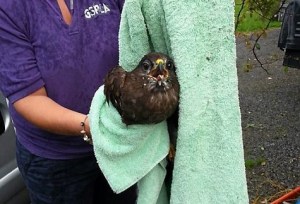
A dead red kiteA press release has gone out this morning appealing for information after a dead red kite was discovered on Royal Deeside. According to the information released (see here), the bird was found in an area of woodland near Aboyne on 6th April 2013. The wing-tagged bird was known to be a three-year-old breeding female, originally from Perthshire, who had successfully raised three offspring in 2012 close to the area where subsequently she was killed.

Bizarrely, the press release does not explain how the kite was killed. Instead it has the following cryptic statement:

After recovery of the carcass, a post mortem was carried out. This revealed that the bird’s death was not by natural causes”.

So what does that mean then? Was she poisoned? Caught in a leg-hold trap? Shot? Caught in a crow trap and clubbed to death?

We’ve seen this sort of press release before, notably in 2010 when the police force formerly known as Northern Constabulary put out an appeal for information after an osprey died from what was described as ‘deliberately inflicted injuries’ (see here). A few days later it was confirmed that the osprey had been shot (see here).

If this kite’s death was the result of a crime, which we presume it was given that she died of ‘unnatural causes’ and the police are appealing for information, then why the hell aren’t we just told straight? What’s the point of dressing it up to make it sound less serious than it is?

And why, yet again, has there been such a long delay between the discovery of the dead bird and the appeal for information? The bird was found on 6th April – the weekend after the Easter bank holiday – that’s over two and a half months ago. Sure, the police will want to conduct their initial investigations and so there may be an understandable delay of a couple of weeks, but there’s absolutely no operational excuse for a delay of nearly three months before it’s made public.

So here we have yet another example of an illegally-persecuted raptor – yet more evidence that the wildlife criminals are continuing to defy the law, safe in the knowledge that they’re virtually untouchable. Where are the promised ‘new measures’ to tackle raptor persecution from our Environment Minister, Paul Wheelhouse? We expected a statement from him this week but so far, nothing. The Scottish parliamentary recess begins next week (29th June until 1st September) – will we hear from him before then? Email: ministerforenvironment@scotland.gsi.gov.uk

Some background info about Scottish red kites:

Following their extinction as a breeding bird in Scotland in 1917, a joint RSPB Scotland and Scottish Natural Heritage project was undertaken with the aim of restoring the species to its former range.

Kites were released in four areas of Scotland:

In 1989-1994, 93 birds on the Black Isle;

In 1996-2001, 103 birds in Stirlingshire/Perthshire;

In 2001-05, 104 birds in Dumfries & Galloway;

In 2007-09, 101 birds in Aberdeenshire.

In 2012, there were 214 breeding pairs of red kites in Scotland.

From 1989-2011, a minimum of 75 red kites fell victim to illegal poisoning, with a further seven the victims of illegal shooting, trapping or nest destruction.

UPDATE 13.30hr: It’s been confirmed that this red kite had been shot. Why the bloody hell didn’t they just say that to begin with?

Hand in of buzzard petition today at Holyrood

In the space of a couple of weeks in May, a petition calling for the Scottish Government not to cull buzzards reached a remarkable 23,000 signatures.

Compare this figure with the number 5,000 – this is the number of people who have so far voted for their ‘favourite’ species in Scotland’s ‘Big 5’ campaign. That campaign has been running for over two months.

Well done to Lewis Davies who set up the ‘Do not cull buzzards’ petition in the wake of Natural England’s disgusting decision to issue a licence in England allowing the destruction of buzzard nests and eggs to ‘protect’ pheasants reared for game-shooting. Well done also to the 23,000 people who agreed with him and made the effort to sign.

Today, the petition will be handed over to Environment Minister Paul Wheelhouse at Holyrood. If you’re in Edinburgh and can get to Holyrood at 12.30 then come on over….

Scottish gamekeeper convicted for poisoning buzzard

Buzzard BellA Scottish gamekeeper has today been convicted for a number of wildlife crime offences, including the poisoning of a buzzard.

Peter Finley Bell (62) pleaded guilty to four charges at Stranraer Sheriff Court and was fined a total of £4,450.

Bell is a full-time gamekeeper and has sole responsibility for rearing pheasants and organising shooting on Glasserton and Physgill Estates which includes land on Glasserton Home Farm, Whithorn.

Bell committed the poisoning offence on 23 December 2012 at Glasserton Home Farm. He had laced the carcass of a pheasant baited with Carbofuran and set the bait in a field. A birdwatcher passing the farm saw something flapping in the field and on closer inspection found that it was a common buzzard, lying on the ground, in the last throws of life.

Subsequent forensic work showed that the buzzard had died as a result of ingesting the poisoned bait.

A search of Bell’s home address on 5 March 2013 revealed poisonous substances in his tool shed and home which are illegal to possess, namely Carbofuran, Strychnine and Aphachloralose.

Bell’s fine was broken down as follows:

£2,450 for killing the buzzard (reduced from £3,500 to reflect his guilty plea)

£1,400 for possession of Carbofuran (reduced from £2,000)

£300 for possession of Strychnine (reduced from £500)

£300 for possession of Alphachloralose (reduced from £500).

There are some interesting points about this case. First of all, the speed of the judicial process – offences committed in December 2012 and March 2013, criminal convicted by June 2013! That has to be some sort of record and it is very, very pleasing to see.

But why, if the poisoned pheasant carcass and buzzard were found in December, did it take more than two months to conduct a search of Bell’s home?

It’ll be interesting to find out if Bell is/was a member of the Scottish Gamekeepers’ Association: info@scottishgamekeepers.co.uk

It’ll also be interesting to find out if Glasserton & Physgill Estates are members of Scottish Land & Estates: info@scottishlandandestates.co.uk

UPDATE: An important question, raised by blog commentator Michael Gill: what about vicarious liability in this case? Shall we ask the Environment Minister? Email: ministerforenvironment@scotland.gsi.gov.uk

UPDATE 16.20: The SGA has issued a statement about this conviction (see here). Interestingly, they do not address the fundamental question of whether this gamekeeper is/was one of their members. The SGA is a member of PAW Scotland and serves on the PAW Scotland Raptor Persecution Priority Delivery Group. Would it be appropriate for the SGA to continue to serve in this capacity (and take credit for its PAW membership) without being transparent about whether it has a convicted poisoner amongst its membership? We think it would be highly inappropriate. Please raise these concerns with the PAW Scotland Chair – Environment Minister Paul Wheelhouse – and demand SGA transparency on this case. Email: ministerforenvironment@scotland.gsi.gov.uk

UPDATE 17.25: Scottish Land and Estates have issued a statement to say that the estate in question has been booted out of their organisation. Good news. Statement here.

UPDATE 19th June 08.30: According to a BBC article (here), this convicted gamekeeper was indeed a member of the Scottish Gamekeepers’ Association and he’s now been kicked out. Strange that the SGA excluded this information from their own statement on their own website.

More false allegations about this blog

About two months ago the landowners’ organisation, Scottish Land & Estates, made a series of false allegations about this blog (see here).

It seems they just can’t help themselves. Two days ago (14th June 2013) they published the following on their website, in response to our blog about the discovery of poisoned baits on Leadhills Estate (our original article here) –

Information about police investigation leaked by anonymous website

Confidential information about an active police investigation on a grouse moor has again been leaked to the media.

This relates to an incident in March at Leadhills Estate where according to the police, some items were removed for scientific analysis and a number of people were detained, but no charges have been made. An anonymous website, allegedly with close links to the animal rights movement, found out confidential information that Government science laboratory analysis of the items had tested positive for carbofuran and published this confidential information, resulting in media coverage on 11th June.

Although there were no birds of prey involved, the whole land management and shooting industry is very concerned about a possible attempted poisoning after such a sharp drop in such incidents over the last three years. However, little is known about the detail of this case and it is vital that nothing is done or said which might risk prejudicing the legal process or cause unjustifiable damage to the reputations of anyone connected to the estate. Questions certainly need to be asked about the leaking and publication of material information about the case while this is still under active police investigation.

The media stories included a comment from Scottish Land & Estates which said: “It would be inappropriate to comment while the facts of the matter have still be established. As an organisation, we are actively involved in the Partnership for Action Against Wildlife Crime and our membership undertakes an enormous amount of good work in this area.”  The Scottish Gamekeepers Association also said “Because this appears to be subject of a live investigation, it would not be appropriate to comment other than to reiterate that the Scottish Gamekeepers’ Association does not condone illegal poisoning.”

Here is the link to the article on their website.

Let’s start with their sub-header: “Confidential information about an active police investigation on a grouse moor has again been leaked to the media”. This may well be an active police investigation but in terms of reporting restrictions that is irrelevant. What is important is when the actual criminal case becomes active. Once the criminal case, not the police investigation, becomes active, this then triggers certain reporting restrictions relating to the Contempt of Court Act 1981. Under Scottish law, a criminal case becomes active once an arrest warrant has been issued, or someone has been arrested, or someone has been charged. Thus, in this instance, SL&E’s use of the phrase ‘an active police investigation’ is misleading as it suggests information has been leaked in contempt.

Now let’s look at their first paragraph, and particularly the sentence: “An anonymous website, allegedly with close links to the animal rights movement, found out confidential information that Government science laboratory analysis of the items had tested positive for carbofuran and published this confidential information, resulting in media coverage on 11th June”. They don’t name the ‘anonymous website’, but as we were the only anonymous website to publish the original article then we have to assume they are referring to us. In which case, we would like to know the basis of their claim that we allegedly have close links to the animal rights movement. In our view this is a crudely attempted slur on our credibility. The stereotypical image of the animal rights movement as portrayed in the media has traditionally focused on the illegal activities of those involved in campaigns against animal testing laboratories – the image of a black-clothed, balaclava-wearing extremist intent on breaking the law by fire-bombing business premises, vehicles and homes or digging up human remains, all in the name of ‘defending the rights of animals’, immediately springs to mind. Is that the image that Scottish Land & Estates are trying to attribute to us? If it is, it looks like they have scored another own goal. We would argue that that stereotype is no longer valid – look at the thousands of people who recently protested in London against the badger cull. They could legitimately be portrayed as being members of the animal rights movement and yet that crowd included serving Members of Parliament and even QCs. Law-breaking terrorists marauding through London causing damage & inciting fear, or concerned professionals legitimately and peacefully exercising their right to protest? We wholeheartedly support the lawful badger cull protesters and if that defines us as having ‘close links to the animal rights movement’ then so what? We are happy to have that association, although we’d argue that it doesn’t amount to anything like ‘close links’. But if SL&E are trying to suggest that we are ‘closely linked’ with criminal activities then that is a much more serious allegation that our lawyers would be most interested in examining.

Sticking with their first paragraph, let’s move on to their claim that we published “confidential information” (about the Carbofuran) “resulting in media coverage on 11th June”. This is utter bollocks. We deliberately did not name the type of poison that had been used to lace the poisoned baits in our original article. SL&E should try reading our article again and pay closer attention this time. Carbofuran was actually first mentioned in the BBC’s article, which was published several hours after ours on 10th June, and which we added as an update to our original article later that evening. We’ll be happy to accept an apology from Scottish Land & Estates in relation to their false allegation against us.

But so what if we had mentioned Carbofuran? This isn’t ‘confidential information’ – look at the quarterly poisoning stats published by SASA – they always name the poison(s) they’ve detected in the course of on-going police investigations, and quite rightly so; this is a matter of massive public interest. Look at any other area of crime involving banned substances – the police always publish the name of the banned substances that they’ve seized, e.g heroin, cocaine etc. As an example, here is a news item from just yesterday detailing the seizure of cannabis and the name of the premises where it was reportedly found. This type of reporting is very, very common – if you don’t believe us just take a look at Police Scotland’s website and look at the frequency with which these seizure stories appear. Funny isn’t it, that those investigations are publicised within a matter of days and yet those news reports don’t prejudice the outcome of any subsequent criminal case, do they? So why should the reporting of alleged raptor persecution investigations be treated any differently?

Moving on to their second paragraph and the following sentence: “However, little is known about the detail of this case and it is vital that nothing is done or said which might risk prejudicing the legal process or cause unjustifiable damage to the reputations of anyone connected to the estate. Little is known about the detail of this case precisely because of our restraint in the publication of details! Check out the first sentence of paragraph three in our article:

Because this is an on-going police investigation there is only limited detail that we’re prepared to publish at this stage”.

Are those the words of people intent on prejudicing the legal process? No, they’re not. They’re the words of responsible bloggers who could easily have published a mass of detail, such as the number of poisoned baits found, the specific site location, the way the baits were stored, the specifics of the meat used, and the name of the poison used to lace the baits. We could even have posted photographs from the scene. We deliberately didn’t include any of this material evidence in our article.

Their last sentence in paragraph two reads: “Questions certainly need to be asked about the leaking and publication of material information about the case while this is still under active police investigation”. Questions certainly do need to be asked, but not about the leaking and publication of material information, for all the reasons we’ve stated above. No, other more relevant questions need to be asked, such as:

  • Why didn’t Police Scotland publicise this inquiry when it first started three months ago?
  • What relationship does Scottish Land & Estates have with Leadhills Estate, i.e. is Leadhills (Hopetoun) Estate a member of SL&E and if so, will SL&E be temporarily suspending that membership pending the outcome of the police investigation?
  • Should Scottish Land & Estates be allowed to continue to participate on the PAW Scotland Raptor Persecution Priority Delivery Group without this level of transparency?

SL&E also published a further article two days ago, relating to media coverage (here & here) of the alleged felling of the white-tailed eagle nest tree on Invermark Estate. Read their article here. In this article, SL&E state that the estate has been ‘fully cooperating’ with the police inquiry. You wouldn’t expect anything else from a law-abiding estate. Hopefully that ‘full cooperation’ includes full and complete witness statements from everyone involved with the Estate from the top down. Anything less, such as ‘no comment’ interviews would not, in our opinion, be in the spirit of what we’d call ‘full cooperation’, even though such responses are entirely legal.

Also in this article, SL&E argue that it was inappropriate for information about the case to be released before the outcome is known. This sounds like a philosophy whereby there should be a blanket media ban on publishing any information relating to alleged raptor persecution incidents until the outcome of the police case is known. That would probably suit the game-shooting industry down to the ground: if this ridiculous philosophy was in place, none of us would be any the wiser to the hundreds of illegally-killed raptors found on shooting estates over the last 25+ years because the majority of these cases have not resulted in charges being brought and are, therefore, still technically considered to be ‘on-going’ police investigations. To put it in a broader context, if the philosophy was given a wider application we wouldn’t know anything of, for example, Operation Yewtree or the recent Woolwich murder.

Scottish Land & Estates would do well to put their influence to better use and focus their efforts on ousting the criminal element from within the game-shooting industry instead of wasting time promoting censorship of responsible reports on matters of legitimate public interest.

Police investigate alleged destruction of sea eagle nest on Scottish grouse moor

_68160602_tree1bc

This is just jaw-droppingly shocking.

Police Scotland are investigating the alleged destruction of a white-tailed eagle nest on Invermark Estate in the Angus Glens, according to the BBC.

RSPB Scotland claim that the nest was the first sea eagle breeding attempt in East Scotland in over a century, following the reintroduction of the species to this region over the last six years. Apparently the nest had been built up since November 2012 and the nest cup was already lined and thus primed for use. The RSPB claim they warned Invermark Estate about the presence of the nest; the BBC reports the nest tree was felled in January this year.

Here is the RSPB’s statement:

Over several months our staff had been monitoring this pair of white-tailed eagles from the East of Scotland release scheme in collaboration with local landowners. We confirm that a nest had been built, but the tree was felled. When this incident came to light, we notified the police immediately and shared all our intelligence, since all nests of white-tailed eagles are fully protected. If anyone can provide further information on this deplorable incident, they should contact Police Scotland as soon as possible. This is a current police investigation.

This is the first nesting attempt by white-tailed eagles in the east of Scotland for over a century, and is the start of what we hope will become a thriving population of white-tailed eagles in this former part of their natural range. In East Scotland, there has been a 6 year reintroduction programme since 2007 between RSPB Scotland, Scottish Natural Heritage, Forestry Commission Scotland, and the Norwegian authorities, who have helped with supply of donor birds. In east Scotland, this project has captured widespread public imagination and support, and is involving many local stakeholders. It is desperately disappointing and frustrating that what should have been a cause for celebration for all those interested in our wildlife appears instead to have become yet another statistic in the long list of crimes against Scotland’s birds of prey”.

Invermark Estate, situated at the top of Glen Esk, strongly refutes the allegations. Here is their official statement:

We take our wildlife management responsibilities very seriously and are proud of our record in this area. We have also had an excellent relationship with all relevant wildlife organisations, especially RSPB with whom we often work in partnership. The estate has also been an enthusiastic supporter of the Partnership for Action Against Wildlife Crime. We have many species on the estate including golden eagles, ospreys – as well as the sea eagles in question which are thriving on the estate. We have long been happy with the presence of all these species. Any suggestion that the estate or its employees – who are highly trained and implement extensive conservation programmes – would jeopardise or disrupt species that have made this estate their home, is disputed in the strongest possible terms”.

Invermark is part of the Dalhousie Estates. We think that Dalhousie Estates is a member of the landowners’ organisation, Scottish Land & Estates. At least it was in 2010 as the owner, Lord Dalhousie, signed the now infamous landowners’ letter to then Environment Minister Roseanna Cunningham, condemning illegal raptor persecution (see here).

Here is the official statement in response to the tree-felling allegations from Scottish Land & Estates:

Invermark Estate has an exemplary record in wildlife conservation and protection. At this stage the facts have yet to be established. There is a worrying trend in these matters that certain people take the irresponsible view that accusations can be made anonymously through the media, in the middle of police investigations, with the objective of hoping that mud sticks and an estate can be portrayed as being guilty until proven innocent. What we do know in this case is that the sea eagles are alive and well and remain on the estate where they are welcome along with many other great examples of Scottish wildlife”.

The allegations being made are astonishing. If proven, this would be the most extraordinarily brazen display of raptor persecution in Scotland in a long time. We’re used to hearing the now all-too familiar reports of the clandestine use of poison against birds of prey on some sporting estates in Scotland – a secretive & illegal practice that is easy to hide and easy to deny if challenged. But felling a tree that contains a massive nest structure, built by a large and highly conspicuous raptor that is afforded the highest possible level of legal protection in the land? That would be some display of arrogance, wouldn’t it? Unlike poisoning, you couldn’t really hide what you’d done, and the chance of there being before/after photographic evidence to prove the existence of such an historic nest would surely be quite high, especially if you knew the nest was being monitored. You’d probably only fell the tree if (a) you thought there was a very good chance you could get away with it, or (b) even if you were caught you couldn’t give a toss as you know you’d probably just get a fine of a few hundred quid, or maybe even a community service order.

Five months on and the police investigation ‘continues’, whatever that means. Draw your own conclusions. And why, yet again, have Police Scotland not mentioned this inquiry? Why are we having to rely on tip-offs given to the media to learn about these alleged crimes? (Well done BBC journalist David Miller, by the way). It’s not as though the public aren’t even interested in the East Scotland sea eagle reintroduction project for god’s sake – there has been huge public interest in the project, ever since it began in 2007, and the first nest is a long-awaited symbolic and historic event. Is it in the public interest to keep under wraps the allegation that the nest has been illegally destroyed? No, it isn’t, but it sure as hell is in the game shooting industry’s interest. Just how much influence do they have over police operations?

This alleged incident is, we think, a game-changer. In many ways, the first East Scotland sea eagle nest is a symbolic and historic event, just not in the way we had imagined it would be. According to the BBC article, Environment Minister Paul Wheelhouse has given his strongest indication yet that the introduction of new measures to tackle illegal raptor persecution is imminent. To be brutally frank, he’s going to find himself at the centre of a fucking shit-storm if he doesn’t. Sorry about the bad language but, seriously, if that’s what concerns you most about this blog entry then you really shouldn’t be here.

Please consider emailing the Environment Minister to let him know what you think about the latest allegations and to ask him when, exactly, might we see these new measures he keeps promising? Email to: ministerforenvironment@scotland.gsi.gov.uk

BBC article here.

UPDATE 21.00hrs: An article in the Scotsman (here) provides a further statement from Paul Wheelhouse:

This incident is under police investigation and I am therefore unable to comment in detail, but if reports are correct this is a shocking and brutal way to end the nesting attempts of a pair of young sea eagles. I know the Scottish public will be similarly shocked by such reports particularly as this was the first attempt by the species to nest in the east of Scotland for 100 years.

I have been clear that if we are faced with continuing incidents involving raptor persecution, whether that is poisoning, or shooting, trapping or nest destruction I would take action.

I have been made aware of this incident and others, and so have been working with officials to develop further measures which will target those who continue to flout the law and I will announce further details shortly“.

UPDATE 23.30hrs: For a limited period, watch David Miller’s tv report on Reporting Scotland here (BBC iPlayer, 11.40 mins in).

Significant haul of poisoned baits found on Leadhills Estate

leadhills estateA significant haul of pre-prepared poisoned meat baits has been found on Leadhills Estate, South Lanarkshire. And when we say significant, that’s what we mean. We’re not talking about one or two baits here; we’re talking a considerable number that, if used, would have been part of a comprehensive poisoning campaign.

The poisoned baits were discovered on 8th March 2013. Yes, that’s right, over three months ago. We’ve waited patiently for Police Scotland or NWCU or PAW Scotland to issue a press release about this, but, true to form, they’ve remained silent. During this period they even launched the 2012 poisoning maps, making much of what they called a ‘sharp fall’ in the number of poisoning incidents, even though they were well aware of what had just been uncovered at Leadhills Estate.

Because this is an on-going police investigation there is only limited detail that we’re prepared to publish at this stage. However, in due course, the full story will emerge. It’s worth keeping an eye on a forthcoming website (http://projectraptor.org.uk/) where photographs and film footage will probably appear.

This incident raises many of the usual concerns. Firstly, why has it been kept covered up? Why didn’t Police Scotland (“Keeping People Safe,” according to their website) issue a public safety warning about the discovery of these highly toxic poisoned meat baits that have the potential to kill anyone coming into contact with them? Many people, not just local residents but tourists too, visit the moors around Leadhills for recreational pursuits. Why were they not informed about the risks? That’s not ‘Keeping People Safe’ by any stretch of imagination.

Secondly, why are Police Scotland still making the same fundamental errors that they were making ten years ago in investigations of this type? They sent two marked police vehicles to collect the evidence – thus alerting the would-be poisoners that their stash had been discovered and allowing them an opportunity to hide any other incriminating evidence. This is basic stuff! Did they conduct a search of the surrounding moorland to see if any baits had already been placed? You probably can guess the answer to that.

Why didn’t they attend the scene covertly and install hidden cameras at the site where the poisoned baits were discovered? We all know that without evidence linking a specific person to the baits, a conviction would be virtually impossible to secure. So why not use cameras to film the person(s) coming to the poison storage site and either picking up the baits or replenishing the stash with new baits?

Nobody will be surprised to learn that Leadhills Estate is once again at the centre of another wildlife crime investigation; the latest in a long list dating back at least a decade. The following incidents are known, confirmed persecution incidents (data from RSPB Scotland & Scottish Government) from 2003-2011 (2012 & 2013 data not yet published). This list does not include ‘probable’ or ‘possible’ incidents such as the discovery of buried decomposing carcasses too decayed for analysis:

2003 April: hen harrier shot

2003 April: hen harrier eggs destroyed

2004 May: buzzard shot

2004 May: short-eared owl shot

2004 June: buzzard poisoned (Carbofuran)

2004 June: 4 x poisoned rabbit baits (Carbofuran)

2004 June: crow poisoned (Carbofuran)

2004 July: poisoned rabbit bait (Carbofuran)

2004 July: poisoned rabbit bait (Carbofuran)

2005 February: poisoned rabbit bait (Carbofuran)

2005 April: poisoned buzzard (Carbofuran)

2005 June: poisoned rabbit bait (Carbofuran)

2005 June: poisoned rabbit bait (Carbofuran)

2006 February: poisoned buzzard (Carbofuran)

2006 March: poisoned buzzard (Carbofuran)

2006 March: poisoned pigeon bait (Carbofuran)

2006 April: dead buzzard (persecution method unknown)

2006 May: poisoned rabbit bait (Carbofuran)

2006 May: poisoned rabbit bait (Carbofuran)

2006 May: poisoned egg baits (Carbofuran)

2006 June: poisoned buzzard (Carbofuran)

2006 June: poisoned raven (Carbofuran)

2006 June: 6 x poisoned rabbit baits (Carbofuran)

2006 June: poisoned egg bait (Carbofuran)

2006 September: 5 x poisoned buzzards (Carbofuran)

2006 September: poisoned rabbit bait (Carbofuran)

2006 September: poisoned rabbit bait (Carbofuran)

2007 March: poisoned buzzard (Carbofuran)

2007 April: poisoned red kite (Carbofuran)

2007 May: poisoned buzzard (Carbofuran)

2008 October: poisoned buzzard (Carbofuran) [listed as ‘Nr Leadhills’]

2008 October: poisoned rabbit bait (Carbofuran) [listed as ‘Nr Leadhills’]

2008 November: 3 x poisoned ravens (Carbofuran) [listed as ‘Nr Leadhills’]

2009 March: poisoned rabbit bait (Carbofuran)

2009 March: poisoned raven (Carbofuran)

2009 April: poisoned rabbit bait (Carbofuran)

2009 April: poisoned magpie (Carbofuran)

2009 April: poisoned raven (Carbofuran)

2010 October: short-eared owl shot

2011 March: illegally-set clam trap

2011 December: buzzard shot

2012 October: golden eagle shot (just over boundary with Buccleuch Estate)

The evidence is clear. Poisoning is taking place with virtually total impunity (some would say immunity) on this estate. As far as we can tell, there has only been one successful prosecution for poisoning – a gamekeeper convicted in 2010 for laying out a poisoned rabbit bait (see here).

So why is it that the poisoners, whoever they may be, can keep getting away with it?

Is Leadhills Estate (part of the Hopetoun Estates) a member of the landowners’ organisation, Scottish Land & Estates (SLE)? The Chairman of Hopetoun Estates, the Earl of Hopetoun, is a Director of SLE. If Leadhills Estate is a member, then all of SLE’s talk about condemning illegal raptor persecution and stamping it out is utter hypocrisy. The question of whether Leadhills Estate is an SLE member is one that needs to be raised by the members of the Partnership for Action Against Wildlife Crime (Scotland). SLE plays a prominent role in PAW Scotland and earns considerable kudos for that role (kudos that the organisation is not afraid to use for PR purposes). It is now high time that SLE is asked to provide some transparency about its relationship with Leadhills Estate.

We’d also like to ask Environment Minister Paul Wheelhouse what action he intends to take in light of the latest discovery of poisoned baits at Leadhills Estate? He may well try and dodge the question by saying ‘It’s an on-going police investigation so I can’t comment’. But we’re not asking him to comment on the actual investigation – what we’re asking is whether he’ll keep his earlier promises about introducing new measures to combat raptor persecution if evidence comes to light to demonstrate it is still a problem. Well Paul, here’s your filthy evidence. Now what are you going to do about it? Emails to: ministerforenvironment@scotland.gsi.gov.uk

UPDATE 18.45hrs: BBC journalist David Miller has just posted an article on this incident on the BBC News website (great to see another high profile journalist willing to discuss illegal raptor persecution). You can read his article here.

The article contains the following hilarious quotes:

From Police Scotland: “Police officers, including a wildlife crime liaison officer, were dispatched to the area the same day and following an extensive search, items were found and seized. A number of people were detained by police in connection with this inquiry, which is currently ongoing“.

Hmm, an ‘extensive search’, eh? That’s not what we’d heard!

From Scottish Land and Estates: “It would be inappropriate to comment while the facts of the matter have still to be established. As an organisation, we are actively involved in the Partnership for Action Against Wildlife Crime and our membership undertakes an enormous amount of positive work in this area“.

Er, the facts of the matter have been established. A significant haul of pre-prepared meat baits were found stashed on this estate and government scientists have confirmed the presence of Carbofuran.

Wouldn’t it be ‘inappropriate’ for SLE to remain in the government-led PAW Scotland group, and in the government-led Scottish Raptor Persecution Priority Delivery Group, if it was found that Leadhills Estate was a member of their organisation? Come on PAW Scotland members and SRPPDG members, ask them the bloody question!

From Scottish Gamekeepers’ Association: “Because this appears to be subject of a live investigation, it would not be appropriate to comment other than to reiterate that the Scottish Gamekeepers’ Association does not condone illegal poisoning“.

Perhaps they’ll consider conducting their own investigation again, just as they did with the Deeside eagle case, and let us know what really happened….my money’s on the real culprits being either badgers, buzzards, sparrowhawks, pine martens or goshawks.