The Wildlife Trusts, in partnership with Northumberland Wildlife Trust, have bought part of the Rothbury Estate in Northumberland and are bidding to buy the remainder of the estate within two years, in what they describe as ‘securing the entire estate for nature and the nation‘.
The estate is being sold by ‘Lord’ Max Percy, the youngest son of the Duke of Northumberland; some of his family have been prominent members of the grouse shooting dynasty for decades.
The Wildlife Trusts intend to transform the estate “to create a national flagship for nature recovery” (see their press release here, and read the FAQ section at the foot of the page for more detail about their plans).
Location map from Knight Frank sales brochure
The Rothbury Estate includes a grouse moor and a pheasant and partridge shoot, according to the sales brochure published in 2023. ‘Lordenshaws is regarded as one of the finest driven grouse moors in Northumberland‘, according to the sales blurb, but then aren’t all grouse moors described as being ‘the finest’ or the ‘most prestigious’? I’ve yet to see one described as being ‘a bit crap’.
Sales blurb about Lordenshaws on the Rothbury Estate. Screen grab from Knight Frank brochure
But according to Craig Bennett, the Chief Executive of the Wildlife Trusts, “Obviously [allowing shoots] would not be appropriate for the Wildlife Trusts. We hope to showcase nature-friendly farming and conservation grazing and produce fruit, vegetables and some sustainable meat for local people”, quoted in The Guardian, here.
Confusingly, the sporting rights (for the grouse moor and lowland pheasant & partridge shoot) on what was described as ‘Lordenshaws Estate’ were up for grabs in 2022/early 2023, presumably referring to this particular part of Rothbury Estate and before the estate was put up for sale in late 2023. The letting details were advertised by one of grouse moor ‘guru‘ Mark Osborne’s agencies:
It’s very good news that this land will now be under the management of the Wildlife Trusts and I hope they manage to raise the other £30 million required to buy the rest of the estate within two years.
If you’d like to contribute, please visit their donations page here.
The Moorland Association (a lobby group for grouse moor owners in northern England) has issued a statement in response to the Channel 4 exclusive last week that featured covertly-filmed RSPB footage showing three gamekeepers on an unnamed grouse moor, plotting to kill, and then apparently killing, an untagged hen harrier.
In its rattled response, the Moorland Association forgot to mention its deep concern about the appalling and seemingly criminal behaviour of those three gamekeepers, as so clearly exposed by the RSPB’s footage, and instead focused on its “deep concern” that the RSPB had passed the footage to Channel 4, claiming that the RSPB’s action “could materially affect a police investigation“.
On the contrary, the RSPB and Channel 4 took great care (a) not to name the grouse moor on which the gamekeepers had been filmed, not even the county in which it had been filmed, and (b) not to reveal the identities of the three gamekeepers caught red-handed. In addition, the Moorland Association was not privy to communications between the RSPB and the police about this footage.
I think it’s very revealing that the Moorland Association seems to be more concerned with protecting the image of the grouse shooting industry than rooting out the criminals within it.
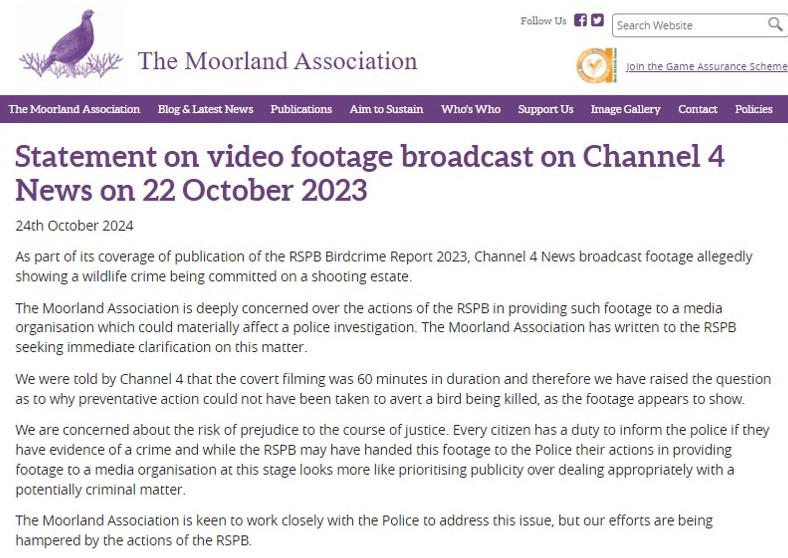
Here’s the MA’s statement in full:
Screen grab from the Moorland Association website
The last line made me laugh out loud:
“The Moorland Association is keen to work closely with the Police to address this issue, but our efforts are being hampered by the actions of the RSPB“.
What efforts are those, then? And how, exactly, are those “efforts” being hampered by the release of that footage?
The Moorland Association should be grateful to the RSPB for its skill and tenacity in securing such clear evidence of what’s going on on that grouse moor, and no doubt on many other grouse moors, too. Surely, if the Moorland Association is so committed, as it claims, to a ‘zero tolerance’ policy against raptor persecution, it should be thanking the RSPB for demonstrating that (a) illegal raptor persecution is still going on, (b) where it’s going on and who’s doing it, and (c) how the crimes are being committed.
But then this is the organisation whose CEO, Andrew Gilruth, was recently booted off the national ‘partnership’ designed to tackle illegal raptor persecution in England and Wales (the Raptor Persecution Priority Delivery Group – RPPDG), after the Moorland Association had published an inflammatory blog that looked to be an attempt to sabotage the National Wildlife Crime Unit’s (NWCU) new Hen Harrier Taskforce (see here).
That blog wasn’t a one-off incident either – we later learned that Gilruth had been ejected from the group for “wasting time and distracting from the real work” [of tackling raptor persecution] for some time, according to a senior police officer (see here).
I’m not the only one questioning the Moorland Association’s response. The Northern England Raptor Forum (NERF) published this statement about it. Well worth a read.
I suspect what’s really agitating the Moorland Association is the fact that this highly damaging footage/audio has been seen by millions of Channel 4 News viewers, many of whom would have been previously unaware of the damage being caused by the shameful driven grouse shooting industry.
The RSPB has produced a podcast interview with Ian Thomson, Head of Investigations at RSPB Scotland.
Ian has worked in the Investigations team for 18 years and has played a crucial role in not just gathering the evidence of ongoing raptor persecution in Scotland, but perhaps more importantly, he has been highly influential in persuading the law makers that a change of policy was needed to tackle these crimes.
Needless to say, his effectiveness has resulted in him receiving years of defamatory and offensive abuse, on pretty much a weekly basis, from those in the game-shooting industry seeking to undermine his reputation and credibility. They’ve roundly failed – Ian’s opinion is held in high regard by conservationists, politicians, civil servants and journalists alike.
In this podcast Ian discusses the charity’s latest Birdcrime report and he also provides a good overview of the new legislation passed by the Scottish Parliament that is intended to deal with raptor persecution on grouse moors. He also talks about the importance of enforcing the new regulations for the legislation to be effective and for it to do what the Parliament intended when it passed the Bill last spring.
For anyone who still wants to pretend that the grouse shooting industry isn’t responsible for the systematic extermination of hen harriers on grouse moors across the UK, here’s the latest catalogue of crime that suggests otherwise.
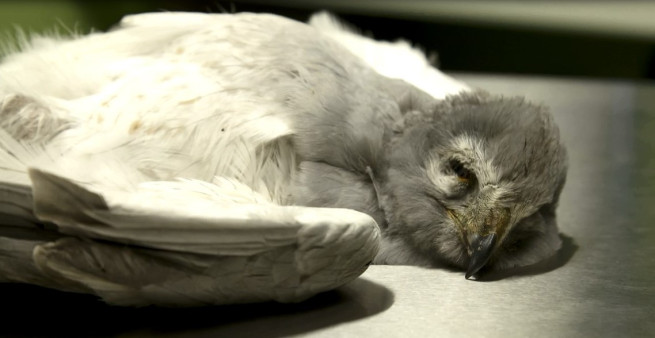
[This male hen harrier died in 2019 after his leg was almost severed in an illegally set trap that had been placed next to his nest on a Scottish grouse moor (see here). Photo by Ruth Tingay]
This is the blog I now publish after every reported killing or suspicious disappearance.
“They disappear in the same way political dissidents in authoritarian dictatorships have disappeared” (Stephen Barlow, 22 January 2021).
Today the list has been updated to include the most recently reported victim, an un-tagged hen harrier shot on a grouse moor by one of three gamekeepers secretly being filmed by the RSPB’s Investigations Team (here).
I’ve been compiling this list only since 2018 because that is the year that the grouse shooting industry ‘leaders’ would have us believe that the criminal persecution of hen harriers had stopped and that these birds were being welcomed back on to the UK’s grouse moors (see here).
This assertion was made shortly before the publication of a devastating new scientific paper that demonstrated that 72% of satellite-tagged hen harriers were confirmed or considered likely to have been illegally killed, and this was ten times more likely to occur over areas of land managed for grouse shooting relative to other land uses (see here). A further scientific paper published in 2023 by scientists at the RSPB, utilising even more recent data, echoed these results – see here).
2018 was also the year that Natural England issued a licence to begin a hen harrier brood meddling trial on grouse moors in northern England. For new blog readers, hen harrier brood meddling was a conservation sham sanctioned by DEFRA as part of its ludicrous ‘Hen Harrier Action Plan‘ and carried out by Natural England (NE), in cahoots with the very industry responsible for the species’ catastrophic decline in England. For more background see here and for a critical evaluation of the trial after 5 years see this report by Wild Justice. This year, the brood meddling trial appears to have collapsed for reasons which are not yet clear (see here).
Brood meddling has been described as a sort of ‘gentleman’s agreement’ by commentator Stephen Welch:
“I don’t get it, I thought the idea of that scheme was some kind of trade off – a gentleman’s agreement that the birds would be left in peace if they were moved from grouse moors at a certain density. It seems that one party is not keeping their side of the bargain“.
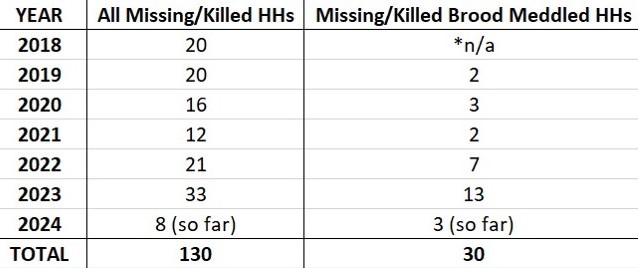
With at least 130 hen harriers gone since 2018, and 30 of those being brood meddled birds, there is no question that the grouse shooting industry is simply taking the piss. Meanwhile, Natural England pretends that ‘partnership working’ is the way to go and DEFRA Ministers remain silent.
*n/a – no hen harriers were brood meddled in 2018
‘Partnership working’ according to Natural England appears to include authorising the removal of hen harrier chicks from a grouse moor already under investigation by the police for suspected raptor persecution (here) and accepting a £75k ‘donation’ from representatives of the grouse shooting industry that prevents Natural England from criticising them or the sham brood meddling trial (see here). This is in addition to a £10k ‘donation’ that Natural England accepted, under the same terms, in 2021 (here).
Thankfully, the Scottish Government has finally decided to act by introducing a grouse moor licensing scheme under the Wildlife Management & Muirburn (Scotland) Act 2024. The intention behind this new legislation is that grouse shooting estates could have their licences suspended/revoked if, on the balance of probability, it is shown that any raptor persecution crimes (& some other associated offences) are linked with grouse moor management on that estate.
So here’s the latest gruesome list of ‘missing’/illegally killed hen harriers since 2018. Note that the majority of these birds (but not all) were fitted with satellite tags. How many more [untagged] harriers have been killed?
February 2018: Hen harrier Saorsa ‘disappeared’ in the Angus Glens in Scotland (here). The Scottish Gamekeepers Association later published wholly inaccurate information claiming the bird had been re-sighted. The RSPB dismissed this as “completely false” (here).
5 February 2018: Hen harrier Marc ‘disappeared’ on a grouse moor in Durham (here).
9 February 2018: Hen harrier Aalin ‘disappeared’ on a grouse moor in Wales (here).
March 2018: Hen harrier Blue ‘disappeared’ in the Lake District National Park (here).
March 2018: Hen harrier Finn ‘disappeared’ near Moffat in Scotland (here).
18 April 2018: Hen harrier Lia ‘disappeared’ in Wales and her corpse was retrieved in a field in May 2018. Cause of death was unconfirmed but police treating death as suspicious (here).
8 August 2018: Hen harrier Hilma ‘disappeared’ on a grouse moor in Northumberland (here).
16 August 2018: Hen harrier Athena ‘disappeared’ on a grouse moor in Scotland (here).
26 August 2018: Hen Harrier Octavia ‘disappeared’ on a grouse moor in the Peak District National Park (here).
29 August 2018: Hen harrier Margot ‘disappeared’ on a grouse moor in Scotland (here).
29 August 2018: Hen Harrier Heulwen ‘disappeared’ on a grouse moor in Wales (here).
3 September 2018: Hen harrier Stelmaria ‘disappeared’ on a grouse moor in Scotland (here).
24 September 2018: Hen harrier Heather ‘disappeared’ on a grouse moor in Scotland (here).
2 October 2018: Hen harrier Mabel ‘disappeared’ on a grouse moor on the edge of the Yorkshire Dales National Park (here).
3 October 2018: Hen Harrier Thor ‘disappeared’ next to a grouse moor in Bowland, Lanacashire (here).
23 October 2018: Hen harrier Tom ‘disappeared’ in South Wales (here).
26 October 2018: Hen harrier Arthur ‘disappeared’ on a grouse moor in the North York Moors National Park (here).
1 November 2018: Hen harrier Barney ‘disappeared’ on Bodmin Moor (here).
10 November 2018: Hen harrier Rannoch ‘disappeared’ on a grouse moor in Scotland (here). Her corpse was found nearby in May 2019 – she’d been killed in an illegally-set spring trap (here).
14 November 2018: Hen harrier River ‘disappeared’ on a grouse moor in the Nidderdale AONB (here). Her corpse was found nearby in April 2019 – she’d been illegally shot (here).
16 January 2019: Hen harrier Vulcan ‘disappeared’ in Wiltshire close to Natural England’s proposed reintroduction site (here).
28 January 2019: Hen harrier DeeCee ‘disappeared’ in Glen Esk, a grouse moor area of the Angus Glens (see here).
7 February 2019: Hen harrier Skylar ‘disappeared’ next to a grouse moor in South Lanarkshire (here).
22 April 2019: Hen harrier Marci ‘disappeared’ on a grouse moor in the Cairngorms National Park (here).
26 April 2019: Hen harrier Rain ‘disappeared’ on a grouse moor in Nairnshire (here).
11 May 2019: An untagged male hen harrier was caught in an illegally-set trap next to his nest on a grouse moor in South Lanarkshire. He didn’t survive (here).
7 June 2019: An untagged hen harrier was found dead on a grouse moor in Scotland. A post mortem stated the bird had died as a result of ‘penetrating trauma’ injuries and that this bird had previously been shot (here).
5 September 2019: Wildland Hen Harrier 1 ‘disappeared’ on a grouse moor nr Dalnaspidal on the edge of the Cairngorms National Park (here).
11 September 2019: Hen harrier Romario ‘disappeared’ on a grouse moor in the Cairngorms National Park (here).
14 September 2019: Hen harrier (Brood meddled in 2019, #183704) ‘disappeared’ in the North Pennines (here).
23 September 2019: Hen harrier (Brood meddled in 2019, #55149) ‘disappeared’ in North Pennines (here).
24 September 2019: Wildland Hen Harrier 2 ‘disappeared’ on a grouse moor at Invercauld in the Cairngorms National Park (here).
24 September 2019: Hen harrier Bronwyn ‘disappeared’ near a grouse moor in North Wales (here).
10 October 2019: Hen harrier Ada ‘disappeared’ on a grouse moor in the North Pennines AONB (here).
12 October 2019: Hen harrier Thistle ‘disappeared’ on a grouse moor in Sutherland (here).
18 October 2019: Member of the public reports the witnessed shooting of an untagged male hen harrier on White Syke Hill in North Yorkshire (here).
November 2019: Hen harrier Mary found illegally poisoned on a pheasant shoot in Ireland (here).
November 2019: Hen harrier Artemis ‘disappeared’ near Long Formacus in south Scotland (RSPB pers comm).
14 December 2019: Hen harrier Oscar ‘disappeared’ in Eskdalemuir, south Scotland (here).
December 2019: Hen harrier Ingmar ‘disappeared’ in the Strathbraan grouse moor area of Perthshire (RSPB pers comm).
anuary 2020: Members of the public report the witnessed shooting of a male hen harrier on Threshfield Moor in the Yorkshire Dales National Park (here).
23 March 2020: Hen harrier Rosie ‘disappeared’ at an undisclosed roost site in Northumberland (here).
1 April 2020: Hen harrier (Brood meddled in 2019, #183703) ‘disappeared’ in unnamed location, tag intermittent (here).
5 April 2020: Hen harrier Hoolie ‘disappeared’ on a grouse moor in the Cairngorms National Park (here)
8 April 2020: Hen harrier Marlin ‘disappeared’ on a grouse moor in the Cairngorms National Park (here).
19 May 2020: Hen harrier Fingal ‘disappeared’ on a grouse moor in the Lowther Hills, Scotland (here).
21 May 2020: Hen harrier (Brood meddled in 2019, #183701) ‘disappeared’ on a grouse moor in Cumbria shortly after returning from wintering in France (here).
27 May 2020: Hen harrier Silver ‘disappeared’ on a grouse moor on Leadhills Estate, Scotland (here).
2020: day/month unknown: Unnamed male hen harrier breeding on RSPB Geltsdale Reserve, Cumbria ‘disappeared’ while away hunting (here).
9 July 2020: Unnamed female hen harrier (#201118) ‘disappeared’ from an undisclosed site in Northumberland (here).
25 July 2020: Hen harrier Harriet ‘disappeared’ on a grouse moor in the Yorkshire Dales National Park (here).
14 August 2020: Hen harrier Solo ‘disappeared’ in confidential nest area in Lancashire (here).
7 September 2020: Hen harrier Dryad ‘disappeared’ on a grouse moor in the Yorkshire Dales National Park (here).
16 September 2020: Hen harrier Fortune ‘disappeared’ from an undisclosed roost site in Northumberland (here).
19 September 2020: Hen harrier Harold ‘disappeared’ on a grouse moor in the Yorkshire Dales National Park (here).
20 September 2020: Hen harrier (Brood meddled in 2020, #55152) ‘disappeared’ next to a grouse moor in North Yorkshire (here).
24 February 2021: Hen harrier Tarras ‘disappeared’ next to a grouse moor in Northumberland (here)
12th April 2021: Hen harrier Yarrow ‘disappeared’ near Stockton, County Durham (here).
18 May 2021: Adult male hen harrier ‘disappeared’ from its breeding attempt on RSPB Geltsdale Reserve, Cumbria whilst away hunting (here).
18 May 2021: Another adult male hen harrier ‘disappeared’ from its breeding attempt on RSPB Geltsdale Reserve, Cumbria whilst away hunting (here).
24 July 2021: Hen harrier Asta ‘disappeared’ at a ‘confidential site’ in the North Pennines (here). We learned 18 months later that her wings had been ripped off so her tag could be fitted to a crow in an attempt to cover up her death (here).
14th August 2021: Hen harrier Josephine ‘disappeared’ at a ‘confidential site’ in Northumberland (here).
17 September 2021: Hen harrier Reiver ‘disappeared’ in a grouse moor dominated region of Northumberland (here)
24 September 2021: Hen harrier (Brood meddled in 2021, R2-F-1-21) ‘disappeared’ in Northumberland (here).
15 November 2021: Hen harrier (brood meddled in 2020, #R2-F1-20) ‘disappeared’ at the edge of a grouse moor on Arkengarthdale Estate in the Yorkshire Dales National Park (here).
19 November 2021: Hen harrier Val ‘disappeared’ in the Lake District National Park in Cumbria (here).
19 November 2021: Hen harrier Percy ‘disappeared’ in Lothian, Scotland (here).
12 December 2021: Hen harrier Jasmine ‘disappeared’ on a grouse moor (High Rigg Moor on the Middlesmoor Estate) in the Nidderdale AONB in North Yorkshire (here).
9 January 2022: Hen harrier Ethel ‘disappeared’ in Northumberland (here).
26 January 2022: Hen harrier Amelia ‘disappeared’ in Bowland (here).
10 February 2022: An unnamed satellite-tagged hen harrier ‘disappeared’ in a grouse moor dominated area of the Peak District National Park (here). One year later it was revealed that the satellite tag/harness of this young male called ‘Anu’ had been deliberately cut off (see here).
12 April 2022: Hen harrier ‘Free’ (Tag ID 201121) ‘disappeared’ at a ‘confidential site’ in Cumbria (here). It later emerged he hadn’t disappeared, but his mutilated corpse was found on moorland in the Yorkshire Dales National Park. A post mortem revealed the cause of death was having his head twisted and pulled off. One leg had also been torn off whilst he was still alive (here).
April 2022: Hen harrier ‘Pegasus’ (tagged by the RSPB) ‘disappeared’ on a grouse moor at Birkdale in the Yorkshire Dales National Park (here).
May 2022: A male breeding hen harrier ‘disappeared’ from a National Trust-owned grouse moor in the Peak District National Park (here).
May 2022: Another breeding male hen harrier ‘disappeared’ from a National Trust-owned grouse moor in the Peak District National Park (here).
14 May 2022: Hen harrier ‘Harvey’ (Tag ID 213844) ‘disappeared’ from a ‘confidential site’ in the North Pennines (here).
20 June 2022: Hen harrier chick #1 stamped to death in nest on a grouse moor in the Yorkshire Dales National Park (here).
20 June 2022: Hen harrier chick #2 stamped to death in nest on a grouse moor in the Yorkshire Dales National Park (here).
20 June 2022: Hen harrier chick #3 stamped to death in nest on a grouse moor in the Yorkshire Dales National Park (here).
20 June 2022: Hen harrier chick #4 stamped to death in nest on a grouse moor in the Yorkshire Dales National Park (here).
17 August 2022: Hen harrier (brood meddled in 2022, #R1-M1-22) ‘disappeared’ on moorland in the Yorkshire Dales National Park (here).
September 2022: Hen harrier ‘Sullis’ (tagged by the RSPB) ‘disappeared’ on a grouse moor in Cumbria (here).
5 October 2022: Hen harrier (brood meddled in 2022, #R3-M2-22) ‘disappeared’ on moorland in the Yorkshire Dales National Park (here).
10 October 2022: Hen harrier ‘Sia’ ‘disappeared’ near Hamsterley Forest in the North Pennines (here).
October 2022: Hen harrier (brood meddled in 2021, #R1-F1-21) ‘disappeared’ in the North Sea off the North York Moors National Park (here).
1 December 2022: Hen harrier male (brood meddled in 2021, #R1-M1-21) ‘disappeared’ on moorland in the Yorkshire Dales National Park (here).
7 December 2022: Hen harrier female (brood meddled in 2020, #R2-F2-20) ‘disappeared’ from winter roost (same as #R3-F1-22) on moorland in North Pennines AONB (here). Later found dead with 3 shotgun pellets in corpse.
14 December 2022: Hen harrier female (brood meddled in 2022, #R3-F1-22) ‘disappeared’ from winter roost (same as #R2-F2-20) on moorland in the North Pennines AONB (here). Later found dead with two shotgun pellets in corpse.
15 December 2022: Hen harrier female (brood meddled in 2022, #R2-F1-22) ‘disappeared’ on moorland in the Yorkshire Dales National Park (here).
30 March 2023: Hen harrier female (brood meddled in 2022, #R1-F3-22) ‘disappeared’ in Yorkshire (here). Notes from NE Sept 2023 spreadsheet update: “Final transmission location temporarily withheld at police request“.
1 April 2023: Hen harrier male (brood meddled in 2022, #R2-M1-22) ‘disappeared’ in Yorkshire (here). Notes from NE Sept 2023 spreadsheet update: “Final transmission location temporarily withheld at police request“.
April 2023: Hen harrier ‘Lagertha’ (tagged by RSPB) ‘disappeared’ in North Yorkshire (here).
April 2023: Hen harrier ‘Nicola’ (Tag ID 234078) ”disappeared’ in North Yorkshire (here).
April 2023: Untagged male hen harrier ‘disappeared’ from an active nest on RSPB Geltsdale Reserve in Cumbria (here).
April 2023: Another untagged male hen harrier ‘disappeared’ from an active nest on RSPB Geltsdale Reserve in Cumbria (here).
April 2023: Untagged male hen harrier ‘disappeared’ from an active nest in Durham (here).
4/5 May 2023: Satellite-tagged male hen harrier called ‘Rush’ ‘disappeared’ from a grouse moor in Bowland AONB in Lancashire (here).
9/10 May 2023: Hen harrier male called ‘Dagda’, tagged by the RSPB in Lancashire in June 2022 and who was breeding on the RSPB’s Geltsdale Reserve in 2023 until he ‘vanished’, only to be found dead on the neighbouring Knarsdale grouse moor in May 2023 – a post mortem revealed he had been shot (here).
17 May 2023: Satellite-tagged hen harrier called ‘Wayland’ ‘disappeared’ in the Clapham area of North Yorkshire, just north of the Bowland AONB (here).
31 May 2023: Hen harrier male (brood meddled in 2022, tag #213932, name: R2-M3-22) ‘disappeared’ in Northumberland (grid ref: NY765687) (here).
11 June 2023: Hen harrier male (brood meddled in 2021, tag #213922, name: R2-M1-21) ‘disappeared’ at a confidential site in the Yorkshire Dales National Park. Notes from the NE spreadsheet: “Final transmission location temporarily withheld at police request“ (here).
12 June 2023: Hen harrier male (brood meddled in 2020, tag #203004, name: R1-M2-20) ‘disappeared’ on a grouse moor in Co. Durham (grid ref: NY976322) (here).
6 July 2023: Satellite-tagged female hen harrier named ‘Rubi’ (tag #201124a) ‘disappeared’ on a grouse moor in Co. Durham (grid ref: NY911151) (here).
23 July 2023: Hen harrier female (brood meddled in 2023, tag #55154a, name: R1-F1-23) ‘disappeared’ on a grouse moor in Co. Durham (close to where ‘Rubi’ vanished), grid ref: NY910126 (here).
29 July 2023: Hen harrier female (brood meddled in 2020, tag #55144, name: R2-F2-20) ‘disappeared’ at a confidential site in the North Pennines. Notes from the NE spreadsheet: “Dead. Recovered – awaiting PM results. Final transmission location temporarily withheld at police request“ (here).
9 August 2023: Satellite-tagged hen harrier called ‘Martha’ ‘disappeared’ on a grouse moor (Westburnhope Moor) near Hexham in the North Pennines (here).
11 August 2023: Satellite-tagged hen harrier called ‘Selena’ ‘disappeared’ on a grouse moor (Mossdale Moor) in the Yorkshire Dales National Park (here).
11 August 2023: Hen harrier female (brood meddled in 2023, tag #201118a, name: R3-F1-23) ‘disappeared’ in Co. Durham (grid ref: NZ072136) (here).
15 August 2023: Satellite-tagged hen harrier called ‘Hepit’ ‘disappeared’ on a grouse moor (Birkdale Common) near Kirkby Stephen in the Yorkshire Dales National Park (here).
24 August 2023: Hen harrier female (brood meddled in 2023, tag #55155a, name: R1-F2-23) ‘disappeared’ at a confidential site in Northumberland. Notes from the NE spreadsheet: “Final transmission location temporarily withheld at police request“ (here).
August-Sept 2023: Satellite-tagged hen harrier called ‘Harmonia’ ‘disappeared’ in the Yorkshire Dales National Park (here).
September 2023: Hen harrier female ‘Saranyu’, tagged by the RSPB in Cumbria in June 2023, ‘disappeared’ in Durham in September 2023 (no further details available yet – just outline info provided in 2022 Birdcrime report) (here).
September 2023: Hen harrier female ‘Inger’, a female tagged by the RSPB in Perthshire in July 2022, ‘disappeared’ on a grouse moor in the Angus Glens in September 2023 (here).
15 September 2023: Hen harrier male called ‘Rhys’, tagged in Cumbria on 1st August 2023, ‘disappeared’ on a grouse moor in the Yorkshire Dales National Park. Grid ref: SD798896 (here).
24 September 2023: Hen harrier female (brood meddled in 2023, name: ‘R2-F2-23’) ‘disappeared’ in the North Pennines, grid ref: NY888062 (here).
25 September 2023: Hen harrier female (brood meddled in 2022, name: ‘R1-F4-22’) ‘disappeared’ on a grouse moor in the Yorkshire Dales National Park, grid ref: SE077699 (here).
26 September 2023: Hen harrier female called ‘Hope’, tagged in Cumbria on 21 July 2023, ‘disappeared’ next to a grouse moor in the Yorkshire Dales National Park, grid ref: SD801926 (here).
4 October 2023: Hen harrier male (brood meddled in 2020, name: ‘R1-M3-20’) ‘disappeared’ in Co Durham, grid ref: NY935192 (here).
4 October 2023: Hen harrier female (brood meddled in 2023, name: ‘R4-F1-23’) ‘disappeared’ on a grouse moor in the Yorkshire Dales National Park, grid ref: SE003981 (here).
14 October 2023: Hen harrier male called ‘Cillian’, tagged in Cumbria on 1 August 2023, ‘disappeared’ in south west Scotland, grid ref: NY051946 (here).
15 November 2023: Hen harrier female called ‘Hazel’, tagged in Cumbria on 21 July 2023, ‘disappeared’ on the Isle of Man, grid ref: SC251803 (here).
27 November 2023: Hen harrier female called ‘Gill’, tagged in Northumberland on 10 July 2023, ‘disappeared’ at a confidential location in Teeside (here).
12 February 2024: Hen harrier female called ‘Susie’, Tag ID 201122, found dead at a confidential location in Northumberland and the subject of an ongoing police investigation (here).
15 February 2024: Hen harrier female called ‘Shalimar’, tagged on the National Trust for Scotland’s Mar Lodge estate in 2023, ‘disappeared’ in suspicious circumstances on a grouse moor in the notorious Angus Glens (here).
7 March 2024: Hen harrier male (brood meddled in 2023, name R2-M1-23) found dead in Devon. According to an FoI response from Natural England in June 2024 this death is the subject of an ongoing police investigation (here).
24 April 2024: Hen harrier male called ‘Ken’, Tag ID 213849a, ‘disappeared’ in suspicious circumstances close to a grouse moor in Bowland, grid ref SD 684601 (here).
17 May 2024: Hen harrier male (brood meddled in 2023, name R2-M2-23) ‘disappeared’ in suspicious circumstances next to Middlesmoor grouse moor in Nidderdale, grid ref SE043754 (here).
25 June 2024: Hen harrier female (brood meddled in 2023, name R2-F1-23) ‘disappeared’ in suspicious circumstances on a grouse moor in Yorkshire Dales National Park, grid ref NY985082 (here).
July 2024: Hen harrier female named ‘Helius’ satellite tagged by the RSPB ‘disappeared’ in suspicious circumstances in Bowland (here).
October 2024: An un-tagged hen harrier was shot on a grouse moor by one of three gamekeepers being secretly filmed by the RSPB (here).
To be continued…….
Not one of these 130 incidents has resulted in an arrest, let alone a prosecution. I had thought that when we reached 30 dead/missing hen harriers then the authorities might pretend to be interested and at least say a few words about this national scandal. We’ve now reached ONE HUNDRED AND THIRTY hen harriers, and still Govt ministers remain silent. They appear not to give a monkey’s. And yes, there are other things going on in the world, as always. That is not reason enough to ignore this blatant, brazen and systematic destruction of a supposedly protected species, being undertaken to satisfy the greed and bloodlust of a minority of society.
And let’s not forget the response from the (now former) Moorland Association Chair (and owner of Swinton Estate) Mark Cunliffe-Lister, who told BBC Radio 4 in August 2023 that, “Clearly any illegal [hen harrier] persecution is not happening” (here).
Nor should we forget the response from the Game and Wildlife Conservation Trust’s (GWCT) Director of Policy Dr Alistair Leake who wrote a letter to the Guardian newspaper in November 2023 stating that the hen harrier brood management [meddling] scheme “is surely a shining example of human / wildlife conflict resolution that would be the envy of other countries trying to find similar solutions“ (I kid you not – here).
It remains to be seen whether DEFRA Ministers under the new Labour Government will be prepared to tolerate such blatant criminality. Watch this space.
Yesterday evening, Channel 4 News featured some incredible footage, secretly filmed by the RSPB’s investigations team, of three gamekeepers on an unnamed grouse moor in northern England, first plotting to kill, and then apparently killing, a hen harrier.
If you didn’t see it, here it is:
The footage was remarkable, not because it showed gamekeepers killing birds of prey – we’ve all seen plenty of secretly filmed footage catching gamekeepers committing these crimes.
What was different about this particular footage was the audio quality – so acutely clear that we could hear the radio comms between the three gamekeepers, one in view (the estate’s Head gamekeeper, according to the RSPB) and the other two strategically placed elsewhere on the grouse moor but taking clear direction about what not to shoot (a hen harrier with a satellite tag) and what to shoot (an untagged hen harrier, whose death would not be revealed to the wider world, or so they thought). They were also heard discussing what else they’d casually shot that afternoon – a buzzard and a raven, both protected species.
I daresay their conversation probably revealed much more, but the full audio transcript is not being released by the RSPB, at least not yet, but it may come to light either as evidence in a prosecution trial or as a stand alone release once any criminal proceedings have concluded.
I hope there is a prosecution – actually, I hope there are three of them – and three convictions with appropriately severe sentences, although I’m not holding my breath. We’ve been here many times before, with what is often clear and compelling video evidence of raptor persecution offences, only for the case to be thrown out on a technicality.
I imagine the very well paid defence lawyers are already circling the wagons, ready to argue that the video/audio evidence should be deemed inadmissible if the landowner’s permission wasn’t granted in advance of filming.
Can you imagine an abattoir owner, or the national trade body of abattoir owners, using this defence if someone had secretly filmed their employees inflicting gratuitous cruelty to animals? No, me neither because it’d not only be ludicrous and provoke justifiable public revulsion, but it could also be argued that it looked like a clear indication that the owner and the abattoir trade association condoned the crimes of those employees.
But prosecuting those three gamekeepers, important as that is, isn’t all that’s at stake in this particular case.
The bigger picture here is what that RSPB footage has exposed about the grouse shooting industry. For years, the representative bodies of that industry have insisted, time and time again, that gamekeepers are not ‘at it’, that the RSPB has fabricated the evidence, that gamekeepers are being unfairly attacked, and that any of us who report on such crimes to raise awareness are nothing more than ‘anti-shooting extremists’ whose opinions should be disregarded as ‘lies’.
In recent years, they’ve mobilised to deliver a unified propaganda missive designed to hide what they actually get up to and to instead present themselves as raptor-loving, law-abiding members of society.
I’m sure, in fact I know, that there are some decent members in that industry who abhor the illegal killing of raptors as much as many of us do. But there are not enough of them and they don’t speak out often enough against the criminals within their industry. The time is fast approaching when they may regret that.
The wider significance of this RSPB footage is what it reveals about the grouse-shooting industry’s propaganda campaign on hen harriers and the utter futility of the brood meddling sham.
It seems pretty clear to me from the footage, given the time of day and the number of harriers present, that those three gamekeepers were staking out a hen harrier roost. It’s been common knowledge for years amongst raptor fieldworkers that gamekeepers sit out on the hill to target harriers coming in to roost, and if they don’t manage to kill them when they’re flying in, then they’ll take their dogs, guns and thermal imagers through the roost site under the cover of darkness to get the job done.
I thought it was interesting that these three gamekeepers didn’t want to kill any harriers that were carrying satellite tags because that would draw unwanted attention to the estate but any without a satellite tag were fair game, because those hen harriers, if killed cleanly, could be disposed of, probably stamped into the peat, without anyone being any the wiser, so the industry can maintain the charade that hen harriers are welcome on grouse moors.
It’s clear from the high number of satellite-tagged hen harriers that have been illegally killed in recent years that not all gamekeepers are as devious as these three, but how many more gamekeepers are out there targeting non-tagged harriers? We know of 129 hen harriers (now 130 if we include the one shot in this footage) that have been killed or have vanished in suspicious circumstances since 2018. Every time another one is reported, there’ll be voices from the industry desperately trying to cast doubt about the fate of the bird in an attempt to cover up the appalling truth.
And that’s the significance of this latest footage. It delivers that appalling truth with such clarity that there’s nowhere left for the grouse shooting industry to hide.
There’s also nowhere left for Natural England to hide. The evidence couldn’t be any clearer – the brood meddling sham has not changed the attitude of the grouse shooting industry towards hen harriers and any thought that Natural England might have about rolling out brood meddling as a so-called annual ‘conservation licence’ should be as dead and cold in the water as that shot hen harrier.
Kudos to the team at Channel 4 News and especially chief correspondent Alex Thomson for their willingness, once again, to broadcast the atrocities of the grouse shooting industry with such lucidity.
Our biggest thanks needs to go to the RSPB’s Investigations Team, whose dedication, ingenuity, professionalism and sheer tenacity, despite the daily foul, vitriolic abuse they’re subjected to from the criminals and their benefactors, continues to provide us with such insight.
If you want to demonstrate your support please consider making a donation to keep the team in the field – see here.
UPDATE 24 October 2024: 130 hen harriers confirmed ‘missing’ or illegally killed in UK since 2018, most of them on or close to grouse moors (here)
UPDATE 31 October 2024: Moorland Association’s response to THAT damaging video/audio aired on Channel 4 News last week (here)
UPDATE 14 April 2025: Gamekeeper from a Yorkshire Dales grouse moor charged in relation to alleged shooting of a hen harrier (as featured on Channel 4 News last October) here
UPDATE 2 May 2025: Gamekeeper Racster Dingwall pleads not guilty to two charges relating to alleged conspiracy to kill a Hen Harrier on grouse moor in Yorkshire Dales National Park (here)
UPDATE 4 May 2025: News coverage about first court appearance of Yorkshire Dales gamekeeper Racster Dingwall in relation to alleged conspiracy to shoot a Hen Harrier (here)
UPDATE 9 September 2025: Gamekeeper Racster Dingwall back in court today for case relating to Hen Harrier shooting on a grouse moor in Yorkshire Dales National Park (here)
UPDATE 9 September 2025: Judge rules RSPB covert video surveillance is admissible evidence in prosecution of gamekeeper Racster Dingwall (here)
UPDATE 25 September 2025: More detail on court ruling accepting admissibility of RSPB’s covert surveillance in prosecution of gamekeeper accused of conspiracy to kill a Hen Harrier (here)
I’ll come back to the exclusive report on Channel 4 News this evening about gamekeepers caught plotting to kill, and then killing, a hen harrier on a grouse moor in Northern England. There’s a lot to say!
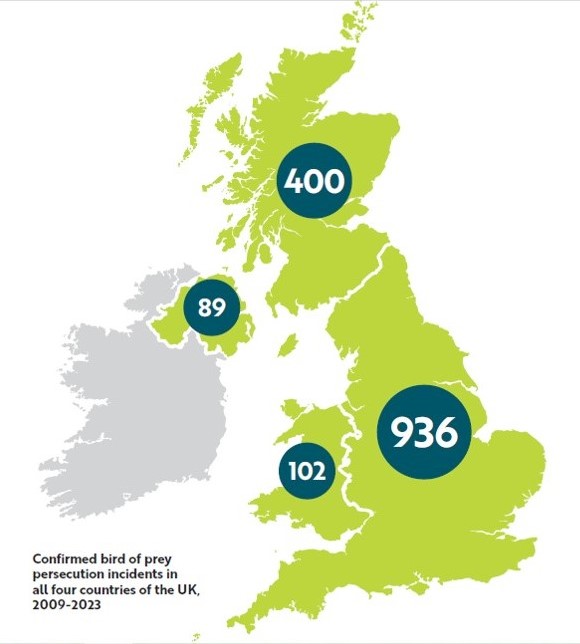
Meanwhile, the RSPB has just published its latest Birdcrime Report (2023), which provides a summary of raptor persecution crimes across the UK over the last 15 years (2009-2023).
Here’s the RSPB press release:
Illegal bird of prey killing must end, demands RSPB Birdcrime report
The Birdcrime report, which reviews the past 15 years, reveals that at least 1,344 birds of prey were illegally killed between 2009-2023, with crimes continuing to emerge. These criminal acts target threatened species including Golden Eagles, Goshawks and Hen Harriers.
The majority of incidents are associated with land managed for gamebird shooting.
The RSPB is calling for significant legislative change across the UK to stop bird of prey persecution.
The RSPB is calling for an end to the relentless illegal killing of birds of prey in a new report, which documents 15 years of criminal slaughter.
The Birdcrime report, published today (22 October), reveals that between 2009-2023 there were 1,529 confirmed bird of prey persecution incidents involving 1,344 individual birds of prey. These include rare and threatened species such as Golden Eagles, Hen Harriers, Peregrines, White-tailed Eagles and Goshawks.
These latest figures reveal that crimes are being committed on a considerable scale year-on-year. Worryingly, they represent just the tip of the iceberg as many of these incidents take place in unpopulated areas where they go unseen and unreported to the authorities, and as a result there is no consequence for these illegal acts.
Many of the victims were killed in brutal ways. In 2022, a Hen Harrier was found dead near the border of Yorkshire and Cumbria; the post-mortem examination concluded that its head had been pulled from its body while still alive.
Raptor persecution is having a direct impact on species that are already struggling. Two young White-tailed Eagles – a species slowly recovering having been wiped out in the UK by persecution in the last century – were found dead in County Antrim, Northern Ireland, in 2023. Analysis confirmed that both eagles had died by ingesting Bendiocarb, a highly toxic insecticide. Laying poisoned baits, which are incredibly dangerous to people and pets, is illegal, yet a common technique used to kill birds of prey.
The majority of raptor persecution incidents are associated with land managed for gamebird shooting, where some individuals deliberately target birds of prey to maximise the number of gamebirds available to shoot for sport.
Scientific studies reach the same conclusion. A landmark paper (Ewing et al, 2023) published in Biological Conservation revealed that the illegal killing of Hen Harriers associated with gamebird management accounts for up to three-quarters of Hen Harrier annual mortality.
And of all people convicted of bird of prey persecution-related offences between 2009 and 2023, 75% were connected to the gamebird shooting industry. All birds of prey are protected by law, under the Wildlife and Countryside Act 1981 and the Wildlife (Northern Ireland) Order 1985. Yet in the past 15 years, only one person has been jailed. Current laws are not serving as an effective deterrent or punishment for these crimes.
For decades the RSPB Investigations Team has challenged bird of prey persecution by detecting and recording crimes and assisting with police investigations.
The RSPB also uses satellite tag technology to shine a light on the scale of persecution faced by Hen Harriers. The real-time data received from these tags gives previously unknown insights into where the birds go and, crucially, when and where they die. It has revealed that more Hen Harriers were killed or disappeared under suspicious circumstances in 2023 than in any previous year.
To end this culture of criminality, the RSPB is calling for the licencing of all gamebird shooting across the UK by the government in Westminster and all of the devolved administrations, building on the work already started in Scotland to licence grouse shooting.
Mark Thomas, RSPB UK Head of Investigations, said:
“Our latest report harrowingly details what the team sees on a day-to-day basis: the scale of raptor persecution, where it is happening and who is responsible. In the last 15 years, a minimum of 1344 amazing birds like Hen Harriers, Red Kites and eagles have been deliberately killed, the majority in connection with gamebird shooting – that’s a national disgrace which requires urgent government action. If we are to save birds like the highly threatened Hen Harrier, then the current legislation is clearly not enough: we need licencing of gamebird shooting throughout the UK, stronger penalties and meaningful sentencing to stop these crimes and save our wildlife.”
The Wildlife Management and Muirburn Act, passed in March 2024, means all grouse shoots in Scotland require a licence to operate, and that this licence could be revoked if a crime is committed. This progressive legislation will help ensure legal and sustainable management across a significant area of upland Scotland and introduces a much-needed deterrent for those who kill birds of prey for economic reasons.
Beccy Speight, RSPB Chief Executive, said:
“For decades, the RSPB has investigated hundreds of cases of illegal bird of prey persecution in the UK. A significant proportion of these incidents happen on or near land associated with gamebird shooting. The RSPB is calling on the Westminster Government and all devolved administrations across the UK to introduce the licencing of gamebird shooting. This progressive step will help challenge the relentless killing of our birds of prey and help to safeguard their future survival.”
ENDS
The RSPB’s Birdcrime 2023 report can be read/downloaded here:
If you’re interested in who is continuing to kill hen harriers on UK grouse moors, you should tune in to Channel 4 News this evening at 7pm for an exclusive by Chief Correspondent Alex Thomson, based on dynamite information provided by the RSPB’s Investigations Team.
DON’T MISS IT!
UPDATE 23 October 2024: RSPB secretly films gamekeepers plotting & then killing a hen harrier on a grouse moor in northern England (here)
Further to the blog on 30 September 2024 (here), a man attended court yesterday after being summoned in relation to the illegal poisoning of a red kite and two buzzards between 2017 and 2022.
John Bryant, 40, of West Ashby, Horncastle, Lincs appeared at Boston Magistrates Court on 16 October 2024 where he confirmed his name, age and address. He didn’t enter a plea.
The case was continued and Bryant will appear again on 20th November 2024.
NB: As this case is live comments are turned off until criminal proceedings have concluded.
UPDATE 24 November 2024: Lincolnshire man faces trial in relation to poisoned red kite and buzzards (here)
UPDATE 12 March 2025: Lincolnshire gamekeeper guilty of multiple offences in relation to deaths of red kite and buzzards (here)
An outbreak of Highly Pathogenic Avian Influenza (H5N5, ‘Bird Flu’) has been detected in 20 released pheasants, according to the Animal and Plant Health Agency (APHA).
The outbreak was reported on APHA’s weekly updated database (here) and is recorded as being found in week 39, which was 23-29 September 2024, in the Wychavon District of Worcestershire.
Released pheasants on an English game shoot (NB: not connected to the recent HPAI outbreak). Photo by Ruth Tingay
The APHA database shows this is the most serious outbreak reported this year, with all the other reports showing that only between 1-5 birds (seabirds, waterfowl and raptors) have been affected at any one location since January 2024.
However, due to the idiotic legal status of pheasants, referred to as Shrodinger’s Pheasant by Wild Justice, it is understood that because these pheasants have been released and are thus currently considered ‘wild‘ (i.e. no longer dependent on a gamekeeper for food/water/shelter), no HPAI control zones have been put in place to help stop the disease from spreading.
Marvellous.
It’d be good to think that the shoot concerned has made the sensible decision to close the shoot for the rest of the season to help stop the disease from spreading via birds fleeing from the beaters and guns, via gundogs, via shooters’ boots and vehicle tyres etc. But given there’s no legal obligation, what’s the betting the shoot is continuing?
UPDATE 17 October 2024: This blog post inspired a feature in The Guardian today (here).
The long-running trial of prominent falconer and eagle breeder Andrew Knowles-Brown, 69, from Elvanfoot, Scotland concluded at Lanark Sheriff Court yesterday where he was found guilty of multiple offences relating to the welfare of approx 90 eagles and some parrots at his breeding facility, the Scottish Eagle Centre.
This was the second trial Knowles-Brown had faced – in February 2023 he was cleared of all charges at Lanark Sheriff Court in relation to the alleged mistreatment of ten imported White-bellied sea eagles at the Scottish Eagle Centre (see here).
However, for reasons that are still unclear to me, the charges facing Knowles- Brown were split into two separate trials, with the second trial focusing on allegations of causing unnecessary suffering to a number of eagle species, failing to ensure the welfare of a number of parrots, and failing to ensure the welfare of approx 90 eagles. Knowles-Brown, and his fellow accused, Alan Rothery, 65, had denied all the charges.
The charges against Rothery were not proven but Knowles-Brown was found guilty of all charges except one (in relation to the welfare of a golden eagle). He was found to have caused unnecessary suffering to the eagles and parrots and to have failed to protect them from injury, suffering and disease between June and December 2019.
Many of the birds were found in squalid caged conditions where they were unable to exhibit natural behaviour and had no access to clean water.
This investigation has been ongoing for five years, since the Scottish SPCA and Police Scotland raided the Scottish Eagle Centre in January 2019 amidst concerns for the welfare of the eagles being bred by Knowles-Brown.
Eagle expert Dave Anderson from the Scottish Raptor Study Group attended the raid to safely catch and handle any birds that the vets wanted to inspect. Following the end of the trial yesterday, Dave commented:
“I was genuinely shocked at how the birds were being kept. Long rows of golden eagles tethered on bow perches, which had clearly been there for some time and allowed limited movement other than a hop from ground to perch.
The blocks of box profile cages running parallel to each other were reminiscent of some old Victorian film and reminded me of jail cells or a lunatic asylum.
Different species of eagle were housed next to each other, some noisy like the sea eagles of which there were many, next to Aquila eagles such as Golden and Verreauxs, where calling and screams from their neighbours, the only light was upwards! To me nothing could be more depressing.
I came in to the yard where an African fish eagle was calling through the bars of its caged window, with no water and feet deep of unused food and faeces. The door was locked so we couldn’t gain entry, and no key was found to enter that cage.
We moved around finding squalid conditions in all corners, rat cages in the drains. We moved to yet another section where we found a Tawny eagle on the floor of an aviary where 2 other eagles were defecating on top of it, the grounded eagle had no where to go, this bird could not open its foot and its wings were severely damaged. I caught and held this bird so it could be assessed by an avian vet. I held this poor eagle as it was put to sleep. What a sad waste of a life, this bird had clearly been suffering for some time.
In my opinion, none of this obsession was to benefit eagle conservation, this seemed to be for profit and profit only by someone who claims to care and know about eagles. I have worked with wild eagles for more than 40 years, I still really cant put in to words just how such a facility and the conditions all those poor eagles were made to live in, make me feel. I am extremely angry about what I saw but hopefully some form of justice will be handed down to Mr Knowles-Brown for the suffering he presided over for so long.
It’s taken 5 long years for the guilty verdicts to be handed down, I only hope that the decision is made to rehome all the eagles to people who can genuinely give them a life of stimulation and some freedom which they deserve“.
In court yesterday, Sheriff Diane Turner said:
“It is blindingly obvious to me that there were some really significant issues with the overall standards in the facility and I’m satisfied that it did cause a risk to the welfare of the birds and that they did suffer because of that.”
Knowles-Brown will be sentenced next month and the Sheriff is reportedly considering whether to disqualify him from keeping birds. If suitable homes cannot be found for the eagles it is unlikely that Knowles-Brown will be disqualified. If anyone reading this has suitable facilities, please contact the Scottish SPCA.
Knowles-Brown is a prominent figure in the falconry world, having served as the Chair of the Scottish Hawk Board and Vice-Chair of the UK Hawk Board.
The Hawk Board, which enjoys close ties with the Countryside Alliance, represents falconers, hawk-keepers and falconry clubs and provides welfare guidelines for those keeping raptors in captivity.
It also engages in political lobbying (e.g. it was against the Scottish Government’s decision to afford the Mountain Hare full legal protection) and Knowles-Brown himself has provided evidence to the Scottish Parliament’s Rural Affairs Committee when it was considering its draft Protection of Wild Mammals (Scotland) Bill.
UPDATE 6th January 2025: Sentencing for convicted eagle breeder Andrew Knowles-Brown delayed until June 2025 (here).
UPDATE 15 October 2025: Prominent falconer Andrew Knowles-Brown fined almost £14,000 for ‘shocking’ animal cruelty (here)










 Raptor Persecution UK