
Journalist, broadcaster and Sunday Times columnist Rod Liddle hosted a 20 minute segment on the pros and cons of grouse shooting during his Saturday morning show on Times Radio last Saturday (9th August 2025), as pre-advertised in a blog here last week.

You can listen back to the discussion via the Times Radio website (here: starts at 02:04.05) and you can read / download the transcript here:
There were three interviewees – conservationist Dr Mark Avery, who was the instigator of the now 11-year old campaign to ban driven grouse shooting as detailed in his book, The Inglorious 12th: Conflict in the Uplands; Ben Macdonald, founder and director of a rewilding organisation called Restore; and Andrew Gilruth, CEO of The Moorland Association, the lobbying organisation for grouse moor owners in England.
I won’t comment much on Mark’s contribution – his thoughts on driven grouse shooting will be well known to regular readers of this blog and were characteristically robust.
It was the first time I’d heard Ben Macdonald speak on grouse shooting and although I found his opening remarks quite condescending towards those of us in the conservation sector who have spent years calling out the criminal elements of the driven grouse shooting industry and their unsustainable practices (does Ben think we should all have turned a blind eye?), I found his comments on restoring the ‘fundamentally depleted two-dimensional grouse moor landscape’ to be thoughtful and interesting.
The comments I really want to focus on, though, are those of Andrew Gilruth.
I’ve written previously about Andrew’s predisposition for what I’d call grossly misrepresenting scientific opinion when he worked for the Game & Wildlife Conservation Trust (GWCT), by cherry-picking information that helped present a favourable view of driven grouse shooting (e.g. see here, here and especially here). Whether he did this deliberately or whether he’s just incapable of interpretating scientific output is open to question.
This behaviour of spreading misinformation has continued, though, since he joined the Moorland Association in 2023, and last year resulted in his expulsion from the police-led Raptor Persecution Priority Delivery Group (RPPDG – a partnership to tackle the illegal killing of birds of prey in England & Wales).
Andrew’s opening line in his conversation with Rod Liddle didn’t bode well if you were hoping for a straight, undistorted conversation:
“… I also welcome, you know, Ben’s point, that Mark could only highlight what’s wrong …”
We don’t know what Rod Liddle asked Mark at the start of the discussion because it wasn’t included in the recording, but given Mark’s response it’s quite likely that he was asked to outline the problems with driven grouse shooting, to set the scene. We don’t know whether Rod asked Mark to speak about how to resolve those issues, but if he did, it wasn’t included in the programme, so for Andrew to argue that, “Mark could only highlight what’s wrong” was the first misrepresentation of many.
Rod moved the conversation swiftly on to the illegal killing of Hen Harriers on grouse moors and Andrew lost his composure within seconds. The sudden increase in his voice pitch was a dead giveaway.
I’ve written before about how the illegal killing of birds of prey is one of the most difficult issues for the driven grouse shooting to defend – because it’s indefensible. And Andrew couldn’t defend the persecution figures so instead he resorted to accusing the RSPB of publishing “unproven, unverified smears“. The irony wasn’t lost on me.
Those so-called “unproven, unverified smears” (actual crime incidents to you and me) have been accepted by everyone, including the Government, Police, Natural England, peer-reviewed journal editors – everyone except the grouse-shooting industry, some of whose members are the ones carrying out these crimes.
There’s now even a dedicated police-led taskforce that has been set-up to tackle these crimes (the Hen Harrier Taskforce), based on clear-eyed evidence, that is specifically targeting certain grouse moor estates in persecution hotspots, because that’s where the crimes are taking place, repeatedly.
To continue to deny that these crimes happen on many driven grouse moors, and to instead claim that they’ve been fabricated by the RSPB, is just absurd, but very, very telling.
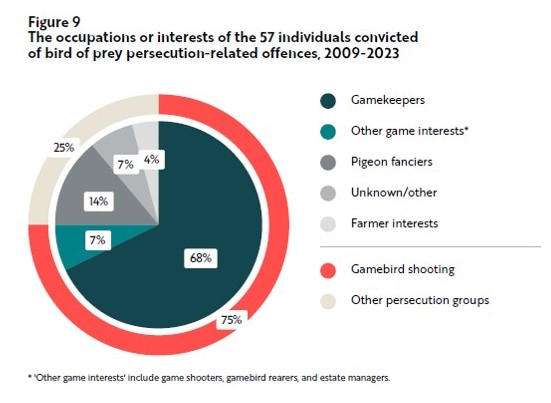
Andrew then tried to use some tightly-selected prosecution data (produced by the RSPB – which, er, he’d just accused of being an unreliable source) to demonstrate that gamekeepers weren’t responsible for killing birds of prey. He chose a single year of data (last year’s) that just happened to not include any prosecutions of gamekeepers, and he used that as his sole evidence base to support his argument.
Had he picked any other year from the last fifteen or so, there’d quite likely be a gamekeeper conviction or two in there. However, selecting just a single year of data is wholly misrepresentative when you’re looking at trends, and a trend is exactly what we’re looking at when discussing which profession is most closely linked with the illegal persecution of birds of prey. To reliably identify a long-term trend you need to look at several years worth of data, and when you do that, here’s what the data tell us – it couldn’t be clearer:
Andrew’s not averse to using long-term trend data when it suits his argument though – he stated that, “Hen Harriers are now at a 200-year high“. The problem with that argument is that he forgot to mention what the baseline was for that trend – Hen Harriers were virtually extirpated (locally extinct) in England as a breeding species by the late 19th Century, primarily due to persecution, so any increase since then is bound to look impressive!
He also forgot to mention that last year the Hen Harrier breeding population in England was in decline again; this year’s figures have not yet been released but the word on the ground is that the numbers have dropped further, and notably on driven grouse moors. The illegal killing continues – at least 143 Hen Harriers have ‘disappeared’ in suspicious circumstances or have been found illegally killed since 2018, most of them on or close to driven grouse moors, with at least 14 more cases yet to be publicised (see here).
I find it endlessly fascinating that the grouse shooting industry will claim ownership of a (short-lived) increase in the Hen Harrier breeding population on driven grouse moors and yet will absolve itself from any responsibility for the illegal killing of Hen Harriers on, er, driven grouse moors.
Rod moved the discussion on to heather burning and Andrew’s contortions were unceasing. He argued that moorland burning has been happening in the UK for 6,000 years, as though a reference to the slash and burn agriculture of the Neolithic period justifies the continued burning of moorland in the 21st Century.
Society, and science, has moved on, and we now know that the repeated burning of blanket bog is inconsistent with the UK’s international responsibilities to maintain/restore blanket bog to favourable conservation status. We know that only 16.4% of the UK’s SAC blanket peatlands are in good conservation condition, and we also know that burning on deep peat grouse moors continues, despite recent legislation that makes it illegal inside protected areas.
In 2023, two grouse moor owners were convicted for burning on deep peat in protected areas, one in the Peak District (here) and one in Nidderdale; embarrassingly, that estate was owned by a Board member of the Moorland Association (here) and that’s perhaps why Andrew failed to mention it.
All in all, I’m thankful that Rod Liddle hosted this discussion. Not because it moved the conversation on – it didn’t, at all – but because I think it demonstrated that The Moorland Association is still utterly incapable of moving with the times. Its grotesque and snide distortion of reality is laid bare for all to see. Negotiation remains futile against such perverse denial.
The campaign to ban driven grouse shooting will continue. Watch this space.





 Raptor Persecution UK