72 hen harriers confirmed ‘missing’ or illegally killed since 2018, most of them on or close to UK grouse moors

For anyone who still wants to pretend that the grouse shooting industry isn’t responsible for the systematic extermination of hen harriers on grouse moors across the UK, here’s the latest catalogue of crime that suggests otherwise.

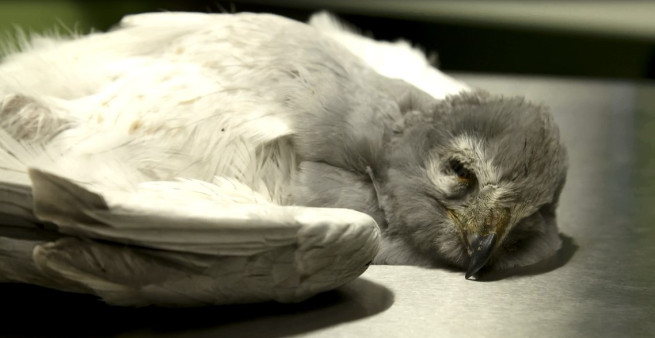
[This male hen harrier died in 2019 after his leg was almost severed in an illegally set trap that had been placed next to his nest on a Scottish grouse moor (see here). Photo by Ruth Tingay]

This is the blog I now publish after every reported killing or suspicious disappearance.

They disappear in the same way political dissidents in authoritarian dictatorships have disappeared” (Stephen Barlow, 22 January 2021).

Today the list has been updated to include the two most recently reported victims, two young satellite-tagged hen harriers that ‘disappeared’ earlier this year, one in Cumbria on 12th April 2022 and one in the North Pennines in May 2022 and are both the subject of a police investigation (see here).

I’ve been compiling this list only since 2018 because that is the year that the grouse shooting industry ‘leaders’ would have us believe that the criminal persecution of hen harriers had stopped and that these birds were being welcomed back on to the UK’s grouse moors (see here).

This assertion was made shortly before the publication of a devastating new scientific paper that demonstrated that 72% of satellite-tagged hen harriers were confirmed or considered likely to have been illegally killed, and this was ten times more likely to occur over areas of land managed for grouse shooting relative to other land uses (see here).

2018 was also the year that Natural England issued a licence to begin a hen harrier brood meddling trial on grouse moors in northern England. For new blog readers, hen harrier brood meddling is a conservation sham sanctioned by DEFRA as part of its ludicrous ‘Hen Harrier Action Plan‘ and carried out by Natural England (NE), in cahoots with the very industry responsible for the species’ catastrophic decline in England. For more background see here.

Brood meddling has been described as a sort of ‘gentleman’s agreement’ by commentator Stephen Welch:

I don’t get it, I thought the idea of that scheme was some kind of trade off – a gentleman’s agreement that the birds would be left in peace if they were moved from grouse moors at a certain density. It seems that one party is not keeping their side of the bargain“.

With at least 72 hen harriers gone since 2018, I think it’s fair to say that the grouse shooting industry is simply taking the piss. Meanwhile, Natural England pretends that ‘partnership working’ is the way to go and DEFRA Ministers remain silent.

‘Partnership working’ according to Natural England appears to include authorising the removal of hen harrier chicks from a grouse moor already under investigation by the police for suspected raptor persecution (here) and accepting a £75k bung from representatives of the grouse shooting industry that prevents Natural England from criticising them or the sham brood meddling trial (see here). This is in addition to a £10k bung that Natural England accepted, under the same terms, in 2021 (here).

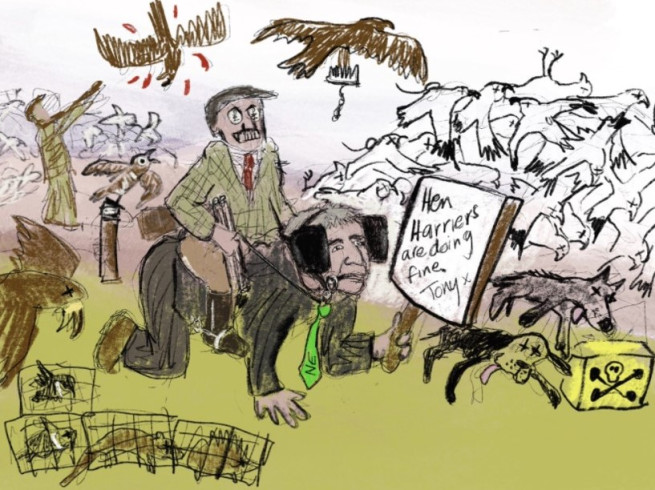
[Cartoon by Gill Lewis]

So here’s the latest gruesome list. Note that the majority of these birds (but not all) were fitted with satellite tags. How many more [untagged] harriers have been killed?

February 2018: Hen harrier Saorsa ‘disappeared’ in the Angus Glens in Scotland (here). The Scottish Gamekeepers Association later published wholly inaccurate information claiming the bird had been re-sighted. The RSPB dismissed this as “completely false” (here).

5 February 2018: Hen harrier Marc ‘disappeared’ on a grouse moor in Durham (here)

9 February 2018: Hen harrier Aalin ‘disappeared’ on a grouse moor in Wales (here)

March 2018: Hen harrier Blue ‘disappeared’ in the Lake District National Park (here)

March 2018: Hen harrier Finn ‘disappeared’ near Moffat in Scotland (here)

18 April 2018: Hen harrier Lia ‘disappeared’ in Wales and her corpse was retrieved in a field in May 2018. Cause of death was unconfirmed but police treating death as suspicious (here)

8 August 2018: Hen harrier Hilma ‘disappeared’ on a grouse moor in Northumberland (here).

16 August 2018: Hen harrier Athena ‘disappeared’ on a grouse moor in Scotland (here)

26 August 2018: Hen Harrier Octavia ‘disappeared’ on a grouse moor in the Peak District National Park (here)

29 August 2018: Hen harrier Margot ‘disappeared’ on a grouse moor in Scotland (here)

29 August 2018: Hen Harrier Heulwen ‘disappeared’ on a grouse moor in Wales (here)

3 September 2018: Hen harrier Stelmaria ‘disappeared’ on a grouse moor in Scotland (here)

24 September 2018: Hen harrier Heather ‘disappeared’ on a grouse moor in Scotland (here)

2 October 2018: Hen harrier Mabel ‘disappeared’ on a grouse moor on the edge of the Yorkshire Dales National Park (here)

3 October 2018: Hen Harrier Thor ‘disappeared’ next to a grouse moor in Bowland, Lanacashire (here)

23 October 2018: Hen harrier Tom ‘disappeared’ in South Wales (here)

26 October 2018: Hen harrier Arthur ‘disappeared’ on a grouse moor in the North York Moors National Park (here)

1 November 2018: Hen harrier Barney ‘disappeared’ on Bodmin Moor (here)

10 November 2018: Hen harrier Rannoch ‘disappeared’ on a grouse moor in Scotland (here). Her corpse was found nearby in May 2019 – she’d been killed in an illegally-set spring trap (here).

14 November 2018: Hen harrier River ‘disappeared’ on a grouse moor in the Nidderdale AONB (here). Her corpse was found nearby in April 2019 – she’d been illegally shot (here).

16 January 2019: Hen harrier Vulcan ‘disappeared’ in Wiltshire close to Natural England’s proposed reintroduction site (here)

7 February 2019: Hen harrier Skylar ‘disappeared’ next to a grouse moor in South Lanarkshire (here)

22 April 2019: Hen harrier Marci ‘disappeared’ on a grouse moor in the Cairngorms National Park (here)

26 April 2019: Hen harrier Rain ‘disappeared’ on a grouse moor in Nairnshire (here)

11 May 2019: An untagged male hen harrier was caught in an illegally-set trap next to his nest on a grouse moor in South Lanarkshire. He didn’t survive (here)

7 June 2019: An untagged hen harrier was found dead on a grouse moor in Scotland. A post mortem stated the bird had died as a result of ‘penetrating trauma’ injuries and that this bird had previously been shot (here)

5 September 2019: Wildland Hen Harrier 1 ‘disappeared’ on a grouse moor nr Dalnaspidal on the edge of the Cairngorms National Park (here)

11 September 2019: Hen harrier Romario ‘disappeared’ on a grouse moor in the Cairngorms National Park (here)

14 September 2019: Hen harrier (Brood meddled in 2019, #183704) ‘disappeared’ in the North Pennines (here)

23 September 2019: Hen harrier (Brood meddled in 2019, #55149) ‘disappeared’ in North Pennines (here)

24 September 2019: Wildland Hen Harrier 2 ‘disappeared’ on a grouse moor at Invercauld in the Cairngorms National Park (here)

24 September 2019: Hen harrier Bronwyn ‘disappeared’ near a grouse moor in North Wales (here)

10 October 2019: Hen harrier Ada ‘disappeared’ on a grouse moor in the North Pennines AONB (here)

12 October 2019: Hen harrier Thistle ‘disappeared’ on a grouse moor in Sutherland (here)

18 October 2019: Member of the public reports the witnessed shooting of an untagged male hen harrier on White Syke Hill in North Yorkshire (here)

November 2019: Hen harrier Mary found illegally poisoned on a pheasant shoot in Ireland (here)

14 December 2019: Hen harrier Oscar ‘disappeared’ in Eskdalemuir, south Scotland (here)

January 2020: Members of the public report the witnessed shooting of a male hen harrier on Threshfield Moor in the Yorkshire Dales National Park (here)

23 March 2020: Hen harrier Rosie ‘disappeared’ at an undisclosed roost site in Northumberland (here)

1 April 2020: Hen harrier (Brood meddled in 2019, #183703) ‘disappeared’ in unnamed location, tag intermittent (here)

5 April 2020: Hen harrier Hoolie ‘disappeared’ on a grouse moor in the Cairngorms National Park (here)

8 April 2020: Hen harrier Marlin ‘disappeared’ on a grouse moor in the Cairngorms National Park (here)

19 May 2020: Hen harrier Fingal ‘disappeared’ on a grouse moor in the Lowther Hills, Scotland (here)

21 May 2020: Hen harrier (Brood meddled in 2019, #183701) ‘disappeared’ on a grouse moor in Cumbria shortly after returning from wintering in France (here)

27 May 2020: Hen harrier Silver ‘disappeared’ on a grouse moor on Leadhills Estate, Scotland (here)

2020: day/month unknown: Unnamed male hen harrier breeding on RSPB Geltsdale Reserve, Cumbria ‘disappeared’ while away hunting (here)

9 July 2020: Unnamed female hen harrier (#201118) ‘disappeared’ from an undisclosed site in Northumberland (here).

25 July 2020: Hen harrier Harriet ‘disappeared’ on a grouse moor in the Yorkshire Dales National Park (here)

14 August 2020: Hen harrier Solo ‘disappeared’ in confidential nest area in Lancashire (here)

7 September 2020: Hen harrier Dryad ‘disappeared’ on a grouse moor in the Yorkshire Dales National Park (here)

16 September 2020: Hen harrier Fortune ‘disappeared’ from an undisclosed roost site in Northumberland (here)

19 September 2020: Hen harrier Harold ‘disappeared’ on a grouse moor in the Yorkshire Dales National Park (here)

20 September 2020: Hen harrier (Brood meddled in 2020, #55152) ‘disappeared’ next to a grouse moor in North Yorkshire (here)

24 February 2021: Hen harrier Tarras ‘disappeared’ next to a grouse moor in Northumberland (here)

12th April 2021: Hen harrier Yarrow ‘disappeared’ near Stockton, County Durham (here)

18 May 2021: Adult male hen harrier ‘disappeared’ from its breeding attempt on RSPB Geltsdale Reserve, Cumbria whilst away hunting (here)

18 May 2021: Another adult male hen harrier ‘disappeared’ from its breeding attempt on RSPB Geltsdale Reserve, Cumbria whilst away hunting (here)

24 July 2021: Hen harrier Asta ‘disappeared’ at a ‘confidential site’ in the North Pennines (here). We learned 18 months later that her wings had been ripped off so her tag could be fitted to a crow in an attempt to cover up her death (here).

14th August 2021: Hen harrier Josephine ‘disappeared’ at a ‘confidential site’ in Northumberland (here)

17 September 2021: Hen harrier Reiver ‘disappeared’ in a grouse moor dominated region of Northumberland (here)

24 September 2021: Hen harrier (Brood meddled in 2021, R2-F-1-21) ‘disappeared’ in Northumberland (here)

15 November 2021: Hen harrier (brood meddled in 2020, #R2-F1-20) ‘disappeared’ at the edge of a grouse moor on Arkengarthdale Estate in the Yorkshire Dales National Park (here)

19 November 2021: Hen harrier Val ‘disappeared’ in the Lake District National Park in Cumbria (here)

19 November 2021: Hen harrier Percy ‘disappeared’ in Lothian, Scotland (here)

12 December 2021: Hen harrier Jasmine ‘disappeared’ on a grouse moor (High Rigg Moor on the Middlesmoor Estate) in the Nidderdale AONB in North Yorkshire (here)

9 January 2022: Hen harrier Ethel ‘disappeared’ in Northumberland (here)

26 January 2022: Hen harrier Amelia ‘disappeared’ in Bowland (here)

10 February 2022: An unnamed satellite-tagged hen harrier ‘disappeared’ in a grouse moor dominated area of the Peak District National Park (here)

12 April 2022: Hen harrier ‘Free’ (Tag ID 201121) ‘disappeared’ at a ‘confidential site’ in Cumbria (here).

May 2022: A male breeding hen harrier ‘disappeared’ from a National Trust-owned grouse moor in the Peak District National Park (here).

May 2022: Another breeding male hen harrier ‘disappeared’ from a National Trust-owned grouse moor in the Peak District National Park (here)

14 May 2022: Hen harrier ‘Harvey’ (Tag ID 213844) ‘disappeared’ from a ‘confidential site’ in the North Pennines (here).

To be continued……..

Not one of these 72 incidents has resulted in an arrest, let alone a prosecution. I had thought that when we reached 30 dead/missing hen harriers then the authorities might pretend to be interested and at least say a few words about this national scandal. We’ve now reached SEVENTY TWO hen harriers, and still Govt ministers remain silent. They appear not to give a monkey’s. And yes, there are other things going on in the world, as always. That is not reason enough to ignore this blatant, brazen and systematic destruction of a supposedly protected species, being undertaken to satisfy the greed and bloodlust of a minority of society.

Please consider sending a copy of this list of dead/missing hen harriers to your elected representative. Ask them for their opinion, tell them your opinion, and demand action (politely please). We know where these crimes are happening and we know why they’re happening. The Government’s own data, published three years ago, have provided very clear evidence (see here). MPs need to know how many of us care about this issue and how we will not be fobbed off by disingenuous platitudes from DEFRA Ministers (e.g. see hereherehere and here for repeated recent examples of this).

Not sure who is your MP? Click here to find out.

Don’t be put off by thinking, ‘Well my MP is a grouse shooter, he/she won’t bother responding so why should I bother?’. Do not give these politicians an easy option out. As your elected representative they have a duty to listen to, and respond to, constituents’ concerns, whether they agree with them or not.

If you use social media, please share this post.

If you fancy scribbling a few sentences to your local newspaper or even a national one, please do.

Please talk to friends, family and colleagues about these 72 birds. They will be horrified about what’s being allowed to go on.

We MUST increase public awareness. It’s up to all of us.

Hen harrier persecution continues amid increased breeding success

There’s been quite a lot of news about hen harriers in the last couple of weeks as this year’s breeding figures have been announced: 119 chicks from 49 nests, 34 nests being successful (see Natural England press release here).

That is the highest number of chicks fledged in over a century, according to Natural England, but there are many questions still to be answered about these figures and as ever, Natural England isn’t being transparent with the results.

I’d like to know how many of the 49 nests were on privately-owned grouse moors. Not on tenanted grouse moors (e.g. like National Trust and water utility companies’ land) where tenants are now at risk of having their shooting leases withdrawn if persecution takes place, e.g. see here), not on RSPB reserves, or Forestry England land – but on actual privately owned moors managed for driven grouse shooting. I think it’s telling that this detail has not been provided.

13 of this year’s 119 chicks were ‘brood meddled’ from four nests at unknown locations in northern England – not very impressive considering 13 chicks successfully fledged from a single site, the Tarras Valley Nature Reserve, without any need for brood meddling.

For new readers, hen harrier brood meddling is a conservation sham sanctioned by DEFRA as part of its ludicrous ‘Hen Harrier Action Plan‘ and carried out by Natural England (NE), in cahoots with the very industry responsible for the species’ catastrophic decline in England. For more background see here. Brood meddling is in place entirely as a result of the authorities failure to stop grouse moor managers from illegally killing this species. Instead of prosecuting these criminals, the Government has sanctioned the removal of the harriers from the grouse moors, to be reared in captivity and then released somewhere else to become targets for being killed on another grouse moor later in the year.

The hen harrier brood meddling conservation sham is a five-year trial, started in 2018 and is being used to assess whether grouse moor owners’ attitudes towards hen harriers will change. I look forward to reading the scientific committee’s report, but judging by the continued persecution of this species on driven grouse moors, it can hardly be described as a brilliant success. A brilliant wheeze, perhaps, from the point of view of the grouse moor owners who’ve had harriers legally and forcibly removed from their moors, but a conservation success? How can it be when the original cause of the species’ decline (illegal persecution) hasn’t been addressed and is ongoing?

We already know that since 2018 when the brood meddling trial began, at least 70 hen harriers have either been illegally killed or have ‘disappeared’ in suspicious circumstances, most of them on or close to driven grouse moors (see here). A scientific paper published in 2019, using the Government’s own data, demonstrated the unequivocal link between hen harrier persecution and driven grouse shooting (here).

And even in this latest press release from Natural England, we’re told that 15 hen harrier nests failed this year, “including failures subsequently investigated by the police“. How many were investigated? Where were they? How many were on privately-owned grouse moors? What were the outcomes of the police investigations? Why hasn’t there been any publicity about these suspected crimes?

The press release also reveals that since March this year, three more satellite-tagged hen harriers have ‘disappeared’, with at least two of them the subject of police investigations. Why hasn’t there been any publicity about these suspected crimes? I will update my list of dead/missing hen harriers shortly.

It continues to be a source of huge frustration that Natural England will go all-out promoting the ‘good news’ stories about hen harriers but never provides prominence to the ongoing cases of illegal persecution. I’m sure the £75k bung it’s received from the game-shooting industry has absolutely nothing to do with it.

I also note that Natural England’s press release says absolutely nothing about the unspeakable atrocity inflicted on hen harrier Asta, whose wings were torn off so her satellite tag could be fitted to a crow in an attempt to deceive the authorities that Asta was alive and well.

Changed attitudes? I don’t think so.

UPDATE 4th September 2022: Natural England utterly compromised on tackling hen harrier persecution (here)

Good news! Sidelined Dorset wildlife crime cop joins National Wildlife Crime Unit

Claire Dinsdale QPM, the wildlife crime officer who was leading on the Dorset eagle poisoning case until senior officers decided to close the investigation prematurely after what looked suspiciously like political interference (here), has left Dorset Police and has taken up a new role with the National Wildlife Crime Unit (NWCU).

This is really good news! Claire was held in very high regard by those involved in tackling wildlife crime and her dedication to the role saw her contributing thousands of hours of her own time, on top of her normal police duties, to gather evidence to identify suspects and increase the chances of them being charged. She was awarded the Queen’s Police Medal in 2020 for her efforts.

A twitter spat with local Conservative MP Chris Loder, followed by senior officers’ inexplicable decision to block the investigation into the poisoned eagle, led to Claire going on long-term sick leave in March this year.

I’m delighted to see her move to the NWCU where hopefully her contributions will be valued and supported.

Perspective required as National Trust celebrates two successful hen harrier nests in Peak District National Park

The National Trust is celebrating two successful hen harrier breeding attempts in the Peak District National Park this year, in what it describes as ‘the most successful year for hen harrier breeding in the Peak District for over a decade‘.

Here is a press release issued by the National Trust this morning:

National Trust records most successful year for hen harrier breeding in the Peak District for over a decade

Seven hen harriers have successfully fledged from multiple nests on National Trust land in the High Peak, making 2022 the most successful year for hen harrier breeding on land cared for by the conservation charity in the Peak District for over a decade, despite two nest failures earlier this year.

[Hen harrier chicks, photo by Tim Melling]

The National Trust, RSPB and Peak District Raptor Group have been working closely together to encourage more birds of prey to live and thrive in the Peak District, by protecting birds currently living there, whilst also creating rich feeding and nesting grounds.

Work undertaken by the Trust includes cutting heather to allow a more diverse range of moorland plants such as sphagnum moss, bilberry and cottongrass to grow, which helps attract the different insects and small mammals which the birds rely upon for food. The charity is also working closely with tenants to ensure their land management practices support the vision for more birds of prey in the area.

Craig Best, General Manager of the National Trust in the Peak District said:A great deal of work has gone into encouraging more breeding pairs of these majestic birds to the Peak District, so this is brilliant news.

The presence of the birds indicates a plentiful and healthy food source, which shows the work we have done so far to improve the landscape is starting to provide ideal conditions for different species to thrive. However, we want to see more of these important birds of prey in the High Peak, as they play an important role in creating the right ecological balance in the landscape. That is why it is crucial that we continue to work together to achieve our aim of growing the population of birds of prey in the area and doing everything we can to prevent persecution.”

Mark Thomas, Head of investigations at the RSPB said:

Despite the suspicious loss of two hen harrier nests in this area earlier in the season [Ed: see here] we are delighted that further pairs have bred successfully and raised youngsters. This is a validation of the National Trust’s Moorland Vision, and a testament to the partnership work being undertaken to ensure hen harriers and other species flourish in our uplands. Hen harriers are protected by law – yet a government study in 2019 identified criminal persecution by humans as the main factor suppressing the UK hen harrier population. The Dark Peak is sadly one of the worst areas in the UK for raptor persecution, for this reason we will be keeping a close eye on the continuing survival of the chicks that have been tagged this year.”

To help monitor the birds progress and to aid understanding of the species, the birds have also been fitted with tracking tags by the RSPB and Natural England. The National Trust also works with the local Raptor Monitoring Group.

Mike Price from the Peak District Raptor Monitoring Group said: A mild winter, good prey availability and the fine weather during the nesting period have no doubt all contributed to what appears to be a successful year for breeding Hen Harriers both locally and nationally. It is another step along the journey to get a self-sustaining breeding population of Hen Harriers established in the area. Now the birds have fledged, the birds will face further threats, so we need to continue to work together to remain vigilant and do all we can to protect them.

Visitors and local residents can help with conservation efforts by staying on footpaths and keeping dogs on leads during ground nesting bird season, which lasts from the beginning of March to the end of July.

ENDS

When two nests inside a National Park are deemed a cause for celebration, and they amount to ‘the most successful breeding year for over a decade‘, you get a good idea of just how dire the situation is for hen harriers inside a National Park that has sufficient habitat and prey to host many, many more pairs.

The last time two hen harrier nests were successful on National Trust land in the Peak District National Park was back in 2006, fledging ten chicks. But those two nests were only ‘successful’ because a team of 40+ volunteers provided 24-hour-round-the-clock protection and supplementary feeding after the two breeding males ‘disappeared’ in suspicious circumstances (see here). Shockingly, they were only the second and third pairs to nest there in 140 years!

The National Trust was praised in 2016 when it terminated the shooting lease on one of its moors after video evidence emerged of an armed gamekeeper laying in wait next to a decoy hen harrier, presumably with the intention of luring in a live harrier and shooting it at close range (see here and here).

But despite that bold move by the National Trust, the suspected persecution of hen harriers in this National Park continues.

In 2018, a young satellite-tagged hen harrier called Octavia ‘disappeared’ in suspicious circumstances on a privately-owned grouse moor in the Peak District National Park (here).

In 2021, a displaying pair of hen harriers ‘disappeared’ in suspicious circumstances on another privately-owned grouse moor in the Peak District National Park (see here).

In February this year, another satellite-tagged hen harrier ‘disappeared’ in suspicious circumstances on another privately-owned grouse moor, neighbouring the grouse moor where Octavia vanished 4 years earlier (see here).

In May this year, two active hen harrier nests were abandoned on a National Trust-leased moor after the suspicious disappearance of two more breeding males, leaving ten eggs to chill and die (see here).

So actually, the news that two hen harrier nests have been successful this year on National Trust land inside the Peak District National Park goes against all the odds and for that, the National Trust, the Peak District Raptor Monitoring Group and the RSPB deserve to celebrate. However, as is emphasised in the National Trust press release, the seven fledglings are still not safe and face ongoing threats both inside the National Park and beyond.

Let’s see how long it takes before they feature on this sobering list of 70 (so far) hen harriers illegally killed or vanished in suspicious circumstances in the UK since 2018.

UPDATE 24th August 2022: Excellent BBC regional news coverage of hen harrier persecution & conservation in Peak District National Park (here)

Goshawk nest attacked in Peak District National Park – Derbyshire Police appeal for information

An appeal for information by Derbyshire Police’s Rural Crime Team (21st August 2022):

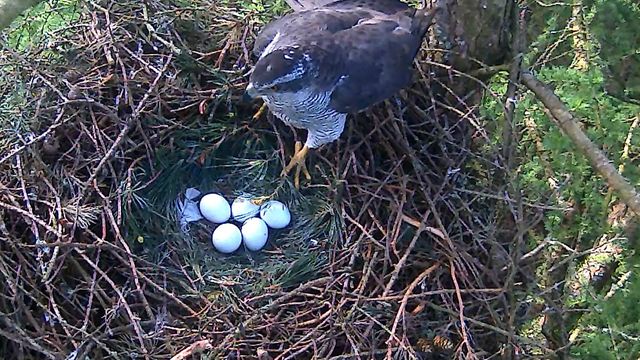
‘Back in June this year a larch tree at Westend in the Upper Derwent Valley which was home to a pair of goshawks was found to have been interfered with. Sadly, the birds abandoned the site and it was discovered that the tree had drilled holes and bolts all the way up it which we believe to be evidence of how the nest had been accessed. A local ornithologist had confirmed the presence of eggs in the nest prior to all this but had then found the be no longer there.

[A goshawk nest, photo by Archant]

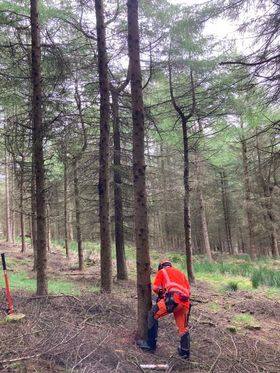
With help from Forestry England staff a forensic examination was carried out on the tree and items were submitted to the lab.

We are appealing to anyone who may be able to provide information to help with this enquiry.

Thank you‘.

ENDS

[Photo of the forensic examination of the goshawk’s nest tree. Photo by Derbyshire Police]

Goshawks in the Dark Peak area of the Peak District National Park have been the target of relentless illegal persecution for decades, along with a number of other raptor species including peregrine and hen harrier (the most recent incident reported earlier this summer – here).

The majority of these crimes have been linked to driven grouse shooting. For new blog readers, the following reports and scientific papers provide good background evidence:

Illegal baited trap in Airdrie ‘a deliberate attempt to attract wild birds’, particularly birds of prey

Press release from the Scottish SPCA (17th August 2022):

Appeal for information after Jackdaw caught in illegal trap in Airdrie

The Scottish SPCA has appealed for information after a Jackdaw was found in an illegal spring trap in Plains, Airdrie, on 18th May 2022.

Scotland’s animal welfare charity was alerted to the incident by a member of the public who discovered the live bird in the trap.

A Scottish SPCA special investigations unit inspector, who cannot be named due to undercover operations, said: “Sadly, the Jackdaw caught in the trap had sustained such horrendous injuries that they had to be put to sleep to end their suffering.

The bird was caught in the trap by their left leg. A post mortem showed the leg had a severe open fracture and was partially amputated causing severe pain and suffering.

The spring trap was illegally set and had deer legs scattered around it as bait, in what appears to be a deliberate attempt to attract wild birds.

We are appealing to the local community to pass on any information relating to a person, or persons, illegally killing birds, particularly birds of prey.

These traps are unlawful and indiscriminate and will cause unnecessary suffering to any bird or animal caught in them.

If anyone knows who this device might belong to then we would urge them to phone our animal helpline immediately on 03000 999 999. All calls can be treated confidentially.

Equally, if anyone spots an illegal trap such as this, or a trap or snare they suspect is illegal, please don’t hesitate to contact us.”

ENDS

GWCT disregards police investigation into alleged wildlife crime on Van Cutsem’s Norfolk estate

Last week I wrote about how former Cabinet Secretary Fergus Ewing MSP, the Scottish Gamekeepers Association, and landowners’ lobby group Scottish Land & Estates had shown complete disregard for the sanction imposed on Moy Estate after raptor persecution crimes had been recorded there (see here).

This week it’s the turn of the Game & Wildlife Conservation Trust (GWCT) to seemingly turn a blind eye.

Have a look at this event currently being promoted on GWCT’s website:

Regular readers will know that Hilborough House is the home of William van Cutsem. In May this year, police raided the estate after video footage emerged of alleged raptor persecution.

The footage, captured on a secret camera installed by the Hunt Investigation Team, appeared to show a crow cage trap in woodland alleged to be on the Hilborough Estate. The trap had been baited with live pigeons (this is an offence) and a young goshawk was attracted to the bait, entered the trap and then couldn’t escape. A masked man is then recorded entering the trap, pinning the goshawk to the side netting with a stick so he could grab the bird, and then removing it from the trap and walking away with it (also an offence). The goshawk’s fate is not shown.

As far as I’m aware, the police investigation is ongoing.

Mr Van Cutsem hasn’t commented publicly about this investigation although in a classic attempt at diversion, the Mail on Sunday ran a piece quoting ‘an unnamed source close to Mr van Cutsem’ who questioned the relationship between the Hunt Investigation Team and the RSPB:

What also is interesting is how close HIT works with the RSPB. It would be good to understand how a mainstream charity is working with a shady group’. 

Oh the irony!

RSPB wants ‘action & delivery’ from Scottish Government on grouse moor licensing scheme

RSPB Scotland has published a blog today calling for ‘action and delivery’ from the Scottish Government on its promised grouse moor licensing scheme.

The Government announced in November 2020 that grouse shooting businesses in Scotland will need to be licensed to operate, under new proposals to tackle raptor persecution.

It also announced that muirburn will also only be permitted under licence, in order to protect wildlife and habitats, regardless of the time of year it is undertaken and whether or not it is for grouse moor management or improving grazing.

The Government stated there will also be a statutory ban on burning on peatland, except under licence for strictly limited purposes, such as approved habitat restoration projects.

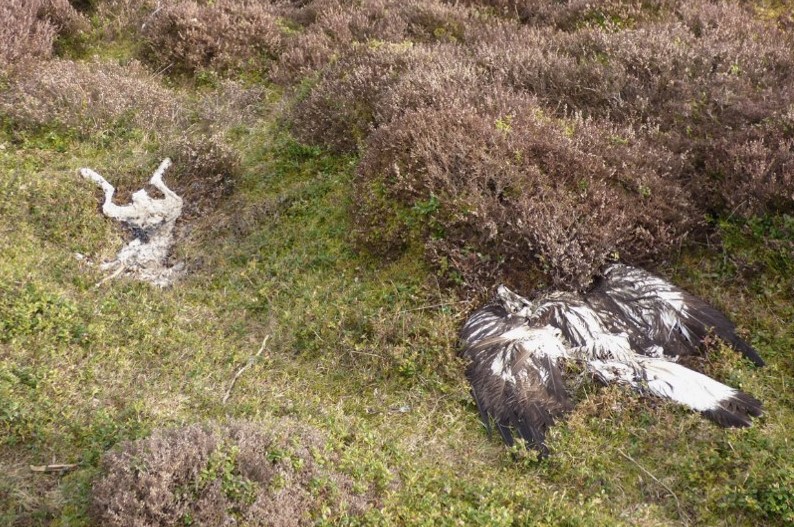
Since that announcement in November 2020, there hasn’t been any further action, but there has been plenty more evidence of illegal raptor persecution, including the poisoning of this golden eagle on a grouse moor at Invercauld Estate in the Cairngorms National Park:

RSPB Scotland writes:

We have been very patient, but nearly 20 months on from this announcement, we want to see some action and delivery on these promises by the Scottish Government. Proposals must be brought forward in the forthcoming Programme for Government in autumn 2022 for the introduction of grouse moor and muirburn licensing legislation in the next Parliamentary year“. 

You can read the full RSPB blog here.

Sparrowhawk shot and another suspected shot – Police & SSPCA investigate

Police Scotland and the Scottish SPCA have launched an investigation after the confirmed shooting of a sparrowhawk and the suspected shooting of another, found in the same area of Renfrewshire in April, one week apart.

The following article is from the Daily Record (dated 15th July 2022):

Two birds of prey ‘shot dead’ in Renfrewshire as probe launched.

Animal welfare chiefs say they suspect that two birds of prey have been shot dead in the space of a week.

The Scottish SPCA is working with Police Scotland as they look into the incidents after a firearm was confirmed as being used in one of the Sparrowhawk’s death.

One bird had to be put to sleep, while another was found dying with suspicious injuries which the SSPCA believe may be linked. A bird initially thought to have been stunned was found on Lochwinnoch Golf Course, Renfrewshire, on April 5 but its injuries were unsurvivable.

An undercover Scottish SPCA special investigations unit inspector said: “It was initially thought that the bird had been stunned but upon examination at the Scottish SPCA National Wildlife Rescue Centre in Fishcross, it was discovered that they had been shot.

This caused a catastrophic shoulder injury and sadly resulted in the bird having to be put to sleep.

Another member of the public also reported finding another sparrowhawk the week before, which was bleeding from the wing. Unfortunately, that bird died before help could be called for.

It is unknown if they had also been shot but it’s certainly very suspicious that two sparrowhawks with similar injuries were found in the same area only a week apart.

We are working closely with Police Scotland to establish the circumstances around the bird’s injuries due to the use of a firearm in the incident.

We would like to find out what happened to this sparrowhawk.

If anyone witnessed anything or has any information they feel may be relevant they can contact our confidential animal helpline on 03000 999 999 or Police Scotland on 101, quoting incident number KB01540722 of 5 April 2022.”

ENDS

Farmer receives pathetic fine for poisoning two buzzards & a raven

This article appeared in The Journal today:

Farmer fined €500 for poisoning protected bird species in Co Wicklow

By Lauren Boland

A FARMER HAS been fined for poisoning protected birds in Co Wicklow after pleading guilty to what a judge described as a “serious crime”.

Christopher Thomas Noel Doyle, also known as Noel Doyle Senior, with an address at Crehelp in Co Wicklow, came before the Carlow District Court over a breach of restrictions on the use of poisoned bait.

The judge imposed a €500 fine and €1,500 in expenses that he must pay within four months.

A conservation ranger told the court he had discovered two dead buzzards, a dead raven, and a sheep carcass on lands at Athgreaney, Co Wicklow.

[Buzzard, photographer unknown]

The court heard that the ranger first found a dead buzzard and after further investigation identified a second dead buzzard, a dead raven, and a sheep carcass placed near a fox den.

Post-mortems by the Department of Agriculture and testing by Dublin Regional Veterinary Laboratory and the State Laboratory found that the birds died due to high levels of poison (carbofuran) in their systems.

The sheep had been cut open and the wound was laced with large amounts of carbofuran.

The ranger said that the levels of poison were extremely hazardous to all forms of life and that it was very fortunate that no humans had been accidentally poisoned.

He said it was likely that other wild animals had scavenged the carcasses and died from poisoning but were never found. 

Judge Marie Keane said there was an “astonishing amount of poison” used in what she described as a “serious crime” and “a deliberate enterprise” to try to persecute the local wildlife.

In a statement, Minister of State for Heritage Malcolm Noonan called it a “particularly heinous and disturbing wildlife crime”.

Buzzards are a protected species and deliberate poisoning of them is an offence under the Birds and Natural Habitats (Restrictions on the Use of Poisoned Bait) Regulations 2010.

Carbofuran was previously used as a pesticide in agriculture but is now banned because of its toxicity to wildlife, especially to birds.

Approval for the use of carbofuran products was withdrawn throughout the EU in 2007, including in Ireland in December of that year.

After an 18-month period to use up remaining stock, it was banned fully from 2009.

ENDS