Blog

Raptor persecution in Northern Ireland: 2014 annual report published

ni-persecution-reportPress release from Partnership for Action against Wildlife Crime (Northern Ireland)

NI raptor deaths rise, new report reveals

A report into the illegal killing of Northern Ireland’s native birds of prey has been published by the Partnership for Action against Wildlife Crime. It reveals there were nine confirmed illegal poisoning or persecution incidents, affecting 11 protected birds of prey, in Northern Ireland in 2014. This report follows on from the 2009 – 2013 Persecution Report published last year. Between 2009 and 2014 there is now a total of 44 confirmed reports of native birds of prey being illegally killed, plus one confirmed incident of illegal nest destruction.

The report examines occurrence and trends in persecution of these birds, which has allowed PAW to produce ‘hot-spot’ maps to identify areas where crimes against birds of prey are occurring. Of the nine confirmed cases in 2014, four of these occurred in County Down, two in County Tyrone and one in each of counties Londonderry, Armagh and Antrim. The report shows that the most frequent casualties were buzzards and the recently re-introduced red kite, with four of each of these species killed. Red kites and buzzards are particularly susceptible to poisoned baits as they will scavenge on carrion routinely. There were also two peregrine falcons and a sparrowhawk killed.

Four of the incidents involved the use of the highly toxic pesticide ‘Carbofuran’, which has been banned across the EU since 2001. The poison has often been laid illegally to target ‘pest species’ and the birds of prey have fallen victim to its indiscriminate use. However some species or nests have been specifically targeted. Seven birds also tested showed detectable levels of secondary poisoning by rodenticides (bromadiolone, brodifacoum, difenacoum, and/or flocoumafen) – suggesting that these birds have eaten rodents that have ingested rodenticides.  The levels of these chemicals were not deemed to have been the primary cause of death of these birds but highlight that there is misuse of ‘over the counter’ pesticides across Northern Ireland. Users must always read and adhere to the label instructions of the pesticide; they should collect and correctly dispose of any rodent carcasses daily.

Commenting on the report, Minister for Agriculture, Environment and Rural Affairs (DAERA) Michelle McIlveen MLA, said: “This report highlights the ongoing disregard for the safety of people and animals in our countryside through the illegal use of highly toxic poisons.

The loss of vulnerable birds of prey to acts of persecution is extremely worrying, as they are a keystone species in our ecosystem and play an important role in the natural order. Maintaining and enhancing biodiversity is a central objective of my Department. I call on those responsible for these reckless acts to cease doing so and I urge anyone who may have information about these crimes to contact the PSNI or Crimestoppers.” 

Superintendent, Brian Kee, PSNI service lead for rural and wildlife crime added: It isn’t acceptable for birds of prey or any other wildlife to be killed in this way.  These actions are illegal and the use of toxic poisons is indiscriminate as they put children, pets and livestock at risk too. I would urge anyone with any information on these types of crimes to report this to the PSNI on 101 or anonymously via Crimestoppers on 0800 555 111 and be assured of PSNI continued efforts in the tackling of wildlife crime.”

The report lead author, Dr Eimear Rooney (Raptor Officer for NIRSG) commented: “This is the second report which maps the confirmed bird of prey persecution incidents in Northern Ireland. It is great to have the partner agencies working closely together to combat raptor persecution. This report helps us all to understand the scale and distribution of the problem. It is heart-breaking to think of the deaths of these birds but it is particularly shocking to see the continued usage of highly toxic Carbofuran.”

END

Download the 2014 report here: northern-ireland-raptor-persecution-report-2014

Red kite dead on nest (photo by Northern Ireland Raptor Study Group)

red-kite-dead-on-nest-c-nirsg

Notes to editors:

  • Raptor Persecution is one of the UK Government’s top six Wildlife Crime priorities. Raptor crimes typically comprise illegal poisoning, shooting or trapping events and may occur at any time of the year. It is also illegal to cause disturbance to all breeding raptors or damage their nests or eggs.
  • The Raptor Priority Subgroup comprises Police Service of Northern Ireland (PSNI); Northern Ireland Environment Agency (NIEA); National Wildlife Crime Unit (NWCU); Northern Ireland Raptor Study Group (NIRSG); the Royal Society for Protection of Birds (RSPB); Agri-food and Biosciences Institute (AFBI) and the Health and Safety Executive for Northern Ireland (HSE NI). The Raptor Priority Sub-Group is acting on behalf of and reports back to the main PAW NI steering group currently chaired by the NIEA.
  • Wildlife legislation, namely the Wildlife (Northern Ireland) Order 1985 as amended by the Wildlife and Natural Environment (NI) Act 2011 protects birds of prey from disturbance and/or destruction by special penalties. Penalties can include a custodial sentence and/or up to a £5,000 fine per offence. All raptors are listed on Schedule 1 of the order and there are six raptor species which receive additional protection on Schedule A1 which protects their nests from disturbance or destruction at all times of the year. Schedule A1 includes peregrine falcon, red kite, barn owl, golden eagle white-tailed eagle and osprey.
  • In March 2016 the PSNI, in partnership with the PAWNI Raptor Subgroup members, launched ‘Operation Raptor’. This campaign was developed as a direct result of the publication of the first Bird of Prey Persecution and Poisoning Report, covering the period 2009 – 2013. The ‘Operation Raptor’ campaign is designed to encourage people to report potential crimes to PSNI and also to warn offenders they could face a custodial sentence and/or a fine (up to £5,000 per offence) if they are caught targeting birds of prey through poisoning, shooting or trapping.  Operation Raptor posters are being distributed into ‘hot spot’ areas to highlight the illegal practises to local members if the public, to act as a deterrent to those who seek to kill birds of prey.
  • The Campaign for Responsible Rodenticide Use (CRRU) aims to promote best practice so that rat poisons (rodenticides) in particular should not get into the wildlife food chain where it harms owls, kites and other birds of prey. More information on this can be found at www.thinkwildlife.org
  • A leaflet outlining the protocol for reporting raptor crimes was previously produced by the Raptor Subgroup and is available for download at the following link: http://www.nirsg.com/wp-content/uploads/2014/02/PAWNI-Raptor-Crime-Leaflet.pdf
  • The Bird of Prey Persecution and Poisoning Report 2009-2013, produced by the Raptor Subgroup in November 2015, can be downloaded at the following link: https://www.psni.police.uk/globalassets/advice–information/animal-welfare/documents/pawni-raptorpersecution–poisoning-report-2009-2013-final.pdf
  • More information on the public campaign to ‘Watch Out For Wildlife Crime’ in Northern Ireland can be found at www.wildlifecrimeni.org

Statement from Wildlife Estates Scotland on membership status of Newlands Estate

Those of you who’ve been following the long drawn-out saga of prosecutions relating to the wildlife crime that took place on Newlands Estate, Dumfriesshire in 2015 will know that we’ve been asking questions of various organisations associated with this estate.

One of those questions has been about the membership status of the Newlands Estate in the ‘Wildlife Estates Scotland (WES)’ scheme, administered by Scottish Land & Estates. Since Newlands Estate gamekeeper Billy Dick’s conviction (for killing a buzzard) was upheld in July this year, we’ve asked this:

‘Will the Newlands Estate’s accredited membership of Wildlife Estates Scotland (WES) now be revoked? The conditions of membership of this scheme include: “the requirements to maintain best practice standards of animal welfare and comply with all legal requirements and relevant Scottish codes of practice”. At the time of Mr Dick’s conviction, a spokesperson for WES said the Newlands Estate’s membership and accreditation of WES had been ‘voluntarily suspended’ pending the outcome of legal proceedings. Well, now the gamekeeper’s criminal conviction for wildlife offences has been upheld, how about answering the question?’

Four months on, and thanks to blog readers for writing to WES, the following statement has appeared on the WES website this morning:

wes-statement-newlands

So, Newlands Estate is still a member of WES, albeit in a suspended state. Presumably, WES is waiting to find out whether the allegation of vicarious liability is proven against landowner Andrew Duncan during forthcoming legal proceedings.

That’s an interesting position for WES to take. A wildlife crime did take place on Newlands Estate and a Newlands Estate employee was convicted for it. Why isn’t that sufficient cause for WES to expel Newlands Estate? Two conditions of WES membership were clearly breached (“the requirements to maintain best practice standards of animal welfare and comply with all legal requirements and relevant Scottish codes of practice“). Whether Mr Duncan is subsequently convicted or acquitted of vicarious liability is irrelevant and will not erase these facts.

Let’s imagine, for example, that Mr Duncan is exonerated and WES decides to lift the suspension on membership. WES will still have a wildlife crime estate on its membership list. How does that ‘protect the reputation of its membership, as well as the integrity of accreditation itself’? Here’s a hint, WES: IT DOESN’T.

Other questions we’ve been asking since Newlands Estate gamekeeper Billy Dick’s failed appeal in July 2016 are yet to be answered:

  1. Is/was criminal gamekeeper William (Billy) Dick a member of the Scottish Gamekeepers’ Association? The SGA refused to comment on Mr Dick’s membership status at the time, saying they ‘wanted to wait until the legal process had concluded’. Well, now Mr Dick’s criminal conviction for wildlife offences has been upheld, how about answering the question? Emails to: info@scottishgamekeepers.co.uk
  2. Will Scottish Land & Estates now expel the Newlands Estate from the ranks of SLE membership? SLE said at the time that Newlands Estate’s membership of SLE had been ‘voluntarily suspended’ pending on-going legal proceedings. Well, now the gamekeeper’s criminal conviction for wildlife offences has been upheld, how about answering the question? Emails to: info@scottishlandandestates.co.uk

Vicarious liability prosecution: Andrew Duncan (Newlands Estate), part 11

They’re having a laugh.

Criminal proceedings continued yesterday (22 November 2016) against landowner Andrew Walter Bryce Duncan, who is alleged to be vicariously liable for the crimes committed by gamekeeper William (Billy) Dick in April 2014.

Gamekeeper Dick was convicted in August 2015 of killing a buzzard on the Newlands Estate, Dumfriesshire by striking it with rocks and repeatedly stamping on it (see here). Mr Dick was sentenced in September 2015 and was given a £2000 fine (see here). Mr Dick attempted to appeal his conviction but this was refused on 15 July 2016 (see here).

Here’s a quick review of the proceedings against Andrew Duncan so far:

Hearing #1 (18th August 2015): Trial date set for 23rd Nov 2015, with an intermediate diet scheduled for 20th Oct 2015.

Hearing #2 (20th October 2015): Case adjourned. November trial date dumped. Notional diet hearing (where a trial date may be set) scheduled for 18th January 2016.

Hearing #3 (18th January 2016): Case adjourned. Another notional diet & debate scheduled for 11th March 2016.

Hearing #4 (11th March 2016): Case adjourned, pending the result of gamekeeper Billy Dick’s appeal. Another notional diet scheduled for 4th April 2016.

Hearing #5 (4th April 2016): Case adjourned, pending the result of gamekeeper Billy Dick’s appeal. Another notional diet scheduled for 3rd June 2016.

Hearing #6 (3rd June 2016): Case adjourned, pending the result of gamekeeper Billy Dick’s appeal. Another notional diet scheduled for 17th June 2016.

Hearing #7 (17th June 2016): Case adjourned, pending the result of gamekeeper Billy Dick’s appeal. Another notional diet scheduled for 15th July 2016.

Hearing #8 (15 July 2016): Case adjourned. Another notional diet scheduled for 2 August 2016.

Hearing #9 (2 August 2016): Proceedings moved to trial. Intermediate diet scheduled for 15 November 2016 and provisional trial date set for 7/8 December 2016.

Hearing #10 (15 November 2016): The case was adjourned for another intermediate diet scheduled for 22 November 2016. A new trial date may be set depending on what happens during this hearing.

Hearing #11 yesterday (22 November 2016): The case was adjourned for yet another intermediate diet scheduled for 6 December 2016. Trial dates expected to be assigned during this Dec hearing, so presumably the provisional trial dates of 7/8 Dec have been dumped.

Vicarious liability in relation to the persecution of raptors in Scotland (where one person may potentially be legally responsible for the criminal actions of another person working under their supervision) came in to force nearly five years ago on 1st January 2012. To date there have been two successful prosecutions/convictions: one in December 2014 (see here) and one in December 2015 (see here).  One further case did not reach the prosecution stage due, we believe, to the difficulties associated with identifying the management structure on the estate where the crimes were committed (see here).

Brood meddling: the proposed social science study

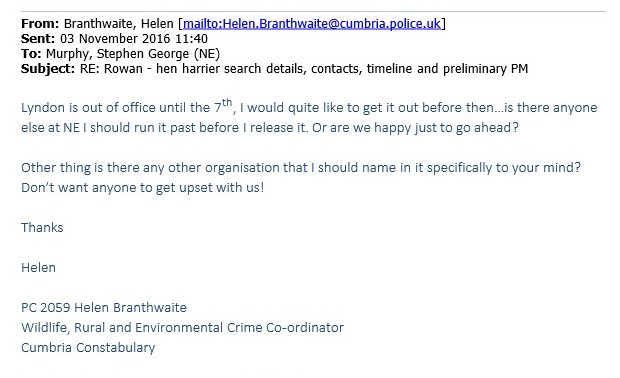
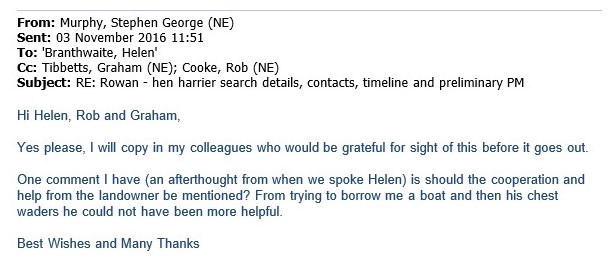
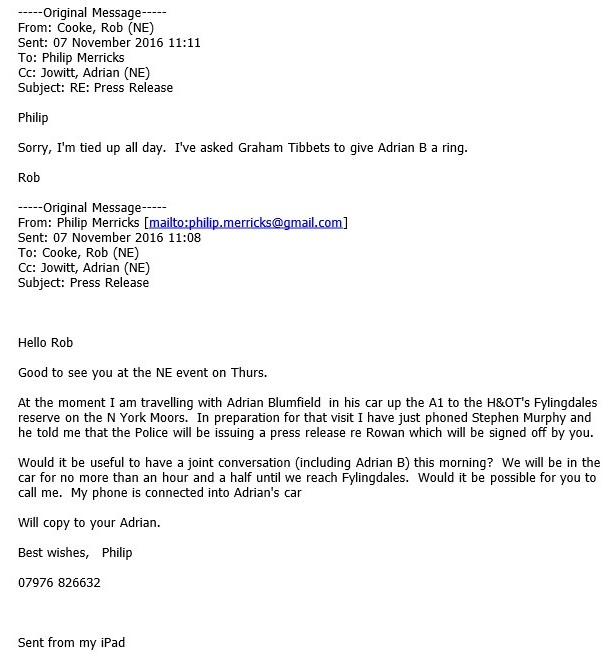
We’ve recently been blogging about DEFRA’s hen harrier brood meddling scheme, due to start in the 2017 breeding season. A series of FoIs has uncovered some of the plans to date (e.g. see here, here, here).

Today’s blog relates to the proposed social science study, which is being viewed as an integral part of the brood meddling trial.

The proposal has been submitted by Steve Redpath (Aberdeen Uni & Trustee of the Hawk & Owl Trust) and Freya St John (Kent Uni), both well known for their interest in wildlife conflict management.

Here’s the proposal: social-science-proposal-brood-meddling-june-2016

Basically the proposal is for a seven-month long study, estimated to cost ~ 50K, to assess how grouse moor managers, gamekeepers and conservationists ‘feel’ about hen harriers and about the different aspects of the wider Hen Harrier Inaction Plan.

Not being social scientists there’s a very good chance that we’re missing something here, and we’d be happy to be corrected, but we’re struggling to see the point/value of this study. Apart from the obvious flaw that the study will rely upon grouse moor owners and gamekeepers telling the truth (good luck with that, researchers!), the attitudes of all these ‘stakeholders’ are already blindingly clear, surely?

The vast majority of driven grouse moor owners and gamekeepers don’t tolerate hen harriers, to the extent that the English hen harrier breeding population is on its knees because these birds are routinely killed. Conservationists place a high nature conservation value on hen harriers and want grouse moor owners and gamekeepers to abide by the law and stop killing them.

The whole premise of the brood meddling scheme is to see whether driven grouse moor owners and gamekeepers will ‘tolerate’ hen harriers if they can be assured that there won’t be more than one breeding pair per 10 sq km. The claimed purpose of brood meddling is to reduce the pressure of predation on red grouse caused by parent hen harriers hunting to provide for their broods (and yet strangely, the industry isn’t up for trialling diversionary feeding). But this predation pressure is not the only aspect of hen harrier ecology that the grouse shooting industry objects to. It is also known that they don’t like to see hen harriers flying over the moors during the grouse-shooting season because the harrier might disrupt the flights of red grouse being driven towards the guns. So who thinks that releasing young hen harriers back to the uplands in August/September is going to work?!

The proof will be in the pudding. Will those captive-reared hen harriers survive once they’ve been released? Their satellite tag transmissions will provide the real answer, not the result of some questionnaire that’s been answered by members of an industry that’s based on criminality and that has proven itself untrustworthy time and time and time again.

Case against gamekeeper Stanley Gordon re: shot hen harrier, part 6

Criminal proceedings continued at Elgin Sheriff Court on Friday against Scottish gamekeeper Stanley Gordon.

Mr Gordon, 60, of Cabrach, Moray, is facing a charge in connection with the alleged shooting of a hen harrier in June 2013.

Here’s a summary of what’s happened so far in this case:

Hearing #1 (19 May 2016): Case continued without plea until 16 June 2016.

Hearing #2 (16 June 2016): Case continued without plea until 14 July 2016.

Hearing #3 (14 July 2016): Case continued without plea until 11 August 2016.

Hearing #4 (11 August 2016): Case continued without plea until 1 September 2016.

Hearing #5 (1 September 2016): Mr Gordon enters a not guilty plea. A provisional trial date is set for 19 December 2016, with an intermediate diet set for 18 November 2016.

Hearing #6 (18 November 2016): Case adjourned for another intermediate diet on 2 December 2016.

Vicarious liability prosecution: Andrew Duncan (Newlands Estate) part 10

Criminal proceedings continued on 15 November 2016 against landowner Andrew Walter Bryce Duncan, who is alleged to be vicariously liable for the crimes committed by gamekeeper William (Billy) Dick in April 2014.

Gamekeeper Dick was convicted in August 2015 of killing a buzzard on the Newlands Estate, Dumfriesshire by striking it with rocks and repeatedly stamping on it (see here). Mr Dick was sentenced in September 2015 and was given a £2000 fine (see here). Mr Dick attempted to appeal his conviction but this was refused on 15 July 2016 (see here).

Here’s a quick review of the proceedings against Andrew Duncan so far:

Hearing #1 (18th August 2015): Trial date set for 23rd Nov 2015, with an intermediate diet scheduled for 20th Oct 2015.

Hearing #2 (20th October 2015): Case adjourned. November trial date dumped. Notional diet hearing (where a trial date may be set) scheduled for 18th January 2016.

Hearing #3 (18th January 2016): Case adjourned. Another notional diet & debate scheduled for 11th March 2016.

Hearing #4 (11th March 2016): Case adjourned, pending the result of gamekeeper Billy Dick’s appeal. Another notional diet scheduled for 4th April 2016.

Hearing #5 (4th April 2016): Case adjourned, pending the result of gamekeeper Billy Dick’s appeal. Another notional diet scheduled for 3rd June 2016.

Hearing #6 (3rd June 2016): Case adjourned, pending the result of gamekeeper Billy Dick’s appeal. Another notional diet scheduled for 17th June 2016.

Hearing #7 (17th June 2016): Case adjourned, pending the result of gamekeeper Billy Dick’s appeal. Another notional diet scheduled for 15th July 2016.

Hearing #8 (15 July 2016): Case adjourned. Another notional diet scheduled for 2 August 2016.

Hearing #9 (2 August 2016): Proceedings moved to trial. Intermediate diet scheduled for 15 November 2016 and provisional trial date set for 7/8 December 2016.

At hearing #10 on Tuesday (15 November 2016) the case was adjourned for another intermediate diet scheduled for 22 November 2016. A new trial date may be set depending on what happens during this hearing.

Vicarious liability in relation to the persecution of raptors in Scotland (where one person may potentially be legally responsible for the criminal actions of another person working under their supervision) came in to force over four and a half years ago on 1st January 2012. To date there have been two successful convictions: one in December 2014 (see here) and one in December 2015 (see here).  One further case did not reach the prosecution stage due, we believe, to the difficulties associated with identifying the management structure on the estate where the crimes were committed (see here).

Following gamekeeper Mr Dick’s failed appeal in July 2016 (see here), we posed a number of questions. These are still to be answered:

  1. Is/was criminal gamekeeper William (Billy) Dick a member of the Scottish Gamekeepers’ Association? The SGA refused to comment on Mr Dick’s membership status at the time, saying they ‘wanted to wait until the legal process had concluded’. Well, now Mr Dick’s criminal conviction for wildlife offences has been upheld, how about answering the question? Emails to: info@scottishgamekeepers.co.uk
  2. Will Scottish Land & Estates now expel the Newlands Estate from the ranks of SLE membership? SLE said at the time that Newlands Estate’s membership of SLE had been ‘voluntarily suspended’ pending on-going legal proceedings. Well, now the gamekeeper’s criminal conviction for wildlife offences has been upheld, how about answering the question? Emails to: info@scottishlandandestates.co.uk
  3. Will the Newlands Estate’s accredited membership of Wildlife Estates Scotland (WES) now be revoked? The conditions of membership of this scheme include: “the requirements to maintain best practice standards of animal welfare and comply with all legal requirements and relevant Scottish codes of practice”. At the time of Mr Dick’s conviction, a spokesperson for WES said the Newlands Estate’s membership and accreditation of WES had been ‘voluntary suspended’ pending the outcome of legal proceedings. Well, now the gamekeeper’s criminal conviction for wildlife offences has been upheld, how about answering the question? Emails to: info@scottishlandandestates.co.uk

We’ll also be watching closely to see whether the Newlands Estate will now be subject to a General Licence Restriction from SNH. If you recall, this restriction may be imposed by SNH where evidence of raptor crime is apparent and it has been available as a sanction for offences committed since 1 January 2014. Mr Dick killed the buzzard on Newlands Estate in April 2014. Although, even if the GL restriction is put in place, the estate can easily side-step it by applying for an ‘individual’ licence instead (e.g. see here).

Cover up in the Cairngorms National Park!

Well done to Scottish animal charity OneKind for organising today’s protest rally at the Scottish Parliament, enabling campaigners to call on MSPs to put an end to the mass unregulated slaughter of tens of thousands of mountain hares on Scottish grouse moors.

Ingeniously, OneKind replicated the now infamous image of that truckload of dead mountain hares (published here and here earlier this year) with their own truckload of (soft cuddly toy) mountain hares:

onekind-hare-rally-stuart-spray

(Photo from the rally by Stuart Spray).

Environment Cabinet Secretary Roseanna Cunningham addressed the rally and said the Scottish Government opposes mass culls, that legislation to protect mountain hares has not been ruled out, but that the Government needs evidence before it can act.

That evidence might be harder to come by in future. A board member of the Cairngorms National Park Authority (Eleanor MacKintosh) recently suggested to members of the Scottish Gamekeepers’ Association that they literally cover up their mass hare-killing sprees by using covers on the back of vehicles to hide the evidence from prying camera lenses instead of having piles of dead hares on display in open-backed trucks!!!

This information (and other fascinating discussions) was revealed in an FoI asking for information about a meeting between the CNPA and the SGA that was held in September this year. We’ll be blogging a lot more about that in due course.

Protest rally against mountain hare slaughter takes place at Holyrood tomorrow

Just a reminder that there will be a protest rally outside the Scottish Parliament building tomorrow, against the continued slaughter of mountain hares on Scottish grouse moors.

As many of you will know, tens of thousands of mountain hares are massacred on Scottish grouse moors, including inside the Cairngorms National Park. These killing sprees are unmonitored, unregulated and uncontrolled (see here for plenty of background information).

The rally will take place between 12-2pm and there will be various speakers including Alison Johnstone MSP, David Stewart MSP and Harry Huyton (Director of charity OneKind, the event organisers) – further details here.

The gamekeeping community is agitated about this protest rally. Last week the Scottish Gamekeepers’ Association tried to deflect attention from their hare killing sprees by drawing attention to other mountain hare culls that take place during the closed season, licensed by SNH, for the purpose of protecting forestry (see here). What the SGA actually achieved by publishing this was a massive own goal – hilariously explained in this OneKind blog here.

Not to be deterred, this week the SGA has sent a briefing note to all MSPs, ahead of the protest rally, trying to explain that the killing of tens of thousands of hares on grouse moors is for the hares’ own good. They also claim that all those dead mountain hares are destined for the human food market.

Here’s a pile of shot mountain hares that didn’t make it to the human food market. They were dumped in a stink pit on an Angus Glens grouse moor. Surrounded by a circle of snares, the odour of rotting hare flesh would have attracted predators, which were likely snared and killed, their bodies probably added to the stink pit.

If you’re disgusted by this, and think the Scottish Government is failing in its duty to protect this species, please try and get to the rally tomorrow and let MSPs know this matters to you.

Brood meddling: the role of the ICBP

We’ve learned, through a series of FoIs about DEFRA’s planned hen harrier brood meddling scheme, that the practical aspect of the trial (i.e. the removal of eggs/chicks from the nests and the subsequent captive-rearing) will be undertaken by the International Centre for Birds of Prey in Gloucestershire (see here and here for previous blogs).

The ICBP is directed by Jemima Parry-Jones, who, along with several others involved in this brood meddling scheme (Philip Merricks, Steve Redpath and Philip Holms), also serves on the Hawk & Owl Trust’s Board of Trustees.

As part of her input, she has produced an estimated costing. Given the number of uncertainties about the trial, the costing is, inevitably, largely guesswork. Nevertheless, it’s pretty detailed and provides an insight to what will be involved.

You can read it here: harrier-brood-management-draft-ballpark-costings

Jemima Parry-Jones’ knowledge and expertise on the breeding and captive rearing of raptors is undeniable. She is a recognised and highly respected world authority on this subject. We can be assured that any hen harrier eggs/chicks that the ICBP receives during this trial will be given the utmost care and attention to ensure they’re fit enough for release.

But what’s so baffling, and yes, disappointing, is that Jemima would want to play any part in this brood meddling scheme. As a lifelong advocate for raptor conservation, why would she support a plan to remove these harriers from the wild, just to enable an industry to kill an artificially-high number of grouse, for personal gratification, and then release those harriers back to the wild knowing that their chance of survival (at the hands of that same criminally-based industry) is virtually nil?

Why go to all the effort of rearing those birds, knowing that in fact all you’re doing is delaying the inevitable? There isn’t a scrap of evidence, not one tiny shred, to suggest that those released juveniles will be left alone; on the contrary, ALL the evidence suggests otherwise.

All we have is the word of the grouse shooting industry that they’ll abide by the law, but who in their right mind would take them at their word?! They don’t even believe it themselves – why else would they propose that the cessation of illegal persecution is not a condition of this brood meddling trial!

Wake up Jemima, you’re being played.

More brood meddling revelations

Following on from yesterday’s blog on some of the details emerging about DEFRA’s hen harrier brood meddling scheme (see here), here are some more revelations that have come to light from a series of FoIs.

There’s a document written by Steve Redpath, Adam Smith (GWCT) and Martin Gillibrand (then secretary of the Moorland Association) dated August 2013. It’s titled ‘Improving the conservation status of hen harriers in the UK – establishing a research trial of a brood management scheme‘.

You can read it here: harrier-trial-brood-management-scheme-final-draft

It’s not clear for whom this document was written, but we’d take a guess that it was produced for DEFRA as an overview of /justification for, a hen harrier brood meddling scheme. Some of the brood meddling plans mentioned in this document may well have been developed further since August 2013. However, there are definitely parts of it still being cited (by Amanda Anderson), word for word, in discussions about the planned 2017 launch of brood meddling.

A few things jumped out at us. The first thing isn’t a revelation as such – the justification for using a brood meddling scheme based on the successful use of this management tool on Montagu’s harriers in western Europe. We’ve heard this a lot, especially from GWCT, and yes, at a superficial level, it does sound like a reasonable comparison. Montagu’s harrier nests in cereal fields are at high risk from mechanised harvesting equipment, and so broods have been removed from the danger areas, captive-reared, and then released back to the wild. And it has worked well.

But what the pro-brood meddlers never mention is the fact that the risk to those Montagu’s harriers is limited to a very short time period when harvesting takes place. Once the crops have been harvested, the risk is gone until harvest time the following year. That is not comparable with the hen harrier situation in the UK. The risk to hen harriers on UK driven grouse moors is year-round. They are killed at the beginning of the breeding season when they try to settle, they are killed during the breeding season, and they are killed during the autumn and winter, particularly at roost sites. Year-round harrier persecution is the name of the game in the UK so to argue that brood meddling will work for hen harriers on grouse moors in the UK just because it’s worked for Montagu’s harriers in agricultural fields abroad is totally absurd. The circumstances are nowhere near comparable.

One revelation that did jump out at us from this document is a sentence in the Introduction section:

Should a trial brood management scheme be successful, the next phase would be to offer this as a management option across the whole of the UK“.

Jesus.

The other revelation we found was this, in the section describing how the trial might work:

Once harriers start settling the trial will commence. As soon as a pair of harriers lays eggs within 10km of another pair, that will activate the brood management scheme. At least one pair must be settled on a grouse moor employing one or more full-time grouse keepers where a suppressed grouse population poses the greatest social, economic and conservation risk“.

Eh? A “suppressed” grouse population? There’s nothing “suppressed” about an artificially-high grouse population with 300-500 birds per sq km, crammed on to a driven grouse moor!

More revelations to follow….

UPDATE 16 Nov 2016: Brood meddling: the role of the International Centre for Birds of Prey (here)