Blog

Two owls shot in Peak District National Park

Police are appealing for information after the discovery of two shot owls in the Peak District National Park.

On the evening of 11 September 2018 a local runner witnessed a short-eared owl flying overhead, followed by what sounded like gunshots. The following morning she returned to the moorland near Wessenden Head in the northern Peak District. She found the bird on the ground, still alive. It was taken to a vet but had to be euthanized due to its injuries, which included a shattered wing.

[Photo of the shot short-eared owl, via RSPB]

The runner who saw the short-eared owl said: “I had just got back to my car when I suddenly saw a short-eared owl fly over my head – it’s always fantastic to see one of these gorgeous birds. This however was followed by the sound of a gunshots, coming from the direction of a dark-coloured pickup. I really hoped this wasn’t aimed at the owl I’d just seen.

The next morning I returned to the same spot and, there on the ground, was a short-eared owl, still alive but clearly wounded. I was so upset but also furious to think that someone had done this on purpose.”

The police are wanting to speak to the driver of the dark-coloured pick up truck, described as having two dog cages on the back with a thick wooden cover over the cages.

This land (Marsden Moor Estate) is owned by the National Trust and is a designated Special Protection Area (SPA) for short-eared owls.

[RPUK map showing the location of the Marsden Moor Estate (orange) in the Peak District National Park]

On 1 October the dead body of a tawny owl was discovered close to where the short-eared owl was found. It had been shot and stuffed inside a dry stone wall on the Kirklees Way footpath near Greenfield Road (not on National Trust property).

[RPUK map showing proximity of Wessenden Head and Kirklees Way footpath to areas managed for driven grouse shooting in the Peak District National Park]

If you have any information relating to these crimes, call West Yorkshire Police on 101 quoting police log number 174211/09/2018.

To share information about raptor persecution in your community in confidence, please call the Raptor Crime Hotline: 0300 999 0101.

Hen harrier brood meddling legal challenge: day 1

The two-day legal challenge (judicial review) of Natural England’s decision to licence hen harrier brood meddling got underway in the Royal Courts of Justice yesterday.

[Mark Avery with his legal team outside the court at the end of day one. L-R: Lewis Hadler, Tessa Gregory, David Wolfe QC, Zoe Leventhal, Mark Avery. Photo by Ruth Tingay]

This is just a brief summary of proceedings so far and doesn’t go in to great detail – that will have to wait.

The public gallery in Court No. 18 was packed and there were eight lawyers in attendance with more folders, files, notebooks, pens and post-it stickers than a Staples shop.

Most of the day was taken up by David Forsdick QC, presenting the RSPB’s case to Ms Justice Lang. Some of this was hard to follow because (a) he’s quite softly spoken, (b) he kept referring the judge to various exhibits that only she and the lawyers had access to, and (c) a lot of his arguments referred to written arguments made by Natural England which the lawyers have seen but the public has yet to hear.

The RSPB has raised a number of challenges against Natural England’s brood meddling licensing decision but the two issues that received the most attention in court related to diversionary feeding and designated sites for hen harriers, particularly Special Protection Areas (SPAs).

It was argued that as the purpose of the brood meddling licence was to further the protection of the hen harrier by investigating means to reduce grouse predation and thus ‘conflict’ and thus illegal persecution, other options to brood meddling should have been considered. Diversionary feeding is a low impact alternative, proven via research (at Langholm) to reduce grouse predation and causes minimal disturbance. As diversionary feeding is also included in DEFRA’s Hen Harrier Action Plan (to which Natural England was a main party in the drafting and now the implementing of the Plan) and Natural England has issued a generic, England-wide licence to permit diversionary feeding, it follows that Natural England is satisfied that diversionary feeding reduces grouse predation and thus reduces ‘conflict’ and thus illegal persecution.

However, given the “very low” uptake of diversionary feeding by landowners it was argued that Natural England has failed to encourage landowners to take this up as a voluntary option and has also failed to use its statutory powers to require the use of diversionary feeding on designated sites. Natural England’s legal arguments against the use of diversionary feeding as a viable alternative to brood meddling (arguments the lawyers have read but we have yet to hear) were derided when reference was made to a recent public statement made by Natural England’s Chairman on the ‘success’ of the 2018 breeding season in which he referred to the effectiveness of diversionary feeding!

Brood meddling on sites specifically designated for breeding hen harriers (i.e. SPAs) received equal criticism, especially as brood meddling relies on the concept of ‘quotas’ and ‘excess’ nests; this is contrary to the statutory conservation objectives of an SPA and case law was used to highlight this fundamental flaw. The point was made that, theoretically, if there was a single hen harrier nest in the centre of the Bowland Fells SPA, given the brood meddling density threshold (0.0125 pr/km2) this could be the only hen harrier nest permitted in this SPA designated for 12 breeding pairs. It was also argued that removing hen harriers from grouse moors in SPAs and then later releasing them in non-grouse moor areas of the SPA (as permitted by the brood meddling licence) constituted an adverse effect on the integrity of the SPA and was thus unlawful.

The RSPB’s case concluded at 3pm and then David Wolfe QC began his opening arguments on behalf of Mark Avery. David will continue this morning and then the court will hear from Natural England. Both claimants (RSPB and Mark Avery) will then have a right of response before the case is adjourned pending Ms Justice Lang’s ruling on the judicial review, which isn’t expected for several weeks and possibly several months.

UPDATE 12/12/18: Hen harrier brood meddling legal challenge: day two (here)

Legal challenge against hen harrier brood meddling reaches the High Court

Press release from law firm Leigh Day (4 Dec 2018)

Campaign to protect endangered hen harriers to be heard in High Court

The High Court will hear a legal challenge to the brood management of endangered hen harriers on Wednesday 5th and Thursday 6th December 2018.

Leading conservationist Mark Avery, represented by law firm Leigh Day, is bringing the judicial review challenge against Natural England’s decision to grant a licence to allow brood management of the birds. The RSPB have also brought a separate judicial review against the decision.

In January 2018 Natural England granted a two-year licence to trial the brood management of hen harriers – one of the rarest birds in England that has the highest possible conservation status for a wild bird and is a protected species under the EU Birds Directive. Brood management involves authorising what is otherwise a criminal offence – the removal of the eggs or chicks of hen harriers from their nests. Under the proposed licences the young birds are reared in captivity before they are reintroduced into the wild.

[Photo by Laurie Campbell]

Campaigners argue that the plan places the precarious English population of hen harriers at further significant risk and fails to address what all agree is the root cause of the hen harrier’s decline, illegal persecution on grouse moors where the bird of prey is known to kill red grouse.  Critics are concerned that the plan will do nothing to boost the hen harrier population and only serves to placate grouse moor owners and the grouse shooting industry. The ongoing problem of the persecution of hen harriers is tragically highlighted by five birds already having been reported missing on or near land managed for grouse shooting in the north of England.  Studies have shown that England should be able to support around 300 hen harrier pairs. But this year (which was a relatively successful year due to high vole numbers which is a main prey species for hen harriers) only 34 chicks fledged from nine English nests, according to a report by Natural England and in 2017 there were only 10 chicks in the whole of England.

Natural England’s stated rationale for the trial is to see whether brood management “could reduce the perceived conflict between hen harriers and grouse management” and thereby lead to fewer attempts to kill hen harriers illegally.

In his legal case Dr Avery argues that Natural England’s decision to grant the licence was unlawful as there were alternative satisfactory solutions available which under the EU Birds Directive had to be considered before Natural England could decide to authorise the taking of eggs and the disturbing of a hen harrier’s nest which is ordinarily a criminal offence. He will argue that the alternative solutions that Natural England should have considered include: licensing grouse shooting; increasing criminal enforcement, introducing vicarious liability for wildlife crime (as recently adopted in Scotland) and considering banning grouse shooting altogether.

Mark Avery said: “The fragile hen harrier population must be protected and allowed to thrive in its natural habitat. It is incredibly sad that Natural England seems to be more interested in serving the grouse shooting industry than the wellbeing of these magnificent birds. In Scotland a range of measures are being pursued which if implemented well and with vigour stand a good chance of making a significant difference, yet in England where the numbers of hen harrier are far fewer the Government has ignored the measures being taken north of the border and chosen to waste its time and money on brood meddling

Tessa Gregory, partner at law firm Leigh Day, added: “Our client believes that there were many alternatives to be considered before deciding on the damaging and pointless measure of allowing brood management of these endangered birds. It is time for the Government to start tackling the real issue: illegal persecution by the grouse shooting industry. Our client has demonstrated that there are many other measures which could be taken that would serve to protect the hen harrier and address criminality in the grouse shooting industry. We hope that the court will agree with our legal arguments and quash Natural England’s decision to allow brood management of hen harriers.”

ENDS

Buzzard found poisoned near Mauchline, south Scotland

From Cumnock Chronicle (29 Nov 2018)

POISONED BIRD OF PREY SPARKS POLICE WARNING

Residents in Mauchline are being warned to be on the look out after a bird of prey was found poisoned.

A member of the public discovered the buzzard, still alive but in a distressed state on land on the outskirts of the town on November 2.

Fortunately, the bird was found quickly and survived. A toxicology report has now confirmed the buzzard ingested poison.

Police Scotland are concerned that this illegal activity is happening in the area and are appealing for any information that may lead to detecting the person responsible for this deliberate act.

PC Sam Briggs, Wildlife Crime Officer, said, “It is a serious concern that someone has targeted wildlife in this illegal and indiscriminate manner. If anything unusual is discovered I would advise not to touch it, but instead cover it if you can and contact the police, giving them the exact location.”

Police are working alongside partner agencies Scottish SPCA, Science and Advice for Scottish Agriculture and Agricultural Officers to fully investigate the matter. Anyone with information on the illegal use of pesticides or who may has seen something suspicious, particularly in the last month or so, can call 101 and quote No: SP-20181120-2194 or Crimestoppers anonymously on 0800 555 111.

ENDS

This is the sixth raptor poisoning in south Scotland this year (that we’re aware of) including four red kites and buzzards that were poisoned in Dumfries & Galloway between Jan-May this year (see here) and a poisoned peregrine found in the Pentland Hills in May this year (see here).

But there’s no need to worry. SNH is “reassured that raptor persecution is not an issue” in this region.

Buzzard & hobby found with horrific spring trap injuries on Isle of Wight

Police press release (4 Dec 2018):

POLICE INVESTIGATION LAUNCHED AFTER BIRDS OF PREY KILLED BY ILLEGAL TRAPS ON ISLE OF WIGHT

Two protected birds of prey, likely to have been caught in illegal spring traps, suffered ‘horrific and traumatic’ injuries.

A joint investigation has been launched by Isle of Wight Police and the RSPB after the birds, a buzzard and a hobby, were found with severed legs in woodland at Littletown, near Briddlesford.

The buzzard was found dead, with a missing foot, on March 14. The hobby — a small falcon similar to a kestrel – was found alive, also with its foot missing, on September 23. It was taken to the RSPCA and put down.

[The buzzard with a severed foot]

[The hobby with a severed foot, photo by RSPCA]

The RSPB said today (Tuesday) the birds were likely to have been illegally trapped.

The birds, a hobby and a buzzard, were found with horrific injuries. Both had lost a foot as a result of becoming caught in a spring trap,” said a spokesperson.

Police were alerted and the birds were sent for post-mortem examinations. The report concluded: ‘Both birds suffered traumatic amputations of one lower limb consistent with the affected leg being caught and held in a spring trap.’

All wild birds are protected by law under the Wildlife and Countryside Act 1981 which makes it an offence to intentionally harm them. Anyone found to have done so faces an unlimited fine with up to six months in jail.

Jenny Shelton, from the RSPB’s investigations unit, said: “Spring traps are sometimes used to catch and kill vermin, and are legal if placed in a tunnel, with a restricted entrance, for this purpose. However spring traps set out in the open are illegal, and pose a huge danger to wildlife. 

We have had numerous reports over the years of birds of prey being deliberately caught in these brutal devices. Birds of prey are incredible creatures and it’s devastating that the lives of these two birds have ended in this way. We are grateful to the people who reported these birds. If you find an injured bird of prey, or come across a metal trap set out in the open or on a pole, call the police on 101 immediately.”

PC Tim Campany, from the Country Watch team, said: “We are working closely with our colleagues from the RSPB to establish what happened. One line of enquiry is that the birds may have been caught and held in a spring-type trap.

This is illegal and is a barbaric method of trapping. It leaves the bird, once freed from the trap, unable to land and feed and it will eventually die of starvation.

Raptor persecution is a priority of the National Wildlife Crime Unit and will not be tolerated.

I would urge anyone with information on suspicious vehicles, persons, or traps located in the Bridlesford area to call us now.”

Anyone with information should call Isle of Wight Police on 101, quoting the reference 44180374840.

ENDS

Illegal raptor persecution is a national wildlife crime priority, so why the hell has it taken nine months for the news of this buzzard to emerge, and two and a half months for the hobby? What’s the point of appealing for information so long after the events?

It’s just not good enough.

These incidents will also cast a shadow on the proposed reintroduction of white-tailed eagles to the Isle of Wight.

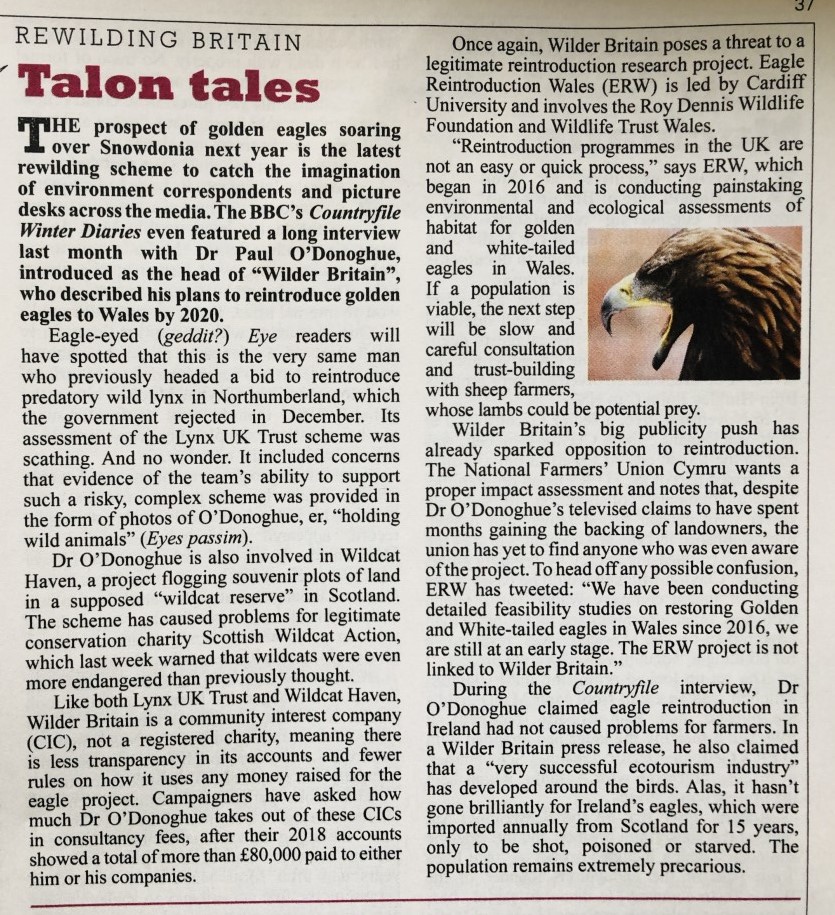
Private Eye, sea eagles, hill farmers & grouse moor burning

White-tailed eagles are never far from the news and even feature in the latest edition of Private Eye:

The Committee on Climate Change reports referred to in the article can be found here.

They’re really worth a read. The following text in the report ‘Land use: reducing emissions and preparing for climate change‘ will be of particular interest to those of us concerned about grouse moor management:

4.2. Identifying and removing barriers to transformational land use

Changes on this scale will require a coordinated, national approach. There are several key barriers that will prevent the scale of action that is required to meet long-term climate change mitigation and adaptation goals:

Missing and incomplete markets for public goods.

At present, the private social costs and benefits related to land use can differ widely, leading to sub-optimal land management strategies from a social perspective. For example, there has been a large-scale effort through government programmes to increase the value land owners place on preserving the carbon locked up in peat soils, in order to incentivise peatland restoration over and above activities such as maintaining heather cover and burning to support grouse shooting.

Between 2007 and 2013, £27 million was paid out to land owners who had taken up moorland restoration under the Higher Level Stewardship scheme. Water companies invested £45 million between 2005 and 2015 in programmes to work with landowners to improve peatland condition as a way of improving water quality.

However, so far these restoration efforts remain insufficient to incentivise the degree of restoration that is needed in the face of climate change. The condition of upland peat SSSIs in England is continuing to decline, from 19% in favourable condition in 2003 to 10% in 2016.

ENDS

Some interesting stats in that last sentence, and worth bearing in mind the next time the grouse shooting industry’s spin doctors try to infer that grouse moor SSSIs are an indication of ‘environmental quality‘.

New RSPB Head of Investigations

Congratulations to Mark Thomas who will be taking on the role of RSPB Head of Investigations in January, following the departure of Bob Elliot earlier this year.

Mark is no stranger to this field. He joined the RSPB’s Investigations Team based at The Lodge HQ way back in 1999 and has spent the last 19 years on the front line, gaining invaluable first hand experience in every type of crime against birds, not least those against birds of prey.

This is an excellent decision by the RSPB – it ensures continuity at a time of great upheaval for RSPB staff and at a critical time for tackling illegal raptor persecution.

Mark said: “Things have changed a lot since I first began. At that time we were the only ones banging on about raptor persecution but these days the word has spread and we receive massive support for our work through the police and other agency partners, as well as from the general public. I’m looking forward to supporting everyone in my team [which includes a number of field investigators as well as intelligence officers and analysts] to help them continue our efforts to tackle bird crime across the country“.

Well done, Mark, this is a well-deserved promotion.

New forensic tool to identify human fingerprints on illegally-killed raptors

Press release from Abertay University (29/11/18):

Scientitists recover fingerprints from feather exposed to outdoor conditions

An Abertay University study has discovered that fingerprints can be recovered from bird feathers that have been left outside, exposing them to environmental conditions.

Previous research from PhD Student Helen McMorris had revealed that it was possible to obtain fingerprints from feathers under lab conditions.

For the first time, she has been able to prove it is possible to recover them from feathers that have been exposed to environmental conditions such as wind and rain.

[Helen McMorris obtains a fingerprint from buzzard feathers. Photo from Abertay University]

In the long term, it’s hoped the research will have a transformative impact on the number of wildlife crime convictions in the UK.

According to the latest RSPB Birdcrime report there were 68 confirmed incidents of raptor persecution last year, with only four prosecutions. From these, just one led to a successful conviction.

Investigations into such incidents can be extremely difficult as there’s no accurate measure of determining human involvement.

McMorris – also a Teaching Fellow at Abertay – said this makes it difficult to prosecute: “At this moment in time toxicology tests can prove that a raptor has been poisoned, and you can prove that a bird has been shot through x-rays and post mortem.

But there’s no way of telling if a human has had any contact with that bird if it’s found dead in a field or on a hillside. You have to assume there has been foul play of some description, but you can’t hone in on the actual person responsible.

This technique potentially gives investigators the chance to prove actual human involvement in raptor persecution, be it through an identifiable fingerprint or a touch mark from a human finger that identifies exact areas of contact on the bird-of-prey”.

Head of Science Dr Ben Jones said “As part of Abertay’s research in improving forensic investigation techniques, this study is an important step in moving from the laboratory closer to a real-life situation, as the technique moves from research to development for use in an investigative setting.”

ENDS

For those interested in the science, this research has been published in Science and Justice, the journal of the Chartered Society of Forensic Sciences. Publishing restrictions prevent us from posting the full paper here but here’s the abstract:

It’s probably a bit of an overstatement to claim that these results “will have a transformative impact on the number of wildlife crime convictions in the UK“. These days the majority of raptor killers are much more savvy about hiding their crimes and often remove and destroy all the evidence (cf all those ‘missing’ satellite tagged raptors that vanish in to thin air).

However, there are still some who are too stupid/lazy/arrogant to get this right, e.g. the shooting of a hen harrier on a grouse moor at Leadhills last year (here). This shooting by a masked gunman was witnessed by a member of the public, and the witness was later able to point the investigating authorities to the location which led to the discovery of the harrier’s body, partly-hidden in vegetation. In rare cases like this, the ability to test the corpse for fingerprints may well have helped to identify the perpetrator.

Similarly, in the recent case of gamekeeper Tim Cowin who shot, then stamped on, and then buried the bodies of two short-eared owls on a grouse moor in Cumbria (here), had the RSPB’s video evidence of Cowin committing his crimes been deemed inadmissible, testing the owls’ feathers for human fingerprints may well have led to Cowin having to face some awkward questions.

This new research isn’t a panacea but it is still another useful weapon in the armoury of those fighting the illegal killing of birds prey, a fight that Ian Thomson (Head of Investigations, RSPB Scotland) has described as ‘an arms race’ (here).

Illegal gin trap found set near Nairn, Highlands

Police Scotland has issued a statement about the discovery of an illegal gin trap found set near Nairn in the Highlands:

ILLEGAL GIN TRAP FOUND NEAR NAIRN (30 Nov 2018)

Police in Nairn have issued a warning about the use of illegal traps following the discovery of one set near the town.

The illegal gin trap, although rusty, was fully functioning and was discovered by a member of the public on the afternoon of Wednesday, November 28 near Howford Bridge a few miles south of the town.

Nothing had been caught in the trap and the device has since been recovered by officers.

[Photo of the gin trap from Police Scotland]

[RPUK maps showing location of Howford Bridge, south of Nairn]

Wildlife liaison officer Constable Jonathan Clarke said: “Gin traps have been illegal for many years and are entirely indiscriminate. This device could have caused serious injury to a wild animal, a pet or even a person if they been caught in it.

Setting a trap such as this is a criminal act, as is possessing something like with the intention of using it.

Setting one in an area close to the river which is popular with dog walkers is extremely reckless and it is fortunate that this was discovered before anything or anyone was injured.

No further traps have been found but I would urge the public to be vigilant when walking in the area.

If anyone does find a trap then please do not try to deal with it on your own but carefully note the location and report it to police immediately.

Enquiries into this trap are ongoing and I would urge anyone with information to contact police on 101, using reference NM3269/18, or call Crimestoppers on 0800 555 111.”

ENDS

Well done Police Scotland for a very fast response to remove the trap and for an equally speedy public alert.

It’s shocking to see these traps still in use. Gin traps have been banned in England since 1958 and banned in Scotland since 1971, and yet still they’re being used to target wildlife.

It’s not clear which species was being targeted in this latest case but previously we’ve seen gamekeepers using them to trap buzzards (gamekeeper convicted in 2015 (here) and his boss convicted for vicarious liability (here) and earlier this year a red kite was trapped resulting in horrific injuries (here)).

Yet another red kite shot & killed in North Yorkshire’s Nidderdale AONB

North Yorkshire Police are appealing for information after the discovery of yet another shot & killed red kite in the Nidderdale Area of Outstanding Natural Beauty (AONB).

The latest in a long line of victims, this red kite was found dead on 25th October 2018 near to Wath.

[X-ray of the shot red kite showing two shotgun pellets. Image from North Yorkshire Police]

[RPUK map showing location of Wath in the Nidderdale AONB]

[RPUK map showing Wath sandwiched between two areas of grouse moor]

Nidderdale AONB is a notorious red kite persecution hotspot with a long history of illegally shot and poisoned red kites (e.g. see here), so much so that last year the Chair of the Nidderdale AONB’s Joint Advisory Committee issued a public statement condemning these killings and warning that it was having a damaging effect on local tourism businesses (see here).

[RPUK map showing the locations of illegally shot or poisoned red kites in the Nidderdale AONB since 2007]

North Yorkshire Police have issued an appeal for information about the latest red kite shooting, and also an appeal for information about a shot buzzard that was found near Selby earlier this month (we blogged about this buzzard a couple of weeks ago, see here).

Appealing for information, Sergeant Kevin Kelly from North Yorkshire Police’s Rural Taskforce said “It’s with much frustration, that I again make another witness appeal regarding two rare birds of prey, that we are privileged to have in our skies, being mindlessly and illegally shot.

If you have any information that will assist the investigation, please come forward and contact police via 101 and pass the information to the Force Control Room. Please quote reference 12180210290 for the buzzard investigation and 12180199938 for the red kite investigation.

We have two extremely experienced wildlife crime officers leading these investigations and they will follow up on any tangible enquiries.  I would also like to take this opportunity to thank the members of public for taking the responsibility to report these matters.

The police press statement includes a quote from the Nidderdale Moorland Group: “We have been made aware of this incident and we are fully supporting the Police investigation. An estate owner and moorland group member found the bird and handed it into the police. The Nidderdale Moorland Group is dismayed by this incident and is committed to helping eradicate wildlife crime. We would ask anyone with information to contact the police“.

Of course, it’s not just red kites that are illegally killed in this grouse moor dominated area of North Yorkshire. Nidderdale AONB and the neighbouring eastern side of the Yorkshire Dales National Park also just happens to be an area where satellite-tagged hen harriers ‘disappear’ without trace in highly suspicious circumstances.

[RPUK map showing Nidderdale AONB and the eastern side of the Yorkshire Dales National Park. Red dot = Wath. Small red stars = locations of illegally shot or posioned red kites since 2007. Orange stars = satellite-tagged hen harriers that have ‘disappeared’ in suspicious circumstances in recent years (data from Natural England). Large red star = hen harrier Bowland Betty who was found shot dead on a grouse moor in 2012]

There has never been a successful prosecution for any of these crimes.

For how much longer do you think DEFRA ministers Michael Gove MP and Dr Therese Coffey MP will continue to be wilfully blind to this so-bloody-obvious serious organised crime?

For how much longer do you think genuine conservation organisations will sit on ‘partnership’ groups with representatives of the grouse shooting industry and pretend that everyone’s working together to eradicate these crimes, when there are zero consequences for the criminals?

[A dead red kite, photo by Marc Ruddock]