Blog

Guest blog: Kevin Cumming, project leader Langholm Moor Community Buyout

Earlier today the Langholm Initiative launched its ambitious crowdfunder for the Langholm Moor Community Buyout (blog here, crowdfunder here).

Kevin Cumming is leading this brilliant project and has written a guest blog to provide more information:

The Langholm Moor Community Buyout: Tackling climate change, ecological restoration and community regeneration

My name is Kevin Cumming. I work for a charity called the Langholm Initiative (LI, LI Website) based in the town of Langholm in Dumfries and Galloway in Scotland. I hold a BA (hons) in Business Administration and an MSc in Conservation and Management of Protected Areas. Currently I manage the LI’s Wild Eskdale project (Wild Eskdale website) which aims to provide outdoor education for the local community whilst promoting eco-tourism in the area.

Imagine a place where hen harriers roam above the dramatic hills of a former grouse moor, sky dancing alongside the unmistakeable call of the curlew. Flowing through this moor might be a river with a hidden world beneath its surface, home to playful otters and bobbing dippers. Native woodlands thriving and creating a mosaic of wonderful habitats. Now consider the benefits if such a place could be protected and taken into community ownership by the people who live and work there. No need to stretch your imagination too far because Langholm Moor in the South of Scotland is such a place, and a unique opportunity has arisen for this precious land to be taken into the care and ownership of the local population through a community buyout.

Make no mistake, this is a big landscape scale project pushing the boundaries of community regeneration and ecological restoration.

So here it is, my take on one of the most important community projects in the UK…

[Tarras Valley at Langholm, photo by Tom Hutton]

The Langholm Moor Community Buyout

The Sky Dancers have returned, the winter’s rain has eased and in the South of Scotland the community of Langholm are preparing for one of the most ambitious plans of a generation.

For the past eight months I have been leading a local working group to investigate the potential for community ownership of nearly 10,500 acres (about 5,600 football pitches) of land close to the town for positive climate action, community regeneration, ecological restoration and wildlife conservation.

During this eight month period unprecedented events occurred in both my own life and around the world. For me personally my first child Freya was born. However, in her first few months of life, we have seen the devastation caused by the Australian wildfires and of course the global impact of Covid-19. In these difficult times this community buyout at Langholm is important because it is a project of vision, it is a project of hope when we need it the most, and perhaps above all, it is a project for our future.

The robust plans put together by the community of Langholm place the environment and climate action at the heart of their decision making. Today we launch our Langholm Moor Crowdfunder and with your help we will be able to make this vision a reality.

The significance of this project cannot be overstated. It addresses so many of the questions we face not only here in the UK but around the world. The climate emergency is the biggest long-term threat that humanity faces. Tackling this threat is going to take landscape scale change to reverse the decades of mistreatment of our natural world. By taking Langholm Moor under local community ownership we want to demonstrate that individuals coming together for a common purpose can do something truly amazing.

We are delighted to say that today the John Muir Trust have demonstrated their faith in the project by announcing that they will be kick-starting the fundraising effort by pledging £100,000 towards the purchase.

Why Langholm?

Langholm was once a booming centre for the textile industry. Most local people would finish school and instantly find local employment in the mills. Speak to people here and they will tell you of the days when you could walk out of a job in the morning and walk into another by the afternoon.

Sadly these days have gone and over the last 20 years there has been a rapid decline in the industry. Just three weeks ago the last mill in Langholm announced its likely closure.

Langholm now faces the same problems as many other rural areas in Scotland; loss of industry, youth migration and an aging population.

Something has to be done to change the fortunes of this once thriving community.

Why This Land and Why Now?

Langholm Moor has huge cultural and natural heritage. People here are immensely passionate about the land they believe to be theirs and have marked the boundaries of the common land for over 250 years. This tradition still goes on today with a spectacular annual event, the Langholm Common Riding.

The national and international importance of the natural heritage on this land is recognised by large parts of it being designated as a Site of Special Scientific Interest and a Special Protection Area (for Hen Harriers).

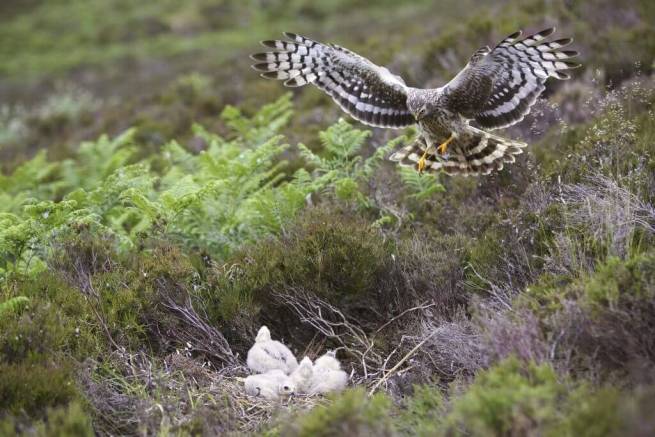
[Hen harrier, photo by Kevin Cumming]

Many of you may be familiar with Langholm Moor: it has been the site of two scientific studies regarding land management for the purpose of driven grouse shooting. The latest of these studies, the Langholm Moor Demonstration Project (LMDP), produced its final report last year (LMDP Final Report). The key finding of this project was clear that driven grouse shooting was no longer economically sustainable on Langholm Moor.

After the conclusion of this study the current landowner announced their decision to sell the land and hoped to do so quite quickly. If the people of Langholm were to have a say in how their moor would be managed they would have to act promptly.  The clock started ticking and the question that faced us was “what could you do with a former grouse moor?”

What will the community do with the land?

The project we have developed over the past eight months in close consultation with the community covers a wide range of subjects. Broadly speaking I would say that it is a project to improve our future both environmentally and economically.

The Langholm Initiative are proposing that we undertake climate action, wildlife conservation, ecological restoration and community regeneration all built around a central goal – creating the Tarras Valley Nature Reserve

On this land, we will carry out work such as peatland restoration, new native woodland creation, ancient woodland regeneration and protect and enhance the incredible flora and fauna that lives here. Repairing damage to our internationally important peatlands will improve carbon storage. Five hundred acres of new native woodlands will provide fantastic new habitat, offer amenity use and sequester carbon dioxide from the atmosphere. Ancient woodland regeneration along the Tarras Water will help provide a mosaic of habitats across the land.

We will investigate sustainable and responsible outdoor tourism. I have travelled all over Scotland wildlife watching and can honestly say that the experiences of Langholm Moor are unique and spectacular.

In a single day I can be treated to the spectacular sky dancing of courting hen harriers, witness the silent hunt of a short-eared owl or be mesmerised by the intimate lekking of black grouse. I can be thrilled by the chase of merlin hunting a meadow pipit, I can smile as I enjoy newly fledged dippers come to terms with life on the Tarras Water and I can laugh at the antics of the wild goat kids. This is a special place – a hidden gem in the South of Scotland.

Is the project sustainable?

At the beginning of this project we were able to raise enough money to undertake some very intensive investigations into the viability of community ownership. Many people donated to our first crowdfunder to help with this (thank you!)

Our feasibility study found that community ownership can be financially viable, and it can run into a modest surplus right away. The main sources of revenue come from an existing commercial forestry plantation, rent from leased residential properties, agriculture and other tenancies. A summary of the Feasibility Study and Business Plan can be found on the Langholm Initiative Website.

By including a small area of land south of Langholm Moor and close to the town of Langholm we have given ourselves options to undertake some sustainable development. This includes the potential for appropriate small scale renewable energy (a single small turbine and a single small solar farm) and the development of a small eco-campsite. We will also investigate repurposing disused and dilapidated steadings for either small scale housing or modern business units, both of which are badly needed in Langholm (there have only been 6 new houses in Langholm in the past 30 years). The vast majority of the land will be used to create the Tarras Valley Nature Reserve. However, these developments in the long term will allow us to continue to promote positive climate action while simultaneously acting as a catalyst for rural community regeneration.

Conservation and development are often seen as opposing forces because in many places, development has been carried out at the expense of the natural environment. If we continue exploiting our planet then it will no longer be able to sustain us. This is one of the main reasons why our project is so important: we will demonstrate that it is possible to deliver ecological restoration alongside the regeneration of a community.

What is the wider impact of the project?

One of the most exciting elements of this project and one that has attracted widespread support, is the potential blueprint that it could provide for other communities across the UK to improve their local environments in a post Covid-19 world.

In the long term this project could also indirectly address other topical land use issues in the UK, including alternative uses for driven grouse moors, agriculture in a post-Brexit Britain and the balance of land ownership in Scotland.

Fundraising

After a careful joint valuation process we know the total cost of purchasing the land is just over £6m. We have applied to the Scottish Land Fund for £3m and hope to raise an additional £3.4m.

The Langholm Initiative are continuing to investigate a number of funding options which we hope will help us towards this figure including the new South of Scotland Enterprise Agency.

We know this is a big ask, especially in these unprecedented and difficult times. However, if you are able to donate what you can to the crowdfunding campaign, you will not only be contributing to one of the most forward thinking community plans of a generation, you will be providing hope for a better future for everyone.

We want this project to inspire communities around the globe to strive for a brighter tomorrow. If you can help us reach our goal, we’ll be another step closer.

ENDS

Here’s the link to the crowdfunder again (please click here)

Interview with Revive campaign manager Max Wiszniewski

Following the launch of Revive’s 2021 manifesto yesterday calling for an end to driven grouse shooting in Scotland (see here), Common Weal, one of the Revive coalition members, has published an interview with Max Wiszniewski, campaign manager for Revive.

[Max Wiszniewski, Revive’s campaign manager. Photo courtesy Revive]

Going into next year’s election, [Scotland’s political] parties have to do more than show concern. They will have to commit and they will have to act“.

The interview can be read in full on Source News, Common Weal’s news analysis website here.

Langholm Moor community buyout: crowdfunder launched

Last summer a local community got together to investigate the feasibility of buying part of Langholm Moor, to turn it from a knackered grouse moor into a nature reserve for the benefit of everyone, after the Duke of Buccleuch announced his intention to sell (see here and here and here).

Plans have just got serious.

Press release from the Langholm Initiative (7 May 2020):

Community land buyout launches crowdfunding campaign to create vast new nature reserve

An initiative to create a vast new nature reserve in Dumfries and Galloway through southern Scotland’s largest community land buyout is being launched today, with a £3 million crowdfunding campaign to help purchase 10,500 acres of Langholm Moor.

The ambitious plan by charity The Langholm Initiative to create the Tarras Valley Nature Reserve, by purchasing wildlife-rich and culturally important land from Buccleuch Estates, has received a huge boost as the John Muir Trust announced it is donating £100,000 to kickstart the appeal.

The project has received widespread support due to its positive goals of tackling climate change, boosting nature restoration and supporting community regeneration.

The crowdfunder launched today on Go Fund Me at www.gofundme.com/langholm-moor-buyout aims to raise just over half of the £6m valuation on the land.

[Langholm Moor, photo by Tom Hutton]

Kevin Cumming, the Langholm Initiative’s project leader, said: “Our community plans here have international significance. At a time of climate emergency, we are committing to undertake direct climate action – including restoration of globally precious peatlands and ancient woodlands, alongside the creation of new native woodlands.

Langholm moor is home to a host of iconic wildlife such as black grouse, Short-eared owls and merlin, and is a stronghold for hen harriers – the most persecuted bird of prey in the UK.

At this critical stage we are asking for the help of the public. We know it’s a big ask at a time like this – but if people can support us by donating to this project we will be ensuring a more positive future for our children.

Langholm, a once thriving textile centre, has seen this industry decline in recent years. The people of this small town, nestled in the beautiful and dramatic Southern Uplands, have a deep connection to the land, which has never been sold before.

The community wants to seize this once in a lifetime opportunity to have control over their own future. It is hoped that through community land ownership and the creation of a nature reserve, a foundation can be laid for local regeneration, supporting eco-tourism and bringing visitors to the area.

Mike Daniels from the John Muir Trust said: “We are extremely excited about this project. Its ambition and vision is what has attracted us to it and today we are pledging £100K to support the community’s purchase of the land.

The protection and restoration of wild places and the regeneration of rural communities goes hand in hand and we are delighted to support this inspiring initiative. We call on other organisations to follow our lead and support the Langholm Initiative.

Kevin Cumming said: “We are extremely grateful to the John Muir Trust for their support. It is the highest compliment for them to offer a significant financial pledge and demonstrates great confidence in the project.

Much of the support for this project has centred on the ambition of a community to place the environment at the heart of its regeneration.

A summary of the Langholm Initiative’s business plan is available at www.langholminitiative.org.uk. Other plans for the project include the development of small-scale modern business units in existing disused buildings, appropriate renewable energy and responsible nature-based tourism.

Kevin Cumming said: “The community’s regeneration is a vital part of this process. The land holds huge cultural value to local people, many of whom are excited about the possible community ownership of it.

A number of other national organisations have offered support to the project.

With the land jointly valued at just over £6m, The Langholm Initiative has also applied to the Scottish Land Fund for £3m towards the purchase, with the other half of the purchase price to be generated through the crowdfunding appeal.

Buccleuch Estates announced its decision to sell about 25,000 acres of its Borders Estate last year.

The Langholm Initiative was formed in 1994, as one of south Scotland’s earliest development trusts. The charity facilitates projects that make a real, lasting difference to the local area and the lives of the people that live there.

To support the appeal, visit www.langholminitiative.org.uk.

ENDS

Here’s the link to the crowdfunder again: HERE

Please support this important initiative if you can.

UPDATE 16.30hrs: Guest blog: Kevin Cumming, project leader, Langholm Moor Community Buyout (here)

This short video from Kevin Cummings is well worth a few minutes of your time:

New energy bar producer donating profits to help tackle raptor persecution

Outdoor Provisions‘ is a new-ish company producing natural energy bars and it’s teamed up with RSPB Investigations to help raise awareness, and funds, to tackle the ongoing illegal persecution of raptors.

The company’s logo features the shape of a generic raptor and it’s selling an enamel pin badge of the same design, with 100% of the profits going to the RSPB’s Investigations Team.

The £6 badge can be ordered online here

There’s also a feature page on the company’s website which provides an overview of raptor persecution and encourages customers to look out for signs of suspected persecution crimes and how to report it (see here).

Great stuff! Please show these guys your support!


Revive coalition launches political manifesto calling for end to driven grouse shooting in Scotland

Press release from Revive, the coalition for grouse moor reform (6 May 2020)

REVIVE LAUNCHES 2021 MANIFESTO CALLING FOR AN END TO DRIVEN GROUSE SHOOTING

Coalition sets out its political asks one year ahead of Scottish elections

Revive, the coalition for grouse moor reform has published its manifesto outlining a number of asks, including an end to driven grouse shooting ahead of next year’s elections. These include tackling climate change, land reform, social justice and protecting Scotland’s wildlife and biodiversity.

Revive is a coalition made up of Common Weal, Friends of the Earth Scotland, League Against Cruel Sports Scotland, OneKind and Raptor Persecution UK, working for grouse moor reform in Scotland and campaigning to end the circle of destruction that surrounds grouse shooting.

Campaign Manager for Revive Max Wiszniewski said: “Driven grouse shooting, an intensively managed blood sport, is inherently unsustainable. Keeping the land managed as barren monocultures for this sport maintains a large area of Scotland’s land in an impoverished state.

This is why the Revive coalition has proposed alternative visions for our moors and launched the manifesto we hope political parties will adopt into their own. We believe this is in line with voters expectations and hope a year from now we can go to the polls with all parties committing to address the environmental crisis in our countryside caused by intensively managed grouse moors.”

Revive is calling for significant reform of Scotland’s grouse moors and is asking Scotland’s political parties to make the following commitments:

● Protect Scotland’s peatland by ending muirburn for the purpose of grouse moor management

● A ban on the use of medicated grit

● A change to the use of non-lead ammunition

● Regulation of off-road hill tracks

● Transformational land reform to be enacted on a national scale

● An end to the snaring, trapping and killing of Scotland’s wildlife for the purpose of increasing grouse numbers

● Licensing of all grouse moor estates

● A transition away from driven grouse shooting

Robbie Marsland, Director of the League Against Cruel Sports added: “Untold thousands of wild animals are killed on an industrial scale as part of rigorous predator control on intensively managed grouse moors just so there are more grouse available for sport shooting. The League is opposed to this senseless cruelty and wholeheartedly supports Revive’s Manifesto calling for an end to grouse shooting and the circle of destruction which surrounds grouse moors.”

The coalition argues that grouse moors managed for sport shooting is one of the least regulated industries in Scotland. Along with measures to tackle climate change and transformational land reform, Revive is proposing a licensing system to end the unsustainable elements of grouse moor management.

Director of Friends of the Earth Scotland, Richard Dixon said: “From their terrible toll on wildlife to their impact on climate change, grouse moors are a 19th century idea that should have no place in the 21st century. Scotland can do much better for local communities and nature.”

ENDS

You can read Revive’s manifesto here: REVIVE manifesto

To read Revive’s other publications (as noted in the manifesto) please visit the publications page on Revive’s website here

Prejudice, ignorance & pride are key drivers of gamekeepers’ desire to kill predators

When the full extent of the wildlife crimes committed by Scottish gamekeeper Alan Wilson was revealed last year (see here), it inevitably led to questions by most reasonable people about his motivation.

These questions weren’t restricted to the issue of illegal persecution; they also led to more general discussions about the legal killing of wildlife by gamekeepers, and these questions continue to dominate conversations about game shoot management in the UK.

[Gamekeeper Alan Wilson, convicted in 2019 of nine offences on Longformacus Estate. Photo Daily Record]

A new paper has just been published that provides insight from interviews with 20 gamekeepers in southern England about their motivation for killing predators (legally).

This research was undertaken by George Swan as part of his PhD, successfully completed in 2017. Obviously there are limitations and caveats associated with such a small sample size from a relatively restricted geographic area but the authors acknowledge these and place their results in an appropriate context.

This is an ‘open access’ paper which means that it’s freely available, in full, here.

The paper doesn’t start well. In a scene-setting paragraph about lowland gamebird management in the UK the number of annually released non-native gamebird species is given as ‘>20 million Pheasants and >2 million Red-legged Partridge’. This is a massive underestimate using out of date references.

The most recent estimate of released gamebirds is from 2016 (see here) and is approaching 60 million released gamebirds per annum (47 million Pheasants, 10 million Red-legged Partridge). These figures from the shooting industry are considered to be conservative and are highly likely to have increased again since 2016.

Incredibly, the exact figure is unknown because the game bird shooting industry is virtually unregulated. There is no statutory requirement to register a shoot nor to provide a record of the number of birds released and then shot. Indeed, in this latest paper the authors even acknowledge that they couldn’t themselves establish the size of any of the shoots involved in the survey ‘as the number of birds released was found to be a sensitive question‘!

Moving on to the gamekeeper interviews, the study’s main findings identify six primary motivations for killing predators. These are described as: professional identity, personal norms, potential penalties, perceived impact, personal enjoyment and perceived ease.

It’s really worth reading the detail of these motivators in the paper (jump to section 3 ‘Findings’ if you want to skip the pre-amble). The level of prejudice, ignorance (of ecological predator-prey relationships) and pride (e.g. ‘one gamekeeper explained how he controlled magpies, in part, because other gamekeepers ‘take the Mickey’ [mocked the respondent] when they saw this species on his beat‘) will be shocking to many. The notion of needing to control predators to ‘maintain balance’ is laughable in the context of releasing almost 60 million non-native gamebirds in to the countryside every year!

To be perfectly frank, none of this will come as any surprise to anyone who’s spent a couple of hours reading gamekeepers’ comments on social media. However, it is useful to have these attitudes documented and analysed in a formal scientific way. The authors propose this research could help to understand and mitigate ‘social conflicts’ over predator management.

For others, this research will be beneficial for those of us who consider that urgent regulation of the UK’s gameshooting industry is required. Indeed, many of the findings in this new paper support Wild Justice’s ongoing legal challenges against the General Licences in England and in Wales which, Wild Justice contends, unlawfully authorise the ‘casual killing’ of millions of birds without the gamekeeper having to justify why the killing is necessary and a last resort.

Incidentally, the crowdfunder to support Wild Justice’s legal challenge of General Licences in Wales is just short of reaching its target. If you’re able to help, please click here. Thank you.


Birds of prey still being killed despite lockdown

Since lockdown began in March there’s been widespread concern that the illegal persecution of birds of prey would escalate, especially on grouse moors (e.g. see here) where fewer people are around to witness the crimes and/or the aftermath.

The UK’s grouse moors have been the epicentre of raptor persecution crimes for years; Mark Avery astutely described the National Parks that are dominated by grouse moors (e.g. Yorkshire Dales, North York Moors, Peak District, Cairngorms) as “massive wildlife crime scenes” (see here).

But of course, the threat to UK raptors isn’t just restricted to areas managed for driven grouse shooting. These birds are targeted and killed in the lowlands too, and quite often (although not exclusively) on land being managed for pheasant and partridge shooting.

Just two weeks ago a red kite was reported as shot on land managed for pheasant shooting, with another two birds also suspected to have been shot at the same location (see here).

It seems that the conservationists’ concerns were well founded. Despite the country being in the midst of a national crisis, and despite the shooting industry’s claims to have a ‘zero tolerance’ of raptor persecution (see here), the killing continues.

Police Supt Nick Lyall, Chair of the Raptor Persecution Priority Delivery Group (RPPDG, the so-called partnership that aims to tackle the illegal killing of raptors) tweeted this yesterday:

Nick singles out North Yorkshire but we’re also aware of a spate of other suspected raptor persecution crimes during lockdown, in a number of other counties across England and Scotland. Most of these have yet to be publicised as police investigations continue but hold on your hats, folks, when they are finally publicised the list is going to be long and damning.

Scottish Gamekeepers Association ‘negotiating with Government’ for new offence of trap damage

News emerged this week, via the Scottish Gamekeepers Association’s (SGA) e-newsletter for members that it is currently ‘negotiating with Government’ for the creation of a new offence relating to trap damage:

This is really quite interesting. The SGA, with others, has been arguing for several years that legally-set traps have been ‘tampered with’ or damaged by members of the public and these claims usually occur just after an illegally-set trap has been discovered and reported in the media. A recent example of this was the male hen harrier that was found in considerable distress with its leg almost severed in an illegally-set trap on Leadhills Estate (see here).

[Male hen harrier found with an almost severed leg, caught in an illegally-set spring trap next to its nest on Leadhills Estate (see here). Nobody has been prosecuted for this barbaric crime but the estate has had its use of the General Licence restricted by SNH as a direct result of this and other offences (see here)].

The implication of such claims has seemed clear – instead of accepting that some gamekeepers continue to break the law (e.g. by setting illegal traps), the shooting industry would rather deflect the blame on to so-called ‘animal rights extremists’ who are accused of ‘setting up estates’.

During a cross-party RACCE committee hearing in 2013, then Environment Minister Paul Wheelhouse said there was no evidence to support claims of widespread trap tampering/damage by ‘activists’ (see here) although it emerged that BASC was undertaking a survey to assess the extent of this alleged problem.

A couple of years later in 2015 that BASC survey revealed that trap tampering/damage did take place but according to industry evidence, it couldn’t be described as being a ‘widespread’ issue (see here).

In 2017 the SGA again complained of a so-called ‘escalation’ in trap damage and again attributed this to ‘activists’ but as we reported at the time (see here), yet again the evidence was lacking.

Let’s be clear here though. It is quite evident, just looking through social media, that some members of the public are indeed deliberately damaging traps to render them unusable, either because they have an ethical objection to the killing of native wildlife to increase gamebird stocks, or because they’ve become so frustrated with what they perceive to be a lack of enforcement action against the criminal gamekeepers, or because they believe the trap to be illegal. The legislation on trap use is complicated and many members of the public are simply unaware of what is legal and what is illegal. (For a basic introduction have a look at this from OneKind and this from Revive).

To be honest, we’d welcome some clarity on what constitutes ‘tampering’ or ‘damage’. At the moment it is not at all clear and trap tampering may not always constitute a criminal offence. For example, the SGA’s lawyer, David McKie, wrote in a 2013 edition of the SGA’s members’ rag:

As a matter of law, there is a significant difference between interference and vandalism.

Vandalism would involve the breaking of a crow cage trap by someone punching or kicking a hole in it, for example, or the deliberate smashing up of a Fenn trap. It would also include the cutting of snares.

Interference does not necessarily involve a criminal offence….That can involve the removal of traps from their set location, the release of decoy birds or the pulling of snares.

The police can probably not charge the individual with interference’.

In some cases there may be a legitimate defence to causing trap damage – e.g. if a trapped animal is seen to be injured inside a padlocked crow cage trap and needs urgent veterinary attention, but the location is remote and there’s no phone signal to call for help, it might be considered reasonable to cut the trap wire to extricate the wounded animal. Much will depend on the individual circumstances of each incident.

Another example might be the discovery of what is obviously an illegally-set trap. Is it an offence to disable it if there is absolutely no question that it’s been set unlawfully? As an example, here’s a pole trap that was photographed on an estate in the Angus Glens. It’s been an offence to set pole traps for over 100 years!

[An illegal pole trap, photograph by RSPB]

It’d be kind of ironic if a member of the public was prosecuted for disabling such a pole trap, when the person who allegedly set it (a gamekeeper was filmed by the RSPB attending the trap) had the prosecution against him dropped by the Crown Office because the video evidence was deemed inadmissible!

So, yes, regardless of the extent of trap tampering / damage, greater clarity is certainly required on what constitutes an offence. However, given how long we’ve been waiting for the Scottish Government to bring in new legislation to tackle the persistent illegal persecution of birds of prey on sporting estates, that’s happening at such a scale it’s known to be affecting entire populations of some of these species, the trap tampering offence that the SGA claims to be ‘negotiating’ should be way down the list of Government priorities.

UPDATE 12 May 2020: Parliamentary questions on proposed new offences for trap damage (here)

UPDATE 16 May 2020: Scottish Government denies ‘negotiating’ with gamekeepers on new offences for trap damage (here)

Satellite-tagged red kite ‘disappears’ on grouse moor in North Pennines AONB

Press release from RSPB (30 April 2020)

Red kite vanishes in suspicious circumstances

Durham Police, the RSPB, the North Pennines AONB Partnership and Friends of Red Kites are appealing for information following the disappearance of a red kite in County Durham.

The young bird was fitted with a satellite tag at Rowlands Gill, near Gateshead in June 2019 by Friends of Red Kites (FoRK) with NERF support. It has been monitored since by the RSPB.

[Red kite ‘KK’ being fitted with a satellite tag as a nestling. Photo via RSPB]

The bird, nicknamed ‘KK’, toured northern England, making it as far as the Peak District, then returned north and has been faithful to the Derwent Valley region ever since.

KK’s tag had been functioning normally until it suddenly and unexpectedly stopped transmitting. The last fix came from an area of driven grouse moor near the Derwent Reservoir on 17 April. It has not been heard from since.

Emma Marsh, RSPB England Director, said: “If you’ve seen a red kite wheeling high overhead you’ll know that they’re splendid birds. They enrich our landscapes and bring joy to many.

When a tag which has been functioning reliably suddenly cuts out, this gives us immediate cause for suspicion. The additional fact that the tag’s last data fix came from an area dominated by driven grouse shooting rings serious alarm bells.

The connection between driven grouse shooting and the illegal killing of birds of prey has been well documented. Sudden, unexplained disappearances of tagged birds of prey are happening far too often in these landscapes. Satellite tags continue transmitting even after death, so if this bird had died naturally we would expect to be able to recover it.”

Red kites are specially protected under the Wildlife and Countryside Act (1981) which makes it an offence to deliberately kill or injure this species. Those found to have done so could be given an unlimited fine and/or a prison sentence.

Harold Dobson, spokesman for the Friends of the Red Kites, said: “It’s 15 years since the first red kites were re-introduced in the Lower Derwent Valley. They are faring well in the valley itself and we enjoy watching these impressive, majestic birds of prey.

As mainly scavengers, the red kites are of no threat to anyone. However, we fear that human persecution is preventing them from naturally expanding their range: since 2010, seven red kites have been found poisoned or shot near the Derwent Gorge and surrounding Durham Moorland. We fear that this may be the tip of the iceberg and that many more persecuted kites are never found.”

Inspector Ed Turner, the lead for wildlife and rural crime for Durham Constabulary said: “The fate of this red kite is not yet clear, we are working with the RSPB to establish what has happened since its transmitter unexpectedly stopped on 17 April 2020. Until we can rule out the possibility that a crime has not been committed, then we will be taking this matter very seriously and if anyone has any information please contact the police quoting 22042020-0078.

Chris Woodley-Stewart, Director of the North Pennines AONB Partnership, said: “Though the fate of this bird isn’t certain, the fact that it was carrying two reliable trackers means this looks very like a crime may have been committed. This is an area where a significant number of kites have been shot or poisoned and we’d really appeal to anyone who knows anything that might help shed light on this incident to come forward.”

If you have any information about this incident, please contact the police on 101, quoting the reference number 22042020-0078. Alternatively, if you have information about birds of prey being killed or targeted near you, please call the RSPB’s confidential Raptor Crime Hotline on 0300 999 0101.

ENDS

GWCT in extraordinary attack on Bradford Council

The Game and Wildlife Conservation Trust’s (GWCT) reputation took another nosedive yesterday when it launched an extraordinary (and unsubstantiated) attack on Bradford Council.

Video footage had emerged on Twitter of a tractor being used to cut heather on Baildon Moor at a critical time for ground-nesting birds. The moor is owned by Bradford Council.

GWCT was tagged in to the tweet and Andrew Gilruth, Director of Communications, went from nought to nasty without any apparent hesitation or pause for thought.

The video was posted on the GWCT’s YouTube account (here), a blog was posted on GWCT’s website (here) and a string of bullying tweets spewed forth to Bradford Council. The council was directly accused of causing the damage.

Bradford Council responded by saying it had not authorised the heather cutting and had reported the incident to Natural England and to the police. A councillor (Alex Ross-Shaw) also confirmed these details. GWCT then started to backtrack (although noticeably didn’t apologise) but the harm had already been done to Bradford Council’s reputation, not least thanks to Andrew Gilruth’s rather unpleasant sneering and spin-doctoring.

It’s not hard to understand the trigger for such nastiness. Many of you will recall it was Bradford Council that banned grouse shooting on Ilkley Moor in 2018 after a concerted campaign by locals (see here) and last year it threatened legal action after allegations that grouse shooters were driving red grouse off Ilkley Moor on to a neighbouring moor to be shot (see here).

For those of you not on social media here is a taste of the content:

Interestingly it looks like someone’s had a quiet word with the GWCT  – perhaps it was Bradford Council’s lawyers, because this morning the GWCT blog has been carefully edited to remove the baseless accusations previously levelled at the council. The changes are underlined in orange:

Funniest of all, at the foot of the revised blog is this appeal for cash, to help GWCT continue its so-called ‘vital work’ (that’ll be smearing the reputation of those who don’t support grouse shooting).