Last month I blogged about what looked to be the collapse of the hen harrier brood meddling sham, after hearing persistent rumours that no broods were meddled this year (see here).
I submitted an FoI to Natural England seeking confirmation of this and yesterday they responded and told me, “no requests came in this year” [from any grouse moor owners] and therefore no hen harrier broods were meddled in 2024.
For new blog readers, hen harrier brood meddling is a conservation sham sanctioned by DEFRA as part of its ludicrous ‘Hen Harrier Action Plan‘ and carried out by Natural England, in cahoots with the very industry responsible for the species’ catastrophic decline in England. In general terms, the plan involves the removal of hen harrier chicks and eggs from grouse moors, rear them in captivity, then release them back into the uplands just in time for the start of the grouse-shooting season where they’ll be illegally killed. It’s plainly bonkers. For more background see here and here.
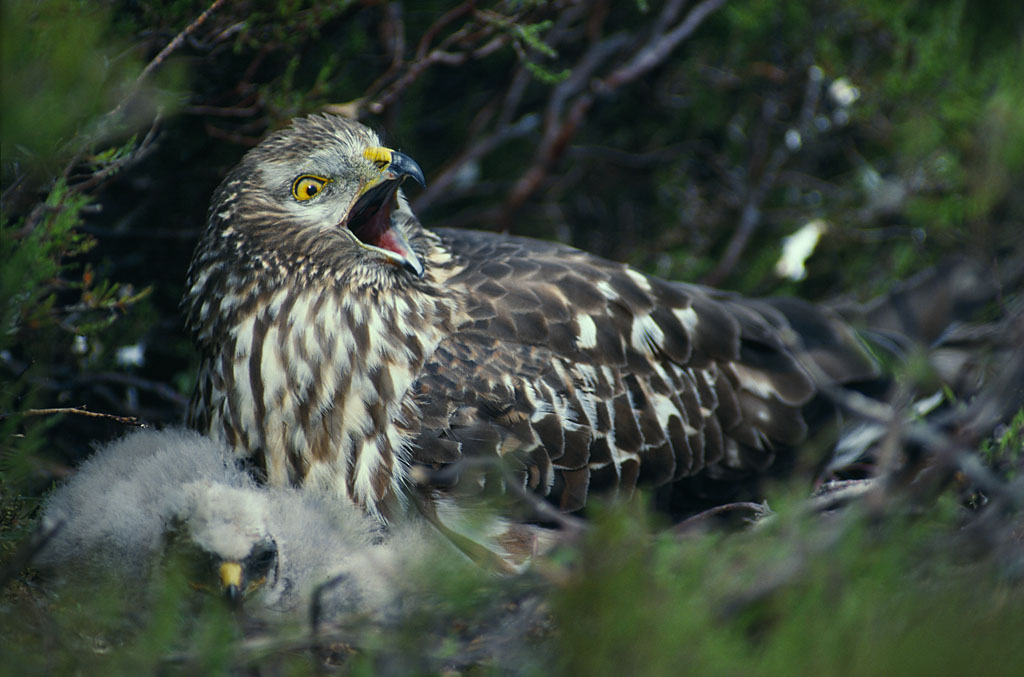
Hen harrier by Laurie Campbell
I also asked Natural England how many hen harrier broods were available for brood meddling this year. NE claimed not to hold any information about that, but it’s common knowledge that there were multiple broods on Swinton Estate this year, and at least one additional brood on a neighbouring estate, so it seems that brood meddling could have taken place this year, had either of those estate owners chosen to use the opportunity.
So why didn’t they?
I’d suggested a few plausible but speculative hypotheses in my earlier blog (here) but one hypothesis I didn’t examine was that the Moorland Association might have thrown its toys out of the pram and withdrawn from the brood meddling trial in retaliation for the pressure its members were coming under from the NWCU’s new Hen Harrier Taskforce, which is using an approach similar to that used to tackle serious and organised crime and applying it to target those who continue to persecute hen harriers on grouse moors.
The Moorland Association had accused the Taskforce police of “bypassingregulation” (here) but instead of meekly deferring and backing away, as has happened for at least two decades, this time the police told the Moorland Association it was “wasting time and distracting from the real work of the Hen Harrier Taskforce” (see here) and subsequently booted the Moorland Association off the national Raptor Persecution Priority Delivery Group (RPPDG), see here, a move warmly welcomed by many in the conservation sector.
The Moorland Association isn’t used to this sort of humiliation. It’s been used to getting its own way, benefiting from the power and influence of some of its members, including the dukes and lords who held sway with the establishment figures of the day. It all seems to be falling apart now though, so it wouldn’t come as any surprise to learn that the Moorland Association had decided to pick up the ball and walk off the pitch, leaving DEFRA and Natural England’s brood meddling ‘trial’ in the gutter.
There’s some evidence to support this theory – I’m told that aside from not engaging in brood meddling this year, some grouse moor owners have also refused access to Natural England staff who wanted to go on to estates and fit satellite tags to other, non-brood meddled hen harrier chicks.
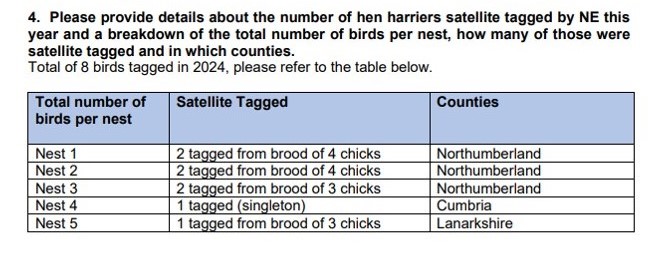
In my FoI to Natural England I asked how many satellite tags NE fieldworkers had fitted to hen harrier chicks this year. This is the response:
That’s an interesting (and short) list. I’m guessing that the three nests in Northumberland are at Kielder (non-grouse moor) and I’m pretty sure that the Cumbria nest is subject to an ongoing police investigation and that the ‘singleton’ chick was a rescue job. The inclusion of the nest in Lanarkshire is a bit bizarre because as far as I’m aware, NE fieldworkers aren’t licenced to tag chicks in Scotland.
Anyway, the table is clear that Natural England didn’t satellite tag many (any?) hen harrier chicks on grouse moors in England this year. I guess we’ll have to wait for Natural England’s end of season report to find out more details – that report is expected sometime this month, along with an updated list on the fates of all the satellite-tagged hen harriers that NE has been monitoring for several years, including all those subject to ongoing police investigations.
We can all speculate about why grouse moor owners might not want to support the continued satellite-tagging of hen harriers by NE (here’s a big clue, here’s another, and here’s another) but fortunately there are other landowners who do support it and provide open access to not only NE field staff but also to those from the RSPB, so hen harrier tagging will continue, with or without support from the grouse shooting industry.
The main question now is what will Natural England do about the hen harrier brood meddling ‘trial’? The licence for the seven-year ‘trial’ has now expired and we should expect a robust scientific review of whether it has addressed the questions it set out to answer (spoiler alert – it hasn’t).
It should also include an assessment of why brood meddling didn’t take place this year and whether that reduces the (misplaced) confidence NE senior staff have previously placed in the grouse shooting industry as a ‘partner’ in this ludicrous pantomime.
The Northern England Raptor Forum (NERF), a collective of regional raptor fieldworkers, is the latest organisation to walk away from the Yorkshire Dales/Nidderdale Bird of Prey Partnership.
You may recall this so-called ‘partnership’ in Yorkshire was established in 2020, with representatives from the grouse-shooting industry, the raptor conservation community, RSPB, Natural England, Police, the Yorkshire Dales National Park Authority and the Nidderdale AONB (now renamed Nidderdale National Landscape) Authority.
The ‘partnership’ was modelled on the similar (now disbanded) ‘bird of prey partnership’ in the Peak District National Park, which, unsurprisingly given the participants from the grouse-shooting industry, was an abject failure (see here).
Photo by Ruth Tingay
The RSPB was the first organisation to walk away from the Yorkshire Dales/Nidderdale Bird of Prey ‘partnership’ in May 2023, citing well-evidenced concerns about the toxic behaviour of the grouse moor owners’ lobby group, the Moorland Association (see here).
Later that year, in December 2023, the CEO of the Yorkshire Dales National Park Authority wrote a damning press release about continued raptor persecution in the Park and said that the ‘partnership’ was preparing to publish another evidence report but that, “Sadly all of this will count for little whilst the persecution of birds of prey continues” (see here).
That report (covering confirmed and suspected illegal raptor persecution crimes in the area during 2022-2023) was duly published earlier this year in May 2024 and demonstrated that the so-called ‘partnership’ was failing to have any significant effect on the rampant criminality associated with driven grouse moors in the Yorkshire Dales National Park and Nidderdale National Landscape (see here).
Set amidst this background, at the end of August 2024 NERF wrote to the Yorkshire Dales/Nidderdale ‘partnership’ secretariat to say it was suspending its involvement in the ‘partnership’ following the Moorland Association’s recent expulsion from the national Raptor Persecution Priority Delivery Group (RPPDG), another so-called ‘partnership’ set up to tackle raptor persecution, that one failing miserably since its establishment in 2011.
If you recall, the Moorland Association was booted off the RPPDG in July 2024 by the National Wildlife Crime Unit (NWCU) because Andrew Gilruth (Moorland Association CEO) appeared to be trying to sabotage the NWCU’s new Hen Harrier Taskforce, set up to tackle the illegal killing of hen harriers on grouse moors in England and Wales (see here and here). Quite reasonably, I think, the NWCU called out Gilruth/Moorland Association for “wasting time and distracting from the real work of the Hen Harrier Taskforce” (here).
In light of this, NERF told the secretariat that by remaining on the Yorkshire Dales/Nidderdale Bird of Prey ‘partnership’ with the Moorland Association, NERF “risks facing reputational damage by association“.
It looks like NERF’s long-standing patience has finally run out. I applaud them for walking away from this absurd charade.
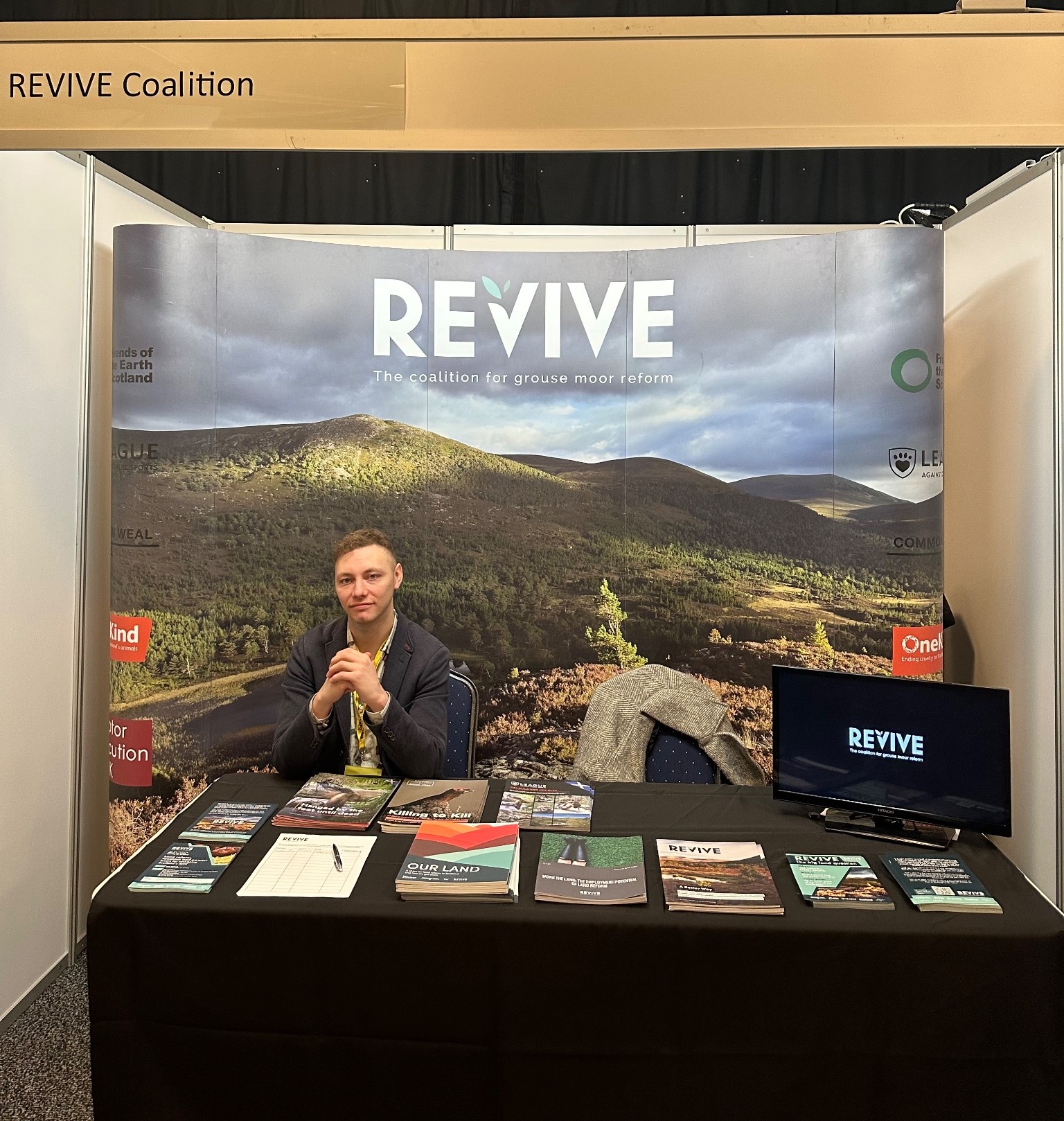
REVIVE, the coalition for grouse moor reform is attending the SNP’s annual conference which starts today.
We have a stand (#17) all weekend where conference delegates can drop by for a chat and pick up copies of our various reports:
On Saturday we’re hosting a fringe event (Sidlaw Room, Level 2) from 12.30 – 13.30hrs on the subject of land reform. Here are the programme notes:
LAND REFORM, TAXATION & POWER: LEVERS FOR RESHAPING SCOTLAND’S LAND
This land is your land but huge swathes of Scotland have been dominated by large landowners and sport shooting interests, enabling unequal land ownership models to persist. In the meantime carbon credits are providing green finance but can it be done better and for the public good instead of private profit? Join us at an opportune time – with an imminent new land reform bill – to discuss levers for progressive change which can be used to achieve transformational land reform for our people, wildlife and environment.
Our panel of speakers will include Max Wiszniewski (REVIVE Campaigns Manager), Dr Helen Armstrong (Sustainable land use consultant at Broomhill Ecology), Dr Craig Dalzell (Head of Policy & Research at Common Weal) and Kate Forbes MSP, Deputy First Minister.
If you’re attending the conference, drop by and say hello!
Press release from International Fund for Animal Welfare (IFAW), 21 August 2024:
Wildlife criminals: Public want them punished, but they routinely get off scot-free, study shows
Criminals who inflict immense suffering on wild animals, such as beating to death, poisoning, or smuggling across borders illegally, are evading justice and penalties in the UK, according to new research.
This is despite new poll findings showing that 97 percent of the respondents believed those who torture wild animals should be punished.
The report ‘System set to fail – prosecuting wildlife crime’ was commissioned by the International Fund for Animal Welfare (IFAW) from criminologists at Nottingham Trent University (now at Anglia Ruskin University (ARU)) and the University of Gloucestershire. It extensively documents first-hand accounts of those working on the front line of wildlife crime, providing a bleak overview of why so many cases do not result in prosecution.
It revealed cases were often unsuccessful due to a lack of resources, training, inconsistent approaches to gathering evidence, and the absence of a centralised recording system for wildlife crime.
In addition, a poll carried out by YouGov has shown that there is overwhelming support for wildlife crime to be taken seriously. Specifically, it found:
97% of people believed that those who torture wild animals should be punished.
92% of people were in support of the government setting up a formal reporting system to record wildlife crime.
Over 80% of people thought that people who illegally trafficked wild animals (81%) or tortured them (85%) should be given a prison sentence.
63% thought that the government should be doing more to tackle wildlife crime.
“Britain’s wildlife is in trouble. This research tells the demoralising tales of enforcers often fighting losing battles against criminals enjoying a lucrative free-for-all to exploit wildlife for greed. It’s a system set to fail”, Catherine Bell, Director of International Policy, IFAW said. “Wildlife crime presents low risk – high reward opportunities to organised gangs, who are often linked to drugs, firearms and other violent offences.”
“If the new government wants to signal their commitment to protecting nature, then this is a golden opportunity”, Bell added.
Police, legal experts and NGOs cite wildlife crime’s ‘non-notifiable’ status as a major source of its inequality under the law. This means incidents do not have to be reported by the police to the Home Office which would use them to compile national crime statistics. As a result, such statistics are hidden in violence, suspicious circumstances offences and anti-social behaviour incidents, preventing clear oversight of the situation.
“Research consistently shows wildlife crime doesn’t get the priority or the resources it deserves. Instead, we have a system reliant on the diligence and dedication of individual enforcement staff. We need better systems in place to provide the necessary support to investigate and prosecute these crimes,” Dr Angus Nurse, research lead and Professor of Law and Environmental Justice at ARU said.
Wildlife crimes occur under a veil of secrecy often in remote places, so overstretched police forces have difficulty allocating resources to investigate and prosecute them. Plus, in June, the Metropolitan Police’s wildlife crime unit was scaled back, with the unit’s detectives being redeployed.
To tackle the problem IFAW is calling on the new government to show that they are committed to taking wildlife crime seriously in the first 100 days of government by introducing new measures. These include:
Making wildlife crime a ‘notifiable’ offence.
Mandatory early legal training in wildlife crime.
Mandatory sentencing and prosecution guidelines.
Better guidance and support on the evidence needed for wildlife crime prosecutions.
Greater multi-agency collaboration.
Raised awareness of wildlife crime across forces.
Commitment to the National Wildlife Crime Unit (NWCU) funding from the government.
IFAW has launched a petition calling on the new Labour Government to consider and implement these measures. To sign it, please visit the IFAW website here.
Police Scotland appeal for information (26 August 2024):
APPEAL FOR INFORMATION FOLLOWING DEATH OF OSPREY IN PERTHSHIRE
We are appealing for information following the death of an osprey in Perthshire.
On Monday, 12 August, 2024 the injured osprey was found in distress by a gamekeeper in the Glen Doll area. The SSPCA was called and the bird taken to the wildlife resource centre in Fishcross for treatment, however it had to be euthanised due to the severity of the injuries.
Following further investigations, x-rays revealed the osprey had been shot and Police Scotland was contacted.
Officers are appealing for anyone with information on what happened to contact them.
Detective Constable Daniel Crilley, Wildlife Crime Investigation, said: “It’s illegal to kill any protected species and we’re working with partner agencies to fully investigate the circumstances.
“Information from the local community is vital and I’d ask anyone who was in the area around 12 August and thinks they may have information which could assist our enquiries to come forward. We’re keen to speak to anyone who may have seen anything suspicious or has information about shooting activity in the area.”
Anyone with information is urged to contact Police Scotland on 101 quoting reference 1671 of 26 August. Alternatively, you can call Crimestoppers anonymously on 0800 555 111.
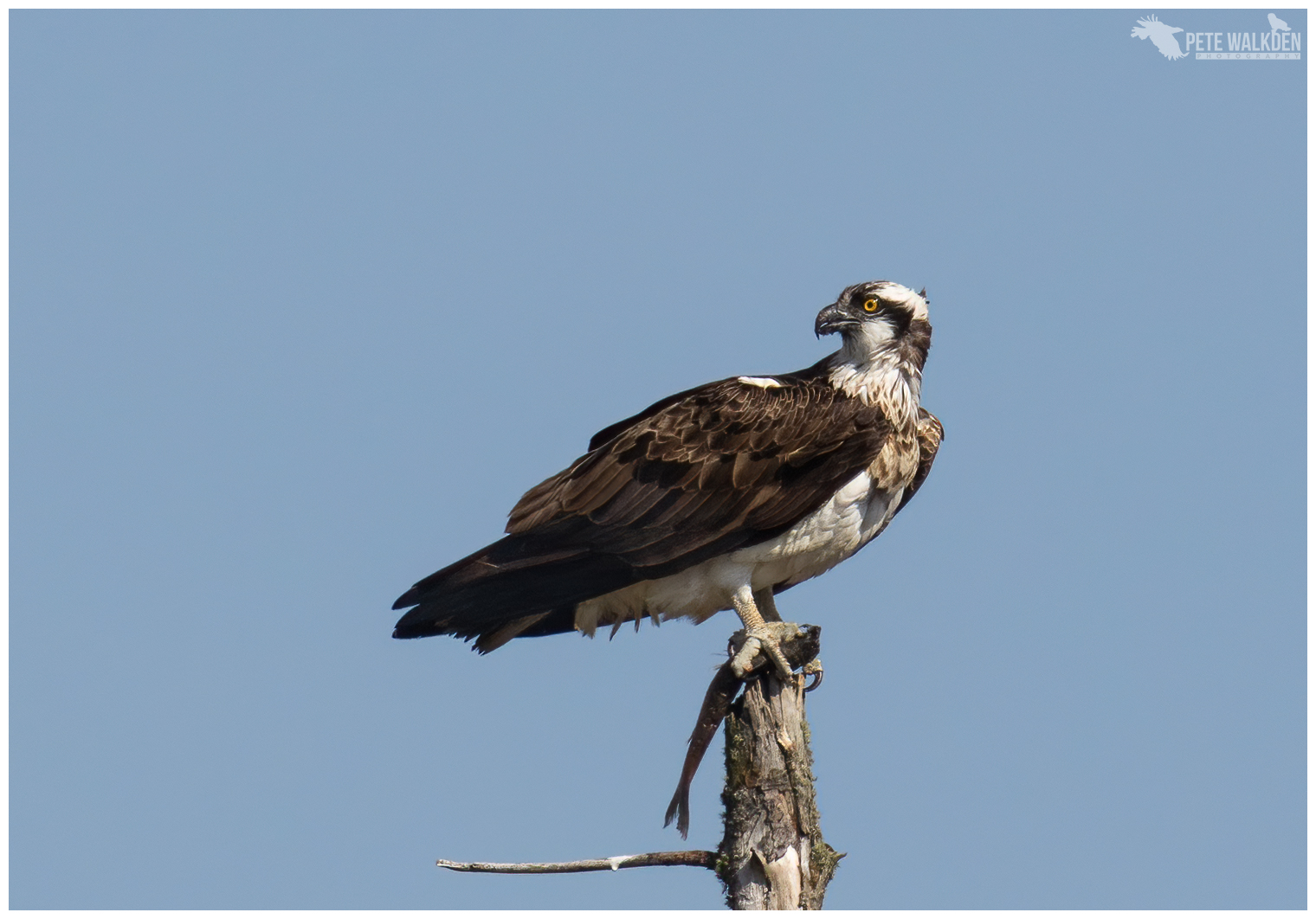
It’s unusual for an Osprey to be shot in the UK, given that they’re a fish-eating specialist and therefore no threat to gamebirds such as red grouse, pheasants or partridges.
Police Scotland’s appeal for information doesn’t say what type of gun was used (shotgun or air rifle) which would have been evident from the x-ray, nor the extent of the osprey’s injuries (i.e. was it able to still fly? If not, it was obviously shot close to where it was found), so it’s quite difficult to comment in detail.
However, given it was found on the opening day of the annual grouse shooting season, in the Angus Glens, an area dominated by driven grouse moors and with a long, long history of illegal raptor persecution, then it’s difficult not to perceive this osprey has been shot by somebody out on a day’s grouse shooting.
Perhaps a case of mistaken identity? One too many sloe gins? Something similar has happened before, that time it was a buzzard shot during a pheasant shoot (see here).
Oh, and the osprey shooting happened inside the Cairngorms National Park.
What better advertisement for the gamebird shooting industry, eh?
This will be an interesting investigation to follow. If it was shot on a moor when a grouse shoot was taking place, how will that impact on the estate’s new licence?
REVIVE, the coalition for grouse moor reform is hosting it’s annual national conference at Perth Concert Hall on Sunday 10th November 2024.
This year’s theme is land reform and the event will be hosted by leading land reform campaigner Dr Lesley Riddoch.
REVIVE National Conference for Land Reform: A turning point for our people, wildlife, and the environment
Sunday 10th November 2024, Perth Concert Hall.
Doors open 11:05. Conference programme (to be released shortly) begins at 12 noon.
REVIVE are thrilled to invite you to the launch of Scotland’s next major push for land reform – a turning point that aims to empower people to change the face of Scotland.
Just 433 people own half of Scotland’s private land. A large amount of this land is used by a few people to kill our wildlife for ‘sport’ while our environment suffers and Scotland’s people are denied access, opportunities, and a say in how our land is run and owned. Scotland remains one of the most nature depleted places in the world.
How can we transform our land to create thousands more good jobs, fund our communities and offer a vision that can unlock our land’s potential for people like you, our wildlife and the environment?
That’s what The Big Land Question will seek to answer – a major national project that is being launched at this conference to pinpoint how the ownership and management of Scotland’s land could be transformed for all of us, not just a few big landowners.
Join us on what we believe will be a key turning point for people, wildlife and the environment that will change the face of Scotland for the better.
In May 2024, Police Scotland issued an appeal for information after the discovery of a dead osprey called ‘Laddie’, the famous breeding male from the Scottish Wildlife Trust’s Loch of the Lowes Reserve in Perthshire (see here).
Criminality had been suspected initially but a few weeks later the police announced that criminality still hadn’t been established but they were awaiting the results of a post mortem to confirm (see here).
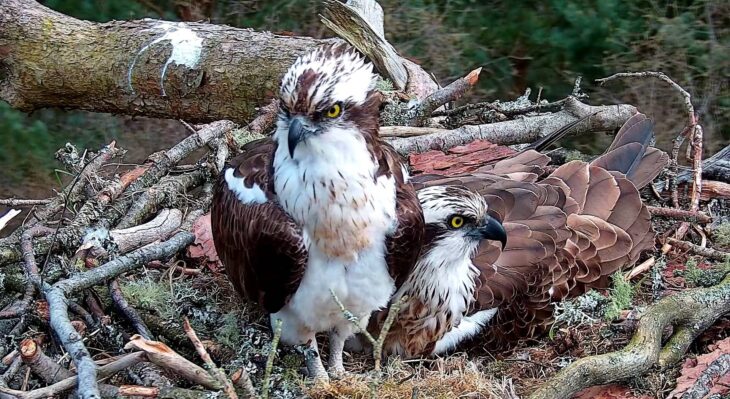
Osprey ‘Laddie’ with his mate. Photo from Scottish Wildlife Trust webcam.
Yesterday Police Scotland (Tayside) issued the following statement on Facebook:
“Following extensive enquiries on the remains of an osprey found near Dunkeld, Perth and Kinross, on Friday, 3 May, 2024, no criminality has been established.
It is believed the protected species, which is thought to have been nesting at Loch of the Lowes, close to where it was found, died from natural causes“.
Further detail has been published by the Scottish Wildlife Trust:
“The post mortem has revealed that the male osprey died of bleeding from stomach ulcers. There was no indication of lead or any other poisoning; evidently, old age played its part. We think he was at least 15 years old” (see here for more info).
Thanks to the blog reader who alerted me to the following notice in Border Telegraph, dated 31 July 2024:
FRAUD CHARGE
A police officer will face trial at Jedburgh Sheriff Court accused of a fraud involving almost £10,000.
Forty-six year-old Suzanne Hall is charged with pretending she had just moved into her home at Lamberton Holdings in Berwickshire with her family in December 2020 after previously staying in a house in Chirnside.
But the charge alleges the Lamberton house had been her sole or main residence since August 2015 and she was due Scottish Borders Council £9,613 in back-dated council tax.
Hall pleaded not guilty to the charge and a trial date was fixed for November 19th 2024.
This looks to be the same WPC Suzanne Hall from Lamberton Holdings who was previously charged, along with her husband Timothy and son Lewis, with offences linked to the alleged laundering of wild peregrines that were later sold for profit to falconers in the Middle East. Her husband and son pleaded guilty but Suzanne Hall’s not guilty plea to five charges was accepted by the Crown in December 2023, although it was reported at the time that, “a fraud charge was deserted with the Crown reserving the right to re-raise the case at a future date” (see here).
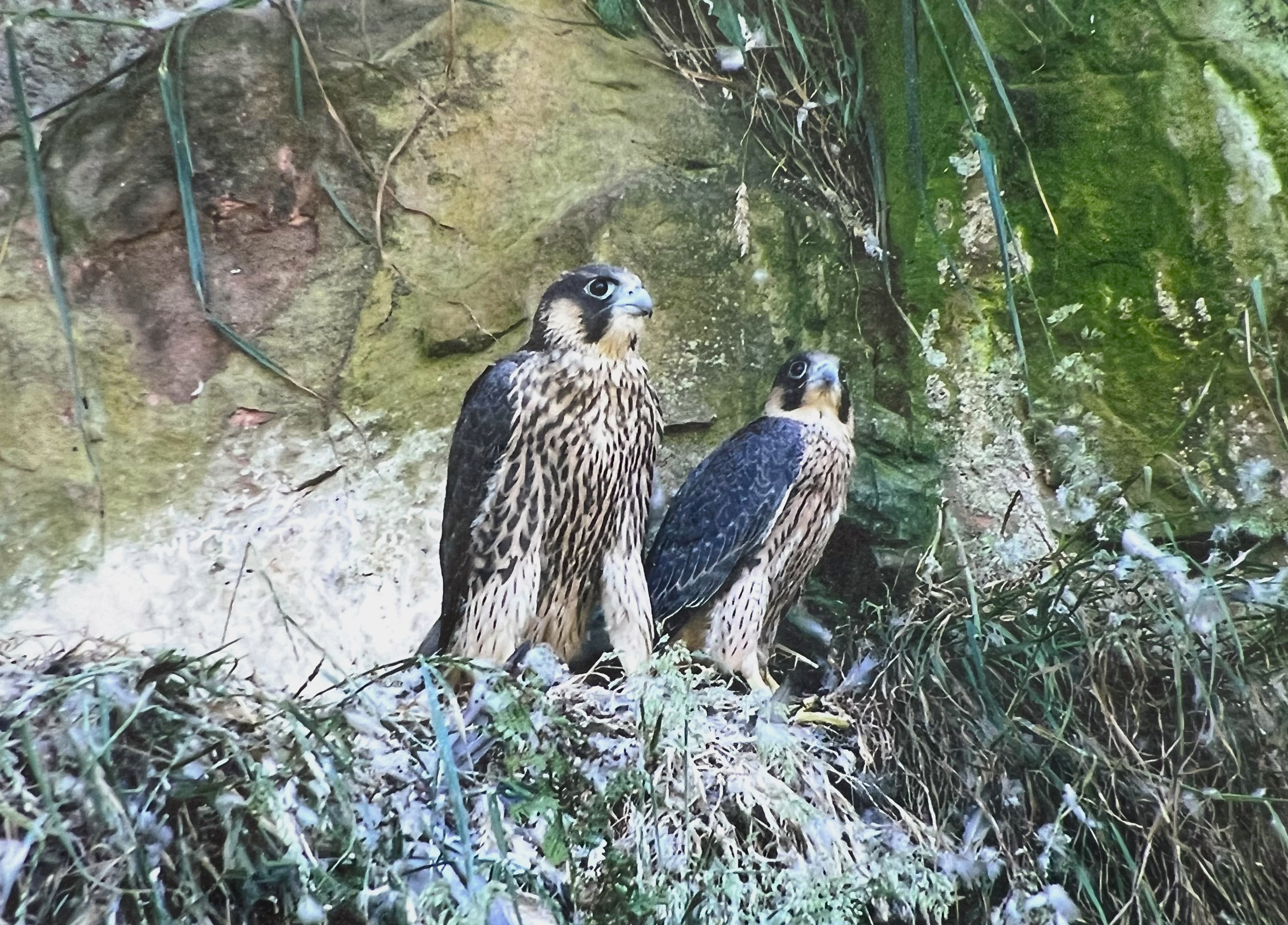
Juvenile peregrines. Photo by Ruth Tingay
It’s not clear whether the latest fraud charge alleged against Suzanne Hall relates to the previously deserted charge or whether this is a different one.
NB: As this case is live, comments are turned off until proceedings have concluded.
Convicted peregrine launderer Lewis Hall, 23, is due to appear at Jedburgh Sheriff Court on 4th September 2024 in relation to action being taken by the Crown to recover £164,028.80 under the Proceeds of Crime Act (see here).
UPDATE 12 October 2024: I’ve received an unconfirmed report that the case against WPC Suzanne Hall has been dropped. I’m seeking confirmation of this and will report in due course.
UPDATE 17 November 2024: Fraud charge dropped? The weird case of WPC Suzanne Hall, wife & mother of convicted peregrine launderers (here)
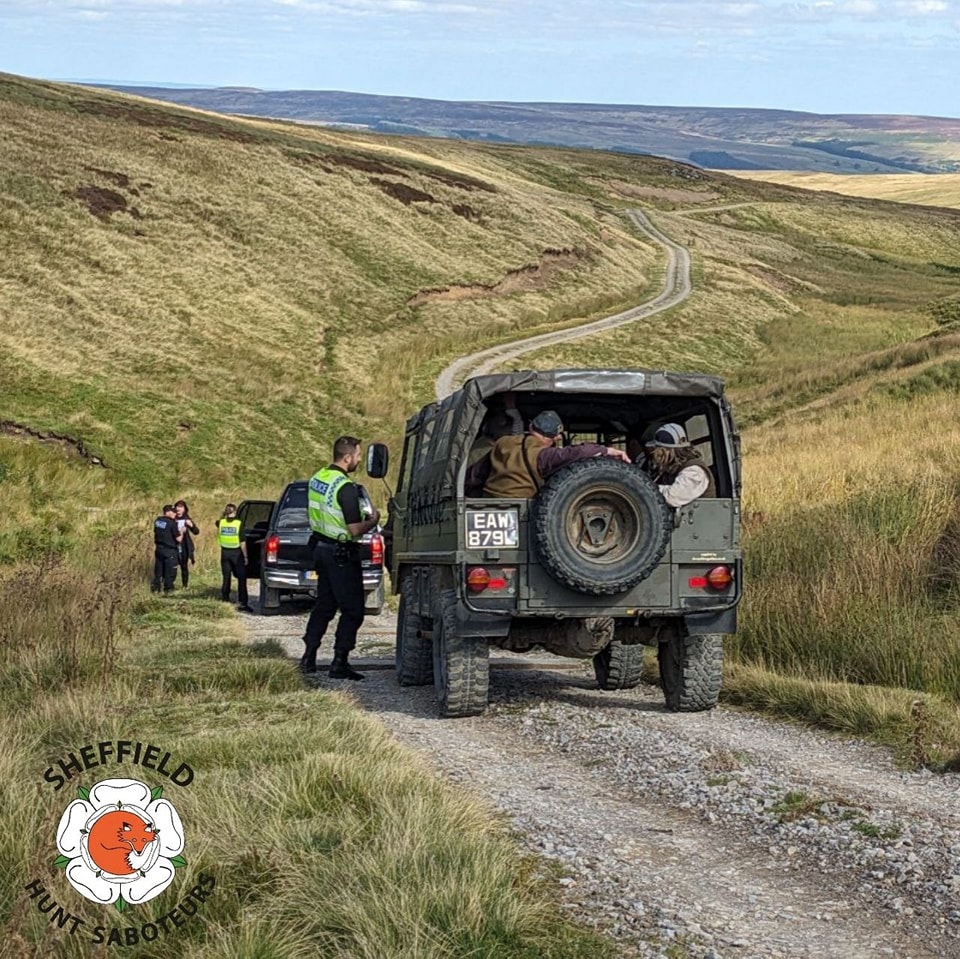
Following the disruption of a grouse shoot on Wemmergill Estate in County Durham on the Inglorious 12th (see here), the Hunt Saboteurs were out again yesterday and this time managed to disrupt a grouse shoot on Stean Moor in Nidderdale, North Yorkshire.
The grouse shooting party leaving Stean Moor yesterday. Photo by Sheffield Hunt Saboteurs
Stean Moor was previously owned by one of the Queen’s good mates, the now late Lord Vestey (see here for obituary, and also see pages 116-117 in Guy Shrubsole’s fascinating book, Who Owns England?).
The Hunt Sabs managed to disrupt two shooting days there last year (see here).
For details of yesterday’s disruption, please see here.
Over the last few months I’ve heard from various well-placed sources that hen harrier brood meddling has not taken place this year.
For new blog readers, hen harrier brood meddling is a conservation sham sanctioned by DEFRA as part of its ludicrous ‘Hen Harrier Action Plan‘ and carried out by Natural England, in cahoots with the very industry responsible for the species’ catastrophic decline in England. In general terms, the plan involves the removal of hen harrier chicks and eggs from grouse moors, rear them in captivity, then release them back into the uplands just in time for the start of the grouse-shooting season where they’ll be illegally killed. It’s plainly bonkers. For more background see here and here.
Photo: Laurie Campbell
I’ve asked Natural England (the licensing authority for hen harrier brood meddling) about the status of brood meddling this year but they haven’t responded yet.
If the rumours are true, and brood meddling hasn’t taken place this year despite there being broods available to meddle with, it raises a lot of questions, not just about what happened this year but also about any future prospects for brood meddling, whether that be as part of the continuing so-called scientific trial or the full roll-out of brood meddling as a recurrent annual practice, which is what the grouse shooting industry wants (laughingly calling it a ‘conservation licence’)!
Long-term blog readers will know that the initial brood meddling trial ran for five years from 2018-2022 inclusive. At the end of that trial, the brood meddling project board (which unbelievably includes vested-interest representatives from the grouse shooting industry such as the Moorland Association and GWCT, as well as the licence applicant, Jemima Parry Jones, who’s paid by the MA to do the brood meddling) decided it wanted to extend the trial and Natural England agreed to a further five year trial period (here).
An initial two-year extension licence was granted for 2023 and 2024 (NE isn’t permitted to grant a licence for longer than a two-year period in one go) with a few changes to the licence conditions as requested by the ‘project board’, including:
An increase in the number of times a pair of breeding hen harriers can have their nest brood meddled (previously, intervention was restricted to prevent the same pair being brood meddled in successive years – this time intervention was permitted in successive years);
No further requirement to satellite tag ALL the brood meddled chicks, only a sub-sample;
In the case of the North Pennines Special Protection Area (SPA) Southern Zone, no further requirement for brood meddled birds from this Zone to be released back into this Zone specifically, but still must be released into the wider North Pennines SPA (the project board had sought to remove entirely the requirement for brood meddled birds to be returned to the same SPA from where they were originally removed – this is important, I’ll come back to this point below).
For more detail about the changes to the licence conditions for 2023/2024 extension, see this Case Submission to Natural England’s High Risk Casework Panel in April 2023 and released to me under FoI:
So if the brood meddling ‘project board’ was so keen for an extension to the brood meddling trial/sham, why would they only take advantage of the extension for one year (2023) instead of the two years for which it was licensed? Just adding a one year extension to the trial doesn’t seem sufficient time (to me) to provide the data required to address the questions the so-called scientific trial was seeking to address, which is why NE approved a two-year licence extension within an extended five-year trial extension.
Well, there are a few hypotheses circulating about that. Of course these are all speculative at the moment because we don’t know for sure that brood meddling didn’t take place this year, but let’s assume for now that it didn’t.
The first hypothesis is that the grouse shooting industry simply hasn’t been able to find sufficient ‘receptor sites’ where the brood meddled chicks would be released post-captivity. We know, from an official internal NE report released via FoI, dated April 2022 (heading into the last year of the initial five year trial), that only four estates had been involved as ‘intervention sites’ (i.e. their hen harriers were brood meddled: one nest in 2019, two nests in 2020 and two nests in 2021) and only three estates had functioned as ‘receptor sites’. That’s not very many estates willing to engage in hen harrier brood meddling, is it?
Incidentally, data from the 2022 breeding season show there were four broods meddled with that year and six broods meddled with in 2024. I haven’t seen any information about how many estates were involved (as intervention or receptor sites) but the figure must still be staggeringly low.
Out of a purported 190 grouse moor member estates, the Moorland Association seems only to have found a handful willing to participate in the brood meddling trial, whether as an ‘intervention’ site or a ‘receptor’ site. I wonder why that is?
It could be that a lot of grouse shooting estates don’t see the point of getting involved in brood meddling because they’ve already got a tried and tested way of removing hen harriers from their moors (i.e. illegally killing them) and the chance of getting caught and prosecuted for it is virtually nil (see here).
It could be that a lot of grouse shooting estates won’t get involved in brood meddling unless it’s guaranteed that after the ‘trial’ period, brood meddling will be rolled out as a standard, legal technique that grouse moor owners can use every year to get rid of hen harriers. There’s some evidence that this hypothesis is more than speculative, as follows:
Cast you minds back to Valentine’s Day 2023 when the Natural England Board and some of its senior staff had a day out at Swinton Estate in Nidderdale (an estate at the epicentre of hen harrier brood meddling and also an estate with a long track record of confirmed and suspected raptor persecution offences, including some relating to hen harriers). I wrote about that day out (here and here).
After their soiree on the Swinton grouse moors, Natural England’s Board and senior staff went out to dinner and invited some fascinating guests. The NE Board had been issued with an internal briefing document to help them navigate what were described as “elephant traps and tricky issues”, which included hen harrier brood meddling. Here’s the briefing document, released to me under FoI – pay attention on page 3 under the heading Future of Brood Management, where it says this:
“NE Board has taken the in-principle decision to continue participation I [sic] brood management on a scientific trial basis. The MA is the principal partner in the trail [sic], promoting participation by estates, organising and funding release facilities and enabling access for our fieldworkers to tag and monitor chicks. Along with all our brood management partners, they are rightly proud of the success so far and are clear that an estate’s appetite for tolerating or welcoming breeding hen harriers is directly related to the availability of brood management as a ‘pressure valve’ to avoid a build-up of breeding hen harriers. The MA has supported the proposal of extending the trial but is clear that this should lead to the eventual wide availability of the technique as a practical and affordable tool“. (Emphasis added by me).
Also of interest in this internal briefing document is the news that the Moorland Association had asked for a ‘fixed release site’ (for brood meddled hen harriers) instead of having to release the birds back the same SPA from where they were removed. The MA had suggested Moorhouse NNR in Upper Teesdale or Ingleborough NNR in the Yorkshire Dales National Park as potential fixed sites. NE didn’t support this and the briefing document states:
“[REDACTED] judgement is that this represents too great a risk to the ‘NNR-brand’ as a whole and individual sites as long as illegal persecution remains a real threat to any hen harrier nest: additionally the MA should have sufficient contacts with access to vast tracts of suitable land if a long term commitment to hen harrier recovery is their goal“. [Emphasis is mine].
So there’s that issue I flagged earlier about the difficulty the MA appears to be having in providing ‘receptor’ sites. Funnily enough, this issue has also been raised again this year in a Moorland Association blog posted on 12 April 2024 (here), where there is quite a lot of moaning about having to release brood meddled hen harriers back in to the same SPA from where they were removed, and of course the now obligatory veiled threat about this potentially being in breach of IUCN guidelines, an argument the MA has also used recently in relation to the Police-led Hen Harrier Taskforce and one that the National Wildlife Crime Unit has summarily dismissed (see here).
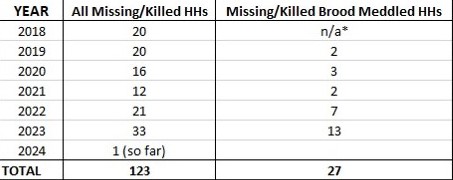
A further hypothesis that’s been put forward about why the hen harrier brood meddling sham appears to have collapsed this year is that the Moorland Association probably doesn’t want to have to keep spending a fortune on paying for satellite tags when those tags are the primary source of evidence that demonstrate that brood meddling has not put an end to hen harrier persecution – indeed, last year (2023) was the worst on record since the brood meddling sham began in 2018, with 33 individual hen harriers reported as being illegally killed or to have disappeared in suspicious circumstances, including 13 brood meddled birds, and most of them on or close to driven grouse moors:
Over the next few weeks there should be more information available about this year’s hen harrier breeding season, including the number of breeding attempts, breeding failures and successes, the number of hen harriers satellite-tagged by Natural England and by the RSPB in various regions, the number of dead/missing hen harriers reported so far this year, and whether brood meddling did take place this year or whether the whole sham has just come tumbling down.
Whatever has happened this year, Natural England’s two-year extended brood meddling licence (2023-2024) has now expired and we can expect a substantial review of the seven-year ‘scientific trial’ which will be used to determine whether the trial is now closed or extended again, whether the grouse shooting industry will get a permanent ‘conservation licence’ (ha!) to continually remove hen harriers from the grouse moors, or whether the new Government will be pressed into dropping the whole sorry pantomime and instead focus its attention (and our money) into taking more effective action against the hen harrier killers.



 Raptor Persecution UK