Grouse shooting banned on Ilkley Moor

Press release from the campaign group Ban Bloodsports on Ilkley Moor, 15 January 2018:

Bradford councillors vote to ban grouse shooting on Ilkley Moor

Bradford Council’s Labour Group votes by overwhelming majority to not renew grouse shooting rights for Ilkley Moor, a move that has been strongly welcomed by wildlife campaigners.

Bradford Councillors voted to not renew controversial grouse shooting rights for Ilkley Moor at City Hall tonight. The decision, which was taken by the Bradford Labour Group, is understood to have been supported by an ‘overwhelming majority’ of those councillors who voted.

Bradford Labour is the largest party on the Council and ending grouse shooting is also backed by Bradford Liberal Democrats, Bradford Green Party and the majority of Independent councillors.

Ban Bloodsports on Ilkley Moor (BBIM), which has lobbied Bradford Council to end grouse shooting on the moor since its formation in May 2014, has strongly welcomed the move. The group notes that over half of protected breeding bird species have declined or become locally extinct on Ilkley Moor, government figures collated by the RSPB Northern England office show. It has urged for efforts to now be focused on reversing the wildlife crash, which has negatively impacted on the moor’s population of specialist species, including Merlin, Dunlin and Short Eared Owl, could result in the loss of the site’s conservation designations if declines continue.

Luke Steele, Spokesperson for BBIM, comments: “Bradford Council’s Labour Group decision tonight to not renew grouse shooting rights for Ilkley Moor is to be commended in the highest terms. It reflects the urgent need to reverse wildlife decline, habitat degradation and public dismay which has overshadowed this treasured moorland since grouse shooting was introduced in 2008. 

“We thank all of those who have relentlessly persued an end to grouse shooting on Ilkley Moor – the strong cross-party representation of Parish and District Councillors, regional MPs including John Grogan, Alex Sobel, Judith Cummins and Naz Shah, visitors to the moor and conservation groups. This is as much a victory for them as it is for the precious wildlife and habitat. Our efforts will now turn to reversing the terrible legacy of grouse shooting on the moor in pursuit of a first-class asset for the region, which promotes wildlife biodiversity, education, leisure and the local economy.”

Bradford Council is the last local authority in the UK to allow grouse shooting to take place on public moorland. Others, including the Peak District National Park Authority and Sheffield Council, already prohibit the practice on their upland estates, having previously allowed it, and now maintain the land using other methods.  During a recent consultation on the future management of Ilkley Moor, the largest number of submissions received by the local authority on any single topic urged an end to grouse shooting.

ENDS

This is a significant victory for a grassroots campaign group. Well done!

Stop illegal persecution then no need for reintroduction of hen harrier to southern England, says DEFRA Minister

In response to a Parliamentary question about the reintroduction of hen harriers to lowland England, a DEFRA Minister responded as follows:

Sounds good, doesn’t it? Unfortunately, this response didn’t come from Dr Therese Coffey MP or Michael Gove MP. It came from Ben Bradshaw MP back in 2004, who at the time was the Under Secretary of State at DEFRA, under the leadership of Margaret Beckett.

The question came as part of a series of Parliamentary questions posed by James Gray MP (Conservative, North Wiltshire) in response to the launch of Operation Artemis, a police-led initiative aimed at tackling the illegal persecution of the hen harrier. Mr Gray wasn’t a fan (no surprise when you look at his background) as you can see from this Early Day Motion from Labour MP Tony Banks:

We haven’t been able to find the exact quote from Mr Gray on Hansard, but it’s clear he wasn’t in support of Operation Artemis, and judging by this (scroll down to the bottom), a number of his fellow Conservative MPs agreed.

Operation Artemis was launched in the spring of 2004 and part of the initiative was for police officers to visit every single estate where there was the potential for hen harriers to breed. The idea was that police officers would provide landowners and gamekeepers with a code of best practice to help any hen harrier breeding attempt, and invite those land owners and gamekeepers to sign up to support the initiative.

Here is Paul Henery (Police WCO for Northumberland) and Chief Constable Richard Brunstrom at the launch (photo by Guy Shorrock)

There was apparently strong support in Wales, but in England, landowners and gamekeepers reacted with fury. Here is a cutting from the RSPB’s Legal Eagle newsletter in July 2004:

And here is the astonishing response from the National Gamekeepers’ Organisation (take note of the suggestion that the limited police budget for this scheme could be decimated by police officers having to respond to a barage of complaints, which could then be withdrawn at the last minute):

Fourteen years on, the hen harrier’s breeding population in England remains critical, the illegal persecution of this species continues unabated, it is virtually impossible to secure a conviction even when high definition video evidence of the crime is available, the Conservative Government has approved the removal of hen harriers from grouse moors to allow a few hundred rich folk (including a number of Conservative MPS) to shoot 0.75 million red grouse in the face for a bit of fun, and thinks that importing hen harriers from France in to southern England under the guise of being a conservation initiative is a great idea, even though illegal persecution continues (which means the scheme does not meet the required IUCN guidelines for reintroductions).

Diverting attention from the illegal killing of peregrines on grouse moors

One of the many criticisms about the proposed reintroduction of hen harriers to southern England is that if a population does manage to become established, the grouse-shooting industry will use it to divert attention from the on-going eradication of this species on intensively managed driven grouse moors. ‘Look, hen harriers are doing just fine in the lowlands, the species’ conservation status has improved, everything’s fine, there’s nothing to worry about anymore’.

If you don’t think that that’s what will happen, just take a look at this letter from the Countryside Alliance, published in The Times yesterday:

PEREGRINE’S SUCCESS

Sir, your report that the peregrine falcon is “now seeking sanctuary in cities as it comes under threat” fails to provide vital context (“Prized peregrine falcons falling prey to greed“, News, Jan 9). The peregrine falcon population reached a low of about 150 pairs in the 1960s as a result of the impact of toxic agricultural chemicals such as DDT in the food chain as well as illegal persecution. However, improved legislation and protection has helped the peregrine falcon to expand its range and numbers. The latest estimates place the number of peregrines at a historic high of 1,500 pairs, and has led to the peregrine having its conservation status declared “secure”. The species, like other raptors such as the buzzard and red kite, is an undoubted conservation success.

ENDS

No mention then, of how illegal persecution on the north of England grouse moors is suppressing local peregrine populations (see here).

No mention then, of how the preliminary results of the 2014 national peregrine survey show a sharp decrease in peregrine occupation in the UK’s uplands, especially in areas intensively managed for driven grouse shooting (see here).

No mention then, of how illegal persecution has led to the continuing decline of peregrines in the grouse moor areas of north east Scotland, particularly on the eastern side of the Cairngorms National Park (see here).

No mention then, of how illegal persecution has led to the continuing decline of the peregrine’s breeding population on the grouse moors of Bowland.

No mention then, of how illegal persecution has led to the continuing decline of the peregrine’s breeding population on the grouse moors of the Dark Peak in the Peak District National Park (see here).

Funny, that.

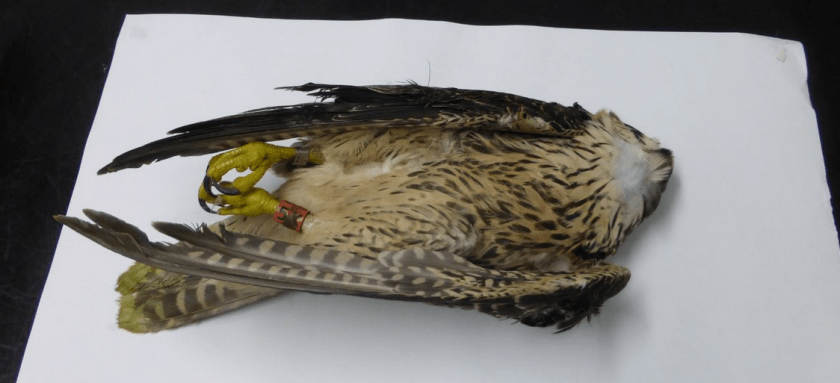
Photo of a dead peregrine that was found shot next to a grouse moor in the Peak District National Park in 2016 (RSPB photo)

Reports of 2017 grouse shooting season distorted by PR bluster

We’ve been reading some reports of the 2017 grouse shooting season and it’s pretty clear that the industry is engaging in a public relations offensive to try and portray an image of huge success with significant support from local communities.

For example, there’s this article in today’s edition of The Northern Echo, headlined ‘Grouse Moors of North Yorkshire report successful shooting year’, with commentary from the North Yorkshire Moors Moorland Association

And then there was this article in last week’s Darlington & Stockton Times, headlined ‘Successful grouse shooting season in Nidderdale helps boost local economy’, with commentary from the Nidderdale Moorland Group.

There’s nothing wrong with reporting on business success, of course, but these articles lose credibility when you notice the similarity between them. For example, there is a quote in the first article from Tina Brough of the North Yorkshire Moors Moorland Association:

The grouse industry is a life line for many in our rural community offering employment opportunities and supporting many local businesses, with shooting-related tourism bolstering trade during the winter off-season“.

There’s also a quote in the second article from Roy Burrows of the Nidderdale Moorland Group:

The grouse industry is a life line for many in our rural community offering employment opportunities and supporting many local businesses, with shooting-related tourism bolstering trade during the winter off-season“.

Oh dear. Two identical ‘quotes’, word for word, supposedly from two individuals in different parts of the country? It’s pretty obvious that ‘somebody’, or more likely ‘some organisation’ has concocted a general press release designed to impress on the public how successful and important grouse shooting is (to the local economy), and then asked the moorland groups to adapt it to their particular areas.

The second article also includes a quote attributed to a couple of local hoteliers who talk about how important game shooting is to their annual revenue. Again, nothing wrong with that, but don’t be fooled by thinking that ALL local businesses benefit from, and support, the grouse shooting industry. The article failed to include the news that several local business owners in Nidderdale are so fed up with the continued illegal persecution of raptors on Nidderdale grouse moors that they’ve contributed thousands of pounds towards a reward for anyone who can provide information leading to the arrest and conviction of those involved (see here). There’s been a similar outcry from local traders in the neighbouring Yorkshire Dales National Park, who have reportedly complained to the Yorkshire Dales National Park Authority that the Park’s (deserved) reputation as a raptor persecution hotspot may damage their businesses (see here).

And just sticking with Nidderdale for a moment, the second article opens with this line:

The grouse shooting season proved a runaway success in the Nidderdale Moorland Group area with most estates enjoying a full shooting programme‘.

That’s an interesting claim, because according to a review of the grouse shooting season by sporting agency Dalesport (here), it wasn’t quite as successful a season as the Nidderdale Moorland Group is claiming:

There were Moors in Nidderdale and Coverdale that did not shoot and, yet some Nidderdale Moors had a real bumper seasons. What was very interesting about Nidderdale and Coverdale is that Bulgy Eye was present on most of the moors throughout the season and whether this was something to do with a lack of stock on a number of the moors is a separate question in itself‘.

It’s worth bearing in mind, when reading these reviews, who actually wrote them. All of the above articles included commentary from those with a vested interest in portraying the grouse shooting industry as a favourable and lucrative business. It’s not in their interests to say anything different, no matter how distorted the story they present to the media.

As a final aside, do take the time to read sporting agency Dalesport’s review of the 2017 grouse shooting season. Again, bear in mind that this sporting agency has a commercial interest in demonstrating to potential new clients how the agency can help them find ‘good’ shooting days so the review cannot be described as objective, but it does provide an insight to what is considered ‘good’ shooting – it’s still all about how many red grouse are available to shoot.

When will the grouse shooting industry wake up and realise that this continued reliance on the intensification of grouse moor management, just to get big bags, is going to be their downfall?

National Trust set to initiate new grouse shooting leases in Peak District National Park

In April 2016 we published a video of an armed man crouching next to a decoy hen harrier on Ashop Moor, which is part of the National Trust’s Park Hall & Hope Woodlands Estate in the Peak District National Park.

That video footage sparked outrage and significant public pressure was placed on the National Trust to take action against its shooting tenant (believed to be Mark Osborne).

As a direct result of that public pressure, in June 2016 the National Trust announced that it was pulling the shooting lease four years early and the shooting tenant had been asked to leave by April 2018. The National Trust was widely applauded for its action.

In 2017 the National Trust announced it was seeking new tenants ‘to work with us to create a new exemplar model delivering outstanding moorland nature conservation with grouse shooting’. Not everyone agreed that grouse shooting should continue on these National Trust moors and a local campaign group, Moorland Vision, was established to encourage the National Trust to consider rewilding these moors. This group delivered a petition to the National Trust last summer and had the support of 15 local environmental groups.

Yesterday, the National Trust released a statement to say that it had selected three new shooting tenants under a five-year lease:

After a thorough interview process the National Trust has selected three new shooting tenants to work as partners on the High Peak Moors in Derbyshire. A fourth area of land will not be let.

The tenants will have the opportunity over the next five years to work in partnership with the Trust to demonstrate that less intensive forms of grouse shooting can be compatible with the charity’s High Peak Moors Vision.

Andy Beer, Regional Director for the Midlands said: “We’ve made our decision based on what we think is best for nature. The High Peak is a managed landscape and we have chosen tenants who have committed to work with us to carry out land management which is good for the birds, plants and insects. With regards to hawks, falcons and owls we’ve made it very clear that the High Peak should have more of these birds, and we expect to see an increase in their numbers over the next five years.

This partnership is a new way of working, one which operates transparently, works to the highest standards, and helps us deliver our conservation aims of the High Peak Moors Vision“.

ENDS

This public statement doesn’t provide much detail at all but Mark Avery managed to glean a bit more from a discussion with the National Trust (see here). Of particular interest was this:

  • some land, on the Kinder plateau, will be taken out of shooting altogether
  • another parcel of land (the Back Snake – north of the A57) will be run as a walked-up shoot by a local farmer/gamekeeper
  • another parcel of land (south of the A57 area of the Hope Woodlands) will be run as a driven grouse shoot by a consortium of GWCT members
  • a fourth parcel of land (known as Park Hall) will be shot by the age-old method of shooting over dogs

Here’s a map of the estate as published by the National Trust when they advertised the tenancies. The red area is the Hope Woodlands site (with the A57 running through it) and the blue area is Park Hall. The town to the north west is Glossop:

As Mark Avery commented, it looks like the National Trust is trying to appease everyone by incorporating different types of grouse moor management (and in one area, no grouse shooting at all), but not everyone is impressed. If you read the response written by Moorland Vision (here), the group makes some persuasive arguments and describes the new grouse shooting leases as “a lost opportunity”. And it’s not as though the National Trust had no other option but to allow grouse shooting – according to the Moorland Vision blog the Derbyshire Wildlife Trust had also submitted a bid to help manage some of the moorland around Kinder Scout and Bleaklow, but the National Trust appears to have dismissed this an an option.

There’ll be more detail to come about these new tenants and we’re particularly looking forward to finding out more about the ‘consortium of GWCT members’ who will be running the driven grouse shooting south of the A57. The GWCT knows all about this area (Ashop Moor) – a day’s grouse shooting here was a GWCT raffle prize last year – donated by William Powell (co-owned by one Mr Mark Osborne, the current shooting tenant whose lease has been terminated).

These moors are also part of the long-failing Peak District Bird of Prey Initiative – will the new tenants help to increase the number of breeding raptors on these moors? Rest assured, this will be closely monitored.

Case against Bleasdale Estate gamekeeper James Hartley: part 2

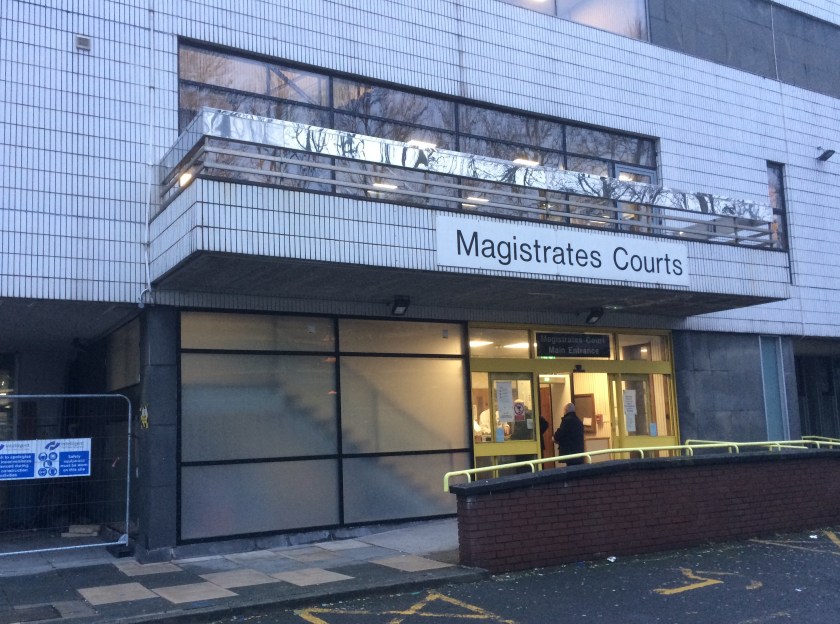
Today we attended Preston Magistrates Court in anticipation of listening to a case hearing in relation to the prosecution of James Hartley, a gamekeeper from the Bleasdale Estate in Bowland who is accused of a number of offences in relation to the alleged killing of two peregrines in April 2016 (see first court report for details here).

Photo by RPUK

Mr Hartley has pleaded not guilty to the alleged offences and today’s hearing had been initiated for the court to hear legal arguments from both the prosecution and defence before the onset of a potential trial.

At some point between the first hearing in September 2017 and today’s hearing, this case has been elevated to be heard by a District Judge rather than by magistrates. We don’t know the reason for this.

Legal arguments were not heard in court today, and a further date for those arguments to be heard has been set for 14th March 2018.

In addition, defence barrister Justin Rouse QC requested that District Judge Goodwin direct, under the Contempt of Court Act 1981, Section 4(2), “no publication of preliminary interests“, due to what he described as “inappropriate reporting of the previous hearing“. No details of the alleged inappropriate reporting were given in court.

District Judge Goodwin agreed with Mr Rouse’s concerns and, in the interest of avoiding the substantial risk of prejudicing the case, she directed that “nothing pertaining to the legal arguments may be published prior to the conclusion of this case“.

At the end of today’s hearing we asked District Judge Goodwin for clarification on this point and she told us that as of today we may not publish anything about the specific legal arguments that are due to be heard on 14th March (although we can report on these legal arguments at the conclusion of this case), but we were free to report that today’s hearing took place and we are free to report on the trial (if it proceeds) as long as that reporting is fair and accurate – the usual caveats for reporting on legal proceedings.

Given this direction from District Judge Goodwin, we will not be publishing any blog readers’ comments on this particular case until it has concluded.

Depending on the outcome of the legal arguments to be heard on 14th March 2018, and District Judge Goodwin’s judgement (which she said would be ‘reserved’ – which means she won’t make a judgement on the day of the hearing but will take time to consider the legal position and announce her judgement at a later date), a preliminary trial date has been set for 23 April 2018 and is expected to conclude on 30 April 2018.

GWCT’s North of England Grouse Seminar 2018

The GWCT is hosting another North of England Grouse Seminar on March 8th at The Morritt Hotel & Garage Spa, Greta Bridge, nr Barnard Castle in County Durham.

Here’s the planned programme:

What an exciting line-up! First some news about how intensive grouse moor management has caused the rapid spread of disease across moors in England & Scotland.

Then some science that shows if you kill off predators, waders will have improved breeding success (duh!). Oh, and so will your red grouse, meaning there’ll be more birds for you to kill later in the year. Not that that’s your primary motive – no, you’re all about wader conservation and any side benefits that help increase your already-way-too-high red grouse population are simply unintended.

Then a bit about how great it is to repeatedly burn the heather on your grouse moor (as long as you ignore the widespread environmental damage this causes). It’s no big deal, it’s just like getting your hair cut. The fact that moorland burning has been detected in 55% of Special Areas of Conservation and in 63% of Special Protection Areas, (sites that are designated under EU legislation for their conservation value) and yet many are in ‘unfavourable condition’ with burning identified as the primary cause, is nothing to worry about.

Then after a spot of lunch, there’s an as yet to be revealed guest speaker from Natural England, talking about er, something.

Perhaps it’ll be someone coming along to reassure the room full of grouse moor owners that they needn’t worry, Natural England is doing its level best to ensure the last known fixes of all those missing satellite-tagged hen harriers remain a secret. [Incidentally, we have an update on this – blog coming soon].

Or perhaps it’ll be someone coming along to advise grouse moor owners how to get a licence to kill marsh harriers.

Then there’s some stuff about black grouse, and then a chance to hear the ‘final results’ from the Langholm 2 Project. Perhaps this time Dr Sonja Ludwig will be allowed to answer any questions about the science by herself, instead of being bulldozed off stage by someone who clearly doesn’t understand etiquette, nor science, and doesn’t like buzzards.

You don’t have to be a grouse moor owner to attend this seminar. If you’ve got a spare £40, you can book your ticket here.

Wildlife minister Therese Coffey stifles wildlife crime reporting

Back in November 2017, Labour MP Kerry McCarthy tabled the following parliamentary question on wildlife crime reporting:

A perfectly reasonable question, and probably an attempt by Kerry to drag the Westminster Government up to the standard of the Scottish Government, which, since the Wildlife and Natural Environment (Scotland) Act 2011, has had a statutory obligation to publish an anual wildlife crime report.

Now in its 5th year of reporting, the Scottish Government reports are still a long way from being perfect, largely due to issues with Police Scotland withholding data (and we’ll be blogging more on this shortly), but at least the Scottish reports are heading in the right direction as they focus specifically on the six national wildlife crime priorities (badger persecution, bat persecution, CITES issues, freshwater pearl mussels, poaching, and raptor persecution).

However, Wildlife Minister Dr Therese Coffey seems to have other ideas about wildlife crime reporting. Here is her response to Kerry’s question:

So according to the Wildlife Minister, there’s no need for any additional reporting on annual wildlife crime statistics because the Office for National Statistics and the Ministry of Justice already has this covered.

What the Wildlife Minister failed to acknowledge is that these ‘official statistics’ are not detailed enough to identify wildlife crime at the national wildlife crime priority level. Nowhere near.

The only ‘officially’ recorded wildlife crime at present is an obscure set of offences (apart from the important COTES regs) such as some relating to fisheries, sharks, whales, hedgerows and limestone pavements (sourced from the Home Office Counting Rules for Recorded Crime’, under the sub-heading ‘Miscellaneous Crimes Against Society’):

That’s it. So if you see someone shoot a golden eagle on a grouse moor in northern England and you report that to the police, it will be logged in the police control room and given a reference number, but because it isn’t a ‘notifiable’ crime, no report will be sent to the Home Office, so there’ll be no record of it in the ‘official’ statistics.

In November 2017, a consortium of environmental organisations operating under the umbrella group Wildlife & Countryside LINK published a damning report on how wildlife crime is currently recorded in England & Wales and is urging policy makers to address this issue. The report was spot on. To effectively tackle wildlife crime we need to know the scale of the crime being committed. Without properly recorded stats, this is impossible.

Either Therese Coffey doesn’t know about the limitations of the current wildlife crime recording policy (in which case she needs to employ better advisors), or if she does know about these limitations, her answer reveals a distinct lack of interest in monitoring the crime statistics relating to the six national wildlife crime priorities (with the exception of the COTES regs which cover CITES issues).

Either way, it’s yet another example of how little interest the Westminster Government has in tackling illegal raptor persecution and all the other wildlife crime that is allowed to flourish under this Government’s reign.

Can we please just have some honesty about the Heads up for Harriers project?

The controversial Heads Up for Harriers project got another airing at the weekend, this time on BBC Radio Scotland’s Out of Doors programme.

For those who missed it, you can listen to it on the BBC iPlayer HERE for the next 27 days (starts at 01.58, ends 07.39).

For the sake of posterity, here’s the transcript, and our comments are below:

Mark Stephen (presenter): Last year we covered the launch of an ambitious project to put cameras in hen harrier nests on grouse moors to see why the bird’s population numbers are so low. Now, we’d best not underestimate the challenge of this project in getting access to some moorland where privacy is treasured. The results are in and one of the main drivers behind Heads up for Harriers is Professor Des Thompson of Scottish Natural Heritage. Des has been talking to Euan.

Des Thompson: The hen harrier is one of our most special birds of prey, it’s a fantastically beautiful, graceful bird. It’s one of our most endangered birds. In the UK we’ve got hardly any birds nesting….[interrupted].

Euan McIlwraith: Is that just because they have a habit of taking grouse and they’re not welcome on the moors? Is that the main reason?

Des Thomson: Well historically that’s certainly been the case Euan, they’ve not been welcome at all on the intensively managed grouse moors. But they’re doing very well in the Outer Isles, we’ve got roughly just under 500 pairs at the moment but not doing anything like as well on the grouse moors.

Euan McIlwraith: So we should have them throughout Scotland or is it just mainly on the moorland?

Des Thompson: No, we should have them throughout Scotland, I mean historically they’ve nested in lowland areas but their best habitat and the best foods for these birds [is] on heather dominated areas.

Euan McIlwraith: The project last year, Heads up for Harriers, what was the idea of the project?

Des Thomspon: Well there’s two things we’re trying to do with Heads up for Harriers, one is just encouraging people to report their sightings of these birds, I mean they’re just so beautiful to see, and we’ve had a fantastic response from people throughout the country, just giving us information on where they’re seeing these birds and we can follow up to see how these birds are faring. But we’ve also recognised that on grouse moor areas they’re either absent or not doing well, so we’ve wanted to work with estates and conservationists to encourage these birds to settle. Where they’ve settled, with the agreement of the estates we’ve put out nest cameras to see what’s happening to the nests. If nests are failing, why? Is it because of foxes, crows, or disturbance or some other factor?

Euan McIlwraith: That was last year, what kind of results have you got?

Des Thompson: Well we’ve been very lucky because we’ve now got more than 20 estates participating.

Euan McIlwraith: Was that a hard thing, to persuade people?

Des Thompson: Yeah, it was actually, if I’m frank with you Euan. We’ve had to develop a very strong partnership involving Scottish Land & Estates, RSPB, Scottish Raptor Study Groups, SNH and other people, bringing them together, having candid conversations, which is sort of code for quite difficult discussions, but in the end we’ve had estates coming forward saying, ‘Ok, bring it on, we want to have hen harriers settle in our areas, we want to show that we can look after them’. Now, we’re not being naive, there are quite a number of estates I’d like to see joining the scheme, they’ve not come forward yet, and I would like to reach into these estates to see if we can get them to come on board.

Euan McIlwraith: So what did you do? Did you put cameras beside the nest and just monitor how many survive?

Des Thompson: Yes, we’ve had some fantastic people working with us, one person in particular, Brian Etheridge, who this year won the Nature of Scotland Species Champion Award, has been brilliant at working with estates, going out working with estate staff, locating nesting hen harriers, finding the nest, cannily putting out the camera and then re-visiting it to see how the birds are faring.

Euan McIlwraith: So what kind of results have you had?

Des Thompson: Well a sort of mixed bag, pretty much what you’d expect across the country. We’ve had some nests being predated by foxes, we’ve had some nests failing for natural reasons, but overall across all of our nest sites we’ve had 37 fledged harriers from the nests which is a great result.

Euan McIlwraith: So that would imply that if it went on, you should be able to re-populate Scotland?

Des Thompson: I don’t know about re-populating Scotland because we’ve still got a lot of estates that we need to reach in to and you’ll know that the Scottish Government has recently set up an expert group to look at the management of driven grouse moors, and there’s still a number of moors that we need to reach in to, to try and influence management.

Euan McIlwraith: What about the success rate of the chicks because they’re normally, I presume, 3 eggs laid and survival would be one?

Des Thompson: Yes, I mean in some cases four, five or even six eggs if we’re lucky, most of the chicks will fledge and that’s where it gets very difficult. Some are predated, some unfortunately are being persecuted, they’re either being poisoned or killed, the females tend to stay on the moor, the males migrate very long distances because they’re feeding on much smaller prey.

Euan McIlwraith: But the results, I’m led to believe, compared to England were much more impressive?

Des Thompson: Well, they are, but you would expect me to say that. Well in England, we’ve got virtually no hen harriers nesting. We don’t have the sort of partnership working we have in Scotland so I think we’re extremely fortunate. But I think its fair to say that raptor conservationists, a number of raptor conservationists are impatient for change, they want to see the fortunes of hen harriers much better, and I think they’re absolutely right, so that’s why I want to really throw down the gauntlet to those remaining estates where there’s intensive driven grouse shooting and to say we really would like to work with you, to see if we can extend the scheme.

Euan McIlwraith: Because it’s in their interests, isn’t it, if you can actually say, ‘I’ve put a camera on the harrier nest, they’re surviving, it’s not us’?

Des Thompson: Well I think it is, Euan, but I think also reputationally, for the wider brand of Scotland, why would we not want to see hen harriers in the wild uplands of Scotland, it’s such a fantastic spectacle, especially in spring when you’re getting males flighting, I mean it’s a wonderful thing to see so it’s in their interests to do so.

ENDS

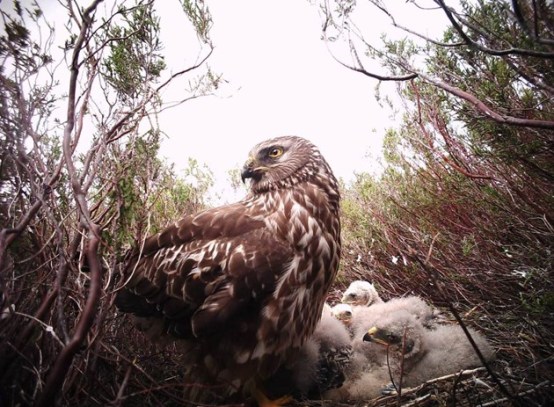
Photograph from a 2017 Heads up for Harriers nest camera:

For God’s sake, when are we going to get some honesty about the Heads up for Harriers project?

Let’s just be clear – the purpose of installing nest cameras is not ‘to find out what’s happening to these birds’ – we already know what’s happening, and Des even alluded to this in his interview. On intensively managed grouse moors, breeding hen harriers are not tolerated. They are illegally killed and this has been going on for decades, in England and in Scotland.

We know that at some nests the breeding attempt can and will fail, from a number of natural causes, but that’s perfectly normal. These types of failures are NOT the cause of the declining hen harrier population, nor the reason behind the persistent absence of breeding hen harriers on driven grouse moors – that is down to illegal persecution. It’s a fact, accepted by Governments, by statutory agencies, by police forces, by conservationists, in fact by everybody except those involved with the driven grouse shooting industry.

So let’s stop pretending that we need the Heads up for Harriers project to determine ‘what is happening to hen harriers’. No, the real reason for wanting these estates to sign up for the Heads up for Harriers project is to prevent them from killing nesting birds. If they know there’s a camera pointing at the nest, the gamekeepers will not touch those birds.

In this interview, when discussing the results from the 2017 breeding season, once again it was glossed over that none of the seven estates with nest cameras were intensively managed driven grouse moors (we’ve blogged about this quite recently, here, and we’ll be saying more in the near future). Those estates with cameras are not known as raptor persecution hotspots and they do not have a reputation for killing hen harriers. These are relatively progressive estates that do tolerate hen harriers and have done for some time, with or without this project. To claim this as a project ‘success’ is wholly misleading.

And while it’s true that of the 21 estates that have signed up for this project, some ARE intensively managed grouse moors (including a number in the Angus Glens), not one of those driven grouse moors has produced a hen harrier breeding attempt. Its all very well signing up for the scheme and using this for a bit of PR value, but until they support a hen harrier breeding attempt, their ‘participation’ is meaningless.

And even if some of those intensively managed grouse estates did manage to support a hen harrier breeding attempt, that wouldn’t stop the illegal killing of the fledglings. As we’ve seen over and over and over again, as well as breeding adults, dispersing young harriers are also illegally killed on driven grouse moors, and this would take place beyond the view of a nest camera.

And please, Des, stop also pretending that there’s ‘a very strong partnership’ between SLE, RSPB, SRSG, SNH and others involved with this project.

There is not!

Sure, there is partnership working with ‘decent’ estates (i.e. those that don’t kill raptors), as there always has been, but the relationship between raptor conservationists and the driven grouse shooting industry has never been worse!

We’ve seen grouse moor estate owners telling raptor workers they’re no longer welcome (here), we’ve seen a Director of the Scottish Gamekeepers Association repeatedly making outrageous and false accusations about raptor workers (here), we’ve seen the Director of the Scottish Moorland Group falsely accuse raptor workers of producing “deeply flawed” peer-reviewed science (here), we’ve seen the Chairman of the Scottish Gamekeepers Association falsely accuse the Scottish Raptor Study Group of ‘driving [gamekeepers’] wives, children and grandchildren from their homes‘ (here), we’ve got the Scottish Gamekeepers Association refusing to attend PAW Scotland Raptor Group meetings through a perceived lack of trust (here), and we’ve got SLE refusing to tell the RSPB (a Heads up for Harriers project partner) the names of the participating estates in this project (here).

Does that sound like ‘a very strong partnership’ to you?

Come on, stop with the spin, stop with the secrecy, stop with the pretence. We’ve had enough. And no, we’re not “impatient for change” – raptor conservationists’ patience has been tested to the limit over several decades – it’s no surprise it has now run out.

Previous blogs about the Heads up for Hen Harriers project: see hereherehereherehere, here, here, here, here

Compare & contrast: two cases of the illegal storage of poisons

Well this is fascinating.

In December 2017, a pest control company and one of its directors was sentenced for the illegal storage of poisons, following an HSE investigation in to the alleged secondary poisoning of a tawny owl (by rodenticide).

During the investigation, a number of poisons not authorised for use were found improperly stored at the premises. In addition, part used canisters of Phostoxin (a compound that reacts with moisture in the atmosphere or the soil to produce phosphine, a poisonous gas, used to control rabbits within their burrows) were found stored inside a filing cabinet within the workplace.

Rodent Service (East Anglia) Limited of Cooke Road, Lowestoft, Suffolk pleaded guilty to breaching Sections 2 (1) and 3 (1) of the Health and Safety at Work etc. Act 1974. The company has been fined £100,000 and ordered to pay costs of £10,000. The company was also ordered to pay a victim surcharge of £170.

Donald Eric Martin, Director of Rodent Service (East Anglia) Limited also pleaded guilty of an offence of neglect by virtue of S37 of the Health and Safety at Work etc. Act 1974. He was sentenced to a six months in prison, suspended for 12 months, and ordered to pay costs of £1000 and a victim surcharge of £115.00.

Details of this case can be found on the HSE website here (thanks to one of our blog readers, Mick, for drawing this to our attention).

Now, compare the outcome of this case with that of the recent case involving the discovery of an illegal poisons cache found buried in a hole in woodland on Hurst Moor, a grouse moor on the East Arkengarth Estate in North Yorkshire.

In the East Arkengarth Estate case, the RSPB had discovered a number of poisons, including Cymag (another fumigant with similar properties to Phostoxin), Bendiocarb and Alphachloralose and had identified a gamekeeper who was filmed visiting the cache. However, the Crown Prosecution Service refused to prosecute due to ‘procedural concerns’ but North Yorkshire Police, quite reasonably, considered the gamekeeper unfit to be in charge of firearms and removed his firearms certificates.

The gamekeeper appealed this decision (with the help of the BASC Chairman as his defence lawyer!) and the court held that although it was accepted he had stored dangerous poisons at an unauthorised location, removing his firearms certificates was deemed ‘disproportionate’ and they were duly reinstated.

Although there are differences between these two cases, there is one very clear parallel. Both cases involved professional pesticide users who should have completed COSHH risk assessments and training and thus known there are very strict rules and regulations about the storage and use of these inherently dangerous chemicals.

In one case, not connected with the grouse shooting industry, the company (and its Director) was absolutely thrashed by the court for such serious offences.

In the other case, directly linked to the grouse shooting industry, there was no prosecution, the gamekeeper was considered fit to be entrusted with a firearm, and there was no subsidy withdrawal for the estate as the poisons cache was found in a small plantation, not on agricultural land (see here).

In other words, there were no penalties or consequences whatsoever for the East Arkengarthdale Estate and its employee.

Amazing, eh?