RSPB press release (28 Feb 2019)
Rare hen harrier vanishes in Wiltshire
A young male hen harrier has disappeared in suspicious circumstances in Wiltshire and is believed most likely to be dead.
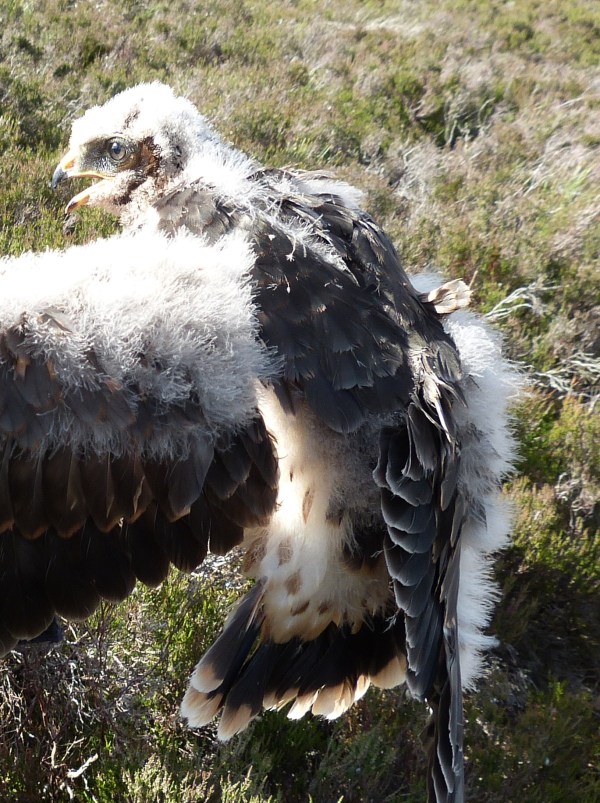
The harrier, named Vulcan, was one of five chicks to fledge from a nest in Northumberland last summer. He was fitted with a satellite tag as part of the RSPB’s EU-funded Hen Harrier LIFE project, which enabled the nature conservation charity to track his movements.
[Hen harrier ‘Vulcan’, photo by RSPB]
Vulcan was tracked by the RSPB moving from Northumberland down to the Peak District where he remained throughout September. He then continued to head further south through Hampshire and Dorset. On 16 January 2019, Vulcan’s tag sent out its final transmission, from a location south of Calstone Wellington in Wiltshire.
RSPB Investigations staff searched the area, which is farmland and heavily managed for pheasant and partridge shooting, but there was no sign of Vulcan or his tag. He has not been heard from since and the matter was reported to Wiltshire Police.
Satellite tagging technology is commonly used to follow the movements of birds. Tags continue to transmit regularly, even when the bird dies, and until the tag reaches the end of its lifespan. Vulcan’s tag was providing regular updates on the bird’s location, so the sudden and unexpected ending of transmission is suspicious and could suggest criminal interference. Vulcan is the 11th satellite-tagged hen harrier to disappear since last summer.
Hen harriers are one of the UK’s rarest birds of prey with only nine successful nests recorded in England in 2018 despite sufficient habitat for over 300 pairs. An overwhelming body of scientific evidence suggests that the main reason for their low numbers is illegal killing associated with driven grouse shooting.
Dr Cathleen Thomas, RSPB Hen Harrier LIFE Project Manager, said: “When a bird you’ve been following since it was a chick suddenly disappears without a trace, it’s a crushing blow. Vulcan’s tag had been performing brilliantly, so for it to suddenly stop transmitting makes us very suspicious that something has happened to him.
“Wiltshire is not the only place where hen harriers have disappeared in unexplained circumstances. Since last summer 10 other satellite-tagged hen harriers have also vanished suddenly across the UK including in Northumberland, the Peak District, Wales and Scotland. There is a very worrying trend here.”
PC Marc Jackson of Wiltshire Police said: “Wiltshire Police have received a report from the RSPB in relation to the missing harrier ‘Vulcan’, and the Rural Crime Team are working with the RSPB to establish the full circumstances surrounding the incident.
To find no trace of this bird raises obvious concerns about what may have happened to it. If anyone has information please contact Wiltshire Police on 101 or Contact Crime stoppers on 0800 555111 if you would prefer to remain anonymous.”
Vulcan’s suspicious disappearance may prove a hurdle for the proposed southern reintroduction of hen harriers. Natural England is currently looking into the feasibility of introducing hen harriers from the continent to Parsonage Down National Nature Reserve, near Salisbury Plain.
Gareth Cunningham, RSPB Head of Nature Policy, said: “The disappearance of Vulcan raises serious concerns over the safety of any planned reintroduction. The RSPB has serious reservations about this approach to hen harrier conservation in England and we believe ending hen harrier persecution is the key to restoring the UK’s population of these magnificent birds. As such, the RSPB does not support the proposed reintroduction.”
If anyone has any information relating to this incident, please call Wiltshire Police on 101. Alternatively, call the RSPB Raptor Crime Hotline confidentially on 0300 999 0101.
ENDS
As the RSPB points out, this ‘may provide a hurdle’ (read: should be a bloody great big red flashing light) for the proposed reintroduction of hen harriers to southern England as part of DEFRA’s mad hen Harrier (In)Action Plan.
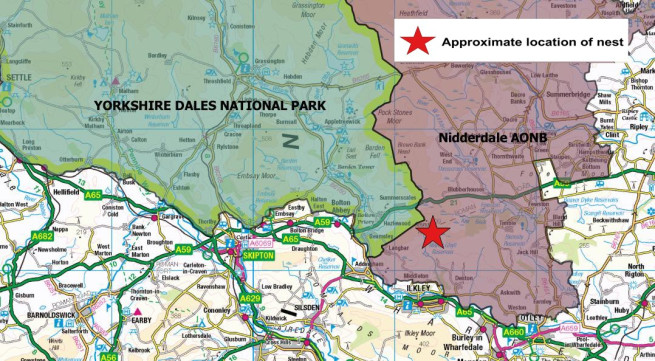
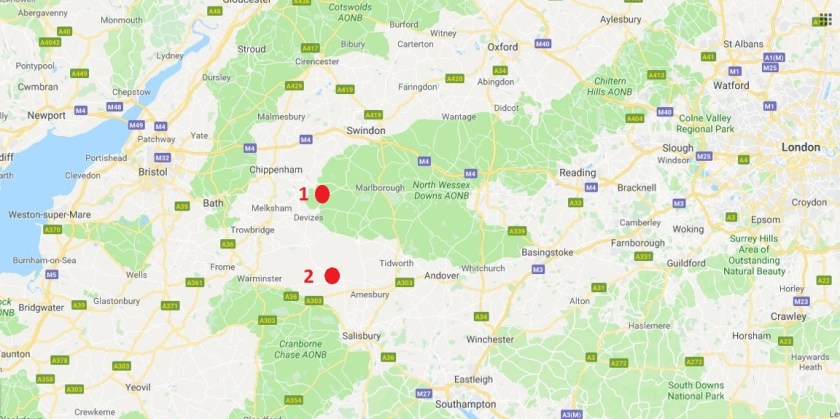
The location of Vulcan’s last known tag signal is less than 20 miles from Natural Engand’s proposed reintroduction site at Parsonage Down National Nature Reserve:
[RPUK map showing 1: Vulcan’s last known location; 2: Natural England’s proposed hen harrier reintroduction site]
We’ve blogged a lot about this proposed ‘reintroduction’ of hen harriers to southern England although technically it’s not a reintroduction because the species is not regionally extinct here and it should more aptly be called the ‘Let’s divert attention from the criminal killing of hen harriers on grouse moors plan’. We have been strong critics of the plan, not least because those young hen harriers tipped out in Wiltshire will likely roam far and wide during their post-fledgling dispersal period (as we know from sat tag data) and if they end up anywhere near a grouse moor they’ll be shot on sight. Releasing birds in to southern England will not solve the cause of the species’ decline in the first place, which undeniably is illegal persecution on driven grouse moors. And now there’s a strong possibility that Vulcan was a victim of illegal persecution, just a few miles from the proposed hen harrier release site. Which country is going to be stupid enough to donate hen harriers to the UK when we can’t even safeguard those birds hatched here, let alone any that are donated for a so-called ‘reintroduction’ project?
For previous blogs on this topic see:
28 Nov 2016 – Hen Harrier reintroduction to southern England: an update (here)
3 Jan 2017 – Hen harrier reintroduction to southern England: the feasibility/scoping report (here)
8 Jan 2017 – Hen harrier reintroduction to southern England: the project group and their timeline (here)
9 Jan 2017 – Hen harrier reintroduction to southern England: who’s funding it? (here)
9 Jan 2017 – Hen harrier reintroduction to southern England: a bonkers proposal for Exmoor National Park (here)
12 Jan 2017 – Hen harrier reintroduction to southern England: Wiltshire (here)
14 Feb 2017: Leaked email reveals Natural England’s views on Hen Harrier Action Plan (here)
23 Feb 2017: Hen harrier reintroduction to southern England: donor countries (here)
19 July 2017: Hen harrier reintroduction to southern England: new project manager appointed (here)
20 July 2017: Hen harrier reintroduction to southern England: Dartmoor as potential new release site (here)
20 July 2017: Hen harrier reintroduction to southern England: revised costs (here)
21 July 2017: Hen harrier reintroduction to southern England: project team vists France (here)
27 July 2017: RSPB statement on hen harrier reintroduction to southern England (here)
15 Aug 2017: Natural England Board making up justification for hen harrier southern reintroduction (here)
24 October 2017: Hen harrier reintroduction to southern England: Natural England delays release of information (here)
11 December 2017: Hen harrier reintroduction to southern England: report of fieldtrip to France (potential donor country) (here)
12 December 2017: 2018 start date for reintroduction of hen harrier to southern England? (here)
14 January 2018: Stop illegal persecution then no need for reintroduction of hen harrier to southern England, says DEFRA Minister (here)
13 March 2018: Hen harrier reintroduction to southern England: has France said “Non”? (here)
We’ve no idea what the latest is as Natural England is being true to form and keeping everything secret, although there are persistent rumours that birds may be donated by Spain, this year. Time for some more FoIs……
UPDATE 11.20hrs: The RSPB has published a blog about Vulcan’s disappearance (here)
UPDATE 12th March 2019: Gamekeepers’ rep suggests disappearance of hen harrier Vulcan was ‘set up’ by RSPB (here)