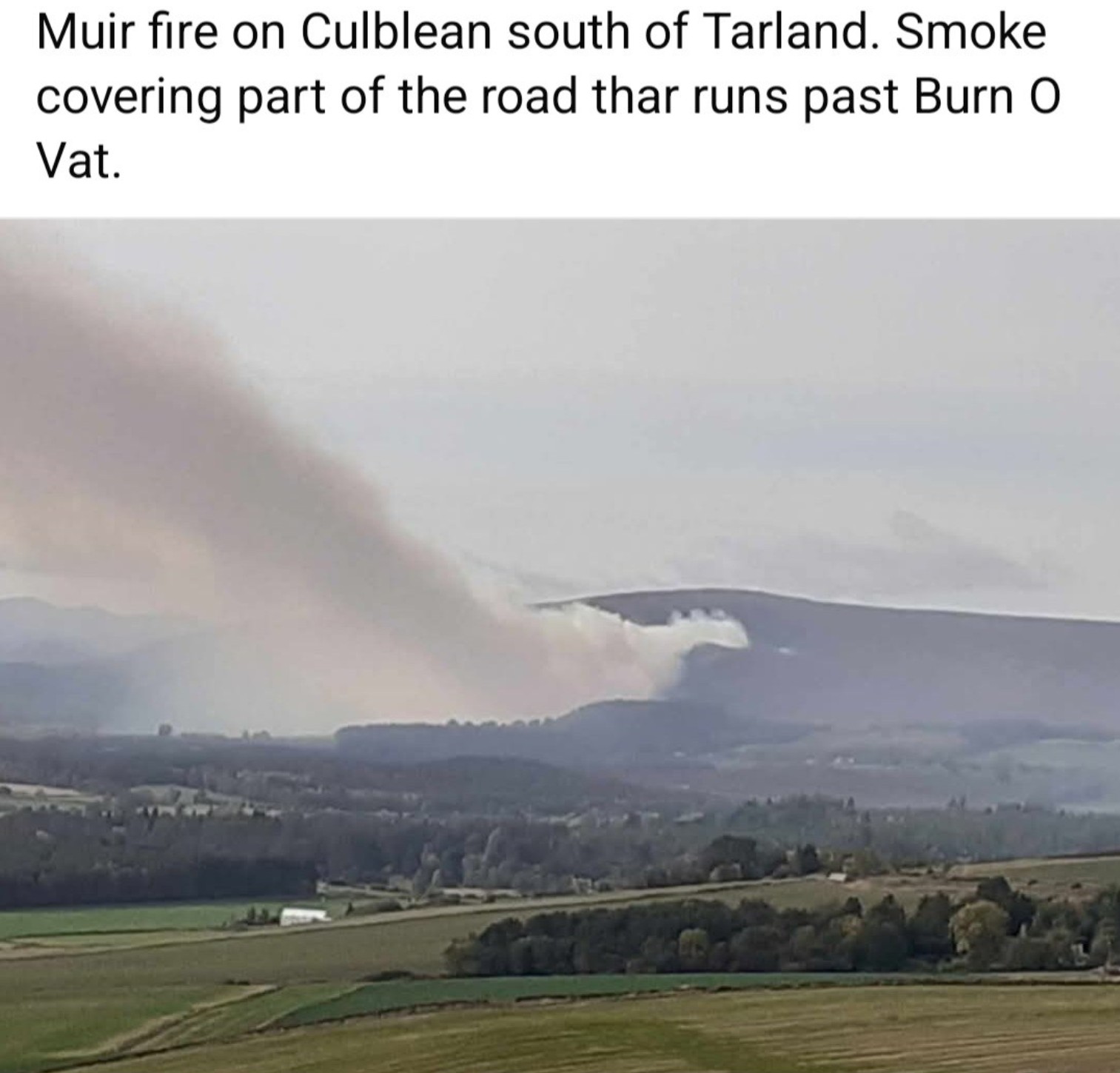
Breaking News….on the day the Scottish Government announced it was delaying, for a second time, the implementation of muirburn licensing after aggressive lobbying from the grouse shooting industry, news is coming in of what locals have described as an ‘out-of-control muirburn’ on a grouse moor on the east side of the Cairngorms National Park that is now a rapidly spreading wildfire.
Cromar Community Council posted this on social media late this afternoon:
Police Scotland (North East) posted this:
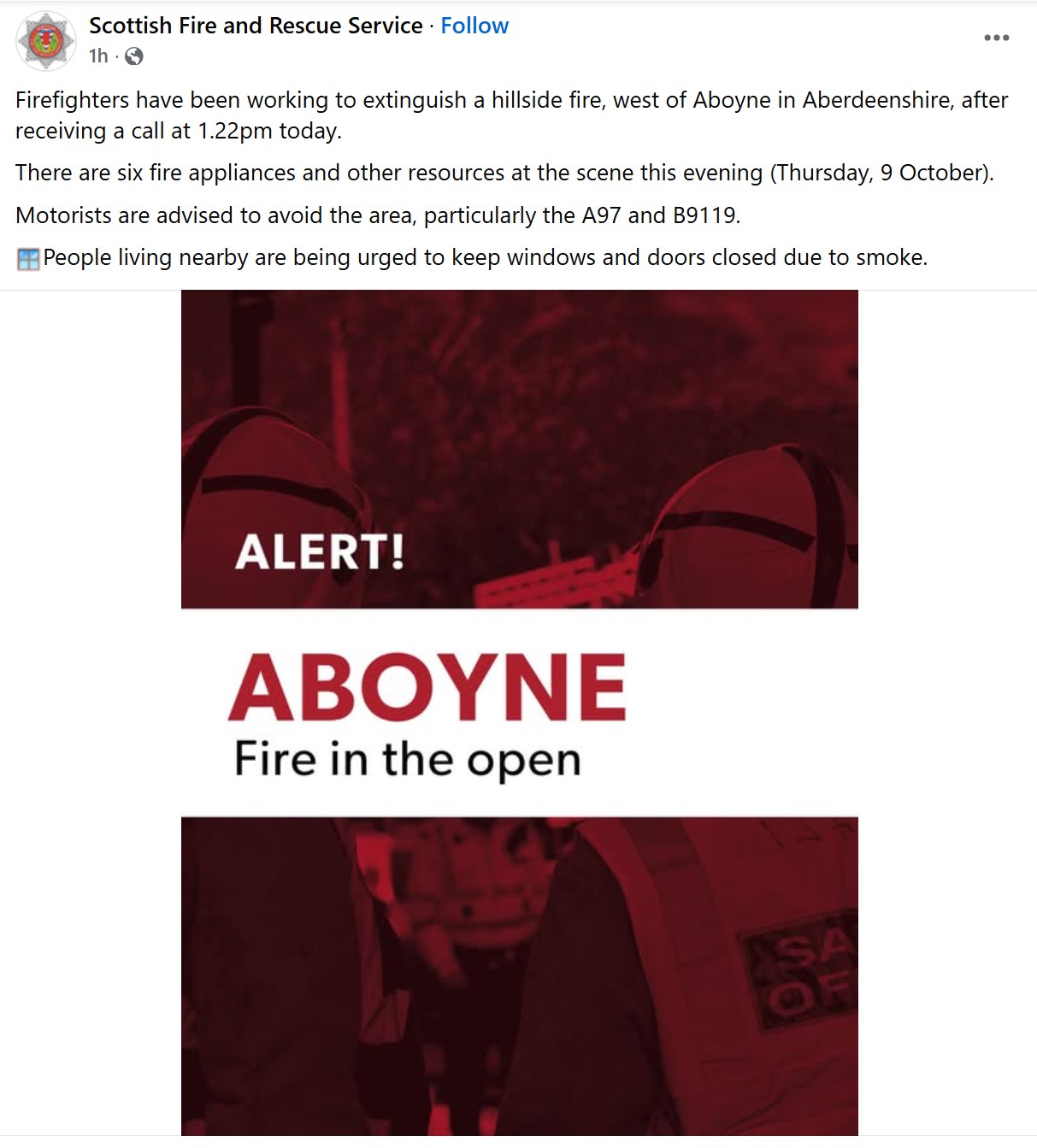
The Scottish Fire & Rescue Service posted this:
A local blog reader has reported that this was a prescribed muirburn, started (legally) by gamekeepers on a grouse moor but that it got out of control and has now spread to the nearby Muir of Dinnet National Nature Reserve.
According to Andy Wightman’s Who Owns Scotland website, the location where the fire started appears to be the Dinnet & Kinord Estate.
Given that the out-of-control fire was first reported at 1.22pm and fire crews are still tackling it seven hours later, this is clearly a significant incident.
Slow handclap for the Scottish Government.
UPDATE 11 October 2025: “SNP caves to shooting lobby” – reactions to Scottish Government’s decision to delay muirburn licensing (again) (here)
UPDATE 13 October 2025: ‘The problem, which the Scottish Government is willfully ignoring, is that muirburn is responsible for a large number of wildfires’ (here)
UPDATE 30 October 2025: Scottish Govt fiddles while grouse moors burn (here)
The Scottish Government has, for the second time, delayed the implementation of muirburn licensing after caving in to pressure from aggressive lobbying by the grouse shooting industry.
A quick re-cap for new blog readers:
In March 2024, the Scottish Parliament voted for the Wildlife Management and Muirburn (Scotland) Bill, which introduced, amongst other things, a requirement for all muirburn to be licensed (see here).
The Bill was enacted in May 2024 and became the Wildlife Management & Muirburn (Scotland) Act 2024 and since then we’ve seen the introduction of a grouse moor licensing scheme (although this still remains contentious as the licence has been significantly weakened after lobbying by the grouse shooting industry – an update on that is coming shortly) and the banning of the use of snares.
The introduction of the muirburn licence, also contentious because many conservationists didn’t believe it went far enough (e.g. see here), was due to be in place for the start of the 2025/26 muirburn season on 15 September 2025, some 18 months after the Scottish Parliament voted in favour of it.
Deliberately setting fire to vegetation on peatland carbon stores, to facilitate an artificially high number of Red Grouse for shooting, is both obscene and absurd. Photo by Ruth Tingay
However, in June 2025 the Scottish Government announced it was delaying implementation until 1 January 2026 because the grouse shooting industry had laughably argued that it wasn’t practical or fair for the licences to begin in September 2025 (see here).
Since then, the grouse shooting industry has continued its lobbying and wants the licences dropped altogether because of what it calls the ‘need’ for muirburn to ‘control the fuel load’ – the amount of combustible vegetation which could influence the intensity and spread of wildfires.
Although if you read these two fascinating recent articles written by Professor Douglas MacMillan for the ParkswatchScotland blog (here and here), you’ll see that within the Cairngorms National Park at least, a considerable number of wildfires are believed to have been caused by ‘muirburn gone wrong’.
Nevertheless, inevitably it seems the powerful lairds have applied sufficient pressure for the Scottish Government to capitulate once again, probably with an eye on the forthcoming election.
Yesterday, an obviously-planted written question appeared on the Scottish Parliament’s website:
Question reference: S6W-41119
Asked by Emma Harper MSP (SNP, South Scotland)
To ask the Scottish Government whether the muirburn licensing provisions in the Wildlife Management and Muirburn (Scotland) Act 2024 will be implemented on 1 January 2026, in light of the lessons learned following the wildfires in Dava and Carrbridge in summer 2025.
The question was answered this morning by Jim Fairlie MSP, Minister for Agriculture and Connectivity:
Following discussions with a number of stakeholders and experts over recent weeks, I have decided to delay implementation of the muirburn provisions until the start of the next muirburn season in Autumn 2026.
This decision will provide us with the time and opportunity to carefully consider the upcoming changes to muirburn and how these changes can be brought forward in a way which does not adversely affect our ability to prevent and respond to wildfires. Wildfires as I saw this summer, are very damaging to our precious peatland carbon stores and further discussions on this issue will take place with key stakeholders and at the Wildfire Summit on 14 October 2025.
I don’t know what the legal position is for the timing of when legislation must begin after being enacted, but as it currently stands, it’ll be well over two years between the Wildlife Management & Muirburn (Scotland) Act 2024 being enacted and muirburn licensing commencing, assuming, that is, that the Scottish Government doesn’t capitulate again before the start of the 2026 muirburn season on 15 September 2026.
Meanwhile, across the border in England, I see that the Moorland Association has written a Pre-Action Protocol (PAP) letter to Defra to challenge the lawfulness of the Heather & Grass Burning (England) (Amendment) Regulations 2025, announced in September 2025 to restrict the burning of vegetation on deep peat, redefined from the current 40cm to 30cm depth (see here). A PAP letter marks the start of potential legal action (judicial review).
To be honest, none of this political lobbying and legal action by the grouse shooting industry in both Scotland and England should come as any surprise. Intensive driven grouse shooting relies not only on wildlife crime (it’s not possible to have the grossly excessive number of Red Grouse available to shoot without killing off as many native predators as possible), but relies also on torching the uplands via muirburning to sustain an artificial environment for those excesses of Red Grouse.
If muirburning is banned, or restricted, the intensively managed grouse moors simply wouldn’t be commercially viable. And that’s why the grouse shooting industry is throwing everything in to challenging the new regulations north and south of the border.
I suspect there’ll be a significant and angry reaction to the Scottish Government’s decision to further delay the implementation of muirburning at the behest of the lairds- one to watch.
UPDATE 9 October 2025: Breaking news…’out-of-control’ muirburn on grouse moor in Cairngorms National Park (here)
UPDATE 11 October 2025: “SNP caves to shooting lobby” – reactions to Scottish Government’s decision to delay muirburn licensing (again) (here)
UPDATE 13 October 2025: ‘The problem, which the Scottish Government is willfully ignoring, is that muirburn is responsible for a large number of wildfires’ (here)
UPDATE 30 October 2025: Scottish Govt fiddles while grouse moors burn (here)
Following the recent collapse of the Yorkshire Dales National Park Bird of Prey Partnership (due to its failure to tackle crimes against birds of prey), and the news that since 2015, 29 Hen Harriers have gone ‘missing’ in suspicious circumstances and almost 40 other raptors have been found poisoned, trapped or shot in the Yorkshire Dales National Park since 2015, including Peregrines, Hen Harriers, Red Kites and Buzzards, there’s some welcome news from a local community who has had enough and has decided to do something about it. Bravo!
Friends of the Dales, the environmental campaigning charity, is launching a powerful new campaign − Eyes on the Skies − calling for an end to criminal killing of birds of prey in the Yorkshire Dales. The campaign kicks off with a high-profile live webinar on Tuesday 21 October at 5.30pm, featuring leading conservation expert Kate Jennings, UK Head of Site Conservation & Species Policy at the RSPB.
Kate will highlight the long history of bird crime in the Yorkshire Dales, drawing on evidence and case studies from the RSPB’s Investigations Team which works in support of the police and statutory agencies to bring criminals before the courts.
“We are delighted that Kate is joining us at the Eyes on the Skies launch event,” said Jonathan Riley, Chair of Trustees at Friends of the Dales. “She will shine a spotlight on Bird Crime in the Yorkshire Dales and the illegal and inhumane methods criminals use to trap, shoot and poison birds of prey − crimes that persist despite more than seventy years of legal protection.”
The Yorkshire Dales remains a blackspot for raptor persecution, with species such as hen harriers, short-eared owls, and red kites especially targeted. Just last week the RSPB issued a press release about the disappearance of Sita, a one-year-old female satellite-tagged Hen Harrier. The RSPB said that Sita is the 29th hen harrier “to suspiciously disappear in the national park since 2015” and that the bird “is likely to have been shot”.
“It is appalling that the hen harrier, one of the UK’s rarest birds, continues to be shot, trapped, and poisoned in our National Park, which should be a sanctuary for wildlife,” added Jonathan.
Public concern for these crimes is growing. In early 2024, more than 1,000 people responded to the first consultation on the new Management Plan for the Yorkshire Dales National Park, with ending the illegal persecution of birds of prey emerging as one of the top priorities.
David Butterworth, Chief Executive of the Authority also confirmed: “The Yorkshire Dales National Park Authority is unwavering in its commitment to raptor conservation. We will continue to collaborate with landowners, managers and organisations sharing our vision. We applaud those whose efforts have helped some species recover. But we must also confront the grim reality that criminal persecution still occurs.”
Friends of the Dales Eyes on the Skies campaign supports one of the core objectives of the new management plan for the Yorkshire Dales National Park, as well as the vital work of other organisations such as the National Wildlife Crime Unit, RSPB and Hen Harrier Action. The campaign will amplify messages around the scale and nature of these appalling crimes, educate people in how to spot and report any suspicious or illegal activity they might see and also inspire people to learn more about the birds themselves and why they are vital to a healthy, biodiverse ecosystem.
David Butterworth added: “The uplands of the Yorkshire Dales National Park should be a stronghold for a diverse range of raptor species. As apex predators, their presence signals a healthy environment. Their absence, conversely, is a warning.”
Summing up Jonathan Riley said: “Our Eyes on the Skies campaign will incorporate many more events including further webinars from insider experts, outdoor educational events and even some more creatively focussed activities. So, on behalf of the charity, I would encourage anyone who is interested in learning more to register for the free launch event on Tuesday 21 October at 5:30 pm, and sign up to our monthly email newsletter so they can be kept updated.”
Police Scotland Wildlife Crime Liaison Officer Constable Ann Ashman said:
“From enquiries carried out so far, we know this sparrowhawk has been poisoned with insecticide carbosulfan, resulting in a harrowing death.
“Sparrowhawks are protected under the Wildlife and Countryside Act 1981, and it is an offence to intentionally or recklessly kill or injure them.
“The use of carbosulfan is illegal, with the substance having been banned in the UK since 2008. This substance can cause death in humans, so its illegal use is extremely reckless.
“We are carrying out an investigation in relation to this incident and will be working with a range of partner organisations. The public has an important role to help up combat wildlife crime. If you see anything suspicious, please report it to us via 101, or anonymously to Crimestoppers on 0800 555 111.”
Anyone with information is asked to contact Police Scotland on 101, quoting incident number 1179 of 2 October, 2025.
Media attention has been drawn to the Yorkshire Dales National Park this week, following the RSPB’s press release on the suspicious disappearance of a satellite-tagged Hen Harrier named ‘Sita’.
When it comes to the illegal killing of birds of prey, the Yorkshire Dales National Park is rarely out of the news, and that’s hardly surprising when 29 satellite-tagged Hen Harriers have gone ‘missing’ there and 39 other raptors have been found poisoned, trapped or shot there since 2015, including Peregrines, Hen Harriers, Red Kites and Buzzards.
Yorkshire Dales National Park. Photo by Ruth Tingay
Given these appalling figures, the RSPB has described the Yorkshire Dales National Park as a ‘no-fly zone for birds of prey’.
High profile cases within the National Park have included the conviction of a gamekeeper who was filmed shooting two Short-eared Owls on a grouse moor and then stamping the corpse of one of them into the peat and shoving the other one inside a drystone wall (here); a gamekeeper filmed on a grouse moor using a tethered Eagle Owl to attract Buzzards that he then shot and killed from close range (here); the stamping to death of four Hen Harrier chicks in a nest on a grouse moor (after obscuring the camera pointing at the nest, here); the grisly death of a Hen Harrier caused by his head and leg being pulled off whilst he was still alive (here); and three individuals caught on camera on a grouse moor discussing the shooting and killing of a Buzzard and a Raven before apparently shooting and killing a Hen Harrier (here) – one gamekeeper has been charged with conspiracy to kill a Hen Harrier, he has pleaded not guilty and his case will proceed to trial in January 2026 after his barrister failed in his attempt to have the case thrown out on a legal technicality.
The Yorkshire Dales National Park Authority has also long recognised the extent of this criminal activity and has responded to public concern (e.g. see here and here). Earlier this year the Park Authority terminated its five-year ‘partnership’ with the grouse shooting industry to tackle these crimes, after recognising the futility of this endeavour. Two conservation organisations (the RSPB and the Northern England Raptor Forum) had already walked away from the sham in 2023 and 2024 respectively.
In an article published a couple of days ago by the Craven Herald & Pioneer, Mark Corner, a member of the Yorkshire Dales National Park Authority is quoted saying the continued illegal killing of raptors in the Park was “a crying shame“.
He added: “As the member champion for the natural environment, I’m personally embarrassed that we are the worst spot in the country in terms of the illegal killing of birds.”
In the same article, there’s an hilarious quote from the Yorkshire Dales Moorland Group, which is one of a number of regional groups set up in 2015 to represent local grouse moor owners and their gamekeepers in an attempt to counter the bad publicity about ongoing illegal raptor persecution. I think that members of most of these regional moorland groups have been, or still are, the subject of police investigations into illegal raptor persecution.
A spokesperson for the Yorkshire Dales Moorland Group reportedly told the reporter that ‘hen harrier numbers were at a 200-year high across the uplands’.
That’s simply not true – Hen Harrier breeding attempts on grouse moors across the north of England have been in sharp decline over the last two years – the only areas where they remain stable is on land managed for conservation rather than for Red Grouse shooting.
According to its FaceBook page, the Yorkshire Dales Moorland Group claims to have “around 100,000 acres of managed uplands here in the Dales where the estates are members of this group (virtually all of the moors)“.
Why is it then, there were only two Hen Harrier breeding attempts in 2025 across the whole of the Yorkshire Dales and neighbouring Nidderdale? I’d like the Moorland Group to provide a plausible explanation for these absences.
The Yorkshire Dales Moorland Group also told the Craven Herald reporter:
“Our keepers have and will always assist the police in searches for missing persons, lost dogs or missing birds. Tag failure is rare but not unheard of.
“The default accusation that persecution is responsible is regrettable. The conservation work undertaken by moor keepers is commendable as can be seen by the abundance of raptors and other rare species in the Dales“.
What “abundance of raptors” are those then? All the dead ones? Or just the ones that are allowed to breed because they don’t pose any threat to Red Grouse stocks?
And if these grouse shooting estates are so keen to help the police, how many of them signed the letter last year agreeing to allow the police to enter the land and use equipment for the purposes of crime prevention and detection? Did any of them sign it?
And if these gamekeepers are so keen to help police investigations, how many of them have given ‘no comment’ responses when interviewed about suspected raptor persecution crimes on these moors? Maybe it’d be quicker to count how many gamekeeper didn’t give a ‘no comment’ interview.
The article also quotes Alex Farrell, Head of Uplands at BASC:
“As a committed conservation organisation, we are taking progressive steps with our partners to oversee the continued recovery of hen harriers.
“Figures released by Natural England today show that collaborative effort resulted in 106 fledged hen harrier chicks in England this year – up from 80 last year“.
What “progressive steps” is BASC taking?
Oh, and those figures released by Natural England show that the small increase in Hen Harrier fledging rates are in spite of, not because of, any so-called ‘collaborative effort’ from the grouse shooting industry.
Natural England has finally got around to publishing the data for the 2025 Hen Harrier breeding season, which demonstrate very clear differences between areas managed for conservation and those managed as privately-owned grouse moors.
The headline on Natural England’s blog (‘Numbers of nesting hen harriers in England have risen slightly in 2025‘) is technically accurate but I would argue it’s also cynically misleading because it only tells half the story, and the half that’s missing provides the all-important context required to understand the ongoing threats facing Hen Harriers in England (and some other parts of the UK) – that of the illegal killing of this species on moorland managed for driven grouse shooting.
I say this is cynical because the headline as it’s written is handy for (a) Natural England, (b) Defra and (c) the grouse shooting industry, who can (and will) point to it as an indication of a so-called ongoing ‘conservation success story’ when they’re being criticised by conservationists for not doing enough to tackle the relentless persecution of this species.
If you bother to delve deeper than the headline and drill down in to the figures, it’s crystal clear that Hen Harrier persecution is still so rampant on many driven grouse moors it’s suppressing the distribution of this species at a national level.
According to Natural England’s data, there were 39 nesting attempts in 2025, of which 33 were successful, up from 34 attempts (25 successful) in 2024. Natural England has presented the breeding attempts data in the following table:
The context to these data, which Natural England has failed to include, is the predominant land use in each of those areas. If you’re a casual reader with no understanding of those areas, you’ll think that Hen Harriers are doing ok in some areas and not so much in others, but you’ll have no clue about the differences in land management between those areas and therefore the influence of that land management on Hen Harrier nesting attempts.
I’ve annotated Natural England’s table to show what’s actually going on:
You can now see the predominant land management in each area and it becomes apparent that the areas predominantly managed for conservation (in green) are the areas where most Hen Harrier nesting attempts took place, compared to the low number of nesting attempts on privately-owned grouse moors (red) where Hen Harriers are not welcome.
For example, in Bowland, Lancashire, there were 15 nesting attempts this year, and all of them except one were on moorland owned by United Utilities, wardened by the RSPB.
In the whole of the North Pennines, the only two nesting attempts were on the RSPB’s Geltsdale Reserve in Cumbria.
But even on these protected sites, Hen Harriers weren’t safe; four breeding males ‘disappeared’ during the breeding season, suspected to have been killed whilst hunting on nearby grouse moors, and nests were only successful thanks to the intervention of the RSPB.
In the Peak District, the only two nesting attempts were on moorland managed by the National Trust.
In the Yorkshire Dales and Nidderdale, the only two nesting attempts were on privately owned grouse moors, down from a high of 15 nesting attempts in 2023. Interestingly, raptor fieldworkers report that there weren’t any nesting attempts on Swinton Estate this year – the grouse shooting industry’s poster child for Defra’s ludicrous Hen Harrier brood meddling trial where the estate championed the removal of some Hen Harrier chicks which were reared in captivity before being released elsewhere. Word has it that the grouse shooting at Swinton has now been leased and that Natural England fieldworkers were not welcome this year. There are also unverified reports that the winter roost site on Swinton Estate ‘is no longer there’. More on that if I receive further information.
Hen Harrier nesting attempts in Northumberland this year are a little less clear. There were 18 known attempts, and the majority of those are likely to have been on Forestry England-managed land at Kielder, a known hotspot for Hen Harriers in recent years, although it’s possible that a couple of attempts may have been recorded on nearby privately-owned grouse moors.
So it looks like there were probably between 3-5 Hen Harrier nesting attempts on privately owned grouse moors in England in 2025; the rest of the 39 nesting attempts took place on land managed for conservation.
It would be helpful if Natural England would publish the associated land management information alongside the data on Hen Harrier nesting attempts, and the subsequent outcome of those attempts – it used to do this. Why has it stopped?
To be fair, beyond the headline and the table in Natural England’s blog, there are some clear statements acknowledging the ongoing issue of Hen Harrier persecution, although in my opinion they could still be much more explicit about the unequivocal link between HH persecution and driven grouse moors:
‘Hen harriers are rare primarily because they are killed and prevented from nesting successfully‘ [on many driven grouse moors];
and
‘This population recovery remains fragile, and efforts to reduce illegal killing and disturbance of hen harriers remain necessary across muchmany driven grouse moorsofin the English uplands‘.
It’s also notable that Natural England did not mention any of this year’s suspected and confirmed Hen Harrier persecution crimes in its blog, and nor has it updated its database on the fates of its satellite-tracked Hen Harriers. The last update was in April 2025. Typically, NE has updated the database every 3-4 months – it’s now been six months. Natural England, along with various police forces and the National Wildlife Crime Unit’s Hen Harrier Taskforce, is still suppressing information about an estimated 20 incidents, some of them dating back over 18 months.
In May this year I blogged about a young satellite-tagged Hen Harrier named ‘Sita’ who had disappeared under suspicious circumstances from a winter roost site on an unnamed grouse moor in the Yorkshire Dales National Park in February 2025 (here).
There was very little information available – neither North Yorkshire Police or the National Wildlife Crime Unit’s Hen Harrier Taskforce had made any statements or appeals for information.
Eight months on, today the RSPB has helpfully published some information about Sita’s disappearance having been told by North Yorkshire Police and the NWCU that there were no further lines of enquiry.
The RSPB’s press release is as follows:
ANOTHER HEN HARRIER LIKELY TO HAVE BEEN SHOT IN THE YORKSHIRE DALES NATIONAL PARK
The satellite tag of a one-year-old Hen Harrier sent its last transmission from land managed for grouse shooting between Swaledale and Wensleydale
Illegal persecution of Hen Harriers is the main factor limiting the recovery of this rare, red-listed species in the UK
This Hen Harrier is the 29th to suspiciously disappear in the national park since 2015 with each tag worth £3000.
As part of the RSPB’s on-going Hen Harrier monitoring, a female bird, named Sita was fitted with a satellite tag in summer 2024, fledging from her nest in the Forest of Bowland. Subsequently, her tag data showed that she had settled at a wintering site on moorland between Reeth and Redmire, in the northeast of the Yorkshire Dales National Park. However, concern was raised when Sita’s tag stopped transmitting from a roost site on 27 February 2025.
Hen Harrier ‘Sita’ being fitted with a satellite tag in Bowland in 2024. Photo by Northern England Raptor Forum (NERF).
When sat-tagged Hen Harriers die naturally, the tag will continue to transmit, allowing recovery of the bird, which can then undergo analysis to determine the exact cause of death. However, it is accepted that sudden, unexplained transmission loss without signs of tag malfunction in this species sadly indicates that the bird is likely to have been shot, especially if no tag or body is then found.
The RSPB reported the incident to North Yorkshire Police, the National Wildlife Crime Unit (NWCU) and their Hen Harrier Task Force, however, despite launching a police investigation neither Sita nor her tag have been found. In late August, almost six months after the incident took place, the Police and NWCU formally confirmed that there were no further lines of enquiry. Sita is one of several satellite tagged Hen Harriers that have disappeared under suspicious circumstances this year, with several cases being referred to the NWCU in recent weeks.
Dominated by grouse moorland, the Yorkshire Dales National Park, is sadly one of the most well-known hotspots for bird of prey killing. Between 2015 and 2024, 67 confirmed or suspected incidents were recorded within or near the National Park. These include 39 incidents where birds of prey (including Peregrine, Hen Harriers, Red Kites and Buzzards) were targeted, poisoned, trapped or shot and is the location where 28 suspicious disappearances of tagged Hen Harriers have taken place. Sita’s loss brings the total to 29.
Hen Harrier Action, the wildlife conservation charity that sponsored Sita’s satellite tag from public donations, expressed deep concern at her disappearance and the continuing threat to these birds.
Paul Samuels, Hen Harrier Action Co-chair: “The Yorkshire Dales National Park is a landscape where Hen Harriers ought to be thriving. Yet time and time again headlines about the Park are dominated by illegal persecution stories, most often associated with grouse moors. Sita’s short life and sad end should be a catalyst for change.”
As repeated police investigations have shown, crimes against Hen Harriers are strongly linked to land managed for grouse shooting, where some individuals illegally kill birds of prey as they are regarded as a threat to their commercial grouse stocks. The RSPB is calling for licensing of grouse shooting to be introduced in England – mirroring the system introduced in Scotland in 2024 under the Wildlife Management and Muirburn (Scotland) Act 2024. Under such legislation, estates implicated in bird of prey persecution could lose their licence to shoot grouse.
Howard Jones, RSPB Senior Investigations Officer: “The most effective way to stop the killing of these incredible birds is through licensing grouse shooting in England. It’s very simple, the sooner this is introduced the quicker Hen Harriers will get the protection that they urgently need.”
If you have information about anyone killing birds of prey which you wish to report anonymously, call the RSPB’s confidential Raptor Crime Hotline on 0300 999 0101.
ENDS
This is the first time we’ve been given any level of detail about Sita’s last known location, on a grouse moor between Reeth and Redmire on the north-east side of the Yorkshire Dales National Park.
If you look at the land ownership in that area (courtesy of Guy Shrubsole’s excellent website, Who Owns England?), you’ll see there are at least two large grouse shooting estates between Reeth and Redmire:
The turquoise area is Grinton Estate and the green area is Bolton Estate. I don’t know who owns the unmapped area of moorland to the east. There’s no suggestion that any of them were involved in Sita’s suspicious disappearance. I can’t pin down the Hen Harrier’s last known location with any more precision because, sensibly, the RSPB has not publicised the location of the winter roost from which Sita vanished, and nor would I want them to.
I applaud the RSPB for releasing the information they have – there’s no legitimate justification for North Yorkshire Police and the NWCU’s Hen Harrier Taskforce to suppress this case. None whatsoever, especially when they’ve stated they have no further lines of enquiry.
The withholding of information about ‘missing’ and/or confirmed illegally killed Hen Harriers is an ongoing issue, involving several other police forces in northern England. I’m aware of at least 14 cases involving the disappearance and/or illegal killing of Hen Harriers that are currently being withheld from the public, some of them dating back over 18 months so there can be no excuse about not wanting to jeopardise investigations, which in all likelihood have come to a similar dead end (pun intended).
I also noted the following sentence in the RSPB’s press release:
‘Sita is one of several satellite tagged Hen Harriers that have disappeared under suspicious circumstances this year, with several cases being referred to the NWCU in recent weeks‘ [emphasis is mine].
So just how many suspected or confirmed incidents of Hen Harrier persecution are being withheld, and why? It sounds like we’re quickly heading towards 20 cases.
The Scottish Government’s nature advisory agency, NatureScot, has been now been procrastinating for 17 months on whether to impose a sanction on an estate in relation to the ‘shooting and killing’ of a sleeping Golden Eagle called Merrick.
Merrick was a young satellite-tagged Golden Eagle, released in south Scotland in 2022 as part of the South Scotland Golden Eagle Project, a lottery-funded conservation initiative which translocated young Golden Eagles from various sites across north Scotland to boost the tiny remnants of the Golden Eagle breeding population in south Scotland that had previously been decimated by illegal persecution and had become isolated by geographic barriers.
Camera trap photo of golden eagle Merrick in 2022, from South Scotland Golden Eagle Project
A year after her release, which had seen her fly around south Scotland and down into northern England and back, on 12 October 2023 Merrick’s satellite tag suddenly and inexplicably stopped transmitting from a roost site in the Moorfoot Hills in the Scottish Borders where she’d been sleeping overnight.
A project officer from the South Scotland Golden Eagle Project went to her last known location where he found Merrick’s feathers and blood directly below her roost tree. Police Scotland later determined from the evidence that she’d been ‘shot and killed’ and that someone had then ‘removed her body and destroyed her satellite tag’ (see here).
There was limited scope for anyone to be charged and prosecuted for killing this eagle unless someone in the know came forward with sufficient evidence to identify the individual(s) responsible. In addition, the prospect of an estate having its grouse-shooting licence withdrawn as a consequence of this crime was zero, given that this offence took place prior to the enactment of the Wildlife & Muirbun (Scotland) Act 2024.
That just left a General Licence restriction as a possible sanction. Not that I’d describe a GL restriction as an effective sanction, for reasons that have been explored previously on this blog (e.g. here and here). Nevertheless, it’s still something and, given the high-profile of Merrick’s death, you might think that making a decision on whether to impose a GL restriction would be a high priority for NatureScot.
I wrote about NatureScot’s procrastination on this case in August (see here), after receiving a response to a Freedom of Information request I’d lodged in June 2025. That response confirmed that NatureScot had received an information package from Police Scotland, on which it would base its GL restriction decision, in April 2024.
Seventeen months on and we’re now at the end of September 2025 and there’s still no sign of a decision from NatureScot.
What’s the hold up? Why hasn’t this decision been a priority for NatureScot?
What sort of message does NatureScot’s procrastination send out to others who might be thinking of ‘getting rid’ of a Golden Eagle in south Scotland, or any other part of Scotland for that matter?
The consequences became very clear yesterday when it was announced that two more satellite-tagged Golden Eagles from the South Scotland project had ‘disappeared’ in suspicious circumstances.
Press release from Police Scotland, 29 September 2025:
APPEAL FOR MISSING GOLDEN EAGLE
Detectives are appealing for information after a satellite-tagged golden eagle disappeared in the hills to the north of Langholm.
The tag on Tarras, a four-year-old male golden eagle, has displayed suspicious patterns and data reports, and officers are concerned he may have come to harm between Wednesday, 27 August, 2025 and Friday, 29 August, 2025.
A full search of the area where his tag last transmitted has been carried out using specialist resources, including dogs trained in tracing birds and their tags, however neither the bird nor the satellite tag have been recovered.
Tarras was translocated to the area in 2021 as part of the South of Scotland Golden Eagle Project.
Officers and wildlife partners have subsequently been unable to trace his mate, Wren. Although there is nothing to suggest she has come to harm, her disappearance coincides with that of Tarras and concerns are growing for her welfare.
Detective Sergeant David Lynn, National Wildlife Crime Coordinator, said: “The data received from Tarras’ tag suggests that he has come to harm to the north of Langholm and efforts remain ongoing to locate him and his tag.
“We cannot say for certain that Wren has also come to harm, but her disappearance is worrying.
“Our investigation remains ongoing, and we are working with a range of partner agencies to establish more details around the disappearance of both birds.
“I would urge anyone with any information that may assist to contact us.”
Anyone with any information should call 101, quoting reference number 1987 of Friday, 26 September, 2025. Alternatively, please contact Crimestoppers though 0800 555 111, where anonymity can be maintained.
ENDS
There’s quite a bit of information missing from this press release, just as there was from the other recent press release about the poisoned Red Kite found in Perthshire.
This was a satellite-tagged territorial pair so the sudden disappearance of both of them at the same time is highly suspicious.
Why isn’t there any information provided about their last known positions according to their tag data? A police search has already taken place, so it’s not as though naming the location would provide a suspect with a chance of hiding or removing evidence.
It’d be very interesting to know the proximity of the nearest Red-legged Partridge release pen to the eagles’ last known locations…
In November last year, conservation campaign group Wild Justice published a report (Collateral Damage) highlighting shockingly high levels of rodenticides (rat poisons) found in Buzzards and Red Kites and showed how the UK Government was ignoring the evidence (see press release here).
This led to a flurry of Parliamentary questions (see here) and promises for a review in 2025.
Since then, further reports show that the use of Second Generation Anticoagulant Rodenticides (SGARs), particularly Brodicfacoum, is causing widespread harm to wildlife including Foxes, Otters and Peregrines (see here).
A poisoned Red Kite. Photo by Dr Marc Ruddock
The Health & Safety Executive (HSE) which controls the approval regime in the UK for rodenticides and decides what can and cannot be used, has announced a consultation on rodenticides. The consultation is looking at what alternatives to SGARs are available.
If the HSE is going to continue to approve SGARs for use, it needs to show that no other viable alternatives are available.
Apart from taking preventative measures, there ARE other viable alternatives, but the chemical companies aren’t keen for these to be promoted because SGARs are highly profitable financially, even though they’re disastrous for many species, especially raptors, from an ecological perspective.
The alternatives include:
Non-SGAR alternative rodenticides such as Cholecalciferol, with which the targeted rodent stops feeding once a lethal intake has been consumed (reducing risk of secondary poisoning of predators and scavengers).
Zinc Phosphide – a highly effective acute rodenticide.
DR8 – a product developed with the support of the New Zealand Government which is specific to rats and poses no apparent secondary poisoning risk.
Carbon Dioxide gas (also known as Rat Ice).
Contraceptive products such as ContraPest, which controls rat populations by restricting rodent reproduction.
The HSE’s public consultation is not especially user-friendly, and nor does it seem to have been widely promoted (apart from amongst the chemical companies who will no doubt be pushing for the HSE to retain its approval for SGARs and to ignore the alternatives).
However, Wild Justice has prepared some helpful guidance on how to complete the consultation and is encouraging as many members of the public as possible to take part – you’ll find the guidance here.
The deadline for completing this consultation is this coming Tuesday (30 September 2025) so we don’t have long.
Please, if you have some time today, have a go at completing the consultation and help put pressure on the HSE to remove, or at least limit, the use of SGARs.




 Raptor Persecution UK