
The Wildlife Management & Muirburn (Scotland) Act 2024, passed by the Scottish Parliament in March 2024, introduces a grouse moor licensing scheme in Scotland which begins in August.
For new readers, this Act was introduced as the Scottish Government’s response to the continued widespread illegal killing of birds of prey on grouse moors. It will work on the basis that all red grouse shooting must now be licensed in Scotland under a section 16AA licence and if, on the civil burden of proof (i.e. the balance of probability) sufficient evidence is found that the licence has been breached (including evidence of illegal raptor persecution), the licence can be withdrawn as a sanction, preventing the shooting of red grouse on a particular estate for a period of up to five years.

This licensing scheme, although not without its flaws, has been generally welcomed by most in the conservation sector because, after decades of getting away with it, finally it looked like grouse moor owners would be held to account for the crimes committed by their employees (e.g. see here).
However, from what I’ve just read, I think the licensing authority, NatureScot, has just handed the grouse moor owners a massive ‘get out of jail free’ card.
NatureScot has recently published the framework it will use to outline its approach to modifying, suspending or revoking the section 16AA licence. We’re all familiar with the general principle of how NatureScot uses frameworks to implement decisions, e.g. see here for the framework it uses when deciding whether to impose a General Licence restriction on estates where there’s evidence of wildlife crime.
That decision framework has been fairly robust, resulting in a number of GL restrictions (including the latest one yesterday on Lochindorb Estate) and as far as I can tell, all the appeals sanctioned estates have made against their GL restriction have failed (e.g. see Leadhills Estate failed appeal here, Moy Estate failed appeal here, Invercauld Estate failed appeal here).
In fact the ‘ultimate’ appeal against NatureScot’s decision framework to impose a General Licence restriction, a judicial review brought by Raeshaw Estate, demonstrated that NatureScot’s framework was based on solid principles (see here) although I’d still argue that the GL restriction is only useful as a reputational driver, not as a serious sanction because sanctioned estates can simply apply to NatureScot for an individual licence that permits them to continue doing the activities that are supposedly forbidden under the General Licence restriction (see here for background discussion).
Indeed, it’s precisely because the General Licence restriction hasn’t been effective (in stopping raptor persecution on grouse moors) that the Scottish Government decided to bring in the more serious sanction of grouse moor licensing.
I think many of us have been focused on the detail of the new Grouse Moor Code of Practice that outlines the things that grouse moor owners can and can’t do under the new grouse moor licensing scheme, and none of us gave much thought to the framework that NatureScot would devise to help it make decisions on licence withdrawals. That was a mistake on our part.
Here is the decision framework that NatureScot will use to determine whether grouse moor licences will be revoked under the new legislation:
I’ve not had time to go through this in detail but already I can see areas that need questioning, such as why the evidence NatureScot will use to base its decision on modifying, suspending or revoking a licence will only be accepted from Police Scotland and NatureScot staff. Why won’t evidence from the Scottish SPCA be used? Surely this is an oversight, given that the new legislation has created increased investigatory powers for the SSPCA and the relevant offences for which a licence may be revoked include those under the section 19 of the Animal Health and Welfare (Scotland) Act 2006, an area of expertise for the SSPCA.
However, the most glaring issue I’ve found so far in this framework is this:
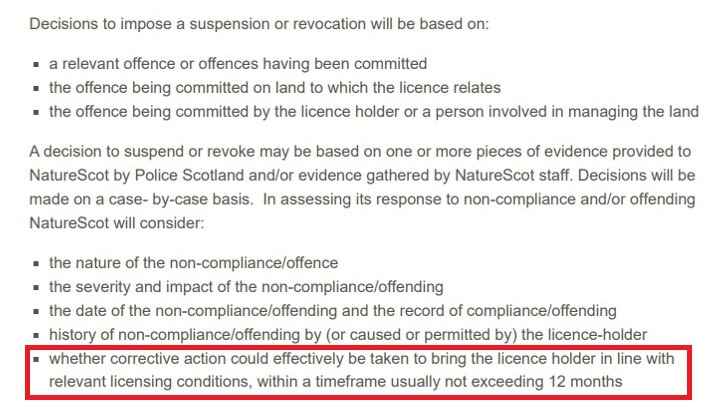
What the hell is ‘corrective action’?? What does that even mean? Does it mean that if a grouse moor estate sacks one of its gamekeepers and replaces him/her with a different one, the estate gets to keep its section 16AA grouse shooting licence because the estate has been seen to have taken ‘corrective action’?
Does that mean that a grouse shooting estate can continually replace gamekeepers, every time an offence has been committed, to avoid ever having its 16AA licence revoked?
If that is what ‘corrective action’ means then this new grouse shooting licence isn’t worth the paper it’s written on. Raptor persecution will continue, criminal gamekeepers will just be moved around to work on different estates (this already happens) and grouse moor owners will never be held to account.
I don’t have time to write anymore today but I’ll be talking with others, including legal advisors, and questions will need to be asked of Ministers.
In haste…
UPDATE 8 August 2024: NatureScot provides clarification on its framework for suspending new grouse moor licences (here)
 Raptor Persecution UK
This isn’t a surprise I never thought for 1 minute that this licencing law would b of any use, governments always seem to find a way of relaxing the very restrictions that they impose so the perpetrators of illegal killing of raptors can wriggle out of the net after commiting a crime that the Supposed law inplace is there to protect birds and give the authorities the teeth to bring prosecutions that can hurt!!! Watch this space?
I am most surprised you did not expect this. It is not a big shock to anyone else its another case of “money talks” these twisted people will ALWAYS prevail because money is the only thing that matters to the majority of people whether it be north or south of the border. Thatis precisely why muirburn is fine with its double impact on the environment but the rest of of us must not be allowed to burn logs or diesel due to global and enviromental reasons. An awful lot of people expecting things to change now the government has changed it seems are in for a big let down these loopholes could of course be closed but that remains to be seen.
“An awful lot of people expecting things to change now the government has changed it seems are in for a big let down these loopholes could of course be closed but that remains to be seen.”
You appear to be confusing a Scottish Law (the subject you began writing about) with a change in Westminster (nothing to do with Scottish Law or its potential ‘loopholes’).
NatureScot continues to disappoint. I frequently see inappropriate behaviour on protected sites – and in particular motor vehicles churning up dunes and grassland – and the response is always the same – ‘Can you phone the police?’. The biggest problem with that is I live in a remote area and police officers are few and far between. The sites in question have no signs to inform anyone that they are protected. Byelaws are essential too. It really is heartbreaking to see these special places being trashed and there be no action taken whatsoever to save them.
The dread many of us have felt, that the new legislation looked too good to be true, already looks justified.
There are equal concerns amongst anti-hunting groups, that Labour will fudge their commitment to close all the loopholes and finally ban hunting.
When legislating they need to coordinate with groups such as yourself.
NatureScot showing yet again that it is not fit for purpose. What is it about these national governmental organisations that ensures they put nature protection behind anything else they can put in the way?
NatureScot doing what they can to water down the grouse licensing legislation. Natural England ignoring the advice of its own senior scientist and issuing new Badger cull licences.
‘NatureScot showing yet again that it is not fit for purpose. What is it about these national governmental organisations that ensures they put nature protection behind anything else they can put in the way?”
NatureScot is an “arm’s length, executive, non-departmental public body”. It is not directly controlled by the Scottish Government, but exists to give official advice to it, although it receives most of its funding from that Government (through its sponsoring Department). It has conferred upon it extensive statutory powers, and is a statutory consultee.
Originally, its predecessor(s) simply had to consider what was best for nature.
But the last Labour Government undertook a review of such public bodies, appointing Phillip Hampton of Sainsbury’s, and in May 2005, Gordon Brown announced a Better Regulation Plan. The legislation was enacted in November 2006.
What this did, among many other things, was to place a responsibility on such bodies to consider in their advice to Government the economic impact of that advice.
So, what was best for nature took a back-seat to ‘how much does it cost‘?
NatureScot call it “balancing duties“.
The so-called Hampton Principles were adopted throughout the devolved nations. Hence in https://www.nature.scot/doc/applying-naturescots-balancing-duties you will find:
“NatureScot is alert to a range of other interests when discharging its responsibilities for nature. These include wider social and economic interests.”
In one stroke, the only body officially charged with looking after nature (the voice for nature in Government) and with the statutory powers to do so, was compromised.
I wonder how the the local trickle-down from shooting compares with the local spending from visitors arriving to ride bikes, walk, watch birds, or other less-harmful activities. This would include spending on attractions like the NTS.
Perhaps someone with influence might ask NS?
Exactly!
The thing is, bodies such NatureScot are ill-equipped to monetise activities: that is well outside of their area of expertise. They, therefore, become highly susceptible to the economic arguments from the businesses they are supposed to be regulating.
What the Hampton Principles did was to make bodies like NatureScot do the ‘dirty economic work’ of Government for them. But Governments can be unelected: NatureScot cannot!
It was a bad day for nature and the environment when these ‘principles’ were thrust upon them… and it was applied across the board, environment, water…
Not a surprise that NatureScot, an agency of the Scottish Government had no intention on clapping down on landowners. Now of course without the Scot Greens the SNP will do nothing to displease the lairds.
How much money has been paid to NatureScot?
Who is going to be held responsible for wasting an awful lot of taxpayers money if/when the licencing legislation is found not fit for purpose?
This appears to be a deliberate sabotage of the legislation on licensing. How would the words, “corrective action” be defined legally? Can the Scottish Government, or NatureScot provide a definition as to what this comprises exactly?
Those who are above the law — then landowners — appear to have every wish granted. When I say that I am being ingenious because historical precedent indicates a deeper involvement in these processes than simply recipients of largesse
Disappointing, but not a surprise. NatureScot go along with pretty much anything landowners and developers want to do, irrespective of the long term ecological damage.