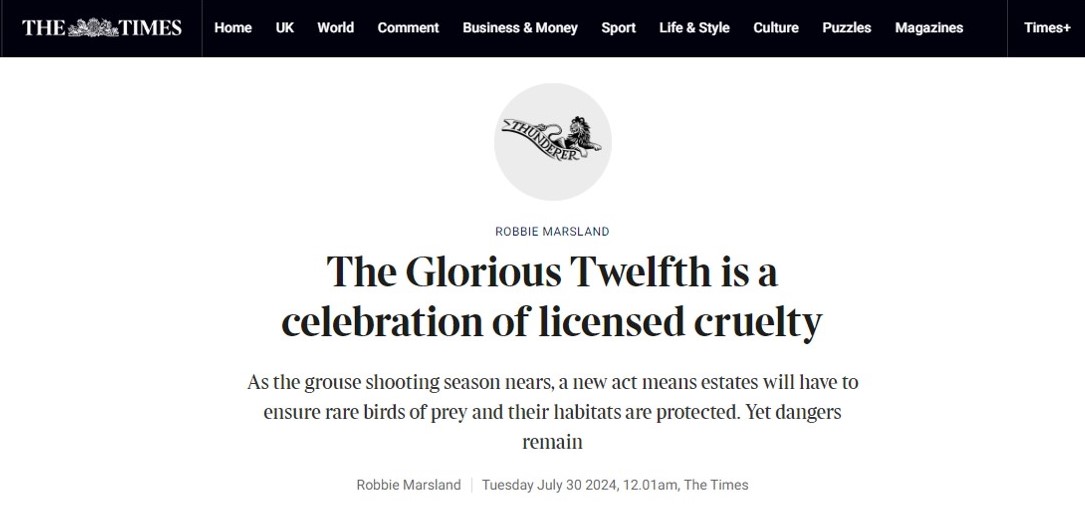
The Times published an opinion piece yesterday written by Robbie Marsland, Director of the League Against Cruel Sports (Scotland) and a founder member of REVIVE, the coalition for grouse moor reform:
As we approach the beginning of another controversial grouse shooting season, Scotland’s Wildlife Management and Muirburn Act will, for the first time, require the licensing of shooting estates. All shooting estates are expected to be granted these licenses with ease. The question is, which will be the first to lose its licence?
Licensing was introduced by the Scottish government this year after decades of failure by the shooting industry to end the illegal killing of birds of prey on, and around, grouse moors. The underlying reason for that failure is very simple. Birds of prey, such as hen harriers and golden eagles — both specially protected species — include grouse in their diets. But grouse are valuable. One way to value a grouse moor is by the size of its “game bag”, the number of grouse that can be shot each year.
A report to the Scottish government from the independent Grouse Moor Management Group five years ago said that the capital value of an estate could be increased by £5,000 for every pair of grouse shot on that estate. So, even if a hen harrier or a golden eagle were to include only ten or twenty grouse in their diet, there’s quite the financial incentive to remove the “problem”.
The new act also tackles moorland management activities that are potentially environmentally unsustainable. Since 2019, REVIVE, a unique coalition of environmental, animal welfare and social justice organisations, has described these activities as “the circle of destruction” surrounding Scotland’s grouse moors. From the mass use of antibiotics prescribed prophylactically to “protect” grouse, to huge swathes of heather being burnt off peatland each year, destructive management activities increase the number of grouse that can be shot for sport.
The act means that from this year onwards, estates will lose their licence to operate if they are believed to be at fault in failing to protect birds of prey, or breaking regulations on how the heather should be burnt or antibiotics used. All this is welcome, but the government chose to continue to allow the killing of hundreds of thousands of foxes, stoats, weasels and crows, all of which also include grouse in their diets, as a concession to the shooting estates.
The act is an important step forward in protecting our majestic birds of prey, peatland carbon sinks and the wider environment. But if hundreds of thousands of animals continue to be killed each year, so that hundreds of thousands of grouse can be shot for sport, the circle of destruction will continue. It’s often said that you can’t license cruelty. Perhaps Scotland just has.
Robbie Marsland is Director of Scotland and Northern Ireland for the League Against Cruel Sports
This year is the 10th anniversary of Hen Harrier Day and it’ll be marked by an event at Carsington Water in Derbyshire on Saturday 10th August.
This year’s event is organised by the charity Hen Harrier Action and runs from 11am – 4.45pm on Saturday 10th Aug. Entry is free although you’ll have to pay for parking (calculated by the hour, max of £7 for the day).
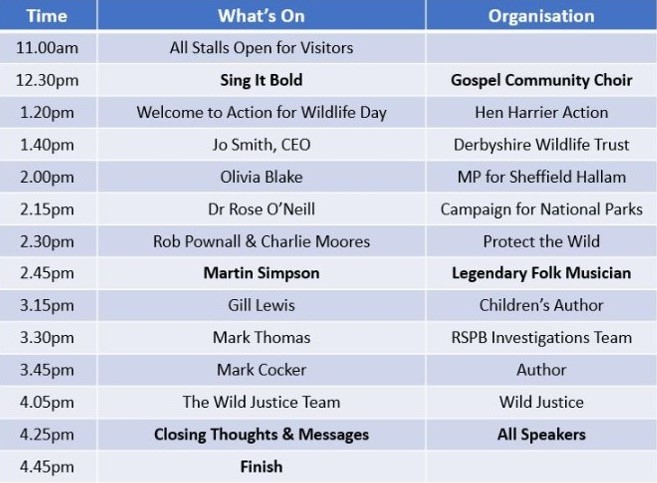
The programme for the day looks like this:
In addition to events on the main stage, there’ll be over 20 stalls from the following organisations:
I’ll be there with my fellow co-directors from Wild Justice – Mark Avery and Chris Packham, and we’ll be looking back on the first ten years of Hen Harrier Day campaigning and looking forward to what comes next.
I hope to see some of you there – especially any of the #Sodden570 who were there when it all began amidst Hurricane Bertha at Derwent Dam!
For full details of this year’s event at Carsington Water please click here.
Eight hen harrier chicks have fledged on the Tarras Valley Nature Reserve this year, continuing to buck the trend in south Scotland.
The results of last year’s national Hen Harrier Survey demonstrated a steep regional population decline of 32% across the Southern Uplands and of four Special Protection Areas (SPAs) designated for hen harriers in this region, they were only breeding successfully in one – Tarras Valley.
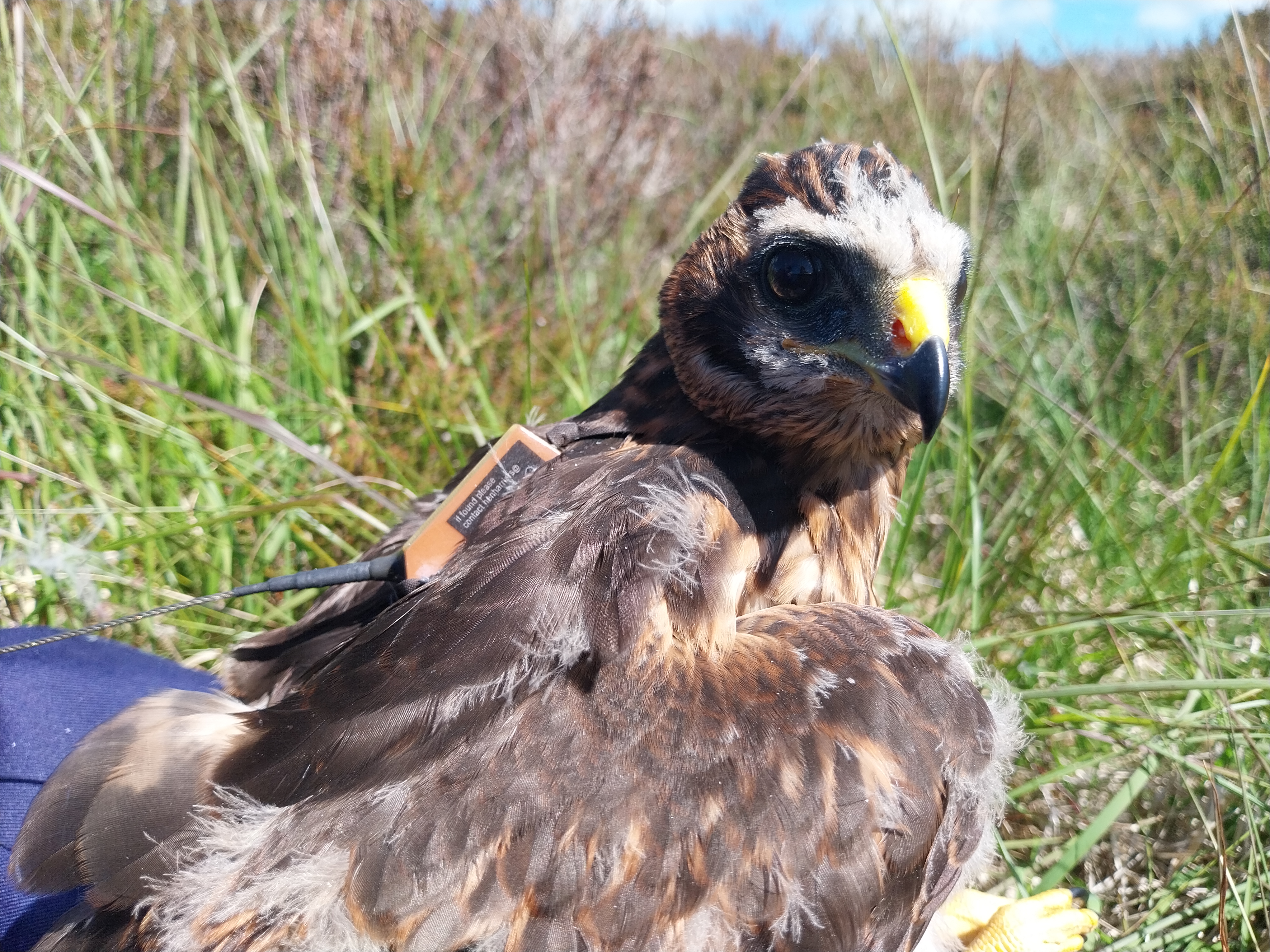
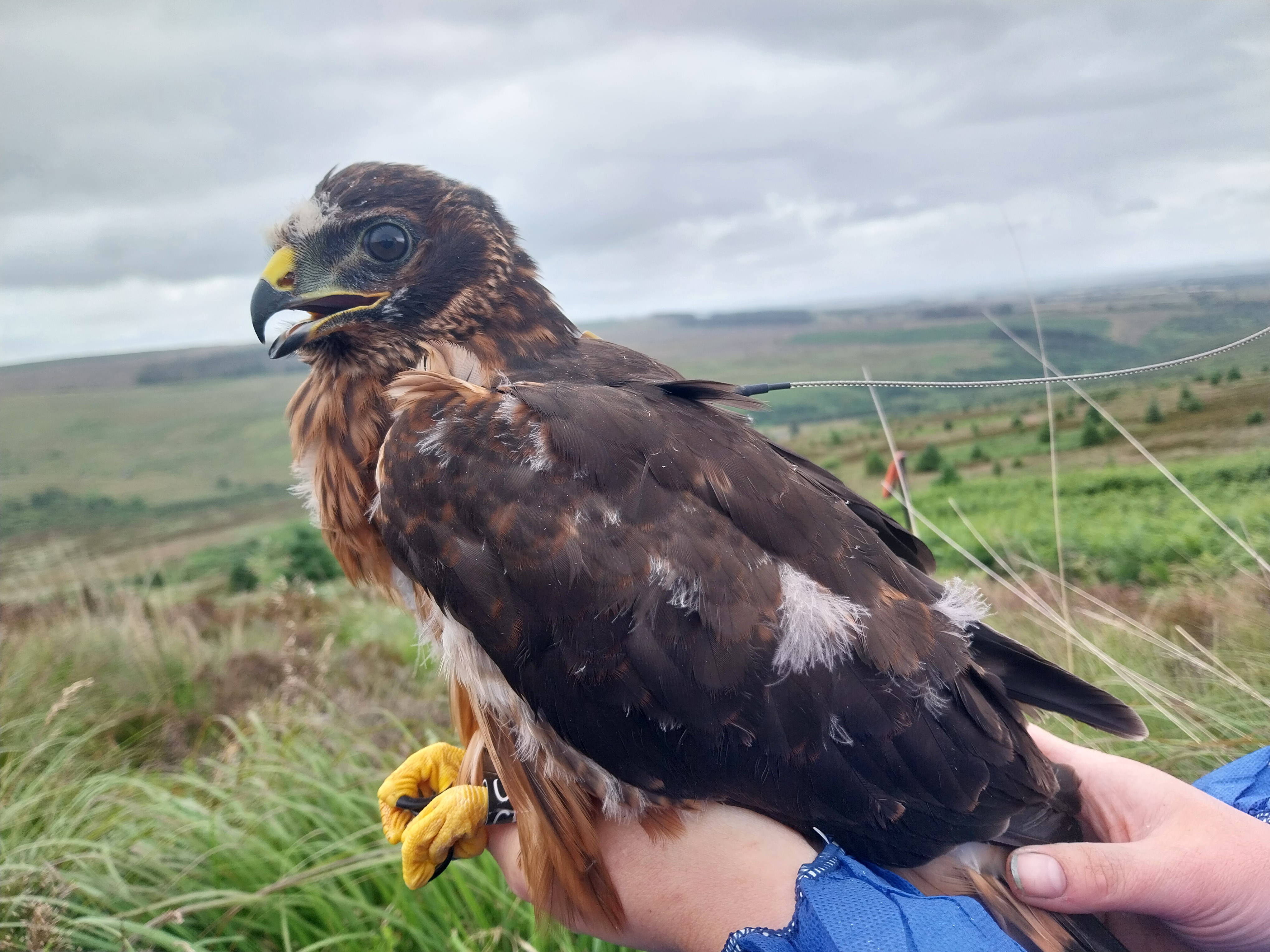
Three of this year’s eight chicks have been satellite tagged – two females (siblings) and a male – with funding provided by the RSPB and charity Hen Harrier Action.
The three were named Ceilidh, Gilda and Red by Langholm Academy’s Head Girl and Boy and members of the raptor group and were tagged by licensed fieldworkers from the RSPB.
Photos of Ceilidh, Gilda and Red, copyright RSPB Scotland:
Tarras Valley was previously a driven grouse moor (known as Langholm Moor) but was bought from Buccleuch Estate a couple of years ago after an epic fundraising effort and is now a community-owned nature reserve, supported by the Langholm Initiative.
The Tarras Valley Nature Reserve team is working towards the development of a five-year action plan and many restoration projects are already underway – have a look around the TVNR website here to see what’s already been started and what else is planned.
Unsurprisingly, there are some in the grouse shooting industry who have been, and continue to be, critical of this community-owned project and seem desperate for it to fail, or at least for it to be perceived as a failure.
I mentioned last month that the Chairman of the Scottish Gamekeepers Association, Alex Hogg, recently told a Parliamentary Committee that the Tarras Valley Nature Reserve was a “species desert” and “there is nothing there at all” [now that it’s no longer being managed as a driven grouse moor].
His assessment seemed to be based not on any detailed surveys he’d undertaken, but on a single car journey he made recently over the moor. He obviously missed the hen harriers and all the other resident and visiting birds, not to mention all the other species that have been recorded on site in the last couple of years.
It’s a common theme, this slagging-off former grouse moors that are now part of a significant rewilding effort, because the gamebird shooting industry wants everyone to believe that managing a moor for grouse is the best and only suitable option for the land.
Some grouse moors do have big numbers of wader species, that’s without doubt, but it’s not a good indicator of wider biodiversity on the moor. The main reason those waders do well is because predators are ruthlessly and systematically destroyed, some legally, others illegally, for the benefit of producing an artificially-high population of red grouse for paying guests to shoot at. The benefit to the waders is simply a convenient by-product of that.
Well done to the team at Tarras Valley Nature Reserve and the army of volunteers who are helping to encourage a wide suite of habitats and species to re-establish and thrive here, including those hen harriers.
The grouse moor owners’ lobby group in England, the Moorland Association, has at long last been booted off the Raptor Persecution Priority Delivery Group (RPPDG), the so-called partnership for tackling raptor persecution crimes in England & Wales.
The trigger for this expulsion seems to have been the Moorland Association’s inflammatory blog earlier this month where it looked to be trying to sabotage the work of the police’s new National Hen Harrier Taskforce (I wrote about it, here).
The Moorland Association has now posted a new blog (here) where it claims to be ‘perplexed’ about its expulsion from the RPPDG:
Hilariously, in addition to being ‘perplexed and ‘bemused’, the Moorland Association’s response includes this line, which made me laugh out loud:
“We regret this decision, as the Moorland Association has been a loyal member of the group since it was established and has arguably achieved more than any other partner in reducing wildlife crime, with bird of prey numbers at record highs“.
I’ve written about the failure of the RPPDG many times since its inception in 2011, and have argued that it simply won’t work when there is a clear conflict of interest amongst some of the ‘partners’ whose sole intention seems to be to undermine progression on tackling these crimes. We’ve seen similar when the Peak District Bird of Prey Initiative collapsed last year (here).
From the beginning, the RPPDG has been dominated by organisations from the game shooting industry and the group’s perpetual lack of results (it’s achieved precisely nothing in terms of effectively tackling raptor persecution) has been consistently supported by a series of Tory DEFRA Ministers whose wilful blindness has been off the scale (e.g. Therese Coffey here, Rebecca Pow here, Richard Benyon here, Rebecca Pow again here, Richard Benyon again here, and Trudy Harrison here).
Let’s see what happens with the RPPDG now the Moorland Association has been removed from its position of influence.
Well done to Chief Inspector Kev Kelly, head of the National Wildlife Crime Unit (and current stand-in Chair of the RPPDG) for a courageous (and in my view, long overdue) decision to remove the Moorland Association from the RPPDG. I imagine he considered the consequences of making such a decision (i.e. a nasty, spiteful backlash from certain quarters) but decided the potential benefits to the partnership outweighed the cost. It’s an impressive example of integrity and I applaud him for it.
UPDATE 1 August 2024: Police call out Moorland Association for “wasting time & distracting from the real work” of Hen Harrier Taskforce (here)
UPDATE 22 November 2024: Revealed: letter of expulsion to Andrew Gilruth (CEO, Moorland Association) from Head of National Wildlife Crime Unit (here)
A man has been charged with killing two wild birds with an air rifle after police received reports of someone seen dumping a Tawny Owl and a Woodpigeon in a wheelie bin in Colne, Lancashire, in March 2024.
Joe Morris, 28, of White Grove, Colne, Lancashire has been charged with killing a non-Schedule 1 bird, causing unnecessary suffering to a protected animal and possessing an air weapon in a public place.
He is due to appear before Blackburn Magistrates on 22 August 2024.
UPDATE 29 April 2025: Lancashire man convicted of shooting Tawny Owl in local park (here)
POISONED BUZZARD LEADS TO ASHLEY GAME FARM & THE COMPANY’S DIRECTOR PAYING OVER £40,000 IN FINES
The discovery of a poisoned Buzzard next to a poisoned bait led to the search of a gamebird breeding farm in Chulmleigh, Devon conducted by Devon and Cornwall Police in March 2021.
A number of pesticides offences were discovered including the presence of Carbofuran, the same highly toxic chemical found on the poison bait that had killed the Buzzard.
On 18 July 2024 after pleading guilty to multiple pesticide offences Ashley Game Farm Ltd was ordered to pay £40,000 in fines and the company’s Director, Christopher Hodgson, was fined £1,500.
In October 2020, a member of the public discovered a dead Buzzard– a protected species under the Wildlife and Countryside Act 1981 – lying on top of a pheasant carcass by a pheasant release pen, near Hollocombe in Devon, and promptly reported it to Devon and Cornwall Police.
The two birds and a second dead pheasant found nearby were submitted by the police to the Government’s Wildlife Incident Investigation Scheme (WIIS) for examination and toxicology testing. Meat found in the Buzzard’s beak and both pheasant carcasses tested positive for Carbofuran. This evidence confirmed that the Buzzard had died as a result of feeding on the illegally placed poison baits.
In March 2021, following the toxicology results, a search of land, buildings and vehicles led by Devon and Cornwall police, supported by the National Wildlife Crime Unit, Natural England and the RSPB, took place at Ashley Game Farm in Chulmleigh, Devon. During the search significant amounts of prohibited and unauthorised pesticides and veterinary medicines were found stored around the property. A forensic search of two vehicles detected positive traces of the banned pesticide Carbofuran – the same banned pesticide which had been found on the pheasant carcasses and which had caused the Buzzard’s death.
Photo by RSPB Investigations
Ashley Game Farm is a member of the Game Farmers Association and a leading UK supplier of game birds including (Pheasant and Red-legged Partridge) which are sold as young birds to shooting estates across the UK and Europe, where in many cases they are reared and released to be commercially shot.
The insecticide Carbofuran has been banned in the UK since 2001 because of its high toxicity and associated risks. Although the storage and use of any product containing Carbofuran is an offence, it is one of the most commonly abused substances associated with the illegal poisoning of birds of prey, accounting for almost one third of all bird of prey persecution poisoning incidents in England between 2018 and 2022.
The practice of laying poisoned baits to persecute protected birds of prey is often associated with areas managed for gamebird shooting where these birds are perceived by some as a threat to gamebird stocks. Deliberate poisoning has resulted in the death of many species of protected birds of prey over decades. Historic incidents have shown this indiscriminate illegal practice has also resulted in the death of domestic animals and poses significant risks to humans, wildlife and the environment.
On 18 July 2024 at Exeter Magistrates Court, Ashley Game Farm and the Director of the company were charged with the following offences:
Ashley Game Farm:
On or before 26/03/2021 at Ashley Game Farm Limited, namely stored a plant protection product, namely Rivett MAPP 11300, without a valid authorisation or permission granted in accordance with Retained EU Regulation 1107/2009. Contrary to section 24 and 27 of the Plant Protection Products (Sustainable Use) Regulations 2012.
Between 01/10/2020 and 27/03/2021 at Ashley Game Farm Limited, used a plant protection product, namely Carbofuran, in contravention of Article 28 (1) of Retained EU Regs 1107/2009. Contrary to section 24 and 27 of the Plant Protection Products (Sustainable Use) Regulations 2012.
On or before 26/03/2021 at Ashley Game Farm Limited, used a Biocidal product, namely Lodi’s Sapphire Grain otherwise in accordance with the terms and conditions of its authorisation under Article 22 (1) and the labelling and packaging requirements of Article 69. Contrary to section 24 and 27 of the Plant Protection Products (Sustainable Use) Regulations 2012.
On or before 26/03/2021 at Chulmleigh contravened a requirement imposed by a prohibition notice served under section 22 of the Health and Safety at Work etc Act 1974 in that used a Biocidal product, namely Mole Valley Farmers Difenacoum Cut Wheat Rat Bait without authorisation being in force allowing for its use. Contrary to sections 22 and 33(1)(g) of the Health and Safety at Work etc Act 1974.
On or before 26/03/2021 at Chulmleigh in the county of Devon possessed an unauthorised veterinary medicinal product, namely possessed an unauthorised veterinary medical product, namely Dimetridazole (DMZ). Contrary to regulations 26(1), 43(r) and 44(1) of the Veterinary Medicines Regulations 2013.
Christopher Hodgson, Director of Ashley Game Farm:
On or before 26/03/2021 at being a Director of Ashley Game Farm Limited, a body corporate who had committed an offence, stored a plant protection product, namely Rivett MAPP 11300, without a valid authorisation or permission granted in accordance with Retained EU Regulation 1107/2009 and the offence was committed with the consent or connivance, or attributable to the neglect of Christopher Hodgson. Contrary to section 24 and 27 of the Plant Protection Products (Sustainable Use) Regulations 2012.
The company Ashley Game Farm Ltd pleaded guilty to all five charges and was ordered to pay £40,000 in fines and £590 in costs. Christopher Hodgson pleaded guilty to the one offence and was ordered to pay £1,500 in fines and £150 in costs.
Mark Thomas, RSPB Head of Investigations UK: “Yet again the discovery a dead bird of prey and poisoned baits leads to the detection of lethal banned poisons. This is the latest example of highly toxic pesticides being stored and used illegally in connection with the gamebird industry. As past cases have demonstrated these chemicals are extremely hazardous to our wildlife and environment, but also pose a considerable risk to members of the public and domestic animals. In this case, we welcome the significant fines despite not knowing who exactly killed the protected bird of prey.”
Howard Jones, RSPB Senior Investigations Officer: We would like to thank Devon and Cornwall Police, Natural England, NWCU, CPS and Defra. This successful outcome was the result of some incredibly effective partnership working. The fact that Carbofuran is still being found 20 years after it was banned shows the lack of reform, as the law stipulates, being shown by some within the gamebird industry. As this case has shown, individuals and businesses that chose to store and use these types of highly toxic pesticides are taking significant risks and committing serious criminal offences.
Jenny Mashford, Devon and Cornwall Police: “This incident was brought to the police’s attention thanks to a member of the public who identified the poisoned raptor. We carried out a warrant at the defendant’s premises with the assistance of several other agencies including Natural England, the National Wildlife Crime Unit, the RSPB and Defra. It is a very positive outcome in our fight against wildlife crime, of which bird of prey crime is a national wildlife crime priority. We would like to thank all those involved for their hard work and assistance with this case.”
If you notice a dead or injured bird of prey in suspicious circumstances, call the police on 101 and fill in the RSPB’s online reporting form HERE.
If you have information about anyone killing birds of prey which you wish to report anonymously, call the RSPB’s confidential Raptor Crime Hotline on 0300 999 0101.
For new readers, this Act was introduced as the Scottish Government’s response to the continued widespread illegal killing of birds of prey on grouse moors. It will work on the basis that all red grouse shooting must now be licensed in Scotland under a section 16AA licence and if, on the civil burden of proof (i.e. the balance of probability) sufficient evidence is found that the licence has been breached (including evidence of illegal raptor persecution), the licence can be withdrawn as a sanction, preventing the shooting of red grouse on a particular estate for a period of up to five years.
This licensing scheme, although not without its flaws, has been generally welcomed by most in the conservation sector because, after decades of getting away with it, finally it looked like grouse moor owners would be held to account for the crimes committed by their employees (e.g. see here).
However, from what I’ve just read, I think the licensing authority, NatureScot, has just handed the grouse moor owners a massive ‘get out of jail free’ card.
NatureScot has recently published the framework it will use to outline its approach to modifying, suspending or revoking the section 16AA licence. We’re all familiar with the general principle of how NatureScot uses frameworks to implement decisions, e.g. see here for the framework it uses when deciding whether to impose a General Licence restriction on estates where there’s evidence of wildlife crime.
That decision framework has been fairly robust, resulting in a number of GL restrictions (including the latest one yesterday on Lochindorb Estate) and as far as I can tell, all the appeals sanctioned estates have made against their GL restriction have failed (e.g. see Leadhills Estate failed appeal here, Moy Estate failed appeal here, Invercauld Estate failed appeal here).
In fact the ‘ultimate’ appeal against NatureScot’s decision framework to impose a General Licence restriction, a judicial review brought by Raeshaw Estate, demonstrated that NatureScot’s framework was based on solid principles (see here) although I’d still argue that the GL restriction is only useful as a reputational driver, not as a serious sanction because sanctioned estates can simply apply to NatureScot for an individual licence that permits them to continue doing the activities that are supposedly forbidden under the General Licence restriction (see here for background discussion).
Indeed, it’s precisely because the General Licence restriction hasn’t been effective (in stopping raptor persecution on grouse moors) that the Scottish Government decided to bring in the more serious sanction of grouse moor licensing.
I think many of us have been focused on the detail of the new Grouse Moor Code of Practice that outlines the things that grouse moor owners can and can’t do under the new grouse moor licensing scheme, and none of us gave much thought to the framework that NatureScot would devise to help it make decisions on licence withdrawals. That was a mistake on our part.
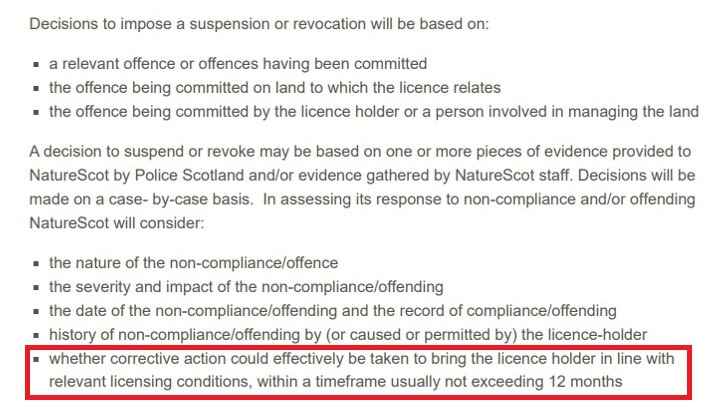
Here is the decision framework that NatureScot will use to determine whether grouse moor licences will be revoked under the new legislation:
I’ve not had time to go through this in detail but already I can see areas that need questioning, such as why the evidence NatureScot will use to base its decision on modifying, suspending or revoking a licence will only be accepted from Police Scotland and NatureScot staff. Why won’t evidence from the Scottish SPCA be used? Surely this is an oversight, given that the new legislation has created increased investigatory powers for the SSPCA and the relevant offences for which a licence may be revoked include those under the section 19 of the Animal Health and Welfare (Scotland) Act 2006, an area of expertise for the SSPCA.
However, the most glaring issue I’ve found so far in this framework is this:
What the hell is ‘corrective action’?? What does that even mean? Does it mean that if a grouse moor estate sacks one of its gamekeepers and replaces him/her with a different one, the estate gets to keep its section 16AA grouse shooting licence because the estate has been seen to have taken ‘corrective action’?
Does that mean that a grouse shooting estate can continually replace gamekeepers, every time an offence has been committed, to avoid ever having its 16AA licence revoked?
If that is what ‘corrective action’ means then this new grouse shooting licence isn’t worth the paper it’s written on. Raptor persecution will continue, criminal gamekeepers will just be moved around to work on different estates (this already happens) and grouse moor owners will never be held to account.
I don’t have time to write anymore today but I’ll be talking with others, including legal advisors, and questions will need to be asked of Ministers.
In haste…
UPDATE 8 August 2024: NatureScot provides clarification on its framework for suspending new grouse moor licences (here)
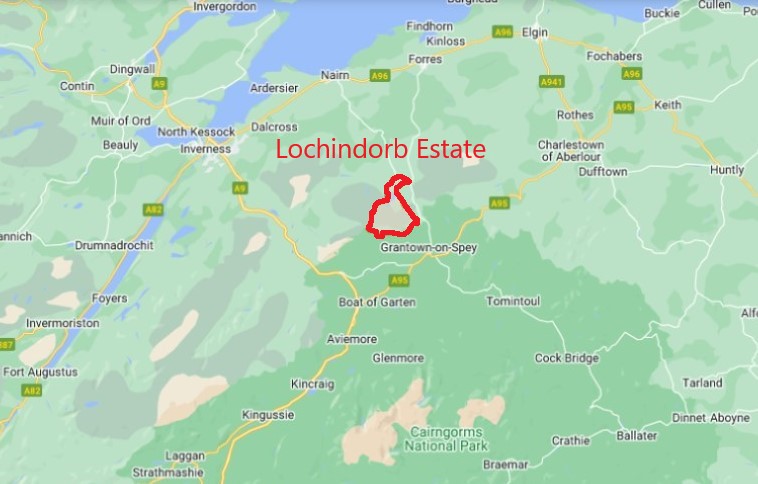
NatureScot has restricted the use of general licences on Lochindorb Estate, near Grantown-on-Spey, for three years.
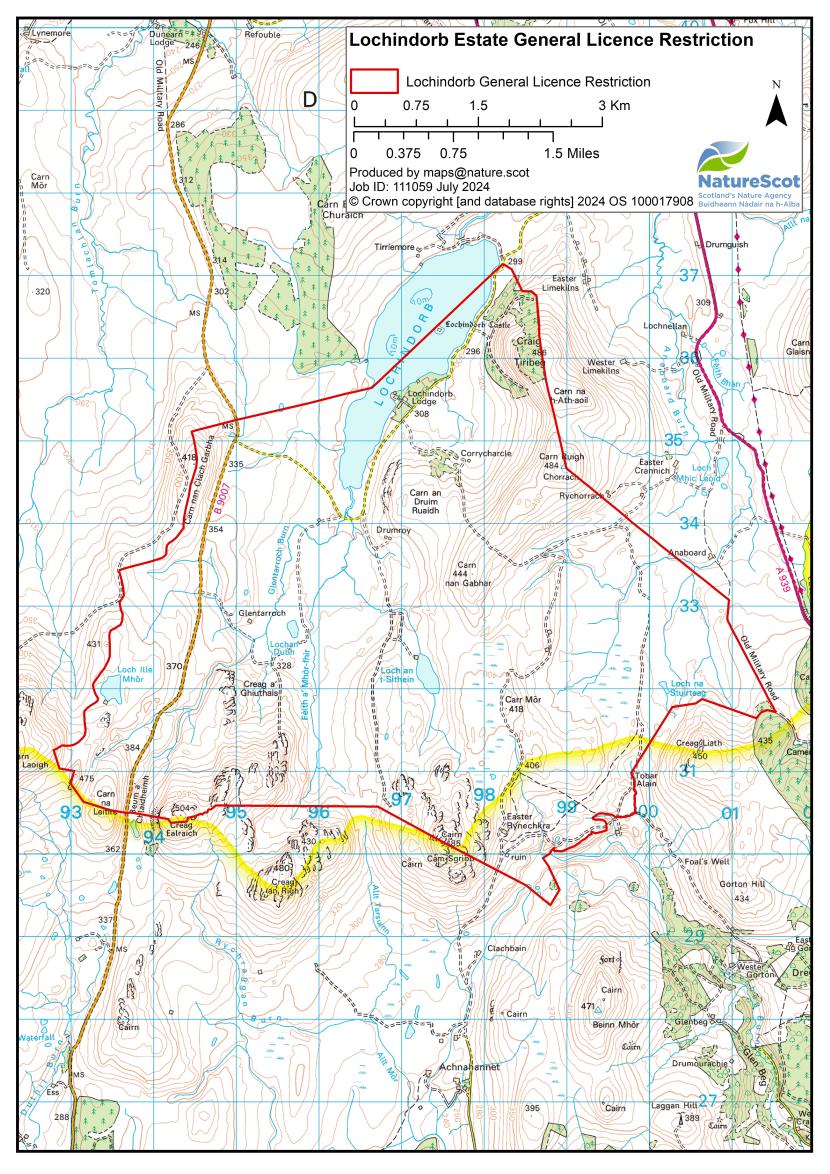
An RPUK map showing the general boundary of Lochindorb Estate – details provided by Andy Wightman’s Who Owns Scotland website
The decision was made on the basis of evidence provided by Police Scotland of wildlife crime against birds.
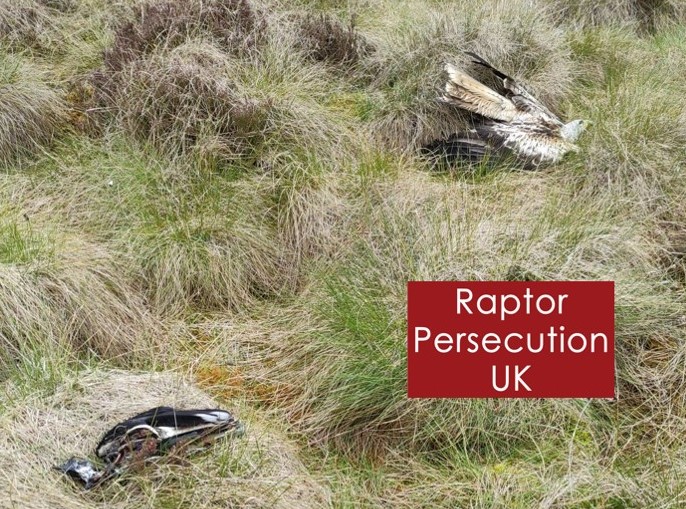
This evidence included a red kite found poisoned with an insecticide in 2021 near to a lapwing bait on land managed at the time by the estate [Ed: here], and a red kite shot on Lochindorb estate in 2023 [Ed: here].
The poisoned red kite and the lapwing used as poisoned bait. Photo by RPUK blog reader
Donald Fraser, NatureScot’s Head of Wildlife Management, said: “We have decided, in discussion with Police Scotland, to suspend the use of general licences on this property for three years until March 2027, given the persecution of red kites which has taken place on Lochindorb Estate and on neighbouring land managed by them at the time of the incident.
“NatureScot is committed to using all the tools we have available to tackle wildlife crime. This measure will help to protect wild birds in the area, while still allowing necessary land management activities to take place.
“We believe this is a proportionate response to protect wild birds in the area and prevent further wildlife crime. We will continue to work closely with Police Scotland and consider information they provide on cases which may warrant restricting general licences.
“The estate may still apply for individual licences; however, these will be subject to enhanced record-keeping and reporting requirements and will be closely monitored to ensure adherence with licence conditions.”
General licences allow landowners or land managers to carry out control of common species of wild birds, such as crows and magpies, to protect crops or livestock, without the need to apply for an individual licence.
In addition to this restriction, there are currently four other restrictions in place in Scotland: on Moy Estate in Highland, Invercauld Estate in the Cairngorms National Park, Lochan Estate in Perthshire and Millden Estate in Angus.
ENDS
Here is a map from NatureScot showing the area of Lochindorb Estate where the General Licence restriction applies. This restriction prohibits the use of General Licences 01, 02 and 03 on that land from 16th July 2024 up to and including 15th July 2027.
I presume then, that the 56 year old gamekeeper arrested last year as part of the investigation into the shooting of the red kite on Lochindorb Estate has not been charged. If he had, this General Licence restriction would have been delayed until court proceedings had finished.
It’ll also be interesting to see whether this General Licence restriction affects Lochindorb Estate’s ability to apply for a section 16AA grouse shooting licence under the new Wildlife Management & Muirburn Act 2024.
For new readers, this Act was introduced as the Scottish Government’s response to the continued widespread illegal killing of birds of prey on grouse moors. It will work on the basis that all red grouse shooting must now be licensed in Scotland under a section 16AA licence and if, on the civil burden of proof (i.e. the balance of probability) sufficient evidence is found that the licence has been breached (including evidence of illegal raptor persecution), the licence can be withdrawn as a sanction, preventing the shooting of red grouse on a particular estate for a given period.
My guess is that Lochindorb will still be able to apply for a section 16AA grouse shooting licence, even though the estate is now under a 3-year General Licence restriction, because these offences were committed before the new legislation was enacted, so it will be deemed ‘unfair’ to apply the legislation retrospectively.
That will also mean that the other four grouse-shooting estates currently serving a general Licence restriction after evidence of raptor persecution was uncovered on their land (Moy Estate in the Monadhliaths, Invercauld Estate in the Cairngorms National Park, Lochan Estate in Strathbraan and Millden Estate in the Angus Glens) will also be able to apply for a section 16AA licence to shoot red grouse this year.
A couple of weeks ago I blogged about the new National Hen Harrier Taskforce – a police-led initiative to tackle the ongoing persecution of hen harriers on driven grouse moors (see here).
This hen harrier was euthanised after suffering catastrophic injuries in an illegal trap set next to its nest on a grouse moor in 2019. Photo by Ruth Tingay
The Taskforce’s proposed strategy for tackling hen harrier persecution on grouse moors is based on a new framework designed to tackle all types of Serious Organised Crime that was launched by the Home Office last year (see here). It’s based on a three-step plan of ‘Clear, Hold, Build‘.
Step one (‘Clear‘) involves police officers relentlessly pursuing organised crime members within a community (or in this case, an industry), using all available powers to ‘clear’ the offenders from specific locations.
Step two (‘Hold‘) sees officers undertake continued high visibility activity to ensure other serious organised criminals can’t move in and operate in the vacuum created by step one.
Step three (‘Build‘) relates to building local community resilience and trust, through partnership-working, to ensure that Serious Organised Crime doesn’t reoccur at that location.
When I wrote about the Taskforce a few weeks ago (here) I mentioned a similar police initiative, called Operation Artemis, that was launched to tackle hen harrier persecution on grouse moors in 2004, some twenty years ago. That initiative crashed and burned within three years because grouse moor owners refused to cooperate with the police. The new Taskforce has a more sophisticated theoretical approach and stronger enforcement support, but the basic premise is the same: establish a partnership between landowners and the police to target the hen harrier killers.
However, as we’ve come to learn, partnership-working is only successful if all partners have the same objective and there are no conflicts of interest.
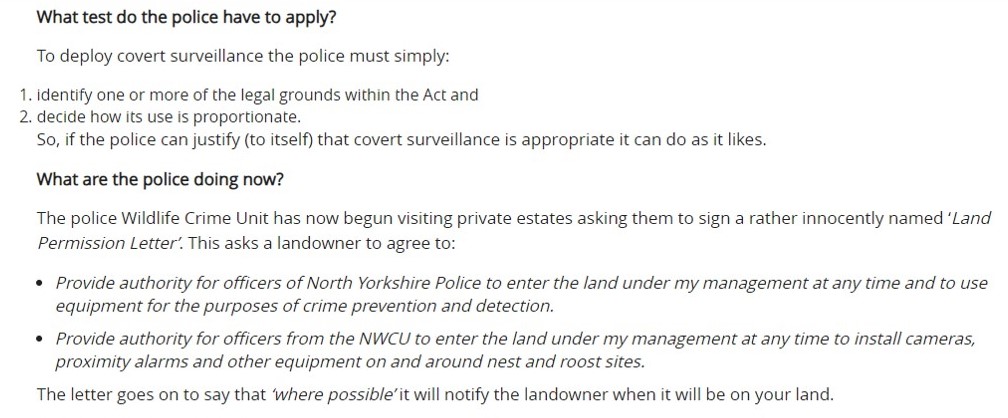
In an extraordinary blog posted on the Moorland Association’s website on 8 July 2024, (the Moorland Association is the lobby group representing grouse moor owners in England), it is suggested that the police are ‘bypassing regulation’ by asking grouse moor owners to sign a letter giving permission for the police to enter land at any time and use equipment for the prevention and detection of crime. This includes the installation of cameras, proximity alarms and other equipment on and around hen harrier nest and roost sites.
The Moorland Association is advising its members not to sign any letters authorising police access without first taking legal advice because, it suggests, this is an attempt to ‘bypass regulation on surveillance’.
I don’t see any issue with the Moorland Association advising its members to seek legal advice – that’s standard due diligence – but to state that the police are ‘bypassing regulation on surveillance‘ seems to me to be incendiary.
Here is a copy of the Moorland Association’s blog, screen grabbed here because it has already been altered from its original version (more on that below).
I’m not sure who wrote the Moorland Association’s blog because there’s no name attached to it but my money would be on the author being the Moorland Association’s CEO, Andrew Gilruth. Why do I think that? Well Mr Gilruth built an impressive reputation for presenting distorted information when he worked as Director for Communications for the GWCT (e.g. see here, here and especially here) and the Moorland Association’s blog has all the familiar hallmarks.
For example, the opening paragraph of the Moorland Association’s blog goes like this:
‘Most will remember the irony of RSPB staff falling foul of the courts in order to try and catch others breaking the law – and then expressing outrage when their evidence was thrown out of court here. In short, judges felt the police could not use others to circumvent the law on covert surveillance‘.
I’m not sure of the relevance of including this statement about the RSPB’s video evidence in the context of the Moorland Association’s blog about police surveillance, other than to (a) try yet again to undermine the credibility of the RSPB and (b) contrive an image that the police have previously ‘used others’ to ‘circumvent the law on covert surveillance‘.
It is accurate for the Moorland Association to point to the court case in 2015 where the judge ruled the RSPB’s video evidence as inadmissible. As regular blog readers will know, there have been a number of court cases where the RSPB’s evidence has been ruled inadmissible (e.g. here and here) but what the Moorland Association’s blog conveniently fails to point out is that there have also been a number of cases where the RSPB’s video evidence has been accepted by the courts and has, in fact, been crucial to the conviction of criminal gamekeepers, including these recent cases in 2022 here, again in 2022 here, and in 2023 here.
Far from the police ‘using others to circumvent the law‘, the police have worked legitimately and lawfully in partnership with the RSPB many times to convict criminal gamekeepers, both with and without the use of covert surveillance.
This successful partnership really agitates many in the game-shooting industry and I’d argue that’s the reason the Moorland Association’s blog opens with that paragraph – to infer that the police have a track record of ‘circumventing the law on covert surveillance‘ and to place this thought firmly in their members’ minds before moving on to discuss why the Moorland Association believes the police’s latest tactics on the Hen Harrier Taskforce are of ‘concern‘.
The rest of the blog appears to be a distortion of what the police are asking landowners to do. It’s surely obvious that the police aren’t asking landowners for permission to undertake covert surveillance – it would hardly be ‘covert’ if they’re telling the landowner that’s what they intend to do!
Rather, what it seems the police are actually asking for is permission to visit the moor at any time (Step one of the three-step strategy) and to install equipment (including proximity alarms and cameras) ‘on and around nest and roost sites‘, to catch the criminals that are killing hen harriers. You know, the criminals that the landowners and their gamekeepers claim to have no knowledge of, but who are repeatedly turning up on their estates, armed, to commit serious crime.
This isn’t covert surveillance in the sense of spying on people who live and work on that estate – hen harriers don’t tend to nest close to people’s houses and, as hen harriers are a Schedule 1 protected species, nobody should be anywhere near their nest sites without a disturbance licence anyway, so the likelihood of a landowner or their employees being ‘covertly surveyed’ by a nest camera is pretty implausible, assuming they’re not involved in the crimes being committed at those sites.
I note that the Moorland Association blog appears to have been edited since it first appeared on 8th July – it now includes a ‘note’ (under the sub-header ‘Should I sign oneofthese letters?‘) to clarify the police’s position that what they are asking for does not amount to covert surveillance. That’s an interesting edit. I wonder if it’s been added on legal advice to try and soften the Moorland Association’s accusations against the police? I imagine the police’s reaction to the Moorland Association’s original blog would not be favourable, given that it’s not conducive to partnership working and also seems to be verging on defamation.
The wider context of this Moorland Association blog is of most interest to me. Here is an organisation that repeatedly claims to have a ‘zero tolerance’ policy against raptor persecution, and yet here it is giving a pretty good impression of an organisation intent on sabotaging the police’s attempts to tackle raptor persecution (as well as other Serious Organised Crime) on grouse moors.
If I was a landowner, and armed criminals were repeatedly coming on to my estate to kill protected wildlife, I’d be on the phone to the police without hesitation, asking them to respond. Not just for the sake of the wildlife but for the safety of my family, my employees, my neighbours and the visiting public. I’d be asking for an armed response unit and would give them permission to do whatever they thought necessary, for however long it took to catch the gunmen. Wouldn’t this be the response of any reasonable, law-abiding citizen who had nothing to hide?
It’ll be fascinating to see what the police’s response is to the Moorland Association’s blog, assuming they’ve seen it. From the presentations I’ve heard from DI Mark Harrison, the officer from the National Wildlife Crime Unit (NWCU) leading the National Hen Harrier Taskforce, he’s playing strictly by the rules, being transparent, and initially taking a softly, softly approach with landowners, refusing to embarrass estates by naming them publicly as hen harrier persecution hotspots because he wants to work in partnership with them.
Hen Harrier Taskforce approach, presented by DI Harrison at a recent seminar. Photo: Ruth Tingay
I’ve been cynical of his ‘partnership’ approach and have suggested that all he’s doing is shielding the criminals. However, DI Harrison has been very clear that his tactics are part of a longer-term strategy and that if landowners refuse to cooperate, it makes it easier for him to take the next step and upgrade the tactics to something far more serious.
The Taskforce isn’t just looking at wildlife crime. It is also intent on tackling offences such as theft (of satellite tags), criminal damage (of satellite tags), fraud offences, criminal use of firearms, and potential conspiracy offences relating to encouraging or assisting crime. Some of these are very serious offences, triable either way (i.e. can be heard in a higher court that has greater sentencing powers than a magistrates court) and thus there are more serious consequences for anyone convicted of these offences than being convicted for a wildlife crime offence.
The tactics that he’ll be empowered to use are far more intrusive than anything these grouse moor estates will have faced before, he won’t need their permission to deploy them and they won’t know what’s happening until it’s too late.
Let’s see if the Moorland Association’s inflammatory blog will trigger a response from DI Harrison and the NWCU, resulting in the Taskforce ramping up its tactics on any grouse shooting estates where a landowner refuses to sign up.
UPDATE 23 July 2024: Moorland Association booted off the Raptor Persecution Priority Delivery Group (RPPDG) here
UPDATE 22 November 2024: Revealed: letter of expulsion to Andrew Gilruth (CEO, Moorland Association) from Head of National Wildlife Crime Unit (here)
The Scotsman has published my opinion piece today about the potential impact of the new licensing scheme for grouse shooting in Scotland.
You can read it on The Scotsman website (here) and it’s reproduced below:
I call them ‘The Untouchables’. Those within the grouse-shooting industry who have been getting away with illegally killing golden eagles, and other raptor species such as hen harriers, buzzards and red kites, for decades.
They don’t fear prosecution because there are few people around those remote, privately owned glens to witness the ruthless and systematic poisoning, trapping and shooting of these iconic birds. If the police do come looking, more often than not they’re met with an Omertá-esque wall of silence from those who, with an archaic Victorian mindset, still perceive birds of prey to be a threat to their lucrative red grouse shooting interests.
For a successful prosecution, Police Scotland and the Crown Office must be able to demonstrate “beyond reasonable doubt” that a named individual committed the crime. As an example of how difficult this is, in 2010 a jar full of golden eagle leg rings was found on a mantelpiece during a police raid of a gamekeeper’s house in the Highlands. Each of those unique leg ring numbers could be traced back to an individual eagle.
The gamekeeper couldn’t account for how he came to be in possession of those rings, but the police couldn’t prove that he had killed those eagles and cut off their legs to remove the rings as trophies.
Despite the remains of two red kites, six illegal traps, an illegally trapped hen harrier and poisoned bait also being found on the estate, the gamekeeper was fined a mere £1,500 for being in possession of one dead red kite, that was found mutilated in the back of his estate vehicle.
In another case in 2010, three golden eagles were found poisoned on a grouse-shooting estate in the Highlands over just a few weeks. Even though the police found an enormous cache of the lethal poison – carbofuran – locked in a shed to which the head gamekeeper held a key, they couldn’t demonstrate that he was the person who had laid the poisoned baits that had killed the eagles. This meant he was fined £3,300 for the possession of the banned poison, but wasn’t prosecuted for killing the eagles.
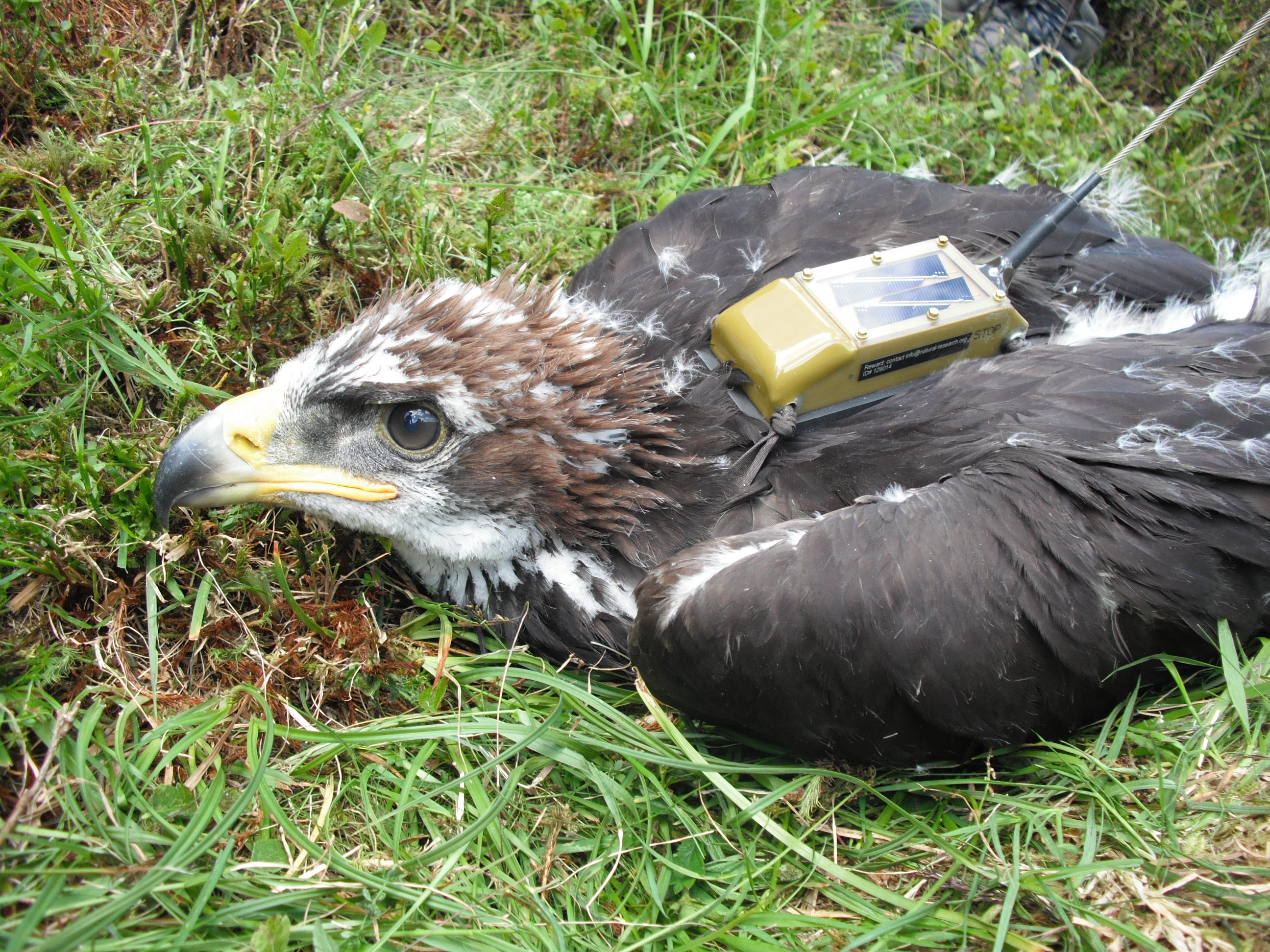
In recent years, researchers have been fitting small satellite tags to young golden eagles which allows us to track their movements across Scotland, minute by minute. Analysis has shown that between 2004 and 2016, almost one third of tagged eagles (41 of 131 birds) ‘disappeared’ in suspicious circumstances, mostly on or next to grouse moors.
Satellite-tagged golden eagle prior to fledging. This eagle was tagged in 2014, ‘disappeared’ on a Strathbraan grouse moor in 2016 and it’s satellite tag was found wrapped in heavy lead sheeting in the River Braan in 2020. Photo by Duncan Orr-Ewing
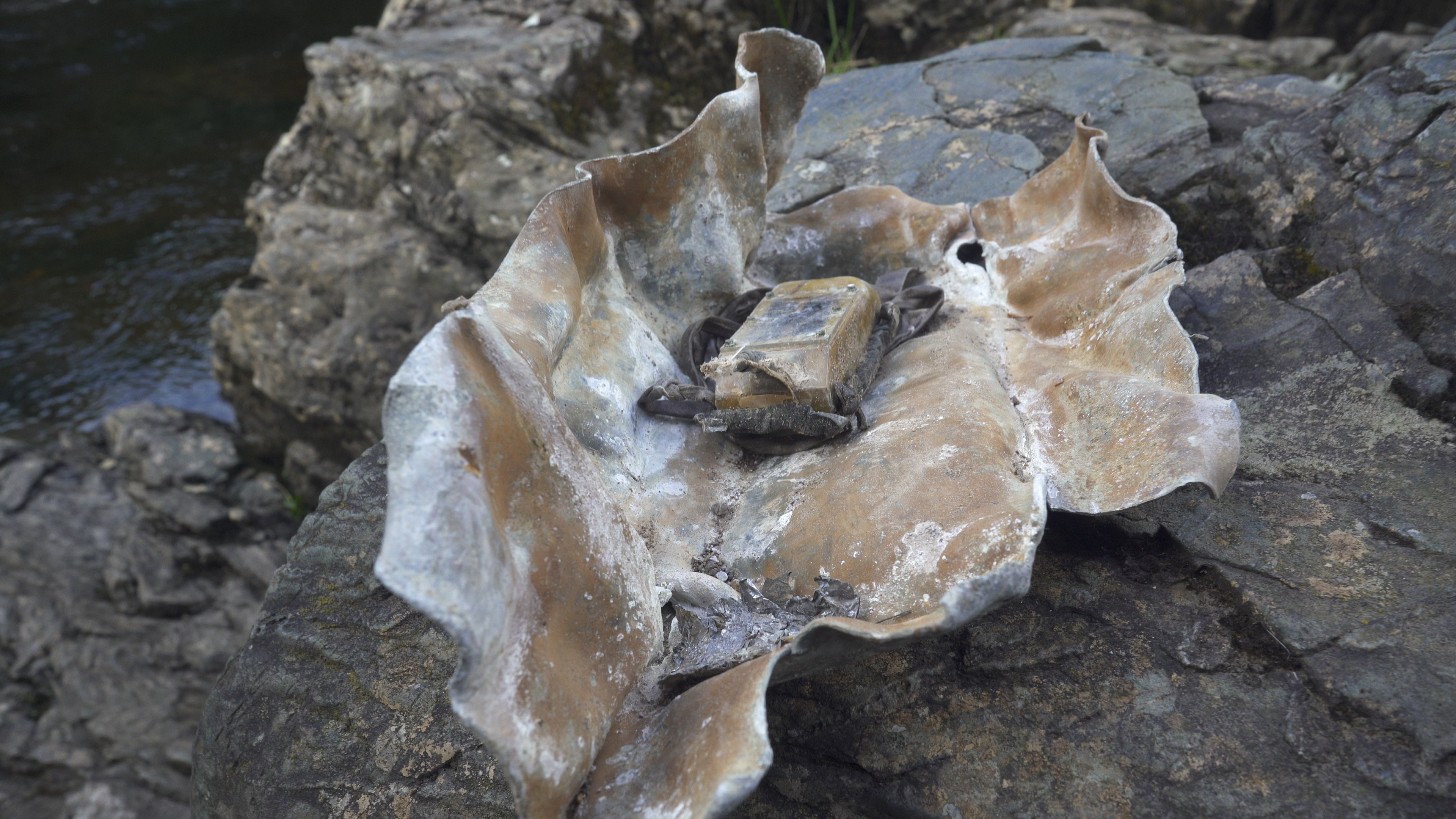
The lengths the criminals will go to avoid detection were exposed in 2020 when a walker found a satellite tag that had been cut off an eagle, wrapped in heavy lead sheeting – presumably to block the signal – and dumped in the River Braan. The tag’s unique identification number told us it belonged to a young eagle tagged in the Trossachs in 2014. This eagle had disappeared without trace from a Perthshire grouse moor in 2016, in an area where eight other tagged eagles had vanished in similar suspicious circumstances. Nobody has been prosecuted.
The remains of the satellite tag that had been cut off the eagle, wrapped in lead sheeting and dumped in a river. Photo by Ian Thomson, RSPB Scotland
The most recent disappearance of a tagged eagle happened just before Christmas 2023, close to the boundary of a grouse moor in the Moorfoot Hills. ‘Merrick’ was translocated to the area in 2022 as part of the South of Scotland Golden Eagle Project. Her tag data told us she was asleep in a tree immediately before she disappeared. Police found her blood and a few feathers at the scene and concluded she’d been shot. Who shoots a sleeping eagle? Again, no one has been prosecuted.
This situation has persisted for decades because although golden eagles have been afforded legal protection for the last 70 years, to date there hasn’t been a single successful prosecution for killing one. The chances of getting caught and prosecuted have been so low that the risk of committing the crime has been worth taking, over and over again. Until now.
Earlier this year, the Scottish Parliament passed new legislation, the Wildlife Management and Muirburn (Scotland) Act 2024, which introduces a licensing scheme for grouse shooting. For the first time in 170 years, red grouse shooting can now only take place on estates that have been granted a licence to shoot.
How will this stop the slaughtering of golden eagles and other birds of prey on Scotland’s grouse moors? Well, the licence can be revoked for up to five years if there is evidence of wildlife crime on the estate. Significantly, this will be based on the civil burden of proof which has a lower evidential threshold than the criminal burden of proof.
This means that instead of the police having to prove ‘beyond reasonable doubt’ that a named individual was responsible, they now have to prove that it’s based only on the ‘balance of probability’. This is a real game-changer because instead of being perpetually ‘untouchable’, now there are real, tangible consequences for the grouse shooting industry if these crimes continue. Estates will no longer be able to rely on the implausible protestation that ‘a big boy did it and ran away’.
As with any legislation, it will only be effective if it is strongly enforced. The jury’s out on that and we’ll be keeping a close eye on performance, but as the licensing scheme is based on a policy of mistrust, the Scottish Government has sent an unequivocal message to the grouse shooting industry. We all know what’s been going on and the public will no longer tolerate it.











 Raptor Persecution UK