Two dead buzzards have been found next to a dead pigeon in a south Wales wood – all three have tested positive for Bendiocarb, a restricted poison that is currently the most widely-used substance for illegally poisoning birds of prey.
The two dead buzzards and the poisoned bait were found in woodland near HM Prison Parc in Bridgend in August 2022.
One of the poisoned buzzards next to the poisoned bait (a pigeon)
It’s not clear why it’s taken seven months for an appeal for information to emerge but it’s noticeable that the appeal (see below) has been led by the RSPB and not by South Wales Police.
So yet again, another police force has failed to warn the public about the use of a highly dangerous poison in a public area, that’s already killed at least two protected species.
I don’t understand why it’s so difficult for police forces to get this right – we see them cocking this up time and time and time again. Even if there’s a delay getting results back from the lab (as there so often is), it’s pretty obvious from the circumstances in this case that poisoning was the likely cause of death and therefore the public should have been alerted/warned immediately, not seven months after the event. Seriously, how hard can it be? It doesn’t inspire confidence, does it?
RSPB PRESS RELEASE:
Poisoned buzzards prompt police warning to public
*Two Buzzards – a species protected by law – were found poisoned in Bridgend, posing a risk to public safety.
*Police and RSPB Cymru are asking anyone with information to come forward.
South Wales Police and RSPB Cymru are appealing to the public for information after two Buzzards were found illegally poisoned near HM Prison Parc in Bridgend.
The bodies were found by a member of the public alongside a dead feral pigeon in woodland near the prison in August 2022, and South Wales Police launched an investigation.
All three birds tested positive for the insecticide bendiocarb, a fast-acting poison. This is now banned in most forms but is frequently used to target birds of prey.
It has not been possible to identify a suspect.
Niall Owen, RSPB Raptor Officer, said: “It’s clear that these Buzzards were killed after feeding on the pigeon, which was laced with poison in a deliberate act to target birds of prey. This is not only illegal and dangerous to wildlife but represents a serious risk to any person or pet that may have come across it. If you have any information relating to this incident, please contact South Wales Police on 101.”
All birds of prey are protected by law, and to kill or injure one could result in jail and/or an unlimited fine.
If you find a dead or injured bird of prey which you suspect may have been poisoned or illegally killed in some way, call 101 and contact the RSPB via this online reporting form.
You can also get in touch anonymously by calling the RPSB’s Raptor Crime Hotline: 0300 999 0101.
Further to this morning’s news that Millden Estate in the Angus Glens has been slapped with a three-year General Licence restriction after evidence was found of raptor persecution crimes (see here), it’s worth examining the background to this case.
Millden is one of a number of grouse-shooting estates situated in the Angus Glens that has featured many, many times on this blog (see here for all Millden posts).
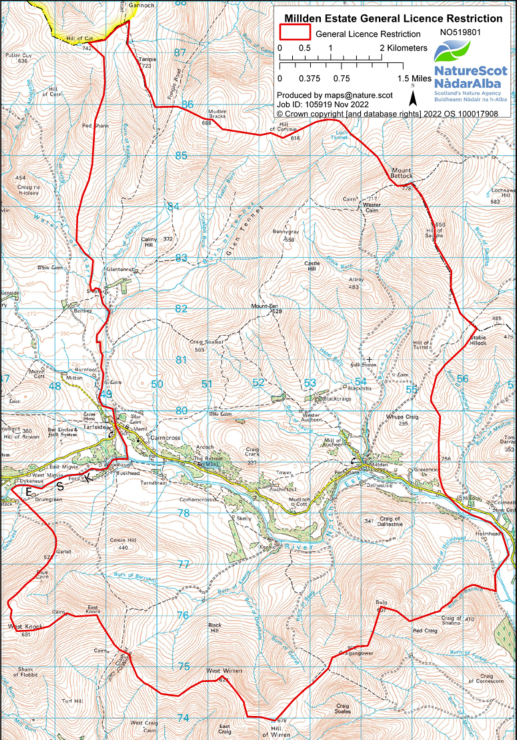
Location of Millden Estate in the Angus Glens. Estate boundaries sourced from Andy Wightman’s Who Owns Scotland website
Millden Estate first came to my attention in July 2009 when a young satellite-tagged golden eagle called Alma was found dead on the moor – she’d ingested the deadly poison Carbofuran (here). It wasn’t clear where she’d been poisoned and the estate denied responsibility.
Then in 2012 there was the case of another satellite-tagged golden eagle, believed to have been caught in a spring trap on Millden Estate before moving, mysteriously, several km north during the night-time only to be found dead in a layby with two broken legs a few days later (here and here). The estate denied responsibility and the Scottish Gamekeepers Association conducted an ‘analysis’ (cough) and deduced it was all just a terrible accident (here).
There have been other incidents – former Tayside Police Wildlife Crime Officer Alan Stewart describes ‘a horrendous catalogue of criminality’ recorded on Millden Estate during his time (see here). However, despite this history, nobody has ever been prosecuted for raptor persecution crimes on Millden Estate.
Today’s announcement from NatureScot that a General Licence restriction has been imposed on Millden Estate is the first sanction I’m aware of at this location. It has been imposed after three shot buzzards were found in bags outside two gamekeeper’s cottages during an SSPCA-led investigation into badger-baiting and other animal-fighting offences in 2019.
That investigation led to the successful conviction in May 2022 of depraved Millden Estate gamekeeper Rhys Davies for his involvement in some sickening animal cruelty crimes (see here). Despite his conviction, Millden Estate denied all knowledge of this employee’s criminal activities (here).
There hasn’t been a prosecution for the shooting (or possession) of those three shot buzzards, nor for the six other shot raptors found in a bag just a short distance from the Millden Estate boundary (here), and nor will there be, according to a statement provided to me by the Crown Office (here).
With this long history of un-attributable wildlife crime on and close to Millden Estate, the imposition of a General Licence restriction is welcome news, although in real terms it’s nothing more than a minor inconvenience to the estate. It doesn’t stop their legal killing of so-called pest species (e.g. crows) because all they have to do is apply for an Individual licence, which NatureScot will have to grant (although it can revoke an Individual licence if more evidence of crime emerges – as happened on Raeshaw Estate in 2017 – see here), and nor does it stop the legal killing of red grouse, pheasants or red-legged partridge by paying guests.
This photograph appeared on social media in 2017 titled ‘Team Millden’ and shows a bunch of blokes dressed in Millden tweed grinning inside the estate’s larder after a day’s grouse shooting.
I’ve written about the monumental ineffectiveness of General Licence restrictions many times (e.g. see here, here, here, here, here) and my view hasn’t changed. The only weight that a General Licence restriction carries is a reputational hit for the estate on which it is imposed, which was the Environment Minister’s aim when GL restrictions were first mooted (here).
This is useful from a campaigner’s perspective because it allows us to demonstrate that raptor persecution continues on Scottish grouse moors, despite the absurd denials of senior industry representatives (e.g. see here).
But it doesn’t stop the estate’s business activities. You might think that others in the industry, or even elected politicians, would shun a restricted estate but that simply doesn’t happen (e.g. see here and here).
And nor is it an effective deterrent – Leadhills Estate, a grouse moor in South Lanarkshire, was slapped with a second General Licence restriction after ‘clear evidence’ of wildlife crime was uncovered whilst the estate was still serving its first restriction notice (see here)!
Given the current number of grouse-shooting estates serving General Licence restrictions after ‘clear evidence’ of wildlife crime was provided by Police Scotland: Leadhills Estate (here), Lochan Estate (here), Leadhills Estate [again] (here), Invercauld Estate (here), Moy Estate (here) and now Millden Estate (here), it’s clear that the Scottish Government’s proposed grouse-shoot licensing scheme can’t come soon enough.
There are strong rumours that the Wildlife Management (Grouse) Bill will be presented to the Scottish Parliament before Easter and many of us are eagerly awaiting its publication to see the details of what is proposed and, importantly, how it will be enforced.
One thing’s for sure, it will need to be a lot more robust than the General Licence restriction and any sanctions, which should hopefully include terminating an estate’s ability to continue gamebird shooting during a determined-sanction period, will need to be deployed a lot quicker than the time it takes for a General Licence restriction to be imposed (it’s taken four years for the GL restriction to be placed on Millden Estate).
UPDATE 10th March 2023: Millden Estate says it will appeal General Licence restriction imposed after evidence of raptor persecution (here)
NATURESCOT HAS RESTRICTED THE USE OF GENERAL LICENCES ON MILLDEN ESTATE, IN THE ANGUS GLENS, FOR THREE YEARS
The decision was made on the basis of evidence provided by Police Scotland of wildlife crime against birds.
This evidence included three shot buzzards found on the estate in 2019, and incidents relating to trapping offences.
Donald Fraser, NatureScot’s Head of Wildlife Management, said: “The discovery of three shot buzzards on Millden estate, two of which were found within a bag at an estate house, as well as trapping offences and ongoing concerns relating to general licence compliance, have resulted in the suspension of the use of general licences on this property for three years until March 2026.
“NatureScot is committed to using all the tools we have available to tackle wildlife crime. This measure will help to protect wild birds in the area, while still allowing necessary land management activities to take place.
“We believe this is a proportionate response to protect wild birds in the area and prevent further wildlife crime. We will continue to work closely with Police Scotland and consider information they provide on cases which may warrant restricting general licences.
“The estate may still apply for individual licences; however, these will be subject to enhanced record-keeping and reporting requirements and will be closely monitored to ensure adherence with licence conditions.”
General licences allow landowners or land managers to carry out control of common species of wild birds, such as crows and magpies, to protect crops or livestock, without the need to apply for an individual licence.
In addition to this restriction, there are currently four other restrictions in place in Scotland: on Moy Estate in Highland, Invercauld Estate in the Cairngorms National Park, Lochan Estate in Perthshire and Leadhills Estate in South Lanarkshire.
ENDS
I’ll be writing more about this later today….
UPDATE 16.20hrs: Millden is yet another grouse-shooting estate to be sanctioned after police find evidence of raptor persecution (here).
UPDATE 10th March 2023: Millden Estate says it will appeal General Licence restriction imposed after evidence of raptor persecution (here)
Last week a new scientific study was published, led by eminent researchers from the University of Cambridge, showing that three years into a five-year pledge to completely phase out lead shot in UK game hunting, 94% of pheasants on sale for human consumption were killed using toxic lead ammunition (see here).
The continued use of this poisonous ammunition has health consequences for wildlife (especially birds of prey), the environment and for humans – see here for further information.
Many thanks to Green Party Life Peer Natalie Bennett who has lodged a parliamentary question for DEFRA to answer, asking what steps the Government plans to take to end the use of toxic lead shot given the gamebird-shooting industry’s continued failure to do it voluntarily.
UPDATE 24th April 2023: DEFRA Minister responds to question on gamebird shooting industry’s failure to stop using toxic lead ammunition (here)
Last month I wrote about how a number of key conservation and animal welfare organisations had apparently been excluded from submitting evidence to the Scottish Government’s independent review on whether the Scottish SPCA should be given increased powers to enable them to investigate a wider suite of wildlife crimes (see here).
A Freedom of Information request had revealed that the non-governmental organisations that had been invited to contribute evidence to the review (Scottish Gamekeepers Association, Scottish Land & Estates, British Association for Shooting & Conservation, and the National Farmers Union Scotland) greatly outweighed the number of conservation/animal welfare organisations invited to participate (limited to the RSPB).
Significantly, a number of important organisations were missing from the list of invited participants, including Scottish Badgers, Scottish Raptor Study Group, OneKind, League Against Cruel Sports, Scottish Wildlife Trust.
It was notable that the pro-gamebird shooting organisations that were invited to participate had all previously been vociferously against giving more powers to the SSPCA (no surprise!) whereas the excluded organisations had all been previously supportive of increased powers.
I wanted to understand whether it was the Scottish Government that had excluded conservation/animal welfare organisations from participating in the review (Scot Gov had previously told me that it had provided a list of ‘key stakeholders’ to the independent Review Chair, Susan Davies FRSB), or whether that decision to exclude them had been made by Susan Davies.
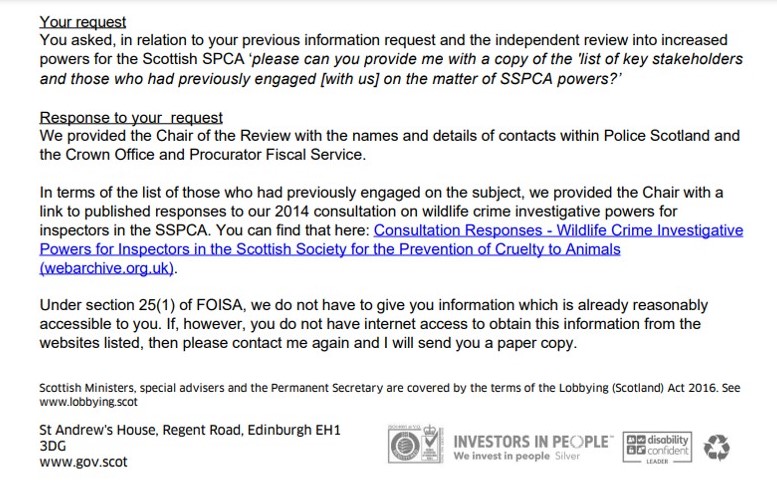
It’s taken the Scottish Government a whole month (!) to respond to my latest FoI with the following:
It appears, then, that the decision to exclude all those conservation and animal welfare organisations from participating in the review was made by the Review Chair, Susan Davies.
This is surprising, given Susan’s long-standing career in nature conservation. However, as I pointed out in an earlier blog, if the independent review DOES recommend increased powers for the SSPCA, then by inviting an overload of anti-SSPCA game shooting organisations, the Review Chair has cleverly covered off any opportunity for them to suggest their views were under-represented in the review process.
Time will tell. We now have to wait for the review to be published, having been submitted to the Scottish Government in October 2022.
Today this blog reaches its 13th year anniversary.
Who would have guessed, thirteen years ago, that I’d still be writing it? I’m sure, in fact I know, there are plenty who wish I wasn’t, but their ongoing attempts to intimidate and harass simply strengthen my resolve to continue with it.
The blog is approaching nine million views:
As ever, huge thanks to those who help fund my time, those who work with me behind the scenes (you know who you are), to those who send me information, to those who take the time to comment here, and especially to those who share blog posts on social media channels – raising awareness of the illegal killing of birds of prey was the main driver behind setting up this blog and it continues to be one of its main objectives.
The National Trust (NT) has terminated another grouse-shooting lease in the Peak District National Park after the RSPB uncovered evidence of suspected wildlife crime on one of the NT’s tenanted grouse moors.
The shooting lease, on NT moorland at Park Hall, was held by a nearby grouse shooting estate called the Hurst & Chunal. It is understood that the NT lease on Park Hall was a short-term, one-year lease, initially.
However, in February 2021 the RSPB filmed an unidentified individual at dusk on Park Hall, placing rodenticide blocks (Brodifacoum) inside holes on the moorland that were suspected to be part of a badger sett. This was reported to Derbyshire police who launched an investigation, along with Natural England and the Health & Safety Executive. The RSPB has published a detailed blog about this case – see here.
The police investigation failed to result in a prosecution. Enquiries were made by Derbyshire Police’s Rural Crime Team after the search, including interviews of suspects. After a review, the police informed the RSPB that they could not bring criminal charges in this case.
The Natural England/HSE investigation is believed to be ongoing.
Meanwhile, the National Trust has taken the decision to terminate the grouse-shooting lease and will not be renewing it or offering it to another tenant; instead the moor will be now be re-wilded.
National Trust-owned moor at Park Hall. Photo: RPUK
This isn’t the first time the NT has terminated a grouse-shooting lease in the Peak District National Park.
You may recall, back in April 2016, I published a video of an armed man crouching next to a decoy hen harrier on Ashop Moor, which, incidentally, is also part of the NT’s Park Hall & Hope Woodlands Estate in the Peak District National Park.
That video footage, filmed by two local birdwatchers, sparked outrage and significant public pressure was placed on the National Trust to take action against its shooting tenant (believed to be Mark Osborne).
In June 2018, the National Trust announced a significant change in how it was going to select new shooting tenants, ‘to work with us to create a new exemplar model delivering outstanding moorland nature conservation with grouse shooting’ (see here). Many saw this as welcome progress from the NT but others saw it as a ‘lost opportunity’ to remove driven grouse shooting altogether from NT land.
Since the NT modified its tenancy agreements in 2018, at least one new tenant has been and gone, and at least one current tenant is hosting a number of successfully breeding raptor species whilst moderately managing a driven grouse shoot (far less grouse shot in 2021 compared to the thousands shot on some of the more intensively-managed moors).
It was rumoured last year that the NT had agreed to introduce even more modifications to its moorland tenancies, such as burning restrictions, the removal of medicated grit, and the removal of traps and snares, although I haven’t yet seen a formal statement on this from the National Trust.
I think the National Trust’s decision to terminate the grouse shooting lease at Park Hall, AND its refusal to offer the lease to anyone else, deserves much applause. Full credit too, to the RSPB’s Investigations team for providing the evidence needed by the NT to take such decisive action.







 Raptor Persecution UK