Response to grouse shooting Bill from REVIVE, the coalition for grouse moor reform

Further to this morning’s news (here) that the Scottish Government has introduced its long-promised grouse shooting bill, formally known as the Wildlife Management & Muirburn (Scotland) Bill, REVIVE, the coalition for grouse moor reform has published the following press statement in response:

REVIVE coalition urges Parliament to be bold on new wildlife Bill

Scottish Government’s draft Wildlife Management and Muirburn (Scotland) Bill marks biggest intervention in land management for generations

The Scottish Government has today published its draft Wildlife Management and Muirburn (Scotland) Bill. The Bill has been introduced to protect the environment and tackle the persecution of birds of prey. It is expected to significantly change the way in which large areas of Scotland are managed, making it one of the biggest interventions in this area for generations.

Campaign Manager for REVIVE, Max Wiszniewski said: “The proposed Bill is a major intervention in land management that regulates destructive practices through licensing, instead of stopping them.

Intensively managed grouse moors are unnatural monocultures that are burned and stripped of competing wildlife so more grouse can be shot for sport. By creating a circle of destruction around huge areas of our land, biodiversity and more diverse economic opportunities are missed for Scottish people and communities.

With a new First Minister on the horizon, as the Bill progresses through Parliament, we hope it will be even bolder and braver to meet the expectations of the Scottish people.”

The Bill follows a review into grouse moor management led by Professor Werritty, the findings of which were published in December 2019. A year later the Scottish Government committed to introduce measures which will hold land managers far more accountable for their activities.

The Bill proposes to strictly regulate the use of muirburn, the controlled burning of vegetation, on peatland as well as ending raptor persecution. It also includes measures to ensure grouse moors are managed sustainably, to ban the use of glue traps for rodents and tighten regulations for the use of other types of wildlife traps.

Robbie Marlsand, Director of the League Against Cruel Sports Scotland, a REVIVE coalition partner added: “When it comes to grouse shooting, this Bill appears well intentioned but kicks a couple of contentious cans down the road. Snares are primitive, cruel and indiscriminate. This Bill should remove them from the Scottish countryside – with no ifs and no buts.

The impact of this Bill on killing grouse for sport will also depend much on the content of a yet to be written code of conduct that shooting estates must comply with. Only when that is finalised will we be able to appreciate the potential impact of this legislation. For example, hundreds of thousands of animals are killed each year so that there can be more grouse to shoot for fun and it’s not yet known if this Bill will change that.

Killing any animal for entertainment is repugnant to the majority of people in Scotland. We therefore welcome any incremental steps that will make it more difficult to do.”

ENDS

Breaking news….Scottish Government introduces grouse shoot licencing bill

BREAKING NEWS…..

This morning the Scottish Government has introduced its long-promised grouse shooting bill, formally known as the Wildlife Management & Muirburn (Scotland) Bill.

This draft legislation is a direct result of the game-shooting industry’s failure to stop illegally killing birds of prey on many Scottish grouse moors. That was the trigger, and there are also now other aspects to the Bill that are an attempt to tackle other poorly-regulated aspects of unsustainable grouse moor management.

The Bill contains provisions to:

  • Ban the use and purchase of glue traps and introduce licensing and training requirements for certain other types of wildlife traps;
  • Introduce a licensing regime for land used for the shooting of red grouse;
  • License all muirburn; and
  • Introduce enabling powers to allow the Scottish Ministers to extend the role of inspectors appointed under the Animal Health and Welfare (Scotland) Act 2006 to investigate certain wildlife offences.

As it has only just been published, I haven’t had time to read it properly or analyse its contents. I’ll comment further in due course.

Scottish Government has provided this overview:

Now the Bill has finally been introduced, this is how it will progress through Parliament over the coming months. There will be plenty of opportunity for comment on, and amendments to, this Bill.

Here are the all important documents:

The Bill, as introduced:

Scottish Government’s Explanatory Notes:

Scottish Government’s Policy Memorandum (i.e. explaining why the Bill has been created):

Even more parliamentary questions about raptor persecution & more predictable paper shuffling from DEFRA

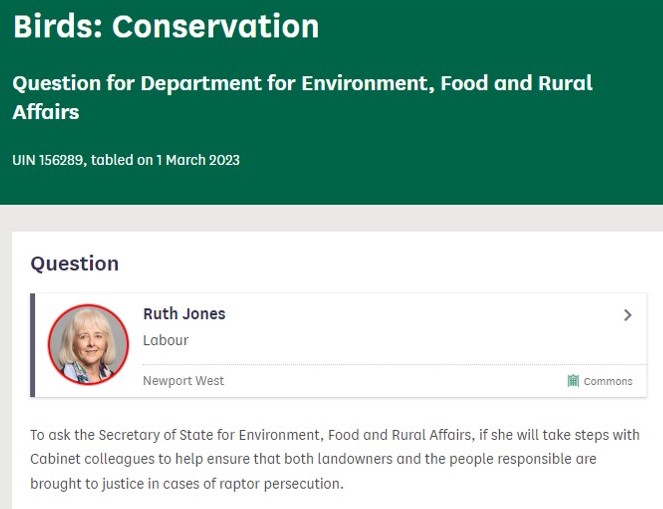
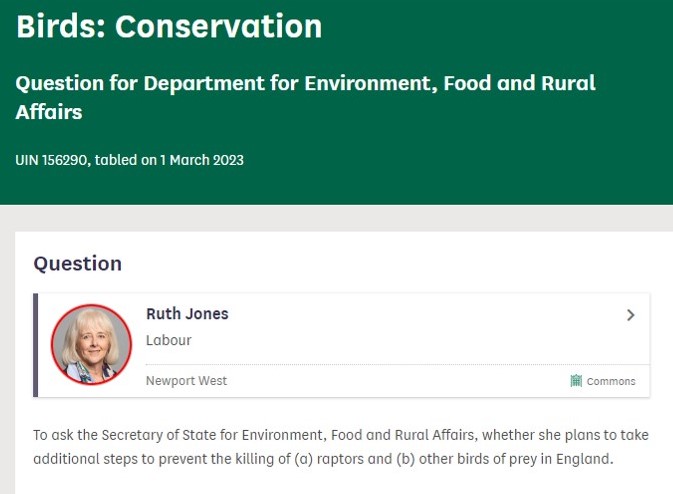
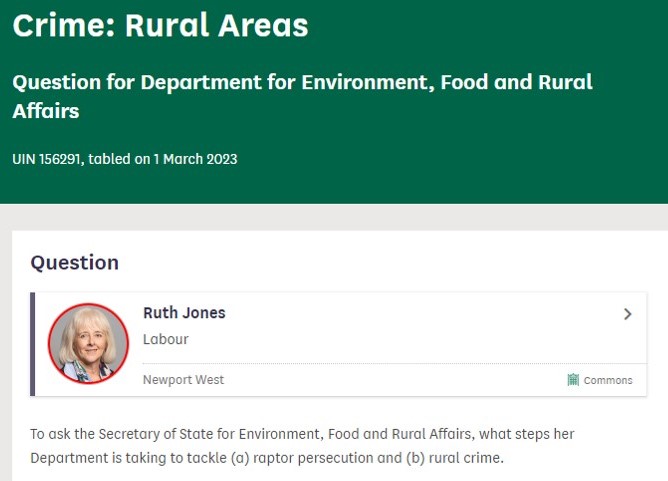
Here are some more parliamentary questions relating to the Westminster Government’s failure to effectively tackle raptor persecution, this time submitted by Ruth Jones MP (Labour, Shadow Minister at DEFRA).

The following four questions were lodged on 1st March 2023:

There’s a fair bit of overlap with these four questions but I’m not going to criticise Ruth Jones for tabling them in this format. On the contrary, I’m delighted to see a Shadow Minister making an effort on this subject and applying pressure on DEFRA.

Is it significant that there’s been a recent flurry of parliamentary questions about raptor persecution? I like to think so.

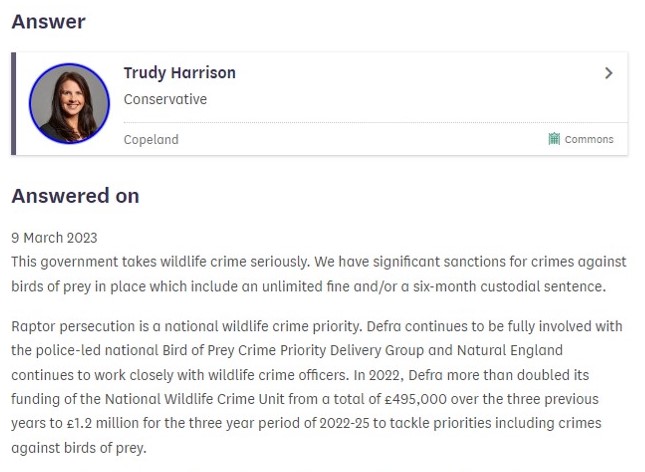
Ruth Jones’s written questions were answered on 9th March 2023 by Trudy Harrison, the Parliamentary Under Secretary of State in DEFRA, as follows:

This response is predictably lame and amounts to nothing more than paper-shuffling by DEFRA. In fact, I reckon DEFRA has a folder where stock phrases are kept and hauled out each and every time there’s a question about why the Westminster Government is failing so badly when it comes to tackling raptor persecution.

Many of the sentences in Trudy Harrison’s response are pretty much carbon-copies of those given by Environment Minister Rebecca Pow in September 2021 (here), those given by DEFRA Minister Richard Benyon in February 2022 (here), those given by Rebecca Pow in February 2022 (here), those given by Richard Benyon in April 2022 (here), and those given by Trudy Harrison earlier this month (here).

Once more, for the record:

Harrison/DEFRA says:This government takes wildlife crime seriously“.

Does it? The evidence suggests not.

Harrison/DEFRA says:We have significant sanctions for crimes against birds of prey in place which include an unlimited fine and/or a six-month custodial sentence“.

Indeed, these sanctions are in place but there has only ever been one custodial sentence handed down to a raptor-killer – and that was in Scotland in 2015 when gamekeeper George Mutch was given a four-month custodial sentence for crimes he committed in 2012 (here). There haven’t been any others since then, and a custodial sentence has never been handed down in England, Wales or Northern Ireland for raptor persecution crime.

Harrison/DEFRA says:Raptor persecution is a national wildlife crime priority“.

On paper, yes. In reality, no. Raptor persecution was identified as a national wildlife crime priority in 2009. That’s 14 years ago, and hundreds of birds of prey have been illegally killed in the UK since then.

Harrison/DEFRA says:Defra continues to be fully involved with the police-led national Bird of Prey Crime Priority Delivery Group“.

This so-called Priority Delivery Group has been in place since 2011 and has delivered absolutely nothing of meaningful effect since then, largely due to the fact it is dominated by pro-shooting organisations who have a stranglehold on any progress that could have /should have been made. In my view, it’s a partnership sham, designed to look as though efforts are being made to effectively tackle illegal raptor persecution in England and Wales (see here).

Harrison/DEFRA says:Natural England continues to work closely with wildlife crime officers“.

Yes, and in recent years NE has been involved with a number of multi-agency raids. Good. However, NE also ‘partners’ with the grouse-shooting industry, facilitating DEFRA’s ludicrous hen harrier brood meddling scheme, designed to placate the very industry responsible for this species’ persecution and subsequent catastrophic decline.

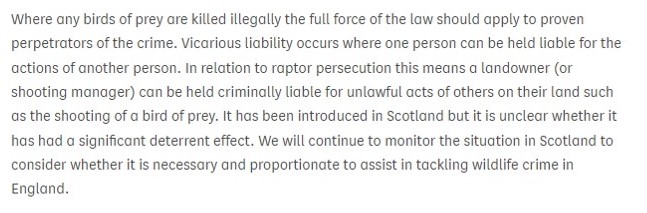
Harrison/DEFRA says: “[Vicarious liability] has been introduced in Scotland but it is unclear whether it has had a significant deterrent effect. We will continue to monitor the situation in Scotland to consider whether it is necessary and proportionate to assist in tackling wildlife crime in England“.

Vicarious liability has been in place in Scotland for 11 years. The recent UN report on UK wildlife crime made a recommendation that vicarious liability be introduced without delay in England and Wales. What does DEFRA have to lose by introducing it south of the Border?

Parliamentary question: what steps is DEFRA taking to fully investigate raptor persecution crimes during avian flu pandemic?

Another timely written question from Caroline Lucas MP (Green Party), as follows:

The presence of avian flu has important consequences for how the corpse of a dead raptor is handled and stored, under strict government rules, and unfortunately this impacts on the ability to conduct standard toxicology analyses for other potential causes of death, notably the detection of certain poisons.

You may recall this was an issue with the investigation into the suspicious death of a white-tailed eagle found dead on the Isle of Wight in March 2022 (here).

The police investigation into the circumstances and cause of death of that white-tailed eagle was hampered because a preliminary test indicated the eagle was harbouring avian flu (although this was ruled out as the cause of death during a later post mortem). However, as avian flu was detected, protocol dictated that the eagle’s tissue samples be stored in formalin, which then restricted the lab’s ability to detect poisons such as Bendiocarb or the significance of rodenticides in its body. As a result, the cause of death of this white-tailed eagle was unsatisfactorily recorded as ‘uncertain’ (see here).

Caroline’s written question was answered last Friday by Trudy Harrison, the Parliamentary Under Secretary of State in DEFRA, as follows:

This is another fluffy response from the DEFRA Minister, that looks substantive on the surface but when you drill down into it, it doesn’t say very much at all, other than the Government is ‘alive to the enforcement challenges’. It doesn’t tell us how those challenges are to be met, or even whether it will be possible to overcome them.

This is of serious concern, especially relating to raptors whose diets leave them more susceptible to contracting avian flu, for example white-tailed eagles . I’m aware that another young white-tailed eagle was found dead in Hampshire last autumn. It’s death was deemed ‘suspicious’ based on its movements and behaviour prior to death but it, too, tested positive for avian flu and as a result APHA refused to even conduct a post mortem to determine the cause of death, which may have been due to avian flu, or, like the dead white-tailed eagle found on the Isle of Wight last spring, it may just have been carrying avian flu but it wasn’t the cause of its death.

Parliamentary question: What is DEFRA’s timeline for enacting stronger regulation to address raptor persecution?

There have been a number of written Parliamentary questions in recent weeks relating to wildlife crime, and particularly to addressing raptor persecution.

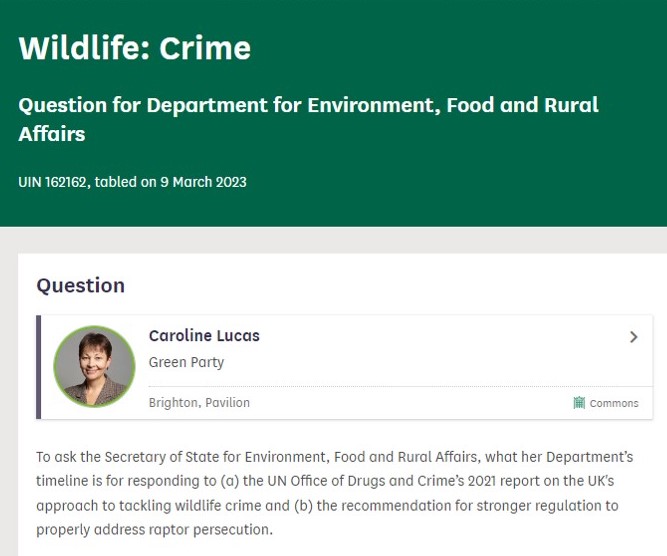
Here’s the first one, submitted by Caroline Lucas MP (Green Party):

The report to which Caroline is referring is the UN Office of Drugs and Crime’s Wildlife and Forest Crime Analytical Toolkit Report: United Kingdom of Great Britain and Northern Ireland (2021), which is basically a comprehensive review of the prevalence of wildlife crime in the UK and an assessment of judicial responses. The report provides a series of recommendations that the UK and devolved Governments could implement to better address the issues.

The summary recommendation for addressing raptor persecution is as follows:

To bolster the legislative framework required to properly address raptor persecution, the WCA and licensing regime across the entire UK should be synthesised and aligned. As it currently stands, the discrepancy in sentencing, vicarious liability, disqualification powers, and more (for example, operationalisation of the pesticide provisions in the WCA), presents a confusing picture to law enforcement and the public. Though raptor persecution has been set as a priority for the UK, the differences in the statutory and licensing regimes present many obstacles to ensuring raptors receive the same level of protection across the entire UK‘.

You can download the report here:

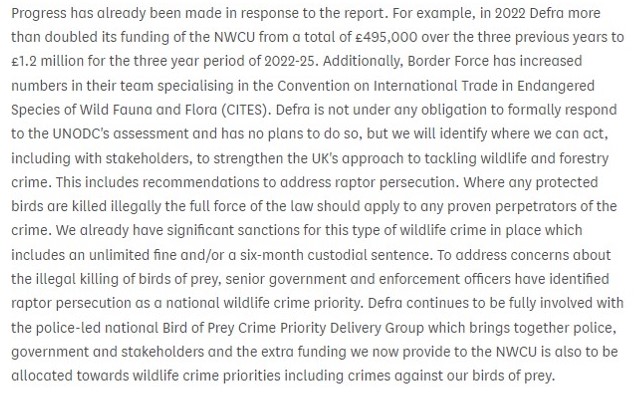
Caroline’s written question was answered last Friday by Trudy Harrison, the Parliamentary Under Secretary of State in DEFRA, as follows:

As we’ve come to expect from DEFRA, this is little more than airy waffle.

Harrison says:Where any protected raptors are killed illegally the full force of the law should apply to any proven perpetrators of the crime“.

Yes, it should, but it routinely isn’t.

Harrison says:We already have significant sanctions for this type of wildlife crime in place which includes an unlimited fine and/or a six-month custodial sentence“.

Indeed, these sanctions are in place but there has only ever been one custodial sentence handed down to a raptor-killer – and that was in Scotland in 2015 when gamekeeper George Mutch was given a four-month custodial sentence for crimes he committed in 2012 (here). There haven’t been any others since then, and a custodial sentence has never been handed down in England, Wales or Northern Ireland for raptor persecution crime.

Harrison says:To address concerns about the illegal killing of birds of prey, senior government and enforcement officers have identified raptor persecution as a national wildlife crime priority“.

Raptor persecution was identified as a national wildlife crime priority in 2009. That’s 14 years ago, and hundreds of birds of prey have been illegally killed in the UK since then.

Harrison says:Defra continues to be fully involved with the police-led national Bird of Prey Crime Priority Delivery Group which brings together police, government and stakeholders“.  

This so-called Priority Delivery Group has been in place since 2011 and has delivered absolutely nothing of meaningful effect since then, largely due to the fact it is dominated by pro-shooting organisations who have a stranglehold on any progress that could have /should have been made. In my view, it’s a partnership sham, designed to look as though efforts are being made to effectively tackle illegal raptor persecution in England and Wales (see here).

Harrison says:The extra funding we now provide to the NWCU is also to be allocated towards wildlife crime priorities including crimes against our birds of prey“.

The additional funding for the NWCU is really the only meaningful effort that DEFRA has made in over a decade, but it’s for the seven national wildlife crime priorities, not just for raptor persecution. The NWCU has played a valuable role in raptor persecution investigations in recent years, often partnering with others on multi-agency raids, and whilst that has been a significant and welcome move, the bottom line is that the NWCU can’t force any police authority to investigate raptor persecution, as we saw so clearly with the botched investigation by Dorset Police into the poisoned white-tailed eagle. NWCU officers were just as frustrated as the rest of us but they can only offer advice and training to Police forces; they can’t compel them to run a decent investigation, no matter how much they would want to.

Hen harrier goes ‘missing’ from a Peak District grouse moor – police confirm his satellite tag had been deliberately cut off

Press release from RSPB (16th March 2023)

MISSING HEN HARRIER HAD SATELLITE TAG CUT OFF

*Anu, a satellite tagged Hen Harrier, vanished after roosting near Upper Midhope in the Peak District National Park – on land managed for driven grouse shooting.

*RSPB Investigations Officers located the bird’s tag three days later and police forensics found it had been deliberately cut off the bird. Investigators fear the bird was illegally killed and his tag removed to hide the evidence.

*Anu joins a long list of birds of prey which have suspiciously disappeared or been killed in relation to land managed for driven grouse shooting. Licensing of grouse shooting as a meaningful deterrent to wildlife crime is needed in England, replicating current proposals in Scotland.

Anu being satellite-tagged before fledging in Bowland in 2021. Photo: RSPB

Yet another mysterious disappearance involving a rare Hen Harrier has been identified by the RSPB and South Yorkshire Police.

Anu, a young male, tagged in Bowland in 2021, was one of several young Hen Harriers fitted with a satellite tag by the RSPB: a small, unobtrusive device which enables scientists to monitor the movements of individual birds and gain greater understanding of this rare and criminally persecuted species.

Anu’s tag indicated that he was roosting on a grouse moor near Upper Midhope on 10 February 2022. However, the tag data showed unusual movement from the bird after 10.25pm that night, when Anu would normally have been stationary.

The tag’s next signal on 11 February was more surprising still, indicating the bird was dead. After an intensive search, the tag was found, some 9km away to the east, on 14 February at Wharncliffe Chase. But suspiciously there was no sign of the body.

This was reported to South Yorkshire Police and forensic analysis confirmed the tag harness had been cut by a human rather than bitten or pulled off. The RSPB suspects that Anu was killed, and the body and tag separated to remove evidence from the crime scene, with the tag then dumped. Anu’s body remains missing, and further enquiries have been unsuccessful.

Tom Grose, RSPB Investigations Officer, said: “To find Anu’s tag detached from his body, having been deliberately cut off, categorically shows human involvement. It is highly suspicious that he roosted on a grouse moor the night before, was unexpectedly active in the hours of darkness and hasn’t been seen since.

We suspect that Anu was killed that night, his tag cut off and then the body dumped away from the grouse moor by someone trying to cover their tracks. The deliberate killing of a wild bird is illegal, yet sadly criminal persecution has been identified is the main reason driving Hen Harrier declines.”

A 2019 study of satellite-tagged Hen Harriers by Natural England revealed that 72% of 58 satellite-tagged Hen Harriers were either confirmed or considered very likely to have been illegally killed. Furthermore, it found that Hen Harriers were ten times more likely to vanish mysteriously or die on a grouse moor than anywhere else.

Tom added: “When only a small percentage of Hen Harriers in the UK are tagged, you can’t help wonder what is happening to the other non-tagged birds. This is a species in trouble, and the UK population remains far below what it should be. As the nature crisis tightens its grip, illegal persecution of raptors must be stopped and that will only happen through the licensing of driven grouse moors – as is happening in Scotland – to bring accountability to this form of land management.

The RSPB would like to thank South Yorkshire Police and the National Wildlife Crime Unit (NWCU) for their work on this case.

If you have any information about this incident, or know of anyone killing birds of prey, please call South Yorkshire Police on 101. The RSPB also has a dedicated confidential Raptor Hotline: 0300 999 0101. This is for information relating to crimes involving birds of prey only.

ENDS

The news of this latest ‘missing’ hen harrier coincides with the publication of some (more) propaganda from Natural England yesterday about how they’re planning to extend their dodgy hen harrier brood meddling trial. I’ll comment on that over the weekend, because that coincides with a recent FoI response I received about NE’s plans for brood meddling, but I won’t have time to write it before the weekend.

Meanwhile, I’ll just update the VERY long list of hen harriers that have been confirmed illegally killed or that have ‘disappeared’ in suspicious circumstances, mostly on or close to grouse moors, since the start of NE’s hen harrier brood meddling trial in 2018. We’re up to 77 and counting… I don’t see Natural England promoting those awkward but damning data.

Anu was already on the list of 77 – his suspicious disappearance was reported in February 2022 (here).

Fascinating new details emerge about investigation into raptor persecution on Shaftesbury Estate in Dorset

Earlier this year, criminal gamekeeper Paul Allen was sentenced for multiple wildlife, poisons and firearms offences committed on the Shaftesbury Estate in Dorset in 2021 (see here).

He first came to the attention of the police after a member of the public discovered a dead red kite on the estate in November 2020. Tests revealed it contained the poison Bendiocarb and this triggered a multi-agency raid in March 2021 led by Dorset Police’s (now former) wildlife crime officer Claire Dinsdale.

The poisoned red kite found on the Shaftesbury Estate by Dorset resident Johanna Dollerson

Officers found the corpses of six dead buzzards by a pen behind the gamekeeper’s house (tests later showed they had all been shot, including one that was was estimated to have been shot in the last 24hrs). Officers also found the remains (bones) of at least three more buzzards on a bonfire.

A loaded shotgun was found propped up behind a kitchen door (!) and 55 rounds of ammunition were found in a shed. Both the gun and the ammunition should have been inside a locked, specifically-designed gun cabinet, by law. The gun and the ammunition were not covered by Allen’s firearms certificate.

Officers also found a number of dangerous, and banned, chemicals, including two bottles of Strychnine, two containers of Cymag and a packet of Ficam W (Bendiocarb) in various locations, including in a vehicle used by Allen.

Some of you may also recall that Allen was initially charged with killing the red kite, but court records showed that this charge, along with two others, was subsequently dropped minutes before the hearing (see here), probably as some kind of bargaining agreement between the lawyers.

Allen was sentenced in February 2023 and escaped a custodial sentence due to his personal circumstances (see here).

If you recall, the Shaftesbury Estate was also where a young satellite-tagged poisoned white-tailed eagle was found dead, a year later, in January 2022. Tests revealed the eagle’s liver contained seven times the lethal dose of the rodenticide Brodifacoum but Dorset Police refused to conduct a search of the estate, despite already running an investigation into gamekeeper Paul Allen’s crimes on the same estate(!), and they still haven’t provided a credible explanation for that appalling decision (see here).

Now new details have emerged about what was found during the investigation into gamekeeper Allen, thanks to Guy Shorrock, a member of the PAW Forensics Working Group and a former Senior Investigator at RSPB. Guy has written a guest blog for Wild Justice to demonstrate how the Raptor Forensics Fund, initiated by Wild Justice in 2020, has been used to help bring a number of criminal gamekeepers to court.

In that guest blog, Guy discusses the forensic testing undertaken on a ‘cut open’ dead rat that had been found next to the red kite’s corpse. Tests revealed it, too, contained the poison Bendiocarb – in other words, it had been placed as a poisoned bait. Forensic testing also confirmed that the kite had consumed part of a brown rat. You don’t have to be Poirot to piece it all together but even though Allen’s vehicle contained multiple pots of Bendiocarb, this still isn’t sufficient evidence to demonstrate without reasonable doubt that he was responsible for placing the poisoned bait that killed that red kite. This is a very good example of just how high the criminal burden of proof is and why so many prosecutions against gamekeepers have failed.

What has also been revealed is that in addition to being poisoned by Bendiocarb, that red kite also contained NINE times the lethal level of the rodenticide Brodifacoum in its system!! Sound familiar? The dead white-tailed eagle, found on the same estate a year later, contained seven times the lethal dose. To me, this makes Dorset Police’s decision not to search the Shaftesbury Estate even more non-sensical than previously thought.

Wild Justice has asked its legal team to examine Dorset Police’s botched handling of the poisoned white-tailed eagle case and expects to have more news on that in due course.

Meanwhile, I’d really encourage you to read Guy’s guest blog on Wild Justice’s website (here), published this morning, for a fascinating insight into the pain-staking forensic work that goes in to prosecuting those who continue to kill raptors.

The Raptor Forensics Fund, initiated by Wild Justice and supported by donations from the Northern England Raptor Forum, Tayside & Fife Raptor Study Group, Devon Birds, and a number of generous individuals who wish to remain anonymous, is now running low (because it’s been used so often!). Wild Justice intends to top up the fund shortly. If you’d like to donate to Wild Justice’s work, please click here. Thank you.

Prominent falconer cleared of welfare allegations relating to ten eagles but faces charges for another 90 eagles

Last year I wrote about a prominent falconer, Andrew Knowles-Brown, who was facing multiple charges relating to the alleged mistreatment of approximately 90 raptors at his Scottish Eagle Centre in Lanarkshire following an investigation led by the Scottish SPCA (see here).

Knowles-Brown denied all the charges.

For reasons that are unclear to me, these charges were split into two separate trials: one trial for the alleged mistreatment of ten White-bellied sea eagles which had recently been imported from a zoo in Brunei; and a second trial relating to alleged welfare offences for approximately 90 eagles held at the Scottish Eagle Centre.

In February this year, Knowles-Brown was cleared of all charges in the first trial relating to the ten imported White-bellied eagles, according to a (paywalled) report in The Times written by David Meikle.

The court heard that international avian veterinary expert Neil Forbes had said the ten eagles were in “totally inappropriate” accommodation and he’d expressed concerns about ventilation, cleaning and veterinary care. However, a vet who was over-seeing the quarantine process had not raised any concerns about the welfare of the eagles or the conditions in which they were being kept.

Knowles-Brown denied failing to provide the birds with appropriate vet care, keeping them in overcrowded enclosures and using a power washer in the enclosure. The second charge, which he also denied, alleged he failed to provide the ten eagles with enough space to fly, drinking water and failed to monitor them while in quarantine between July and September 2019.

At Lanark Sheriff Court in February 2023 Sheriff Adrian Cottam said the evidence did not prove the facilities or conditions for the birds were inappropriate and cleared him of all allegations.

Mairi-Clare McMillan, the depute fiscal, said: “What is clear is that these ten birds were in a quarantine facility which all of the Crown experts indicate was too small for them and that the birds would not have been able to exhibit their natural behaviours and would have suffered physical and mental stress.”

Mark Moir KC, defending, said: “Andrew Knowles-Brown did not behave in the way alleged and did not cause any suffering which is alleged.”

The second trial, relating to alleged welfare offences for approx 90 other eagles, is due to be heard on 29th March 2023.

As the second case is still live, comments won’t be accepted on this blog until all proceedings have concluded. Thanks for your understanding.

UPDATE 16th June 2023: Second trial underway for falconer charged with welfare offences relating to 90 eagles (here)

UPDATE 22 January 2024: Trial continues in Scotland for falconer charged with welfare offences relating to 90 eagles (here)

UPDATE 15 October 2024: Prominent falconer & eagle breeder Andrew Knowles-Brown guilty of welfare offences relating to approx 90 eagles in Scotland (here)

UPDATE 15 October 2025: Prominent falconer Andrew Knowles-Brown fined almost £14,000 for ‘shocking’ animal cruelty (here)

Job vacancy: RSPB Investigations Intelligence Manager

The RSPB is recruiting for a new Intelligence Manager for its Investigations Team.

Here’s a copy of the job advert:

Reference:FEB20230961
Expiry date:23:59, Sun, 2nd Apr 2023
Location:Flexible in UK
Salary:£36,577.00 – £39,267.00 Per Annum
Benefits:Pension, Life Assurance, 26 days Annual Leave

Are you passionate about managing intelligence data to highlight and tackle the illegal killing of birds of prey? Could you oversee the stringent handling of crime reports, disseminating appropriate critical intelligence to investigations staff and police – enabling them to catch offenders and make a real difference? Do you see both critical detail and the bigger picture, safely managing an intelligence team within a leading conservation organisation playing a significant partnership role in ending crimes against birds of prey. If so, our mission is urgent, and we need you now!

Day to day you will be managing a team of three Intelligence Officers, who receive and process hundreds of bird crime reports each year, overseeing the compilation of key information for our annual Birdcrime report, and disseminating time critical crime reports to both RSPB Investigation Officers and external partners including the Police and the National Wildlife Crime Unit.

You will be responsible for data and intelligence stewardship, governance, quality and reputational risk management for highly restricted data, as well as ensuring intelligence is managed in line with statutory and best practice requirements.

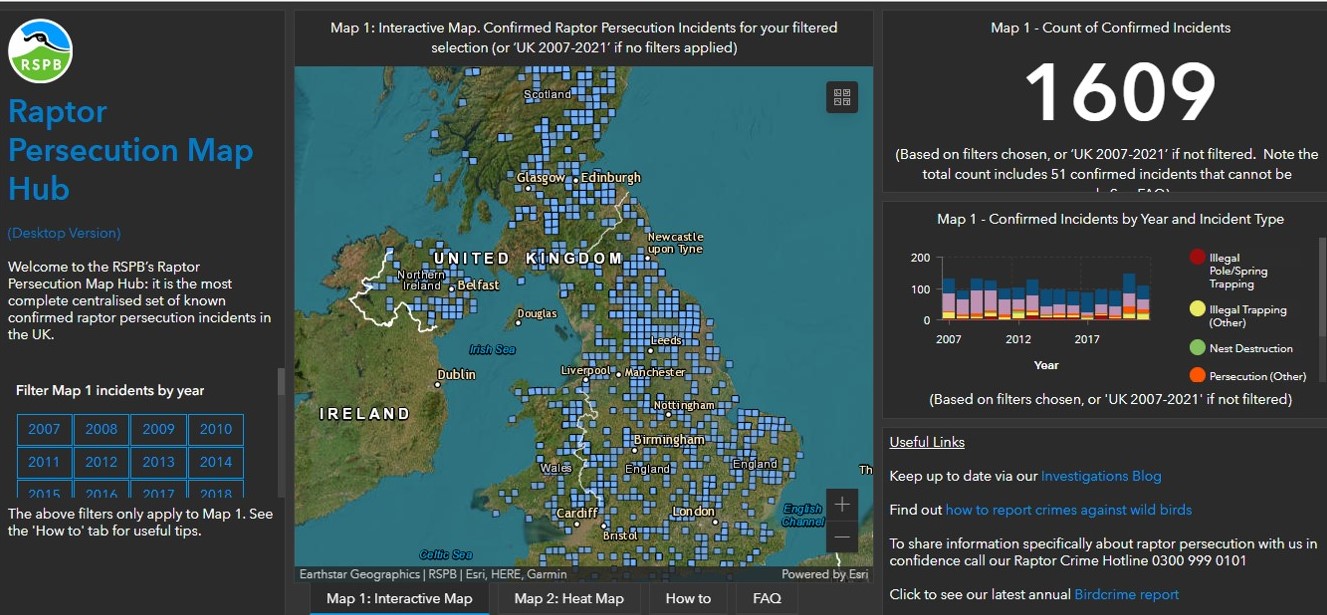
Curated incident data are used on the RSPB’s Raptor Persecution Map Hub to allow users to examine confirmed raptor persecution crimes across the UK

Essential skills, knowledge and experience:

  • High level of technical and practical knowledge of data and/or intelligence management and best practice.
  • Proven knowledge of legislation relevant to information management including Data Protection Act and Human Rights Act.
  • Practical knowledge of wildlife protection legislation.
  • Knowledge of specialist software enabling its successful deployment in support of key result areas above.
  • Proven high levels of IT literacy and numeracy.
  • Proven excellent written and verbal communication skills to achieve key result areas.
  • Proven ability to prioritise competing and high volume demands effectively and to provide a high level of customer care.
  • Proven ability to train others (non-specialists) and run workshops in specialist subjects including data/intelligence management and analysis.
  • Proven ability to solve problems and develop systems, information and data-related policies and to lead compliance across a large organisation.
  • Proven ability to persuade and influence key partners, and manage and develop relationships at high levels.
  • Experience of leading teams and developing/delivering bespoke training courses.
  • Capable and confident in designing and delivering internal and external presentations.
  • Experience of handling, analysis and presentation of specialist data.
  • GCSE or equivalent in English and Maths.

Desirable qualifications, knowledge, skills and experience

  • Knowledge of Police standards for Intelligence Management.
  • Information systems-related qualification or experience of information systems security.
  • Experience of working with statutory agencies or in the law enforcement arena.
  • First degree in biology, ecology or conservation, or equivalent relevant experience
  • Experience of communicating with witnesses of criminal activities and conducting risk assessments to ensure their position is not compromised.
  • Experience of preparing material for and working with media organisations on difficult or controversial issues

Additional information:

  • This role will require occasional travel within the UK.
  • This role will require occasional overnight stays away from home.
  • Police vetting (NPPV3) and Security Clearance will be required for this role.
  • The RSPB works for a healthy environment for all and we therefore expect you to take action in accordance with our Environmental Policy and objectives. Together we can make a positive difference for our world.
  • In the RSPB, volunteers are a major resource and make a vital contribution to the RSPB’s aim to take action for the conservation of wild birds and the environment. Employees are responsible for encouraging, developing and supporting volunteers in their work for the RSPB.

This is a Permanent, Full-Time role. We are looking to conduct interviews for this position from 12th April 2023. For further information please contact mark.thomas@rspb.org.uk 

As part of this application process you will be asked to provide a copy of your CV and complete an application form including evidence on how you meet the skills, knowledge, and experience listed above.

This role will require completion of a DBS/PVG/Access NI in addition to the standard pre-employment checks.

ENDS

The online job advert can be read here.

Millden Estate says it will appeal General Licence restriction imposed after evidence of raptor persecution

Earlier this week, NatureScot announced it had imposed a three-year General Licence restriction on Millden Estate in the Angus Glens, after three shot buzzards were found in bags outside gamekeepers’ cottages on the estate in 2019 (see here and here).

In an article subsequently published by The Courier this week (here), an unnamed spokesperson for Millden Estate said they would appeal the decision.

Quotes from Millden Estate cited in The Courier article include:

The estate does not condone or tolerate any illegal activity relating to the welfare of animals or wildlife“,

and

We are extremely disappointed by this decision and intend to appeal

and

The estate does not condone or tolerate any illegal activity relating to the welfare of animals or wildlife and it has robust and comprehensive systems in place to ensure compliance with the law.

We were shocked at the time to learn of all allegations of wildlife crime against an employee of the estate. He was subject to an extensive investigation by the police and the crown and dealt with.

The employee involved was suspended by the estate with immediate effect and resigned a few days later when the police investigation was still at an early stage.

At no stage was the estate itself the focus of the investigation. We consider that the estate is being unfairly penalised for events not within its control and for which it bore no responsibility.”

The last three sentences from the estate are mostly what I would describe as being a red herring because they relate to the conviction of Millden Estate gamekeeper Rhys Davies for badger-baiting and other sadistic animal welfare offences, which took place at locations away from Millden Estate (although he kept his mutilated and scarred fighting dogs kennelled at Millden; injuries that the Crown Office described as ‘obvious injuries’ but which apparently went unnoticed by Davies’ gamekeeper colleagues and bosses for months).

Two of gamekeeper Rhys Davies’ obviously mutilated dogs, tethered to what appears to be a work vehicle. Photo: SSPCA

Oh, and the estate WAS the focus of the investigation into gamekeeper Rhys Davies as the search warrant included a provision to search various sites on Millden Estate looking for evidence of badger sett disturbance (I’m not aware that any was found there). And Davies’ tied cottage and associated outbuildings on the estate were also searched, under warrant, where a number of serious firearms offences were uncovered, specifically, an unsecured Benelli shotgun was found propped up against a wall near the front door; two unsecured rifles were also found: a Tikka .243 rifle on the sofa and a CZ rifle in the hall cupboard next to the open gun cabinet;  and an assortment of unsecured ammunition was found including 23 bullets in a pot on the floor, five in a carrier bag behind the front door and one on top of a bed, according to a statement by the Crown Office.

So why do I think the latest remarks from Millden Estate to the journalist from The Courier are a red herring? Well, simply because the General Licence restriction hasn’t been imposed on Millden Estate for Davies’ depraved offences – it has absolutely nothing to do with him or his crimes. The General Licence restriction has been imposed after the discovery of three shot buzzards shoved inside bags outside two gamekeepers’ houses (found during the SSPCA/Police raid at Millden when they were investigating Davies) as well as ‘incidents relating to trapping offences’, for which Davies, nor anybody else, has been prosecuted.

Tellingly, the Millden Estate spokesperson fails to mention any of this detail, but instead focuses on how Davies has been ‘dealt with’ [convicted] and is no longer employed at Millden. Irrelevant, mate.

Of course, Millden Estate is entitled to appeal NatureScot’s decision to impose a General Licence restriction, as laid out in the framework for restrictions on NatureScot’s website (here). Although to be honest it’s all a bit absurd as the estate has already had one opportunity to appeal, when NatureScot first notified Millden of its intention to restrict the General Licence. Now it gets another bite of the cherry.

But so be it. Other estates with a restriction have also previously appealed, and all have failed. For example, Raeshaw Estate lost a judicial review in 2017 here; Leadhills Estate lost an appeal in 2019 here (and this is really worth reading- it’s hilariously inept); and Leadhills Estate lost another appeal in 2021 after a second GL restriction was imposed here; Lochan Estate in Strathbraan lost its appeal in 2022 here; Invercauld Estate lost its appeal in 2022 here; and Moy Estate also lost its appeal in 2022 here).

Millden Estate must lodge its appeal in writing within 14 days of receiving its General Licence restriction notice from NatureScot. That will trigger a suspension of the restriction notice (ridiculous, I know!) until such time as NatureScot has undertaken the appeal process, which it tries to complete within four weeks.