Job vacancies x2: Osprey Project Assistant, Birds of Poole Harbour

The charity Birds of Poole Harbour is recruiting for two (paid!) Osprey Project Assistants.

Summary:

An exceptional opportunity for a keen conservationist to get experience on a landmark Osprey translocation project in Poole Harbour. The role will include husbandry and monitoring of translocated chicks pre and post release.

Background:

Birds of Poole Harbour was founded in 2013 with three key objectives in place; to educate and promote bird conservation, preservation and observation in and around the Poole Harbour area.

Ospreys, which feed exclusively on fish, historically bred across the whole of Britain and NW Europe; but populations drastically declined in the Middle Ages and became extinct in England by the mid 1800’s. The five-year project looks to restore Ospreys to their former breeding grounds in the south of England where they used to have the local nickname “Mullet Hawk”. At the same time the project will provide an important stepping stone between breeding populations in Britain and northern France, with the aim of enhancing the long-term survival of the Western European population as a whole. The project is part of a wider conservation recovery plan of Osprey in Western Europe and the Mediterranean region and is being led by Birds of Poole Harbour, Scottish charity ‘The Roy Dennis Wildlife Foundation’ and local Poole based-business ‘Wildlife Windows’.

Translocation has proved a highly successful means by which to restore ospreys to areas from which they have been lost. The much-admired population at Rutland Water in the East Midlands was established by a pioneering translocation project in the late 1990s and similar work has since taken place in two regions of Spain as well as in Italy, Portugal and Switzerland.

This pan-European experience means that the Poole Harbour project, which will involve licensed collection of five/six-week old chicks from healthy, sustainable populations in Scotland, has the best-possible chance of success. Once collected the chicks will be safely brought down to Poole Harbour and held in large holding pens at a confidential site for just two – three weeks to acclimatize to their new home and prepare for their first flights. Once released they will continue to be provided with fresh fish on artificial nests, to replicate normal osprey behaviour, and so are likely to remain around Poole Harbour for a further five-six weeks (the normal post-fledging period) before beginning their long migration to West Africa. During this period the birds will imprint on the area and adopt Poole as their new home.

We are now in the third year of the project and seeking to recruit committed, responsible and diligent individuals to assist in the husbandry and monitoring of the birds during their time here in Poole Harbour.

Duration: 3 months, 1st July –30th Sept 2019

Working Hours: Full-time (40 hours per week) including weekend, early morning and evening hours.

Pay: Pro-rata £17, 000

Reports to: Osprey Project Officer and Head of Science and Operations.

Closing Date: 28th February

Interviews are expected to be held the week beginning 11th March.

Duties:

The Osprey Project Assistants are expected to assist with:

  • Preparation of Osprey food – cutting fish
  • Feeding of Osprey chicks
  • Monitoring chicks via CCTV
  • Monitoring of fledged chicks using detection of radio transmitter signals and optical equipment
  • Collection of data on food consumption, chick development, behaviour and location
  • Data entry as per data collected above
  • Equipment, site and resources maintenance – cleaning food preparation area, re-stocking supplies
  • Supervision of volunteers

Person Specification

Full training will be provided for this role including food preparation, feeding, behavioural monitoring via CCTV and telemetry (yagi) and data recording.

Attribute Importance
Friendly and outgoing personality Essential
Attention to detail Essential
Dedicated and proactive attitude Essential
Ability to work as a team Essential
Physically fit Essential
Accurate data entry Essential
Volunteer management Desirable
Full clean driving licence and access to own vehicle Essential
Knowledge of animal husbandry or ecology, especially avian Desirable


If you think you could excel in this role, then please email Jobs@birdsofpooleharbour.co.uk with a CV and cover letter explaining why you think you’re suitable.

Shooting Times fakes conflict between Chris Packham & Royal family

Here’s the second distorted news item from this week’s Shooting Times (we blogged about the first one here and we’ll be blogging about the third, and most perhaps most disingenuous one next).

The editor’s stated emphasis on “communicating the truth and demanding high standards” seems to have fallen upon deaf ears again.

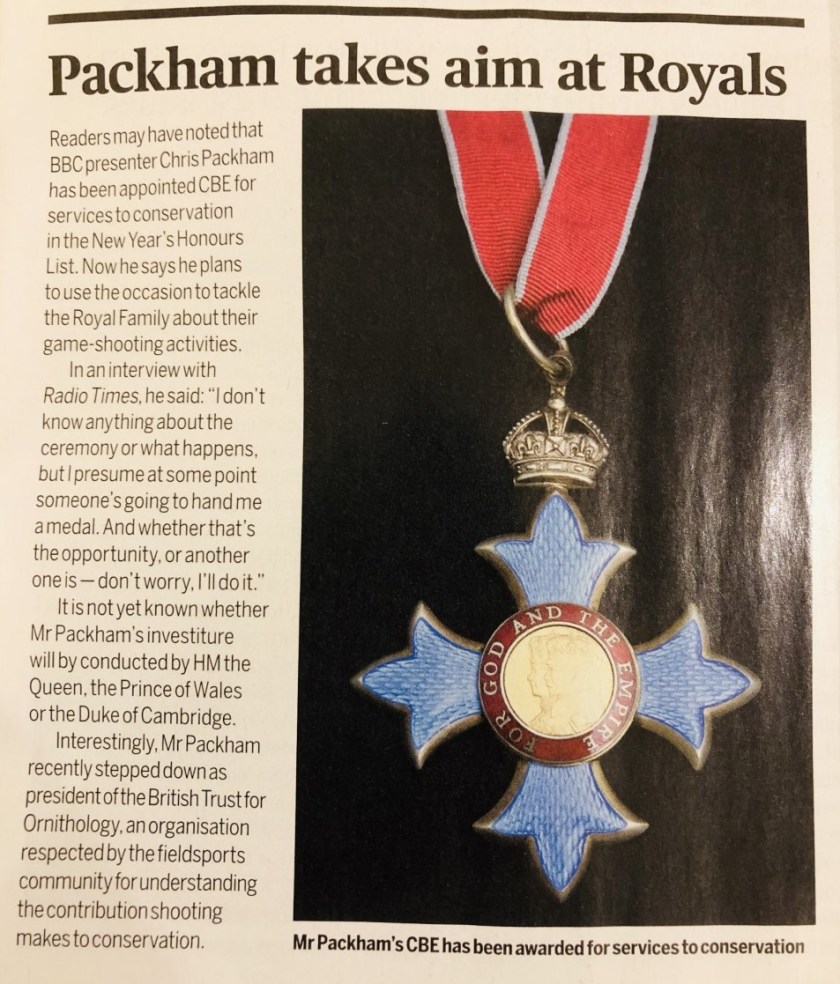
Here’s the article:

This time the unidentified author has come late to the party on Chris Packham’s CBE and his impending visit to the Palace but has regurgitated the crap published by The Telegraph on 22 January where it was suggested that Chris was going to “interrogate” the royals about grouse shooting. We debunked the Telegraph’s fake news at the time (here) but Shooting Times has published a similarly contorted piece, not quite as contrived as the Telegraph’s article but still with an inappropriately distorted headline.

Chris has not ‘taken aim’ at the royals – on the contrary, if you read his interview with the Radio Times he praises the bravery of the two princes for speaking out about mental health and says he intends to use his CBE “to open more doors and have more conversations“, emulating their courage by speaking out about issues that are important to him.

How’s that ‘taking aim’ at the royals?

Shoddy, Shooting Times, very shoddy. And not dissimilar to the alleged ‘dirty tricks’ and smear campaigns levelled against Chris by others from within the game shooting sector.

Secretary for Werritty Review confirms prelim results will not be presented at GWCT conference

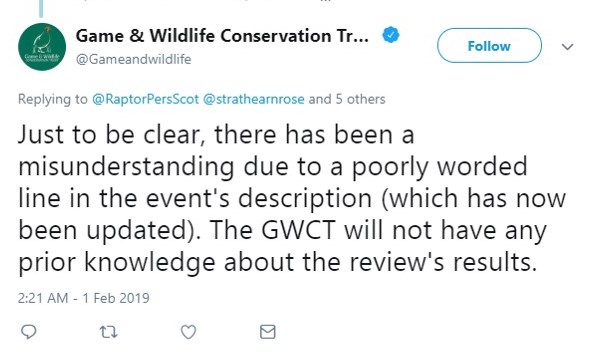
Further to last night’s blog about the GWCT’s claim that the preliminary results of the Werritty grouse moor review will be presented at a GWCT conference in March (see here), we’ve received confirmation from the Werritty Review secretary, Karen Rentoul, that GWCT does not have any prior insight to the recommendations of the group.

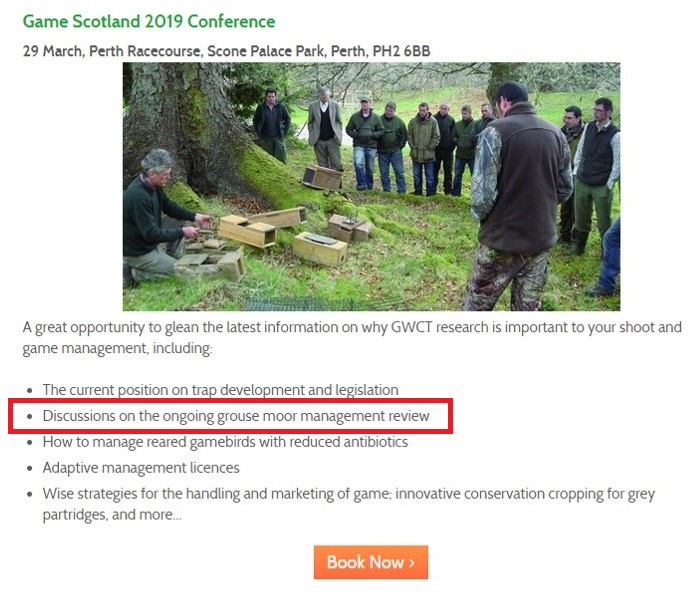
GWCT has since amended the information on its website.

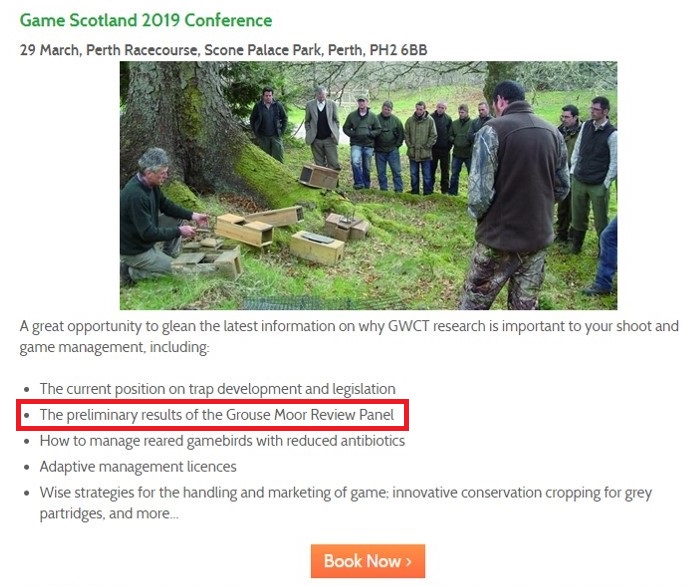
Here’s what it said this morning:

And here’s what it says now:

GWCT also tweeted this explanation:


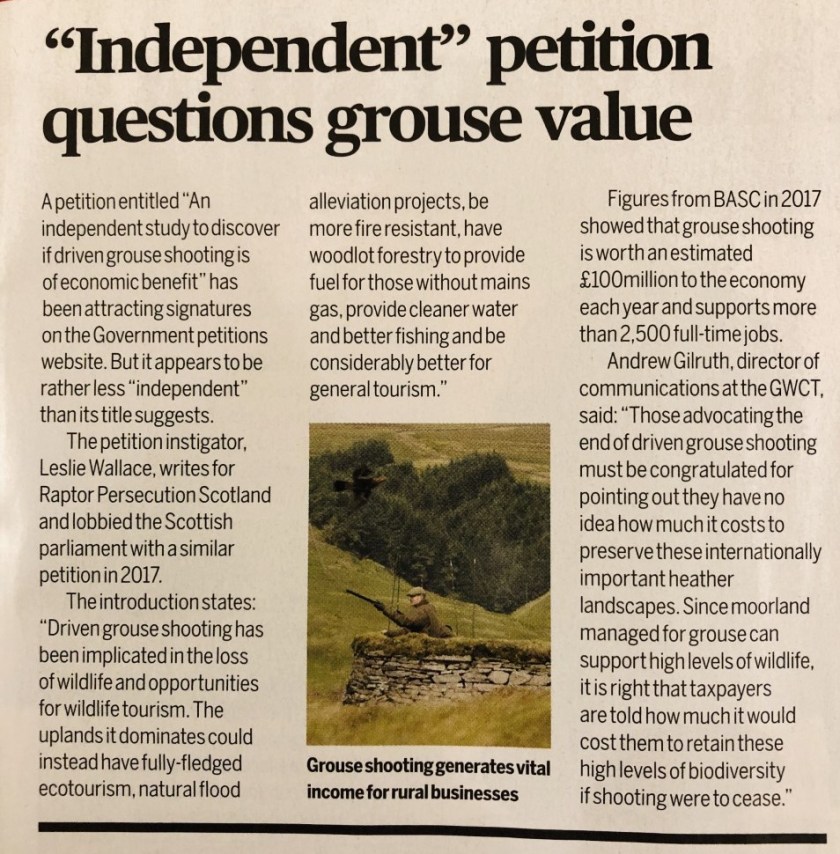
Bizarre news item in Shooting Times re: Les Wallace’s grouse petition

Shooting Times is always good for a laugh but the latest edition (30 Jan 2019) is particularly entertaining.

It starts with Patrick Galbraith’s editorial where he discusses the “few rogues” (ahem) causing problems for the shooting industry and emphasises the importance of ‘communicating the truth and demanding high standards’.

Sadly, three of the six news articles that follow Patrick’s editorial can only be described as distorting the truth and meeting low standards.

We’re going to blog about each of those three news items separately, starting with this one:

The author of this news item is not identified but whoever wrote it seems to be a little bit confused.

The author argues that the petition isn’t “independent”. Eh? The petitoner (Les) isn’t claiming to be independent, but is calling for an independent study on grouse shooting economics. It’s not difficult to understand, is it?

The author then claims that Les “writes for Raptor Persecution Scotland”. Hmm. Two things here – the blog hasn’t been called ‘Raptor Persecution Scotland’ for, ooh, about five years (?) now, do keep up Shooting Times, and although several authors write this blog, Les isn’t one of them, unless you count his recent guest blog (written about his petition). The Shooting Times article implies Les writes regularly for the blog, which is a distortion of the truth. The clue is in the word ‘guest’ blog.

The author then discusses an estimate of the value of grouse shooting, using a figure from BASC. Er, BASC cannot possibly be defined as being independent, which kind of reinforces the importance of Les’s call for an independent study!

The article ends with a quote from Andrew Gilruth, who can always be relied upon for a bit of snidey spin, but he does appear to be supportive of Les’s petition. Funny, we didn’t see GWCT pushing its members to sign the petition in the six months since it was launched.

All in all, a confused distorted mess from Shooting Times.

By the way, Les’s petition ends tomorrow. He has already secured the 10,000 signatures required to trigger a response from DEFRA (which will be interesting) but if you want to support it, here’s your last chance. Please click HERE

Prelim results of Prof Werritty’s grouse moor review to be revealed at GWCT conference?!

In May 2017 Scottish Environment Cabinet Secretary Roseanna Cunningham initiated a review of grouse moor management following continued evidence of widespread illegal raptor persecution associated with this type of land use (here).

Six months later the members of the review group were announced by the Scottish Government (here) and the review process became known to many of us as the Werritty Review, named after the group’s Chair, Professor Alan Werritty.

Throughout 2018 the Werritty Review group met with a series of individuals and organisations and provided regular reports on progress (here). These reports were welcome although the content was only summarised and no real detail has emerged.

That’s fair enough – we’ll find out the detail in due course, once all the formalities have ended. We’ve been told that the Werritty Review Group’s report will be submitted to Roseanna Cunningham this spring, although in the group’s terms of reference published on the Scottish Government website (here) it states the final report will be submitted “before the end of June 2019“. Hmm, let’s hope we don’t have to wait that long.

But hang on a minute, according to the GWCT, if you’re willing to pay £30 to attend its ‘Game Scotland 2019’ conference in March you’ll get to hear all about the Werritty Review group’s preliminary results before anyone else, assuming that the ‘Grouse Moor Review Panel’ described below is the same as the Werritty Review. What other ‘Grouse Moor Review Panel’ is there?

This can’t be right, surely?

Who will be presenting those “preliminary results” to conference attendees? Will it be a member of the Werritty Review Panel? Perhaps Professor Werritty himself?

Will these preliminary results be revealed before the final report has been submitted to the Scottish Government?

How can the results of a Scottish Government-funded review, paid for with public funds and of huge national interest, be given to the GWCT before being released to the public?

We’ll be asking the Scottish Government if this is true and if so, for an explanation…..stay tuned.

UPDATE 1 Feb 2019: Secretary for Werritty Review confirms prelim results will not be presented at GWCT conference (here)

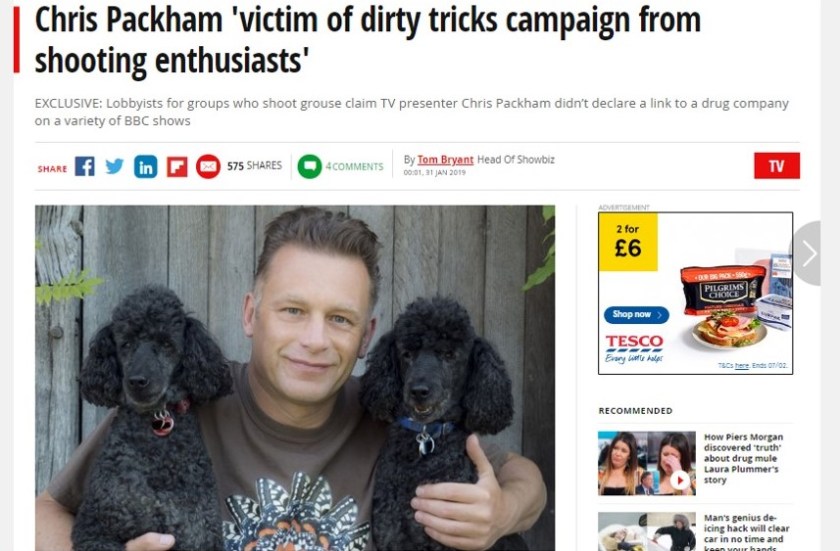
Chris Packham ‘victim of dirty tricks campaign by grouse shooting lobby’

The Countryside Alliance, with others, has long been trying to silence Chris Packham by either calling for him to be sacked from the BBC or “reined in”, e.g. here and here, by claiming that Chris “abuses his position” as a BBC presenter to “promote an extreme agenda”.

It’s amusing then, to see the BBC calling out this campaign in an article in today’s Mirror:

The article is reproduced here in case it disappears:

Shooting enthusiasts have been accused of staging a “dirty tricks” campaign to get Chris Packham sacked from the BBC.

They accused the Winterwatch star of breaking BBC rules by plugging a dog tick treatment he has links to.

Wildlife-lover Packham, 57, is an outspoken critic of grouse shooting.

Abzed, a company which lobbies for grouse-shooting, claimed Packham was employed by a PR firm representing MSD Animal Health to help sales of its insecticide Bravecto.

It alleged he did not declare that interest while appearing on BBC shows in 2015 to speak about the “Big Tick Project”, a campaign which raises awareness of ticks on dogs.

Abzed put forward Tim Bonner, chief executive of the Countryside Alliance.

Bonner, whose organisation is also pro fox-hunting, claimed: “Buying Mr Packham is the way companies buy BBC coverage. This is not public service broadcasting, it is the BBC for sale.”

But a TV source hit back, saying: “At no time did Chris ever mention the name of the drug, only to say there were treatments available.

“The fact events a number of years ago are being pored over to find some sort of smoking gun is just dirty tricks.”

The BBC also insisted: “This is a spurious claim given there’s no evidence of Chris promoting this product in his role as a BBC presenter.”

Packham has claimed killing of wildlife on driven grouse moors “is a relentless, year-round slaughter”.

Opponents of shooting say it is directly contributing to a rapid fall in the number of hen harriers, which prey on grouse.

Countryside groups and the Government say grouse shooting is a legitimate activity which boosts the rural economy.

London-based Abzed is run by Ian Gregory, who last night insisted he did not call for Packham to be sacked.

But he said: “The drug company’s PR firm… boasted about how successful his involvement was in getting a huge amount of coverage across the BBC for its sales campaign.

“It then bragged about how successful that campaign was at boosting sales. So Chris Packham was chosen by the drug company because the BBC has made him famous and he used that fame to promote the drug’s sales campaign on the BBC. These are facts not dirty tricks.”

ENDS

Here’s that BBC quote again:

The fact events a number of years ago are being pored over to find some sort of smoking gun is just dirty tricks“.

Well done to that BBC source! It follows an earlier statement from the BBC in 2016 following complaints received from BASC, Countryside Alliance, Moorland Association and the National Gamekeepers’ Organisation about Chris publishing a non-BBC video about driven grouse shooting and, quite reasonably, using his personal twitter account to promote it. The BBC responded to the complaints as follows:

Chris Packham is a naturalist in his own right and is not solely employed by the BBC. If Chris Packham wishes to express his personal views outside of his employment on BBC natural history programmes, he is entitled to do so”.

Interestingly, BASC, Countryside Alliance, Moorland Association and the National Gamekeepers’ Organisation have been in the news recently after disrupting a national meeting designed to tackle illegal raptor persecution, by refusing to attend because, again quite reasonably, new organisations had been invited to participate. We await to see whether they’ll manage to climb back in to their prams before the next meeting in April.

The PR firm Abzed, mentioned in the Mirror’s article above, funded by the grouse-shooting lobby and headed by the ecologically illiterate Ian Gregory, has also been in the news recently with what appears to be yet another smear campaign against the RSPB’s efforts to protect hen harriers, helped again by Andrew Gilruth of the GWCT who appears to be regurgitating some nonsense that dribbled from his mouth in 2017.

Chris has also been in the news recently, after being appointed CBE for services to nature conservation.

It looks like honesty and integrity are winning out over alleged dirty tricks and smear campaigns.

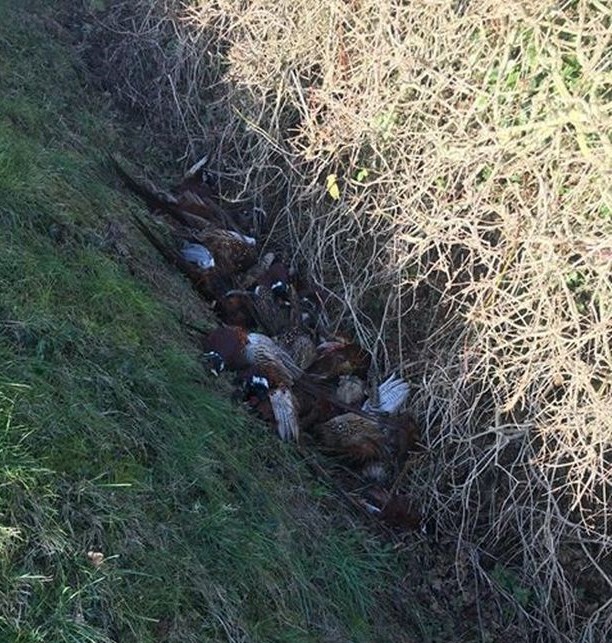
Dead pheasants dumped in Lincolnshire, presumed shot

Another week and another photograph of a pile of dumped pheasants, this time in Lincolnshire and less than two weeks after video footage of a JCB dumping hundreds of shot pheasants in to hole in Leicestershire caused national outrage after being published by The Times.

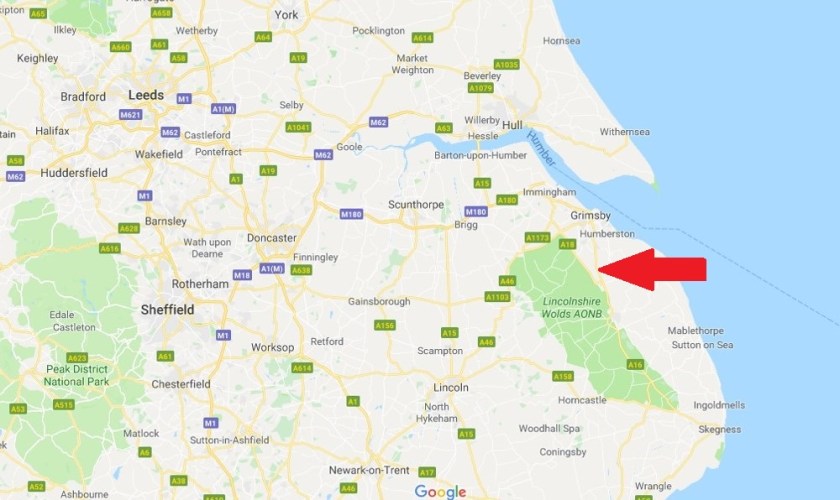
The latest photograph was taken by dog walker Alan Fox who found two piles of pheasants dumped by the A16, between Brigsley and Waithe, Lincolnshire:

Mr Fox told Lincolnshire Live that he’d found the birds at around 12.30pm on Monday 29 January and said he believed there were between 50-100 pheasants, all piled on top of each other.

He said: “The dog smelled something and I saw some pheasants on the floor, then another group about 10 metres further down. I would think that someone has had a shoot somewhere and these birds are surplus to what they can sell or eat“.

Regular blog readers will know that shooting and then dumping gamebirds is being reported quite often – e.g. see herehereherehereherehereherehere, here and undoubtedly it’s driven by an over supply of birds and little demand by consumers for purchasing game bird meat.

This is hardly a surprise when you consider that an estimated 50 million non-native gamebirds (pheasants & red-legged partridge) are released in to our countryside EVERY YEAR, to provide live targets for people with guns. This is barely regulated – they can release as many of these alien species as they like and kill as many of them as they like, as long as they’re killed within the shooting season. The Code of Good Shooting Practice says “shoot managers must ensure they have appropriate arrangements in place for the sale or consumption of the anticipated bag in advance of all shoot days“ but this, evidently, is not happening.

And of course sitting alongside these unregulated releases is legal and illegal predator control – the mass slaughter of native wildlife, including raptors, done to protect the gamekeepers’ ‘livestock’. And for what? Just so the shot game can be chucked under a hedge by a roadside?

Shooting industry representatives are doing their best to proclaim effective self-regulation and as recently as November 2018 BASC claimed that “the values and standards of the UK shooting community…is driven by strong ethics and respect for quarry“.

Yep, it really looks that way.

More on the SGA’s “completely false” claim that hen harrier Saorsa has been re-sighted

Last Friday we blogged about how the Scottish Gamekeepers Association (SGA) had published a statement claiming that a satellite-tagged hen harrier (‘Saorsa’) had been “re-sighted in Perthshire” after the RSPB reported it as having disappeared in suspicious circumstances from the Angus Glens last year.

RSPB Scotland issued a statement in response which said the SGA’s claim was “completely false” (here).

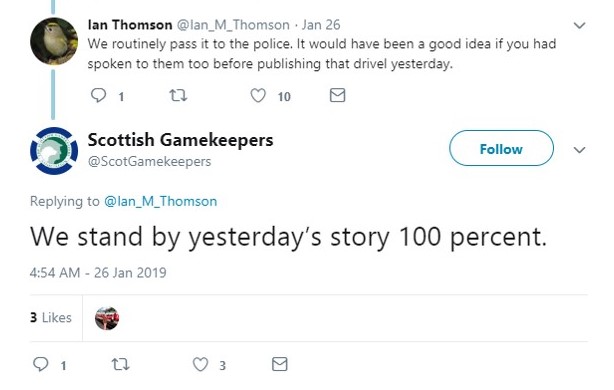
Despite being told “there isn’t a shred of evidence to support the claim that it [Saorsa] has reappeared“, the following day the SGA was still promoting its fake news on Twitter:
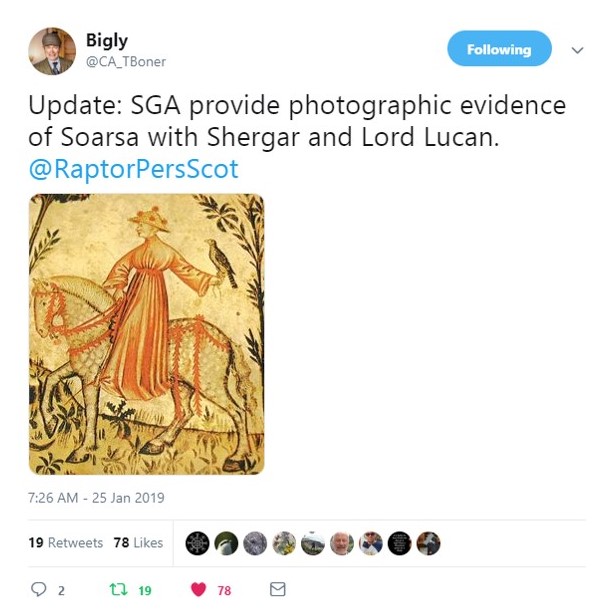
Other Twitter users offered equally conclusive evidence that Saorsa was alive and well, along with Shergar:

It’s also worth revisiting the SGA’s statement made when Saorsa was first reported missing last year, especially an extraordinary claim made by Bert Burnett of the SGA, who suggested that the RSPB had peverted the course of justice by finding Saorsa’s body and ‘secreting it away because it had died of natural causes’ (here).

On last Friday’s blog we said we’d return to the SGA’s latest press release about Saorsa to discuss some of the other inaccurate claims made about the satellite-tagging process. Many of the myths have been dealt with before, on this blog and elsewhere, and yet still the SGA churns out this guff, either too stupid to grasp the basics or deliberately trying to discredit the technology that’s revealing so much about the widespread extent of illegal raptor persecution.

So, here’s the SGA’s original press release (Friday 25 January 2019) and our commentary in italics:

GAMEKEEPERS SEEK ACCOUNTABILITY OVER SATELLITE TAGGED RAPTORS

Scotland’s gamekeepers are calling for accountability regarding satellite tags fitted to wildlife.

The call comes after The Scottish Gamekeepers Association learned that a tagged Hen Harrier, reported as disappearing ‘suspiciously’ in Angus last May, was re-sighted in Perthshire afterwards, according to investigators.

[RPUK: Nope, she hasn’t been “re-sighted” since she vanished in the notorious Angus Glens in Feb 2018].

Anti-grouse moor campaigners who owned the tag’s data publicly blamed the grouse industry, urging Scottish Government to license the sector.

[RPUK: Nope, the RSPB are not “anti-grouse moor campaigners”, they are simply calling for the regulation of grouse moor management. And nope, when Saorsa disappeared the RSPB did not “publicly blame the grouse industry” – the SGA has fabricated this claim – you can read the RSPB’s press statement about Saorsa’s disappearance in Feb 2018 here and you won’t find a single word of accusation against anyone or any industry].

However, no media statements were issued to correct the accusations, leaving local estate employees living with the burden of criminal suspicion.

[RPUK: No media statements were issued (by the RSPB) because, er, Saorsa is still missing from the Angus Glens. And again, to repeat ourselves, the RSPB did not make a single accusation against any industry, estate or estate employee when reporting Saorsa’s disappearance].

The SGA has also learned of a sea eagle currently flying around Grampian with a tag dangling from its body, potentially endangering its welfare.

[RPUK: Are we seriously expected to believe that the SGA is concerned over a sea eagle’s welfare?!! Isn’t this the group that has repeatedly lobbied for licences to enable the legal killing of this and other raptor species in Scotland? Ah yes, here. And isn’t this the group that’s lobbied the Scottish Government in abject hysteria about sea eagles potentially eating babies? Ah yes, here and here. And hasn’t this species been relentlessly persecuted on Scottish grouse moors, notably the victim of illegal poisoning (e.g. here), as well as having its nest tree illegally felled on an Angus grouse moor? Ah yes, here].

The female sea eagle, pegged with yellow wing markings and the letter ‘E’, has been spotted by concerned land managers.

In recent times, four golden eagles have also been independently photographed in the Angus glens with displaced tags; one clearly hanging from a bird’s neck.

Another eagle was observed in Perthshire last week with the bird’s feathers completely obscuring the tag; something manufacturers acknowledge will distort readings.

[RPUK: If a tag’s solar panel has been covered by a feather the tag won’t charge and the steady decline in battery voltage will be revealed in the tag’s engineering data. This means the tag operator can correctly identify battery drainage as the cause of the loss of data rather than the sudden and unexpected loss of data that is caused when someone kills the eagle and destroys the tag and hides the evidence of the crime].

Gamekeepers believe tags are now being deployed by campaigners as political weapons, aware there is no independent scrutiny.

[RPUK: Gamekeepers believe many things, such as white-tailed eagles being a threat to babies and toddlers, but it doesn’t mean there’s any truth in that belief. The SGA needs to read up on the strict regulations governing the deployment of satellite tags in the UK, which includes researchers quite rightly having to provide a proposal to the licensing authority that includes the detailed scientific justification for fitting a tag. Anybody seeking permission to fit tags as “a political weapon” will be laughed out of the door by the, er, independent scientific committee that scrutinises every single application].

Whilst the SGA is not advocating a ban, they believe Scottish Government must act to make fitting and monitoring of the devices accountable.

[RPUK: See above response]

An FOI to Scottish Natural Heritage by SGA revealed that the heritage body currently holds no information from satellite tags in Scotland, despite hundreds being operational.

Similarly, tag reliability cannot be independently verified as there is no duty for tag owners to disclose information regarding malfunction.

[RPUK: Incorrect. There is actually a duty for tag operators to report on tag status. In addition, concientious researchers are publishing data on tag malfunctions to enable tag manufacturers to constantly update and overcome any technical glitches in tag design. In addition, in the interest of transparency details of golden eagle tag malfunction were made publicly available in the Scottish Government-commissioned review in 2017. The number of tags known to have malfunctioned were insignifcant in relation to the number of tags that suddenly stopped and then vanished in suspicious circumstances, the vast majority of those occurring on driven grouse moors].

“At the moment, satellite tags are like the wild west,” said SGA Chairman Alex Hogg. “Anyone with funding can buy one, have it fitted to a protected bird, and retain its data. They can then release interpretations to the media, if the tag stops. We saw this with the choreographed ‘Fred the Eagle’ case near Edinburgh, which remains unexplained despite a concerted attempt to finger a grouse moor.

[RPUK: Incorrect. See above response on the rigorous licensing regulations for tag deployment in the UK. As for golden eagle Fred, we reported that he disappeared in suspicious circumstances right next to a grouse moor, in an area where other raptor persecution crimes had been discovered, just like all the other sat-tagged golden eagles that have disappeared in almost identical circumstances. We did not, at any time, accuse the grouse moor owner or his employees of any involvement. The SGA didn’t like the reports, which incidentally were all published with police approval, because Chris Packham’s involvement in the reports created a media storm. Too bad, the SGA had better get used to that – watch this space].

“Although tag fitters are approved, we have seen basic ‘granny knots’ used to fit tags and we have just heard of two tagged Harriers in Perthshire being killed by foxes within three days, with only one tag and body recovered. A tagged adult Harrier lost on National Trust ground this year was never found, neither was its tag, and a predated youngster was only discovered by chance. These are stories the public never hear and it is a shame they have to come out behind a veil of secrecy.

[RPUK: Could Alex Hogg explain how the SGA has been close enough to a sat-tagged raptor to identify a supposed ‘granny knot’? (The skilled fieldworkers who fit sat tags have had a long laugh about the depth of ignorance revealed by that claim, by the way). And as for Hogg’s claim that the public ‘never hear’ of tagged raptors dying from natural causes (it’s hardly news, Alex), perhaps he should pay more attention to RSPB blogs – here’s one from just a few weeks ago which, again in the interest of transparency, details, er, the natural deaths of several tagged hen harriers, but again these natural losses are heavily outnumbered by those that have vanished in suspicious circumstances on driven grouse moors].

“Despite claims these devices are almost infallible, failure rates and unexplained loss are high and there have been numerous examples of lost birds turning up alive or birds re-appearing miles or days from last tag signals.

[RPUK: These tags have a high rate of proven reliability but of course there will be a few exceptions to the rule  – nobody has ever denied that. The point is, these ARE exceptions to the rule and no matter how hard the SGA tries to deny it, the suspicious clustering of ‘missing’ tagged raptors, as repeatedly shown in the 2017 golden eagle sat tag review, is overwhelming evidence of continued widespread illegal persecution. We expect a similar pattern when the English hen harrier satellite tag data analysis is finally published (any time now?) and when the Scottish hen harrier satellite tag data analysis is finally published (hopefully soon). It’s strange that the SGA isn’t clamouring for these studies to be published].

“If this information was held independently, all this could be scrutinised transparently by experts and the relevant authorities could act accordingly.”

[RPUK: Er, the golden eagle sat tag data WERE scrutinised transparently by independent experts, and the relevant authority (Scot Gov) DID act accordingly by instigating a comprehensive review of grouse moor management and asking for recommended options for regulation, including estate licensing! Has Alex been smoking something?]

Late last year the SGA commissioned a legal opinion of SNH’s report into the fates of satellite tagged golden eagles, a paper which sparked the present review of grouse shooting.

[RPUK: Ah yes, the legal opinion that everybody dismissed, including the Scottish Government, not least because it was written by a lawyer with no scientific expertise].

The opinion, authored by QC Ronald Clancy, made a strong case for independent scrutiny of tags as the report relied entirely on manufacturer data for its conclusions.

“The present tagging system gives rise to accusation but no prosecutions.

“If tags are to be used to identify crime then the information must be held independently so it may lead to court action.

“If independent data monitoring makes things more difficult for people committing wildlife crime, that surely is in everyone’s interest,” added SGA Chairman Alex Hogg.

ENDS

It’s quite clear that the game-shooting industry, and especially the SGA, has spent considerable time and effort in recent years trying to undermine the satellite-tagging of raptors, either by launching disgusting personal & abusive attacks against those involved in the projects, or by arguing that raptor satellite-tagging should be banned because it’s ‘cruel’ and the tag data serve no purpose other than to try and entrap gamekeepers, or by claiming the raptors have been killed by imaginary windfarms, or by claiming conservationists have killed the raptors to set up gamekeepers, or by misapplying scientific results from failed saltwater turtle tags in the Indian Ocean to golden eagles in Scotland in the hope that nobody would notice! The industry knows how incriminating these raptor sat tag data are and so is desperately trying to do everything in its power to corrode public and political confidence in (a) the tag data and (b) the justification for fitting sat tags to raptors.

Fortunately, Scottish Environment Minister Roseanna Cunningham is no fool and neither is the public. Every time another satellite-tagged raptor disappears in suspicious circumstances, another nail gets hammered in to the coffin.

“They can hide the tags. They can hide the bodies. But they can’t hide the pattern“ (Dr Hugh Webster).

UPDATE 30 January 2019: A sketch from Mr Carbo

Obituary: Dr Adam Watson

Renowned biologist, ecologist and mountaineer Dr Adam Watson passed away earlier this week at the age of 88. Appropriately and fondly known as ‘Mr Cairngorms’, he produced an incredible body of work including 23 books, 287 peer-reviewed scientific papers and 178 technical reports.

Not surprisingly, many tributes have appeared in the national media and on the internet in the last few days. Here’s one of them, penned by some of his collaborators at RSPB Scotland:

Born in Turriff, Aberdeenshire, Dr Adam Watson was unique, and in many ways defined a special era of field natural history. A polymath, he was a master of many things – first class scientist, Fellow of the Royal Society of Edinburgh, accomplished ski mountaineer, expert on Gaelic place names and the north-east’s history, geography and weather. He was arguably the most knowledgeable Scottish naturalist and ornithologist of the last century. The international authority on the Cairngorms, and on golden eagles (his is the longest study in Europe), ptarmigan, red grouse, dotterels, snow buntings, waders, corn buntings and mountain hares, Adam was closely involved in long-term and detailed studies of all these species and more.

His scientific output was prolific through a long lifetime of work associated with the former Institute of Terrestrial Ecology (now Centre for Ecology and Hydrology), and in his later years he published many books which captured his lifetime’s experience in subjects as diverse as Scotland’s mammals, Scottish mountain snow patches, hill walking and climbing, expeditions to the Arctic and using trained dogs for biological research. A winner of numerous accolades, including the RSPB President’s Award, Adam was a staunch conservationist, fiercely criticising what he saw as bad land management in Scotland. He worked tirelessly against raptor persecution and led the establishment of Scotland’s first Raptor Study Group, in the north-east. He gave freely of his expertise to those supporting the conservation of birds of prey and other species and vulnerable habitats, and was always someone that RSPB staff could ask for context and background when help was needed.

In recent years, we have been proud to work with Adam to assist him in publishing his long-term studies of corn buntings, and over 70 years of surveys of mountain hares, and these papers have contributed immensely to improving the conservation prospects of both these species. His wide-ranging expertise and penetrating thinking is impossible to replace, and we feel his loss deeply as a friend, collaborator and wise critic.

Ian Francis, Hywel Maggs, Allan Perkins & Jeremy Wilson

Adam’s research made the headlines last year when analysis of his long-term scientific data revealed mountain hare numbers on moorlands in the eastern Highlands had declined to less than one per cent of their initial levels (here), a decline linked to the continued mass slaughter of mountain hares on intensively driven grouse moors across the region.

Adam was also a founding member of the North-East Scotland Raptor Study Group and spent a lifetime studying golden eagles (in his own time) since he saw his first pair on Deeside in 1943 when he was just thirteen. His early studies were pioneering and led to a series of scientific papers, somehow produced in and around his hundreds of other commitments. These papers included:

Watson, A. (1957). The breeding success of golden eagles in the north east Highlands. Scottish Naturalist 69: 153-169.

Brown, L.H. and Watson, A. (1964). The golden eagle in relation to its food supply. Ibis 106: 78-100.

Watson, A. (1982). Work on golden eagle and peregrine in north east Scotland in 1981. Scottish Birds 12: 54-56.

Payne, S. and Watson, A. (1983). Work on golden eagle and peregrine in north east Scotland in 1982. Scottish Birds 12: 159-162.

Payne, S. and Watson, A. (1984). Work on golden eagle and peregrine in north east Scotland in 1983. Scottish Birds 13: 24-26.

Watson, A. and Rothery, P. (1986). Regularity and spacing of golden eagle nests used within years in northeast Scotland. Ibis 128: 406-408.

Watson, A., Payne, S. and Rae, R. (1989). Golden eagles: land use and food in northeast Scotland. Ibis 131: 336-348.

Watson, A., Rae, S. and Payne, S. (2012). Mirrored sequences of colonisation and abandonment by pairs of golden eagles. Ornis Fennica 89.

Watson, A. (2013). Golden eagle colonisation of grouse moors in north east Scotland during the Second World War. Scottish Birds 33: 31-33.

Adam was reported to be particularly chuffed last summer when Golden Eagle Species Champion Andy Wightman MSP named a young satellite-tagged eagle in honour of Adam’s influence during Andy’s early years on the hill.

Watch out for a new book on Scottish golden eagles, co-authored by Adam Watson, due out at the end of 2019:

SGA’s claims about hen harrier Saorsa “completely false”, says RSPB

Further to our lunchtime blog (here) about the Scottish Gamekeepers Association fabricating a story about a supposed “re-sighting” of a satellite-tagged hen harrier (Saorsa) who disappeared in suspicious circumstances in the Angus Glens in February 2018, the RSPB has just issued the following press statement:

Ian Thomson, RSPB Scotland’s Head of Investigations said; “The SGA’s claims about the hen harrier “Saorsa” are completely false and are totally at odds with what the police have informed us today. This bird has been missing since February 2018, when it was reported to the police. There isn’t a shred of evidence to support the claim that it has reappeared, and its tag has not transmitted any data since the date of it vanishing in suspicious circumstances.

The SGA has refused to attend meetings of the Partnership for Action Against Wildlife Crime since the publication of the Scottish Government’s review of satellite tagging in May 2017, and has consistently refused to accept the findings of that review. Their repeated baseless attempts to discredit proven technology and question the reputations of respected scientists and Scottish Government reports are entirely due to the fact that the use of this technology is shining an increasingly bright light on the widespread criminality associated with intensive grouse moor management.”

ENDS

[Hen harrier Saorsa has not been since since she disappeared in suspicious circumstances in the Angus Glens in Feb 2018. Photo by Brian Etheridge]

UPDATE 28 January 2019: More on the SGA’s “completely false” claim that hen harrier Saorsa has been re-sighted (here)