Press release from National Parks & Wildlife Service (30 May 2025)
Minister O’Sullivan calls for co-operation in the investigation of the possible poisoning of a white-tailed eagle
The National Parks & Wildlife Service appeals to the public for information
An investigation is underway following the discovery of one of Ireland’s oldest breeding white-tailed eagles, Caimin (Y) who was found dead in Clare last Saturday. Initial post mortem results from the Regional Veterinary Laboratory indicate a possible death from poisoning.
Caimin held territory at the Mountshannon nest site on Lough Derg for the past seventeen years. During that time, he mated and fledged a number of chicks. He was one of the first chicks to arrive as part of an NPWS Reintroduction Programme to bring back this formerly extinct species to Irish skies and was released from Killarney National Park in 2008. All of the white-tailed eagle chicks reintroduced under the programme are fitted with satellite tags, which enables them to be monitored and tracked.
White-tailed Eagle ‘Caimin’. Photo by Bob Foyle
In 2013, Camin mated with Saoirshe, a female eagle who was also part of the Reintroduction Programme. They became the first white-tailed eagles to successfully raise and fledge chicks in the wild in Ireland in over one hundred years. Caimin raised and fledged chicks into the wild until 2016, when Saoirshe died of Avian Influenza. He held the territory and mated again with Bernardine (B) in 2023 to successfully fledge more chicks to the wild from the same nest site in Mountshannon. Despite the loss of her mate, Bernardine is continuing to raise a chick on the nest site in Mountshannon.
Minister of State for Nature, Heritage and Biodiversity, Christopher O’Sullivan said:
“Any loss in the wild not due to natural causes, is usually the result of human activity and this tragic loss of a wonderfully aged bird, breeding happily in the Irish wild, is deeply regrettable.
“The Reintroduction Programme had been making significant progress in restoring this lost flagship species to Irish skies. These birds are part of Ireland’s natural heritage and are important for our biodiversity, as they are a good indicator species regarding the health of our ecosystems.
“We will continue with our efforts to introduce, nurture and protect these birds and I have tasked the NPWS with leaving no stone unturned to try to get to the bottom of this heinous potential crime.”
Eamonn Meskell, Divisional Manager, NPWS said:
“The knowing destruction of this wonderful bird of prey displays a wanton disregard for our re-introduction and nature protection efforts.
“These noble birds are beloved of the public and each loss is keenly felt by them and indeed by the staff of NPWS who have nurtured these birds from chicks to fledglings, onto adult life and into successfully breeding pairs. We know we can rely on the public’s help in this investigation”.
The main threat to the species in Ireland is persecution, predominantly through shooting and the illegal use of poison and wind turbine strikes. The misuse/illegal use of poisons accounts for nearly 50% of eagle deaths where the cause of mortality was able to be determined. Other causes of death include wind turbine strikes, lead shot poisoning and shooting. Avian Influenza and adverse weather also negatively impacted the breeding population.
If you have any information, please notify your local Garda station or your local National Parks and Wildlife Service office.
Many, many thanks to all of you who signed the Northern Ireland Raptor Study Group’s (NIRSG) petition calling for a ban on the possession of dangerous, raptor-killing pesticides.
The petition has just passed its target of 50,000 signatures and the NIRSG has issued the following press release:
The NIRSG held a recent Raptor Conference which provided incredible insights into a range of topics locally and globally. Many of the talks raised a consistent theme of targeted persecution of birds of prey. Not least amongst these was the on-going issue in Northern Ireland of the Possession of Dangerous pesticides.
Some of the NIRSG 2025 conference attendees supporting the call for a ban on dangerous, raptor-killing pesticides. Photo by Marc Ruddock
The NIRSG highlighted that 63 raptors have been killed between 2009 and 2023 with a range of poisons, dominated by Carbofuran which has been banned for nearly 25 years. There have been at least 30 buzzards, 16 peregrine falcons, 13 red kites, 3 white tailed eagles and 1 golden eagle all poisoned in this time frame.
This evidence is collated by the Partnership for Action Against Wildlife Crime in Northern Ireland (PAW NI) and published in raptor persecution reports, which include ‘hotspots’ of illegal killing of our native birds of prey. These reports are publicly available on the PAWNI webpage available here and also aggregated in the RSPB Bird Crime reports available here.
In 2011, the wildlife legislation in Northern Ireland was strengthened, resulting in increased sentences of £5,000 fines (per offence) and up to 6 months imprisonment. The updated laws included a provision to ban the possession of prescribed ingredients under “Section 15B Possession of pesticides harmful to wildlife” of the Wildlife (Northern Ireland) Order 1985 as amended.
As part of that legislation there should have been an attached Order listing the banned chemicals. That list has never been created. Wildlife has continued to be poisoned by these dangerous and banned substances.
The legislation states in Section 15B Part 2: “A prescribed ingredient is one which is prescribed for the purposes of this Article by an order made by the Department; but the Department may not make an order under this Article unless it is satisfied that it is necessary or expedient to do so in the interests of protecting wild birds or wild animals from harm”. [Emphasis added by NIRSG]
There is significant evidence of continued harm from banned pesticides to birds of prey, based on robust post-mortem and laboratory results, which has been published in many reports. We believe it is indeed expedient for Minister Andrew to implement this Order to protect our birds of prey from harm. 50,000 people agree with us. Thank you to everyone who has supported the petition and helped give a voice to our wildlife.
The NIRSG will be seeking a meeting with Minister Andrew Muir to present the petition now that it has surpassed 50,000 signatures.
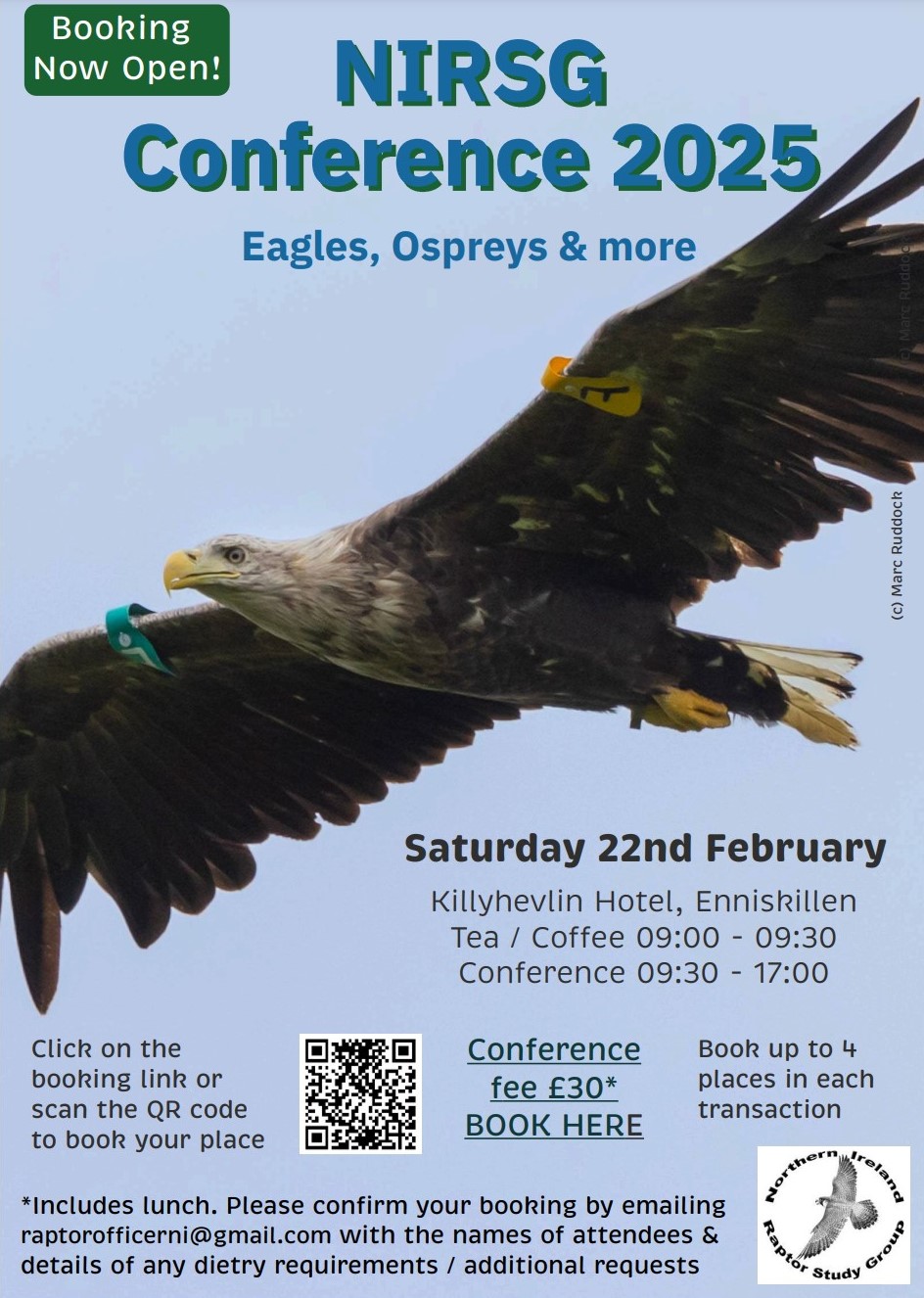
Booking is open for The Northern Ireland Raptor Study Group (NIRSG) conference taking place this Saturday (22 February 2025) at the Killyhevlin Hotel, Enniskillen.
The conference is open to everyone – you don’t need to be a member of the NIRSG to attend. To find out more information and details of how to book, please visit the NIRSG website (here).
You’ll see that Phase 2 of the NIRSG’s campaign to ban dangerous, raptor-killing pesticides will be launched on Saturday morning. I wrote about this campaign a few days ago (see here) and wanted to drum up support to help the petition reach 50,000 signatures before this coming Saturday (it had been stubbornly stuck at 46, 206 signatures for a while).
This petition/campaign was initiated after the discovery of two young white-tailed eagles that were found dead on Northern Ireland’s only driven grouse moor in 2023 – they’d both been illegally poisoned by the toxic pesticide Bendiocarb.
Many, many thanks to the approx 1,500 of you who have signed in the last few days – the current total is 47, 761 signatures. We need a couple more thousand people to pledge their support to reach the target.
Can you help? You don’t need to be a resident of Northern Ireland to sign – the petition is open to anyone, anywhere, who cares about the illegal use of these dangerous poisons to kill birds of prey (and any other wildlife that comes into contact with indiscriminately placed poisonous baits).
If you’d like to sign and/or share the petition with others, please click HERE.
Your help is needed to ensure a petition, calling for a ban on the possession of dangerous, raptor-killing pesticides in Northern Ireland, passes the target of 50,000 signatures before next week.
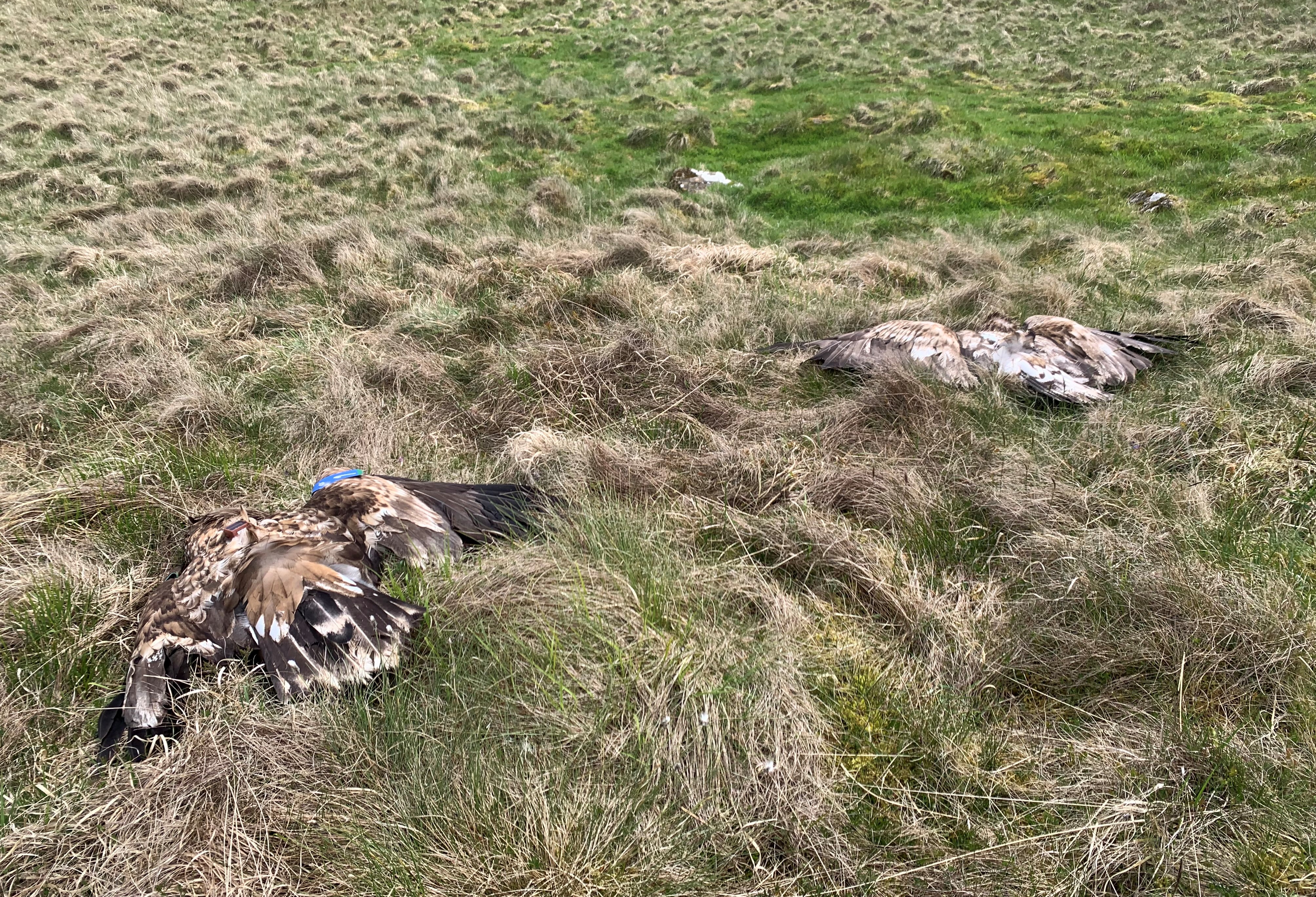
The petition was launched by the award-winning Northern Ireland Raptor Study Group (NIRSG) in July 2023 following the illegal poisoning of two young White-tailed Eagles that were found dead, side by side, on Northern Ireland’s only driven grouse moor at Glenwherry, in the Antrim Hills.
The two poisoned white-tailed eagles. Photo: Northern Ireland Raptor Study Group
The eagles had both ingested the highly toxic insecticide, Bendiocarb, which is currently only licensed for indoor use in Northern Ireland. This chemical is so dangerous that it’s an offence to even possess it in Scotland, let alone place it out in the open on a bait to attract any passing predators.
The petition calling for a ban on the possession of Bendiocarb and a range of other dangerous chemicals used to illegally target birds of prey currently has 46,206 signatures. The target is 50,000 signatures and ideally this target can be met before next week, when the NI Raptor Study Group will be announcing Phase 2 of its campaign to get these pesticides out of circulation. A petition with 50,000+ signatures will help get the attention of the politicians the NIRSG will be approaching.
You don’t need to be a NI resident to sign the petition; any decent human being with an interest in protecting birds of prey and other wildlife can sign it.
If you haven’t already signed, and want to help this important campaign, please sign the petition HERE.
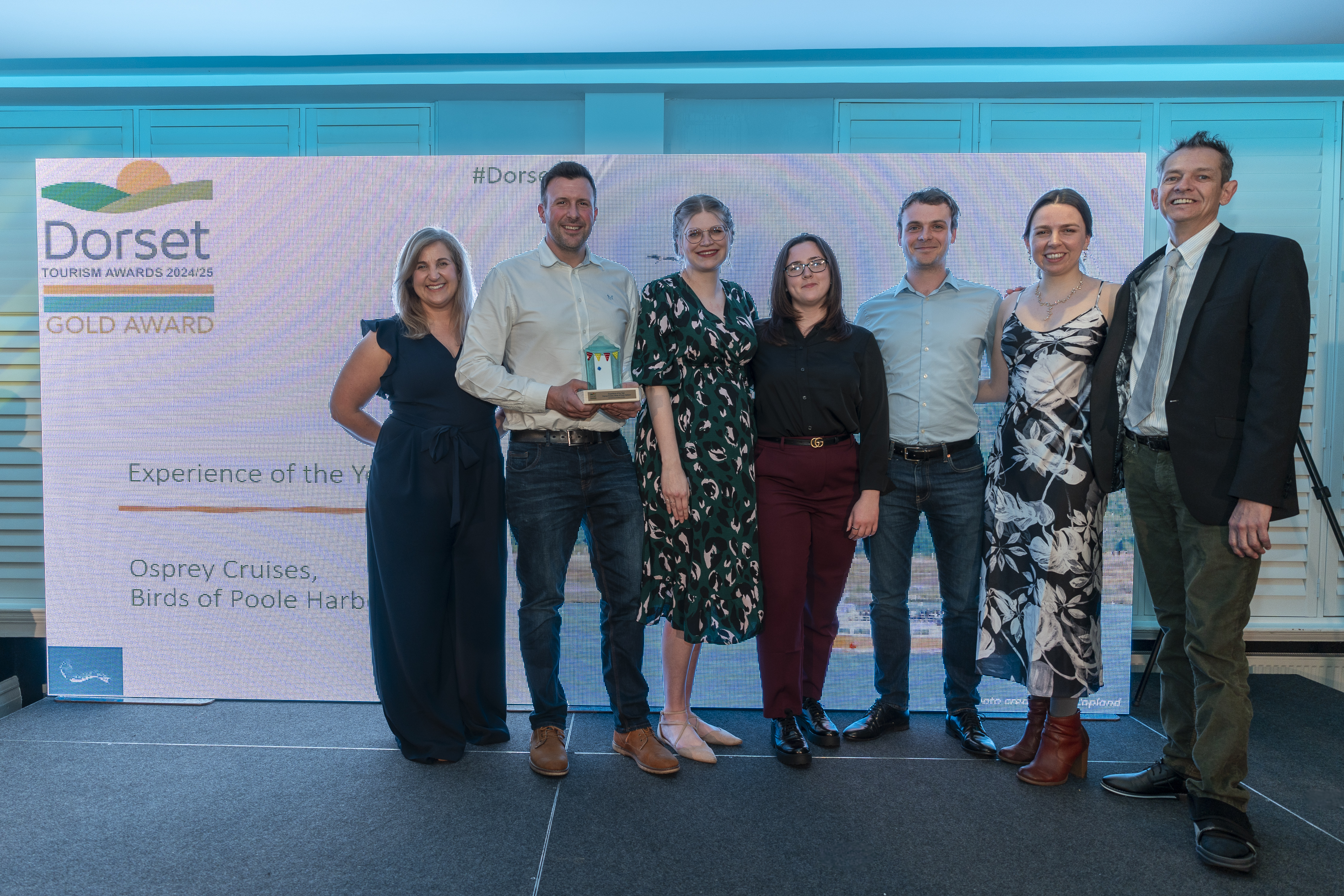
HUGE congratulations to the fantastic team behind the charity Birds of Poole Harbour whose Osprey Cruises have won GOLD in the 2024/25 Dorset Tourism Awards (Experience of the Year category)!
The Birds of Poole Harbour team collecting their gold award earlier this week. Photo by Ian Plested, IPVisuals, Dorset Tourism Awards 2024/25
If ever there was a well-deserved award, this is it, because the work of this small, passionate and knowledgeable team expands far, far beyond the popular Osprey Cruise boat trips that they run every summer.
In the world of UK raptor conservation, the charity is probably best known for successfully bringing back Ospreys to the south coast of England, working in close partnership with the Roy Dennis Wildlife Foundation. Ospreys were translocated from Scotland over a number of years, starting in 2017, and are now regularly breeding in Poole Harbour, with the first chicks hatching in southern England in almost 200 years.
The Osprey project is just one of several high impact conservation projects this team is involved with and they are currently working towards a Chough reintroduction on the Purbeck Coast. They are also heavily involved in various annual bird surveys and bird ringing projects around this important wetland site.
Public engagement and education has always been one of the core objectives of the Birds of Poole Harbour charity, and boy, do they deliver on that front!
They run a School Bird Boat Project during the winter and spring, offering local primary schools free two-hour harbour boat trips, including free coach travel to and from Poole Quay. There are free binoculars for the pupils to use and they’re encouraged to participate in identifying and recording different species whilst on board, as well as learning about natural history, conservation and their local environment. Imagine the impact those boat trips have on those kids.
In addition to the school boats, the charity delivers an extraordinary events calendar throughout the year which members of the public can pay to attend. They do guided walks and ID courses, talks and free pop-up events, but probably the most popular events are the various boat cruises which attract thousands of visitors a year, many of them selling out quickly and attracting visitors from far beyond Dorset.
I’m one of those visitors and I’ve been making the trip down to join these boat trips since 2017. Initially it was to see the Ospreys, but more recently the big draw for me is the resident pair of White-tailed Eagles that have set up home in Poole Harbour. There are plenty of other raptor species too, notably Marsh Harriers and Peregrines, and because of the diversity of habitats around the harbour there are many, many more bird species to see.
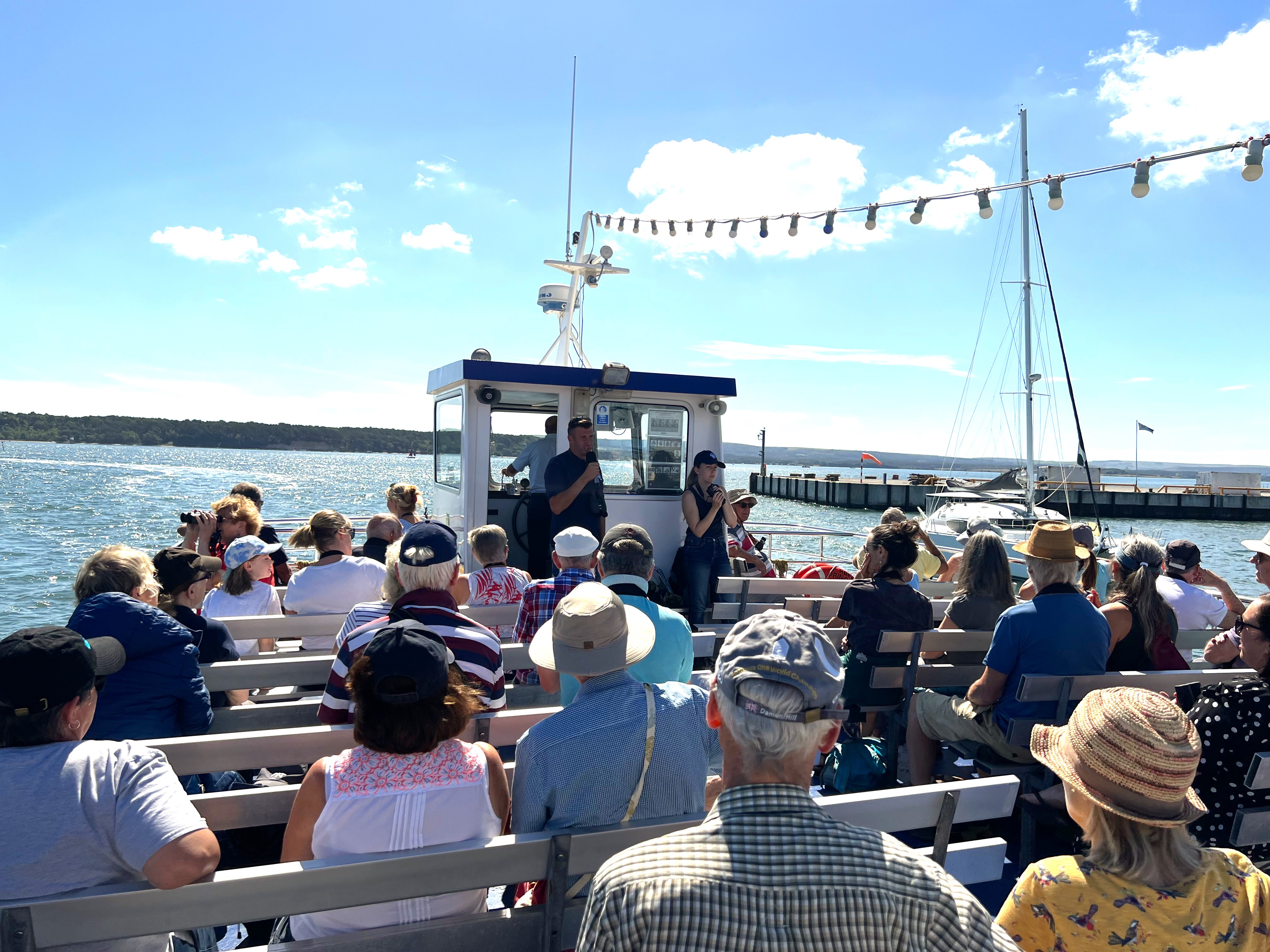
These boat trips usually last for three hours and members of the BOPH team are always on board to provide a running commentary (and they also know where the eagles like to hang out). The trips are hugely enjoyable and massively informative. You don’t need to be an expert birder to attend – the passengers are often an eclectic mix of backgrounds and experience, ranging from the expert to the novice and everything inbetween. If you want a brilliant, fun and engaging day out, look out for this year’s boat trip dates on the BOPH website (being announced shortly). You can also organise a private, bespoke boat trip, e.g. as a corporate event or as an event for supporters as Wild Justice did in 2023.
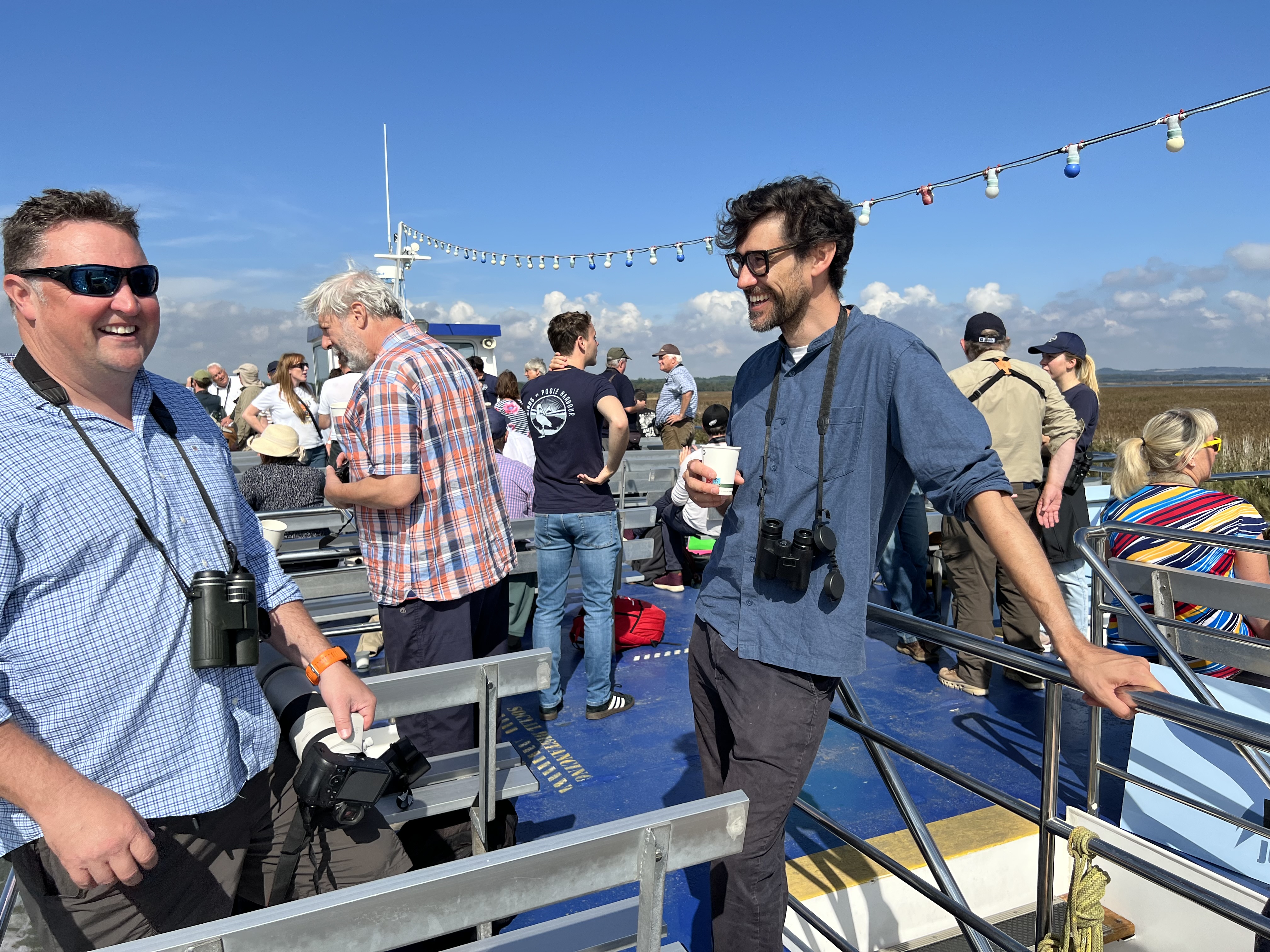
BOPH boat trips – photos by Ruth Tingay
For those who can’t visit the harbour in person, Birds of Poole Harbour provide a daily blog of bird sightings, a regularly-updated website with news from their various projects, and they provide live-streaming webcams so people from around the world can follow the fortunes of the Ospreys’ breeding seasons.
Another winner at the 2024/25 Dorset Tourism Awards was Careys Secret Garden, based on the western side of the harbour, who won GOLD in the Ethical, Responsible & Sustainable Tourism category, SILVER in the Small Visitor Attraction of the Year category, and took home the WINNER OF WINNERS award, too! Careys Secret Garden works in partnership with Birds of Poole Harbour and offers a wide range of events, courses and activities from March to October, including the Careys Osprey Tours where small groups can book to visit a viewing platform to watch the famous nest belonging to Ospreys CJ7 & 022. If you’re in the area for a BOPH boat trip, I’d highly recommend a visit to this special, secluded location.
Congratulations again to both organisations on winning the richly-deserved recognition these awards will bring.
I wonder if former Conservative MP Chris Loder was at the awards ceremony?
Press release from The National Parks & Wildlife Service (NPWS), 14 January 2025:
INVESTIGATION UNDERWAY FOLLOWING THE DEATH OF A WHITE-TAILED EAGLE IN COUNTY WESTMEATH
The National Parks and Wildlife Service (NPWS) appeal to the public for information.
The NPWS has launched an investigation following the recent shooting dead of a White-tailed Eagle beside Lough Owel, near Mullingar, Co. Westmeath and is appealing to the public for information.
The two-year old female eagle was part of the NPWS White-tailed Eagle Reintroduction Programme. She was released in 2022 on the Shannon Estuary. Investigating officers have established that the bird was shot, but, are awaiting further results of forensic analysis that may provide additional information.
The NPWS deplores the deliberate killing of rare and endangered species, and takes bird of prey persecutions extremely seriously.
NPWS is appealing for any information the public may have in relation to the incident.
As part of the reintroduction programme, White-tailed Eagle chicks are fitted with satellite tags to monitor their movement. Information from the satellite tag for the dead eagle indicates that she died sometime on Friday the 6th of December, the day before Storm Darragh, in the Ballynafid / Portnashangan area at Lough Owel.
Satellite information shows that she was present in the area over the previous couple of weeks having travelled widely across the country since her release in 2022. In early 2023, she left north Kerry, and spent time at various locations along the western seaboard. She also travelled to Donegal and spent a lot of time making trips over and back to north Antrim, Fermanagh, Cavan and other counties, including visiting Lough Ree in the north midlands. Lately she had come back to Westmeath where she moved between local lakes- Lough Owel, Lough Derravaragh and Lough Ennell.
Members of the public can contact the NPWS by emailing wildlifeenforcement@npws.gov.ie. All reports will be treated in the strictest of confidence.
ENDS
There is a further NWPS statement dated 15 January 2025:
MINISTER NOONAN APPEALS TO THE PUBLIC FOR INFORMATION FOLLOWING THE DEATH OF A WHITE-TAILED EAGLE AT LOUGH OWEL IN CO. WESTMEATH
“Like all who cherish our wildlife, I was devastated to hear of the recent shooting dead of a White-tailed Eagle beside Lough Owel, near Mullingar in Co. Westmeath. White Tailed Eagles are magnificent creatures; their presence are such good indicators of the health of our ecosystems and countryside and now part of our wider efforts to restore nature. It is an absolute deplorable act to kill such a rare and endangered species.
“This young female eagle was part of the very successful NPWS White Tailed Eagle Reintroduction Programme in partnership with Norway. I was honoured to be present at the release of these stunning creatures to the wild in my role as Minister of State for Nature and Heritage.
“After being released into the Shannon Estuary in 2022 she had peacefully settled into the Irish landscape travelling from north Kerry, spending time in Western Seaboard before travelling to Armagh, Fermanagh, Cavan and other counties, including visiting Lough Ree in the north midlands. Lately she had returned to Westmeath where she moved between local lakes- Lough Owel, Lough Derravaragh and Lough Ennell. Satellite tags fitted by NPWS indicate that she died on 6th December the day before Storm Darragh, in the Ballynafid/ Portnashangan area at Lough Owel.
“White Tailed Eagles are treasured by local communities and visitors to Ireland alike and any loss resonates throughout. I appeal to the public to come forward with any information that they may have in relation to this incident. I am assured that NPWS are undertaking a thorough investigation led by the Wildlife Crime Directorate with the support of An Garda Siochána and will, where possible, bring the perpetrators of this unacceptable crime to justice. Members of the public can contact the NPWS by emailing wildlifeenforcement@npws.gov.ie. All reports will be treated in the strictest of confidence“.
Last week I wrote a blog about three separate proposals to release White-tailed Eagles in Cumbria, Wales, Severn Estuary and Exmoor National Park in a strategic attempt to bolster and connect the current populations in Scotland, Ireland, Northern Ireland and southern England (see here).
A journalist from The Times has picked up on that blog and an article was published yesterday in TheSunday Times featuring quotes from the National Farmers Union (NFU), who, predictably, do not support the proposals.
The article is behind a paywall so I’ve reproduced it below:
The white-tailed eagle was persecuted to extinction in the British Isles by gamekeepers, farmers and collectors over several centuries, culminating in the last known wild bird being shot dead in 1918.
But now the nation’s largest bird of prey could once again become a common sight thanks to a new set of rewilding schemes across England and Wales.
The birds, also known as sea eagles, were first reintroduced to Scotland in the Seventies by conservationists, and a similar effort was started on the Isle of Wight in 2019. Until then, the last recorded breeding pair in southern England was in 1780.
Now these small populations are set to be bolstered and connected by a growing number of separate reintroduction projects planned in Cumbria, Wales, the Severn Estuary and Exmoor.
But the reintroduction of the birds, which are legally protected under the Wildlife and Countryside Act 1981, has caused a backlash from farming groups and landowners, who claim they could harm their livestock, primarily lambs, and the environmental schemes they already carrying out.
They also want compensation schemes in place should their livestock start falling prey to the fourth largest eagle in the world.
The Welsh farmers union told The Times it does not support efforts to reintroduce the white-tailed eagle, known as the “flying barn door” thanks to its two-metre wingspan.
Hedd Pugh, the NFU Cymru rural affairs board chairman, said there are “no longer any truly wild areas in Wales”, with all the countryside being “a managed landscape — created, shaped and maintained by farmers over generations”.
“There is a real concern that any reintroduction of this species would cause risk to animal health and welfare and have an impact on livestock production, with newborn lambs particularly at risk,” he said.
“There is also the unknown effect the white-tailed eagle could have on other birds, wildlife and protected species.”
Pugh said that NFU Cymru believes species recovery efforts “should firstly focus on supporting species that are already present in Wales before reintroduction is considered.”
After their reintroduction in Scotland 50 years ago, there are now there are an estimated 150 breeding pairs in the country.
Juvenile white-tailed sea eagles can roam 200km beyond their nest site and when settled, the its hunting territory can be up to 70 sq km.
The eagle is found in dozens of European countries, with no substantial recorded problems relating to livestock attacks, but farmers in Scotland have consistently said their lambs are being killed by the reintroduced species.
The Scottish government launched its Sea Eagle Management Scheme in 2015, which gives money to affected farmers, in acknowledgment that lambs are being taken.
A research paper published at the end of 2023, analysing more than 11,000 food fragments found in sea eagle nests, found lamb accounted for 6 per cent of prey items. However, some nests in the study contained more than 30 per cent lamb remains.
Victoria Vyvyan, the president of the Country Land and Business Association, acknowledged reintroducing species can be beneficial but said “it must be backed by clear research and plans to manage risks like predation, otherwise it risks livestock and livelihoods”.
“It’s crucial to listen to rural communities, address their concerns, and offer fair compensation for any losses,” she said. “Conservation must protect the environment without harming those who rely on it for a living.”
The NFU said reintroductions can play a role in delivering nature recovery but highlighted “concerns about the adverse impacts a reintroduction could have”.
Richard Bramley, NFU environment forum chair, has called on the government to develop and implement a framework “which outlines the process it will follow when managing species reintroductions in England to help minimise impact, risks and any unintended consequences”.
“We also ask that where it is shown there will be an impact that this is properly funded,” he said.
In 2019, Natural England granted a licence to release about 60 birds on the Isle of Wight as part of a reintroduction project led by Forestry England and the Roy Dennis Wildlife Foundation.
The foundation is now considering releasing up to 20 eagles in Exmoor national park over a three year period. The park said it has been doing “a lot of liaison with local landowners and shoots regarding white-tailed eagles already visiting Exmoor”.
The Eagle Reintroduction Wales project is also looking into the feasibility of bringing the eagle back to southeast Wales and the Severn Estuary.
The Cumbrian white-tailed eagle project is exploring the possibility of bringing the birds back to the southern part of Cumbria. The University of Cumbria, Cumbria Wildlife Trust, the Lifescape Project, RSPB, the Wildland Research Institute and the Lake District national park authority want to see their return, after the last recorded white-tailed eagle breeding attempt was near Haweswater in 1787.
Research has already been undertaken to assess prey availability, habitat suitability and a population viability assessment has been completed.
The team is now carrying out a social feasibility study and has launched a questionnaire to evaluate the public’s attitudes and views on a potential reintroduction.
ENDS
I suppose I shouldn’t be surprised that this newspaper only published quotes from those who hold what seem to be ‘anti-eagle’ views – where are the quotes from conservationists with opposing views, or farmers from southern England who have direct experience with the reintroduced WTEs from the Isle of Wight?
And although I’m pleased that journalists from The Times are using this blog as a material source, I’m less impressed that large chunks of my research/writing have been plagiarised and passed off as the journalist’s own work. It’s not a difficult or onerous task to give credit to the original source, e.g. with a simple link.
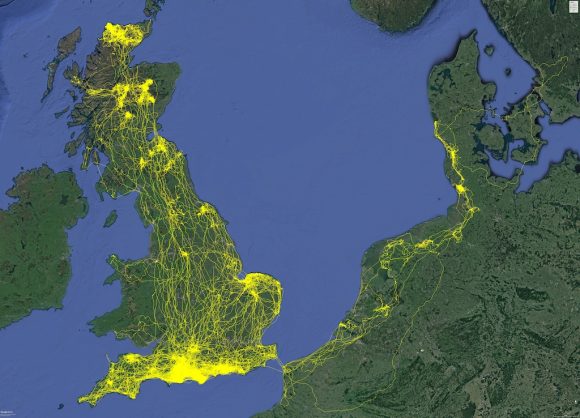
As for the concerns raised by the NFU and Country Land & Business Association about the proposed releases of White-tailed Eagles – a quick look again at that map showing the widespread dispersal of satellite-tracked WTEs that were released on the Isle of Wight indicates that the eagles are on their way, with or without more releases, and in some cases are already there (Exmoor National Park), although not yet breeding as far as I’m aware.
Satellite tracking data up to Jan 2024 of WTEs released in southern England. Copyright Tim Mackrill / Roy Dennis Wildlife Foundation
This map also raises another issue. One of the requirements to justify the translocation of a species is that the species in question shouldn’t be able to get there of its own accord, e.g. through natural expansion of the population.
Given the dispersal capabilities of those WTEs on the coast of southern England, and of the expanding WTE population in Argyll in Scotland, it seems to me it’s quite likely that WTEs will reach these proposed release areas of their own accord sooner rather than later. Sure, translocations would speed things up, but given the proximity of the proposed release areas to where WTEs are already established, I do wonder whether it’d be a good use of valuable funding, as much as I’d like to see WTEs in more places.
Given the academic credentials of all those involved in each of the three release proposals, I don’t doubt that they’ll be giving this careful consideration.
Various separate projects are gaining traction to release White-tailed Eagles (WTE) in Cumbria, Wales, Severn Estuary, and Exmoor National Park in a strategic attempt to bolster and connect the current populations in Scotland, Ireland, Northern Ireland and southern England.
EXMOOR NATIONAL PARK
The Roy Dennis Wildlife Foundation, responsible for the successful reintroduction of WTEs to southern England, is now considering small-scale releases in other areas to help restore the former population. The Foundation’s first proposed location is Exmoor National Park in Somerset/Devon.
This area was identified as an important location for WTEs as tracking data from the reintroduced eagles on the Isle of Wight show it’s somewhat of an eagle hotspot, with at least seven individuals making regular visits.
Satellite tracking data up to Jan 2024 of WTEs released in southern England. Copyright Tim Mackrill / Roy Dennis Wildlife Foundation
The Roy Dennis Wildlife Foundation and Forestry England is partnering with the Exmoor National Park Authority (ENPA) with a view to releasing up to 20 WTEs over a three year period.
A press release from ENPA says, “Over the last few years we have been doing a lot of liaison with local landowners and shoots regarding white-tailed eagles already visiting Exmoor“.
I’ll bet they have! Exmoor is heaving with pheasant and partridge shoots, including several run by, shall we say, ‘interesting’ sporting agents. An earlier plan to release Hen Harriers on Exmoor was met with resistance by local shoots because they feared it would ‘lead to increased scrutiny of legal activities‘(!) (see here).
The ENPA is currently running a ‘public perception survey’ to find out people’s views on the proposed release of WTEs. The online survey is open to everyone, but especially those who live and work within Exmoor NP and those who visit. If you’d like to participate, the survey is here.
WALES and the SEVERN ESTUARY
A different project is planning to release White-tailed eagles back into Wales and to the Severn Estuary after several years of careful research and consultation.
White-tailed Eagles were formerly distributed across Wales but haven’t bred there for over 150 years since being wiped out by persecution (see here and here).
The Eagle Reintroduction Wales (ERW) Project has been undertaking research for quite a few years (e.g. here) and is now working in partnership with the Durrell Wildlife Conservation Trust, Gwent Wildlife Trust and the Wildfowl & Wetlands Trust on actively planning for a WTE reintroduction in southeast Wales and the wider Severn Estuary.
The ERW Project has also launched a public opinion survey to find out people’s views on the release of WTEs. Again, the survey is open to everyone but especially those who live and/or work in the region and the wider Bristol Channel area. If you’d like to participate, the survey is here.
CUMBRIA
The Cumbrian White-tailed Eagle Project is exploring the possibility of bringing WTEs back to the southern part of Cumbria. This is a consortium of organisations, including the University of Cumbria, Cumbria Wildlife Trust, The Lifescape Project, RSPB, the Wildland Research Institute and the Lake District National Park Authority.
The last recorded WTE breeding attempt was near Haweswater in 1787.
Research has already been undertaken to assess prey availability, habitat suitability and a population viability assessment has been completed.
The team is now undertaking a social feasibility study and has launched a questionnaire to evaluate the public’s attitudes and views on a potential WTE release. The questionnaire is aimed at individuals living in Cumbria and the surrounding areas. If you’d like to participate, the questionnaire is here.
UPDATE 6th January 2025: Predictable backlash from NFU to proposed releases of White-tailed Eagles (here)
UPDATE 23 October 2025: Should White-tailed Eagles be reintroduced to Cumbria? Another questionnaire seeks your views (here)
Last month conservation campaign group Wild Justice published a detailed report on the impact of the mis-use and abuse of second generation rodenticides (SGARs) on red kites and buzzards in England and the failure of the Government’s Rodenticide Stewardship Scheme, which had been set up in 2016 to reduce the amount of rodenticides in wildlife (see here for press release and a copy of the Wild Justice report, ‘Collateral Damage‘).
Brodifacoum bait station illegally set on the edge of a grouse moor in the Yorkshire Dales National Park. Photo by Ruth Tingay
Brodifacoum. Photo by Ruth Tingay
On the back of the publication of Wild Justice’s report, Scottish Greens MSP Ariane Burgess lodged the following parliamentary question on 19th November 2024:
Question reference S6W-31459
To ask the Scottish Government, in light of the latest report, Collateral Damage, by the UK campaign group, Wild Justice, which states that the Rodenticide Stewardship Scheme in England “is a failed scheme”, and other reports that have indicated increased exposure to anticoagulant rodenticides in common buzzards in Scotland, whether it has assessed the effectiveness of the rodenticide scheme in Scotland.
The question was answered by Agricultural Minister Jim Fairlie on 3rd December 2024:
The Scottish Government continues to contribute to UK-wide monitoring of rodenticide use and exposure in wildlife. There is evidence that many users of rodenticides are complying with the Campaign for Responsible Rodenticide Use’s (CRRU) Rodenticide Stewardship Scheme (RSS), and that in Scotland rodenticide use in agriculture has substantially declined since the introduction of the scheme. But, despite this, recent environmental data for Scotland indicate that it has not yet achieved the aim of significantly reducing wildlife exposure.
Both the UK Government Oversight Group, which includes Scottish Government representation, and CRRU have acknowledged that rodenticide residues in UK wildlife have not declined as hoped. The RSS is being updated firstly to ban the use of second generation anticoagulant rodenticides (SGARs) bromadiolone and difenacoum for open area use from the end of this year. This means no SGARs will be available for open area use; this is also intended to reduce accidental or deliberate misuse of other products in open areas. Secondly, training requirements for the farming sector are also being brought in line with other sectors from end 2025 to ensure a consistent level of professional training across all sectors and reduce the risk of poor practice.
Whilst it’s true that legal authorisation is being rescinded for the use of the SGARs Bromadiolone and Difenacoum in open areas (see press release on this from June 2023, here), it is very clear from the Wild Justice report that the total increase of SGAR exposure in red kites and buzzards in England is being driven by a dramatic increase in the use/mis-use of Brodifacoum, not by Bromadiolone or Difenacoum.
Fig 3 from Wild Justice’s Collateral Damage report (p8) showing the percentage of buzzards and red kites analysed by the WIIS that contained different concentrations of Brodifacoum, Bromadiolone and Difenacoum.
Brodifacoum is the dominant SGAR being found in birds of prey and is more toxic than Bromadiolone and Difenacoum. It used to be restricted to internal use only, until the Government decided to relax that regulation and permit its use ‘in and around buildings’ – a regulation that is obviously being breached routinely given the high levels of exposure in birds of prey (e.g. here).
From January 2025, Bromadiolone and Difenacoum will also be permitted for use ‘in and around buildings’, but there are no proposed tighter rules on the use of Brodifacoum.
Minister Fairlie suggests that a restriction against any use in open areas of any SGAR is intended to reduce accidental or deliberate mis-use of other products in open areas and that new training requirements for all users (not just professional pest controllers) will ‘reduce the risk of poor practice’.
I suppose he’s thinking that this standardisation will remove any supposed ‘confusion’ between the use of different products. However, given that Brodifacoum is already supposedly restricted to use only ‘in and around buildings’, yet has been used with increasing frequency by gamekeepers for targeting birds of prey, Wild Justice argues that the new legal restrictions are unlikely to improve things significantly.
The Wild Justice report suggests that a better option is to return Brodifacoum to its pre-April 2016 approval status, so that it can be used in strict ‘internal areas’ within buildings, and to limit its use to professional pest control companies.
For those who might have missed it, Wild Justice’s Collateral Damage report can be read/downloaded here:
A proposal to translocate white-tailed eagles to Cumbria that has been in development for a number of years (see here) has reached the public consultation stage.
The Cumbrian White-tailed Eagle Project is being overseen by a steering group comprising the University of Cumbria, Cumbria Wildlife Trust, The Lifescape Project, RSPB, the Wildland Institute, the Lake District National Park Authority alongside local estate owners and managers.
According to the steering group, research has indicated that Cumbria has sufficient suitable habitat to support a population of white-tailed eagles and the county is considered an important strategic location to encourage links between other populations in Scotland, Ireland and Northern Ireland and the south of England.
The group is now engaging with the public to listen to views on bringing back this species to Cumbria and has begun a series of drop-in sessions, meetings and workshops (details here).
Unsurprisingly, this news has triggered the usual idiotic fear-mongering hysteria about white-tailed eagles based on ignorance and a persistent Victorian attitude to raptors, led, of course, by The Telegraph:
This is just lazy journalism. Had The Telegraph bothered to undertake any research at all, it would know that a series of scientific studies have shown that white-tailed eagles are generalist predators with a broad diet, and the most recent study from Scotland (here) shows that lambs are not an important food source for this species but marine prey is. This finding is also supported by a recent dietary study from the WTE Isle of Wight Reintroduction Project (here), which also concluded “there have been no cases of livestock predation since the project began“.
The hysteria was continued by this tweet from Mark Robinson, a farmer in North Yorkshire whose Twitter bio says he’s also the Reform Party spokesperson for the Thirsk and Malton Constituency (having failed to get elected in June). According to Farmer Robinson, the eagles will be ‘snatching up babies’ -:
It sounds like Farmer Robinson has been reading the discredited guff of the Scottish Gamekeepers Association, who has previously written to the Scottish Government about concerns that white-tailed eagles might eat children (here).
UPDATE 23 October 2025: Should White-tailed Eagles be reintroduced to Cumbria? Another questionnaire seeks your views (here)








 Raptor Persecution UK