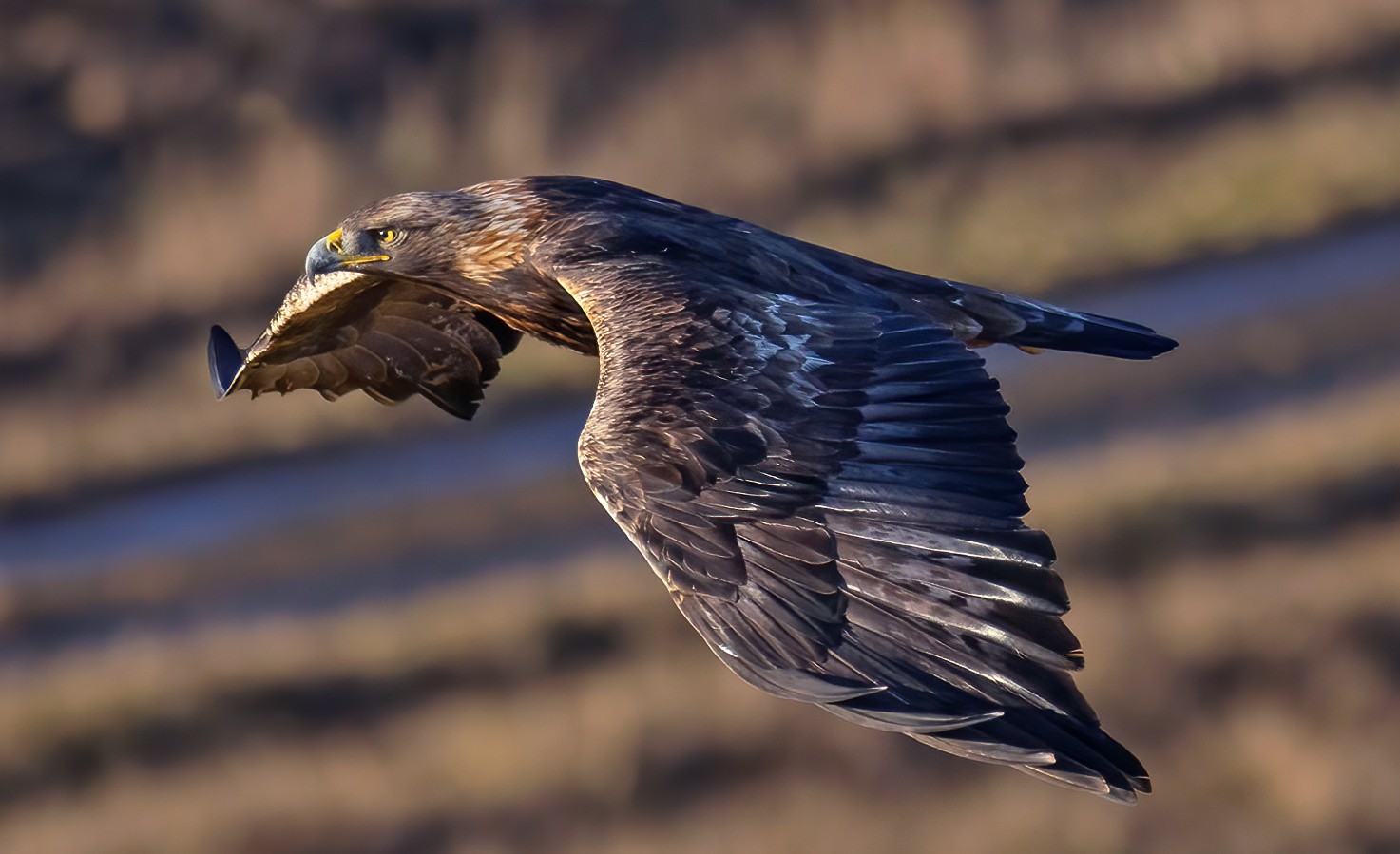
On Tuesday, 20 January, 2026, police were made aware a gamekeeper from an estate in Stanhope had discovered an injured golden eagle on Thursday, 15 January, 2026.
The bird was wearing a satellite tracking device and was identified as Hamlet, a four-year-old golden eagle that had been relocated from the Outer Hebrides to the Scottish Borders in 2023.
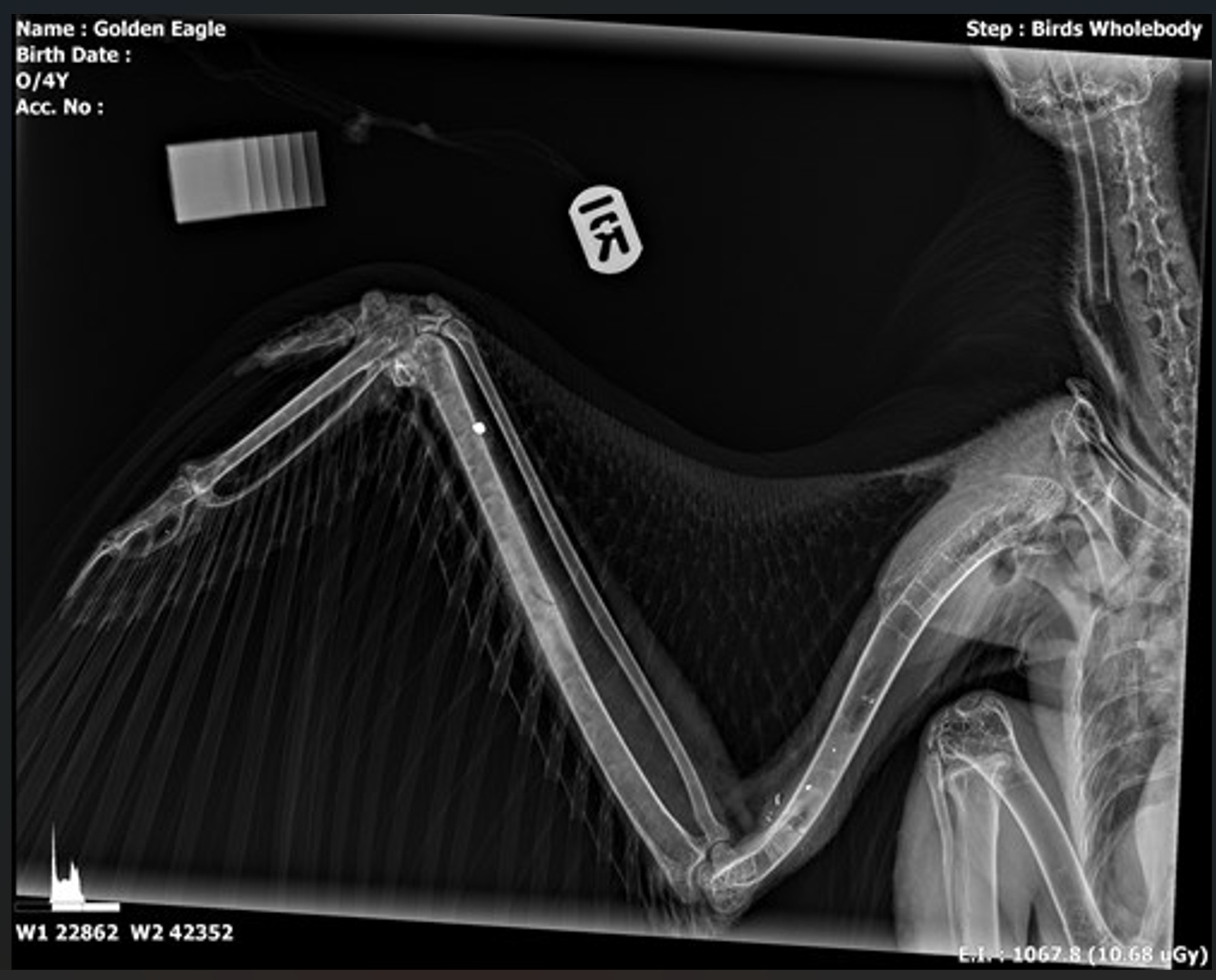
Hamlet was examined by a vet, who confirmed shotgun pellet injuries to his wing. He received treatment and made a full recovery. Hamlet has since been returned to the wild.
X-ray showing shotgun damage to the eagle’s right wing. Photo by SSPCA via Police Scotland
Officers investigating the crime have reviewed Hamlet’s tracking data and following consultation with raptor and veterinary experts, it’s believed Hamlet was shot during the first week of January 2026 in an area between Stanhope and Glenbreck, off the A701 Broughton to Moffat Road.
Detective Sergeant David Lynn, National Wildlife Crime Coordinator, said: “It is extremely disappointing that we are investigating another golden eagle persecution crime. Very few people would have the means, opportunity and motive to commit this crime and I would urge anyone with any information to contact us so we can identify whoever is responsible for shooting Hamlet.”
Police Scotland, with the support of the UK National Wildlife Crime Unit, is conducting a thorough enquiry in the local area to identify the culprit. Anyone with information is asked to call Police Scotland via 101, quoting incident number 1221 of 3 February, 2026. Alternatively, you can pass on your information anonymously to Crimestoppers using 800 555 111.
ENDS
‘Hamlet’ is the sixth victim of eagle persecution in the Scottish Borders in recent years:
Golden Eagle ‘Fred’ disappeared in an area managed for gamebird shooting in the Pentland Hills in January 2018 (his satellite tag transmitted from the North Sea a few days later – here).
Golden Eagle ‘Merrick’ was shot whilst she was sleeping in a tree next to a grouse moor in the Moorfoot Hills in October 2023 (we’re STILL waiting for NatureScot to make a decision about whether a General Licence restriction will be imposed as a consequence – see here).
Golden Eagles ‘Tarras’ and ‘Wren’ disappeared in an area managed for gamebird shooting near Langholm in August 2025 (see here).
A White-tailed Eagle ‘disappeared’ in the Moorfoot Hills area in November 2025 (here).
All six of these eagles were satellite-tagged. Nobody has been prosecuted in relation to any of these incidents.
Following the appalling news over the last couple of days about the highly suspicious, and almost certainly criminal, disappearance of three satellite-tagged White-tailed Eagles here, here and here, there has, as usual, been complete silence from the land management sector, with the exception of Scottish Land & Estates, who commented that, “land managers in Moorfoots have been helping police with the search and will continue to provide whatever help they can as the investigation progresses“.
As for the other shooting organisations, who so often claim to have a zero tolerance stance against raptor persecution, there’s been no comment and no condemnation. Nix. Nada.
As a reminder, all of those organisations (except the Moorland Association, whose CEO was booted off for spreading misinformation) are members of the police-led Raptor Persecution Priority Delivery Group (RPPDG) – a so-called ‘partnership’ whose function includes ‘awareness raising‘ and ‘raising the profile [of illegal raptor persecution] via media exposure‘. Not a single word.
In contrast, the often very reserved RSPB has not only expressed its disgust, but it has put its money where its mouth is and is offering a reward of £10,000 for information leading to a conviction of those involved. This is welcome news for all of us who have not only enjoyed seeing these birds occupying their rightful place in UK skies, but also for those of us who are sick to the back teeth of the relentless killing of protected birds of prey across our countryside.
Juvenile White-tailed Eagle, photo by Pete Walkden
However, it turns out that it hasn’t just been the three White-tailed Eagles from the England re-introduction project that have disappeared in recent months. The bottom of the RSPB article, linked above, reveals some new information:
‘Further to the suspicious disappearance of these three White-tailed Eagles, a fourth bird, fledged from a nest in Perthshire in 2024, disappeared on a grouse moor in Nairnshire in May this year. A police search took place but neither bird nor tag were found.
This was the latest of nine tagged birds of prey, including two other White-tailed Eagles, whose tags were functioning as expected, to suddenly disappear in the northern Monadhlaith area of Inverness-shire and Nairnshire since 2018. These disappearances have occurred in an area where multiple confirmed incidents of poisoning, shooting and illegal trap use have been recorded’.
FFS.
I can’t see why it’s taken seven months for this news to emerge, but it doesn’t make it any less appalling.
As the RSPB article suggests, this area of Inverness-shire and Nairnshire is horrific for bird of prey killings and for the suspicious disappearances of tagged raptors.
This latest White-tailed Eagle to vanish is the third in the area since 2019 (e.g. see here), adding to a long history of tagged Golden Eagle disappearances here dating back 15 years (and leading to the Scottish Government commissioning its review of the fates of satellite-tagged Golden Eagles back in 2016).
Numerous other incidents have been uncovered in this same area in recent years, close to the NW boundary of the Cairngorms National Park. These have included the shooting of a Sparrowhawk on Moy Estate (for which a gamekeeper was later convicted, here), the discovery of a poisoned Red Kite in the Moy area, here, and the discovery of a shot Red Kite on Lochindorb Estate, here.
Needless to say, the vast majority of those incidents, including the disappearance of the White-tailed Eagle in May, were on grouse moors.
Perhaps the local wildlife criminals were emboldened by NatureScot’s watering-down of the new grouse shoot licence last autumn?
At least that issue appears to have been sorted by a Government amendment to close the loophole, which recently passed Stage 2 of the Natural Environment (Scotland) Bill…but I’ll write about that in another blog.
For now, we have four missing White-tailed Eagles (all vanishing from areas managed for gamebird shooting, whether that be lowland Pheasant & Partridge shooting or upland Grouse shooting), two missing Golden Eagles (also vanishing from areas managed for gamebird shooting), and I’ve lost count of the number of missing Hen Harriers, also vanishing from areas managed for gamebird shooting.
I’ll be updating the Hen Harrier Missing/Dead List over the Xmas period when I’ll have some time…there are still some more to add to the 143 Hen Harriers we already know about.
Further to the news on Thursday (here) that three White-tailed Eagles have ‘disappeared’ in suspicious circumstances, one in England, one in Wales and one in Scotland, Dyfed-Powys Police has issued a separate public appeal for information which includes a bit more detail about the Welsh case.
I’ve added some commentary below the police press release.
Dyfed-Powys Press Release:
Dyfed-Powys Police are appealing for information regarding the suspicious disappearance of a satellite tagged white-tailed eagle in the Newtown area of mid Wales.
Dyfed-Powys Police and the UK National Wildlife Crime Unit (NWCU) are jointly investigating the disappearance of a white-tailed eagle and the theft and disposal of its satellite tag and harness.
The satellite tag has been recovered from remote moorland in this area and shows that it has been removed from the bird with a sharp instrument, most likely a knife, before being hidden in an attempt to dispose of it.
Searches in the area to try and locate the body of the bird have so far been unsuccessful.
Police are appealing for anyone who was in the following areas at the specified times to contact police.
Between 11am and 1pm on Saturday 13th September 2025 at or around the Gwgia Reservoir, Tregynon (W3W///visa.hoped.assess)
Between midday and 3pm on Saturday 13th September 2025 on access land near Bryn y Fawnog (W3W///portfolio.newsprint.eyelash)
Dyfed-Powys Police can be contacted either online by emailing 101@dyfed-powys.police.uk, or by calling 101, quoting police Ref. 25000766626.
Alternatively, contact the independent charity Crimestoppers anonymously by calling 0800 555111, or visiting crimestoppers-uk.org.
All potential lines of enquiry, including detailed forensics such as DNA and fingerprints, are being pursued. Dyfed-Powys Police and NWCU are working closely with the tag owners, the Roy Dennis Wildlife Foundation and Forestry England, to analyse the data, and progress this investigation.
ENDS
Juvenile White-tailed Eagle, photo by Pete Walkden
My commentary:
This isn’t the first raptor persecution incident in this pheasant-shooting area.
In April 2020, a member of the public found the corpses of two Red Kites, which she thought was suspicious. She photographed them and posted the images on social media, intending to return the next day.
Wildlife TV presenter Iolo Williams saw the post and headed out to the location that evening. The two bodies had ‘disappeared’ but Iolo found the body of a third Red Kite, which was later x-rayed and found to contain shotgun pellets (see here).
A police investigation was launched but didn’t result in anyone being charged or prosecuted.
This area was also in the news in November 2018 when the League Against Cruel Sports revealed that 57,000 Pheasants had been released over a five-year period at Gregynog Hall, owned at the time by the University of Wales, with shooting reportedly leased to Bettws Hall Estates. The League launched a campaign to stop gamebird shooting on the estate.
In response, a spokesperson for the University of Wales told BBC News, “The University of Wales has received the correspondence from the League Against Cruel Sports regarding this matter, and is currently in the process of reviewing the structure and arrangements for Gregynog Hall” (see here).
The shooting lease for 2019 was not renewed whilst the review was undertaken (see here).
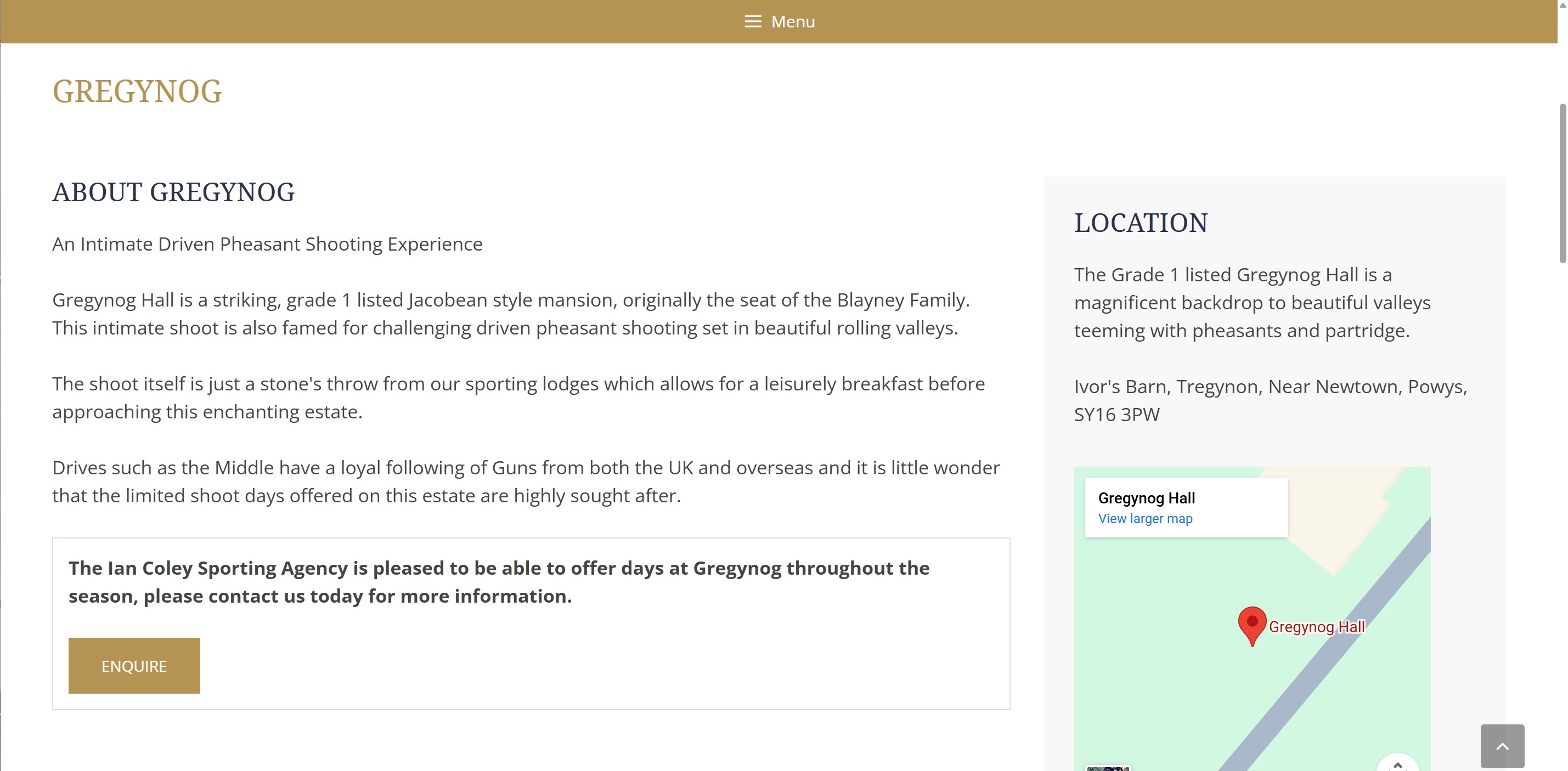
However, my research suggests that a Pheasant-shooting lease is still in operation, no longer run by Bettws Hall Estates, but apparently by the Ian Coley Sporting Agency, whose website lists the shoot as “beautiful valleys teeming with pheasants and partridge“.
However, according to a Trustees report (2022) of The Gregynog Trust, the new landowners, shooting leases have been terminated.
There’s no suggestion that anyone connected with the shoot was involved with the disappearance of the young White-tailed Eagle at Gwgia Reservoir (part of the Gregynog Estate) or the removal of his satellite tag, probably with a sharp knife, before a crude attempt to hide it on a nearby hillside, and I’m sure they’ll have been keen to assist the police with its investigation.
Since 2019, Gregynog Hall and estate has been run by a charitable trust (The Gregynog Trust) and I’m sure the Trustees are appalled that this young White-tailed Eagle was apparently targeted on its estate.
UPDATE 16.00hrs:I’ve received communication from a representative of The Gregynog Trust who says the incident is not on their land, and “We do not condone or allow any form of hunting or blood sports on our estate, this is not negotiable“. This information conflicts with the published information I’ve found during my research, but until I can clarify that, please do not contact The Gregynog Trust about this incident.
Further to the news yesterday (here) that three White-tailed Eagles have ‘disappeared’ in suspicious circumstances, one in England, one in Wales and one in Scotland, Police Scotland has issued a separate public appeal for information which includes a bit more detail about the Scottish case:
Police Scotland are appealing for information after a satellite-tagged white-tailed eagle disappeared in the vicinity of the Moorfoot hills.
The bird was four years old and had been translocated as a chick from Scotland to the Isle of White as part of a licenced reintroduction programme run by the Roy Dennis Foundation.
In March 2025 the bird flew back to Scotland and held a territory in the Moorfoot Hills spending most of its time in the hills between Peebles and Heriot.
In early November it expanded its range and spent the majority of its time on the lower ground to the North of the Moorfoots by Gladhouse Reservoir but after four days its satellite tag then suddenly stopped working in circumstances that give rise to suspicion.
A full search of the area where the tag last transmitted and the areas it had been frequenting has been carried out by Police Scotland Wildlife Crime officers accompanied by colleagues from the UK National Wildlife Crime Unit and a bird ecology expert however neither the bird nor the satellite tag have been recovered.
Police Constable Ali Whitby, Wildlife Crime Officer for the Lothian and Scottish Borders division said:
“This is a huge iconic bird of prey that chose to fly hundreds of miles north and settle in the Moorfoot Hills. Being so big its presence was known to people working and living in the area and it thrived for 8 months; the fact it has now gone missing in suspicious circumstances is extremely disappointing.
“I would urge anyone with any information that may assist to contact us.”
Anyone with any information should call 101, quoting reference number PS-20251215-1347. Alternatively, please contact Crimestoppers though 0800 555 111, where anonymity can be maintained.
Press release from Forestry England (17 December 2025)
THREE WHITE-TAILED EAGLES DISAPPEAR IN SUSPICIOUS CIRCUMSTANCES
The public are being asked to help the police investigate the suspicious disappearance of three white-tailed eagles. The cases include a chick born in the wild earlier this year in Sussex, one of the first white-tailed eagles to fledge in England for hundreds of years.
White-tailed Eagle G842 on the nest with its sibling in Sussex prior to fledging earlier this year (Photo: Forestry England)
The missing birds are part of a project led by Forestry England and the Roy Dennis Wildlife Foundation to reintroduce this lost species to England. Their disappearance is being investigated by several police forces and the National Wildlife Crime Unit.
The return of white-tailed eagles to England is one of the country’s key conservation successes over recent years. Since 2019, 45 white- tailed eagles have been released. Several breeding pairs have formed with six chicks being born in the wild for the first time since the 1780’s. Any targeting of the birds will potentially impact the long-term success of the project.
All of the released birds are tagged with satellite trackers allowing the team to closely follow their location and movements. In September the trackers of two eagles were found dumped close to the birds’ last recorded location. Both had been cut off the birds using a sharp instrument. In the case of another eagle, its tag has stopped sending data. The last message received from the device was on 8 November and no sightings of the bird have been recorded since then.
Tim Mackrill from the Roy Dennis Wildlife Foundation said: “We monitor the satellite data, showing the bird’s minute-by-minute movements, on a daily basis and always investigate any suspicious or unusual data. It was devastating to find the stolen and dumped tags, particularly for the chick in Sussex who fledged this summer and had only just begun its life. So many people in the area had shared the joy of seeing these birds breed again after hundreds of years and our ongoing monitoring has shown how well they were fitting into the landscape. To have that destroyed just a few months later is deeply shocking“.
Steve Egerton-Read, White-Tailed Eagle Project Officer for Forestry England, said: “We are returning this lost species to the English landscape and have had so much support from the public. These special birds are helping people connect with natural world and showing how with a little bit of help nature can thrive. We are asking the public to show this support again by encouraging anyone who has information that may help the police investigation to come forward“.
There was tremendous public support and local pride this summer when two white-tailed eagle chicks fledged from a nest in Sussex. Both were the offspring of eagles released by the project in 2020 and the first pair to successfully breed in England for over 240 years. The two chicks had spent the first few months of their lives exploring the local West Sussex area.
On 26 September, a satellite tag belonging to one of the chicks (G842) was recovered from the River Rother, near Petersfield. It had been removed from the bird using a sharp instrument. Searches in the area to try and locate the body of the bird have so far been unsuccessful.
Sussex Police are appealing for information from anyone who was in or around Harting Down and Petersfield on the evening of 20 September 2025. Any members of the public who may have seen the bird or any suspicious behaviour can contact them on 101 or 0800 555 111 quoting incident number 769.
Dyfed Powys Police are investigating a similar incident on 13 September, where a satellite tag belonging to white-tailed eagle G615 was recovered in remote moorland. The tag had been removed with a sharp instrument before being hidden in an attempt to dispose of it. Searches in the area to try and locate the body of the bird have so far been unsuccessful.
The force is interested in hearing from anyone who was at or around the Gwgia Reservoir, Tregynon between 11am and 1pm or on access land near Bryn y Fawnog between 12 noon and 3pm on 13 September. Callers should quote crime reference number 137.
In a third incident, concerns are growing for G819 after its tag, which usually transmits the data daily, has stopped working. The last transmission was sent on 8 November in the Moorfoot Hills area. Police Scotland are treating the disappearance as suspicious and asking anyone with information to contact them on 101 or 0800 555 111 quoting incident number PS-20251215-1347.
The reintroduction of white-tailed eagles is conducted under licence from Natural England, the Government’s wildlife licensing authority. White-tailed eagles are a protected species under the Wildlife and Countryside Act (1981). Disturbing, destroying or interfering with them and their nests are criminal offences.
ENDS
My commentary:
Hands up, who’s surprised?
No, me neither.
These reports are so depressingly familiar these days, we’ve pretty much come to expect them. Although there’s something particularly sickening about killing a White-tailed Eagle. It’s no lesser crime, in the eyes of the law, than killing a more common species like a Buzzard or a Sparrowhawk – the offence is the same and the available penalty is the same. But these eagles, the UK’s largest raptor, have been brought back from the brink through intensive conservation efforts by many people over many decades. Progress has been hard-won, because these birds are slow to mature (between 4-6 yrs) and when they do eventually reproduce they generally only manage to rear one or two chicks per season, on rare occasions three, and they don’t necessarily breed every year, which means that population recovery is slow. Any illegal killing, on top of natural mortality, is obviously going to hamper that reestablishment.
And there’s no doubt whatsoever that at least two of these eagles were the victims of illegal persecution, given the clear evidence that their satellite tags had been cut off and crude attempts were made to hide them. Given the area in south Scotland where the third White-tailed Eagle has vanished, a well-known persecution hotspot, it wouldn’t be a surprise to learn that that bird has also been killed illegally, most likely shot.
Kudos to the White-tailed Eagle Reintroduction team (Roy Dennis Wildlife Foundation & Forestry England) for putting out an appeal for information after three months of silence from Dyfed-Powys Police and Sussex Police.
UPDATE 18 December 2025: More detail on the ‘missing’ White-tailed Eagle in south Scotland (here)
UPDATE 19 December 2025: More detail about the missing White-tailed Eagle in mid-Wales (here)
UPDATE 19 December 2025: Fourth White-tailed Eagle ‘disappears’ & RSPB offers £10,000 reward for information leading to a conviction (here)
The absurd claim that White-tailed Eagles had ‘snatched’ five Shetland pony foals on South Uist hit the headlines at the end of August.
A crofter / farmer named Donald Cameron said that five of his Shetland pony foals had disappeared between May and July when they were a few weeks old, and that he could see ‘no other explanation’ other than they’d been taken by White-tailed Eagles.
The average healthy weight for a Shetland pony at birth would be around 20-27kg, with rapid daily weight gain up to around 36-45kg at a month old. White-tailed Eagles in the Western Palearctic weigh between 3.5-5kg (males) and 4.5-7kg (females).
The premise that an eagle could ‘snatch’ and then carry away something that is three times heavier than itself is plainly nonsensical.
On hearing Donald Cameron’s claims about the loss of his five Shetland ponies, NatureScot organised for expert eagle biologists to examine the prey remains in two White-tailed Eagle nests closest to Cameron’s croft. There was no trace of any Shetland pony body parts (and even if there had been, it still wouldn’t mean that the eagles had killed the ponies; it’s far more plausible that they could have scavenged a carcass). The only mammalian prey found were rabbits and Brown Rat, with most of the remains being seabirds, ducks and geese.
This fits with the findings of a recent and extraordinarily robust recent scientific paper, examining the diet of breeding White-tailed Eagles across Scotland over a 20-year study (1998-2017), where seabirds and wetland birds featured prominently in the diets of eagles on the Uists:
The same paper demonstrated that the number of lamb remains found in eagle nests has declined over the last 20 years:
On the rare occasion where eagles may still take the odd live lamb, there’s a Sea Eagle Management Scheme, run by NatureScot, where support is available for those who experience sea eagle predation impacts.
But Donald Cameron is not satisfied. He claims that the examination of the two closest White-tailed Eagle nests was ‘inconclusive’ and also claims that the eagles are “decimating everything we have”.
In the most recent sensationalist scaremongering article from The Telegraph on this subject (6th October 2025 – they’re really dragging out this story), it says that Mr Cameron believes the White-tailed Eagles are responsible for the so-called ‘eerie silence’ on Loch Druidibeag.
The article begins with this:
‘Visiting Loch Druidibeag 20 years ago, you might have spotted swans perched on the water, geese on the banks and curlews surveying the sheep grazing the slopes that rise dramatically from the water’s edge.
‘But today, the waters have fallen silent. Eerily so. Now, the only thing that moves in the loch, on the island of South Uist in the Outer Hebrides, is a battered rowing boat bobbing beside a jetty as waves lap against the shore.
‘Donald John Cameron’s family have farmed this land for generations. But he believes an ancient foe is responsible for the eerie silence – and that it has also snatched away some of his most cherished animals‘.
I put this claim to an ecologist who has lived and worked in the Outer Hebrides for many years:
“All bollocks! No change to the bird life in the Druidibeag area as far as I can see. It’s a great place for wildlife. Several hundred Mute Swans on Loch Bi just to the north“.
Funnily enough, a few years ago a journalist was sniffing around on a story about Loch Bi. A local farmer / crofter had told him that he’d seen White-tailed Eagles feeding on the carcasses of dead Mute Swans on Loch Bi, and he reckoned the eagles had killed them all. The story never appeared in the media after NatureScot informed the journalist that Bird Flu had killed the swans, and the eagles were doing what they do best – scavenging the remains.
Back to the latest article..
It continues: ‘… there are thought to be 150 pairs of the bird [WTE] now living on the island. In fact, the eagles are now an all too familiar sight for farmers.
‘Lambs have allegedly been abducted in the dead of night, dogs have been attacked and Mr Cameron claims his Shetland pony foals were snatched by the eagles.
‘Although conservationists have insisted there is no evidence eagles took the foals, it is easy to understand Mr Cameron’s concern. The White-tailed eagle’s wingspan can go to eight feet and it’s sharp talons mean it’s thought to be capable of snatching animals weighing up to 12kg‘.
FFS. There aren’t 150 pairs of WTEs on South Uist! Back to my ecologist friend:
“There are seven known territories on South Uist, with one or two other locations where pairs may be establishing so 7-10 pairs would be the best estimate. In the areas where the ponies are there are two territorial pairs“.
And since when have ‘sharp talons’ had any bearing on the weight that an eagle can carry?! The main physiological features that determine how much a raptor can lift/carry are primarily related to muscle strength, wing surface area and body weight. It’s utter nonsense to argue about the sharpness of its talons in this context.
It’s farcical to be writing about these things, and talking about lambs being ‘abducted in the dead of night’, but it all plays into the demonisation of raptors in general, but particularly of White-tailed Eagles.
It’s just the latest in a long history of baseless accusations made about this species, although this is the first time that the eagles have been accused of taking Shetland ponies – usually they’re accused of being a threat to babies and toddlers (e.g. see here and here), which of course feeds into sensationalist headlines that editors know will sell copy.
Mr Cameron told one journalist that the ponies were ‘like my pets’. Yep, if there’s one thing that will stir up irrational fear in the public, apart from threats to babies and toddlers, it’s threats to people’s pets. Just ask Donald Trump – I suspect he knew exactly what he was doing when he falsely accused immigrants from Haiti of killing and eating dogs and cats in Ohio:
“In Springfield, they’re eating the dogs, the people that came in, they’re eating the cats. They’re eating the pets of the people that live there.”
False hysteria would be funny if it didn’t have real world consequences. There are horrific consequences for those immigrants, of course, and for the eagles, those consequences are also very real. The Telegraph article claims that Jon Gillies, the Chief Executive of the company that manages the South Uist Estate, is calling ‘for the right to shoot down the eagles‘.
The article says: ‘He says this year’s attacks have led him to stop taking his show cocker spaniel on walks with him in the hills because “I don’t want my dog to be killed”. And he thinks the law that allows crofters to shoot a dog if it attacks animals should be extended to sea eagles.
‘Mr Gillies says: “I think that a crofter should have the right to protect their livestock, and I don’t believe that livestock should be sacrificed to protect another species.”
‘The 62-year-old, who grew up on the island, said: “I remember as a boy when local people would take matters into their own hands by going into the hills and burning out golden eagle nests because everybody thought they were taking sheep. Once the fear gets into people’s minds, that’s how they respond“‘.
EXACTLY! It’s all about generating fear and the media has a lot to answer for.
That photograph of a White-tailed Eagle standing on a bloodied dead lamb, with the eagle’s beak covered in blood and wool, is a case in point. It’s used over and over again whenever there’s a scare story about eagles killing lambs but the context is never provided by the newspaper.
Photo taken from The Telegraph article published 6 Oct 2025
I think this photo is used to add ‘credibility’ to the scare stories – a reader will look at it and think, ‘Oh, well there must be some truth in this story because look, there’s a photo of an eagle that’s killed a lamb ‘on a hillside in Scotland”.
But that photograph is staged, using a captive eagle and a dead lamb. The scene was set up by Pete Cairns, a brilliant conservation photographer who, ironically, uses powerful imagery to explore conflicting attitudes towards predators. Here he is on Twitter (X) in 2022, responding to the mis-use of this very photograph:
I have no idea what happened to Mr Cameron’s five Shetland ponies. Maybe they were stolen? Locals tell me the ponies are left to roam freely across miles of rugged moorland and they’re small enough to shove inside a van without anyone noticing. There are credible reports of Shetland pony theft in southern England in recent years (e.g. here, here, here, here and here).
Maybe it’s those pesky translocated sea eagles from the Isle of Wight? Cue journalist from The Telegraph making some phone calls…
The proposition to release White-tailed Eagles in Cumbria has been knocking around for a number of years now (e.g. see this feasibility report from 2022).
The Cumbrian White-tailed Eagle Project is being overseen by a credible steering group comprising the University of Cumbria, Cumbria Wildlife Trust, The Lifescape Project, RSPB, the Wildland Institute, the Lake District National Park Authority alongside local estate owners and managers.
According to the steering group, research has indicated that Cumbria has sufficient suitable habitat to support a population of White-tailed Eagles and the county is considered an important strategic location to encourage links between other populations in Scotland, Ireland and Northern Ireland and the south of England.
The group is conducting a social feasibility study, ‘to help us to understand attitudes and values, and the anticipated impacts of a potential white-tailed eagle reintroduction in Cumbria‘.
A questionnaire is available and is aimed at ‘individuals living in Cumbria and the surrounding area’. A further questionnaire for organisations is anticipated in the near future.
This isn’t the first survey of attitudes towards the release of White-tailed Eagles in Cumbria – it seems to be the latest in a long line (e.g. see here and here).
Whilst I’d welcome the sight of White-tailed Eagles in the Lake District, I do have reservations about this project (i.e. one of the requirements to justify the translocation of a species is that the species in question shouldn’t be able to get there of its own accord, e.g. through natural expansion of the population – see more commentary from me here). However, I applaud the project’s openness, transparency, and willingness to consult the public.
Not everyone is supportive of the proposed translocation, for very different reasons to mine. In response to the previous public consultations, the usual fact-free hysteria was whipped up about the supposed threat posed by the eagles to lambs and babies.
More recently, in response to the latest public consultation, this poster was on display at the Millom & Broughton Agricultural Show in the Lake District in August, from the Herdwick Sheep Breeders’ Association (thanks to a blog reader for sending it in):
This level of ignorance and ‘anti-eagle’ views in the UK, often promoted by idiotic journalists, is probably why so many of our native raptors continue to be illegally killed. It’s as if the last 50 years of successful raptor conservation projects never happened to those with this Victorian mindset.
The recent accusations that White-tailed Eagles ‘ate five Shetland ponies’ on South Uist recently is a perfect example. I’ll write more about that ludicrous claim shortly but it’s interesting to note that the Herdwick Sheep Breeders’ Association chose to include it on this poster.
If you’re local to Cumbria or the surrounding area, or even if you’re a visitor to the Lake District, please consider filling in the questionnaire to provide a more balanced and informed view. Closing date is Friday 31 Oct 2025.
Andrew Muir MLA, Minister of Agriculture, Environment and Rural Affairs made the following statement in the Northern Ireland Assembly this week:
“The killing of birds of prey, whether deliberately or through improper use of pesticides or other poisons, is deplorable, it’s a crime, and it diminishes our biodiversity.
I recently met with the Northern Ireland Raptor Study Group, RSPB and Ulster Wildlife last week to discuss this issue and I recognise the need to address bird of prey persecution in Northern Ireland and am determined to take more action to help stamp out this repugnant activity.
My department is exploring ways to strengthen the enforcement and sanctions for the current plant protection product [PPP, also known as pesticides] legislation relating to storage and use of unauthorised plant protection products.
A new working group will also be established to pull together relevant stakeholders and fully consider a potential road map and requirements for any new secondary legislation to prohibit the possession of dangerous pesticides in Northern Ireland in the next Assembly mandate“.
Wow! 14 years of can-kicking by DAERA (Dept of Agriculture, Environment & Rural Affairs) seems to have finally been brought to an end by this decisive commitment to take action from Minister Muir.
Without doubt, this is a direct result of evidence-collecting and campaigning by the Northern Ireland Raptor Study Group (NIRSG), led by the wonderful Dr Eimear Rooney & Dr Marc Ruddock.
Following the discovery in May 2023 of two illegally poisoned White-tailed Eagles at Glenwherry, Northern Ireland’s only driven grouse moor, the NIRSG began a petition calling for Ministers to add a list of proscribed poisons to section 15B of the Wildlife (Northern Ireland) Order 1985, which has been missing from the legislation since it was last updated in 2011.
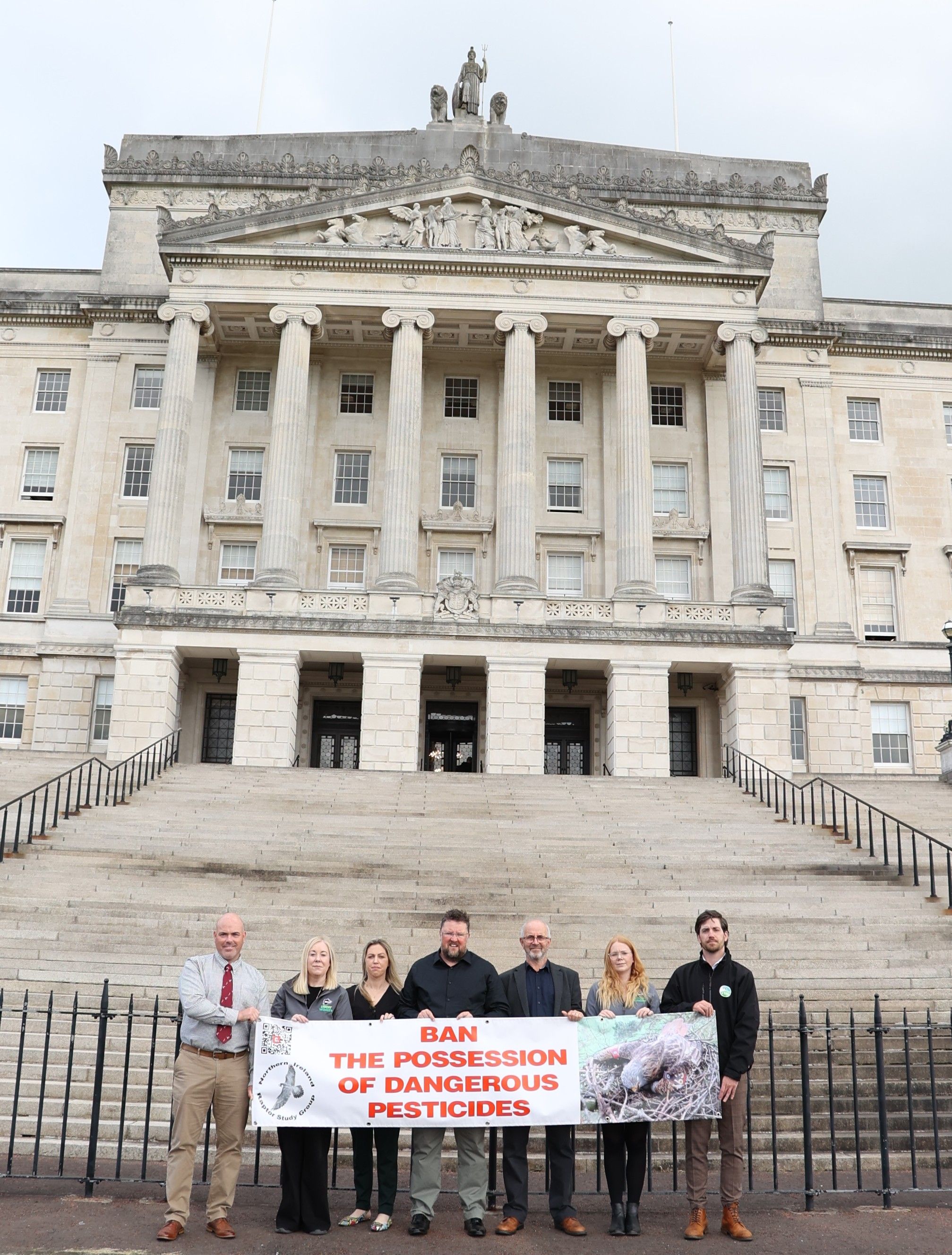
That petition attracted over 50,000 signatures (including many RPUK blog readers – thank you) and was handed in by the NIRSG to Minister Muir at Stormont last month, with support from the RSPB and Ulster Wildlife.
A week later, the Police Service of Northern Ireland revealed that a Red Kite had been found illegally poisoned in a raptor persecution hotspot in County Down (here).
Minister Muir’s recognition of this long-standing and ongoing issue, and his pledge to actually do something about it, is very welcome news and is in stark contrast to Defra’s pathetic filibustering on the same issue in England.
Huge congratulations to the Northern Ireland Raptor Study Group and their partners – this is a big win.
The debate on banning driven grouse shooting took place at Westminster Hall on Monday 30 June 2025, as a result of Wild Justice’s petition passing 100,000 signatures.
Wild Justice shared its views on the debate in its newsletter this morning, as follows:
On Monday afternoon, and in a 34-degree heatwave, Wild Justice headed to the Houses of Parliament to watch our petition be debated by backbenchers in Westminster Hall. This is the third time in nine years that a petition on this subject has met the criteria for a debate (100,000 signatures) but the first time under a Labour government. A massive thank you to everyone who helped it past the threshold (again).
Following Labour’s woeful response to our petition when it reached 10,000 signatures – in which they stated, ‘The Government has no plans to ban driven grouse shooting’ (see our blog here) – we didn’t have high hopes for a particularly reasoned or informed debate.
Only two Labour MPs turned up to contribute on Monday – the brilliant Olivia Blake MP (Sheffield Hallam), and Sam Rushworth MP (Bishop Auckland). [Ed: actually there was a third Labour MP, Joe Morris from the Hexham constituency, who didn’t make a speech but did make one intervention to ask about introducing vicarious liability for landowners as in Scotland].
As usual, Olivia – whose constituency yielded the highest number of signatures on our petition, and whose residents have to live alongside the polluting smoke and flooding caused by driven grouse moors – was brilliant. As the standalone backer of our petition in the debate, she clearly and firmly articulated her support, highlighting the subjects of air pollution, environmental degradation and criminal activity.
An amusingly dry comment was her suggestion to those employed, often on very low wages, by the industry charging up to £7,000 for a day’s grouse shooting; “If I were a beater, I might be unionising to take more of that profit home to my family.”
Mr Rushworth’s arguments were less coherent, stating firmly his dedication to animal welfare and his stance against fox hunting, whilst also defending an industry known for its illegal persecution of birds of prey and its legal, yet unethical, killing of wildlife such as the routine killing of foxes, referred to by the industry as ‘vermin’.
Why did so few Labour MPs – and not a single Green MP – turn up to the debate? Is this subject deemed by them to be in the ‘too difficult’ category? Are Labour perhaps wary of upsetting other ‘countryside’ groups after the reprisals over their unpopular ‘family farm tax’ proposals? Or do they simply not care about the widespread criminality and environmental damage associated with driven grouse shooting?
We know lots of you contacted your MPs over the last few weeks and asked them to attend the debate on Monday – so they can’t argue that they were unaware of the issues or of the debate. It would be interesting to hear how they account for their absence if any of you decide to challenge them on it.
Ban Driven Grouse Shooting – a game of BINGO
Although there was an almost empty house to defend our petition, we did enjoy a full house of grouse shooting BINGO. When challenged on its bad practices and poor track record, the driven grouse shooting industry has a few well-rehearsed and worn-out lines it peddles on repeat. Watching the debate on Monday we enjoyed crossing off the usual list of cliches, tropes and outright lies.
Some of our highlights included:
Claims that the driven grouse shooting industry has a ‘zero tolerance for raptor persecution’. Last week the RSPB published new figures which showed 102 Hen Harriers have been confirmed or are suspected to have been illegally killed between 2020 – 2024, mostly from areas managed for driven grouse shooting in northern England.
By the way, Greg Smith MP gets the star bonus prize for the most absurd statement which made us laugh out loud during the debate: ‘Gamekeepers are not the enemy of the hen harrier; they are its strongest ally in the uplands’. Mr Smith (a self-declared member of the Countryside Alliance & BASC) can look forward to a fruitful career on the panto circuit when his parliamentary career is over.
‘The UK has 75% of the world’s heather moorland, which is ‘rarer than rainforest’’. Upland heather moorland is an artificial, man-made habitat created by management techniques including burning vegetation on vast areas of peatland, causing air pollution and increasing carbon emissions. The ‘75%’ myth is also totally inaccurate and was debunked six years ago in this excellent blog by Professor Steve Carver of Leeds University.
‘Managed grouse moorland also provides a defence against tick-borne diseases’. This desperate claim came from Shadow Defra Minister Robbie Moore MP, and its irony wasn’t lost on us. A recent scientific study suggests that ticks found in woodlands where lots of Pheasants are released are two and a half times more likely to carry Lyme disease bacteria than ticks found in woodlands where no Pheasants are released (see here). Perhaps the ‘guardians of the countryside’ should consider stopping the annual release of 50 million non-native Pheasants if they’re so concerned about the prevalence of tick-borne diseases.
Daniel Zeichner, Defra Minister for Food Security and Rural Affairs, rounded off the ‘debate’ by providing the Government’s position on our petition. He repeated Labour’s earlier stance about having no plans to ban driven grouse shooting but this time adding, “we keep options under close review”. Not close enough, obviously.
He did acknowledge the cast-iron link between driven grouse shooting and the illegal persecution of birds of prey but then feebly muttered, “There are strong penalties in place for offences committed against birds of prey and other wildlife, and anyone found guilty of such offences should feel the full force of the law. Penalties can include an unlimited fine and/or a six-month custodial sentence” (emphasis is ours).
These statements are routinely trotted out by Defra in an attempt to gaslight the public into thinking there’s no need to worry about illegal raptor persecution because measures are in place to tackle it. The very reason that raptor persecution continues on driven grouse moors is because the criminals there know that (a) there is only a miniscule chance of being caught, and (b) even if they are caught, the punishment is of little consequence. The one, and only, custodial sentence ever given to a gamekeeper for committing raptor persecution offences was a case in Scotland in 2014, when a gamekeeper was filmed by the RSPB trapping a Goshawk and clubbing it to death with a stick, amongst other offences. He was given a four-month custodial sentence. Every other gamekeeper convicted since then has received either a small fine (probably covered by his employer) and/or a short community service order.
There’s no effective deterrent and Labour’s trite regurgitation of the words ‘should’ and ‘can’ demonstrates its appalling unwillingness to stop this brazen criminality. That is unforgiveable.
There was one spark of credibility in the Minister’s closing speech, and that was his referral to the Government’s recent public consultation on proposals to extend the Heather and Grass etc. Burning (England) Regulations 2021, including a change to the definition of deep peat from 40cm depth to 30cm depth, which would effectively ban the burning of heather on many driven grouse moors across northern England. It was evident from the speeches made by the Conservatives in the debate that this issue is of HUGE concern to them and their grouse-shooting mates. We look forward to hearing the Government’s announcement on those proposals in the near future.
John Lamont MP (Berwickshire, Roxburgh and Selkirk) first introduced and then concluded the debate, saying in reference to the petition’s 104,000 signatories, “I suspect those people will be a little surprised by the lack of balance in this debate.”
Was Wild Justice surprised at this lack of balance? No, not at all. But motivated? Absolutely. We will of course not be giving up when it comes to the fight to end this environmentally damaging and unjust so-called ‘sport’, mired in wildlife crime and savage animal cruelty.
Onwards and upwards!
ENDS
I must confess that I pretty much zoned out during the ‘debate’, such was the predictability of the propaganda/speeches from the pro-grouse shooting MPs. I was mostly interested in what DEFRA Minister Daniel Zeichner would have to say at the end of the debate. Whilst waiting for him to speak, though, my ears did prick up at the specific mention of some infamous grouse moor areas.
We had Kevin Hollinrake MP (Conservative, Thirsk & Malton) say this:
“I have beautiful moorland, including in Hawnby, Bransdale, Farndale, Snilesworth and Bilsdale—I am very proud of those areas and have visited a number of times“.
The grouse moors of the North York Moors National Park have long been identified as a raptor persecution hotspot, and North Yorkshire as a whole is repeatedly recognised as the worst county in the UK for reported raptor persecution crimes. Not much to be proud of there, Mr Hollinrake.
Sam Rushworth MP (Labour, Bishop Auckland), whose constituency includes some notorious grouse moors in the North Pennines, which is another well-known raptor persecution hotspot, spoke about attending a recent ‘Lets Learn Moor’ event with primary-age schoolchildren. He also mentioned being “disgusted by the criminality that sometimes occurs on the moorland“. I wonder if he realises that these events, funded by BASC, are facilitated by the Regional Moorland Groups, many of whose members have been under police investigation into suspected and confirmed raptor persecution crimes? Awkward. [Ed: Update 3 July 2025 – Pro-grouse shooting Labour MP Sam Rushworth received £10,000 donation from local grouse moor gamekeeper group – here].
And then there was Jim Shannon MP (DUP, Strangford, NI), a fully-signed up member of the Countryside Alliance, BASC and the Ulster Farmers Union, who treated us to this:
“I want to mention the Glenwherry shoot, which is the only grouse shoot in Northern Ireland. It is sponsored by BASC and the landowner. It is a success, but why is that? To start with, Glenwherry had no more than about 10 grouse, but it built that up. As others have said, the magpies, the crows, the greybacks, the foxes and the rats —all the predators—were controlled. It was gamekeepered, and the heath and moorland was burnt in a controlled burning, so that it could regenerate and produce the heather for the young birds and the grouse. Today, that is a successful grouse shoot. Why is it successful? Because grouse shooters know how to do it. They know how to deliver a successful grouse shoot. The lapwings and curlews also gathered momentum as a result. They have a place to breed every year because of the efforts of the gamekeeper and the landowner—the efforts of those who put money into the grouse shooting to make it a success“.
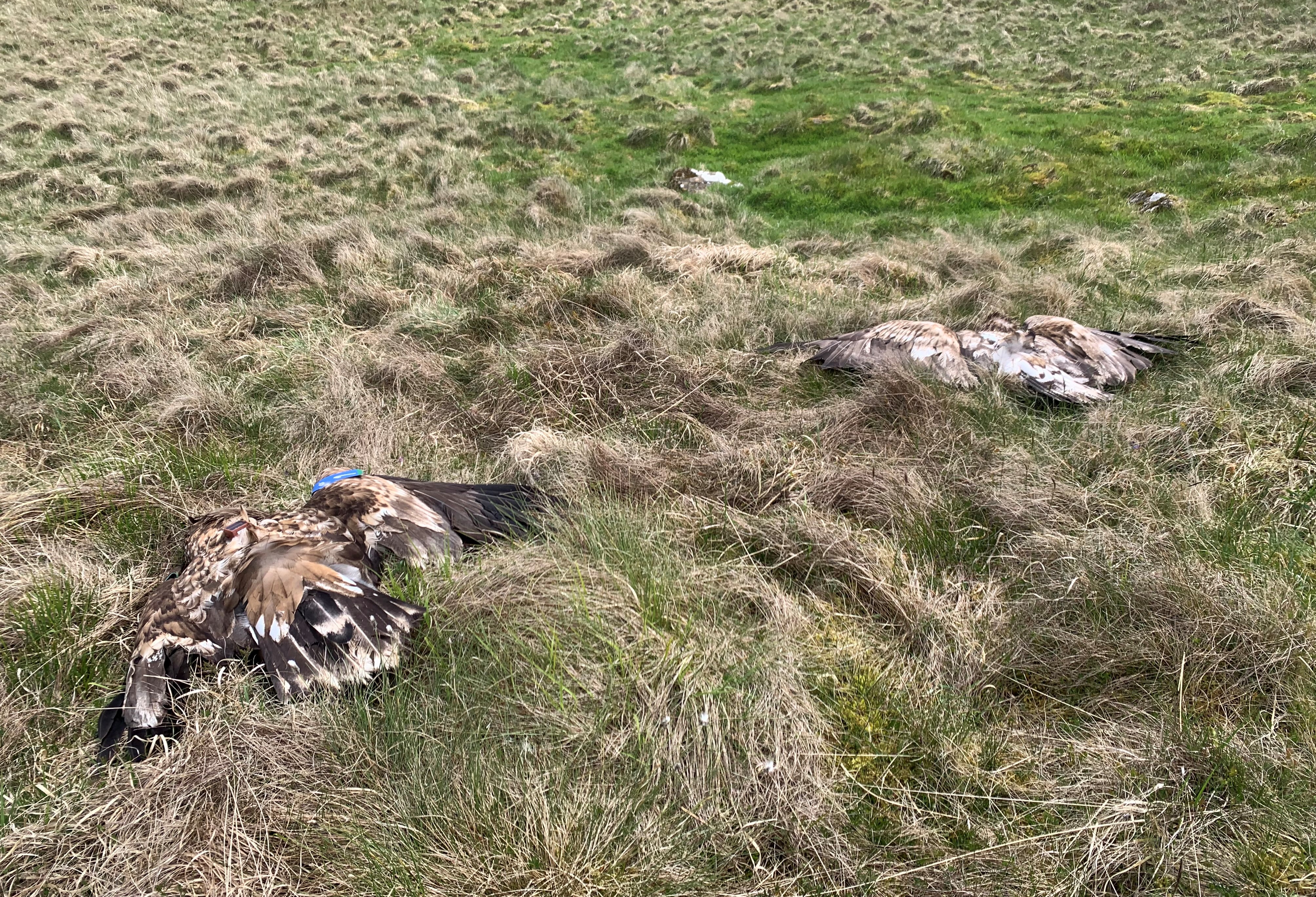
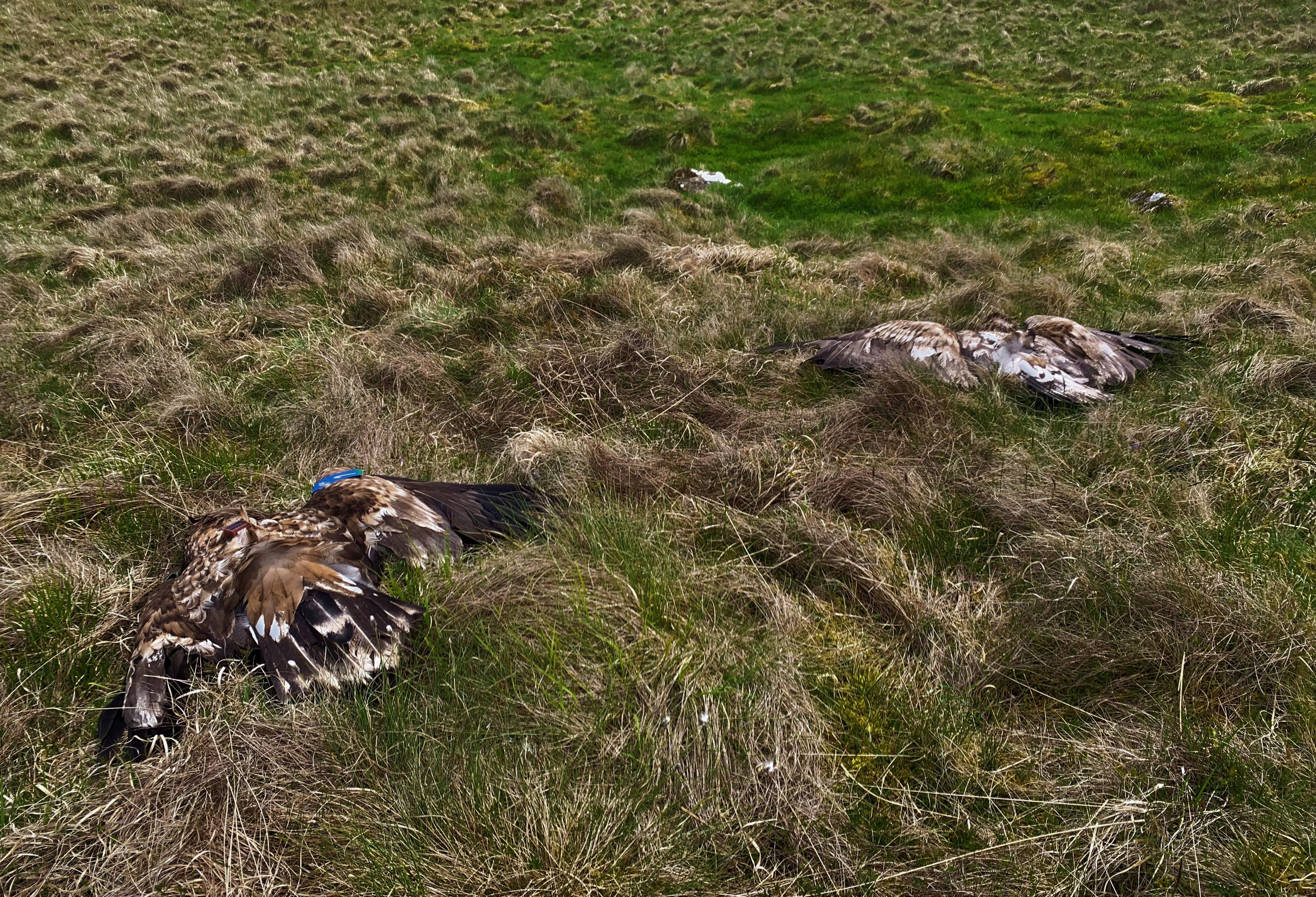
Would that be the same Glenwherry grouse moor shoot where two illegally poisoned White-tailed Eagles were found dead, side by side, in May 2023? Strange that Mr Shannon forgot to mention them.
Two illegally poisoned White-tailed Eagles found dead on Glenwherry, Northern Ireland’s only driven grouse moor. Photo by Northern Ireland Raptor Study Group.
Hen Harriers were mentioned throughout the debate but it was Minister Zeichner’s reference to the Hen Harrier Taskforce, “…which is using technology such as drones and strategic partnerships to detect, deter and disrupt offenders and is targeting hotspot areas and suspected hen harrier persecution” that caught my attention.
Zeichner claimed that, “Early signs suggest that it is having a positive impact“.
Really? That’s not my understanding. The HH Taskforce has been withholding details of multiple suspected and confirmed Hen Harrier persecution incidents over the last year. There are probably legitimate reasons to withhold information about the most recent cases as the police investigations are active but some of the other cases date back many months, some of them from over a year ago. It is simply not credible to argue that making an announcement about those cases will affect an investigation at this stage. I suspect there are other, political reasons for withholding those cases from the public and I’ll set out my reasoning in future blogs – there’s too much to include here.
For those who want to watch the recording of the Ban Driven Grouse Shooting debate you can find it here.
For those who want to read/download the debate transcript, it’s here:
Press release from Northern Ireland Raptor Study Group (17 June 2025)
50,000-signature petition, calling for a ban on poison possession, handed into Stormont.
Today (17th June), a petition begun by the Northern Ireland Raptor Study Group (NIRSG), calling for the possession of various toxic pesticides to be made illegal, was handed in to officials at Stormont by representatives of the Group, alongside staff from RSPB NI and Ulster Wildlife.
The eagles died after consuming a bait laced with Bendiocarb, a chemical prohibited from outdoor use in Northern Ireland, and were the latest victims in a series of poisoning incidents here that has claimed the lives of over 60 protected birds of prey in recent years.
The two poisoned White-tailed Eagles found dead on a grouse moor in May 2023. Photo by Northern Ireland Raptor Study Group
NIRSG’s raptor officer, Dr. Eimear Rooney said: “The day we recovered the bodies of those two eagles from the hillside at Glenwherry was one of the most upsetting of my career working with Northern Ireland’s raptors. White-tailed Eagles are only just making a return to our skies after being made extinct on the island of Ireland by past human actions over 100 years ago. But it’s not just eagles that fall victim to the criminals illegally using these poisons – it’s Red Kites, Buzzards and Peregrine Falcons as well as people’s pet cats and dogs.”
Dawn Miskelly, Ulster Wildlife CEO, said “Poisons have devastating impacts on raptor populations. Protecting these birds from poisoning is not just about conserving individual species – it’s about safeguarding and preserving biodiversity for future generations. We urgently call on the Assembly to recognise the significant public concern around this issue and act by resolving to create legislation to make the possession of these toxic pesticides illegal.”
Ian Thomson, RSPB’s Investigations Manager added “Similar legislation in Scotland has led to the successful prosecution of a sizeable number of individuals linked to the illegal poisoning of wildlife. There is no legal reason to hold onto these chemicals, long banned from use, but we repeatedly see Northern Ireland’s birds of prey fall victim to these same substances. Making their possession illegal here will make identifying the perpetrators of these crimes more straightforward, will hopefully create a significant deterrent to the illegal use of poison, and most importantly, will help protect wildlife, domestic pets and people from harm.”
Dr Marc Ruddock, also from NIRSG, continued: “The Wildlife Order already includes legislation banning the possession of pesticides containing a proscribed ingredient, but, in the 14 years since that legislation was passed, lawmakers have never produced the required list of proscribed ingredients. This means that highly toxic poisons such as carbofuran and aldicarb, banned from legal use, are being stored and utilised by those wishing to do harm to our wildlife. It is clear that the intention of the legislature, in passing these laws back in 2011, was for the possession of these awful chemicals to be a crime, but the final step to do so was never completed. It needs to be done, now, with no further delays and recognise the public’s considerable concerns and acts quickly to create a pathway to finally resolve this issue.”
The organisations that attended today at Stormont are all members of the Partnership for Action Against Wildlife Crime and previously met with DAERA officials. They were also able to discuss their concerns with Minister of Agriculture, Environment and Rural Affairs, Andrew Muir MLA, yesterday.
Dr. Rooney added “Our meeting with the Minster was welcome and constructive, and he acknowledged that the poisoning of our birds of prey is deeply concerning. We are grateful to Minister Muir for meeting us today at Stormont and receiving the petition.”
ENDS
First of all, many thanks to all of you who signed this petition, which reached 50,000 signatures in March this year (see here).
Secondly, well done to the Northern Ireland Raptor Study Group for curating this campaign, supported by the RSPB and Ulster Wildlife. The illegal poisoning of those two White-tailed Eagles, found on Northern Ireland’s only driven grouse moor in May 2023, was both shocking, and yet not shocking. It’s a sad reflection of what we’ve come to expect on many driven grouse moors across the UK.
The groups did well to secure a meeting with Minister Andrew Muir, but it’s surprising to see it described as “constructive”. What does that mean? The Minister was presented with a petition of 50,000 signatures calling for a ban on the possession of these lethal, unlawful chemicals, and he said what, exactly?
‘Oh yeah, thanks, it’s awful isn’t it, let me think about what we can do about it‘?
The remedy is simple, and obvious. Write the list of proscribed poisons and get it added to section 15B of the Wildlife (Northern Ireland) Order 1985.
It’s not that difficult!
UPDATE 25 June 2025: Police launch investigation after Red Kite killed in poisoning hotspot (here)
UPDATE 6 July 2025: Northern Ireland Minister commits to taking action on illegal poisoning of birds of prey (here)





 Raptor Persecution UK