Stoat killed in illegal trap on grouse moor in Teesdale

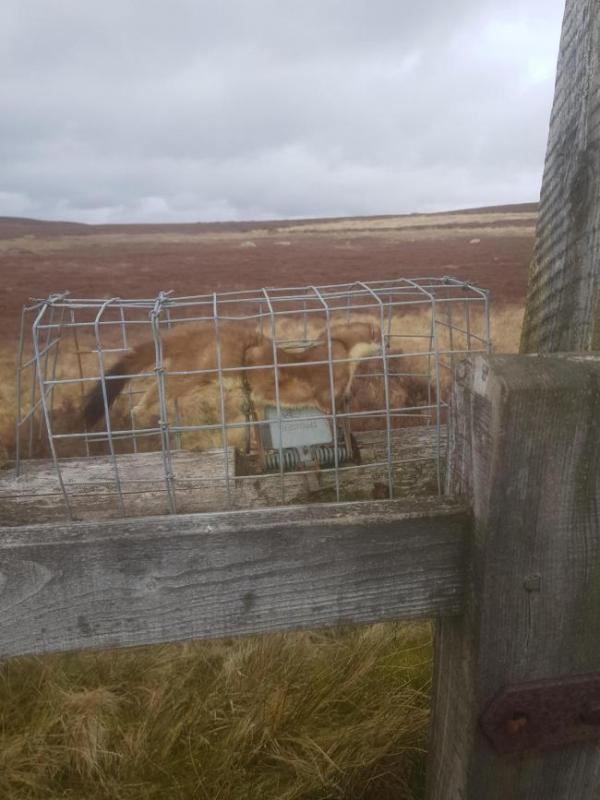
There’s an article in the Northern Echo today reporting the discovery of a dead stoat in an illegally-set Fenn trap on an unnamed Durham grouse moor.

A member of the public had found the stoat and reported it to the League Against Cruel Sports, who reported it to Durham Police.

[Dead stoat caught in illegal Fenn trap on unnamed Teesdale grouse moor, photo via Northern Echo]

An unnamed spokesperson for Durham Constabulary said:

We received reports of a suspected illegal Fenn trap in the Teesdale area and on investigation, found it was illegal and the trap subsequently removed by the landowner.

We would like to remind all those concerned that following new legislation that came into effect on April 1, 2020, the use of Fenn traps and all copycat designs have now been made illegal to trap stoats.

We would encourage landowners to comply and remove any traps that are illegal if they have not already done so.

If members of the public should see any traps which they think are illegal they can contact us by calling 101.”

We’ve blogged previously about the new rules for trapping stoats (see here).

We know that Fenn traps have also been found set in position on other grouse moors since the traps became illegal and we’re aware that at least some of these have been reported to various police forces.

It’ll be interesting to see how long it takes before someone is actually charged with an offence for continuing to use these now-illegal traps for killing stoats, rather than the landowner simply being ‘encouraged to comply’ with the law.

Scottish Government denies ‘negotiating’ with gamekeepers on new offences for trap damage

In early May we blogged about a claim made by the Scottish Gamekeepers Association (SGA) that it was ‘negotiating with Government for a new offence to be created for damage to legal predator control tools‘, i.e. traps and snares (see here).

[A spring (Fenn) trap set on a log, designed to catch and kill any animal that stands on the trigger plate. Gamekeepers argue that traps like these, and others, are routinely damaged by members of the public. Photo from the Untold Suffering report published by the Revive Coalition last year. NB: It is no longer legal to use Fenn traps for killing stoats in the UK as they have been ruled inhumane – new trap designs have recently been approved (see here)]

This claim led to Scottish Greens MSP Mark Ruskell posing two Parliamentary questions earlier this week, asking the Government for details of these alleged ‘negotiations’ (see here).

Environment Cabinet Secretary Roseanna Cunningham has now responded and her answers are hilarious:

Mark Ruskell MSPTo ask the Scottish Government what discussions it has had with the Scottish Gamekeepers Association regarding creating offences and sanctions in relation to animal trap damage, broken down by (a) date and (b) location of discussion. (S5W-28828).

Roseanna CunninghamThe Scottish Government has not had any recent discussions with the Scottish Gamekeepers Association about creating offences and sanctions in relation to animal trap damage.

Mark Ruskell MSPTo ask the Scottish Government how it plans to change the law in relation to the wilful damage of animal traps. (S5W-28829).

Roseanna CunninghamUnder existing legislation and common law a person interfering with a legally set snare or trap may be committing one of a number of possible offences.

The Independent Review of Grouse Moor Management report which was published in December recommended changes to legislation on the use of animal traps. The Scottish Government is currently considering all of the recommendations in the report and will publish a response in due course.

So, in essence then, no, the Scottish Government is not involved in ‘negotiations’ with the SGA as the SGA has claimed, and no, the Scottish Government does not appear to be considering new legislation for the provision of a new offence for alleged trap damage.

Roseanna Cunningham mentions the Government’s ongoing consideration of the recommendations made in the Werritty Review but that review did not include a recommendation for the provision of a new offence for alleged trap damage. What it did recommend, however, was new legislation for trap operators to have to undertake mandatory training before being allowed to set traps!

This begs the question then, why did the SGA claim to be ‘negotiating with Government’ when apparently it is doing no such thing?!

If the SGA could put aside its delusional posturing for a second it’d do well to be spending some time reminding its members of the current legislation on trap use. According to the RSPB this week, ‘the police are following up several raptor persecution cases and multiple reports of illegal trap use on grouse moors‘ (see here). Let’s hope that none of those traps alleged to be being used illegally, belong to an SGA member.

SSPCA appeals for information after crow caught in illegal pole trap

Press release from the Scottish SPCA (12 May 2020)

Scottish SPCA appeals for information after crow caught in illegal trap

The Scottish SPCA has appealed for information after a crow was found caught in an illegal trap in Easthouses Park in Midlothian on 25 April 2020.

Scotland’s animal welfare charity was alerted to the incident by a local resident who managed to free the bird by removing the trap from around its leg.

Scottish SPCA special investigations unit chief inspector, who cannot be named due to undercover operations, said:

The crow flew off but undoubtedly would have sustained serious injury and is likely to have suffered a slow and painful death.

The pole trap is usually designed to catch birds of prey and is illegal to use and possess for use in the UK.

They are primitive, barbaric traps that have no place in modern society. These devices were manufactured at a time when attitudes towards animal welfare were very different.

We are appealing to the local community to pass on any information relating to a person, or persons, illegally killing birds, particularly birds of prey.

These traps are unlawful and indiscriminate and will cause unnecessary suffering to any bird or animal caught in them.

If anyone knows who this device might belong to then we would urge them to phone our animal helpline immediately on 03000 999 999. All calls can be treated confidentially.

Equally, if anyone spots an illegal trap such as this, or a trap or snare they suspect is illegal, please don’t hesitate to contact us.”

ENDS

Parliamentary questions on proposed new offences for trap damage

At the beginning of May we blogged about the Scottish Gamekeepers Association’s claims that it was currently ‘negotiating with Government’ for the creation of a new offence relating to trap damage (see here).

[A spring (Fenn) trap set on a log, designed to catch and kill any animal that stands on the trigger plate. Gamekeepers argue that traps like these, and others, are routinely damaged by members of the public. Photo from the Untold Suffering report published by the Revive Coalition last year. NB: It is no longer legal to use Fenn traps for killing stoats in the UK as they have been ruled inhumane – new trap designs have recently been approved (see here)]

This claim of apparent ‘negotiation’ with the Government is of particular interest, given the Scottish Government’s longstanding and ongoing failure to bring in legislation to licence grouse moor management, despite endless reviews and mountains of evidence, collected over many years, that demonstrate a clear and unequivocal link between grouse moor management and illegal raptor persecution.

It looks like we’re not the only ones with an interest in these claimed ‘negotiations’. Scottish Greens MSP Mark Ruskell has lodged the following Parliamentary questions:

S5W-28828: To ask the Scottish Government what discussions it has had with the Scottish Gamekeepers Association regarding creating offences and sanctions in relation to animal trap damage, broken down by (a) date and (b) location of discussion.

S5W-28829: To ask the Scottish Government how it plans to change the law in relation to the wilful damage of animal traps.

Answers to these questions are due by 19 May 2020.

UPDATE 16 May 2020: Scottish Government denies ‘negotiating’ with gamekeepers on new offences for trap damage (here)

North Yorkshire Police frustrated at ongoing raptor persecution

Following on from the news that yet another shot raptor has been found in Nidderdale AONB (see here), there’s a topical news feature in today’s Yorkshire Post about the ongoing illegal persecution of birds of prey in North Yorkshire.

The article starts off well and focuses on quotes from Inspector Matt Hagen, who leads the North Yorks Police Rural Task Force and also from Supt Nick Lyall, Chair of the Raptor Persecution Priority Delivery Group (RPPDG – the so-called partnership approach to tackling raptor persecution).

Here’s an extract:

The shooting, poisoning and trapping of birds such as red kites and buzzards is a crime previously described by the RSPB as “a stain on our countryside” and has risen in recent years after they were introduced to Yorkshire in the late nineties.

It is thought the offences have been happening for a long time, although increased awareness from the national police campaign Operation Owl has led to a rise in reports from the public.

Nidderdale in particular has been highlighted as a hotspot for the crime, while shootings of birds of prey have also been reported around West Yorkshire.

Disturbingly, there have also been reports of pets being killed after eating poisoned meat left out in suspected attempts at targeting scavenging birds of prey.

Between November 2018 and March of this year, there were 15 crimes recorded in North Yorkshire alone of birds being shot, poisoned or trapped, or tagged birds reported missing. Of these, nine had been shot, including a barn owl found shot in Ryedale in December 2019.

[A shot buzzard found in North Yorkshire in 2018, photo via North Yorkshire Police]

Inspector Matt Hagen, who is Head of North Yorkshire Police’s Rural Taskforce, said: “These crimes are very difficult to investigate because they happen in isolated places and there is often no one around to witness them.

“From what I have seen, some of the people that persecute birds of prey are of the opinion that they diminish the numbers of pheasants, grouse or partridges.

“Many gamekeepers are very pro-conservation, but it just takes one or two individuals in that industry to make a real impact. This is especially the case with hen harriers because they are so endangered. Many birds of prey that are persecuted we find that they were on a grouse moor, or at least near to one of those areas.

“I do know that with the hen harriers, there are not many left in this country, and if this carries on it may well be that they disappear.”

Poisoning is also an issue, where perpetrators leave out poisoned rabbit carcasses for carrion-eating birds such as red kites to find. This poses a risk to local wildlife, pets and even children, police have said.

Insp Hagen added: “We recently had two dogs poisoned in Pateley Bridge, one of whom sadly died. This is still being investigated, but it happened in an area known as a hotspot for these crimes.”

Operation Owl is a campaign originally spearheaded by North Yorkshire Police which has since been made into a national campaign urging the public to be eyes and ears for crimes committed against birds of prey, as most occur in remote areas.

Superintendent Nick Lyall of Bedfordshire Police currently leads the campaign, and has been meeting with the Crown Prosecution Service and senior Government ministers to urge for the crimes to be upgraded from summary-only offences – which can only be dealt with by magistrates and have more lenient sentences – to either-way offences, meaning they can be tried in a crown court.

Supt Lyall said: “We can do search warrants linked to wildlife crimes, but we can’t use our serious crime tactics of covert policing, such as surveillance, to catch these offenders. So for example, if we knew of a nest that was being targeted, we currently can’t put cameras in to see who was disturbing that nest.”

Supt Lyall added that only one or two people are convicted each year for crimes against these birds, with police relying mainly on witnesses as evidence.

“With the remote places these crimes are happening in, that makes it very difficult to prosecute,” he added.

The impact of these crimes is not just felt by the community, but on the environment as well.

A report published by the Nidderdale Area of Outstanding Natural Beauty in September revealed that red kites were failing to expand breeding territory from Wharfedale into neighbouring Nidderdale.

– END OF EXTRACT –

It was pretty accurate reporting up to this point but then it descended in to farce, first with this statement from the journalist:

‘Despite this there is hope, and most gamekeepers and landowners are now strongly committed to conserving all species, with 2019 being a record year for endangered hen harriers breeding’.

There’s a short, but crucially important, word missing from this statement, and that word is ‘say’. As in, ‘…..most gamekeepers and landowners say they’re now strongly committed to conserving all species……’

Of course they’re going to say they’re against raptor persecution – they’ve been saying that for 66 years, ever since the Protection of Birds Act 1954 was enacted. However, all the evidence, of humongous proportions, suggests otherwise!

The article then continues with contributions from Amanda Anderson (Moorland Association) and John Clarke (National Gamekeepers Organisation) both churning out the familiar patter about supposed ‘zero tolerance‘ of raptor persecution and Amanda particularly focusing on the so-called ‘enthusiastic’ support of moorland estates for hen harriers!

She ‘forgot’ to mention the two current police investigations in to the alleged witnessed shooting of hen harriers on two grouse moors and the game shooting industry’s subsequent silence (see here). She also ‘forgot’ to mention the 31 (at least) hen harriers believed to have been illegally killed since 2018, the year when grouse shooting industry reps would have us believe that hen harriers were welcomed back on the grouse moors. She also ‘forgot’ to mention the 2019 research paper that demonstrated that at least 72% of satellite-tracked hen harriers tagged by Natural England were believed to have been illegally killed on British grouse moors.

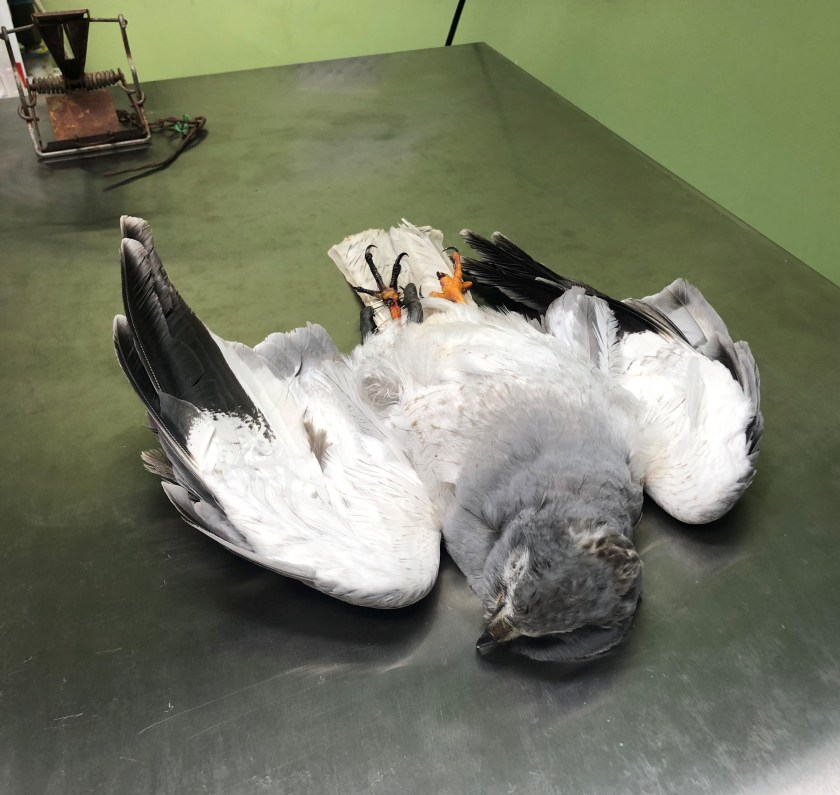
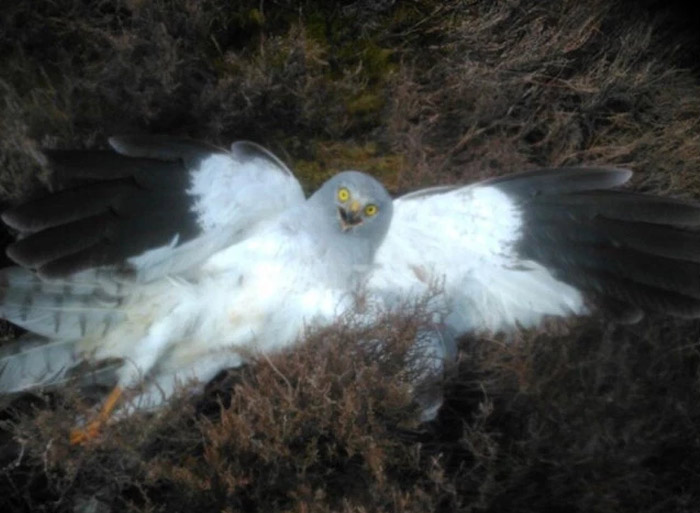
[This hen harrier was caught in an illegally-set spring trap (which almost severed his leg) on a grouse moor on Leadhills Estate last year. He didn’t survive. Read his grim story here. Photo by Ruth Tingay]

Meanwhile, back in the real world unofficial reports from around the UK but particularly from areas managed for driven grouse shooting in the north of England indicate that raptor persecution crimes are still being committed, and that includes hen harriers being targeted yet again.

There’s a famous quote that springs to mind that some journalists would do well to consider:

If someone says it’s raining, and another person says it’s dry, it’s not your job to quote them both. Your job is to look out the f***ing window and find out which is true“.

Scottish Gamekeepers Association ‘negotiating with Government’ for new offence of trap damage

News emerged this week, via the Scottish Gamekeepers Association’s (SGA) e-newsletter for members that it is currently ‘negotiating with Government’ for the creation of a new offence relating to trap damage:

This is really quite interesting. The SGA, with others, has been arguing for several years that legally-set traps have been ‘tampered with’ or damaged by members of the public and these claims usually occur just after an illegally-set trap has been discovered and reported in the media. A recent example of this was the male hen harrier that was found in considerable distress with its leg almost severed in an illegally-set trap on Leadhills Estate (see here).

[Male hen harrier found with an almost severed leg, caught in an illegally-set spring trap next to its nest on Leadhills Estate (see here). Nobody has been prosecuted for this barbaric crime but the estate has had its use of the General Licence restricted by SNH as a direct result of this and other offences (see here)].

The implication of such claims has seemed clear – instead of accepting that some gamekeepers continue to break the law (e.g. by setting illegal traps), the shooting industry would rather deflect the blame on to so-called ‘animal rights extremists’ who are accused of ‘setting up estates’.

During a cross-party RACCE committee hearing in 2013, then Environment Minister Paul Wheelhouse said there was no evidence to support claims of widespread trap tampering/damage by ‘activists’ (see here) although it emerged that BASC was undertaking a survey to assess the extent of this alleged problem.

A couple of years later in 2015 that BASC survey revealed that trap tampering/damage did take place but according to industry evidence, it couldn’t be described as being a ‘widespread’ issue (see here).

In 2017 the SGA again complained of a so-called ‘escalation’ in trap damage and again attributed this to ‘activists’ but as we reported at the time (see here), yet again the evidence was lacking.

Let’s be clear here though. It is quite evident, just looking through social media, that some members of the public are indeed deliberately damaging traps to render them unusable, either because they have an ethical objection to the killing of native wildlife to increase gamebird stocks, or because they’ve become so frustrated with what they perceive to be a lack of enforcement action against the criminal gamekeepers, or because they believe the trap to be illegal. The legislation on trap use is complicated and many members of the public are simply unaware of what is legal and what is illegal. (For a basic introduction have a look at this from OneKind and this from Revive).

To be honest, we’d welcome some clarity on what constitutes ‘tampering’ or ‘damage’. At the moment it is not at all clear and trap tampering may not always constitute a criminal offence. For example, the SGA’s lawyer, David McKie, wrote in a 2013 edition of the SGA’s members’ rag:

As a matter of law, there is a significant difference between interference and vandalism.

Vandalism would involve the breaking of a crow cage trap by someone punching or kicking a hole in it, for example, or the deliberate smashing up of a Fenn trap. It would also include the cutting of snares.

Interference does not necessarily involve a criminal offence….That can involve the removal of traps from their set location, the release of decoy birds or the pulling of snares.

The police can probably not charge the individual with interference’.

In some cases there may be a legitimate defence to causing trap damage – e.g. if a trapped animal is seen to be injured inside a padlocked crow cage trap and needs urgent veterinary attention, but the location is remote and there’s no phone signal to call for help, it might be considered reasonable to cut the trap wire to extricate the wounded animal. Much will depend on the individual circumstances of each incident.

Another example might be the discovery of what is obviously an illegally-set trap. Is it an offence to disable it if there is absolutely no question that it’s been set unlawfully? As an example, here’s a pole trap that was photographed on an estate in the Angus Glens. It’s been an offence to set pole traps for over 100 years!

[An illegal pole trap, photograph by RSPB]

It’d be kind of ironic if a member of the public was prosecuted for disabling such a pole trap, when the person who allegedly set it (a gamekeeper was filmed by the RSPB attending the trap) had the prosecution against him dropped by the Crown Office because the video evidence was deemed inadmissible!

So, yes, regardless of the extent of trap tampering / damage, greater clarity is certainly required on what constitutes an offence. However, given how long we’ve been waiting for the Scottish Government to bring in new legislation to tackle the persistent illegal persecution of birds of prey on sporting estates, that’s happening at such a scale it’s known to be affecting entire populations of some of these species, the trap tampering offence that the SGA claims to be ‘negotiating’ should be way down the list of Government priorities.

UPDATE 12 May 2020: Parliamentary questions on proposed new offences for trap damage (here)

UPDATE 16 May 2020: Scottish Government denies ‘negotiating’ with gamekeepers on new offences for trap damage (here)

Trapping and killing stoats – the new rules

The trapping and killing of wildlife to increase the number of gamebirds available for shooting parties is a daily routine for many gamekeepers.

It is legal to kill some species (e.g. stoats, weasels, foxes, crows) as long as certain conditions are met and it is illegal to kill other species (e.g. most birds including raptors, some mammals) unless a specific licence has been issued for limited purposes.

Earlier this month new legislation was enacted concerning the legal killing of stoats (see earlier blog, here) and there are now General Licences which include new rules and regulations, particularly around the use of Fenn traps, although there is still a lot of uncertainty on some issues.

[A Fenn trap set on a log, photo from the Untold Suffering report published by the Revive Coalition last year]

For those of you interested in this subject there are two excellent blogs that are worth taking the time to read:

The first one is by the animal welfare charity OneKind and it explains some of the welfare issues associated with Fenn traps and why these traps are no longer permitted to be used to trap and kill stoats. Read the blog HERE

The second blog is by author and former police wildlife crime officer Alan Stewart and it explains and critiques the new legislation relating to the killing of stoats. Read the blog HERE

If you’re out walking on your permitted exercise route and you spot one of these traps it’s worth taking a photo, noting the location (use the app What3Words, it’s brilliantly accurate and easy to use) and reporting it. Given the police are pretty busy at the moment it’s probably worth reporting it to OneKind and the RSPB. Their expert staff can assess the photograph and either advise you that the trap looks lawful or they can report it to the police if it looks dodgy.

SSPCA reminds trap operators of animal welfare obligations

Press release from the Scottish SPCA (8th April 2020)

Scottish SPCA appeals to trap and snare operators to fulfil welfare obligation

The Scottish SPCA has appealed for those who operate traps and snares to fulfil their legal welfare obligation of not causing unnecessary suffering to the animals caught in them.

Scotland’s animal welfare charity is offering to assist those who cannot leave their house due to current Government restrictions or if they are self-isolating.

Traps and snares can be set legally to control certain species but because of restriction of movement, they may now be illegal.

[Buzzard caught inside a crow trap. It’s not illegal to trap buzzards in these traps but it becomes illegal if the trap isn’t checked by the operator at least once every 24hrs and the buzzard released immediately upon discovery. Photo RSPB]

Scottish SPCA special investigations unit chief inspector, who cannot be named due to undercover operations, said:

During the pandemic we understand that there is restricted movement and that people may be unwell or self-isolating.

Our concern is that those who may have set traps or snares may be in this situation and not able to get back to them within the legal timeframe of once every 24 hours. We have had evidence of creatures being confined for longer and dying of stress or starvation as a result of not being able to get free.

As the snares and traps will have not been checked within this timeframe, they will now be illegal and the person responsible for them will be breaking the law.

We are here to help anyone who finds themselves in these circumstances. People can contact us and let us know the whereabouts of the devices and we will attend and make them safe so that no animal will suffer.

We are willing to work with land managers and trap snare operators to ensure animal welfare law is being adhered to.

If anyone has any information relating to traps or snares they believe are not being checked, then this can be reported to us in confidence and we will investigate.

People can contact our confidential animal helpline on 03000 999 999 and we will do all we can to assist.”

ENDS

The legal obligation to check a trap at least once within every 24hr period applies only to what are called ‘live catch’ traps, i.e. traps designed to hold the trapped animal, alive. This includes snares and traps such as Larsen and crow cage traps that use live decoys to attract other victims. In Scotland snare operators and crow cage trap operators now need to have unique identification codes placed on their equipment so the police can identify an individual trap user if it is suspected the trap is being used unlawfully and/or is unchecked.

There is no legal duty to check other types of traps that are designed to kill the trapped animal immediately (e.g. legally-set spring traps).

SNH issues new wildlife-killing licences in Scotland

Scottish Natural Heritage (SNH) has issued its new General Licences today, which mostly focus on permitting the killing of some bird species under some circumstances, but there’s also a new General Licence (#14) with new rules on how stoats can be killed.

We blogged about the (then forthcoming) new General Licences for birds back in February (see here) when SNH published some information about the proposed changes.

Although this widespread killing is still mostly unmonitored, uncapped, too loosely regulated and the trap users generally unaccountable for their actions, some of the changes are to be welcomed, including the removal of some bird species from some licences and the removal of General Licences from some protected areas (to be replaced by individual licences) following legal challenges by Wild Justice south of the border.

We particularly welcome the new rule that individual bird trap operators must now register with SNH. Previously the General Licence conditions had stated that live-catch corvid traps (e.g. Larsen traps, Larsen mate traps and multi-catch crow cage traps) had to display an identification number of the trap owner, but this number did not identify an individual trap operator, only the owner, typically the landowner or sporting agent. So if an alleged breach/offence was detected, and the trap was located on a large grouse shooting estate where multiple gamekeepers were employed, it was virtually impossible for the Police to identify an individual suspect (and thus charge anyone) because the estate and gamekeepers simply closed ranks, offered a ‘no comment’ response and failed to identify the actual trap user. It’ll be interesting to see whether SNH knowing the identity of the trap operator will lead to successful prosecutions for mis-use.

[A multi-catch crow cage trap, baited with a live decoy bird and used to capture hundreds of birds which are then killed, often by being beaten to death with a stick. Photo by OneKind]

However, even though there are some welcome changes in the new General Licences there are still many details in need of drastic improvement, not least the paucity of animal welfare considerations.

Late last year, Revive, the coalition for grouse moor reform published a new report authored by coalition members OneKind and League Against Cruel Sports (Scotland) called Untold Suffering, which documented the scale and type of suffering endured by wildlife (and in some cases domestic pets) in various traps deployed on grouse moors.

Today, OneKind has written a blog about the animal welfare implications of the new General Licences for birds and is calling for a comprehensive welfare review (read the OneKind blog here).

Still on the subject of General Licences for birds, Wild Justice continues its legal challenge of the licences recently issued by Natural Resources Wales (NRW) and has written two more blogs about the glaring errors that make those who sanctioned these licences look like fools (see here and here).

The newest General Licence in Scotland (#14) relates to the permitted killing of stoats for the conservation of wild birds or for prevention of serious damage to livestock. Natural England has also issued one and NRW is due to issue one today. This legislation has been in the pipeline for a few years as the UK has to now comply with the Agreement on International Humane Trapping Standards.

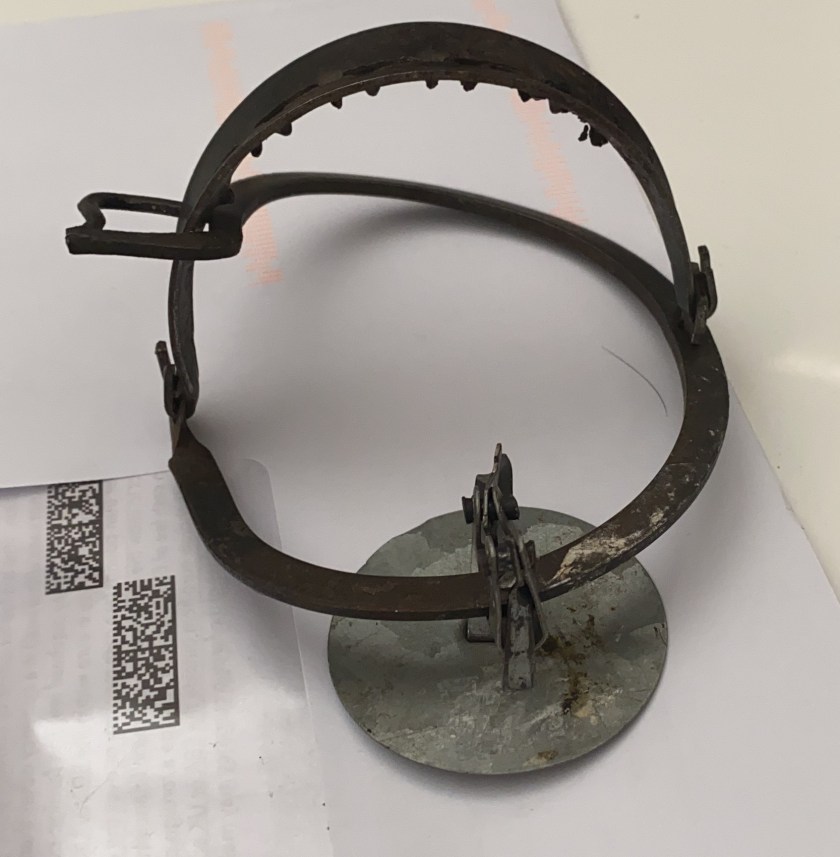
We don’t intend to go in to detail right now but the main point here is that stoat-killers are no longer permitted to use the Mark 4 Fenn (spring) trap for stoats, although apparently it is still a legal trap for rats and weasels as long as the conditions of the Springs Traps Approval Order are met. Instead, five new and apparently humane traps have been authorised by the new General Licence for killing stoats.

[The Mark 4 Fenn Trap is no longer permitted for catching stoats in the UK]

It’s not clear to us whether gamekeepers are still permitted to set the Mark 4 Fenn traps on the pretence of catching rats or weasels (but really still targeting stoats). If a stoat is captured will the trap operator be able to claim it as ‘accidental by-catch’? Or should the new legislation be interpreted in a way that gamekeepers should not set these traps in areas where the risk of catching stoats is high? And how would that risk be measured?

Time will tell, because inevitably there will be gamekeepers who will ignore the law and use these traps illegally, just as they’re still being used as illegal pole traps over one hundred years after pole-trapping was banned!

[A Mark 4 Fenn trap being used as an illegally-set pole trap, photo by RSPB]


(Another) hen harrier shot on a grouse moor in Yorkshire Dales National Park – police arrest suspect

Just five days ago we blogged about the shooting of a male hen harrier on a grouse moor in the Bowland Area of Outstanding Natural Beauty, just across the boundary of the Yorkshire Dales National Park, that had been witnessed by a member of the public. Impressively, North Yorkshire Police arrested a suspect and he has been released pending further enquiries and forensic testing (see here).

Here we go again.

ANOTHER hen harrier has been shot on ANOTHER grouse moor, this time inside the Yorkshire Dales National Park and again it was witnessed by members of the public and again, North Yorkshire Police have arrested a suspect.

Here’s the police press release, published today (17 March 2020):

Two members of the public witness Hen Harrier being shot near Grassington

North Yorkshire Police are investigating the shooting of another Hen Harrier.

Two members of the public witnessed an incident which they believed was the shooting of a male Hen Harrier.

The incident occurred on Threshfield Moor at approximately 10.45hrs on Monday 27th January 2020.

North Yorkshire Police have been conducting enquiries and a man has been arrested in connection with this investigation.

Anyone with further information about this incident or who may have seen anything in the area shortly before the bird was shot, please call North Yorkshire Police on Tel 101 quoting reference # 12200015792.

If you wish to remain anonymous you can pass information to Crimestoppers on 0800 555 111.

This is the second incident of this type to take place in the last six months, with another hen harrier believed to have been shot in October 2019 near Keasden.

ENDS

Hang on a minute – Threshfield Moor? That rings a bell.

[RPUK map showing location of Threshfield Moor in the Yorkshire Dales National Park]

[Photo of the Threshfield grouse moor by Chris Heaton]

Ah yes, Threshfield Moor was reportedly the last known location of another male hen harrier, called John, who ‘disappeared’ in suspicious circumstances in October 2017 – see here.

The people believed to be the owners of Threshfield Moor are interesting and they have interesting connections – see here. Obviously they’ll be devastated to learn about the alleged illegal shooting of a hen harrier on their grouse moor and we’re sure will be doing everything they can to assist the police investigation.

Well done North Yorkshire Police – two arrests for two hen harrier shootings in the space of a few months – that’s really impressive work and the officers involved deserve much credit. There’s clearly some evidence to support reasonable suspicion of involvement because otherwise these arrests wouldn’t have been possible but whether there’s sufficient evidence to proceed to prosecution(s) remains to be seen. Whatever the outcome(s), these latest police investigations in to the alleged shooting of hen harriers on grouse moors expose the shooting industry’s desperate propaganda campaign for what it is and Natural England/DEFRA’s wilful blindness to the bleeding obvious.

So, grouse shooting industry, how’s that professed ‘zero tolerance‘ of illegal raptor persecution going?

So, Natural England /DEFRA, how that’s seriously flawed Hen Harrier (In)Action Plan working out?

Here’s a clue -let’s add the shooting of this latest hen harrier to the ever-expanding list of hen harriers (at least 31 now) believed to have been illegally killed since 2018, the year when grouse shooting industry reps would have us believe that hen harriers were welcomed back on the grouse moors:

February 2018: Hen harrier Saorsa ‘disappeared’ in the Angus Glens in Scotland (here). The Scottish Gamekeepers Association later published wholly inaccurate information claiming the bird had been re-sighted. The RSPB dismissed this as “completely false” (here).

5 February 2018: Hen harrier Marc ‘disappeared’ on a grouse moor in Durham (here)

9 February 2018: Hen harrier Aalin ‘disappeared’ on a grouse moor in Wales (here)

March 2018: Hen harrier Blue ‘disappeared’ in the Lake District National Park (here)

March 2018: Hen harrier Finn ‘disappeared’ near Moffat in Scotland (here)

18 April 2018: Hen harrier Lia ‘disappeared’ in Wales and her corpse was retrieved in a field in May 2018. Cause of death was unconfirmed but police treating death as suspicious (here)

8 August 2018: Hen harrier Hilma ‘disappeared’ on a grouse moor in Northumberland (here).

16 August 2018: Hen harrier Athena ‘disappeared’ on a grouse moor in Scotland (here)

26 August 2018: Hen Harrier Octavia ‘disappeared’ on a grouse moor in the Peak District National Park (here)

29 August 2018: Hen harrier Margot ‘disappeared’ on a grouse moor in Scotland (here)

29 August 2018: Hen Harrier Heulwen ‘disappeared’ on a grouse moor in Wales (here)

3 September 2018: Hen harrier Stelmaria ‘disappeared’ on a grouse moor in Scotland (here)

24 September 2018: Hen harrier Heather ‘disappeared’ on a grouse moor in Scotland (here)

2 October 2018: Hen harrier Mabel ‘disappeared’ on a grouse moor on the edge of the Yorkshire Dales National Park (here)

3 October 2018: Hen Harrier Thor ‘disappeared’ next to a grouse moor in Bowland, Lanacashire (here)

26 October 2018: Hen harrier Arthur ‘disappeared’ on a grouse moor in the North York Moors National Park (here)

10 November 2018: Hen harrier Rannoch ‘disappeared’ on a grouse moor in Scotland (here). Her corpse was found nearby in May 2019 – she’d been killed in an illegally-set spring trap (here).

14 November 2018: Hen harrier River ‘disappeared’ on a grouse moor in the Nidderdale AONB (here). Her corpse was found nearby in April 2019 – she’d been illegally shot (here).

16 January 2019: Hen harrier Vulcan ‘disappeared’ in Wiltshire close to Natural England’s proposed reintroduction site (here)

7 February 2019: Hen harrier Skylar ‘disappeared’ next to a grouse moor in South Lanarkshire (here)

22 April 2019: Hen harrier Marci ‘disappeared’ on a grouse moor in the Cairngorms National Park (here)

11 May 2019: A male hen harrier was caught in an illegally-set trap next to his nest on a grouse moor in South Lanarkshire. He didn’t survive (here)

7 June 2019: A hen harrier was found dead on a grouse moor in Scotland. A post mortem stated the bird had died as a result of ‘penetrating trauma’ injuries and that this bird had previously been shot (here)

11 September 2019: Hen harrier Romario ‘disappeared’ on a grouse moor in the Cairngorms National Park (here)

10 October 2019: Hen harrier Ada ‘disappeared’ on a grouse moor in the North Pennines AONB (here)

12 October 2019: Hen harrier Thistle ‘disappeared’ on a grouse moor in Sutherland (here)

18 October 2019: Member of the public reports the witnessed shooting of a male hen harrier on White Syke Hill in North Yorkshire (here)

November 2019: Hen harrier Mary found illegally poisoned on a pheasant shoot in Ireland (here)

January 2020: Members of the public report the witnessed shooting of a male hen harrier on Threshfield Moor in the Yorkshire Dales National Park (this post)

There are two more satellite-tagged hen harriers (Tony & Rain) that are reported either confirmed or suspected to have been illegally killed in the RSPB’s Hen Harrier LIFE Project Report but no further details are available.

And then there were last year’s brood meddled hen harrier chicks that have been reported ‘missing’ but as they’re carrying a new type of tag known to be unreliable it’s not known if they’ve been illegally killed or if they’re still ok. For the purposes of this mini-analysis we will discount these birds.

So that makes a total of at least 31 hen harriers that are known to have either ‘disappeared’ in suspicious circumstances or have been witnessed being shot or have been found illegally killed in the last two years. And still we’re expected to believe that everything’s perfect, that the grouse shooting industry is not riddled with armed criminals and that hen harriers are doing just fine, thriving even, according to the shooting industry’s propaganda.

Wilful blindness, writ large.

[This male hen harrier was found with his leg almost severed, trapped in an illegally-set spring trap on Leadhills Estate grouse moor in May 2019. He didn’t survive. Photo by Ruth Tingay]