Eight month prison sentence for illegal sale of stuffed birds of prey

A Bedfordshire man has been sentenced to eight months in prison for the illegal sale of stuffed birds of prey.

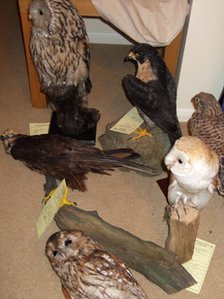
Greg Turner, 32, of St Peter’s Court, Ashwood Close, Potton, described as ‘an unemployed stuffed bird enthusiast’, was reported to have illegally sold over 100 birds on Ebay, netting £22,000. The species included red kite, marsh harrier, goshawk, peregrine, kestrel, barn owl, tawny owl and hawk owl. When officers from the National Wildlife Crime Unit raided his home, they found stuffed birds, two dead birds in his freezer waiting to be stuffed, and forged paperwork.

Kudos to the National Wildlife Crime Unit for their investigation and special mention to Judge Stuart Bridge, who said the following at Luton Crown Court:

In my judgement this was your livelihood, illegally trading in stuffed specimens. It was pre-planned, blatant and calculated and put live birds at risk. You took a risk hoping you would not be noticed. I am told that you have ceased trading and are in work but the seriousness of the offence can only be adequately reflected by immediate custody“.

An excellent result – finally, here’s a judge willing to use the full force of his sentencing powers. Well done to all involved.

BBC news article here

Hertfordshire Advertiser article here

Kim Jong-il is dead but the art of propaganda lives on

North Korean despot Kim Jong-il may be dead but the art of propaganda is alive and kicking here in the UK. A fine example of this is displayed in the latest [January 2012] edition of Modern Gamekeeping, the monthly rag for UK gamekeepers, where there are more calls for the introduction of licences to cull raptors.
It begins in the editorial at the front. Peter Carr dedicates a whole page to the issue of raptor persecution, starting off with condemnation of illegal raptor poisoning [good], but quickly moving on to ‘justify’ the need for legal raptor culling [not so good]. Part of this ‘justification’ includes the following statement:

Buzzards, sparrowhawks, goshawks, hen harriers, and tawny owls are the raptor species that cause us the most problems, though the little owl’s destructive power should not be discounted. All are doing well in most areas of the UK…

Oh dear. But when did facts ever get in the way of 100 year-old anti-raptor propaganda? And here is evidence, should any more be needed, that gamekeepers will not stop at licensed buzzard killing. Sparrowhawks, goshawks, tawny owls and little owls are all apparent targets, and hen harriers too, if they can find any left to kill.

Carr goes on to rally the troops, calling for more strenuous lobbying and “the need for a sensible balance in our countryside“. Presumably that ‘sensible balance’ includes the continued annual release of 40+ million non-native gamebirds into our countryside  and the (mis)management of our uplands to produce artificially-high densities of red grouse, all to the detriment of any native predators that share the habitat?

His editorial ends with this: “Raptor control licences will come, but we must hasten the process with valid argument and an impeccable record of keeping our own house in order“. If these two premises are the ones that will dictate whether raptor culling licences are issued, then conservationists need not fear that they’ll be issued any time soon.

The propaganda continues later in the rag….more on this in the next post…

Scotland’s shame: 2010 poisoning figures published

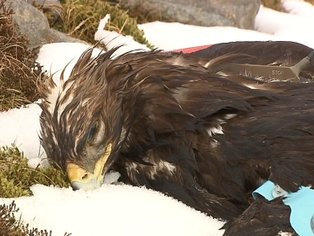
Today the Scottish government has published its latest report on animal poisoning in Scotland. The figures relate to recorded incidents in 2010 and demonstrate a sharp rise in the number of wildlife poisonings, including the widespread illegal poisoning of raptors. The report shows that 69% of all ‘abuse’ cases involved the poisoning of birds of prey, covering a wide area including Borders, Dumfries & Galloway, Highland, Lothian, Strathclyde and Tayside. The illegal pesticide Carbofuran was detected in half of these incidents. The raptors that tested positive for poisons included 40 buzzards, 4 golden eagles, 1 sea eagle, 1 kestrel, 5 barn owls, 2 tawny owls, 2 peregrines, 21 red kites and 11 sparrowhawks.
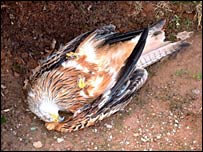
Unsurprisingly, some are trying to play down the appalling statistics. The Scottish Land and Estates Chairman, Luke Borwick, is reported to have said that the organisation is working hard to reduce such incidents “…and there is evidence these joint efforts are beginning to pay off“. He was referring to what he called a “significant decrease” (in illegal raptor poisonings) in the first half of 2011. The Environment Minister Stewart Stevenson also made the same comment. Unfortunately, we are not able to make the assessment for ourselves because the published government figures for 2011 only cover the period January to March 2011. However, the figures for this three-month period tell a very different story to the one that Luke and Stewart are pushing: they include 3 buzzards, 1 golden eagle, 1 red kite and 2 peregrines all illegally poisoned in the first three months of 2011 (see here for earlier report). Hmmm.

There are other reactions from various bodies, including the RSPB, the Police and the Scottish Environment Minister – these can be read on the BBC website here and the Scottish government website here.

To read the depressing SASA government report with all the gory details, click here.

Inverness man accused of buying & selling raptor eggs

According to the BBC, a 51-year-old man accused of buying and selling hundreds of eggs of rare birds is to face trial.

Keith Liddell is alleged to have bought or offered for sale 202 eggs, including those of Egyptian vultures and tawny owls from August 2004 to June 2009. He has also been accused of having 136 wild birds’ eggs at his Inverness property on 24 June 2009. He denies the charges.

At Inverness Sheriff Court, Sheriff Ian Abercrombie set four days for the trial in December. There will be a preliminary hearing to be called on 8 November.

Mr Liddell has been accused of purchasing, offering to purchase, keep for sale or transport for sale, all for commercial gain, eggs from a number of endangered species. He also faces a further charge of being in possession of wild birds’ eggs at his home.

How unusual to see so much detail of alleged wildlife crimes in Scotland being provided in the public domain.

BBC news story here

Poisoned buzzards and bait reportedly found on Edradynate Estate

Following blog posts on 6, 7 and 11 April….

The name of the Perthshire sporting estate raided by Tayside Police earlier this month, following the discovery of poisoned buzzards and poisoned bait in March 2011, has been recently reported on the raptor study group website as Edradynate Estate.

Described by Tayside Police Wildlife Crime Officer Alan Stewart in 2005, “Edradynate Estate, which is owned by an absentee landlord from Hampshire, has probably the worst record in Scotland for poisoning incidents, going back more than a decade. In 14 separate incidents since 1998, 16 poisoned victims (nine buzzards, a cat, a tawny owl, two sparrowhawks, a common gull, a polecat and a crow) and 12 poisoned baits (rabbits, woodpigeons and a pheasant) have been found, with traces of the pesticides mevinphos, carbofuran and alphachloralose”.

His comments were made after the collapse of a trial concerning two gamekeepers from the estate, who were charged with various offences involving the alleged poisoning and trapping of birds of prey. The case was dropped by the Procurator Fiscal, reportedly because of the time taken for the case to be heard. Full story here: http://www.rspb.org.uk/Images/legaleagle43_tcm9-132966.pdf

Since his comments, there have been more discoveries of poisoned birds on this estate, and public denials in the media of any involvement by estate gamekeepers, who claim the dead birds must have been ‘planted’ by someone else. Nobody has ever been convicted for wildlife crime offences on this estate and still the poisoning continues. Let’s hope that Tayside Police are able to detect the perpetrator(s) of the most recent poisoning incident.

Interestingly, it is also reported on the raptor study group website that Edradynate Estate is believed to be a member of the SRPBA and that at least one gamekeeper is a self-confessed member of the SGA. This is difficult to verify though as, conveniently, neither group publicises the names of their members. Both of these groups have made many public statements about how they deplore illegal raptor persecution and how they are working hard to eradicate it. They are both also members of PAW Scotland. It was reported last year that the CEO of the SRPBA paid a visit to Edradynate Estate – perhaps to apply some much needed ‘peer pressure’. If he did, then he is to be congratulated for his efforts, although judging by recent events it would appear that peer pressure was unsuccessful. Or perhaps it was successful, and the latest deaths were attributable to those pesky carcass planters – you know, the ones who have never been seen or heard but who are managing to plant poisoned birds on sporting estates up and down the country…

gamekeeper claims poisoned red kite was “planted”

poisoned red kite

An un-named gamekeeper from the estate in Tayside where a poisoned red kite was found in July 2010 has denied all involvement and claims the dead bird was “planted“.

The self-proclaimed SGA member said: “There is something funny about this and I think someone else has killed this bird and planted it on my estate. Why they have done that, I don’t know“.  This view will come as no surprise to the regular readers of this blog – it is the standard line that is heard so often from the SGA.

He went on: “Anybody who does this should be jailed because it’s not on and I have never done anything like this in my life“.

Interesting that over the last 15 years, the following have all been found dead, confirmed poisoned, on this estate: 9 buzzards, 2 sparrowhawks, 2 crows, 1 gull, 1 tawny owl, 1 pole cat, 1 domestic cat, and now 1 red kite. In addition, 12 poisoned baits have been discovered there (see blog post Aug 27 2010). Whoever is doing the “planting” is managing to maintain a long-term campaign of illegal killing.

Full article about the un-named gamekeeper in The Courier here: http://www.thecourier.co.uk/Living/Outdoors/article/4416/gamekeeper-claims-poisoned-red-kite-was-planted.html

Is Edradynate Estate the place where the red kite was found poisoned?

The location where the dead red kite was found in July (now confirmed to have been poisoned – see earlier blog below) was given by Tayside Police as “Strathtay, near Aberfeldy”, Perthshire. I mentioned a number of sporting estates in my earlier post that have their addresses in this area. I’ve since investigated further and look what I’ve found –

According to Tayside Police’s press release about the latest dead red kite, over the last 15 years the following have been found poisoned in the same area where the recent red kite was found dead – 9 buzzards, 2 sparrowhawks, 2 crows, 1 common gull, 1 tawny owl, 1 pole cat and 1 domestic cat. In addition, they say 12 poisoned baits have also been found.

Compare the above list of dead animals & poisoned baits with the following list of dead animals & poisoned baits, which was reported in the RSPB’s Legal Eagle newsletter (January 2005, #43, page 3) – “In 14 separate incidents since 1998, 16 poisoned victims (9 buzzards, a cat, a tawny owl, 2 sparrowhawks, a common gull, a pole cat and a crow and 12 poisoned baits [rabbits, woodpigeons and a pheasant]) have been found, with traces of the pesticides mevinphos, carbofuran and alphachloralose“.

The 2005 RSPB report relates to the Edradynate Estate, which is situated in Strathtay, near Aberfeldy. Coincidence? You decide.

Nobody was convicted for the earlier alleged offences at Edradynate Estate  thanks to the apparent chronic mishandling of the prosecution case. The Edradynate Estate head gamekeeper (aged 55) and underkeeper (22), both of Aberfeldy, were arrested in 2002 and charged with nine offences relating to the use of poisoned baits and also bird cruelty, including the use of spring traps. On 22 July 2004, two years after the original arrests and 13 court hearings later, the Fiscal dropped the case against them at Perth Sheriff Court. A spokeswoman for the Crown Office admitted the time taken to prepare the case for a trial had been a major factor in the decision to scrap it.

Link to RSPB Legal Eagle #43 here: legal_eagle_43_Jan2005

News report about the failed 2004 court case here: http://www.thefreelibrary.com/Fury+after+’bird+killers’+walk+free.-a0119726014

and here: http://scotlandonsunday.scotsman.com/nature/RSPB-Fury-as-gamekeepers-escape.2548762.jp

Tayside police investigate after dead red kite confirmed poisoned

Poisoned red kite

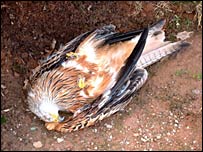
Tayside police have launched an investigation after yet another incident of illegal raptor poisoning. A red kite was found dead in the Strathtay area (near Aberfeldy, Perthshire) at the end of July, and government toxicology reports have confirmed the kite was poisoned.

According to Tayside police, 5 buzzards and a tawny owl met with the same fate in the same area last year. In addition, 9 buzzards, 2 sparrowhawks, 2 crows, 1 gull, 1 tawny owl, 1 pole cat and 1 domestic cat have also been found poisoned in the same region over the last 15 years.

According to the Scottish Raptor Study Groups website, a total of 12 poisoned baits have also been recovered from the same estate where the red kite was found dead.

Tayside Police’s Wildlife Crime Officer Alan Stewart had the following insight:

There is no doubt that the scourge of poisoning wildlife in Scotland has decreased in general terms in recent years. However, there remain a number of ‘hotspots’ that blight our civilisation and our reputation worldwide“.

Alan Stewart

It’s an interesting perspective from someone closely involved with the PAW Scotland group and who really should know better. Has he not read the latest figures that were only published in August this year that demonstrate an increase in illegal wildlife poisoning events? The only thing that has decreased in recent years is probably Tayside Police’s track record of successful prosecutions for raptor persecution incidents.

It’s also interesting to note that once again, the name of the estate involved has not been made public, even though poisoned baits have been found there. There are a number of sporting estates in this area, and it could be any one of the following:

Finynate Estate, Innerwick Estate, Edradynate Estate, Glen Lyon Estate, Chesthill Estate, Remony Estate.

Or may be it’s another estate? Who knows. That’s reassuring for those of you who live in the area, whose children play in the area, whose pets walk in the area, and also for you visitors who come to our countryside to enjoy it, not to find dead raptors or have your dog/child poisoned while out on your holidays.

BBC news story: http://www.bbc.co.uk/news/uk-scotland-tayside-central-11098865

Scottish Raptor Study Groups website: http://www.scottishraptorgroups.org/news.php

“Map of Shame” doesn’t say anything new

Map of Shame 2004-2008

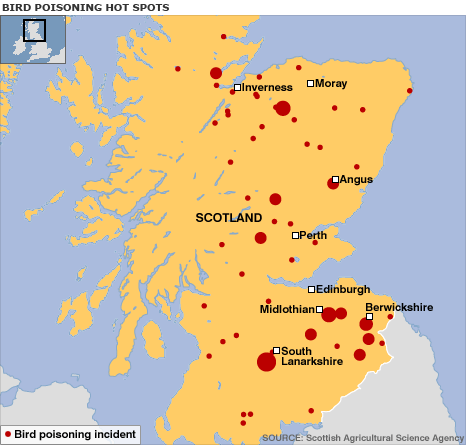
In January 2009, the Scottish government released its ‘Map of Shame’ showing confirmed poisoning incidents between 2004-2008. The map, using data from the Scottish Agricultural Science Agency (SASA), was hailed as a “significant step” in the fight against wildlife crime as it showed the scale of raptor persecution.

In reality, the map doesn’t tell us anything new at all. The RSPB has been producing these maps for years; the difference with this one is that for the first time, the Scottish Rural Property & Business Association (SRPBA) which represents landowners, agreed to its contents.

The map locates 88 incidents in which raptors were poisoned over the previous 5 years, including iconic species such as the golden eagle, white-tailed sea eagle, red kite, buzzard, tawny owl and peregrine.

http://news.scotsman.com/birdsofprey/Bird-of-prey-poisoning-map.4864489.jp

What the map fails to tell us is the name of the shooting estates involved. What is the point of providing such a vague map? There is no point, other than to confirm what was already known – raptor persecution incidents are widespread across Scotland. If the SRPBA is as committed to stamping out wildlife crime as it claims it is, why wouldn’t it take every opportunity to name and shame those known to be involved?

It is not just wildlife-interest groups that are asking for the estates to be named. In September 2009, MSP Sarah Boyack (Scottish Labour) called for the government to name and shame the offending estates and said taking steps to reduce the number of incidents of wild raptors being shot and poisoned was a “matter of urgency”. http://news.stv.tv/scotland/121040-msp-name-and-shame-bird-killers/

The government is due to release the official 2009 raptor poisoning figures shortly….

Eighth red kite to die in scotland from poisoning in 2001

A red kite released in the summer of 2001 as part of a programme to reintroduce the species to Britain was found poisoned later the same year. The rare bird of prey was found in the Balmagie area, north of Castle Douglas in Dumfries & Galloway, and was the 8th red kite to be poisoned in Scotland during 2001. The bird was one of 33 radio-tagged kites released this summer in Dumfries & Galloway. It is the fifth bird of prey that has been found poisoned in the area after the bodies of two buzzards, a tawny owl and a sparrowhawk were found.

Also in 2001, a red kite was found poisoned in the Borders, and six red kites were found poisoned on or near shotting estates in Perthshire, Stirlingshire and Inverness-shire.

Red kites were persecuted to extinction north and south of the border and were reintroduced into Scotland in the late 1980s. In 2001, there were around 40 breeding pairs.

http://www.telegraph.co.uk/news/uknews/1360351/Eighth-red-kite-dies-in-Scotland-from-poisoning.html