Moorland Association’s response to peregrine persecution on Bleasdale grouse moor

The Moorland Association’s response to the RSPB video published on Wednesday is an interesting read.

For new blog readers, the Moorland Association is a lobby group representing the interests of grouse moor owners in England.

Here’s the video again, for those who might have missed it, showing an unidentified individual attending a peregrine nest site where an adult male peregrine had been caught in a spring trap on the nest ledge, and where it thrashed around for over ten hours in a desperate attempt to escape before finally being removed by the unidentified individual. We believe this nest site to have been located on a grouse moor on the Bleasdale Estate in Bowland in April 2016 and that the video footage published by the RSPB related to the prosecution of a Bleasdale Estate gamekeeper – a case that collapsed in April this year due to a series of legal technicalities.

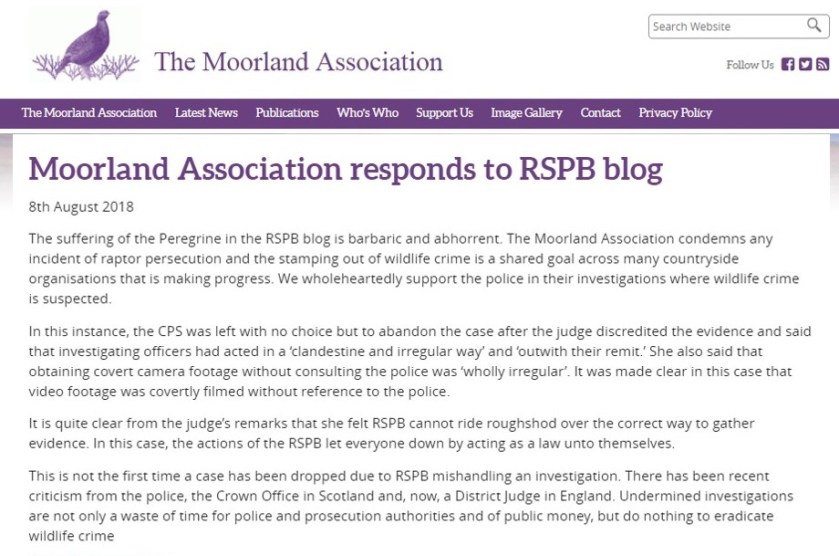
Here’s the Moorland Association’s statement in response to the publication of this video nasty:

The opening line is astonishing: “The suffering of the Peregrine in the RSPB blog is barbaric and abhorrent“.

The peregrine didn’t suffer “in the RSPB blog”, it suffered at its nest site on a driven grouse moor.

A more sincere and accurate Moorland Association statement might have looked like this: “The suffering of the Peregrine in the illegally-set trap that was positioned at the Peregrine’s nest site on a grouse moor on the Bleasdale Estate, a Moorland Association member, is barbaric and abhorrent“.

The rest of the Moorland Association’s statement deflects attention away from the peregrine’s suffering as a result of this crime and instead focuses on trying to undermine the integrity and credibility of the RSPB, as we’ve come to expect.

Not only did the Moorland Association ignore the fact this peregrine suffered on a driven grouse moor (the words ‘grouse moor’ don’t appear anywhere in the MA’s statement!), but it also carefully sidestepped the fact that the grouse moor in question was, at least at the time this footage (and the peregrine) was captured, a Moorland Association member.

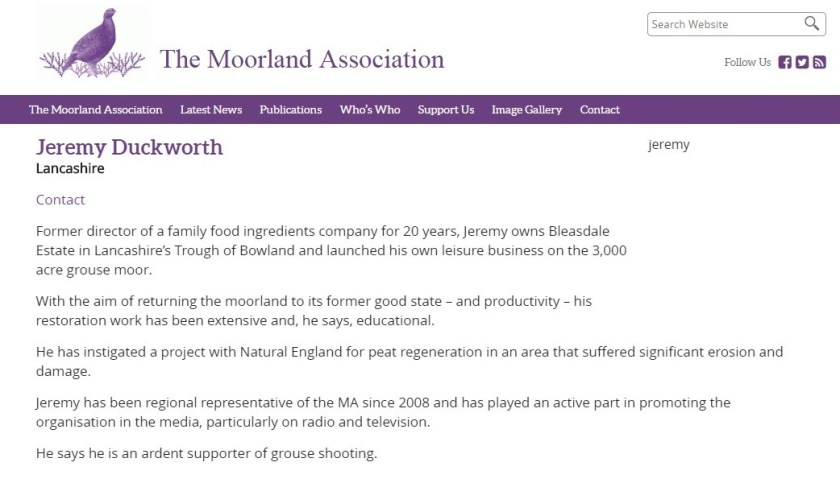
How do we know that? Well, as we blogged back in April 2018 when the court case collapsed (see here), in April 2016 when the alleged offences took place, the owner of the Bleasdale Estate was one Jeremy Duckworth, who also happened to be a Director and Regional Representative of the Moorland Association. Here’s a screengrab from the Moorland Association website in 2016:

Strangely, according to documents lodged at Companies House, Mr Duckworth resigned his Directorship of the Moorland Association in September 2016. There are many different reasons why people resign from Directorships but it’s interesting to note that the timing of Jeremy Duckworth’s resignation coincided with the early stages of the police investigation in to the alleged offences on his grouse moor – obviously nothing to do with damage limitation and purely and simply coincidental, of course:

We wonder whether the Bleasdale Estate is a still a member of the Moorland Association?

We wonder whether the Moorland Association is concerned that an unidentified camouflaged individual was able to repeatedly visit this peregrine nest site on the grouse moor of a Moorland Association member and inflict what looks like unimaginable cruelty to this peregrine?

We wonder whether the Moorland Association is concerned that an unidentified armed individual was able to visit this peregrine nest site and fire four shots as another adult peregrine flew from the nest?

We wonder whether the Moorland Association is concerned about the widespread, systematic persecution of peregrines on driven grouse moors in England, as evidenced by an increasing number of scientific papers (here, here, here)? Incidentally, this last paper, ‘Raptor Persecution in the Peak District National Park’ by Melling et al was published by British Birds in May 2018 but the full paper was only available to BB subscribers. British Birds has now kindly published this paper in full so everyone can read it – see here).

We wonder whether the Moorland Association still expects to be considered a genuine partner in the fight against the illegal persecution of raptors on driven grouse moors when it seems to take every opportunity to attack the RSPB’s Investigations Team instead of those responsible for enabling and carrying out these barbaric crimes?

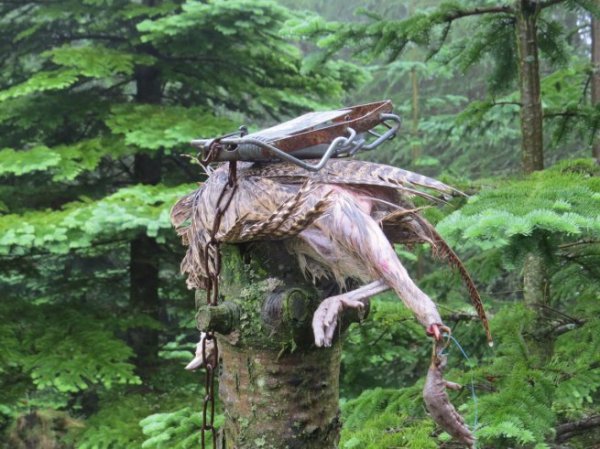
[Photo of an illegally-killed peregrine found next to a driven grouse moor, photo by RSPB]

Peregrine persecution on a grouse moor: Bleasdale video footage finally released

In April this year, a high profile prosecution case for alleged raptor persecution collapsed after covertly-filmed video evidence was deemed inadmissible.

The prosecution was being brought against a gamekeeper from the Bleasdale Estate in Bowland, who had been charged with a string of wildlife offences including the alleged killing of two peregrines in April 2016.

We had followed this case since September 2017, attended each court hearing, and blogged in detail after the case collapsed on a series of technicalities earlier this year (e.g. see here, here, here, here).

The details, as described in court, of what had happened to those two peregrines, were horrific. It was alleged that the adult female peregrine had been shot whilst leaving her nest and the adult male had been caught by the leg in a spring trap that had been set on the nest ledge, where he struggled to escape, in vain, for over ten hours, before being shoved in a bag by an unidentified man and removed from the site.

We’ve been waiting for the RSPB to publish this video footage ever since the case collapsed and the accused walked free. We understand there have been some legal issues about publishing the video and although we don’t know the details, it’s probably a safe bet to guess that some influential people from the grouse shooting industry have probably been working hard to ensure this footage never sees the light of day.

Today the RSPB has released video footage of peregrine persecution in Bowland and although the Bleasdale Estate is carefully not mentioned, it’s quite obvious from the dates cited and the video images that what is being shown in this footage fits the description of what allegedly happened to those two Bleasdale peregrines as desribed to the court earlier this spring.

The RSPB has published a blog describing the circumstances of this footage (here).

Watch the video here but beware, it contains graphic content:

Ater you’ve watched it, think about why nobody has been successfully prosecuted for these crimes.

And then think about why nobody will ever be prosecuted for these crimes.

And then think about why these crimes continue to be committed on grouse moors in 21st Century Britain.

And then think about what you can do to help bring it to an end.

Change must come, but it will only come if people stand up and demand it.

See you at a Hen Harrier Day event this weekend.

UPDATE 10 August 2018: Moorland Association’s response to peregrine persecution on Bleasdale grouse moor (here)

Ring Ouzel is latest victim of ‘vermin’ trap on grouse moor

We’ve been blogging recently about wildlife that has been caught/killed in ‘vermin’ traps set by gamekeepers on grouse moors.

These traps are used to target legal quarry such as stoats and weasels but they often catch other species, as we’ve seen in recent weeks, such as red squirrels, song thrushes, mistle thrushes, red grouse, pied wagtails and kestrels (e.g. see here, here, here). These victims have been aptly described by Dr Rob Sheldon as “collateral damage”.

We have no idea how many innocent victims are killed in these traps, because there is no requirement on the trap user to report the number of animals killed. There must be thousands of them, every year, given the number of traps we know about (at least 2,000 of these traps are set on one grouse moor in the Angus Glens alone).

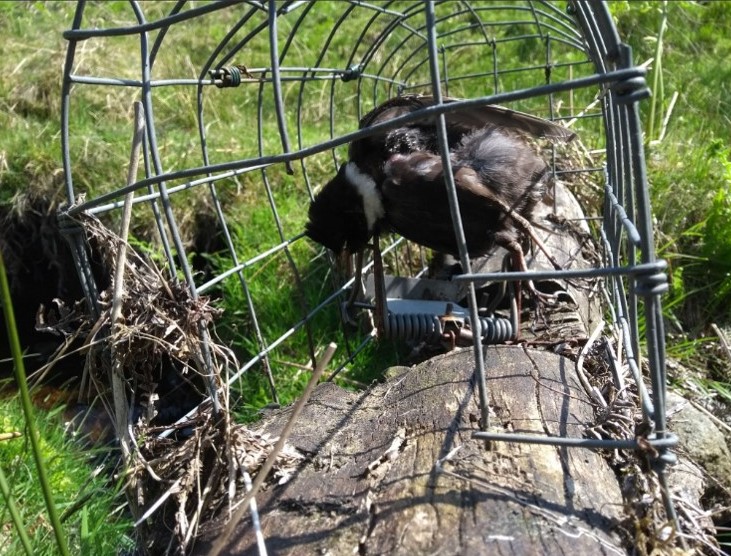
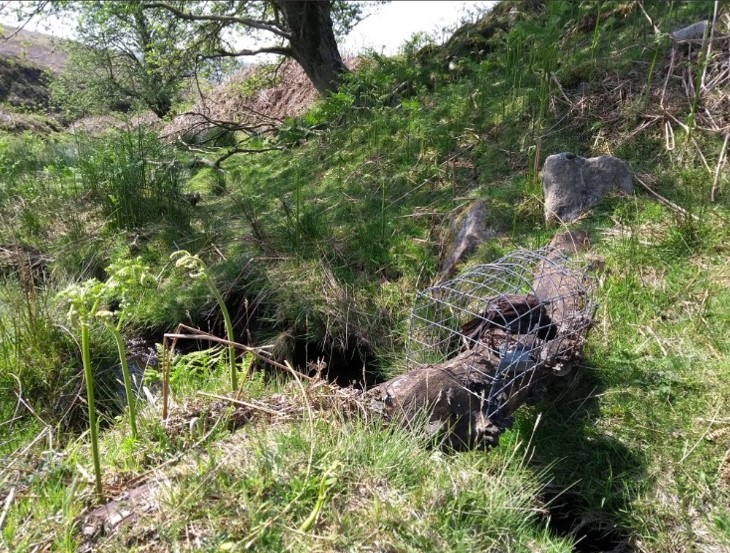
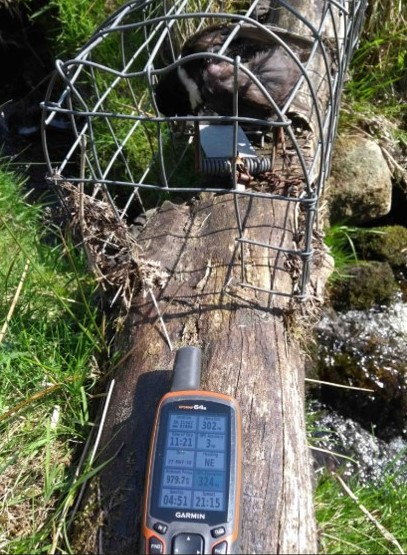
Here’s another victim. This time a Ring Ouzel, photographed dead in a trap on a grouse shooting estate in the Peak District National Park in May this year. If the GPS coordinates in photo #4 are correct, these photos appear to have been taken on the Moscar Estate.

These sorts of traps can be used lawfully as long as certain conditions are applied, e.g. they must be set inside a natural or artificial tunnel and efforts must have been made to restrict the entrance holes to minimise the chances of non-target species getting caught/killed. However, stupidly, the law does not specifiy the min/max dimensions of the entrance holes.

You can see in these photos that efforts to restrict the entrance holes has been made, but clearly not sufficiently to prevent this Ring Ouzel from gaining access and getting killed in the jaws of the trap.

[Photos by an RSPB fieldworker]

Kestrel is latest victim of ‘vermin’ trap on grouse moor

We’ve blogged a bit recently about wildlife that has been caught/killed in traps set by gamekeepers on grouse moors (e.g. see here, here).

These traps are used to kill so-called ‘vermin’ (e.g. stoats and weasels) but we’ve seen plenty of evidence of non-target species also being trapped and killed (e.g. red squirrel, song thrush, mistle thrush, pied wagtail, red grouse, rabbits, ring ouzel).

Here’s another victim – a kestrel this time.

Thanks to the blog reader who sent us the following post from the Walkhighlands forum:

This incident took place on a grouse moor in south Scotland. We contacted the SSPCA for information on the fate of this kestrel. An SSPCA undercover inspector said:

We can confirm that we responded to a call from a member of the public regarding a kestrel that had been reportedly removed from a trap.

Unfortunately due to the severity of the injuries and to prevent further suffering the kestrel had to be put to sleep“.

We understand an investigation is underway to determine whether the trap was set legally or illegally.

Case against Bleasdale Estate gamekeeper collapses as RSPB video evidence ruled inadmissible

We’ve been reporting on the case against Bleasdale Estate gamekeeper James Hartley since September 2017 (see here, here, here, here for previous posts).

Mr Hartley faced 9 charges as follows:

  1. Disturbing the nesting site of a Schedule 1 wild bird (13/04/2016)
  2. Killing a Schedule 1 wild bird (13/04/2016)
  3. Killing a Schedule 1 wild bird (14/04/2016)
  4. Setting trap / gin / snare etc. to cause injury to a wild bird (between 13-14/04/2016)
  5. Taking a Schedule 1 wild bird (14/04/2016)
  6. Possessing a live / dead Schedule 1 wild bird or its parts (14/04/2016)
  7. Possessing an article capable of being used to commit a summary offence under section 1 to 13 or 15 to 17 (13/04/2016)
  8. Possessing an article capable of being used to commit a summary offence under section 1 to 13 or 15 to 17 (between 12/04/2016 – 27/04/2016)
  9. Causing unnecessary suffering to a protected animal – Animal Welfare Act 2006 (between 14/04/2016 – 15/04/2016)

The case collapsed last week after District Judge Goodwin ruled the RSPB video evidence inadmissible at a hearing at Preston Magistrates Court on 28 March 2018.

Reporting restrictions imposed early on in the case prevented us from blogging in detail until the case had concluded. We’re now able to report what happened.

This blog is the first in a series about this case. In this one, we set out the Crown’s case against Mr Hartley, and the defence’s skeleton argument against the admissibility of the video evidence.

Here are the details of the case as presented to the court by the Crown Prosecution Service (barrister: Mr Yip):

On the 11th April 2016 RSPB Investigations Officer [name redacted], in the presence of RSPB Investigations Officer [name redacted], installed a covert video camera pointed towards a peregrine falcon nest site within the boundary of Bleasdale Game Estate in the Forest of Bowland.
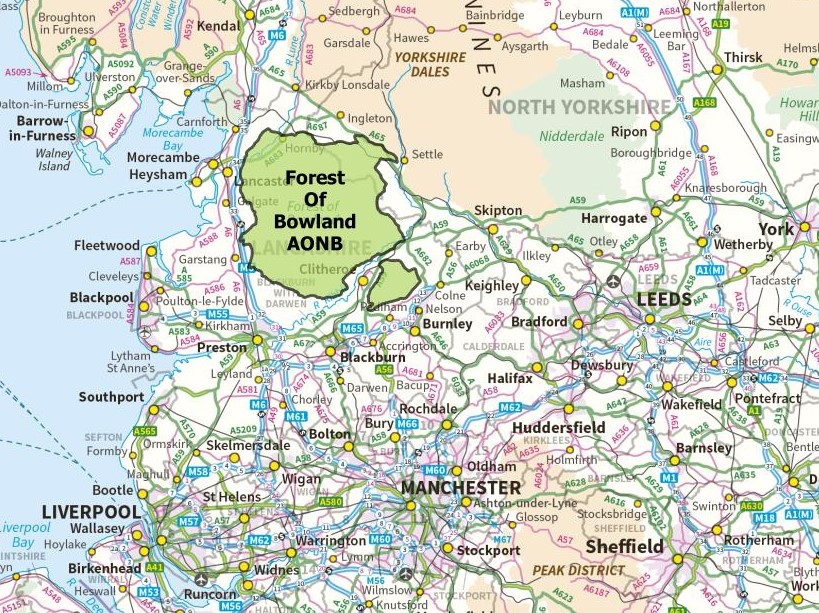
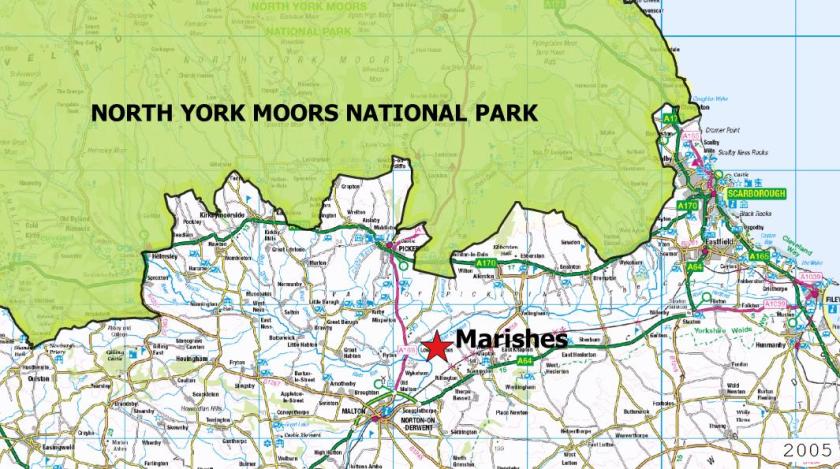
The red star denotes the location of the Bleasdale Estate:

The Bleasdale Estate is owned by Jeremy Duckworth. Mr Duckworth describes the upper moorland as managed for grouse shooting and he employs one gamekeeper for this area, that being the defendant James Hartley.

It is the Crown’s case that the covert camera captured footage which revealed incidents on the 13 and 14 April 2016 where the nest site and birds were interfered with.

The Crown say that a number of clips show that on 13th April 2016 at 19.53hrs an incubating peregrine leaves the nest scrape. This is immediately followed by what appears to be four shotgun discharges. A few minutes later at 19.57hrs a person wearing a camouflage suit and in possession of a hammer attends the nest site for a number of minutes before leaving.

The following morning, 14th April 2016 at 10.29hrs, a peregrine, believed to be the male parent, lands on the edge of the nest ledge and walks in to the nest scrape area. The bird becomes trapped all day in what the Crown say is a spring trap. At 20.25hrs the peregrine is still present. At 23.12hrs a person with a torch visits the site. It is the Crown’s case that the inference is this person had removed the peregrine and the trap as the bird was no longer present the following day.

On 21st April 2016 a number of officers from Lancashire Constabulary and the RSPB attended the nest site area and recovered four eggs and some feathers.

On 26th April 2016 a search warrant was executed and a search was conducted at the defendant’s home address and outbuildings. A green bag containing a number of items was seized from an outbuilding. Forensic DNA analysis from Dr Lucy Webster provides extremely strong support to the proposition that two of the items within this exhibit, an orange handled knife and a wooden handled hammer have been in contact with peregrine falcon.

Between 17.37hrs and 19.11hrs on 24th May 2016 the defendant was interviewed under caution when he declined to answer any questions put to him.

Between 13.16hrs and 13.50hrs on 2nd November 2016 the defendant was interviewed under caution for the second time when he declined to answer any questions put to him.

END

Here is the skeleton argument presented to the court by the defence (barrister: Mr Justin Rouse QC):

The defence seek to exclude the video footage obtained by [RSPB Investigator, name redacted] and the items recovered in the search on the 21 April 2016 under s78 Police & Criminal Evidence Act [PACE] 1984.

S78 PACE provides as follows:

‘…..In any proceedings the court may refuse to allow evidence on which the prosecution proposes to rely to be given if it appears to the court, that, having regard to all the circumstances, including the circumstances in which the evidence was obtained, the admission of the evidence would have such an adverse effect on the fairness of the proceedings that the court ought not to admit it’.

The defence submit that the RSPB have sought to circumvent the provisions of RIPA 2000 [Regulation of Investigatory Powers Act 2000] together with s93 of the Police Act 1997; that they have breached Code B of PACE 1984; that RSPB Investigator [name redacted] was not a data handler for the purposes of the Data Protection Act 1998; that the RSPB chose not to voluntarily adopt the Surveillance Camera Code and/or that the police were bound by that code and that the RSPB were trespassing on the land unlawfully, having failed to seek the permission of the landowner.

END

The full details of the defence’s legal argument will be published in a second blog, along with the judge’s commentary on each of the components of the defence’s argument. For those of us interested in such details it was a fascinating and well-presented argument. And therein lies the crux of this case. In our opinion, the court’s ruling on the video evidence was inevitable, not necessarily because of the strength of the defence’s legal argument, but because of the weakness in the prosecution’s counter-argument against it.

For those of us who sat in the public gallery to observe the legal argument hearing on 14 March 2018, it became apparent, very quickly, that the outcome of this case (and thus, supposed ‘justice’) would be determined by the amount of money available to pay for legal representation.

The representative for the defence was the highly-regarded Mr Justin Rouse QC. We have no idea who paid for his time and expertise (e.g. the defendant? His family? His employer? A representative membership body, e.g. National Gamekeepers Org or BASC?) but whoever it was will no doubt consider it money well spent. It was very clear that Mr Rouse (or his junior) had probably spent a long time in preparation for this case: his presentation was meticulous and thoroughly organised, with every aspect labelled and referenced in a bundle of documents that he’d provided to the judge. On every single point he raised, he was able to tell the judge on which page she should be looking. He was calm, measured and in complete control. A bit of a masterclass.

In contrast, the representative for the prosecution was Mr Yip, who turned up completely unprepared. He arrived without his bundle of evidential documents, muttering something about having left them behind, so he was unable to look up the detail of points raised by the judge. At one point Mr Rouse passed over his own copy of the evidential documents to Mr Yip, to try and help him out. The judge asked Mr Yip several questions about the video evidence and asked to see it (she was particularly interested in the angle of the covert camera and how wide a view it was able to record – a crucial element in deciding whether this was ‘directional’ surveillance, as detailed in RIPA 2000). Astonishingly, Mr Yip told the court he hadn’t seen the video evidence and he didn’t have a copy with him. He was able to produce a couple of still photos from the video but when the judge asked him to point out the position of the nest in the photos, he was unable to do so.

It has been reported on social media that the RSPB “failed to support” this case by “declining” to attend court on 14 March 2018 to answer questions raised by the judge during the legal argument hearing. What utter nonsense. The statement is categorically untrue and is a false claim being made by a group with a long-held and well-documented grudge against the RSPB, presumably with the intention of portraying the RSPB in a bad light. What actually happened was Mr Yip declined to call the RSPB as a witness during that hearing, even after being prompted by the judge, and nor did he ask for an adjournment to allow for him to call an RSPB witness at a later hearing. His reason for this decision is not known (to us) and it proved to be catastrophic for the prosecution’s case.

We think it is fair comment to describe Mr Yip as being ill-prepared for the hearing. However, there may be many reasons for that, beyond his control. It isn’t unusual for the financially-squeezed and under-resourced CPS to drop cases on lawyers at the last minute so for all we know Mr Yip might not have ‘seen’ this case until the night before the hearing. If that is what had happened, it would partly explain the gulf in quality between Mr Rouse’s and Mr Yip’s presentations. That being said, if Mr Yip had not had adequate time to prepare, he could probably have called for an adjournment.

His poor performance did not go unnoticed by the judge and in her ruling delivered to the court on 28 March her criticism was evident. More on this subject in the second blog.

Putting aside for a moment the legal arguments and the standard of presentation, the bottom line is that yet another case of alleged raptor persecution, caught on covert camera, has failed on a technicality (or in this case, several technicalities).

Although the identity of the alleged perpetrator in the Bleasdale case has not been tried and tested in court, there’s no getting away from the fact that the CPS believed the video footage to show that two peregrines appear to have been illegally killed at a nest site on the Bleasdale Estate in 2016. The unidentified perpetrator of this alleged crime will not face justice. Given the catalogue of failed cases under similar circumstances (i.e. covert video footage ruled inadmissible on a technicality), the perpetrators of these crimes have been given yet more impetus to continue, as the chances of successful prosecution these days are almost nil.

No doubt the grouse-shooting industry will jump on this result as an excuse to vilify the RSPB and its approach to investigating raptor persecution crimes. But when the RSPB publishes the video footage of this latest incident, the public will be in a position to judge for itself whether or not the RSPB’s actions were discreditable. Whether the grouse shooting industry likes it or not, public opinion, not court convictions, will ultimately be the deciding factor in addressing the ongoing illegal killing of birds of prey.

UPDATE 13 April 2018: Why the video evidence was ruled inadmissible in the Bleasdale Estate case (here)

UPDATE 16 April 2018: Why other evidence was also ruled inadmissible in the Bleasdale Estate case (here)

UPDATE 16 April 2018: Grouse-shooting industry’s reaction to the failed Bleasdale Estate case (here)

UPDATE 8 August 2018: Peregrine persecution on a grouse moor: Bleasdale video footage finally released (here)

Illegal trap use on GWCT Vice Chair’s shooting estate

Well, well, well.

Last September we blogged about SNH imposing a three-year General Licence restriction on a ‘mystery’ Scottish gamekeeper in response to evidence provided by Police Scotland of alleged raptor persecution crimes. At the time, SNH gave very little information about this case (see here).

After a bit of digging, we worked out that this restriction related to an alleged crime that had happened near Tarland in Aberdeenshire in 2014 where the RSPB had filmed a gamekeeper allegedly baiting an illegal trap close to a goshawk nest:

However, we were unable to establish the name of the estate on which this alleged offence took place and the name of the individual caught on camera setting the trap, as SNH refused several FoI requests and insisted on withholding the information. The name of the individual was withheld under the Data Protection Act – that was fair enough. But we argued that the name of the estate should have been publicised – SNH disagreed.

An article by Severin Carrell in today’s Guardian has finally solved the mystery.

It turns out the individual filmed setting the alleged illegal trap was none other than the Head Gamekeeper of Tillypronie Estate, a grouse and pheasant-shooting estate which at the time was owned by Philip Astor, who was and still is, er, Vice Chair of the Game & Wildlife Conservation Trust (GWCT).

[Estate boundary details from Andy Wightman’s brilliant Who Owns Scotland website]

Gosh, that’s all a bit embarrassing for the GWCT, isn’t it?

Is this why there wasn’t a prosecution and why great efforts were made to keep the details of this alleged crime hushed up?

We wonder if this relationship also had any bearing on SNH’s strange decision to impose a General Licence restriction on an individual, as opposed to the usual practice of imposing it on an estate? Astor sold the estate last year – here is the sales brochure: Tillypronie sales brochure Aug 2016 A three-year General Licence restriction hanging over the estate could have caused obvious difficulties for the sale.

Another unanswered question relates to the Head Gamekeeper’s employment status. The alleged crime took place in March 2014, but according to Sev Carrell’s article, the [unnamed] Head Gamekeeper was still employed at Tillypronie in 2016. That seems a bit odd, doesn’t it? Why would a law-abiding landowner continue to employ an individual who had been caught on camera setting an allegedly illegal trap close to a goshawk nest?

And what of Philip Astor’s position as Vice Chair at the GWCT? Business as usual, eh?

Barn owl with horrific injuries found in North Yorkshire

A barn owl with horrific injuries has been found near Marishes in the Ryedale district of North Yorkshire.

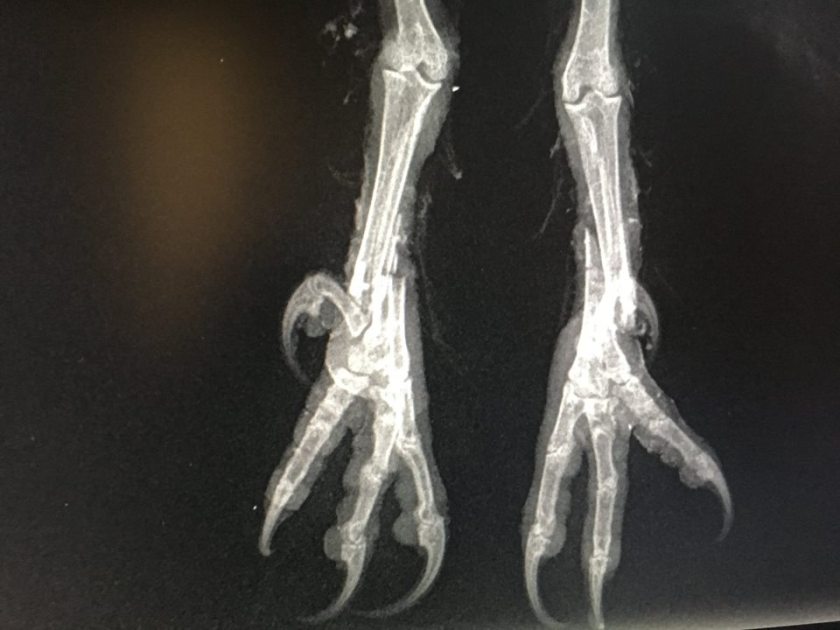
According to expert raptor rehabilitator Jean Thorpe, the barn owl was found close to death. It had suffered two broken legs and its injuries were consistent with having been caught in a spring trap. Jean believes the owl had been released from the trap and then left to die a lingering death, unable to hunt with badly infected wounds.

The owl was taken to Jean’s wildlife centre but died shortly after arrival.

This area is a notorious raptor persecution blackspot. Spring traps are only legal if they are set within either a natural or artifical tunnel to prevent non-target species getting caught in the trap’s jaws.

Anybody with any information about this horrific case please contact Wildlife Police Officer Jez Walmsley at Malton Police Station (Tel: 101).

Photos by Jean Thorpe. Map by RPUK.

Peak District National Park Authority responds to RSPB’s 2016 Birdcrime report

The Peak District National Park Authority has issued a statement in reponse to the publication of the RSPB’s 2016 Birdcrime report.

Sarah Fowler, chief executive of the Peak District National Park, said: “Killing birds of prey is illegal. I am appalled by the persecution of any protected species, no matter what the circumstances.

The RSPB’s latest Birdcrime report brings the plight of birds of prey to the fore. It shows what we are up against in trying to reverse the fortunes of birds of prey. I welcome the recent acknowledgement from shooting organisations that the killing of raptors to protect game birds is part of the problem. It is – and it is damaging to their interests. I welcome and wholeheartedly support their condemnation of such activity.

Being able to watch birds of prey in the Peak District National Park should be part of everyone’s experience.

We have been working with landowners, gamekeepers and partners since 2011 to remedy the situation locally but it is clear from the results that much more needs to be done.

This year peregrines have failed to breed in the Dark Peak for the first time since they recolonised in 1984 and persecution of these incredible birds has been a factor in this. This has to change.

It is incredibly difficult to catch someone in the act or to collect evidence and make a case for prosecution. I appeal to all users of the countryside to help us bring persecution to an end by reporting anything you feel is suspicious to the police. The best hope we have is for law-abiding people within the game bird industry calling out those who operate outside the law.

The Peak District Birds of Prey Initiative will shortly be publishing a report documenting the fortunes of key birds of prey alongside confirmed or suspected incidents of persecution in the moorland areas of the Peak District during 2016 and 2017. On the back of this report, I will look for a renewed commitment from moorland owners and managers in the Peak District to work with us to reverse the fortunes of birds of prey – and a strengthening of this commitment. We cannot achieve this on our own.”

Anyone with information to report about wildlife crime should contact Derbyshire Police on 101 or Crimestoppers on 0800 555111.

ENDS

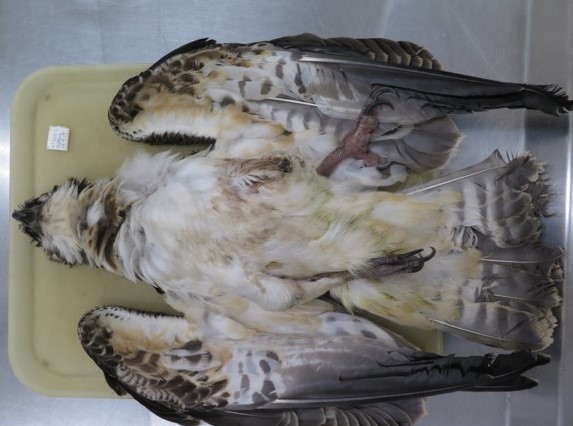
Photo of an osprey found in the Peak District National Park in September 2015. It had two broken legs and succumbed to these injuries soon after being found. The post-mortem stated its injuries were consistent with being caught in a spring trap (Photo by RSPB)

It’s good to see strong condemnation of continued illegal raptor persecution from the Peak District National Park Authority, although, coming a week after the publication of the Birdcrime report it does have a whiff of ‘Oh God, everyone else has commented, we’d better say something too’. Nevertheless, better late than never.

We also appreciate Sarah Fowler’s acknowledgement that the 7-year-long Peak District Bird of Prey Initiative has been a complete and utter failure. She didn’t actually say that – she said, “It is clear from the results that much more needs to be done“, and, with the imminent publication of the Initiative’s 2016 and 2017 annual reports, she said “I will look for a renewed commitment from moorland owners and managers in the Peak District to work with us to reverse the fortunes of birds of prey – and a strengthening of this commitment“.

Hang on. Wasn’t ‘renewed commitment’ from project partners promised in 2015 when the Initiative’s five-year targets had all failed to be met? Ah yes, so it was. And yet, despite that ‘renewed commitment’ we’ve seen continued evidence of illegal raptor persecution within the National Park and now we learn that “This year peregrines have failed to breed in the Dark Peak for the first time since they recolonised in 1984 and persecution of these incredible birds has been a factor in this“.

We don’t want ‘renewed commitment’ from so-called project partners. It’s meaningless bollocks that nobody believes anymore. We’re sick of hearing it and sick of statutory agencies using it to pretend that everything’s going to be ok.

The Peak District National Park Authority needs to start calling out these grouse moor owners, managers and agents, by name, instead of shielding them and their criminal activities within this charade of partnership-working.

SNH refuses to disclose details of individual General Licence restriction

In September 2017 we learned that SNH had imposed a General Licence restriction on an individual for alleged criminal activity in relation to raptor persecution (see here).

This was a highly unusual restriction because it applied to an individual rather than to an estate.

At the time the restriction was announced, SNH provided virtually no information other than to say a General Licence restriction had been imposed and that it would apply for three years.

However, RSPB Scotland released a press statement in relation to this restriction order which included the following quote from RSPB Scotland’s Head of Investigations, Ian Thomson:

The restriction was imposed after RSPB investigations staff passed video footage to police of a gamekeeper allegedly setting illegal traps, baited with a dead woodpigeon, very close to a goshawk nest in NE Scotland”.

Here’s a clip from that video evidence:

From this, we were able to deduce that this alleged wildlife crime took place in March 2014 ‘nr Tarland, Aberdeenshire’, although the specific location was not given.

This alleged offence was reported by Police Scotland to the Crown Office in April 2014 (see here). It is clear, now, that the Crown Office did not prosecute the gamekeeper, probably on the grounds that the video evidence was deemed ‘inadmissible’. That’s the sixth alleged wildlife crime case, that we know about, that the Crown Office has dropped in recent months.

So at this stage we know that an alleged wildlife crime had taken place, we know that a criminal prosecution is not going to happen (because the case is now time-barred), and we know that SNH has imposed an individual General Licence restriction on a gamekeeper as a supposed sanction. The identity of the alleged offender remains a secret, as does the name of the estate where the alleged offence was committed. This lack of transparency is, frankly, appalling, especially when former Environment Minister Paul Wheelhouse had stated when he first introduced General Licence restrictions in 2014 that he expected them to function as “a reputational driver”. Not much chance of that happening when the details of a case are kept secret.

In early October 2017 we submitted an FoI to SNH to try and find out more details about this case. We asked for:

  1. The name of the person who had been given a General Licence restriction (we didn’t expect to be told but thought we’d ask anyway – you never know)
  2. The occupation of that person (we already knew from the RSPB press statement that he was a gamekeeper but we wanted SNH to confirm this)
  3. The name of the county in which this individual resides (we already knew from the RSPB press statement that the alleged offence had taken place in Aberdeenshire but we wanted SNH to confirm this)
  4. The name of the estate from where the Police evidence of alleged raptor persecution had been collected
  5. An explanation about why an individual and not an estate was the recipient of the General Licence restriction
  6. An explanation about how SNH intends to monitor the activities of the individual for potential breaches of his General Licence restriction.

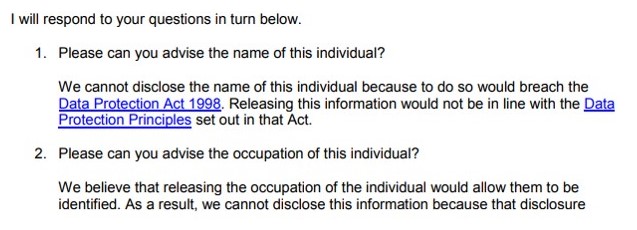
SNH has now responded and it’s astonishing:

It looks like SNH has been taking lessons from Natural England in the withholding of information that should be in the public domain. It’s understandable that SNH can’t disclose the alleged offender’s identity, but withholding details of his occupation and the county in which he resides because “this would allow them to be identified” is obviously nonsense, and we already know this information from the RSPB press release!

We would argue that it is in the public interest to know the name of the estate on which this alleged offence took place (and we do know from various local sources it was on a game-shooting estate and that this gamekeeper was employed by that estate). Why should that information be kept secret? Who is SNH shielding, and why?

And does anyone actually believe that Police Scotland, no matter how well-intentioned, has the resources to track this gamekeeper’s activities for the next three years to ensure he’s not breaching the terms of his General Licence restriction?!

Whilst this response doesn’t get us any further forward in knowing the specifics of this case, what it does demonstrate, quite clearly, is that the General Licence restriction, introduced as a way of publicly embarassing estates where there is evidence of wildlife crime but, due to perceieved evidential difficulties, the cases don’t ever reach the courts, is simply not working.

Tomorrow’s blog, on another General Licence restriction case, will emphasise this point again but on a whole bigger scale.

SNH says ‘no General Licence restrictions currently under consideration’ but what about these 9 cases?

The ability for Scottish Natural Heritage (SNH) to impose a General Licence (GL) restriction order on land where there is evidence of raptor persecution taking place came in to force on 1 January 2014. This measure, based on a civil burden of proof, was introduced by then Environment Minister Paul Wheelhouse in response to the continuing difficulties of meeting a criminal burden of proof to facilitate a criminal prosecution.

Whilst these GL restrictions are not without their limitations (because estates can simply apply for an individual licence instead –  see here, but also see here where SNH recently revoked an individual licence for alleged non compliance), Wheelhouse argued that as the restriction notices will be made public, they should act as a ‘reputational driver‘.

Since 1 January 2014, SNH has only imposed four GL restrictions. The first two were imposed in November 2015 (one for Raeshaw & Corsehope Estates in the Borders and one for Burnfoot & Wester Cringate Estates in Stirlingshire). Then there was a temporary halt for almost two years as Raeshaw & Corsehope Estates made a legal challenge which ended up with a judicial review in January 2017. The court’s decision was announced in March 2017 and SNH was found to have acted properly and lawfully. Since that decision was announced in March 2017, SNH has imposed two more GL restrictions: one for Edradynate Estate in Perthshire in September 2017 and one for an unnamed mystery gamekeeper in Aberdeenshire in September 2017.

Whilst we were pleased to see SNH impose these latest GL restrictions last month, we were also aware of a number of other raptor persecution incidents that have been recorded since 1 Jan 2014 that would potentially meet the criteria required for a GL restriction so we wanted to find out whether SNH was getting on with these.

Photo: an illegal pole trap filmed by RSPB Scotland on the Brewlands Estate in the Angus Glens, July 2015. These traps have been outlawed for over 100 years.

In early October we submitted an FoI to ask SNH how many cases were currently under consideration for a GL restriction. We are pretty shocked by the response received last week:

At the time of your request, no General Licence restrictions were under consideration“.

Really? Why the hell not? We know of at least nine cases that should be being considered, and these are just off the top of our heads – there will be others, as we know Police Scotland is still withholding information about a number of other raptor persecution incidents.

Here are the nine incidents we know about that have all occured since 1 January 2014 when SNH was given the power to impose a GL restriction:

Newlands Estate, Dumfriesshire. Gamekeeper William (Billy) Dick was convicted in 2015 for killing a buzzard on the estate in April 2014. He threw rocks at it and then stamped on it. The estate owner was prosecuted for alleged vicarious liability but then the Crown Office dropped the prosecution in April 2017, saying it wasn’t in the public interest to proceed (see here).

Brewlands Estate, Angus Glens. A gamekeeper was prosecuted for the alleged repeated setting of a pole trap on this estate between 9-17 July 2015. The Crown Office dropped the prosecution case in April 2017 because the video evidence was deemed inadmissible (see here). Another gamekeeper on this estate thought this result was hilarious.

Unnamed pheasant-shooting estate, Lanarkshire. In September 2015 a set pole trap was discovered on a bench directly outside a pheasant-rearing pen on an unnamed estate. Police Scotland apparently dropped the case, for unknown reasons.

Gamekeeper in Ayrshire. In May 2016 a named gamekeeper was charged after allegedly being caught using gin traps on a neighbouring farm of the estate on which he was employed. The Crown Office dropped the prosecution in March 2017 after reportedly ‘getting the dates wrong on its paperwork’ (see here).

Invercauld Estate, Aberdeenshire. In June 2016, walkers discovered a number of illegally-set spring traps staked out on a grouse moor. Two of the traps had caught a Common Gull by the legs. The bird had to be euthanised. There was no prosecution. ‘Some action’ was taken by the estate but whatever this action was it has remained a closely-guarded secret between the estate, the Cairngorms National Park Authority and the Scottish Government (see here).

Glendye Estate, Aberdeenshire. In January 2017 a number of illegally-set spring traps were discovered on a grouse moors on this estate. The Estate Factor and gamekeeper reportedly removed the traps and denied all knowledge of who had set them (see here). There was no prosecution.

Leadhills Estate, South Lanarkshire. On 4th May 2017, witnesses observed the shooting and killing of a hen harrier on this estate. Police Scotland appealed for information (see here & here). As far as we’re aware, there are no impending prosecutions.

Leadhills Estate, South Lanarkshire. On 31 May 2017, witnesses observed the shooting and killing of a short-eared owl on this estate. The corpse was retrieved and sent for a post-mortem. Police Scotland appealed for information. As far as we’re aware, there are no impending prosecutions.

Unnamed grouse shooting estate, Monadhliaths. On 7 June 2017, a member of the public found a buzzard caught in an illegally-set spring trap that had been staked out on an unnamed grouse moor in the Monadliaths. The buzzard was released. Police Scotland appealed for information. Inspector Mike Middlehurst of Police Scotland commented, “Unfortunately, there are some who continue to deliberately target birds of prey; there is nothing accidental in the setup of these traps“. As far as we’re aware, there are no impending prosecutions.

So why haven’t any of these cases been considered for a GL restriction? Is it because SNH is still waiting for Police Scotland to provide ‘formal information packages’ on these cases? (Remember, SNH can only consider potential GL restrictions based on evidence provided to them by Police Scotland). We know that Police Scotland has been slow in delivering this info to SNH in the past (e.g. see here) – are they still dragging their feet?

Or, is it the case that Police Scotland has already provided information to SNH about each of these nine cases and SNH has, for whatever reason, decided not to impose a GL restriction?

Isn’t it in the public interest to know, and importantly to understand, what is happening with these cases? We think so. And that’s why we’ve submitted an FoI to find out.