
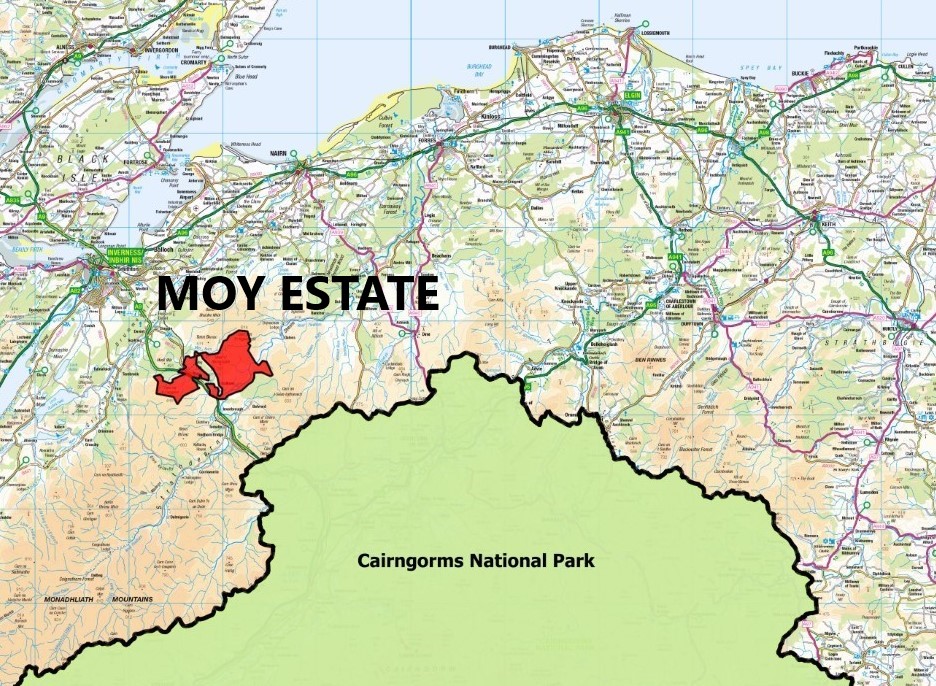
On Friday (31st March 2023), gamekeeper Rory Parker, 24, of Drumbain Cottage, Tomatin, pleaded guilty to shooting and killing a sparrowhawk on 16th September 2021 whilst employed on Moy Estate (see here).
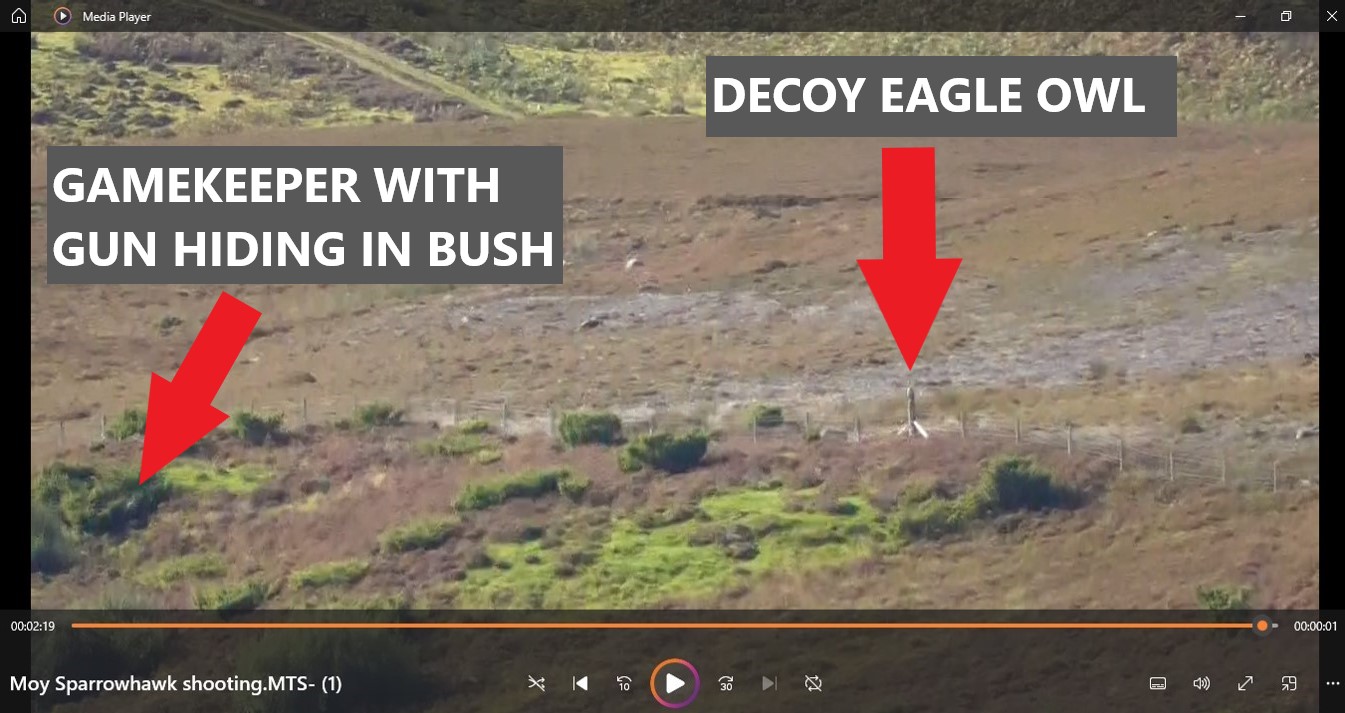
Parker was filmed by an RSPB Investigator as the (at the time 22-year-old) gamekeeper hid in a bush on the grouse moor, a few feet away from a large plastic owl that had been placed on a fencepost. It’s well-known that raptors will be drawn to an owl decoy and will try to mob / attack it. If someone sits quietly nearby with a gun they’ll have a good chance at shooting and killing the raptor whilst it’s distracted by the owl.
We’ve seen this technique deployed on grouse moors many times before, sometimes with plastic decoys, sometimes with live eagle owls (e.g. see here, here, here, here, here, here).
It looks like that’s what happened that September day in 2021. Here’s a screen grab from the RSPB’s video showing the position of Parker and the decoy owl:
If you haven’t yet seen the full video, there’s a copy of it embedded in this tweet below. I’d encourage you to watch it, and take note of Parker’s body language when he goes over to the sparrowhawk he’s just shot, as it’s flapping around, wounded, on the ground. He’s calm and proficient as he stamps his foot/knee on the bird to crush it, before casually picking it up and retuning to his hiding place in the bush. It appears to be quite routine and he does not look at all disturbed at having just committed a serious wildlife crime.
In court, Parker was defended by Mark Moir KC. The KC stands for King’s Counsel and denotes an experienced, high-ranking lawyer considered to be of exceptional ability. I wonder who paid for his services? In mitigation for Parker’s offending, Mr Moir KC reportedly told Sheriff Sara Matheson that his client had been in his job since he left school.
“He is deeply shameful of what he has done. He has brought the estate into disrepute and has now resigned.
“His firearms certificate is likely to be revoked as a result of this conviction. He should have been shooting pigeons and crows that day. Feral pigeons are a problem on the estate.
“However, the sparrowhawk flew over and there was a rush of blood. He says it was a stupid thing to do.”
After watching the video, it didn’t look like ‘a rush of blood‘ to me. It looked entirely premeditated.
Apparently the RSPB video wasn’t shown in open court but I’m not sure whether Sheriff Matheson had an opportunity to see it behind closed doors. I suspect she didn’t, given the sentence she handed down to Parker – a pathetic £1,575 fine and three months in which to pay it.
This should have been a test case of the new Animals & Wildlife (Penalties, Protections & Powers) (Scotland) Act 2020; legislation that was introduced to increase the penalties available for certain wildlife crimes, including those under Section 1(1)(a) of the Wildlife & Countryside Act – ‘Intentionally, or recklessly, killing, injuring, or taking a wild bird‘. Parker committed his offence after the enactment of this new legislation.
Prior to the new legislation, the maximum penalty available for the type of offence Parker committed was up to six months imprisonment and/or a fine of up to £5,000.
The new legislation increased the maximum penalty available (on summary conviction, as in Parker’s case) to a maximum of 12 months imprisonment and/or a fine of up to £40,000.
So why was Rory Parker only given a £1,575 fine??*
The penalty increases in the new Act were introduced by the Scottish Government because the previous penalties were not considered sufficient to recognise the seriousness of wildlife crime(s) [and animal cruelty offences].
This view was supported by an independent review by Professor Poustie, published in 2015, which concluded that the then maximum penalties available to the courts may not have been serving as a sufficient deterrent to would-be offenders, nor reflecting the seriousness of the crime(s).
The Poustie Review was first commissioned in 2013 by then Environment Minister Paul Wheelhouse, and as part of a series of measures aimed at tackling the continued persecution of birds of prey (see here). It was his response to growing levels of public concern and a lack of confidence in the judiciary to deal with raptor-killing criminals. Criticisms of the system had often centred around perceived corruption, vested-interests and biased Sheriffs, and we had come to expect unduly lenient and inconsistent sentencing in most cases (e.g. see here).
The new legislation was supposed to address those concerns with a significant increase in the severity of penalties available for courts to hand down to offenders.
I don’t see any evidence of that in the sentencing of raptor-killing gamekeeper Rory Parker.
*UPDATE: Someone who was in court on Friday has just been in touch to provide further insight into sentencing. They told me:
‘When the defence KC was summing up he repeatedly suggested to the sheriff what penalty might be most appropriate, i.e. a fine and maybe a community payback order. He also told her Mr Parker had savings of £2,000. It was therefore no surprise at all she then issued a £1,800 fine (discounted to £1,500 because he wasn’t considered an adult when he committed the crime. Since when is a 22 year old not an adult?!!!) In my opinion, therefore, the Sheriff was basically spoon-fed the sentence by the KC‘.




 Raptor Persecution UK