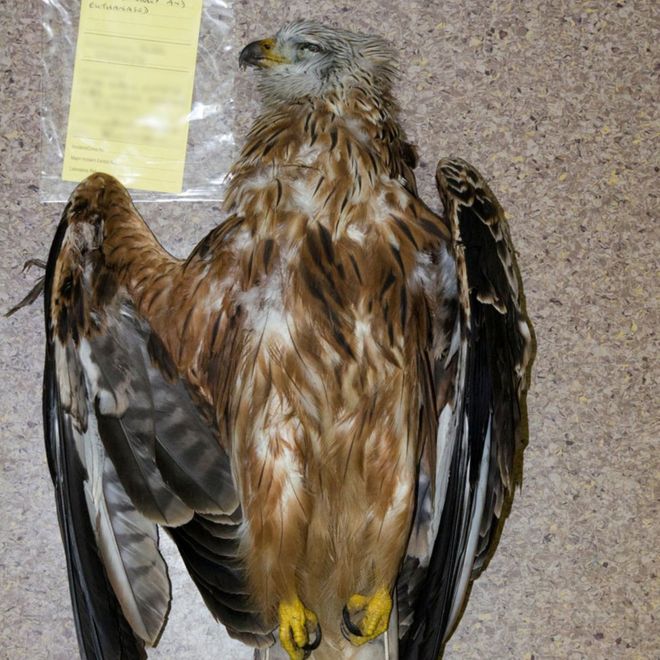
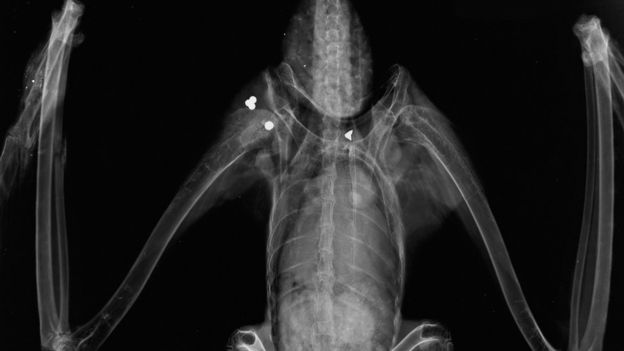
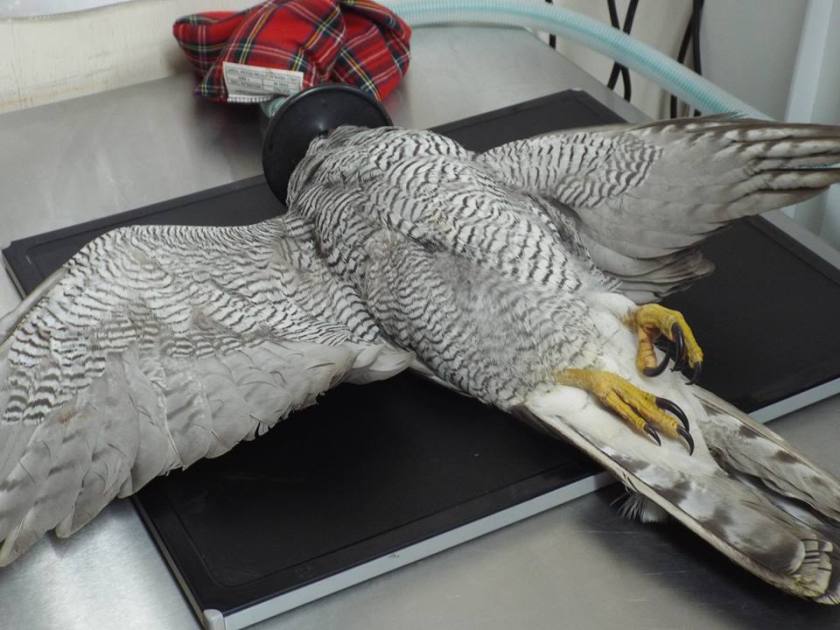
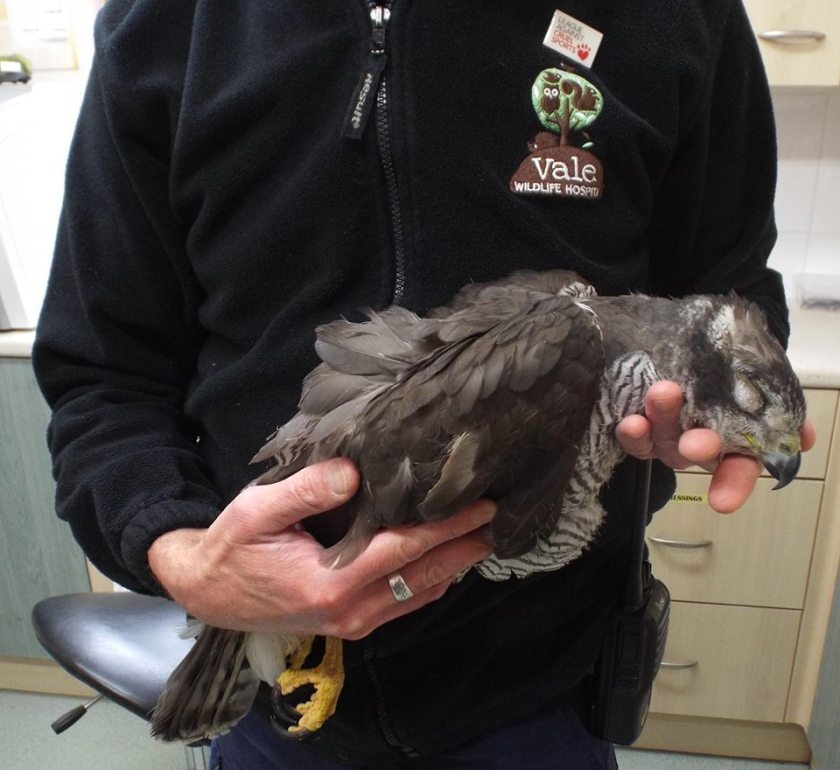
Peregrine found shot dead in Halifax, West Yorkshire

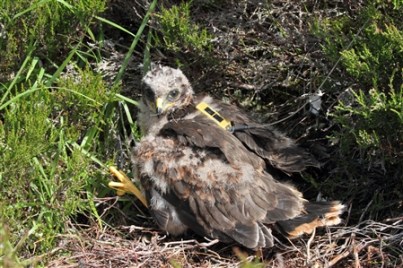
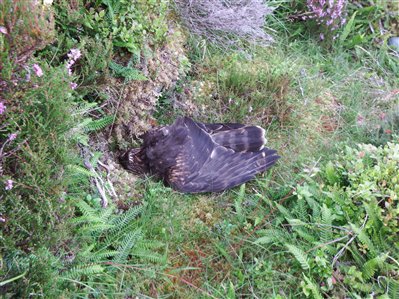
A peregrine has been found shot dead in Halifax, West Yorkshire. It’s body was discovered by a maintenance worker at the foot of a 200 ft chimney at a disused carpet mill.

It’s not known if the bird was shot at the mill or whether it had been shot elsewhere and finally succumbed to its injuries at the mill.

Details from the bird’s BTO leg ring identified it as a bird that had fledged from a church steeple in Devon (St Michael’s Peregrine Project, Exeter).

Article in Exeter Express & Echo here

Recently published preliminary results from the 2014 National Peregrine Survey indicate that illegal persecution of peregrines on upland grouse moors is so high it is affecting this species’ national distribution (see here).

Peregrine photo by Martin Eager

General licences suspended on four Scottish grouse moors in response to raptor persecution crimes

Yesterday, SNH published the following press release:

General licences restricted in wildlife crime hotspots

Scottish Natural Heritage (SNH) has restricted the use of general licences on four properties in two wildlife crime hotspots – one in Stirlingshire and one in the Borders – this week. The decision was made on the basis of evidence provided by Police Scotland of wildlife crime against birds.

Nick Halfhide, SNH Director of Operations, said:

“There is clear evidence that wildlife crimes have been committed on these properties. Because of this, and the risk of more wildlife crimes taking place, we have suspended the general licences on these four properties for three years. They may though still apply for individual licences, but these will be closely monitored.

“This measure should help to protect wild birds in the area, while still allowing necessary land management activities to take place, albeit under tighter supervision. We consider that this is a proportionate response to protect wild birds in the area and prevent further wildlife crime.”

General licences allow landowners or land managers to carry out actions which would otherwise be illegal, including controlling common species of wild birds to protect crops or livestock.

The new measure complements other recent actions to reduce wildlife crime, including vicarious liability for offences against wild birds, which was introduced in 2011.

Restrictions will prevent people from using the general licences on the land in question for three years. This period will increase if more evidence of offences comes to light.

END

As promised in earlier correspondence with SNH about potential General Licence restrictions (e.g. see here), SNH has published ‘details’ of the current restrictions on its website. Although when we say ‘details’ we use the term loosely. The names of the estates have not been published (but see below) and the specific reasons (crimes) that triggered the restriction orders are also absent.

Instead, SNH has published two maps showing the areas where the three-year restriction orders will be in place.

Restriction order #1 can be viewed here: GL restriction order 1_ Nov 2015-2018

The map denoting the area relating to Restriction order #1 is here:

Raeshaw Corshope GL restriction map 2015

Having consulted Andy Wightman’s brilliant website Who Owns Scotland to check estate boundaries, we now know that the delineated area shown in Restriction order #1 includes parts of Raeshaw Estate and the neighbouring Corsehope Estate.

This is fascinating. Raeshaw Estate is well known to us and continues to be of interest. It is a mixed upland estate combining driven grouse shooting as well as pheasant and partridge shooting. We have documentary evidence that Mark Osborne’s company is involved in the estate management (more on that in the near future). Raeshaw Estate has been raided by the police at least twice (2004 and 2009 – poisoned and shot raptors and poisoned baits – see here) although nobody has ever been prosecuted for these crimes. However, the General Licence Restriction can only be applied for crimes that have been uncovered since 1st January 2014; it cannot be applied retrospectively for offences that took place prior to 1st January 2014. This means that further raptor crimes have been uncovered here but there has not been any publicity about them. Why not? There was news of a shot buzzard found in the nearby area on 24th July 2015 (see here), but this bird was found AFTER SNH had notified the estate of the intention to restrict the General Licence (see here) so this incident cannot be the one that triggered the General Licence Restriction.

Corsehope Estate has not been on our radar, although we’re told by local sources that gamekeepers from Raeshaw Estate are involved with ‘vermin control’ here so now we’re very interested.

Restriction order #2 can be viewed here: GL retriction order 2_ Nov 2015-2018

The map denoting the area relating to Restriction order #2 is here:

Burnfoot Wester Cringate GL restriction map 2015

Again, consulting Andy Wightman’s excellent website Who Owns Scotland to check estate boundaries, we now know that the delineated area shown in Restriction order #2 includes parts of Burnfoot Estate and Wester Cringate Estate.

This is also interesting. We believe (although it must be stressed that this is educated speculation as SNH has not published the information) that this restriction order probably relates to a series of raptor persecution crimes including a poisoned red kite (July 2014), a poisoned peregrine (February 2015) and an illegally trapped red kite (May 2015) – see here.

So, what do these General Licence Restriction orders mean? Basically, it means that the following activities, usually permitted under General Licences 1, 2 and 3, are now not permitted in the areas shown on the two maps for three years, starting 13th November 2015 and ending 12th November 2018:

The killing or taking of the following species:

Great black-backed gull, carrion crow, hooded crow, jackdaw, jay, rook, ruddy duck, magpie, Canada goose, collared dove, feral pigeon, wood pigeon, lesser black-back gull, and herring gull.

The use of the following methods to kill/take these species are not permitted:

Pricking of eggs, oiling of eggs, destruction of eggs and nests, use of Larsen trap, use of Larsen Mate trap, use of Larsen Pod trap, use of multi-catch crow cage trap, shooting with any firearm, targeted falconry, and by hand.

That sounds great, doesn’t it? But it’s not quite as clear cut as that. As we’ve discussed before, and as is stated in the SNH press release at the top of this blog, although these activities can no longer be carried out in the two denoted areas under the cover of the three General Licences, individuals may still apply for an individual licence to permit these activities, although SNH claims that if granted, these will be “closely monitored”.

What does ‘closely monitored’ actually mean? Closely monitored by whom? Daily inspections by SNH? Police Scotland? That’s hardly going to happen, is it?

Let’s hope that members of the general public, exercising their right to visit these areas under open access legislation, pay close attention to what’s going on around them. If they see a Larsen trap in use, or a crow cage trap in use, or witness any of the above bird species being killed/taken by any of the methods mentioned above, they inform the Police straight away. Actually, let’s hope they forget the police and inform RSPB Scotland and/or the SSPCA instead – they’re more likely to get a quick response from them.

It’ll be interesting to see how this all pans out. On the one hand, we welcome these Restriction orders and applaud the Scottish Government (especially former Environment Minister Paul Wheelhouse for initiating them), SNH and Police Scotland for pursuing what we hope will be the first of many such Restriction orders. But on the other hand, will these restrictions be anything more than a minor inconvenience to the estates involved because they can simply apply for individual licences to continue their game-shooting activities? We’ll have to wait and see.

RSPB Scotland’s response to the two General Licence Restriction orders here

As yet no response from Scottish Land & Estates or the Scottish Gamekeepers’ Association but we’ll post them here if/when they comment.

UPDATE 11.50hrs: The SGA has issued the following statement on their website:

On November 4th 2015, SNH announced general licence restrictions to two areas encompassing four properties.
The SGA has issued the following statement in response to questions.

A Spokesman for The Scottish Gamekeepers Association said: “The SGA cannot condone wildlife crime and has a clear and consistent policy regarding this.
“As regards this case, it is our understanding that legal discussions are taking place regarding the areas affected and, therefore, it is not appropriate for us to comment further.”
END
UPDATE 13.20hrs: Statement from Environment Minister Dr Aileen McLeod:

“The announcement by SNH that the use of general licences has been restricted on specified areas of land in the Borders and in Stirlingshire is a result of work that the Scottish Government commissioned in July 2013 as part of a package of measures to combat wildlife crime.

We welcome the progress that has been made with this work. However we have not been involved in the decision-making and do not have any comment on the individual cases in question. The General Licence system is a light touch form of regulation. It is clearly sensible to apply closer scrutiny to areas where there is good evidence that wildlife crime has taken place, and we believe that this will prove a useful tool in the fight against bird of prey persecution.”

Two short-eared owls shot dead nr grouse moor in County Durham

Durham Police are appealing for information following the discovery of two dead short-eared owls in Co Durham.

The birds, found on 2nd March, had been shoved inside a pothole near to Selset Reservoir near Middleton-in-Teesdale. Their corpses were sent for post mortem which revealed they had been shot.

News article in the Chronicle here

You have to wonder why it’s taken the police seven months to appeal for information. It’s possible that there was a delay in receiving the post mortem results, but even so, the discovery of two owls inside a pothole surely raises suspicions of criminal behaviour? It’s ironic that the police appeal is eventually made during National Wildlife Crime Aware Week, where police forces across the country are advising the public how to spot signs of wildlife crime and encouraging them to report it. What’s the bloody point if the police then sit on the information for seven months?

Interesting to look at the land-use close to Selset Reservoir…..check out this Google map and note all those weird rectangular shapes (burnt strips of heather) – this is driven grouse moor country.

Ban driven grouse shooting: sign the petition here.

Photos of the two dead short-eared owls by RSPB.

Selset reservoir shot SEOs

SEO_shot_CoDurham_Mar2015a

SEO_shot_CoDurham_Mar2015b

What grisly fate awaits these two satellite-tagged hen harriers?

Bowland HH Jude LaneAs part of the RSPB’s Hen Harrier Life+ Project, the movements of two satellite-tagged hen harriers can now be followed online – see here.

The two birds are called ‘Holly’ and ‘Chance’.

Holly had her satellite tag fitted in June this year by members of the Scottish Raptor Study Group, assisted by the MOD Police and was one of three chicks from a nest located on high security MOD land at Coulport. She was named after a member of the production crew from BBC Scotland’s Landward programme after appearing in a special feature about hen harriers and the threats these birds face from illegal killing (see here). Holly fledged in August and has since left her natal area, moving in to the uplands of central Scotland.

Chance had her sat tag fitted in June last year by members of the Scottish Raptor Study Group and was named by RSPB Scotland staff. She travelled south from her nest in SW Scotland to the RSPB Wallasea Reserve in Essex at the end of October (2014), before crossing the Channel to spend the winter months in western France. Chance came back to the UK in spring this year but has since returned to France via Wales.

The RSPB’s explanation for sat tagging these two hen harriers (and others) is: ‘To better understand the threats they face and identify the places they are most at risk‘.

To be frank, there is already a very good understanding of the threats they face and of the places they are most at risk; it’s been known for at least 20 years that these birds are illegally killed by gamekeepers on driven grouse moors. It’s no mystery and it’s no secret.

However, that’s not to say that continued satellite-tagging is without purpose. There’s a very important reason for continuing to do it, and that is to raise public awareness by getting people ‘involved’ with these individual birds (hence, giving them names) and showing people the birds’ movements (via online maps) so that when they are eventually shot, trapped, poisoned, or they simply ‘disappear’ in grouse moor areas (it’s inevitable), the public outcry will be considerable and the subsequent pressure on the authorities to actually do something about it will be greater. That is, assuming the police decide to publish the information, but it’ll be harder for them to keep quiet if we all know the birds have stopped moving.

There are already plenty of examples of satellite-tagged hen harriers either ‘disappearing’ or being found shot, so nobody should expect anything different for Holly and Chance. Here are some of the well-known individuals from the last few years:

Hen Harrier Annie – found shot dead on a Scottish grouse moor in April 2015 (here).

Hen Harrier Heather – found shot dead at a winter roost site in Ireland in January 2015 (here).

Hen Harrier Sky – ‘disappeared’ on a grouse moor in Lancashire in September 2014 (here).

Hen Harrier Hope – ‘disappeared’ on a grouse moor in Lancashire in September 2014 (here).

Hen Harrier Sid – ‘disappeared’ on a grouse moor in North Yorkshire in September 2014 (here).

Hen Harrier Blue – ‘disappeared’ somewhere (location not revealed) in October 2013 (here).

Hen Harrier Bowland Betty – found shot on a grouse moor in North Yorkshire in July 2012 (here).

Hen Harrier Tanar – ‘disappeared’ on a grouse moor in Aberdeenshire in June 2011 (here).

Hen Harrier (unnamed) – ‘disappeared’ on a grouse moor in southern Scotland in October 2011 (here).

And then there were the 47 hen harriers that Natural England sat-tagged between 2007-2014. Last year we were told that four were still known to be alive, six had been found dead, and a staggering 37 birds (78.7%) were ‘missing’ ‘somewhere’ (see here). Natural England has been persistently coy about telling us us where those 37 birds went missing, even though the satellite tagging project has been funded by us taxpayers.

Bowland Betty

And of course it’s not just hen harriers that we’ve watched meet a premature death. Other species have also been sat-tagged in recent years including Montagu’s harrier ‘Mo’, who ‘disappeared’ on the Queen’s Sandringham Estate in Norfolk last year (here) as well as at least eleven golden and white-tailed eagles (listed here), including some very high profile cases such as golden eagle Fearnan (found poisoned on a Scottish grouse moor here), golden eagle Alma (found poisoned on a Scottish grouse moor here) an unnamed golden eagle that had been illegally trapped on a Scottish grouse moor before being dumped in a lay by (here) and the first fledged white-tailed eagle in East Scotland for over 200 years who ‘disappeared’ on a Scottish grouse moor (here).

So, contrary to the belief of the Hawk & Owl Trust who earlier this year told us that fitting satellite tags to hen harriers “would prevent any gamekeepers from shooting them in the sky” (see here), gamekeepers don’t give a toss whether the bird in their gun sight is carrying a transmitter or not because they know full well that they are highly unlikely to get caught, let alone prosecuted. Not one of the above cases has resulted in a prosecution. So, no, the purpose of tagging isn’t to directly save the bird, but indirectly it just might, if enough of us follow the online movements of Holly and Chance and all the other tagged harriers that will be part of the RSPB’s Hen Harrier Life+ Project and then shout from the rooftops when each bird is illegally killed. It’s going to happen, and we are going to shout.

Top photo: Bowland Betty alive (photo Jude Lane).

Bottom photo: Bowland Betty dead (photo RSPB).

Misleading conclusions from Scot Gov’s 2014 wildlife crime report

Wildlife Crime in Scotland 2014 reportYesterday the Scottish Government published its latest report on wildlife crime: ‘Wildlife Crime in Scotland: 2014 annual report’ (see here).

It was accompanied by a Government press release (here) with a headline statement claiming ‘ Recorded wildlife crime dropped by 20 per cent in the period 2013-2014‘. This claim has been regurgitated, without real examination, in much of the national press, which will give the public the impression that all’s going swimmingly in the fight against wildlife crime in Scotland. This couldn’t be further from the truth.

Let’s start with the report’s name. It claims to be the ‘2014 annual report’, but actually the period covered by the report is the 2013/14 financial year: April 2013 to March 2014. That means the majority of the data are from 2013 (9 months worth) – these are wildlife crimes that took place as long ago as 2.5 years and the most ‘recent’ took place 18 months ago (March 2014). Many more offences occurred during the nine months between April-Dec 2014 but they are not included in this report. Although the report itself does explain the reasons behind this odd time-frame selection, the report’s title does not, which means anyone just browsing the headline news will be given a false impression of how recent these findings are. It’s a small point, but it’s an important one.

However, there are bigger issues than just a misleading report title.

If you take the report’s data at face value (which we don’t – more on that in a second) and accept that it’s representative of all reported wildlife crime in Scotland between April 2013 and March 2014, you might also accept that the claim of a 20% reduction in recorded wildlife crime is accurate. But if you look at the data (Table 1), you’ll notice that this supposed broad reduction (i.e. reduction of recorded wildlife crimes in general) is actually almost entirely due to a large reduction in one particular area of wildlife crime: specifically, fish poaching. To then apply this reduction of a specific wildlife crime to all other types of wildlife crime in a broad sweeping statement is wholly misleading.

Our main issue with this report, as with previous reports, is the Government’s insistence on only using crime data that has been recorded by the Police. Although this report does attempt to address this problem by including separate sections on data collected by others (e.g. Scottish Badgers, SSPCA), these data are still not included in the overall analysis of wildlife crime trends because these incidents weren’t recorded on the Police national crime database. A good example of this is shown in Table 10, which details the number of wildlife cases investigated by the SSPCA. The report accepts that cases investigated solely by the SSPCA (as opposed to cases where the SSPCA has assisted the Police) are not included in the ‘official’ recorded crime data because ‘they are not recorded on the police national crime database’. So in effect, 69 cases that were investigated solely by the SSPCA during the period covered by the report are absent from the national figures. It seems bizarre that even though these data are available (of course they are, they appear in this report, albeit in a separate section!) they are still excluded from the main analysis. This blatant exclusion immediately reduces our confidence in the robustness of the ‘national’ data.

Another blatant exclusion of data is demonstrated in Table 17 in the Raptor Persecution section. This table identifies only 16 bird of prey victims from the mass poisoning in March 2014 known as the Ross-shire Massacre, excluding the other six victims that were found. The report justifies this exclusion by explaining that evidence of poisoning was not found after examinations of those six raptors. That’s fair enough, but surely we’re not expected to believe that those six victims all died of natural causes, in the same small area, and at the same time, as the 16 confirmed poisoning victims? They don’t appear in the figures because a crime couldn’t be identified, but they still died as a result of this crime and to pretend otherwise is nonsense.

An additional problem that erodes public confidence in the accuracy of the ‘national’ data is the issue of how carefully wildlife crimes are recorded. A report published earlier this year (which includes part of the period covered by this latest Government report) revealed systemic problems with the under-recording of several types of wildlife crime as well as failures by the police to undertake follow-up investigations on reports of suspected wildlife crimes (see LINK report here). If the police don’t follow up with an investigation, the incident is unlikely to be recorded as a crime. Until these issues are suitably addressed, the accuracy of ‘official’ ‘national’ wildlife crime data will inevitably be viewed with suspicion.

So, we don’t have much confidence in this report’s data and we certainly don’t agree with the Government’s claim that (overall) recorded wildlife crime has reduced by 20%, but there are some positives. It’s clear that more thought has been put in to the material contained in this year’s report and there is definitely more clarity about the sources used. That’s good progress.

There are also a couple of things in this report that we are particularly pleased to see.

First, let’s go back to Table 10 (SSPCA data). You may remember (if you have a long memory) that in March 2014, the Government opened its consultation on whether to increase the investigatory powers of the SSPCA. That consultation closed in September 2014 and, over a year later, we’re still waiting for a decision. It’s our understanding that one of the main sticking points is with Police Scotland (who, as you’ll recall, strongly objected to an increase of powers – see here). Apparently, the current sticking point is that Police Scotland are worried that they’ll be excluded from wildlife crime investigations because the SSPCA ‘refuses to work with them’. However, if you look at Table 10, you’ll notice that 50% of all wildlife cases taken by the SSPCA during the period covered by this report were undertaken in partnership with the Police. That’s 50%. Does that look like an organisation that is refusing to work with the Police? It doesn’t to us.

The second point of interest in this report appears in Table 18b. This table provides information about recorded bird of prey crimes between April 2013 and March 2014. Have a look at the 7th entry down:

Species: Hen Harrier

Police Division: Aberdeenshire and Moray

Type of Crime: Shooting

Date: June 2013.

Why is this of particular interest? Well, cast your mind back to January 2014 when we blogged about a vague Police Scotland press release that stated a man had been reported to the Crown Office ‘in relation to the death of a hen harrier’ in Aberdeenshire that took place in June 2013 (see here). So it turns out this hen harrier had been shot. Amazing that it took over two years for this information to be made public. But that’s not the most interesting bit. For this unnamed individual to be reported to the Crown for allegedly shooting this hen harrier means that the Police have some level of evidence that they think links him to the crime. If they didn’t have evidence, he wouldn’t have been reported. So, the alleged crime took place 2.4 years ago. The Crown Office was notified 1.9 years ago. What’s happening with this case? Is there going to be a prosecution? Why such a long delay for a crime that is deemed a ‘priority’ by the Scottish Government?

Red kite dies after persecution incident ‘near Tomatin’

Reports have emerged this afternoon that a red kite has died after it was found injured ‘near Tomatin’ on 30 August 2015.

According to a BBC news article (here), ‘Police said its injuries did not appear to have been as a result of natural causes’.

According to an article in the P&J (here), ‘Early examinations of the bird have found its death is not due to natural causes’.

In other words, this kite has been illegally killed but apparently Police Scotland is ‘unable to disclose the nature of the bird’s injuries’ (according to the P&J). So the cause of death has not been revealed, and neither has the location where the injured kite was picked up, other than ‘near Tomatin’. Tomatin is in the heart of driven grouse moor country – just put it in to google maps and look at the amount of muirburn strips that surround the village – this region also has a long track record of raptor persecution on a par with other grouse moor regions such as the Angus Glens.

So, another example of an embarrassingly vague Police Scotland statement in relation to the illegal killing of yet another raptor. It’s the latest in a series of similar cryptic police statements relating to the illegal persecution of raptors:

In September 2010 the police issued a vague appeal for information following the discovery of an osprey in the Highlands that died from what they described as “deliberately inflicted injuries“. It was later reported that the bird had been shot (see here).

In June 2013 a similarly cryptic press release followed the discovery of a dead red kite in Aberdeenshire: “After recovery of the carcass, a post mortem was carried out. This revealed that the bird’s death was not by natural causes“. It was later reported the kite had been shot (see here).

In January 2014, we got more of the same after the discovery of a dead buzzard ‘near the village of Tomatin’. Ooh, that sounds familiar, doesn’t it? The press statement said: “Police said an examination of the buzzard suggested it had not died of natural causes” (see here). We still don’t know how it was killed.

In June 2014 there was another one, this time a hen harrier found dead near it’s nest in Muirkirk. The police said: “Whilst at this time we cannot divulge how the bird was killed, we do believe it was the result of a criminal act and we need to establish why this has happened” (see here and here). Guess, what? Turns out it had been shot (see here).

Police Scotland will claim that withholding information about the cause of the death is part of their investigative strategy, because it is ‘specialist knowledge’ that only the perpetrator and any potential witness will know. That’s a legitimate strategy, of course, but given the low likelihood of actually catching anyone for this type of offence it seems like a fairly pointless exercise. It will, though, allow the game shooting lobby to deny all knowledge and refute any suggestion that the bird was killed by anyone associated with that industry.

Marvellous.

So what do you reckon? Is the illegal killing of this red kite going to be the crime that finally jolts the Scottish Government in to taking the oft-promised ‘further action if necessary’? Probably not. We’re still waiting to hear the Minister’s response to a question we posed three weeks ago following the discovery of a shot buzzard in the Borders. We asked her how she defined ‘if necessary’? (see here). Her response should make for an interesting read.

Whatever she says, she really does need to start delivering something tangible, and fast.

Red kite photo by David Tomlinson

SGA attacks RSPB on false premise

Annie Langholm harrier shot April 2015Never ones to miss an opportunity to stick the boot in on the RSPB, those wildlife crime-fighting heroes at the Scottish Gamekeepers’ Association have mis-kicked, again.

They’ve been whining in the media (Scottish Farmer, see here) about the timing of the RSPB’s press release relating to the discovery of a shot hen harrier called ‘Annie’ (see here).

As you’ll recall, Annie was a young satellite-tagged hen harrier from the Langholm project whose tag indicated she’d stopped moving in March this year (see here). Her corpse was discovered on a grouse moor in late April after several weeks of intensive moorland searches (by the RSPB) and the news of her death was published on 11th August, the day before the start of the grouse-shooting season, when everyone associated with driven grouse shooting is doing their level best to promote it as a sustainable, conservation-friendly tradition (ahem).

How inconsiderate of the RSPB to break this news on the day before the Inglorious 12th. How dare they inconvenience the grouse-shooting lobby like that. Shame on the RSPB for telling the world about another illegally killed raptor found on a grouse moor.

The thing is, the RSPB wasn’t in control of when the news was released.

When Annie’s body had been found (late April), it was submitted the very next day to the SAC Veterinary lab for post mortem. The post mortem results were not released to the RSPB until early August. The RSPB passed on the results to Police Scotland on 5th August. It was then Police Scotland’s call as to when the news was released. According to the article in Scottish Farmer (see here), the police asked the RSPB to sit on the news so that they (Police Scotland) could “crime” the incident, whatever that means. It was then decided, apparently after discussion with the Scottish Government (since when do they get involved with when crime details are released?!) that the news would be published on 11th August.

Instead of trying to smear and discredit the RSPB for publicising this crime, surely the SGA, as a co- member of the Partnership for Action Against Wildlife Crime, should be (a) praising the RSPB for putting in the time and effort, at their own expense, in extreme weather conditions, to retrieve Annie’s corpse; (b) asking the SAC vet lab why it took over three months for the post mortem results to be made available; (c) praising the RSPB for preparing and publishing the press release; (d) focusing their condemnation on the criminal(s) responsible for killing this bird, who, with all probability, are members of the game-shooting industry; and (e) asking the RSPB and other members of PAW Scotland how they (SGA) can usefully contribute to help stop these killings?

Is that really too much to ask?

Scottish gamekeeper fined £2000 for killing buzzard

A Scottish gamekeeper who was recently convicted of killing a buzzard has been sentenced this morning.

William (Billy) Dick, 25, was convicted on 4th August 2015 of illegally killing the buzzard on the Newlands Estate in Dumfriesshire (see here). Two witnesses, alerted to the scene by the sound of gunshot, had observed him throwing rocks at a buzzard which was flailing on the ground, and then they observed him repeatedly stamping on the bird. They observed Dick wrapping something inside a coat and placing it inside his vehicle and then driving away. The carcass was never recovered but a dead hare, feathers and a blood-stained rock were found at the scene. DNA evidence from the feathers confirmed they came from a buzzard.

At Dumfries Sheriff Court this morning the sheriff told Dick that he believed Dick had killed the buzzard “to further the interests of your employer“.

Dick was fined £1,500 for killing the buzzard and a further £500 for possession of the dead buzzard.

Dick’s firearms certificate had been revoked but we understand this is being appealed tomorrow.

So, a £2,000 fine for offences that merit a maximum £5,000 fine and/or a six month custodial sentence. Had Dick pleaded not guilty this fine would have been even smaller (a reward for an early plea). It’s about time the Scottish Government published its commissioned report on wildlife crime penalties, which is already nine months overdue.

Well done to the SSPCA and Police Scotland for an effective investigation and congratulations to Procurator Fiscal Kate Fleming for a successful prosecution. Particularly well done to the two witnesses who reported their observations and were prepared to testify in court.

There is an on-going vicarious liability case relating to this crime (see here) and it’ll be interesting to see what happens in light of the sheriff’s comments in court this morning.

When we blogged about Dick’s conviction in August we asked the SGA whether Dick was one of their members. They refused to answer at the time, saying it would be inappropriate to comment until the case had concluded. Well, now it has concluded so let’s ask them again.

Emails to SGA: info@scottishgamekeepers.co.uk

Dear SGA, Is/was convicted gamekeeper William (Billy) Dick one of your members?

We also asked Scottish Land & Estates whether the Newlands Estate was one of their members. They didn’t respond. Let’s ask them again: info@scottishlandandestates.co.uk

Dear SLE, Is/was the Newlands Estate one of your members?

UPDATE 12.30hrs: COPFS press release here, with disturbing details of Dick’s actions.

UPDATE 13.30hrs: RSPB statement here

UPDATE 13.35hrs: BBC news article here, which indicates Dick may appeal his conviction. There’s also a quote from the SGA, once again refusing to comment on the membership status of Dick “until the legal process has concluded”. Why so coy?

UPDATE 18.50hrs: Turns out the Newlands Estate is a member of Scottish Land & Estates and the Wildlife Estates Scotland initiative – see here for blog post

Two Red kites poisoned & shot in Highlands: get your act together, Police Scotland

RK Cawdor poisoned 2014RSPB Scotland has issued a press release about the discovery of two illegally killed red kites in the Highlands. One was found shot on a railway line and the other one was found poisoned on Cawdor Estate (see photo).

The press release is interesting (read it here) but what’s more interesting is what is revealed by reading in between the lines.

Both birds were discovered in 2014. The shot red kite was found near Beauly in June 2014 (probably this one we blogged about in October 2014) and the poisoned red kite was found in September 2014.

The RSPB statement says, “Both of these incidents took place in 2014 and are now being made public as the Police have concluded their enquiries”.

So it takes Police Scotland over a year to disclose an illegally shot red kite and almost a year to disclose an illegally poisoned red kite. They’ve now ‘concluded their enquiries’ without appealing for information from the public and without executing a search under warrant on Cawdor Estate. What exactly did their ‘enquiries’ entail? Sitting around a table, scratching their heads, before deciding to keep both crimes under wraps?

Of course, an investigation in to the circumstances of the shot red kite would be a hide in to nothing – the bird was most probably shot elsewhere and dumped on the railway line to make it look like it had collided with a train. That’s a very difficult crime to detect, although had the Police made an appeal for information at the time the bird was found, there was always a slim chance that someone might have seen something. But no, far easier just to keep quiet and not attract any more embarrassing media coverage so soon after the mass poisoning of 22 kites and buzzards at nearby Conon Bridge (which is still undetected….more on that soon).

However, the ‘investigation’ in to the circumstances of the poisoned red kite that was found on Cawdor Estate just beggars belief. Cawdor Estate is well known as it has been at the centre of alleged wildlife crimes for over two decades. Here are just some of the incidents recorded either on the estate or close to the estate (for which nobody has ever been prosecuted) –

1992: Dead buzzard, magpie and sheep (laced with Strychnine)

1993:  Dead buzzard (poisoned with Alphachloralose) found on Forestry Commission land 100 metres from the boundary of Cawdor Estate.

1994: Three dead buzzards (poisoned with Alphachloralose) and a poisoned rabbit bait

1996: Three poisoned baits found: a hare laced with Alphachloralose, a goat laced with Aldicarb and a widgeon laced with Strychnine.

1996: A hidden pit containing a suspected bird of prey poisoning kit uncovered by investigators three miles from the estate.

1999: A report sent to the Procurator Fiscal alleging that mountain hares were illegally persecuted in snares on the estate.

2000: A second report submitted to the Fiscal claiming mistreatment of hares on the estate.

2001: A dead golden eagle (poisoned with Carbofuran)

2004: A number of illegal gin traps found set around rabbit baits

2004: A dead buzzard (poisoned with Carbofuran)

2005: A dead red kite (poisoned with Carbofuran)

2007: A dead red kite (poisoned with Carbofuran)

2010: Two red kites found poisoned on neighbouring ground close to estate boundary

With a record like this, wouldn’t you expect Police Scotland, on discovery of the latest poisoned red kite, to request a search warrant and head straight for the estate? Wouldn’t that be a logical first step? Why didn’t that happen?

Did the Police actually talk to anybody on Cawdor Estate about this poisoned kite? If you read a quote attributed to Alex Hogg of the SGA (on the BBC news website here), you’d think not. Hogg says:

“This is the first we have heard of any such incidents….”.

Really? Cawdor Estate has very close links to the SGA. Cawdor’s former Head Gamekeeper and later Sporting Manager Roddy Forbes was the inaugural Chairman of the SGA. And further, the SGA’s 2010 Young Gamekeeper of the Year was an employee on Cawdor Estate. That’s indicative of pretty close ties between the estate and the SGA, and yet the SGA claim not to have heard about this crime?

As an aside, Hogg is further quoted: “….We do not know the possible causes [of the birds’ deaths] which makes it difficult to comment further”.

Eh? The causes of death have been established. One kite was shot, the other was poisoned. Why is it ‘difficult to comment further’? A little bit too embarrassing, Alex?

A Police Scotland spokesperson is also quoted in the BBC article:

“Investigating wildlife crime is challenging because of its nature, and the vast areas covered. Police Scotland works closely with partners including the RSPB to tackle wildlife crime, and brings to bear the full range of investigative techniques at its disposal. Our detection rate is increasing. Our aim is to reduce wildlife crime and earlier this year we launched a campaign raising awareness”.

Yes, of course investigating wildlife crime is challenging, nobody disputes that. But sitting on enquiries, hiding them from the public, and not undertaking searches on estates where poisoned birds are discovered is not ‘bringing to bear the full range of investigative techniques’ at their disposal. It’s anything but that.

And what’s this about ‘our detection rate is increasing’? Are there any data to support this claim or are we supposed to just accept the word of a police force under increasing pressure to get its act together?

So what now for Cawdor Estate, almost one year on from the discovery of this poisoned kite? Might it be too much to hope that SNH will issue a General Licence restriction order? Guess we’ll have to wait and see, although that might be a bit embarrassing for SNH given that they have chucked thousands of pounds (of our money!) at Cawdor Estate to help fund their ranger service.

Vicarious liability prosecution: Andrew Walter Bryce Duncan

A prosecution is underway against Andrew Walter Bryce Duncan, who is alleged to be vicariously liable for the criminal actions of gamekeeper William (Billy) Dick, who was recently convicted of killing a buzzard in April 2014 (see here).

Duncan, 71, of Kirkton, Dumfriesshire, is understood to manage the pheasant shoot on the Newlands Estate where Dick committed his crimes. Dick is due to be sentenced in September.

At a hearing in Dumfries Sheriff Court on Tuesday 18th August 2015, a trial date was set for Duncan (23rd November 2015) with an intermediate diet due to be heard on 20th October 2015.

Great to see the Crown Office pursuing this prosecution. We’ll follow proceedings with interest.

Vicarious liability in relation to the persecution of raptors in Scotland (where one person may potentially be legally responsible for the criminal actions of another person) came in to force on 1st January 2012. To date there has only been one conviction – landowner Ninian Robert Hathorn Johnston Stewart was convicted in December 2014 of being vicariously liable for the criminal actions of Glasserton & Physgill Estates gamekeeper Peter Bell (see here).