3 month suspended sentence for possession of two shot buzzards strung up on farmland

Press statement from National Parks & Wildlife Service (Ireland), 21 October 2021:

Three Month Suspended Jail Sentence for the Possession of two dead Buzzards

A County Laois man has been given a three month suspended prison sentence for the possession of two dead Buzzards, which were found strung up on his land.

On Friday the 15th of October, at Portlaoise District Court, Mr. Desmond Crawford, Roskelton, Mountrath, Co. Laois pleaded guilty to the unlawful possession of two dead Buzzards contrary to Section 45 (2) & 45 (7) of the Wildlife Acts. The offence took place on the 19th of April 2020 at Clonadacasey, Mountrath, Co. Laois. The offence was investigated by the National Parks & Wildlife Service (NPWS) of the Department of Housing, Local Government, and Heritage. It was prosecuted under the Wildlife Acts by Rory Hanniffy BL, instructed by Sandra Mahon, State Solicitor for County Offaly.

In his evidence to the Court, District Conservation Officer Mr Kieran Buckley of the NPWS told Judge Catherine Staines that he, accompanied by two NPWS Conservation Rangers from neighbouring areas, travelled to Clonadacasey to investigate a complaint from a member of the public that two dead Buzzards were tied up to an electricity post and a fence stake in cultivated fields.

Upon arrival, the NPWS searched the area and found one dead Buzzard strung up by its outstretched wings to an electricity post and another dead Buzzard strung up by its legs to a fence stake. Following a line of inquiry, Mr Buckley established that Mr. Crawford was farming the land where he found the two dead Buzzards. Accompanied by NPWS Officers Robert Edge and Colm Malone, Mr. Buckley then interviewed Mr Crawford under caution about the incident.

At the District Court sitting, photographs of the two dead Buzzards and X-ray evidence were presented to Judge Catherine Staines. Mr Buckley told the Judge that the X-ray evidence left no doubt that both Buzzards had been shot, adding that the tight pattern of the lead shot showed clear evidence that both birds were shot at close range. He added that given the time of year, the dead Buzzards may have been a breeding pair. This, he said, would leave them vulnerable to being shot at their nest. Mr Buckley also told the Judge that Buzzards were the most frequent casualty of bird of prey persecutions and added that the NPWS is determined to tackle wildlife crimes of this nature, particularly when this species has recovered from the brink of extinction.

The defence solicitor, Josephine Fitzpatrick, told the Judge that Mr. Crawford denied he had shot the Buzzards, but he was very sorry for what he had done and apologised to the Court.

In her summation, Judge Staines expressed her abhorrence at the undignified manner in which two beautiful birds were displayed, saying it showed no respect whatsoever. It was, she said, “an example of a disgusting lack of respect in an outrageous act of wildlife crime”.  

Judge Staines then detailed to the court that she had to consider a prison sentence as an appropriate way to deal with this matter. She convicted Mr. Crawford of the possession of the two Dead Buzzards under Section 45 (2) and 45 (7) of the Wildlife Acts and imposed a three-month sentence of imprisonment, which she suspended on the Accused’s own bond for a period of one year.

The Minister of State for Heritage and Electoral Reform at the Department of Housing, Local Government and Heritage, Malcolm Noonan TD said that recent judgements in the District Courts indicate clearly that wildlife crimes have serious consequences:

“I welcome the conviction in this awful case and would like to thank everyone involved in securing it. I particularly welcome the comments of Judge Staines, who acknowledged the outrageousness of the crime and the lack of respect shown to these beautiful birds. Recent judgements being handed down in the Courts to people convicted of deliberately destroying habitats or harming wildlife are sending out a clear signal that, as a society, we will no longer tolerate such actions. Wildlife crime is serious, and it has serious consequences. We need to protect nature,” he said.

Ciara O’Mahony, Regional Manager of the South East Region of the National Parks and Wildlife Service at the Department of Housing, Local Government and Heritage, welcomed the reporting of this matter by a concerned member of the public, and encouraged more who witness wildlife crimes such as this to come forward in confidence to the NPWS.

“We are increasingly receiving contact about wildlife crime and habitat destruction, from people who are concerned about biodiversity loss. We welcome such reports, and the nature conservation consciousness and awareness that they represent,” she said. 

Any member of the public wishing to report possible wildlife crime or illegal habitat destruction in Ireland can contact the NPWS through natureconservation@housing.gov.ie or direct to local NPWS staff. For more detail on wildlife legislation, see www.npws.ie

Information in relation to recording incidents involving birds of prey, including Buzzards, “Recording and Addressing Persecution and Threats to our Raptors. A Review of Incidents” can be found in: https://www.npws.ie/sites/default/files/publications/pdf/IWM126.pdf

ENDS

Short-eared owl confirmed shot in Teesdale grouse moor area where two short-eared owls previously found shot

Article published in the Northern Echo yesterday:

Short-eared owl shot and killed in Teesdale

POLICE are appealing for information after a short-eared owl was shot down in Teesdale earlier this year.

A post-mortem on the bird has confirmed the likely cause of its death was being shot with a shot gun.

The owl was found by the side of the road in May.

PC Lorraine Nelson said: “Persecuting birds of prey is never acceptable and we will always do everything we can to work with partners to act on information received about alleged criminal activity.

We would encourage anyone with information on this incident to get in touch.”

Jack Ashton-Booth, RSPB Investigations Officer, said: “Short-eared owls are declining nationally as a species.

Yet they are still widely targeted in our UK uplands: this is the third shot short-eared owl we are aware of in this area in the last six years.

In 2015 two dead short-eared owls, both of which had been shot, were found in a hole on moorland just over 1km away.

Each of those birds could have gone on to have three, four or five chicks, had they been allowed to live.

When I think of the scale of even just one area of moorland, and its array of nooks and crannies… how many more of these stunning birds could have been shot and concealed down holes or buried under peat?

It’s impossible to know.

This illegal killing must stop.

I urge any of you who may have information regarding individuals targeting these birds to come forward and call them out.”

If you have any information, call 101 and ask to speak to PC Nelson.

Alternatively, call the RSPB confidential hotline on 0300 999 0101.

ENDS

This short-eared owl was found shot in May close to the Selset Reservoir in Teesdale, which is an area dominated by land managed for driven grouse shooting, as you can see from this Google map showing the tell-tale rectangular strips of burned heather:

According to RSPB Investigations Officer Jack Ashton-Booth, the latest victim was discovered just over 1km from where two short-eared owls had been found shot and buried in potholes on the Wemmergill Estate in 2015 (see here). Nobody was prosecuted for those two offences, just as nobody will be prosecuted for this latest wildlife crime.

Wemmergill Estate is also the last known location of satellite-tagged hen harrier Marc, who vanished in suspicious circumstances on this grouse moor in 2018 (see here).

The article published yesterday in the Northern Echo was presumably based on information from Durham Constabulary, and claims that the police are appealing for information. I can’t find anything about the crime, investigation or subsequent appeal on the Durham Constabulary website or the police’s Facebook page. If it is there, it’s well hidden.

And once again, it has taken five months for this ‘appeal’ to emerge. I suppose that’s an improvement on the seven months it took Durham Constabulary to appeal for information after the discovery of the two shot owls found in 2015.

Yesterday’s article in the Northern Echo states that:

A post-mortem on the bird has confirmed the likely cause of its death was being shot with a shot gun‘.

My understanding is that the post-mortem report confirmed the owl had been shot and that was the cause of its death shortly afterwards.

There may be more news to come about this latest crime. I will update the blog if/when I receive further information.

UPDATE 18.00hrs:

The RSPB investigations team has confirmed on Twitter that this latest shot short-eared owl was found dead on a grouse moor (estate unnamed but believed to be the same estate (Wemmergill) where two short-eared owls were found shot and shoved down a pothole in 2015.

Also, Chris Woodley-Stewart, Director of the North Pennines AONB Partnership has written a blog on the AONB website to draw attention to this latest crime (see here). Well done, Chris.

57 hen harriers confirmed illegally killed or ‘missing’ on or close to UK grouse moors since 2018

For anyone who still wants to pretend that the grouse shooting industry isn’t responsible for the systematic extermination of hen harriers on grouse moors across the UK, here’s the latest catalogue of crime that suggests otherwise.

[This male hen harrier died in 2019 after his leg was almost severed in an illegally set trap that had been placed next to his nest on a Scottish grouse moor (see here). Photo by Ruth Tingay]

This is the blog I now publish after every reported killing or suspicious disappearance.

They disappear in the same way political dissidents in authoritarian dictatorships have disappeared” (Stephen Barlow, 22 January 2021).

Today the list has been updated to include the most recently reported victim, a young hen harrier called Reiver who hatched on Langholm Moor earlier this year and whose tag suddenly and inexplicably stopped transmitting on 17th September 2021 in a grouse moor area of Northumberland (see here).

The disgraceful national catalogue of illegally killed and ‘missing’ hen harriers will continue to grow – I know of at least one more on-going police investigation which has yet to be publicised.

I’ve been compiling this list only since 2018 because that is the year that the grouse shooting industry ‘leaders’ would have us believe that the criminal persecution of hen harriers had stopped and that these birds were being welcomed back on to the UK’s grouse moors (see here).

This assertion was made shortly before the publication of a devastating new scientific paper that demonstrated that 72% of satellite-tagged hen harriers were confirmed or considered likely to have been illegally killed, and this was ten times more likely to occur over areas of land managed for grouse shooting relative to other land uses (see here).

2018 was also the year that Natural England issued itself with a licence to begin a hen harrier brood meddling trial on grouse moors in northern England. For new blog readers, hen harrier brood meddling is a conservation sham sanctioned by DEFRA as part of its ludicrous ‘Hen Harrier Action Plan‘ and carried out by Natural England (NE), in cahoots with the very industry responsible for the species’ catastrophic decline in England. For more background see here.

Brood meddling has been described as a sort of ‘gentleman’s agreement’ by commentator Stephen Welch:

I don’t get it, I thought the idea of that scheme was some kind of trade off – a gentleman’s agreement that the birds would be left in peace if they were moved from grouse moors at a certain density. It seems that one party is not keeping their side of the bargain“.

With at least 57 hen harriers gone since 2018, I think it’s fair to say that the grouse shooting industry is simply taking the piss. Meanwhile, Natural England pretends that ‘partnership working’ is the way to go.

‘Partnership working’ appears to include authorising the removal of hen harrier chicks from a grouse moor already under investigation by the police for suspected raptor persecution (here) and accepting a £10K bung from representatives of the grouse shooting industry that prevents Natural England from criticising them (see here).

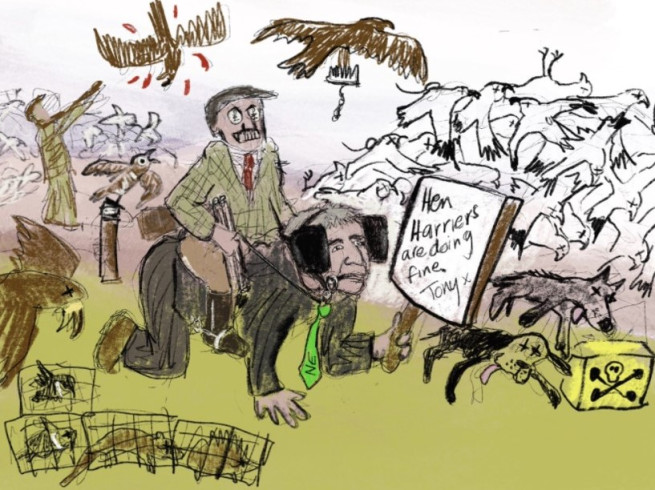
[Cartoon by Gill Lewis]

So here’s the latest gruesome list:

February 2018: Hen harrier Saorsa ‘disappeared’ in the Angus Glens in Scotland (here). The Scottish Gamekeepers Association later published wholly inaccurate information claiming the bird had been re-sighted. The RSPB dismissed this as “completely false” (here).

5 February 2018: Hen harrier Marc ‘disappeared’ on a grouse moor in Durham (here)

9 February 2018: Hen harrier Aalin ‘disappeared’ on a grouse moor in Wales (here)

March 2018: Hen harrier Blue ‘disappeared’ in the Lake District National Park (here)

March 2018: Hen harrier Finn ‘disappeared’ near Moffat in Scotland (here)

18 April 2018: Hen harrier Lia ‘disappeared’ in Wales and her corpse was retrieved in a field in May 2018. Cause of death was unconfirmed but police treating death as suspicious (here)

8 August 2018: Hen harrier Hilma ‘disappeared’ on a grouse moor in Northumberland (here).

16 August 2018: Hen harrier Athena ‘disappeared’ on a grouse moor in Scotland (here)

26 August 2018: Hen Harrier Octavia ‘disappeared’ on a grouse moor in the Peak District National Park (here)

29 August 2018: Hen harrier Margot ‘disappeared’ on a grouse moor in Scotland (here)

29 August 2018: Hen Harrier Heulwen ‘disappeared’ on a grouse moor in Wales (here)

3 September 2018: Hen harrier Stelmaria ‘disappeared’ on a grouse moor in Scotland (here)

24 September 2018: Hen harrier Heather ‘disappeared’ on a grouse moor in Scotland (here)

2 October 2018: Hen harrier Mabel ‘disappeared’ on a grouse moor on the edge of the Yorkshire Dales National Park (here)

3 October 2018: Hen Harrier Thor ‘disappeared’ next to a grouse moor in Bowland, Lanacashire (here)

23 October 2018: Hen harrier Tom ‘disappeared’ in South Wales (here)

26 October 2018: Hen harrier Arthur ‘disappeared’ on a grouse moor in the North York Moors National Park (here)

1 November 2018: Hen harrier Barney ‘disappeared’ on Bodmin Moor (here)

10 November 2018: Hen harrier Rannoch ‘disappeared’ on a grouse moor in Scotland (here). Her corpse was found nearby in May 2019 – she’d been killed in an illegally-set spring trap (here).

14 November 2018: Hen harrier River ‘disappeared’ on a grouse moor in the Nidderdale AONB (here). Her corpse was found nearby in April 2019 – she’d been illegally shot (here).

16 January 2019: Hen harrier Vulcan ‘disappeared’ in Wiltshire close to Natural England’s proposed reintroduction site (here)

7 February 2019: Hen harrier Skylar ‘disappeared’ next to a grouse moor in South Lanarkshire (here)

22 April 2019: Hen harrier Marci ‘disappeared’ on a grouse moor in the Cairngorms National Park (here)

26 April 2019: Hen harrier Rain ‘disappeared’ on a grouse moor in Nairnshire (here)

11 May 2019: An untagged male hen harrier was caught in an illegally-set trap next to his nest on a grouse moor in South Lanarkshire. He didn’t survive (here)

7 June 2019: An untagged hen harrier was found dead on a grouse moor in Scotland. A post mortem stated the bird had died as a result of ‘penetrating trauma’ injuries and that this bird had previously been shot (here)

5 September 2019: Wildland Hen Harrier 1 ‘disappeared’ on a grouse moor nr Dalnaspidal on the edge of the Cairngorms National Park (here)

11 September 2019: Hen harrier Romario ‘disappeared’ on a grouse moor in the Cairngorms National Park (here)

14 September 2019: Hen harrier (Brood meddled in 2019, #183704) ‘disappeared’ in North Pennines (here)

23 September 2019: Hen harrier (Brood meddled in 2019, #55149) ‘disappeared’ in North Pennines (here)

24 September 2019: Wildland Hen Harrier 2 ‘disappeared’ on a grouse moor at Invercauld in the Cairngorms National Park (here)

24 September 2019: Hen harrier Bronwyn ‘disappeared’ near a grouse moor in North Wales (here)

10 October 2019: Hen harrier Ada ‘disappeared’ on a grouse moor in the North Pennines AONB (here)

12 October 2019: Hen harrier Thistle ‘disappeared’ on a grouse moor in Sutherland (here)

18 October 2019: Member of the public reports the witnessed shooting of an untagged male hen harrier on White Syke Hill in North Yorkshire (here)

November 2019: Hen harrier Mary found illegally poisoned on a pheasant shoot in Ireland (here)

January 2020: Members of the public report the witnessed shooting of a male hen harrier on Threshfield Moor in the Yorkshire Dales National Park (here)

23 March 2020: Hen harrier Rosie ‘disappeared’ at an undisclosed roost site in Northumberland (here)

1 April 2020: Hen harrier (Brood meddled in 2019, #183703) ‘disappeared’ in unnamed location, tag intermittent (here)

5 April 2020: Hen harrier Hoolie ‘disappeared’ on a grouse moor in the Cairngorms National Park (here)

8 April 2020: Hen harrier Marlin ‘disappeared’ on a grouse moor in the Cairngorms National Park (here)

19 May 2020: Hen harrier Fingal ‘disappeared’ on a grouse moor in the Lowther Hills, Scotland (here)

21 May 2020: Hen harrier (Brood meddled in 2019, #183701) ‘disappeared’ on a grouse moor in Cumbria shortly after returning from wintering in France (here)

27 May 2020: Hen harrier Silver ‘disappeared’ on a grouse moor on Leadhills Estate, Scotland (here)

day/month unknown: Unnamed male hen harrier breeding on RSPB Geltsdale Reserve, Cumbria ‘disappears’ while away hunting (here)

9 July 2020: Unnamed female hen harrier (#201118) ‘disappeared’ from an undisclosed site in Northumberland (here).

25 July 2020: Hen harrier Harriet ‘disappeared’ on a grouse moor in the Yorkshire Dales National Park (here)

14 August 2020: Hen harrier Solo ‘disappeared’ in confidential nest area in Lancashire (here)

7 September 2020: Hen harrier Dryad ‘disappeared’ on a grouse moor in the Yorkshire Dales National Park (here)

16 September 2020: Hen harrier Fortune ‘disappeared’ from an undisclosed roost site in Northumberland (here)

19 September 2020: Hen harrier Harold ‘disappeared’ on a grouse moor in the Yorkshire Dales National Park (here)

20 September 2020: Hen harrier (Brood meddled in 2020, #55152) ‘disappeared’ next to a grouse moor in North Yorkshire (here)

24 February 2021: Hen harrier Tarras ‘disappeared’ next to a grouse moor in Northumberland (here)

12th April 2021: Hen harrier Yarrow ‘disappeared’ near Stockton, County Durham (here)

18 May 2021: Adult male hen harrier ‘disappears’ from its breeding attempt on RSPB Geltsdale Reserve, Cumbria whilst away hunting (here)

18 May 2021: Another adult male hen harrier ‘disappears’ from its breeding attempt on RSPB Geltsdale Reserve, Cumbria whilst away hunting (here)

17 September 2021: Hen harrier Reiver ‘disappears’ in a grouse moor dominated region of Northumberland (here)

To be continued……..

‘Star lot’ in GWCT’s auction is a day’s shooting at an estate currently at centre of police investigation into shot red kite

It’s always interesting to look at the auction lots in the shooting world’s regular fundraising drives. I think it’s useful, and quite telling, to see who’s supporting who and it can often explain a great deal about why many shooting organisations refuse to call out the criminals when yet another raptor persecution crime is uncovered and instead simply pretend not to have noticed that anything’s happened (also known as wilful blindness).

In the era of a so-called ‘zero tolerance’ approach to raptor persecution, repeatedly declared by the large shooting organisations but yet to be effectively demonstrated in any meaningful way (because it’s all just a blatant publicity stunt in my opinion (e.g. see here)) it’s even funnier to scrutinise the auction booklets and see ‘who’s doing who’.

The latest auction from the Game and Wildlife Conservation Trust (GWCT) reveals an interesting donor, hailed as the auction’s ‘star lot’ on the GWCT website.

This ‘star lot’ comprises a 250-bird mixed pheasant and partridge day for eight guns at the ‘renowned’ Salperton Park in January 2022.

Does Salperton Park ring any bells to anyone? It does to me. This is where a red kite was found in March this year with multiple injuries caused by someone blasting the bird with a shotgun. The extent of the kite’s injuries, with serial fractures, is an indication that it was shot very close to where it was found, critically injured, on the estate (see here and here).

Gloucestershire Constabulary opened a criminal investigation focusing on Salperton Estate and local area, although PC Ash Weller was quoted in the local press:

We are exploring all avenues as this could have been someone travelling through the area rather than someone local to the area“.

Yeah, righto, PC Weller, it wasn’t as if the county was in a Tier 4 ‘stay at home’ lockdown period or anything, or that other alleged persecution incidents had been reported previously at this location, or indeed that raptor persecution has demonstrable links to the game shooting industry. Yeah, let’s focus on the least plausible explanation and go from there.

Needless to say, nobody has yet been charged or prosecuted and nor are they likely to be because the evidence required to link a named individual to this wildlife crime is virtually impossible to attain, even when the police are looking in the right direction.

Where does that leave us?

The sporting agency, Mark Osborne’s William Powell, can continue to advertise the estate as ‘one of the country’s most celebrated partridge shoots”, sporting clients can continue to fork out for shoot days on the estate, and the GWCT can trouser thousands of pounds worth of funds from their auction’s ‘star lot’.

Tremendous.

Extension of General Licence restriction at Leadhills Estate confirmed as pitiful 8 months

Yesterday I blogged (here) about the extended General Licence restriction that has been imposed on Leadhills Estate after further evidence of wildlife crime had come to light since an original three-year restriction was imposed (to run 26 Nov 2019 – 26 Nov 2022).

[The grouse moors of Leadhills Estate. Photo by Ruth Tingay]

However, there was some confusion from the licencing agency, NatureScot, as to just how long this extension was applicable.

Robbie Kernahan, NatureScot’s s Director of Sustainable Growth was quoted in a NatureScot announcement saying ‘…there is enough evidence to suspend the general licences on this property for a further three years‘, which should have taken the restriction to November 2025 but when I looked at the actual detail of the extension on another part of the NatureScot website, the expiry date of the extension was given as 8th July 2023.

I contacted NatureScot’s licensing team this morning and asked them to clarify the apparent discrepancy. I am grateful to Licensing Manager Liz McLachlan for a prompt and clear explanation, as follows:

We have amended the statement on our web-pages as we accept there was some ambiguity in the original wording which you have picked up on. To clarify, the 3 year extension to the restriction is from the date of the most recent (additional) offence, as recorded by Police Scotland, which takes the restriction to July 2023.

For completeness the restriction is from 8 July 2020 to 8 July 2023‘.

I have looked at the amended statement from Robbie Kernahan which now reads:

In this case we have concluded that there is enough evidence to suspend the general licences on this property until 2023‘.

So effectively, this ‘three year extension’ isn’t actually a three-year extension at all. Technically it might be, but in effect it’s actually only an eight month extension because the estate is already serving the original General Licence restriction up until 26 November 2022, so imposing another restriction for the period 8 July 2020 to 26 November 2022, on top of the one already being served, is utterly pointless.

The 8-month extension from 27 November 2022 to 8 July 2023 is the only part of this ‘extended’ restriction that will have any real effect.

And apparently the estate has already served 14 months of the extension, given that it began in July 2020! Why has it taken 14 months for NatureScot to publicise this extended restriction? When was the estate notified of this further restriction? And has it made any difference whatsoever to the estate’s activities, given that the original restriction was already underway (since November 2019)?

And if this extension was in place since July 2020, then why the hell did NatureScot give Leadhills Estate special privileges last year when it granted an out-of-season muirburn licence in September 2020??

What sort of idiotic ‘sanction’ is this? An eight month General Licence restriction for the shooting of a short-eared owl, which is the alleged offence that this extension is based upon. Well that’s really going to put the fear of God up other would-be raptor killers, isn’t it?

It’s a pitiful response.

I don’t know if it’s a result of legal limitations (e.g. can this legal sanction be lawfully applied several years after the original offence?) or if it’s a result of professional incompetence by NatureScot.

I have submitted an FoI to NatureScot to ask for details of the decision-making process in this case and will blog when I receive a response.

[Short-eared owl by Amy Lewis]

Derbyshire Police refuse to publicise report of two shot buzzards on pheasant estate

The blog I wrote a couple of days ago (here) about Police Scotland’s refusal to publicise the discovery of a shot peregrine found on a grouse moor in the notorious raptor persecution area of Strathbraan drew a lot of criticism of wildlife crime policing.

Some of that criticism was fair, in my opinion, but some of it wasn’t. The main point to be made, as has been discussed many times on this blog, is that not all police forces are the same. There are some brilliant, pro-active and creative police forces in the UK, spearheaded by diligent, hard-working officers who feel the same frustration as we all do when cases cannot proceed to court, and not for lack of trying. We’ve seen evidence of these officers’ work in recent months, including at least eight search warrants executed across the country in relation to suspected raptor persecution offences:

On 18th January 2021 there was a raid in Suffolk (here), on 15th March there was a raid in Lincolnshire (see here), on 18th March a raid in Dorset (here), on 26th March a raid in Devon (see here), on 21st April a raid in Teesdale (here), on 2nd August a raid in Shropshire (here), on 12th August a raid in Herefordshire (here) and on 14th September a raid in Norfolk (here).

Yesterday evening we saw another example (here), this time from Police Scotland, resulting in an individual being charged for an alleged offence that took place last week! Whatever the outcome of this case, Police Scotland’s response cannot be faulted and those officers involved should be commended.

It’s my view that slagging off the police in general, accusing them all of being inept, corrupt, members of the Masons etc, is a lazy and inaccurate response to wider failures within the criminal justice system. I get why people do it – the criminal justice system is hopelessly underfunded and some of the legislation is in dire need of updating to close some gaping loopholes – and the public rightly feels frustrated every time another raptor persecution crime goes unpunished, again and again and again, but that still doesn’t justify some of the criticism aimed at the police in general.

However, I think it’s also fair to criticise police forces and officers when it is obvious that investigative procedures are not up to standard. That was the point of the blog post about Police Scotland’s response to the shot peregrine in Strathbraan and it’s also the focus of today’s blog, which looks at Derbyshire Constabulary’s appalling response to a report of the shooting of two buzzards, witnessed by a member of the public on a pheasant-shooting estate in Derbyshire during last year’s first lockdown (April 2020).

To set the scene, this is a large, private estate in the lowlands, heavily wooded and with some lakes and open parkland. Approximately 20,000 pheasants are released for commercial shooting each year. Some of the estate is closed off to the public but other parts are criss-crossed by public footpaths and bridleways, making this a popular location for visitors.

On 1st April 2020, a visiting member of the public was watching two buzzards circling above a wood when he heard a shot and witnessed the buzzards falling. The incident was reported to Derbyshire Police as a suspected raptor persecution crime. The police quickly attended the scene but, I’m told, did not conduct a search of the wood but did speak to the gamekeeper and a number of other estate residents.

With no corpses found and no other witnesses, the next most obvious move would be for the police to issue an appeal for information. But Derbyshire Constabulary had other ideas.

The following is an email sent by a member of the police wildlife crime team to somebody who was asking whether an appeal for information might be forthcoming, given that raptor persecution is a national wildlife crime priority. The police response is astonishing:

This is such a jaw-dropping response I don’t really know where to begin!

The police officer seems to think that if the estate residents didn’t see anything then there was ‘zero chance‘ of further evidence coming to light. Er….what about other visitors? The country was in lock-down at the time but the estate is located in a village where local residents may well have been taking their daily allowance of exercise and who may have witnessed something of relevance.

The police officer also seems to think that issuing an appeal for information would mean accusing the gamekeeper of shooting the buzzards. That’s not the case at all! Just a statement of the facts was all that was needed – without accusing anybody. Police forces do this all the time. And surely, the gamekeeper and the estate owner would welcome an appeal for information if it was possible that someone without authority was wandering around the estate discharging a firearm?! Fear of upsetting the gamekeeper/estate owner ‘when we may need the cooperation of the estate for future things‘ is not a valid reason for not progressing this investigation.

I think the most worrying aspect of the police response is this:

I think we all know that it would inevitably lead to repeated discussions which we’d have to become part of if it was our publication about gamekeeping practices in general. We’ve found that, for our team’s purposes, propaganda is of no value to us and is something we try to avoid‘.

Again, an appeal for information would not need to include any mention of gamekeeping practices. It would just be a statement of facts – that a member of the public reported what he believed to be the shooting of two buzzards at this location, at xx:xx hours on 1st April 2020, if anyone has any information that might help please contact the police on Tel 101 and quote incident ref number xxxxxxx.

How does Derbyshire Constabulary expect to maintain the public’s confidence to report suspected wildlife crime when reports are likely to be viewed as ‘propaganda’ by the police?

This isn’t the first time that Derbyshire Constabulary has faced criticism for the way it deals with reported raptor persecution crimes.

In January 2020, the RSPB issued a press statement about an illegally poisoned buzzard, found next to a poisoned bait, in the Peak District National Park. This crime had been uncovered the year before, in April 2019, but Derbyshire Constabulary had chosen not to say anything about it, nor to warn the public about the danger of poisoned baits being laid out in the countryside, let alone in a National Park (see here).

In response to that press release and the subsequent criticism of the police, Derbyshire Constabulary issued a remarkable statement on Facebook claiming that the circumstances surrounding the discovery of the poisoned buzzard, lying next to the poisoned bait, were ‘inconclusive’ as to whether the buzzard had been deliberately poisoned (yes, really – see here).

More criticism followed, quite rightly in my opinion, and shortly afterwards Derbyshire Constabulary posted another statement on Facebook, where they discussed the size of the geographic area they had to cover, their high workload, the lack of resources available to them and the small size of the team. They did though, commit to doing better (see here).

Just six weeks later this reported shooting of two buzzards landed on their desks.

As I said at the top of this blog, I have no interest in a general slagging off of the police. And particularly of Derbyshire Constabulary – a few years ago an elderly member of my family, suffering from advanced dementia, was prone to wandering off in a confused and distressed state, often for hours on end. Time and again, officers from Derbyshire Constabulary went looking for him and brought him home safely. I will always be grateful for the care and diligence shown by those officers, who went above and beyond my family’s expectations. Their efforts were exemplary and hugely appreciated.

My point is, again, that bringing the perpetrators of wildlife crime to justice, and particularly those guilty of raptor persecution, is difficult enough without some police officers seemingly doing their best to obstruct investigations. Blogs like this one make for uncomfortable reading but it’s clear that there needs to be a root and branch overhaul of procedures, with examples of best practice being highlighted and encouraged, at a national level. This is a role the so-far useless Raptor Persecution Priority Delivery Group (RPPDG) can play in England & Wales, and by the so-far useless PAW Raptor Group can play in Scotland, supported by the National Wildlife Crime Unit.

There are some seriously good officers dealing with wildlife crime but they need to be seen as the rule, not the exception.

Peregrine found shot dead on grouse moor in Strathbraan – Police Scotland refuse to publicise

A peregrine falcon was found shot dead on a grouse-shooting estate in the Strathbraan area of Perthshire in November 2020.

The discovery was made during a police-led multi-agency raid following reports of suspected wildlife crime taking place on the estate. I blogged about that raid in February this year (see here).

This is an estate that has previously been under investigation for alleged wildlife crime offences.

My understanding is that the Scottish SPCA are progressing a case for alleged snaring offences but that Police Scotland were dealing with the shot peregrine (because it was already dead and so was beyond the (current) remit of the SSPCA)

Strathbraan is an area that has received much attention on this blog. Dominated by grouse-shooting estates, it has a very well-earned reputation as a wildlife crime hotspot, and is particularly notorious for the suspicious disappearance of satellite-tagged eagles (one of whose tags turned up in a river, its harness cut and the tag wrapped in lead sheeting to prevent transmission – see here). It is also the area where SNH issued a (flawed) licence in 2018 permitting the mass killing of ravens on the basis of ‘seeing what happened’ – but which was later withdrawn after a legal challenge by the Scottish Raptor Study Group.

[Evidence of intensive grouse moor management in Strathbraan. Photo by Ruth Tingay]

Given the reputation of Strathbraan as a wildlife crime hotspot, and given that raptor persecution is a national wildlife crime priority, and given that Police Scotland has spent much of the last year with a dedicated campaign to try and raise public awareness of wildlife crime and encourage people to recognise and report suspected incidents, it’s difficult to understand why the police have deliberately withheld this crime from the public.

And it has been deliberately withheld. This wasn’t an oversight, or an admin error. It was a conscious decision not to say anything about it. How do I know that? Well, because I’ve been talking to Police Scotland about this crime since January 2021 and have asked, repeatedly, when they were planning on putting out the news / making an appeal for information because I believed it to be in the public interest to do so.

At first I was told that no press release was planned “until I have done a little bit more enquiry in to the circumstances“.

Fair enough.

Three months later I asked again but got no response. I tried again at four months and then finally five months later I was told, “There was no need for us to put out anything in the press from our perspective“, and “As you say from the evidence we have, we will never know where and when it was shot“.

Good grief.

Where’s the x-ray of the shot bird? An examination of its injuries (e.g. broken wings) would provide a pretty good indication of whether it was shot close to where it had been found dead, or whether it might have had the capacity to fly several miles before succumbing to its injuries. In which case, an appeal for information would have been a logical next-step, surely?

And if the police decide to say nothing, as they have in this case, where is the public record of this offence? It’s been almost a year since it was found.

How many more raptor persecution crimes are Police Scotland keeping quiet about? Quite a few, as it happens. More to come….

UPDATE 21st September 2021: Long-eared owl illegally held in trap on same Strathbraan grouse moor where shot peregrine was found (here)

No prosecution for 5 shot buzzards found hidden on Bransdale Estate, North York Moors National Park

In April 2020, during the first lockdown, North Yorkshire Police conducted a search of Bransdale Estate in the North York Moors National Park where they discovered five dead buzzards that had been shoved in a hole under a large rock, presumably to conceal them.

X-rays confirmed that at least four of those buzzards had been shot. A later post-mortem suggested the 5th buzzard had also been shot.

Eight individuals were interviewed under caution.

North Yorkshire Police issued a press statement in May 2020, including an appeal for information (see here).

The following day, Channel 4 News featured the crime in a six minute film (here) which included shocking footage from the police officer’s body camera of when the dead buzzards were being pulled from the hole.

In early June 2020 I blogged about the game-shooting industry’s response to these abhorrent crimes – see here. Remember, this is the industry that has professed to supposedly having a ‘zero tolerance’ policy when it comes to raptor persecution. I’m not quite sure how a wall of silence from the main shooting organisations reflects this policy.

One group did comment (the North York Moors Moorland Association), some of whose members may well have been among those interviewed under caution by the police in the course of this investigation, but I’m not sure that the group’s decision to slag off the police was all that bright or did them any favours (see here).

Fast forward one year and four months to August 2021, and Inspector Matt Hagen of North Yorkshire Police revealed during an online interview about the difficulty of investigating raptor persecution incidents, that this particular criminal investigation is not going any further:

There was one estate on the North York Moors National Park, there were five dead buzzards that were found. Four of them had definitely been shot and from the post mortem it suggested that the 5th one had been shot as well.

We’ve analysed mobile phones and all this takes such a long time and costs a lot of money and ultimately at the end of it all we are not going to be able to progress this case because we have to be able to prove beyond reasonable doubt, to a court, who is responsible, and on this case we’re not able to do that, unfortunately“.

It’s been suggested to me from several locals that a number of gamekeepers have since ‘moved on’ from this estate (to work on game-shooting estates in other parts of the UK) and also that the shooting rights have changed hands since these crimes were uncovered. If true, all coincidental, I’m sure.

I don’t know whether the estate is still lauded as an accredited member of the British Game Alliance, the industry’s so-called official marketing board, which now appears to have changed its name to British Game Assurance. Ironic really because the BGA doesn’t seem to do transparency (e.g. here and here).

So there we have it. Yet another disgraceful raptor persecution crime uncovered on a UK driven grouse shooting estate, inside a National Park no less, where armed culprits have got away with committing wildlife crimes without suffering any consequence whatsoever. And in this case, not through lack of effort by North Yorkshire Police.

[X-ray of one of the five shot buzzards found concealed in a hole on the grouse shooting estate]

Freedom of information documents highlight gamekeepers, fox hunting and raptor persecution in 3 public forests

The Scottish animal welfare charity OneKind has today revealed that Forestry Land Scotland (FLS) is still permitting the use of fox-hunting foot packs in several public forests, partly for the benefit of privately-owned grouse shooting estates. These public forests also happen to be in well-known raptor persecution hotspots.

In a freedom of information response, FLS admitted allowing the fox-hunt foot packs to operate in three public woodlands near Inverness: Loch Farr Wood, Farr Wood and Meall Mor near Moy.

[Moy has long been of interest to this blog, mostly for the frequency of illegal raptor persecution incidents recorded there for over a decade. And then there’s this: a photo to illustrate the stupidity of setting fire to the moor for grouse management, a few hundred yards from some publicly-subsidised wind turbines!]

The FoI documents also reveal that FLS staff suspected that gamekeepers were visiting the forests to look for fox dens to block up, which also happened to be beside Schedule 1 raptor nests, some of which have been repeatedly attacked in previous years.

For example, in 2016 Police Scotland issued an appeal for information after one goshawk and four buzzard nests were abandoned in suspicious circumstances in Moy Forest (see here).

In 2017, also in Moy Forest, masked gunmen were caught on camera underneath a goshawk nest. The nest, containing a clutch of eggs, was mysteriously abandoned shortly afterwards (see here and here).

In July this year, Police Scotland appealed for information after a dead goshawk was found in Loch Farr Wood – this bird had been shot (see here).

The issue of fox-hunting is beyond the remit of this blog although I’d question whether a Scottish Government agency should be complicit in supporting the eradication of native predators for the benefit of driven grouse shooting, which is what appears to be happening here.

If you’d like to read more about OneKind’s freedom of information request and FLS’s response about fox-hunting, gamekeepers and raptor persecution in these public forests, please see the OneKind blog (here) and an article in today’s National (here).

Meanwhile, as the authorities seem unable to tackle raptor persecution in public forests, we’re all still waiting to see whether NatureScot will impose a General Licence restriction on Moy Estate following the discovery of a poisoned satellite-tagged red kite found on the grouse moor almost a year ago, in October 2020 (see here).

New study: raptor persecution in Wales 3 x more likely in areas managed for driven gamebird shooting

Press release from RSPB Wales (24th August 2021)

New research sheds light on crimes against birds of prey in Wales

The theft of eggs and chicks of birds of prey has almost ceased in Wales, but persecution rates are not declining – according to a new RSPB Cymru review, published today.

Crimes against raptors in Wales 1990-2019 – written by RSPB Cymru and published by the Welsh Ornithological Society – summarises the plight of raptors in Wales over the past three decades.

One of the key findings is that since the 1990s, egg and chick theft has almost ceased. Theft used to be a major problem in Wales, with eggs of raptors such as peregrines and red kites stolen by collectors. The chicks of goshawks and peregrines have also been targeted for the purposes of selling to falconers, including in the Middle East. But tougher penalties and a shift in public awareness and attitude has resulted in the detection of only a handful of cases in Wales over the past decade.

On the other side of the coin, the picture for raptor persecution (by shooting, trapping and poisoning) is less positive. While the number of confirmed incidents of raptor persecution fell in 2000 – 09 compared to the previous decade, there has been a marginal increase in the past decade. However, the real total could be much higher, as the number of confirmed persecution cases could only be the tip of the iceberg.

[This buzzard was found shot dead near Powys]

Most worryingly of all, the rate of poisoning cases has increased in the last 30 years, with 52 cases confirmed in the last decade. While laying poison baits in the open has been illegal since 1911, the review suggests that it remains a problem for wildlife in the Welsh countryside. Birds of prey, wild mammals and even household pets can fall victim to the abuse of pesticides.

Julian Hughes, RSPB Cymru Head of Species and lead author of the paper, said:

There has been good progress made over the past three decades to reduce the rate of crimes against our majestic birds of prey. The dramatic reduction in the theft of egg and chick shows that tougher action really does work. This has helped the welcome return of birds such as red kite that was once on the brink of extinction. However, the rise in persecution, and especially poisoning cases, is a big worry. There’s still work to be done to root out these deplorable acts of crime against wildlife.

The paper also shows that the probability of a persecution incident in 2010-19 was three times higher in areas where driven shooting of gamebirds is available for sale.

Julian Hughes continued:

The relationship between raptor persecution and driven shooting was stronger than we expected, and we think this deserves further investigation to understand.”

Anne Brenchley, Chair of the Welsh Ornithological Society, said:

Public awareness of raptor persecution has heightened in the last thirty years, often due to the concerted efforts of the RSPB. The Welsh Ornithological Society fully supports all attempts to reduce raptor persecution, particularly investigating the apparent link between persecution and gamebird management. We hope that the levels of detected illegal raptor persecution continues to decrease over the next thirty years.”

Rob Taylor, Welsh Government Wildlife and Rural Crime Coordinator, said:

Historically the human race has affected the population and even existence of many birds and habitats within Wales, for a variety of reasons. As a nation we have many iconic birds that proudly adorn our skies and we give credit to the work of the few who have gone that extra mile to maintain their essential conservation. The red kite and osprey are a prime example of a success story within Wales, although these can be still subject to unnecessary persecution even in 2021. We, the police and our key partner agencies, have a duty to prevent the further persecution of any bird within Wales and protect them and their habitats for future generations to come. My new role, sponsored by the Welsh Government, will ensure that we remain focused as a nation and the establishment of a Wales Bird Crime Enforcement Group will bring together the necessary expertise to achieve that. Our work today will maintain the natural beauty of our Welsh birds and visitors for generations to come.”

ENDS

The research paper has been published today in the journal of the Welsh Ornithological Society. Here’s the citation:

Hughes, J., Mason, H., Bruce, M. and Shorrock, G. (2021). Crimes against raptors in Wales 1990-2019. Birds in Wales 18 (1): 3-19.

The research paper can be downloaded here: