Leadhills Estate wants to keep details of its General Licence restriction appeal a secret

As many blog readers will know, the notorious Leadhills Estate, a grouse-shooting estate in South Lanarkshire that has been at the centre of police wildlife crime investigations at least 70 times since the early 2000s, is currently serving two General Licence restrictions imposed by NatureScot after ‘clear evidence’ of wildlife crime was provided to the statutory regulator by Police Scotland (see here and here).

For new blog readers, a General Licence restriction is a light-touch sanction for estates in Scotland where there is sufficient evidence of wildlife crime taking place but insufficient evidence to prosecute a specific individual. It’s not really a sanction at all though, because an estate can simply apply to NatureScot for ‘individual’ licences instead of a General Licence which allows them to continue the activities they were supposedly restricted from doing, just with a tiny bit of scrutiny attached (e.g. 1,000 birds were legally killed on a shooting estate despite being under a General Licence restriction, see here).

Nevertheless, a General Licence restriction is useful for campaigners for highlighting to the law makers that wildlife crime persists and further regulation/enforcement is therefore required.

So, back to Leadhills Estate. The reason why this grouse moor estate is currently serving an unprecedented double General Licence restriction is because of police reports relating to the illegal killing of a short-eared owl, two buzzards and three hen harriers that were ‘shot or caught in traps’ on Leadhills Estate in the last few years (see here), the discovery of banned poisons on the estate in May 2019 (see here), the alleged shooting of a(nother) short-eared owl by a masked gunman on a quad bike as witnessed by a local resident and his eight year old son in July 2020 (see here) and the discovery of yet another batch of banned poisons, also in July 2020 (here). A satellite-tagged hen harrier (Silver) also vanished in suspicious circumstances on the estate in May 2020 (here), and although NatureScot don’t consider missing satellite-tagged raptors as sufficient evidence for a General Licence restriction, the disappearance can be used as supportive evidence if further alleged offences are also being considered.

Incredibly, Leadhills Estate with its double General Licence restriction is STILL a member of the lobby group Scottish Land & Estates, which claims to have a ‘zero tolerance’ approach to raptor persecution. Hmm.

[Grouse moor on the Leadhills Estate. Photo by Ruth Tingay]

As you may recall, Leadhills Estate’s second General Licence restriction was announced by NatureScot in late September 2021 (here) and the estate was reported to be considering an appeal (here).

Having seen the estate’s previous (failed) appeal against its first General Licence restriction in 2019 (here), I was keen to see the arguments it would make for an appeal against a second restriction.

On 30th September 2021 I submitted an FoI to NatureScot to request copies of Leadhills Estate’s appeal.

On 3 November 2021 NatureScot responded as follows:

We have withheld a letter from an agent acting on behalf of Leadhills Estate, pending an appeal against NatureScot’s decision to restrict General Licence. This information is of a sensitive nature and disclosure into the public domain could prejudice the applicant’s right to a fair hearing’.

I didn’t see how public disclosure could possibly prejudice a hearing given that it’s all done in-house at NatureScot but fine, I could wait.

In December 2021 it was announced that Leadhills Estate had lost its appeal against the second General Licence restriction (here) so I wrote back to NatureScot on 3rd December as follows:

You told me in the letter dated 3 November 2021 that you were withholding a letter from an agent who was acting on behalf of Leadhills Estate, and the reason you gave for withholding it was that releasing it may prejudice the applicant’s right to a fair appeal. As the appeal process has now concluded and therefore the applicant’s right to a fair hearing cannot be affected, please can you send me the agent’s letter that was previously withheld‘.

Yesterday (5th January 2022) NatureScot responded to my latest FoI request, as follows:

We have completed our information searches, and we have identified eight documents comprising 126 pages relevant to your request. We shared a redacted version of these documents with the solicitors acting on behalf of Leadhills Estate, who have provided additional legal arguments as to why certain information should be withheld. We will need additional time to assess these arguments and, potentially, take further legal advice.

Regulation 7 of the EIRs allows public authorities to extend the time for compliance with requests for up to an additional 20 working days. This means we must respond to your information request by 3 February 2022 at the latest‘.

That’s interesting. Why might Leadhills Estate not want the details of its appeal to be made public? And what legal arguments might it use to block the transparency of the decision-making process of a statutory agency?

I guess we’ll find out on 3rd February.

UPDATE 23rd February 2022: NatureScot refuses to publish details of Leadhills Estate’s general licence restriction appeal (here)

60 hen harriers confirmed illegally killed or ‘missing’ since 2018, most of them on or close to UK grouse moors

For anyone who still wants to pretend that the grouse shooting industry isn’t responsible for the systematic extermination of hen harriers on grouse moors across the UK, here’s the latest catalogue of crime that suggests otherwise.

[This male hen harrier died in 2019 after his leg was almost severed in an illegally set trap that had been placed next to his nest on a Scottish grouse moor (see here). Photo by Ruth Tingay]

This is the blog I now publish after every reported killing or suspicious disappearance.

They disappear in the same way political dissidents in authoritarian dictatorships have disappeared” (Stephen Barlow, 22 January 2021).

Today the list has been updated to include the most recently reported victims, three young hen harriers whose satellite tags inexplicably stopped transmitting and whose corpses vanished in to thin air in July, August and September 2021 (see here).

The disgraceful national catalogue of illegally killed and ‘missing’ hen harriers will continue to grow – I know of at least one more on-going police investigation which has yet to be publicised.

I’ve been compiling this list only since 2018 because that is the year that the grouse shooting industry ‘leaders’ would have us believe that the criminal persecution of hen harriers had stopped and that these birds were being welcomed back on to the UK’s grouse moors (see here).

This assertion was made shortly before the publication of a devastating new scientific paper that demonstrated that 72% of satellite-tagged hen harriers were confirmed or considered likely to have been illegally killed, and this was ten times more likely to occur over areas of land managed for grouse shooting relative to other land uses (see here).

2018 was also the year that Natural England issued itself with a licence to begin a hen harrier brood meddling trial on grouse moors in northern England. For new blog readers, hen harrier brood meddling is a conservation sham sanctioned by DEFRA as part of its ludicrous ‘Hen Harrier Action Plan‘ and carried out by Natural England (NE), in cahoots with the very industry responsible for the species’ catastrophic decline in England. For more background see here.

Brood meddling has been described as a sort of ‘gentleman’s agreement’ by commentator Stephen Welch:

I don’t get it, I thought the idea of that scheme was some kind of trade off – a gentleman’s agreement that the birds would be left in peace if they were moved from grouse moors at a certain density. It seems that one party is not keeping their side of the bargain“.

With at least 60 hen harriers gone since 2018, I think it’s fair to say that the grouse shooting industry is simply taking the piss. Meanwhile, Natural England pretends that ‘partnership working’ is the way to go.

‘Partnership working’ appears to include authorising the removal of hen harrier chicks from a grouse moor already under investigation by the police for suspected raptor persecution (here) and accepting a £10K bung from representatives of the grouse shooting industry that prevents Natural England from criticising them or the sham brood meddling trial (see here).

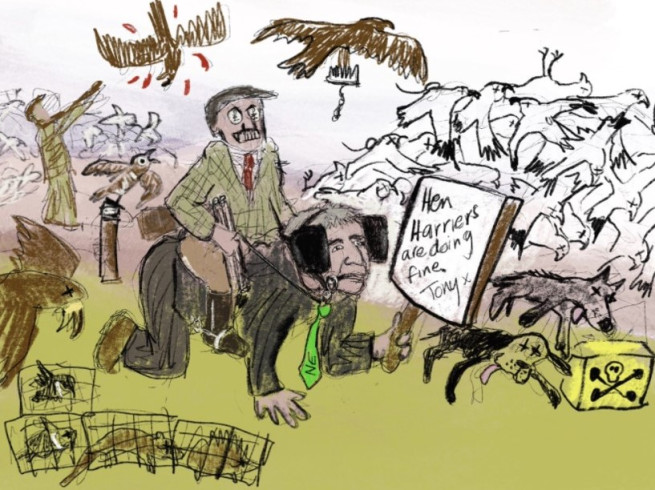
[Cartoon by Gill Lewis]

So here’s the latest gruesome list. Note that the majority of these birds (but not all) were fitted with satellite tags. How many more [untagged] harriers have been killed?

February 2018: Hen harrier Saorsa ‘disappeared’ in the Angus Glens in Scotland (here). The Scottish Gamekeepers Association later published wholly inaccurate information claiming the bird had been re-sighted. The RSPB dismissed this as “completely false” (here).

5 February 2018: Hen harrier Marc ‘disappeared’ on a grouse moor in Durham (here)

9 February 2018: Hen harrier Aalin ‘disappeared’ on a grouse moor in Wales (here)

March 2018: Hen harrier Blue ‘disappeared’ in the Lake District National Park (here)

March 2018: Hen harrier Finn ‘disappeared’ near Moffat in Scotland (here)

18 April 2018: Hen harrier Lia ‘disappeared’ in Wales and her corpse was retrieved in a field in May 2018. Cause of death was unconfirmed but police treating death as suspicious (here)

8 August 2018: Hen harrier Hilma ‘disappeared’ on a grouse moor in Northumberland (here).

16 August 2018: Hen harrier Athena ‘disappeared’ on a grouse moor in Scotland (here)

26 August 2018: Hen Harrier Octavia ‘disappeared’ on a grouse moor in the Peak District National Park (here)

29 August 2018: Hen harrier Margot ‘disappeared’ on a grouse moor in Scotland (here)

29 August 2018: Hen Harrier Heulwen ‘disappeared’ on a grouse moor in Wales (here)

3 September 2018: Hen harrier Stelmaria ‘disappeared’ on a grouse moor in Scotland (here)

24 September 2018: Hen harrier Heather ‘disappeared’ on a grouse moor in Scotland (here)

2 October 2018: Hen harrier Mabel ‘disappeared’ on a grouse moor on the edge of the Yorkshire Dales National Park (here)

3 October 2018: Hen Harrier Thor ‘disappeared’ next to a grouse moor in Bowland, Lanacashire (here)

23 October 2018: Hen harrier Tom ‘disappeared’ in South Wales (here)

26 October 2018: Hen harrier Arthur ‘disappeared’ on a grouse moor in the North York Moors National Park (here)

1 November 2018: Hen harrier Barney ‘disappeared’ on Bodmin Moor (here)

10 November 2018: Hen harrier Rannoch ‘disappeared’ on a grouse moor in Scotland (here). Her corpse was found nearby in May 2019 – she’d been killed in an illegally-set spring trap (here).

14 November 2018: Hen harrier River ‘disappeared’ on a grouse moor in the Nidderdale AONB (here). Her corpse was found nearby in April 2019 – she’d been illegally shot (here).

16 January 2019: Hen harrier Vulcan ‘disappeared’ in Wiltshire close to Natural England’s proposed reintroduction site (here)

7 February 2019: Hen harrier Skylar ‘disappeared’ next to a grouse moor in South Lanarkshire (here)

22 April 2019: Hen harrier Marci ‘disappeared’ on a grouse moor in the Cairngorms National Park (here)

26 April 2019: Hen harrier Rain ‘disappeared’ on a grouse moor in Nairnshire (here)

11 May 2019: An untagged male hen harrier was caught in an illegally-set trap next to his nest on a grouse moor in South Lanarkshire. He didn’t survive (here)

7 June 2019: An untagged hen harrier was found dead on a grouse moor in Scotland. A post mortem stated the bird had died as a result of ‘penetrating trauma’ injuries and that this bird had previously been shot (here)

5 September 2019: Wildland Hen Harrier 1 ‘disappeared’ on a grouse moor nr Dalnaspidal on the edge of the Cairngorms National Park (here)

11 September 2019: Hen harrier Romario ‘disappeared’ on a grouse moor in the Cairngorms National Park (here)

14 September 2019: Hen harrier (Brood meddled in 2019, #183704) ‘disappeared’ in North Pennines (here)

23 September 2019: Hen harrier (Brood meddled in 2019, #55149) ‘disappeared’ in North Pennines (here)

24 September 2019: Wildland Hen Harrier 2 ‘disappeared’ on a grouse moor at Invercauld in the Cairngorms National Park (here)

24 September 2019: Hen harrier Bronwyn ‘disappeared’ near a grouse moor in North Wales (here)

10 October 2019: Hen harrier Ada ‘disappeared’ on a grouse moor in the North Pennines AONB (here)

12 October 2019: Hen harrier Thistle ‘disappeared’ on a grouse moor in Sutherland (here)

18 October 2019: Member of the public reports the witnessed shooting of an untagged male hen harrier on White Syke Hill in North Yorkshire (here)

November 2019: Hen harrier Mary found illegally poisoned on a pheasant shoot in Ireland (here)

January 2020: Members of the public report the witnessed shooting of a male hen harrier on Threshfield Moor in the Yorkshire Dales National Park (here)

23 March 2020: Hen harrier Rosie ‘disappeared’ at an undisclosed roost site in Northumberland (here)

1 April 2020: Hen harrier (Brood meddled in 2019, #183703) ‘disappeared’ in unnamed location, tag intermittent (here)

5 April 2020: Hen harrier Hoolie ‘disappeared’ on a grouse moor in the Cairngorms National Park (here)

8 April 2020: Hen harrier Marlin ‘disappeared’ on a grouse moor in the Cairngorms National Park (here)

19 May 2020: Hen harrier Fingal ‘disappeared’ on a grouse moor in the Lowther Hills, Scotland (here)

21 May 2020: Hen harrier (Brood meddled in 2019, #183701) ‘disappeared’ on a grouse moor in Cumbria shortly after returning from wintering in France (here)

27 May 2020: Hen harrier Silver ‘disappeared’ on a grouse moor on Leadhills Estate, Scotland (here)

day/month unknown: Unnamed male hen harrier breeding on RSPB Geltsdale Reserve, Cumbria ‘disappeared’ while away hunting (here)

9 July 2020: Unnamed female hen harrier (#201118) ‘disappeared’ from an undisclosed site in Northumberland (here).

25 July 2020: Hen harrier Harriet ‘disappeared’ on a grouse moor in the Yorkshire Dales National Park (here)

14 August 2020: Hen harrier Solo ‘disappeared’ in confidential nest area in Lancashire (here)

7 September 2020: Hen harrier Dryad ‘disappeared’ on a grouse moor in the Yorkshire Dales National Park (here)

16 September 2020: Hen harrier Fortune ‘disappeared’ from an undisclosed roost site in Northumberland (here)

19 September 2020: Hen harrier Harold ‘disappeared’ on a grouse moor in the Yorkshire Dales National Park (here)

20 September 2020: Hen harrier (Brood meddled in 2020, #55152) ‘disappeared’ next to a grouse moor in North Yorkshire (here)

24 February 2021: Hen harrier Tarras ‘disappeared’ next to a grouse moor in Northumberland (here)

12th April 2021: Hen harrier Yarrow ‘disappeared’ near Stockton, County Durham (here)

18 May 2021: Adult male hen harrier ‘disappeared’ from its breeding attempt on RSPB Geltsdale Reserve, Cumbria whilst away hunting (here)

18 May 2021: Another adult male hen harrier ‘disappeared’ from its breeding attempt on RSPB Geltsdale Reserve, Cumbria whilst away hunting (here)

24 July 2021: Hen harrier Asta ‘disappeared’ at a ‘confidential site’ in the North Pennines (here)

14th August 2021: Hen harrier Josephine ‘disappeared’ at a ‘confidential site’ in Northumberland (here)

17 September 2021: Hen harrier Reiver ‘disappeared’ in a grouse moor dominated region of Northumberland (here)

24 September 2021: Hen harrier (Brood meddled in 2021, R2-F-1-21) ‘disappeared’ in Northumberland (here)

To be continued……..

“These crimes are being covered up”: RSPB Scotland speaks out as bird crime soars

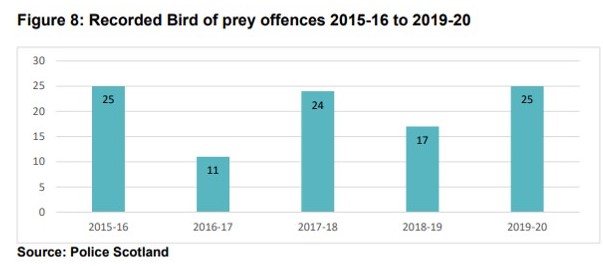
Bird crime soared across the UK in 2020, and RSPB believes Scotland’s native birds of prey will continue to be persecuted, according to two new articles published yesterday in The Courier and The Press & Journal:

Birds of prey such as hawks, eagles, kites, buzzards, harriers, falcons and owls are protected by the Wildlife and Countryside Act 1981.

The RSPB’s annual report revealed that 2020 was the worst year on record for bird crime across the UK.

There were 137 known and confirmed incidents of birds of prey being killed, the highest number in 30 years.

This trend has continued in 2021, according to Ian Thomson, RSPB Scotland’s head of investigations.

He said: “Bird crime covers a whole manner of crimes against wild birds, but what is particularly of concern are those crimes that have an impact on the populations and ranges of a variety of species.”

According to Mr Thomson, bird crime, also known as raptor persecution, is particularly rife in the north-east, with the hen harrier population being a fraction of what it was 20 years ago.

He also explained that golden eagles are only occupying around a third of the breeding territories that they ought to; meanwhile, peregrines have largely disappeared from the uplands in the north-east.

Mr Thomson believes that these low population numbers are largely down to the persecution of birds of prey for the intense land management of grouse moors.

Birds of prey are at the top of the food chain and they hunt and eat grouse and pheasants.

In an attempt to maximise the number of game birds available for clients to shoot, grouse moor managers will eliminate any threats to their birds.

This can include burning patches of heather moorland and releasing clouds of smoke into the air, leaving medicated grit out in the open and hare baiting.

The National Golden Eagle Survey shows that across Scotland the population as a whole is doing well and that there are significant increases in the west where there are no grouse moors.

Mr Thomson said it is the east of Scotland where the populations are a fraction of what they should be.

Scientific reports show that the illegal persecution of golden eagles, hen harriers, red kites and peregrines are largely happening in areas managed for game bird shooting.

Unfortunately, these findings are largely happening in the middle of nowhere,” Mr Thomson said, “out of sight, out of mind, where witnesses are very far and few between.

But, occasionally, an incident occurs that is detected.

In 2020, about a week into lockdown when the entire population of the country was told to stay indoors or to exercise within five miles of your house, we had a young white-tailed eagle poisoned on a grouse moor in Strathdon, in an area with an appalling history of crimes against birds of prey going back 10-plus years.”

Mr Thomson explained there have been cases of birds of satellite-tagged birds disappearing under “suspicious circumstances”.

In March a golden eagle was illegally poisoned on the Invercauld Estate, a grouse moor in the Cairngorms.

Last year a satellite transmitter that had been fitted on a golden eagle was found at the side of a river.

It was wrapped in lead sheeting and thrown into the river where it lay for four years until a walker found it on the bank.

Mr Thomson said: “This is the efforts that people are going to cover up these crimes, they don’t want to be caught.

The problem is, as I say, these crimes are seldom witnessed; to actually get any idea of the scale of it we’re really depending on doing population studies.

We’re never going to find all the victims because, needless to say, if someone shoots a golden eagle they’re not going to leave it around for the RSPB or the police or a hillwalker to find.

These crimes are being covered up.”

The RSPB Scotland’s head of investigations explained that there are other factors that have impacted the populations of birds of prey.

He said that all birds face challenges “just surviving”, through natural mortality, starvation, and loss of habitat due to the intensification of land management or agriculture.

Because of this, populations are much lower than what would be ideal, and so deliberate and illegal killing is adding extra strain to the populations.

As well as being important for biodiversity, birds of prey are an attraction for tourists visiting Scotland.

People interested in photography travel from all over the world to capture Scottish wildlife, bringing millions to the economy.

Mr Thomson highlighted that, on the Isle of Mull, around £5 million a year goes into the island from people going to see white-tailed eagles.

The Scottish Government plans to introduce licensing to grouse moors, which Mr Thomson described as a “game-changer”.

He believes the loss of a license to shoot will introduce a significant deterrent to the estates that do persecute birds of prey.

There are places you wouldn’t want to take your dog for a walk in case it gets caught in a trap or eats something poisonous,” he said. “It’s not just birds that are dying, it’s people’s pets.

Perish the thought that some day some small child will come into contact with chemicals like this, it could have absolutely devastating effects.

It’s not only illegal but it’s reckless and indiscriminate.”

ENDS

Leadhills Estate loses appeal over extension to General Licence restriction

Regular blog readers will be well aware that the notorious Leadhills Estate, a grouse-shooting estate in South Lanarkshire that has been at the centre of police wildlife crime investigations at least 70 times since the early 2000s, is currently serving a three-year General Licence restriction based on what NatureScot described as ‘clear evidence’ of raptor persecution offences, including the illegal killing of a short-eared owl, two buzzards and three hen harriers that were ‘shot or caught in traps’ on Leadhills Estate since 1 January 2014 (see here) and the discovery of banned poisons on the estate in May 2019 (see here).

That original General Licence restriction was imposed on Leadhills Estate by NatureScot in November 2019 and is valid until November 2022.

A General Licence restriction can be imposed by NatureScot when there is sufficient evidence of wildlife crime on an estate but insufficient evidence for the police to charge a named individual. Leadhills Estate has denied all knowledge of any wildlife crime on its land.

[Chris Packham holds a dead hen harrier. This bird was caught by the leg in an illegally-set trap on the Leadhills Estate grouse moor in May 2019. The trap had been set next to the harrier’s nest and was hidden by moss. The harrier’s leg was almost severed. Unfortunately, extensive surgery could not save this bird. Photo by Ruth Tingay]

Since that original General Licence restriction was imposed on Leadhills Estate in November 2019, further alleged offences have been reported and are the subject of ongoing police investigations (see here) including the alleged shooting of a(nother) short-eared owl by a masked gunman on a quad bike as witnessed by a local resident and his eight year old son in July 2020 (see here) and the discovery of yet another batch of banned poisons, also in July 2020 (here). A satellite-tagged hen harrier (Silver) also vanished in suspicious circumstances on the estate in May 2020 (here), and although NatureScot don’t consider missing satellite-tagged raptors as sufficient evidence for a General Licence restriction, the disappearance can be used as supportive evidence if further alleged offences are also being considered.

In light of these latest allegations, in late September 2021 NatureScot announced that a further three-year General Licence restriction (an extension to the first one) was being imposed on Leadhills Estate (here), although it turned out that it wasn’t a three-year extension, as NatureScot had claimed, but was rather an eight-month extension because this latest restriction was running concurrently with the first restriction (see here).

In early October 2021 Leadhills Estate was reported to be considering appealing against the extended restriction (here) and shortly afterwards NatureScot removed the official notification of the extension from its website, a sure sign that an appeal was underway.

Roll on two months and the official notification has been re-posted on NatureScot’s website (here), which I take to mean that Leadhills Estate has lost its appeal and the General Licence restriction has been re-instated until it expires on 8th July 2023. This means that the estate cannot undertake certain activities (e.g. the operation of crow cage traps to kill hundreds of corvids) unless estate gamekeepers apply to NatureScot for an individual licence and NatureScot approves the application(s).

I’ll be monitoring this and will be keen to see whether individual licences are granted to gamekeepers on an estate that has had, in effect, a double General Licence restriction imposed after evidence of multiple wildlife crimes has been provided to NatureScot by Police Scotland.

Earlier this autumn I submitted an FoI to NatureScot to find out on what basis Leadhills Estate was appealing the General Licence restriction. The last time the estate appealed (against the original General Licence restriction), the grounds for appeal were laughable (see here) and were not accepted by NatureScot.

This time, NatureScot refused to release the details of the estate’s appeal because at the time the appeal was considered to be ‘live’ and it was thought that publication might affect the estate’s right to a fair hearing. I don’t know how it would have affected the estate’s appeal, given the appeal is heard in-house at NatureScot and cannot be influenced by outside commentary, but that was NatureScot’s decision.

That’s fine. Now the appeal has been dismissed and the restriction is in place, I have submitted another FoI to NatureScot and I expect the estate’s grounds for appeal to be released in to the public domain.

A response is due from NatureScot by the end of this month. I’ll keep you posted.

UPDATE 23 February 2022: NatureScot refuses to publish details of Leadhills Estate’s general licence restriction appeal (here)

Shot red kite successfully rehabilitated and released in Essex

Last month I blogged about a red kite that had been found injured with shotgun injuries in Galleywood Lane, Chelmsford, Essex (see here and here).

The kite was picked up by concerned members of the public and taken to the South Essex Wildlife Hospital for treatment.

[Photo of the kite by South Essex Wildlife Hospital]

After four weeks of expert care and rehabilitation, this red kite was released back to the wild last week. Well done to all the team at South Essex Wildlife Hospital.

Essex Police are still investigating the circumstances of this illegal shooting and if anyone has any information please contact Wildlife Crime Officer PC Jed Raven on Tel 101 and quote reference number 42/265786/21.

Please note, this police investigation is one of two separate incidents concerning dead red kites. The other one relates to the discovery of a dead red kite that had been found in suspicious circumstances in the Uttlesford area of Essex earlier in November (here).

Update on shot red kite in Essex

On Wednesday I blogged about a police investigation into a shot red kite that had been found in Galleywood Road, Chelmsford, Essex (see here).

The details were a bit sketchy but Essex Police Wildlife Crime Officer Jed Raven had said he believed the kite had suffered wing injuries after someone had fired a shotgun at this protected species.

A further update now reveals that the kite was shot, it flew a short distance, landed in a tree, and then fell from the tree in front of witnesses who took the injured bird to a wildlife hospital.

The kite is currently undergoing treatment.

[Ed: NB. An earlier version of this article said the red kite had died as a result of its injuries. This was incorrect]

If you have any information about this crime, which was committed on 14th November 2021, please contact Essex Police on Tel 101 and quote crime reference number: 42/265786/21

Please note, this police investigation is one of two separate incidents concerning dead red kites. The other one relates to the discovery of a dead red kite that had been found in suspicious circumstances in the Uttlesford area of Essex earlier this month (here).

UPDATE 14th December 2021: Shot red kite successfully rehabilitated and released in Essex (here)

Another red kite shot in Essex

Less than two weeks ago Essex Police announced they were working with the RSPB to investigate the suspicious death of a red kite found in the Uttlesford district (see here).

This morning, Police Wildlife Crime Officer Jed Raven has informed me of another incident, this time the shooting of a red kite.

The details are limited but here is what has been provided so far:

Crime reference number: 42/265786/21

14 November 2021, 2pm.

Galleywood Road, Chelmsford, Essex

Suspect(s) unknown have shot a red kite using what is believed to be a shot gun. The red kite was shot through its wing.

It’s not clear whether the shooting was witnessed and took place at this location at the stated time, or whether this time and location is where the injured kite was discovered.

I understand the kite is currently at a wildlife hospital but I don’t know whether it survived its injuries.

Hopefully more information will emerge as the investigation progresses.

Many thanks to PC Jed Raven for getting the news out. If anyone has any information about this latest crime please contact Essex Police on Tel: 101 and quote crime reference 42/265786/21.

UPDATE 21st November 2021: Update on shot red kite in Essex (here)

UPDATE 14th December 2021: Shot red kite successfully rehabilitated and released in Essex (here)

Yorkshire Dales National Park Authority reacts to 2020 being ‘worst year on record’ for raptor persecution crimes

Last week the RSPB published its latest annual Birdcrime report which showed that 2020 was the ‘worst year on record’ for confirmed crimes against birds of prey in the UK (see here).

For the seventh year in a row, North Yorkshire had more confirmed raptor persecution crimes than any other county in the UK. Twenty-six of the 137 confirmed UK incidents occurred in North Yorkshire. Of these two thirds were directly related to grouse shooting and a further four incidents to other types of shooting. Victims in the county included 16 buzzards, two peregrine falcons, two red kites and one goshawk.

[Grouse moor landscape in the Yorkshire Dales National Park. Photo by Ruth Tingay]

In response to the damning Birdcrime report, the Yorkshire Dales National Park Authority has issued this pretty unequivocal statement:

YORKSHIRE DALES NATIONAL PARK AUTHORITY REACTION TO LATEST RSPB BIRDCRIME REPORT

Commenting on the RSPB Birdcrime Report 2020, Yorkshire Dales National Park Authority Chief Executive David Butterworth said:

“This report makes grim reading for all landscape authorities, landowners, managers and other partners who are working hard to call out and tackle illegal raptor persecution, and it’s embarrassing and humiliating to see North Yorkshire yet again topping the league table with the highest number of confirmed incidents.

“As we’ve said before, the continuing issue of bird of prey persecution in North Yorkshire demands maximum exposure, as do the activities of those who take part in this criminality. People need to know what is happening here and the devastating impact this is having on our protected species. This report lays that bare.

”The Yorkshire Dales National Park Authority condemns raptor persecution in the strongest possible terms and, as highlighted in this report, we will continue to work closely with partners and others to stamp out this crime once and for all.

“I would appeal to anyone, local or visitor, who witnesses any suspicious activity while they’re out and about in the countryside, or anyone who is made aware of it through their networks, to contact the Police”.

The Yorkshire Dales National Park Management Plan objective C5 on illegal persecution of raptors can be viewed here.

For concerns about a possible wildlife crime, you should call 101. If you witness a suspected wildlife crime in action, call 999 immediately and ask for the Police. Finally, you can speak in confidence about raptor persecution directly with the RSPB on 0300 9990101

ENDS

“They all know what is going on, and they cover it up” – police inspector’s view on gamekeepers & raptor killing

Timed to publish on the same day as the RSPB’s Birdcrime report, documenting how 2020 was the ‘worst year on record’ for crimes against birds of prey in the UK (see here), National Geographic has just published a lengthy article, written by journalist Rene Ebersole who visited the UK earlier this year specifically to research the subject of raptor persecution on grouse moors.

Rene visited quite a few field sites and interviewed a lot of people for this piece, including Mark Thomas (RSPB Investigations), Mark Avery (Wild Justice), Caroline Middleton Gordon (Moorland Association), Matt Hagen (North Yorkshire Police and RPPDG), Mark Cunliffe-Lister (Swinton Estate & Moorland Association), Steve Downing (Northern England Raptor Forum), the witness who saw ‘gamekeepers’ shooting buzzards on the Bransdale Estate last year, and some others.

I could spend a long time analysing the contributions from these people but unfortunately I don’t have the time today. I will try and come back to it at some point though, because some of it, especially Cunliffe-Lister’s comments, deserve ripping to shreds. If you’re going to read the article, and I’d urge you to because it’s very, very good, I’d recommend you don’t have a hot drink anywhere nearby when you read Cunliffe-Lister’s predictable denials and diversions. For example:

Grouse shooting had some bad times when raptors were being controlled illegally historically, but now we’re all being responsible and working a way forward, so we can still keep somebody living in this house and working up here, rather than giving up“.

What a prat. It’s these constant denials from senior figures in the shooting industry, in the face of decades worth of overwhelming science and evidence, that provide the raptor killers with the confidence to continue their crimes on the shooting estates, safe in the knowledge they’re probably going to be protected.

North Yorkshire Police Inspector Matt Hagen deserves a medal simply for being prepared to stand up and say it how he sees it, at great risk to his personal and professional life knowing how the nasty brigade has turned on previous officers who’ve dared to form and express an opinion based on evidence and experience.

He talks about knowing the identity of the Nidderdale poisoner, of how the Bransdale gamekeepers all gave ‘no comment’ interviews when questioned about the five shot buzzards found buried on the estate, how ‘shocked and disgusted’ he is about the high level of raptor persecution in the UK, how it’s ‘more likely than not‘ that hen harrier River was shot on the Swinton Estate, despite the ridiculous and largely implausible explanations of estate owner Cunliffe-Lister, and how gamekeepers “all know what is going on, and they cover it up“.

He’s not wrong. This pie chart from the latest RSPB Birdcrime report shows that almost three-quarters of those convicted of raptor persecution crimes in the last 30 years worked in, or had connections to, the game-shooting industry.

The National Geographic article is free and open access. You can read it HERE

Well done, journalist Rene Ebersole and her photographer Anastasia Taylor-Lind – it’s a very good piece and it’s excellent that these disgraceful crimes are being featured by a highly respected organisation such as National Geographic, being exposed to a much wider international audience.

UPDATE: A PDF of the article can now be downloaded here:

Game-shooting industry silent about short-eared owl found shot on North Pennines grouse moor

Earlier this week I blogged about the discovery of a short-eared owl that had been found shot on a grouse moor on the Wemmergill Estate in the North Pennines AONB (see here).

This is the same estate where two short-eared owls were found shot and stuffed into a hole in 2015 (here) and where a satellite-tagged hen harrier called Marc had ‘disappeared’ in suspicious circumstances in 2018 (here).

Those of us interested in stamping out illegal raptor persecution have made sure that Durham Constabulary’s appeal for information about this latest victim has been distributed far and wide (e.g. see blog here by Chris Woodley-Stewart, Director of the North Pennines AONB partnership, and blog here by the Northern England Raptor Forum).

Unfortunately, the leading game-shooting organisations, some of whose members have been and/or are currently under investigation for various raptor persecution crimes, have once again failed to publicise or condemn this crime. I’ve just looked at the websites of the National Gamekeepers Organisation, BASC, Countryside Alliance and the Moorland Association and not one of them has published the police appeal or issued their own appeal.

It’s worth remembering that these organisations also serve on the Raptor Persecution Priority Delivery Group (RPPDG), along with Government officials, police and NGOs. One of the roles of the RPPDG is apparently to raise awareness of ongoing raptor persecution crimes.

I’m not sure how staying silent meets this objective.

On the subject of the RPPDG, I’ve written to the Head of the National Wildlife Crime Unit and asked whether the Countryside Alliance representative, former Police Inspector Phil Davies, will be removed from the RPPDG following his participation in a webinar where criminal information was disseminated about persecuting wildlife and avoiding prosecution (see here). I await a response with interest.

UPDATE 25th October 2021: Police boot off Countryside Alliance rep from all wildlife crime priority delivery groups after hunting webinar trial (here)