Why Scottish grouse moors will have to stop slaughtering golden eagles – opinion piece in The Scotsman

The Scotsman has published my opinion piece today about the potential impact of the new licensing scheme for grouse shooting in Scotland.

You can read it on The Scotsman website (here) and it’s reproduced below:

I call them ‘The Untouchables’. Those within the grouse-shooting industry who have been getting away with illegally killing golden eagles, and other raptor species such as hen harriers, buzzards and red kites, for decades.

They don’t fear prosecution because there are few people around those remote, privately owned glens to witness the ruthless and systematic poisoning, trapping and shooting of these iconic birds. If the police do come looking, more often than not they’re met with an Omertá-esque wall of silence from those who, with an archaic Victorian mindset, still perceive birds of prey to be a threat to their lucrative red grouse shooting interests.

For a successful prosecution, Police Scotland and the Crown Office must be able to demonstrate “beyond reasonable doubt” that a named individual committed the crime. As an example of how difficult this is, in 2010 a jar full of golden eagle leg rings was found on a mantelpiece during a police raid of a gamekeeper’s house in the Highlands. Each of those unique leg ring numbers could be traced back to an individual eagle.

The gamekeeper couldn’t account for how he came to be in possession of those rings, but the police couldn’t prove that he had killed those eagles and cut off their legs to remove the rings as trophies.

Despite the remains of two red kites, six illegal traps, an illegally trapped hen harrier and poisoned bait also being found on the estate, the gamekeeper was fined a mere £1,500 for being in possession of one dead red kite, that was found mutilated in the back of his estate vehicle.

In another case in 2010, three golden eagles were found poisoned on a grouse-shooting estate in the Highlands over just a few weeks. Even though the police found an enormous cache of the lethal poison – carbofuran – locked in a shed to which the head gamekeeper held a key, they couldn’t demonstrate that he was the person who had laid the poisoned baits that had killed the eagles. This meant he was fined £3,300 for the possession of the banned poison, but wasn’t prosecuted for killing the eagles.

In recent years, researchers have been fitting small satellite tags to young golden eagles which allows us to track their movements across Scotland, minute by minute. Analysis has shown that between 2004 and 2016, almost one third of tagged eagles (41 of 131 birds) ‘disappeared’ in suspicious circumstances, mostly on or next to grouse moors. 

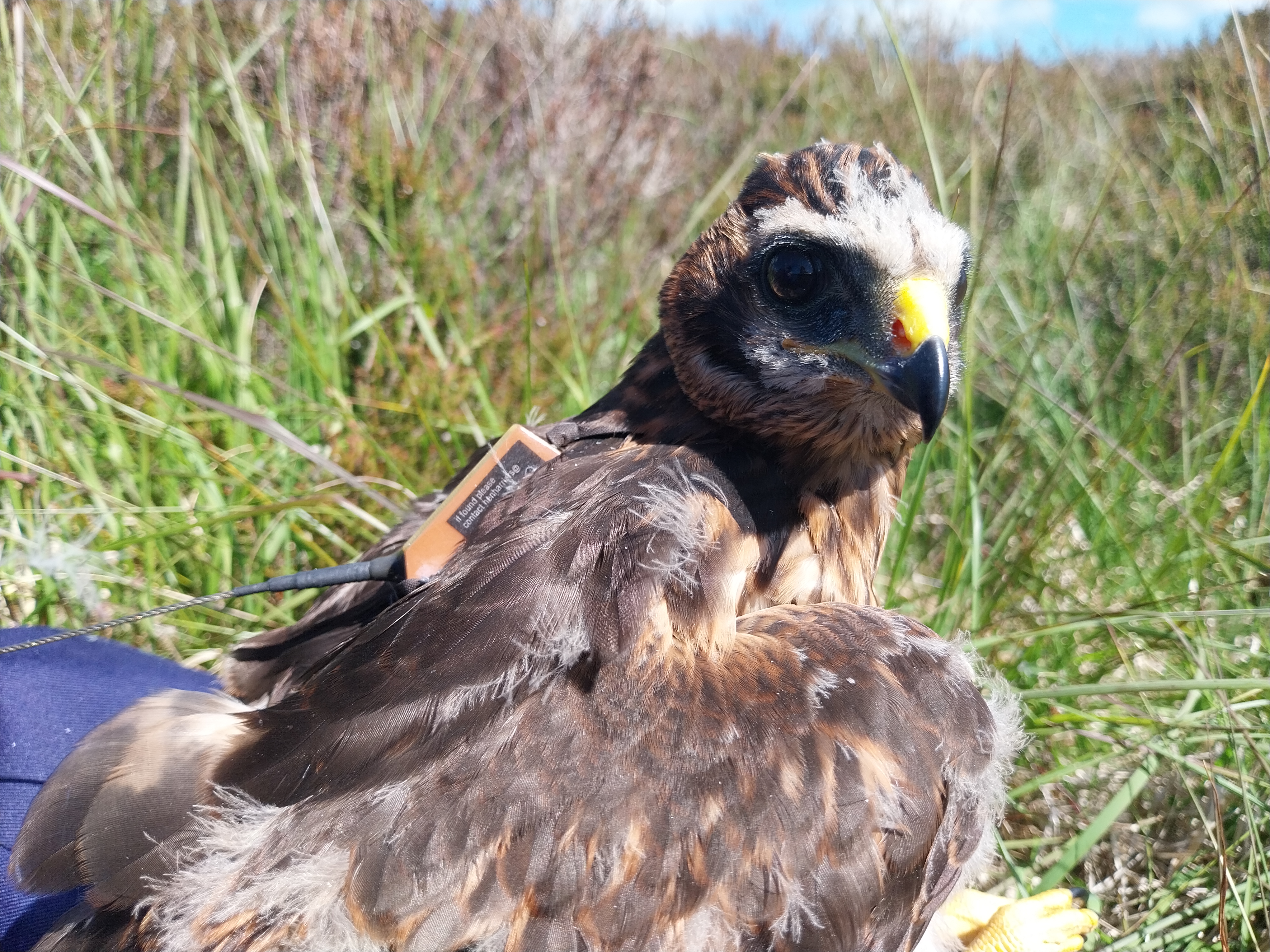
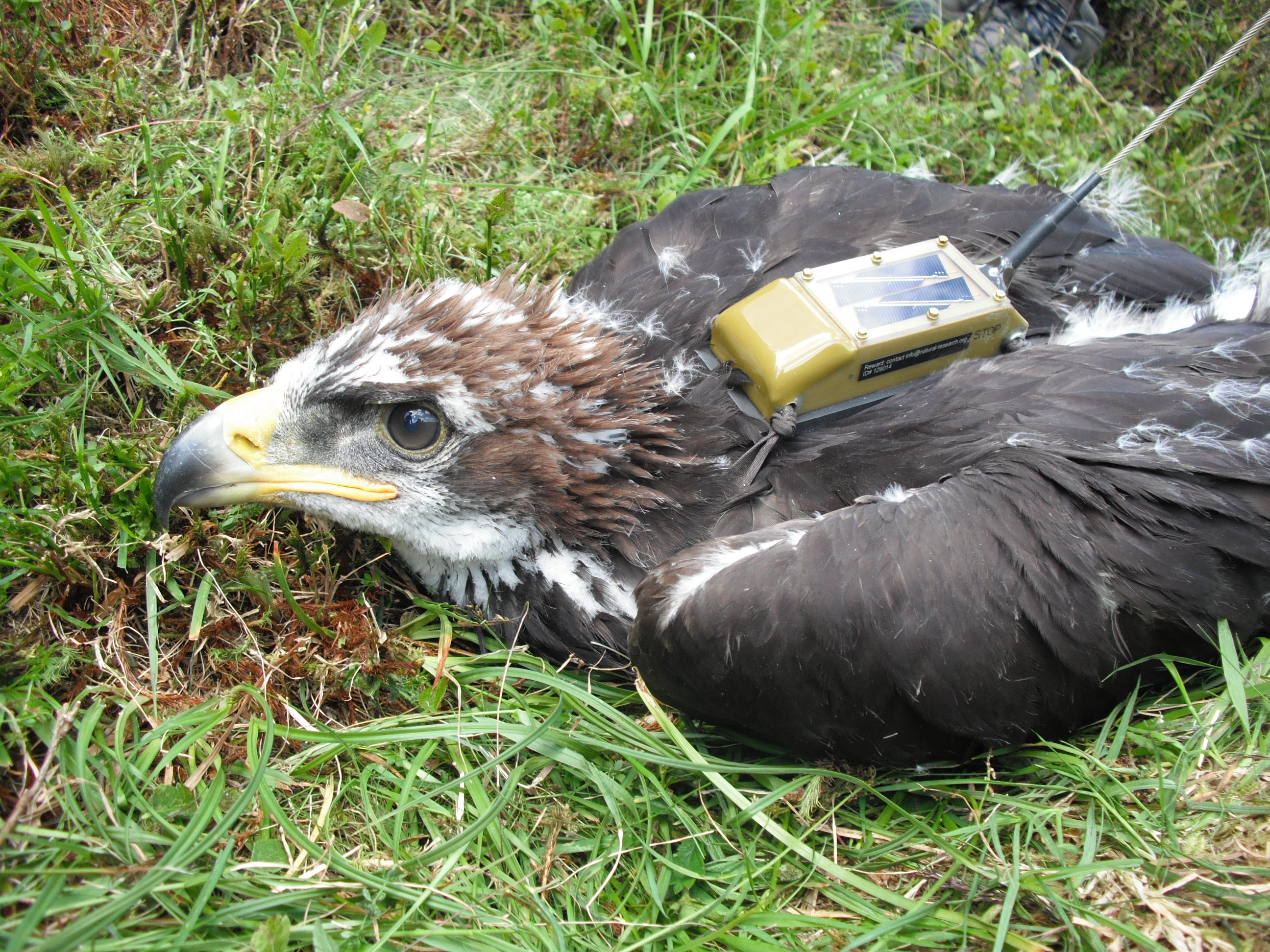
Satellite-tagged golden eagle prior to fledging. This eagle was tagged in 2014, ‘disappeared’ on a Strathbraan grouse moor in 2016 and it’s satellite tag was found wrapped in heavy lead sheeting in the River Braan in 2020. Photo by Duncan Orr-Ewing

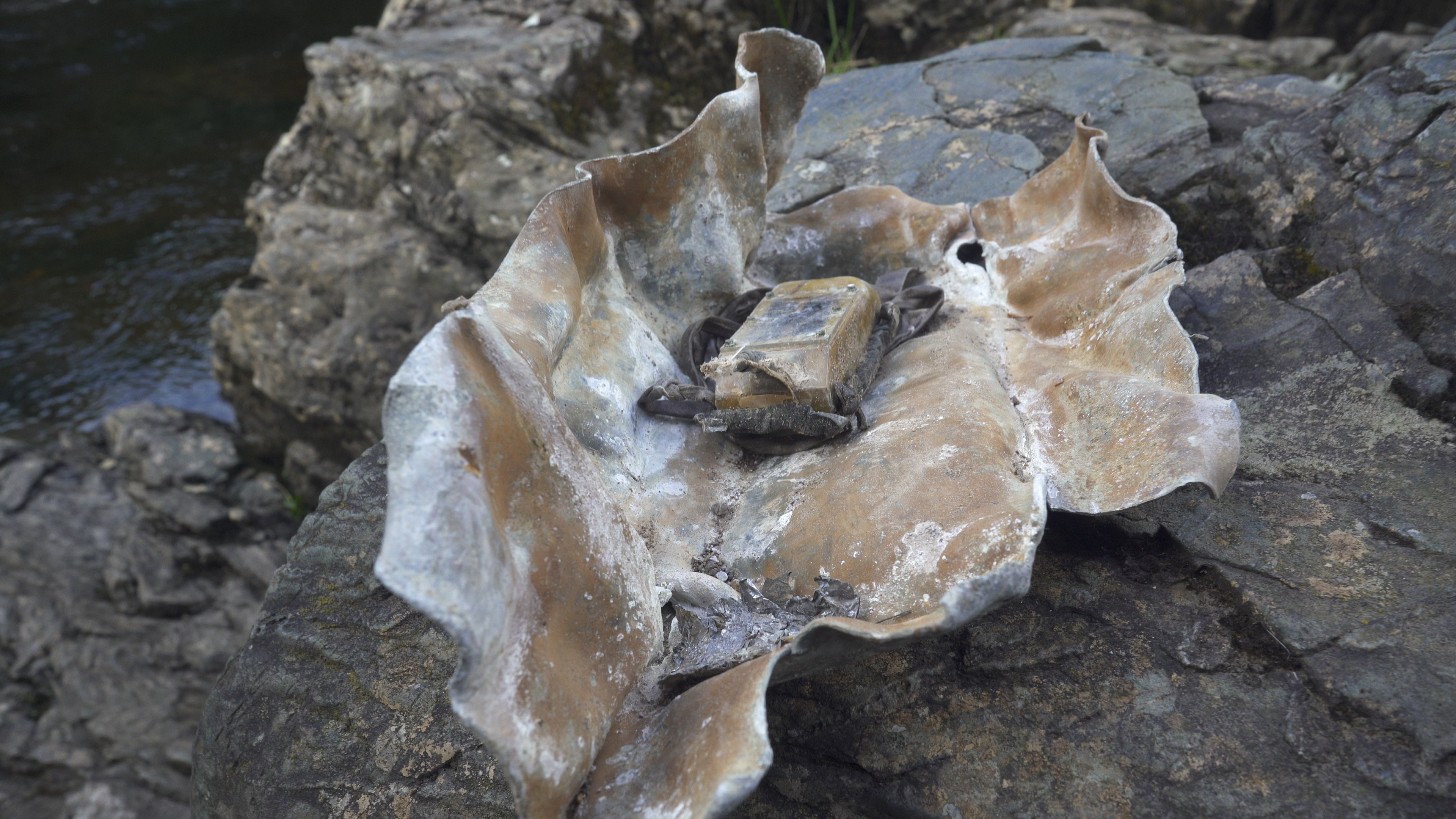
The lengths the criminals will go to avoid detection were exposed in 2020 when a walker found a satellite tag that had been cut off an eagle, wrapped in heavy lead sheeting – presumably to block the signal – and dumped in the River Braan. The tag’s unique identification number told us it belonged to a young eagle tagged in the Trossachs in 2014. This eagle had disappeared without trace from a Perthshire grouse moor in 2016, in an area where eight other tagged eagles had vanished in similar suspicious circumstances. Nobody has been prosecuted.

The remains of the satellite tag that had been cut off the eagle, wrapped in lead sheeting and dumped in a river. Photo by Ian Thomson, RSPB Scotland

The most recent disappearance of a tagged eagle happened just before Christmas 2023, close to the boundary of a grouse moor in the Moorfoot Hills. ‘Merrick’ was translocated to the area in 2022 as part of the South of Scotland Golden Eagle Project. Her tag data told us she was asleep in a tree immediately before she disappeared. Police found her blood and a few feathers at the scene and concluded she’d been shot. Who shoots a sleeping eagle? Again, no one has been prosecuted.

This situation has persisted for decades because although golden eagles have been afforded legal protection for the last 70 years, to date there hasn’t been a single successful prosecution for killing one. The chances of getting caught and prosecuted have been so low that the risk of committing the crime has been worth taking, over and over again. Until now. 

Earlier this year, the Scottish Parliament passed new legislation, the Wildlife Management and Muirburn (Scotland) Act 2024, which introduces a licensing scheme for grouse shooting. For the first time in 170 years, red grouse shooting can now only take place on estates that have been granted a licence to shoot. 

How will this stop the slaughtering of golden eagles and other birds of prey on Scotland’s grouse moors? Well, the licence can be revoked for up to five years if there is evidence of wildlife crime on the estate. Significantly, this will be based on the civil burden of proof which has a lower evidential threshold than the criminal burden of proof. 

This means that instead of the police having to prove ‘beyond reasonable doubt’ that a named individual was responsible, they now have to prove that it’s based only on the ‘balance of probability’. This is a real game-changer because instead of being perpetually ‘untouchable’, now there are real, tangible consequences for the grouse shooting industry if these crimes continue. Estates will no longer be able to rely on the implausible protestation that ‘a big boy did it and ran away’.

As with any legislation, it will only be effective if it is strongly enforced. The jury’s out on that and we’ll be keeping a close eye on performance, but as the licensing scheme is based on a policy of mistrust, the Scottish Government has sent an unequivocal message to the grouse shooting industry. We all know what’s been going on and the public will no longer tolerate it.

ENDS

What did Minister Jim Fairlie say to SLE’s Moorland Conference in June 2024?

Following the Scottish Parliament’s approval of the Wildlife Management & Muirburn (Scotland) Act 2024, which introduces a licensing scheme for the shooting of red grouse in Scotland in another attempt to bring an end to the ongoing illegal killing of birds of prey on many Scottish grouse moors, the landowners’ lobby group, Scottish Land & Estates (SLE) hosted a Moorland Conference on 11 June 2024 and invited Minister Jim Fairlie to speak.

I was interested in what the Minister would say so I asked the Scottish Government for a copy of his notes/speech.

This is what the Scottish Government sent to me:

There was a caveat at the end of the letter from the Scottish Government that went like this:

I would like to advise you that the actual speech by Minister Jim Fairlie, when he addressed the Moorland Conference on 11 June 2024, is likely to differ to the copy of the speech and/or prompt notes provided to him“.

I don’t think there’s anything particularly surprising in the copy of the speech that’s been provided – there’s nothing here that Fairlie didn’t say during his time on the parliamentary committee that scrutinised the Bill at stages one and two, nor during his time as Minister as he steered it through the Stage 3 debate before the Parliament voted to approve the Bill.

Nevertheless, it’s always a good idea to keep track of what Ministers are saying at private meetings, not least to be able to hold them to account if they renege on their previous commitments but also to be able to side-step any hyped-up claims of what’s been said by anyone wishing to present a distorted narrative.

For example, I read a review of the conference that focused heavily on Fairlie’s favourable comments about the grouse shooting industry but was predictably light on his comments linking illegal raptor persecution to grouse shooting.

Fairlie has always been clear about that undeniable link, especially during his time on the Rural Affairs Committee when it was scrutinising the Bill (here) so it’s good to see him reiterate that again to the grouse shooting industry, even though it was sandwiched between some top level fawning.

Grouse moor licensing in Scotland will be in place for start of this year’s grouse-shooting season

Part of the Wildlife Management & Muirburn (Scotland) Act 2024, which requires that the shooting of all red grouse will require a licence, is set to be in place for the opening of the grouse-shooting season on the Inglorious 12th August 2024.

For new readers, this Act was introduced as the Scottish Government’s response to the continued widespread illegal killing of birds of prey on grouse moors. It will work on the basis that all red grouse shooting must now be licensed in Scotland and if, on the civil burden of proof (i.e. the balance of probability) sufficient evidence is found that the licence has been breached (including evidence of illegal raptor persecution), the licence can be withdrawn as a sanction, preventing the shooting of red grouse on a particular estate for a given period.

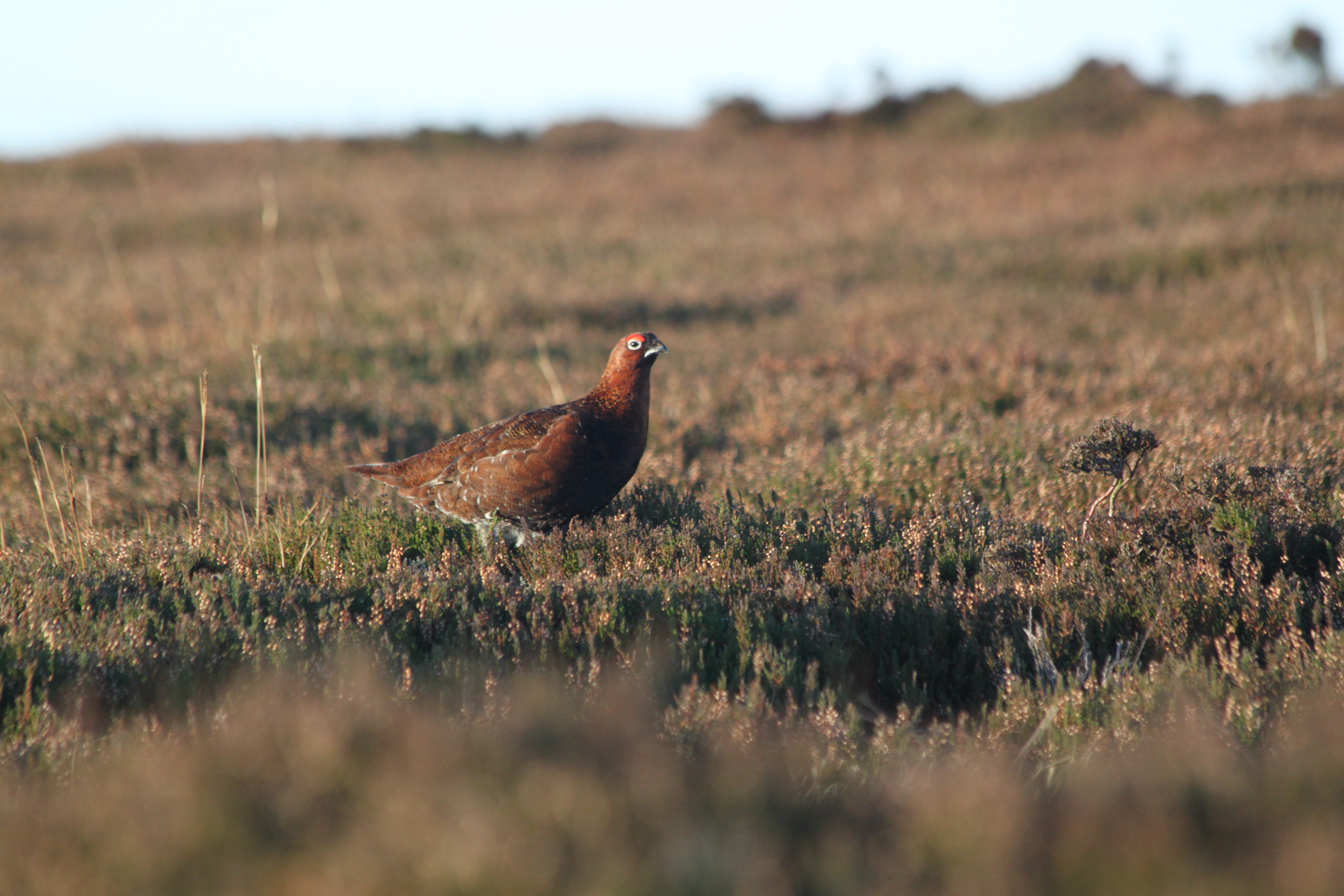
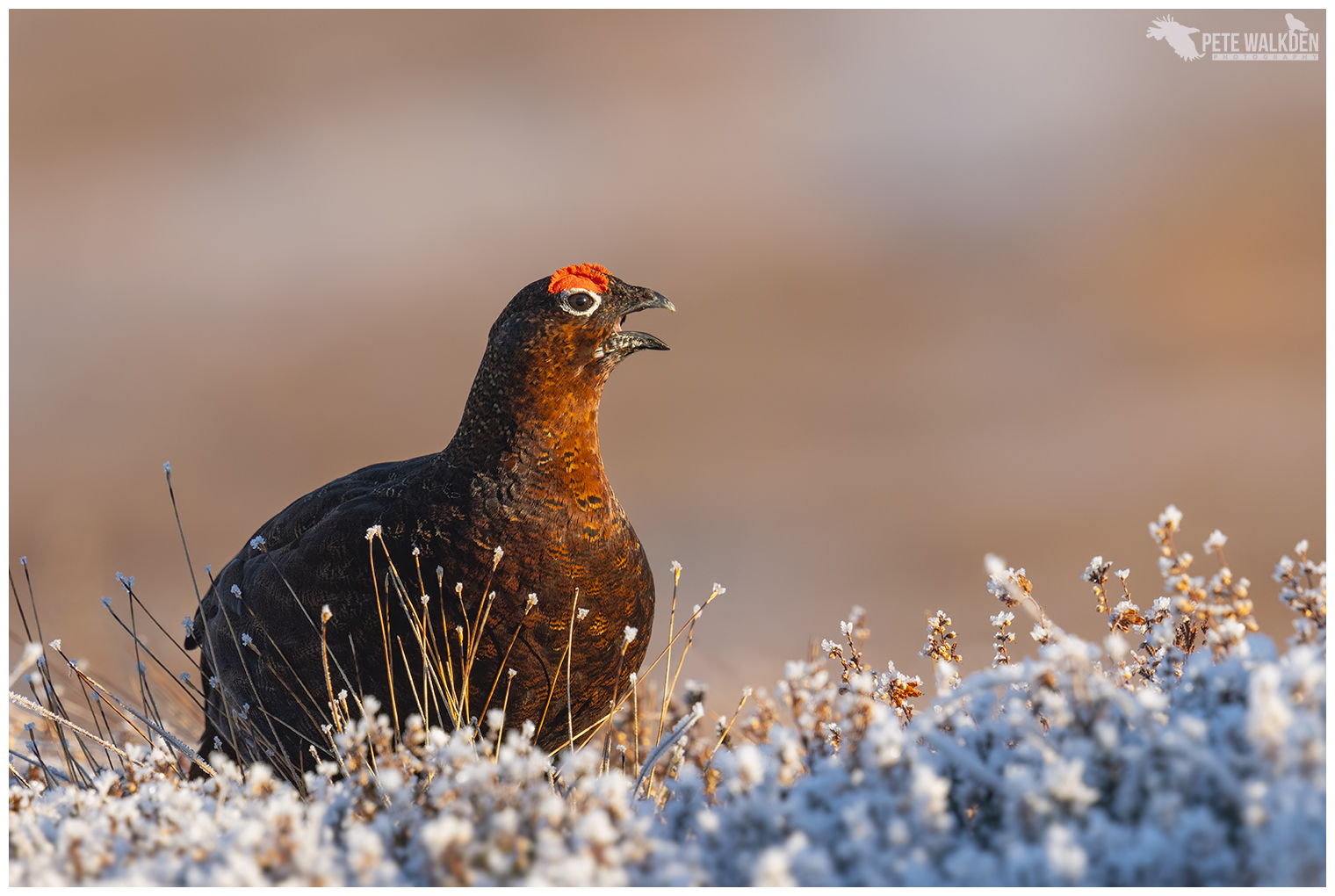
Red grouse photo by Pete Walkden

The Act achieved royal assent on 30th April 2024 (see here) and we’ve been waiting for a formal commencement date (i.e. when the Act becomes legally enforceable).

The legislation required for commencement has now been published and confirms the widely anticipated expectation that the grouse shooting licence would be ready for the start of this year’s season (complete with the associated Grouse Moor Code of Practice) and that the Muirburn licence won’t be ready until at least next year.

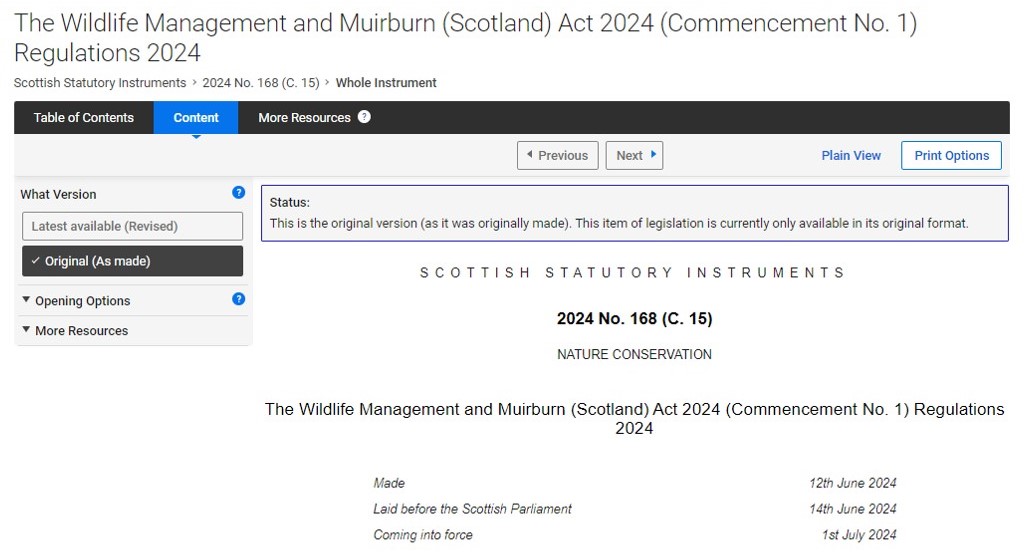
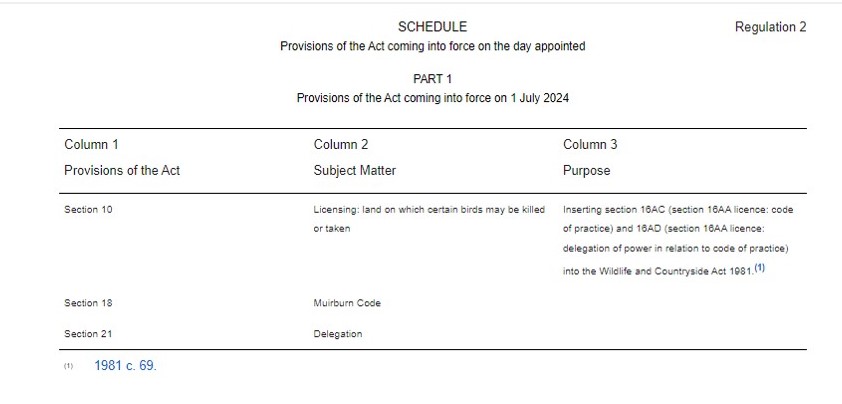
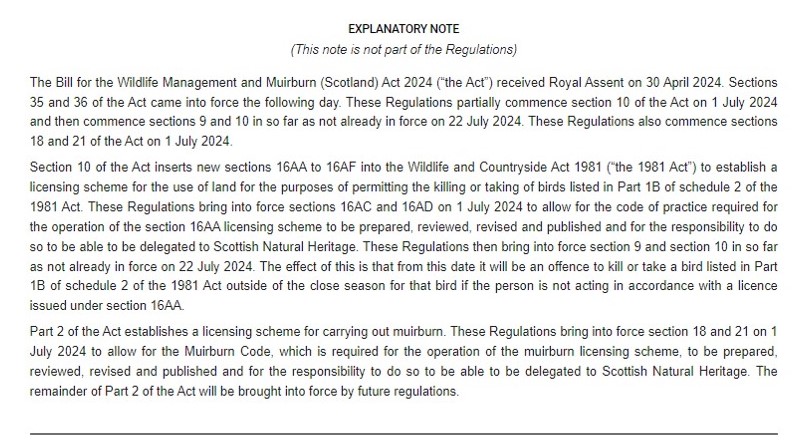
The commencement legislation in the form of a statutory instrument can be read here (and is reproduced below). It’s a necessarily turgid piece of technical legalese but the most important information is the commencement date, and that all looks on track.

Grouse moor owners will shortly be applying to NatureScot for their 16AA licences, which ties them to comply with the associated and soon-to-be-completed Grouse Moor Code of Practice. It’ll be interesting to see how long it takes for an estate to breach the terms of its licence and how any subsequent enforcement and sanction is handled.

Here’s the statutory instrument announcing the commencement dates:

Agriculture Bill amendments could stop big farming payouts for grouse shooting estates

Press release from REVIVE, the coalition for grouse moor reform in Scotland, ahead of today’s debate on the Agriculture Bill:

AGRICULTURE BILL AMENDMENTS COULD STOP BIG FARMING PAYOUTS FOR GROUSE SHOOTING ESTATES

REVIVE, the coalition for grouse moor reform, has welcomed amendments to the Agriculture and Rural Communities (Scotland) Bill that could end generous public funding for grouse shooting estates.

The Stage 3 bill is due to be debated by the Scottish Parliament this afternoon (Tuesday 18 June).

The amendments (#37, #38 and #39) were submitted by Scottish Greens MSP Arianne Burgess. They seek to address the issue of shooting estates being indirectly supported by farm subsidies, with some estates receiving hundreds of thousands of pounds of public money each year.

The amendments would allow ministers to:

#37: rule out specific land uses from getting agricultural subsidies in the future;

#38: end public funding for estates where the primary activity on the land is driven grouse shooting;

#39: ensure that wildlife criminals and irresponsible owners cannot benefit from public funding.

Driven grouse moor landscape in the Cairngorms National Park. Photo by Ruth Tingay

 Eliza Chiswell, REVIVE Campaigner, said: 

REVIVE welcomes Ariane Burgess MSP’s amendments to the Agriculture Bill that would potentially stop grouse shooting estates from receiving public money.

At its launch in 2018, REVIVE expressed shock that shooting estates could be receiving subsidies and it continues to be very concerned that large sums of public money is indirectly supporting, amongst other things, the killing of hundreds of thousands of foxes, stoats, weasels and crows so that more hundreds of thousands of grouse can be shot for entertainment.

It is deeply worrying, for example, that an estate like Invermark, which is “principally a sporting estate” [see here] in 2023 received public money to the tune of £213,545 [see here].

REVIVE has asked its supporters to tell all MSPs that these amendments have strong public support because they ensure that valuable public money supports food production rather than shooting. We hope the amendments receive strong cross-party support and prove to be successful.”

ENDS

The Scottish Greens have also issued a press statement ahead of today’s debate:

The Scottish Government must curb public subsidies for shooting estates and instead use it to support small farmers and the transition to greener agriculture, say the Scottish Greens.

The call comes ahead of the Scottish Parliament voting on the Agriculture and Rural Communities (Scotland) Bill, which will have its final vote this week.

The Scottish Greens rural affairs spokesperson, Ariane Burgess MSP, will be moving amendments that would end subsidies for land that is dominated by grouse moors and boost support for small farmers.

Shooting estates are being indirectly supported by farm subsidies, with one example cited by the REVIVE coalition as having received over £200,000 a year. This allows them to continue the damaging practices of widespread burning of peatland vegetation and the unnecessary killing of our wildlife.

Ms Burgess, said: “It’s grossly unfair that enormous shooting estates are benefiting from subsidies paid for by the taxpayer

This is public money that should be invested in supporting farmers and rural communities to transition to net-zero, but instead it’s being pocketed by giant landowners and is effectively subsidising the management of Scotland’s uplands for bloodsports.

My amendments would prohibit subsidies for driven grouse moors, and ensure that Scottish Ministers cannot hand out public money to wildlife criminals. I hope that all MSPs who are concerned about animal welfare will support these amendments.

The last 14 years have been painful for a lot of people. The last thing we should be doing in a cost of living crisis is handing out subsidies to wealthy landowners for organised cruelty.”

Ms Burgess will also be moving amendments that would support farmers to reduce the environmental impacts of the agriculture industry and assist small to medium scale farmers, crofters and growers to purchase land for food production.

Ms Burgess added: “Small scale farmers play an invaluable role in our food production and in their communities, but, with the current pressures, many are finding it harder to run a sustainable business

Many of them are young and new entrants, and I hope that this bill will provide them with extra support to allow them to purchase and enhance the land around them.”

ENDS

The Stage 3 debate on the Agriculture Bill is expected to start around 3pm in the main chamber and can be watched live on Scottish Parliament TV here.

Grouse Moor Management Code of Practice nears completion

The Wildlife Management & Muirburn (Scotland) Act 2024, which received royal assent on 30th April 2024 (here), is the long-awaited legislation that introduces a licensing scheme for red grouse shooting in Scotland.

It was introduced as the Scottish Government’s response to the continued widespread illegal killing of birds of prey on grouse moors. It will work on the basis that all red grouse shooting must now be licensed in Scotland and if, on the civil burden of proof (i.e. the balance of probability) sufficient evidence is found that the licence has been breached (including evidence of illegal raptor persecution), the licence can be withdrawn as a sanction, preventing the shooting of red grouse on a particular estate for a given period.

This is a significant improvement on the previous situation, where grouse-shooting was mostly unregulated and the evidence required to secure a conviction had to meet the higher threshold of the criminal burden of proof (i.e. beyond reasonable doubt), which was near enough impossible to achieve given the remoteness of the crime locations and the lack of witnesses. Even when a gamekeeper was successfully convicted, the shooting estate rarely suffered any consequences and red grouse shooting could continue as before.

Grouse moors like these at Leadhills (known locally as Dead Hills) in south Scotland will now be subject to licensing rules. Photo by Ruth Tingay

As part of the Wildlife Management & Muirburn Act, two new Codes of Practice are being developed to support the new law – a code of practice for grouse moor management and a code of practice for muirburn. If an estate breaches the terms of these new codes, its licence to shoot red grouse can be removed.

Following an update I wrote last month about the development of these two new codes (see here), there has been further progress on the grouse moor management code (referred to as the Grouse Code).

It is still in draft format but is said by officials to be ‘approaching a final version’. It’s anticipated that the Grouse Code will be in place for the start of the grouse shooting season on the Inglorious 12th August whereas the Code of Practice for Muirburn is not expected to be finalised until early 2025.

The latest draft version of the Grouse Code can be read/downloaded here:

Species licensing review underway by NatureScot

Scotland’s statutory nature conservation agency, NatureScot, has finally started its species licensing review.

The Scottish Government’s Programme for Government 2021-2022 included a commitment to, ‘Review the wider species licensing system with a view to ensuring that the law is being applied correctly and that lethal control is only licensed where the conditions required for such a licence are demonstrably being met. The review will also assess the potential to apply the principle of full cost recovery to species licensing and the introduction of a public register of licenses to improve transparency‘.

This was also included in the shared policy agreement between the Scottish Greens and the SNP in 2021.

Mountain hares by Andy Howard

NatureScot issues approx 90 different types of licences each year to cover all sort of activities that otherwise would be illegal, e.g. Disturbance licences to Raptor Study Group members whose nest monitoring activities would otherwise disturb Schedule 1 raptor species, individual and general licences to kill various wild birds to prevent damage to livestock and crops and to protect public health and safety, licences to use certain traps to kill wild mammals, licences to kill mountain hares to prevent damage to trees, licences to permit the hunting of mammals with more than two dogs, and of course the imminent licences that will be required for grouse moor management under the new Wildlife Management and Muirburn (Scotland) Act 2024.

NatureScot has just published its Terms of Reference (see below) for its Species Licensing Review and there are three main objectives:

  1. Ensure that the law is being applied correctly and that lethal control is only licensed where the conditions required for such a licence are demonstrably being met;
  2. Assess the potential to apply the principle of full cost recovery to species licensing;
  3. Assess the potential to introduce a public register of licenses to improve transparency, bearing in mind data protection and safety of licence holders.

    Objective #1 is obviously important and follows on from significant reviews of the General Licences in England, Wales and Northern Ireland after legal challenges from Wild Justice.

    Objective #2 became a prominent topic of discussion during the debates on the Wildlife Management & Muirburn Bill – it was widely argued by conservationists that grouse moor owners should pay a fee for their licences, not only to cover the admin costs of issuing the licences but especially to cover subsequent compliance monitoring, which should not come at a cost to the public purse.

    Objective #3 is interesting – a searchable public register of licences would be useful, especially if licence holders are required to provide annual licence returns (e.g. how many red grouse were lawfully shot in a particular area in a given season?).

    The anticipated timetable for the review is provided in the Terms of Reference and it’s suggested that a report will be ready for external review in October 2024.

    The Terms of Reference can be read/downloaded here:

    Codes of practice for grouse moor management & muirburn in Scotland – an update

    Last week I wrote about the Wildlife Management & Muirburn (Scotland) Bill gaining royal assent and becoming the Wildlife Management & Muirburn (Scotland) Act 2024 (see here).

    The next big step in the process of this new legislation being enacted is the provision of the two codes of practice that are required to support the new law – a code of practice for grouse moor management and a code of practice for muirburn.

    Grouse moors like these at Leadhills (known locally as Dead Hills) in south Scotland will now be subject to licensing rules. Photo by Ruth Tingay

    The now former Environment Minister Gillian Martin MSP wrote to the Rural Affairs Committee in January 2024 to set out the progress made so far on developing these two codes of practice (see here).

    Last week officials from NatureScot sent a further progress update to those of us who had asked to be kept informed.

    As you’ll see (below), progress isn’t exactly speeding along but I think that’s ok – it’s better to take the time and get things right rather than rush through new rules that end up being unworkable or leave gaping loopholes that the grouse shooting industry would happily exploit given half a chance.

    Here is the latest progress report from NatureScot (sent prior to the Wildlife Management & Muirburn (Scotland) Bill receiving royal assent):

    There’s clearly still a lot of work to do but NatureScot has time. It’s proposed that the grouse moor management code of practice and licensing scheme takes priority and is finalised by mid-summer, presumably in time for it to be up and running by the start of this year’s grouse shooting season on the Inglorious 12th August.

    The muirburn code of practice and licensing scheme, as well as details of the mandatory training courses for both muirburn and the use of certain wildlife traps, will then follow. It’s currently anticipated that the code of practice for muirburn will be finalised by early 2025.

    It remains to be seen whether the recent election of John Swinney as the new SNP leader (and presumed soon-to-elected First Minister) will have an impact on the development and content of these codes of practice and licences. Swinney will want to appoint his own top team – he’s already promised Kate Forbes MSP “a very involved, senior position” which probably leans more towards deputy First Minister and finance than agriculture/environment but let’s see. There’s speculation that John Swinney will lean towards reshuffling his junior Ministers rather than the Cabinet Secretaries (with the exception of whatever senior role is given to Kate Forbes).

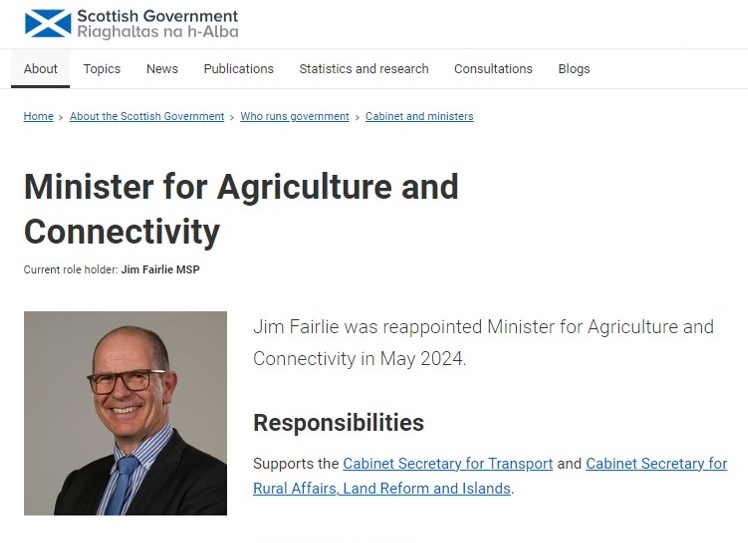
    Current Agriculture & Transport Minister Jim Fairlie MSP is currently the nearest the Scottish Parliament has to an Environment Minister, playing a supporting role to the very experienced Cabinet Secretary for Rural Affairs, Land Reform & Islands, Mairi Gougeon. Fairlie has been deeply involved with the development of the Wildlife Management & Muirburn Act, having served on the Rural Affairs Committee that was responsible for the scrutiny of this Bill prior to his appointment as a junior Minister. It’ll be interesting to see whether he’s allowed to continue or whether he’s replaced by someone with less experience of these issues.

    UPDATE 7 June 2024: Grouse Moor Management Code of Practice nears completion (here)

    Wildlife Management & Muirburn (Scotland) Bill receives royal assent

    The Wildlife Management & Muirburn (Scotland) Bill, passed by the Scottish Parliament on 21 March 2024, has now become the Wildlife Management & Muirburn (Scotland) Act 2024 after receiving royal assent on 30th April.

    A copy of the new Act can be found here.

    The irony is not lost on me that all Bills, but this one in particular, still require royal assent before they become Acts. The idea that a grouse-moor-owning-crown-wearing-unelected bloke from the aristocracy, whose family influenced the popularity of driven grouse shooting many decades ago, is seen as the highest authority on whether grouse shooting should be licensed or not in response to ongoing, widespread criminality on, er, grouse moors, is laughable.

    This particular grouse-moor-owning-crown-wearing-unelected bloke from the aristocracy needn’t worry too much about the effect of the new Act though. If you look at Part 3 31(1) of the Act you find this:

    In other words, if Police Scotland have reason to suspect that a wildlife crime has been committed on one of the king’s private grouse moors (e.g. Delnadamph in the Cairngorms National Park) and they want to get a warrant to conduct a search of the estate for potential evidence, they can only exercise that warrant if they’ve been given prior consent by a person appointed by the king.

    Genius. Can’t see any flaws in that whatsoever.

    Now the Bill has become an Act, the final stage in this long, long process of licensing grouse shooting in Scotland in an attempt to stop the illegal persecution of birds of prey will be the development of the two Codes of Practice associated with the new Act, one for grouse moor management and one for muirburn. More details on the progress of those shortly…

    Police Scotland arrest & charge man from Jed Forest Hunt with alleged fox hunting offences under new wildlife crime legislation

    Police Scotland have arrested and charged a 29 year old man from the Jed Forest Hunt with three alleged fox hunting offences after receiving video footage from the League Against Cruel Sports.

    Another man, aged 55 and from a different hunt, has been arrested following allegations of a further three illegal hunting offences. He has been released pending further enquiries.

    These arrests (and charges in the case of the 29 year old man) are highly significant as I believe they may be the first following the new Hunting with Dogs (Scotland) Act which came into force in October 2023 (see here).

    They’ll be a good test of whether enforcement measures are sufficient for new legislation designed to tackle persistent wildlife crime – an issue we’ll all be monitoring closely when the Wildlife Management & Muirburn (Scotland) Act is enacted later this year on Scottish grouse moors.

    Previous footage from the League Against Cruel Sports, showing a hunter throwing a fox to a pack of hounds, led to the enactment of the new legislation last year. NB: This footage is NOT related to the current arrests.

    Penalties under the new fox hunting legislation include a custodial sentence of up to 12 months and/or a fine up to £40,000 (on summary conviction) or a custodial sentence of up to five years and/or a fine (on indictment, i.e. more serious cases).

    Since the new legislation was enacted last autumn, investigators from the League Against Cruel Sports have been undertaking covert surveillance (via drone and on the ground) of five mounted hunts (The Berwickshire, Jed Forest, Lauderdale, Duke of Buccleuch, and Dumfries and Stewartry) and have submitted their findings to Police Scotland, resulting in the two arrests.

    The League has published video footage from its observations (here) and an end of season report, which can be read/downloaded below:

    Please note: As the 29 year old has now been charged with three alleged hunting offences, comments about his specific case will not be published until criminal proceedings against him have concluded. However, comments about the hunting legislation in general and the League’s findings are welcome, subject to the usual blog policy on libel, personal abuse etc.

    A positive future for sustainable deer management in Scotland – guest blog by Duncan Orr-Ewing

    This is a guest blog from Duncan Orr-Ewing, Convenor of the Scottish Environment LINK Deer Group.

    LINK Deer Group comprises of RSPB Scotland, National Trust for Scotland, John Muir Trust, Scottish Wildlife Trust, Woodland Trust Scotland, Trees for Life, Ramblers Scotland, and Nature Foundation.  

    Duncan’s blog encourages readers to participate in the Scottish Government’s current consultation on Managing Deer for Climate and Nature (details at the foot of this blog). The consultation closes this Friday (29th March 2024).

    Photo by Duncan Orr-Ewing

    A POSITIVE FUTURE FOR SUSTAINABLE DEER MANAGEMENT IN SCOTLAND

    Alongside the progress of the Wildlife Management and Muirburn Bill, which was approved by the Scottish Parliament last week, reforms to deer management in Scotland are also being considered by Scottish Government.

    Measures to update the Deer (Scotland) Act 1996, and to bring it into line with modern day expectations around the need to restore nature and to combat climate change are making steady progress, and are now out to public consultation. New deer legislation will be included in a Natural Environment Bill expected to be laid before the Scottish Parliament in late 2024.

    In the absence of natural predators, such as lynx or wolf – both exterminated in Scotland several centuries ago – deer populations are managed by humans to prevent damage to a wide variety of public interests. Damage can be caused by high deer populations to the natural heritage; to agriculture; to forestry; and also to human health and safety (road traffic accidents and Lyme disease).

    Deer management is carried out to high humane standards by expert stalkers following Deer Management Best Practice, and of course most of the end product – venison- then goes into the human food-chain, and is widely regarded as a healthy alternative to farmed meats.    

    Photo by Duncan Orr-Ewing

    Most of Scotland’s uplands are managed either as grouse moor or as deer forest, and therefore along with grouse moor management, the land management practices which occur in deer forests are hugely important for protecting and enhancing our native wildlife and their habitats in the uplands.

    The latest population estimate for the combined four species of deer (two native and two non-native) that occur here is over 1 million animals. This represents a doubling of the deer population in the last twenty years. For further background and deer timelines see here.

    As with grouse moor management and the independent Grouse Moor Management Review Group (“Werritty Review”), the Scottish Government commissioned an independent review of deer management in 2017 and which reported in 2020, here. It came up with 100 recommendations for improvements to current systems and processes, and to foster better sustainable deer management practices in Scotland. These recommendations were largely accepted by Scottish Government – see here.

    These recommendations of the independent Deer Working Group now form the backbone of the deer legislative proposals for the Natural Environment Bill.

    However, in addition the Scottish Government is proposing a few further, and we think largely beneficial measures. These include provision for what are being called Deer Management Nature Restoration Order powers to NatureScot, the competent deer authority, to take compulsory action to reduce deer numbers to enhance habitats and species in targeted areas. This is intended to help deliver the outcomes of the Scottish Biodiversity Strategy.

    We encourage individuals to respond to the current public consultation on new deer legislation in Scotland which closes on Friday 29th March. This a relatively straightforward exercise and can be done quite quickly – here.

    See also the LINK Deer Group response for further advice and suggestions on how you might respond – here.

    Duncan Orr-Ewing

    Convener, LINK Deer Group

    ENDS

    Editor writes: Some of you may have seen the Scottish Gamekeepers Association’s hysteria in response to the Government consultation, refusing to engage with it and claiming that their members may suffer a ‘mental health toll’ if they have to cull heavily pregnant hinds due to the proposed changes in the deer hunting season- see here.

    As usual, the SGA hasn’t provided proper context. There are proposed changes to female deer seasons to essentially make them all the same for all species. It is still entirely discretionary when deer are shot within the proposed new seasons.

    If folk are worried they can take their cull earlier in season. It’s the same with the now abolished season for male deer. It does not mean stalkers have to cull male deer all year round and some people may stick to the old male deer season.

    The bottom line for conservation though is more deer need to be culled, especially hinds, to reduce burgeoning deer populations. It is the female deer that are critical in that respect.

    If you’re able to complete the consultation by Friday (no specific deadline has been given on Friday) that would be great, thanks. The link is here.