
Follow this link to journalist Rob Edward’s website, where a leaked copy of the Hen Harrier Conservation Framework report is available to download – http://www.robedwards.com/2011/01/revealed-scotlands-bird-killing-fields.html#more
Tag: scottish parliament
Vicarious liability one step closer
Congratulations to the Scottish Parliament’s Rural Affairs & Environment Committee for its continued support of the proposed introduction of vicarious liability to the WANE Bill. Their latest deliberations took place at Holyrood on Wednesday 12 January 2011 during Stage 2 of the Bill and all bar one of the committee members were very much in support of Roseanna Cunningham’s ammendment on this issue.
No surprise to learn that the only person who opposed it was John Scott MSP, who tried to suggest that the issue had been sprung on landowners out of the blue and that the neccesary consultation was inadequate. Roseanna Cunningham bit back with some welcome feistiness and told him his suggestions were nonsense – she had warned over a year ago that unless raptor persecution levels showed a significant drop, then vicarious liability was going to be “inevitable”. She had wanted to give the shooting industry an opportunity to get their house in order on a voluntary basis but after the appalling incidents at Skibo Estate, Moy Estate, and others throughout 2010, it was blatantly obvious that the industry was incapable of self-regulation and thus further legislation was neccessary. The rest of the RAE Committee agreed with her and John Scott MSP was out-voted 7 – 1 for the ammendment to continue to Stage 3.
John Scott also used the Stage 2 meeting to try and bring an ammendment that would allow more flexibility for the issue of licences to kill protected species (presumably starting with buzzards) under the European Birds Directive. That was also given short shrift by the Environment Minister who told him that the flexibility offered by the Directive was inapplicable to sport shooting.
There was no mention of the Hen Harrier Conservation Framework during the 3 hour meeting – presumably because most of the Committee have not yet been given the opportunity to read it. Hopefully it will be available to them before the concluding Stage 2 meeting at the end of January.
Wednesday’s meeting can be viewed on Holyrood TV: http://www.holyrood.tv/library.asp?iPid=3§ion=102&title=Rural+Affairs+and+Environment+Committee
Hen harriers and gamekeepers – ‘damning evidence’ soon to be published
Following the blog posts of December 18th and 24th 2010 about the delayed publication of the long-awaited Hen Harrier Conservation Framework report, one of our readers emailed the Environment Minister, Roseanna Cunningham. Thank you Mike Price for sending us the government’s response:
Thank you for your email of December 24th, to Roseanna Cunningham MSP, Minister for Environment and Climate Change, regarding the Conservation Framework for Hen Harriers. I have been asked to respond on behalf of the Scottish Government.
We are aware of the report and of the delays that it has experienced on its way to publication. Although my understanding is that SNH have arranged meetings with stakeholders to go through their scientific concerns, I appreciate that this is frustrating for those who have an interest in raptors in Scotland and are waiting for the report’s conclusions to be made public.
We have been assured by SNH that the report will be published before the Parliament has completed consideration of the Wildlife and Natural Environment (Scotland) Bill and will be made available to the Rural Affairs and Environment Committee. While I can’t comment on the content of a report that is yet to be published, I assure you that the Minister and her officials look forward to reading its conclusions with great interest.
Kind regards
—
Catherine Murdoch
Natural Resources Division
Rural and Environment Directorate
The Scottish Government
Phone: 0131-244 7140
Mail: 1-D North, Victoria Quay, Edinburgh EH6 6QQ
For information on wildlife crime and PAW Scotland, please visit http://www.PAW.Scotland.gov.uk
Meanwhile back in Gamekeeper World, the SGA has announced it is conducting a national wildlife survey on sporting estates, focusing on birds. SGA Chairman Alex Hogg says on his blog: “We know from extensive scientific studies that land which is managed by gamekeepers has some of the most prolific wildlife in the country“. Hmm, we also know from extensive scientific studies that land which is managed by gamekeepers is where raptors are persistently and illegally persecuted. The forthcoming Hen Harrier Framework report provides very clear evidence that the land where hen harriers are absent (despite it being apparently suitable breeding habitat) also just happens to be land that is managed as grouse moors. What an amazing coincidence! In fact, isn’t that also what the Golden Eagle Conservation Framework reported in 2008? Yes, I think it is. A cynic may conclude that the SGA’s national wildlife survey is simply their latest public relations offensive in an attempt to bury the devastating evidence of hen harrier persecution on Scottish sporting estates that will shortly be published for all to read. And yes, we have read the report – and it most certainly does contain damning evidence. We’ve considered posting it on this site but we will wait and hope that SNH keeps its promise and publishes the report sometime this month.
Alex goes on to encourage SGA members to participate in the forthcoming bird survey, and tells them that the survey form will only take “a short time” to fill in. Is that because most of the native birds have been illegally poisoned, or shot, or clubbed to death after being caught in a trap….?
Alex Hogg Blog here: http://www.scottishgamekeepers.co.uk/content/gamekeepers-conduct-national-wildlife-survey
MSP asks questions about delayed Hen Harrier Framework report
A switched-on MSP has recognised the importance of the Hen Harrier Framework report and its relevance to the current WANE Bill debates, and has raised formal questions in the Scottish Parliament about its delayed publication.
On December 21st 2010, MSP Peter Peacock (Labour: Highlands & Islands) lodged the following two written questions:
To ask the Scottish Executive what the (a) timetable and (b) launch date is for the publication and promotion of the hen harrier conservation framework report by the Scottish Raptor Monitoring Scheme partnership;
To ask the Scottish Executive whether the contents of the hen harrier conservation framework report have been made available to the Rural Affairs and Environment Committee and, if not, whether the report will be published before the Parliament has completed consideration of the Wildlife and Natural Environment (Scotland) Bill.
http://www.scottish.parliament.uk/business/businessBulletin/bb-10/bb-12-22e.htm
Parliamentary questions can be asked by any MSP to the Scottish Government/Executive. The questions provide a means for MSPs to obtain factual and statistical information from the Scottish Government. Written questions must be answered within 10 working days (20 working days during recess). Peter Peacock’s questions are due for answer on Thursday 27 January 2011.
Peter Peacock is no stranger to the WANE Bill, as he is a member of the Rural Affairs & Environment Committee (the committee tasked to consider the finer details of the proposed Bill). He has emerged as one of the leading MSPs trying to introduce measures to ensure that those responsible for illegal raptor persecution are brought to justice for their crimes. He obviously recognises that the information contained within the Hen Harrier Framework report could have a strong influence on the outcome of these proposed measures. The report is alleged to contain “damning evidence” about hen harrier persecution in Scotland and its link to grouse moors – evidence that might just persuade MSPs that the time for strong action against these criminal activities is long overdue.
Unsurprisingly, there have been no calls of concern over the delayed publication of the Hen Harrier Framework report from groups with an interest in game shooting. Is it because they already know the extent of the “damning evidence“, and know that the release of this evidence will weaken their stance as they try to oppose measures such as vicarious liability or estate licensing? Below is a link to a news report from The Independent dating back to 2003, where Scottish Gamekeeper’s Association Chairman Alex Hogg seeks licences for gamekeepers to kill hen harriers. But not all hen harriers, of course, only those that are considered to be “problem” birds. The difficulty here is that many gamekeepers consider ALL hen harriers to be “problem” birds (because they eat red grouse and pheasants) – and they’ll kill them whether they have a licence to do so or not – as the contents of the Hen Harrier Framework report will show. Interesting also to note that in 2003 the Scottish Government introduced “tough new legislation to arrest and imprison anybody who poisons, traps or shoots birds of prey“. Nearly eight years later, how effective has that “tough new legislation” been? I’d say totally ineffective, given the pitiful sentences handed out by Sheriffs to people convicted of such crimes.
http://www.independent.co.uk/news/uk/home-news/gamekeepers-want-to-kill-birds-of-prey-598863.html
Alleged dirty tricks campaign delays publication of hen harrier persecution evidence
The Scottish Raptor Study Group claims that a dirty tricks campaign is behind the delayed publication of a new hen harrier report. The report, called “A Conservation Framework for Hen Harriers in the UK”, contains “some highly damning evidence” that illegal persecution on grouse moors is one of the main reasons behind the species’ imperiled conservation status.
The Scottish Raptor Study Group accuses game-shooting lobbyists of employing delaying tactics so that the report is not published during the critical stages of the WANE Bill. If it is published, it would provide yet further evidence (if further evidence is needed) that illegal persecution is preventing the recovery of yet another protected raptor species. This evidence could persuade MSPs to support tough new measures that have been proposed to combat wildlife crime in Scotland, such as the licensing of shooting estates. Unsurprisingly, the game-shooting lobbyists are dead set against this proposal, and other similar measures, such as the introduction of vicarious liability. By suppressing the hen harrier report, they can continue to claim that everything in the shooting industry is above board and legal.
The report was supposed to have been published by SNH almost a year ago, in January 2010. Where is the public accountability? More importantly, where is the report? Perhaps the authors should email a copy to Julian Assange – he seems to be very good at publishing information that governments and others would rather be kept hidden.
Full details of the story at the SRSG website: http://www.scottishraptorgroups.org/news.php
Raptor persecution “a part real – part imaginary crime”, says MSP
The stage 1 debate on the Wildlife and Natural Environment (Scotland) Bill took place in Holyrood yesterday. The televised debate is available here: http://www.holyrood.tv/library.asp?iPid=3§ion=31&title=General+Debates
The video lasts for 2.04 hours, and the WANE bill debate begins at 30 mins and runs to the end of the video.
Perhaps the most astonishing comment was that made by John Scott MSP (who begins his short speech at 57 mins into the video), who said that the Scottish conservatives do not accept that raptor persecution is widespread, they don’t believe a case has been made for the introduction of vicarious liability, and that raptor persecution was “a part real – part imaginary crime”.
Mr Scott is a member of the Rural Affairs and Environment Committee – the group charged with leading on the WANE bill – and so presumably he has sat through hours and hours of evidence about the extent of wildlife crime in Scotland, and in particular raptor persecution. Was he asleep? Or is his mind padlocked? His eyes blinkered? His ears stuffed with lambswool? Here is his MSP profile: http://www.scottish.parliament.uk/msp/membersPages/john_scott/index.htm
Thankfully, other members of the Committee re-butted his claim during their own statements, and it seems that there is a general consensus that the on-going issue of illegal & widespread raptor persecution in Scotland should be, and will be addressed within the WANE bill, which has now moved into Stage 2 for more detailed discussions.
Environment Minister Roseanna Cunningham announced that the Government’s response to the Committee’s Stage 1 Report will be published next week.
Law to stop raptor poisoning likely to be strengthened
As many of you will know, for the past few months the Rural Affairs & Environment Committee of the Scottish Parliament has been hearing evidence on the proposed WaNE bill (Wildlife and Natural Environment (Scotland) Bill. Certain measures included in this Bill will, if accepted, help to address the on-going issue of illegal raptor persecution across Scotland.
The RAE Committee has today published its Stage 1 Report of this Bill, and they should be congratulated for their interest in, and support of, many of the suggestions made by several wildlife conservation groups to tackle raptor persecution crimes.
In a press release, Committee Convenor Maureen Watt MSP said, “We utterly condemn wildlife crime and the poisoning of iconic birds of prey such as the golden eagle and the hen harrier. The law clearly needs to be strengthened and introducing vicarious liability appears to most of us to be a step in the right direction.”
Stage 2 of the WaNE Bill is expected to take place in December.
Here is a summary of the relevant parts of the report that deal with raptor persecution:
The Committee condemns as wholly unacceptable the illegal killing of raptors which continues across Scotland. The Committee recommends that the Scottish Government instructs police forces to investigate rigorously suspected cases of raptor persecution. The Committee also recommends that the Scottish Government likewise instructs the Crown Office and Procurator Fiscals office to prosecute wildlife crime vigorously.
 The Committee concludes, from all evidence taken on this issue, that detection, investigation and prosecution of this crime is not resulting in a significant reduction in cases of raptor persecution, and that this should be addressed.
The Committee welcomes the Scottish Government’s intention to bring forward an amendment at Stage 2 to introduce a vicarious liability offence in the Bill, which it considers to be a helpful step in the right direction. The Committee awaits further detail on this, which was not available before the conclusion of evidence-taking at Stage 1. The Committee recognises there could be significant challenges in securing convictions under such new provisions, but believes the strengthening of the law in this regard is a helpful addition to the range of provisions available for potential prosecution.
The Committee notes that the majority of private landowners are appalled by raptor persecution. The Committee considers that such landowners should have nothing to fear from a vicarious liability provision.
The Committee welcomes the principle of the estates initiative, a voluntary good governance scheme for private land managers currently being prepared by the SRPBA, and agrees with the Minister that the scheme should be supported and given an appropriate amount of time to become established. However, the Committee also notes that the scheme will be voluntary and will therefore lack the power to compel estates that do not wish to take part. The Committee would welcome clarification from the Minister on how she plans to support the initiative.
The Committee accepts that it would represent a challenge and a significant development of policy to introduce a fully worked up system for licensing sporting estates in the Bill at this stage. The Committee also notes that the issue would not have been subject to consultation and as a result introducing such a system would be inappropriate at this time. However, the Scottish Government may wish to consider the appropriateness of introducing an enabling power in to the Bill which would permit them to introduce a licensing scheme, only after full consultation with stakeholders and parliamentary scrutiny under the super-affirmative procedure. Should it take the power, the Scottish Government could consider formally adopting the estates initiative with appropriate modifications as a code of conduct applicable to all estates. However, any such power should only be used if the Scottish Ministers are not satisfied that the voluntary approach to good governance and any vicarious liability offence are working.
The Committee notes Sheriff Drummond’s proposal to establish a presumption of guilty intent for anyone found in possession of a regulated substance. The Committee also notes his comments on whether an employer could be proven to have knowingly caused or permitted the possession of such a substance. The Committee considers that Sheriff Drummond’s proposals, and the introduction of a vicarious liability offence, are not mutually exclusive, and invites the Scottish Government to consider the proposal.
The Committee also notes the view that there is a further gap in the armoury of potential offences, that which seeks to catch those “concerned in” the use of illegal poisons for the purpose of raptor persecution or in other activity “concerned in” the offence of bird persecution. The Committee urges the Scottish Government to consider developing further offences which cover these points to further strengthen the grounds for potential prosecution.
The Committee invites the Scottish Government to consider the merits of announcing an amnesty on illegal substances such as carbofuran.
The Committee recommends that the Scottish Government reports to Parliament annually on the number of illegal raptor killings, detailing the number of cases brought and those which were successfully prosecuted.
The full report can be read here: http://www.scottish.parliament.uk/s3/committees/rae/reports-10/rur10-08-00.htm
roseanna cunningham – we salute you!
Scottish Environment Minister, Roseanna Cunningham, has today made clear her intention to address the on-going problem of illegal raptor persecution.
Speaking to the Rural Affairs and Environment Committee as they continue to discuss Stage 1 of the Wildlife and Natural Environment Bill (WaNE), she said she intends to bring in an ammendment to Stage 2 of the discussion that would create a new ‘vicarious liability’ offence that would target those who control or manage others who are involved in criminal raptor persecution.
She said:
“Increased awareness and condemnation appears to be doing little to bring down the number of illegal bird poisonings in Scotland. Official figures show that 16 birds of prey were poisoned in the first six months of this year and I find this extremely disappointing.
We have robust legislation in place to tackle this sort of crime but tougher action has to be taken to deter those who think that they can get away with persecuting our wildlife.
I don’t want to unfairly target any particular group and I will be engaging with stakeholders over the coming weeks to make sure that they know what we are trying to achieve with this amendment.
We have a duty to protect our birds of prey as they are an integral part of our national identity. They also help our economy by attracting tourists from across the world and we cannot afford to have our international reputation tarnished by the few who continue to target them illegally.”
Roseanna Cunningham deserves recognition for making this move. Many conservation groups have lobbied for the introduction of vicarious liability for several years, but many of the gamekeeping and landowning groups have vehemently opposed it (hmm, I wonder why?), and especially Sheriff Drummond, who was quite entertaining when he recently presented his views against introducing it at the WaNE bill committee meeting in Holyrood.
It’s still not a certainty that the ammendment will be accepted, but at least it’s on the table.
Well done, Roseanna Cunningham.
Government press release here: http://www.scotland.gov.uk/News/Releases/2010/11/03110045
However, before we all get carried away…there are disturbing reports circulating about the failure to investigate the two poisoned eagles (one golden eagle and one sea eagle) that were found on an estate near Inverness in June (see blog report Oct 13). More on these reports shortly…
eagle killers getting away with it: Skibo update
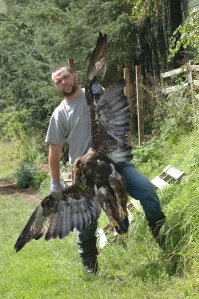 Given the deafening silence on the progress of the Skibo case (see blog report 12 May 2010, where it was reported that three golden eagles, one sparrowhawk and one buzzard had been found on the Skibo Estate in north Scotland), we’ve done some digging around.
Last month (see blog post 20 September 2010), we noted that the results from the toxicology investigation on the dead birds had not been made public. We also noted that the results of the police investigation had not been made public. Infact, since the police raid in early May, the only press coverage was that on 21 June 2010, where Skibo gamekeeper Dean Barr had accused the RSPB of planting the dead birds: http://www.dailyrecord.co.uk/news/scottish-news/2010/06/21/gamekeeper-at-skibo-estate-probed-after-three-golden-eagles-are-found-dead-86908-22348349/
We have discovered that the three golden eagles and one sparrowhawk had all been killed by eating poisoned baits, according to scientific analysis undertaken by government scientists. Their results conclude that two of the golden eagles, plus one sparrowhawk were killed by the banned pesticide Carbofuran. They state the third golden eagle was killed by the banned pesticide Aldicarb. Click here for the SASA report detailing these incidents: SASA poisoning positive results 2010
Given the confirmation that these raptors that were found dead on Skibo Estate in May 2010 had been killed by illegal poisons, it is worrying that there has been no formal notification of any charges brought against anybody for these crimes.
Does this mean that, along with every other single case of eagle persecution in this country, the eagle killer(s) in the Skibo case will be getting away with it?
It is perhaps timely that the WaNE bill is currently being reviewed by the Scottish parliament. Measures proposed in that bill will, if implemented, help to stop these criminals getting away with murdering our iconic birds of prey. For example, if the concept of vicarious liability is accepted, then the Estate Owner/Manager will take full legal responsibility for the actions of their staff.
Right now, nobody takes responsibility and we’re all sick of reading these news stories about yet another eagle/kite/buzzard/peregrine/goshawk/osprey/sparrowhawk/tawny owl/hen harrier/kestrel being persecuted.
Hogg-wash and the WANE Bill at Langholm.
As most readers of this blog will be aware the Scottish Government introduced the Wildlife and Natural Environment (Scotland) bill to parliament on 9th June 2010.
The purpose of this bill is to modernise game law, abolish the designation ‘areas of special protection’, improve snaring practice, regulate invasive non-native species, change the licensing system for protected species, amend current arrangements for deer management and deer stalking, strengthen protection of badgers, change how muirburn can be practised, and make operational changes to the management of Sites of Special Scientific Interest.
The bill (as introduced) can be seen here.
http://www.scottish.parliament.uk/s3/bills/52-WildNatEnv/b52s3-introd.pdf
The Rural Affairs and Environment Committee has been appointed the lead committee to scrutinise the bill and as such has called on various bodies to provide views on the general principles of the bill.
Written submissions can be read here.
http://www.scottish.parliament.uk/s3/committees/rae/bills/WANE/writtensubmissions.htm
Naturally the most important issue on this bill, from a raptor conservation aspect, will be any change to the licensing system for protected species which could theoretically pave the way for the licensed killing of raptors in Scotland.
In a change to the usual passage of such bills the 18th meeting was held in The Buccleuch Centre in Langholm on 7th September 2010 . A full transcript of the meeting can be viewed here.
http://www.scottish.parliament.uk/s3/committees/rae/or-10/ru10-1802.htm#Col2967
(The most relevant discussion involving raptors commences at col 2991)
Alex Hogg (chairman of the Scottish Gamekeepers Association) had much to say on the subject of the licensed killing of raptors and ravens. Mr Hogg pleaded his case saying –
I only have a problem with young rogue buzzards. If I could deal with those specific ones, the problem would stop, I am quite sure. A lot of money would be lost to the rural economy if every shoot in Scotland ended up losing poults. A pheasant poult is worth the same as a lamb—it is worth about £35 when it is shot, and that is a huge amount of income for the rural economy. All that we are asking for is something to deal with specific rogue birds. We do not feel that a huge number would be involved,
Mr Hogg forgot to mention that his last application to the Scottish Government was to kill 12 buzzards on his estate alone, is that a few rogues? And that multiplied by the number of shooting estates in Scotland! Mr Hogg also omitted to expand upon his valuation of his pheasant poults. On an average pheasant shoot the number of pheasants shot is (optimistically) around 50% of the number of poults released so Mr Hogg’s pheasant poult is actually worth £17.50 As he already stated that his employers shoot is a small family operation, i.e. non commercial, it could be argued that they are in fact worth considerably less.
Mr Hogg went on to comment about the “fantastic”number of raptors in Scotland. He obviously fails to mention the vast tracts of Scotland’s uplands where raptors could be expected to be found, but invariably aren’t, these areas being generally termed “grouse moors”
We have worked hard to reduce wildlife crime, and anybody who is caught poisoning any birds of prey will be thrown out of the SGA. Nevertheless, I point out that the numbers of birds of prey in Scotland are at a fantastic high. We have 440 pairs of golden eagles and more than 700 pairs of harriers, whereas there is nothing in England at all. Our raptor population has not stopped rising since the 1960s. The incidence of bird poisoning rose last year, but I am sure that, through peer pressure over the next couple of years, it will go down to nearly zero, although we will not get rid of poisoning. It is like rape and murder—it will always be there. We will try our hardest to drive it out of the country. However, we also need some means of managing the raptor population, the raven population or whatever population we are trying to balance with our work in the countryside.
Mr Hogg is often telling us that poisoned raptors are planted on shooting estates and gamekeepers are blameless scapegoats, therefore it’s hard to understand why he thinks that peer pressure will stop raptor poisoning. Is this an admission that gamekeepers are carrying out raptor persecution crimes?
Mr Hogg’s finale was his roadmap to stop wildlife crime in Scotland which can basically be summarised as “give me my licence to shoot buzzards and wildlife crime is a thing of the past” !
I feel that wildlife crime would stop in the next two or three years if we could address the question that Mike Russell asked, which was how many is too many. How many hen harriers does Langholm need? How many raptors, ravens, rabbits or whatever does an estate need? An estate needs to be managed and kept in balance with nature. It is dead easy to make a political decision about enforcement—to say, “We should jail people for 20 years”—but we should try to get people around a table to try to get them to come to a commonsense solution that everyone will benefit from. People who are involved in wildlife tourism, grouse shooting and the private estates all want the same thing, so we must be able to get around a table and thrash out the issues until we get an answer.
Is anyone fooled by Alex Hogg’s apparent willingness to negotiate? Certainly, the Rural Affairs and Environment Committee asked some very well-informed and revealing questions. Mr Hogg and the SGA appear to be desperately trying to drum up some support for the licensed killing of raptors. We can only hope that the committee recognises and appreciates the damage that this proposed legislation could cause Scotland’s reputation across the world as an environmentally responsible, modern and forward thinking country.
 Raptor Persecution UK