Parliamentary recognition for award-winning Scottish Raptor Study Group members

Following last week’s excellent news that three Scottish Raptor Study Group members had won top prizes in the RSPB’s Nature of Scotland Awards (here), further congratulations are due as an MSP has lodged a motion asking the Scottish Parliament to recognise the efforts of two of these raptor conservationists.

Well done, Logan & Andrea!

MSPs asking questions re: Police Scotland silence on masked gunman in public forest

A couple of weeks ago we blogged about how a masked gunman and his masked accomplice had been captured on camera close to a protected raptor nest in a public (Forestry Commission Scotland) forest (here). The incident was recorded in spring 2017 and was reported to Police Scotland.

There have been no public appeals for information from Police Scotland and no warnings to forest users (such as birdwatchers, cyclists, walkers, visiting families) about this serious threat to public safety.

We asked Justice Secretary Michael Matheson and the Minister for Community Safety & Legal Affairs, Annabelle Ewing, about this issue but neither bothered to respond.

A week later we blogged about how Police Scotland’s reluctance to publicise suspected raptor persecution crimes, such as this one, and others including the use of highly dangerous poisonous baits, was threatening public safety and we urged blog readers to contact their local MSPs and ask them to start asking questions.

We know that some of you have done this (well done and thank you) and we wanted to share some correspondence that one particular couple has received, if only to demonstrate how effective this approach can be.

Let’s call this couple Mr & Mrs Bloggs.

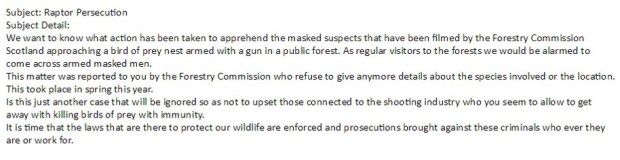
On 16 November 2017, Mr & Mrs Bloggs emailed Police Scotland’s General Enquiries Centre:

Police Scotland responded on the same day with this:

Not to be deterred, Mr & Mrs Bloggs wrote back to Police Scotland:

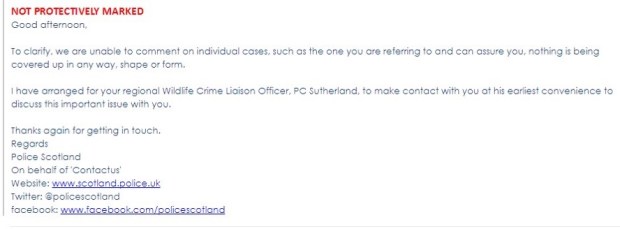
On the same day, Police Scotland responded with this:

The next day, local Police Wildlife Crime Officer Daniel Sutherland wrote to Mr & Mrs Bloggs:

Although Police Scotland should be commended for speedy responses, Mr & Mrs Bloggs were unimpressed with Police Scotland’s refusal to discuss this case so they wrote to their local MSPs to see if they could get anywhere with them.

It turns out to have been an inspired move. Three MSPs have responded, as follows:

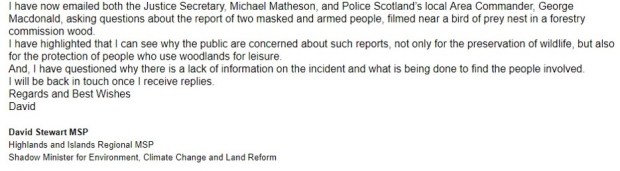
This from David Stewart MSP (Labour, Highlands & Islands, & Shadow Minister for Environment):

This from John Finnie MSP (Scottish Greens, Highlands & Islands):

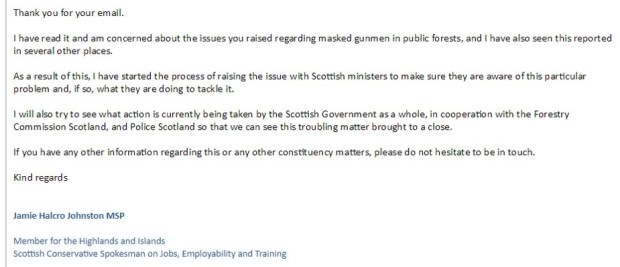
And this from Jamie Halcro Johnston MSP (Scottish Conservatives, Highlands & Islands):

Well done Mr & Mrs Bloggs! Cross-party political interest in under a week.

Let’s see where this goes.

UPDATE 30 December 2017: Masked gunmen at goshawk nest in Moy Forest (here)

Scottish Government announces Grouse moor management review group

Back in May 2017, Cabinet Secretary Roseanna Cunningham announced an intention to set up an independently-led group to review grouse moor management practices, and to advise on the introduction of an estate shoot licensing scheme. This was mainly in response to the publication of the Golden Eagle Satellite Tag Review, which found that almost one third of sat-tagged golden eagles had disappeared in highly suspicious circsumstances on intensively managed driven-grouse moors. But make no mistake, this was also in response to increased public pressure from the SRSG’s petition calling for game shoot licensing and also in response to increasing public anger about the continuing illegal persecution of birds of prey on driven grouse moors.

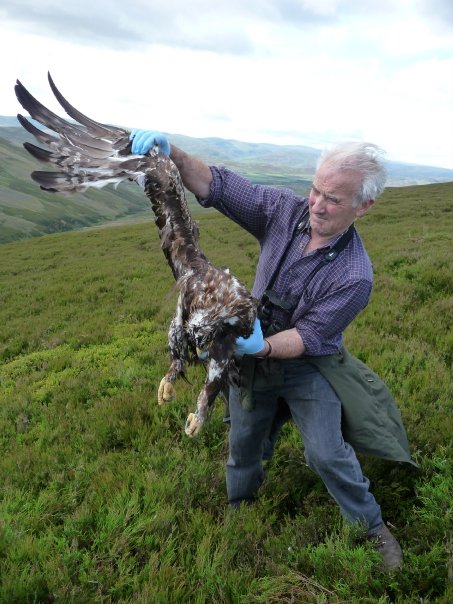
[Photo: Conservationist Roy Dennis with dead golden eagle ‘Alma’ – one of Roy’s first satellite-tagged eagles that was found illegally poisoned on an Angus Glens grouse moor]

Finally, almost six months after that first announcement, the Scottish Government has just released the news about who will serve on this review group.

Here’s the Scottish Government press statement:

New group to focus on sustainability of driven-grouse moors.

Membership of an independent group to ensure grouse moor management practices are sustainable and legally compliant has been confirmed.

The new group will be led by Professor Alan Werrity, who previously chaired a Scottish Natural Heritage review into sustainable moorland management. It includes scientists, moorland managers, regulatory experts and advisers from SNH, Scottish Wildlife Trust, the Game and Wildlife Conservation Trust and the Scottish Environmental Protection Agency.

The group has been set up in response to SNH research that found almost a third of golden eagles being tracked by satellite died in suspicious circumstances and that the majority of cases were where land is intensively managed for driven grouse shooting.

The group will look at the environmental impact of grouse moor management practices such as muirburn, the use of medicated grit and mountain hare culls and advise on the option of licensing grouse shooting businesses.

Environment Secretary Roseanna Cunningham said:

We have been clear that the continued killing of protected species of birds of prey damages the reputation of law-abiding gamekeepers, landowners and the country as a whole.

This new group will look at what we can do to balance our commitment to tackling wildlife crime with grouse moor management practices, so it continues to contribute to our rural economy, while being sustainable and compliant with the law.

The group membership reflects the complex nature and wide range of issues that need to be considered and I look forward to hearing their advice in due course.”

Professor Werrity said:

This is truly challenging work given the traditions underlying moorland management and the concerns coming to light over some mal-practices.

My earlier work chairing the SNH Moorland review also sought to reconcile nature conservation interests with promoting the rural economy. I will be taking an evidence-based approach, and for this we have the right mixture of experience, expertise and knowledge on the group to get to grips with the subject. I look forward to getting started on this review. ”

Background

Read the Golden Eagle Satellite Tag Review

The confirmed membership of the group includes Professor Alan Werrity FRSE, Professor Ian Newton OBE, FRS, FRSE, Professor Alison Hester FSB, (Professor Colin Reid FRSA – see update below) and moorland managers Alexander Jameson BLE MRICS FAAV and Mark Oddy MRICS CEnV MIAagrM.

[Update 28 Nov 2017: Law professor joins grouse moor management review group, here ]

Dr Calum Macdonald (SEPA), Professor Des Thompson (SNH), Dr Adam Smith (GWCT Scotland) and Susan Davies (SWT) will be specialist advisers to the group.

ENDS

Here is the response from RSPB Scotland to today’s announcement:

RSPB Scotland welcomes announcement of grouse moor enquiry

RSPB Scotland has welcomed today’s announcement by the Scottish Government on the grouse moor enquiry panel. Duncan Orr-Ewing, Head of Species and Land Management for RSPB Scotland said: “We very much welcome the announcement of this enquiry and of the independent panel. We look forward to giving evidence to the panel in due course.

The remit of the panel includes consideration as to how grouse moors can be managed sustainably and within the law. There are significant public concerns about how grouse moors are currently being managed in Scotland, including clear evidence gathered over decades of the illegal killing of birds of prey.

In recent years these concerns have broadened to encompass wider grouse moor management practices, as commercialisation has taken place, with an emphasis on producing very large and unsustainable grouse numbers for sport shooting. These practices include muirburn on peatland habitats which are important as carbon stores for combating climate change, the culling of mountain hares and the medication of ‘wild’ red grouse, both designed to prevent grouse diseases and artificially boost grouse bags.

We support the introduction of an effective licensing system for driven grouse shooting, with sanctions including the removal of such licences where illegal practices are confirmed. A licensing system could be supported by a statutory Code of Practice setting out clear management standards to protect public interests and prevent bad management practices. These kind of licensing systems are common place in other European countries and equally support legitimate and well run shooting enterprises.”

ENDS

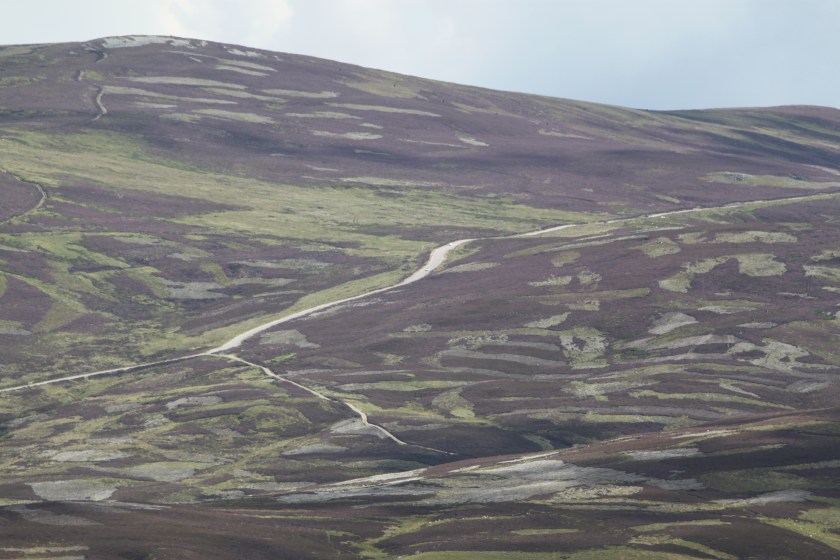
[Photo: the typical landscape of an intensively-managed driven grouse moor in Scotland. Photo by Ruth Tingay]
Here is the response from the Scottish Raptor Study Group to today’s announcement:

Scottish Raptor Study Group warmly welcomes today’s announcement by the Scottish Government on the grouse moor enquiry panel.

Patrick Stirling Aird, Secretary of the Scottish Raptor Study Group said, “We are delighted that the membership of the panel has been announced and look forward to providing evidence when called upon to do so“.

The public have increasing concerns around the way in which grouse moors are being operated with a substantial body of science proving beyond all doubt the widespread and illegal persecution of birds of prey on many such moors.

We support the introduction of licensing for driven grouse shooting with enforceable sanctions where illegal practices are confirmed. Such a licensing scheme could incorporate a statutory code of practice which helps to protect the public interest and to prevent bad management practices. This concept is widespread in Europe and elsewhere and works well with legitimate shooting interests.

ENDS

Here are our first thoughts.

Hallelujah! The panel has finally been announced and presumably its work will now get underway, although notice there is no mention of timescales in the Scottish Government’s statement. That’s not too much of a concern right now – as Roseanna mentions, this work will be complex and it’s in everyone’s interests that it is done thoroughly, so we probably shouldn’t expect any output until at least 2019.

This panel has some serious intellectual heavy weights (Chair, Professor Werrity, and panel members Professors Newton and Hester). All three are at the top of their respective fields and have been for years; their academic achievements and scientific authority are undisputed. We are delighted to see these three involved, especially given Professor Werrity’s intention for having an “evidence-based approach” to the review. Excellent.

The other two panel members (Mr Jameson and Mr Oddy) are a bit of a surprise, to be honest. We didn’t expect to see anybody with such obvious vested interests be part of what had been described as an independently-led review group. Nevertheless, there is probably good reason for having them on board, not least to get buy-in to the review from the game-shooting sector. We know very little about Mr Jameson and only a little bit about Mr Oddy – he’s the chap who, when working for Buccleuch Estates on the Langholm Moor Demonstration Project, suggested that lethal control of buzzards should be a considered option…..but his suggestion was based on no scientific evidence whatsoever, in fact it was the exact opposite of what the science was showing. Hmm.

All in all, just like RSPB Scotland and the Scottish Raptor Study Group, we very much welcome today’s announcement. It is the next step on the road to what many see as the inevitable introduction of an estate licensing scheme in Scotland. We look forward to giving evidence, if invited to do so.

UPDATE 28 November 2017: Law professor joins grouse moor management review group (here)

UPDATE 24 April 2018: Grouse Moor Management Review Group: 1st meeting report (here)

Scottish Government dragging its feet on grouse moor management review

Following last week’s blog about how an announcement was imminent on the formation and composition of the independently-led grouse moor management review group, another deadline has been and gone.

As you’ll recall, Environment Cabinet Secretary Roseanna Cunningham announced this review on 31 May 2017, following the Scottish Raptor Study Group’s petition calling for game-shoot licensing as well as the publication of the Golden Eagle Satellite Tag Review, which demonstrated that almost a third of all satellite-tagged golden eagles in Scotland (41 of 131 eagles) had ‘disappeared’, many in suspicious circumstances on grouse moor estates with a track record of confirmed raptor persecution incidents.

In mid-September 2017 Roseanna told the Scottish Parliament,

Good progress is being made” and “I will announce further details shortly“.

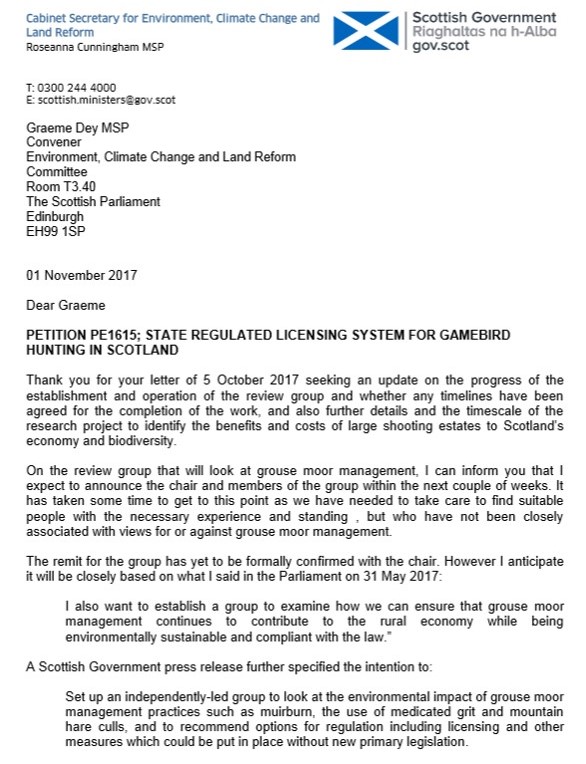
In October 2017 the Scottish Parliament’s Environment Committee wrote to the Cab Sec asking for a progress report on the establishment of this group. Roseanna replied on 1 November 2017 and said,

I can inform you that I expect to announce the chair and members of the group within the next couple of weeks”.

It’s now 20th November and we’re still waiting for an announcement.

Where’s the sense of urgency? Nearly six months have passed. Just how difficult is it to put together a review group?

Come on, Scottish Government, stop dragging your feet and don’t undo the goodwill generated by the Cab Sec’s announcement back in May.

Scot Gov’s grouse moor management review: Chair announcement imminent

It looks like the Scottish Government is about to announce the Chair and members of the much-anticipated independent review group that will be tasked with considering the environmental impacts of grouse moor management techniques and to recommend options for regulation, including licensing.

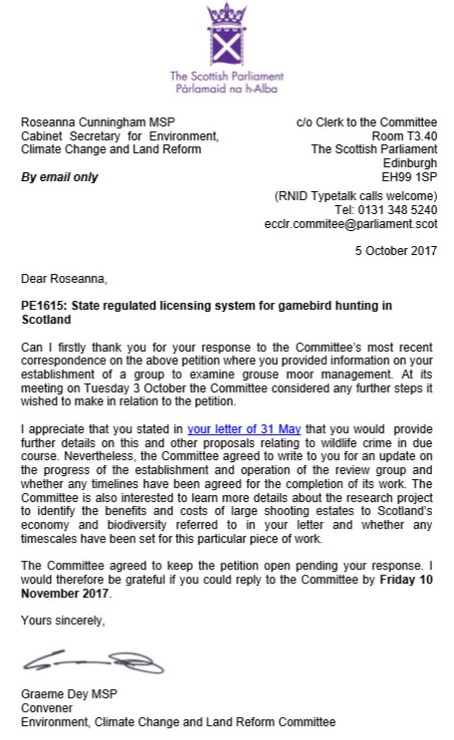
Back in October 2017, the Scottish Parliament’s Environment Committee agreed to write to Environment Cabinet Secretary Roseanna Cunningham to ask for an update on the establishment of this review group, which had first been announced on 31 May 2017. They asked her to respond by 10 November 2017.

Last Friday (10 Nov), the following letter was published on the Environment Committee’s website:

The Cabinet Secretary told the Committee, “I can inform you that I expect to announce the chair and members of the group within the next couple of weeks“. We groaned a little bit, thinking we’d have to wait until late November for this announcement, but then we noticed the date of Roseanna’s letter: 1 November 2017.

That means we can expect this announcement either today (13th) or tomorrow (14th), if she keeps to her word.

UPDATE: 20 November 2017: Scottish Government dragging its feet on grouse moor management review (here)

Costs/benefits study of driven grouse shooting due to begin spring 2018

In September 2017 the Scottish Parliament’s Public Petitions Committee considered petition # PE01633, submitted by Les Wallace, calling on the Scottish Government to sponsor a comprehensive and independent study into the full economic impacts of driven grouse shooting.

The Petitions Committee agreed that a full independent study was needed but was unsure whether this topic would be covered as part of the Scottish Government’s earlier commitment in May to undertake a review of grouse moor management practices.

There was also confusion as to whether the Scottish Government had actually commissioned this research yet, and the Committee agreed to contact the Scottish Government to ask for an update on progress and to ask for a timescale (e.g. start / finish date) of that proposed work.

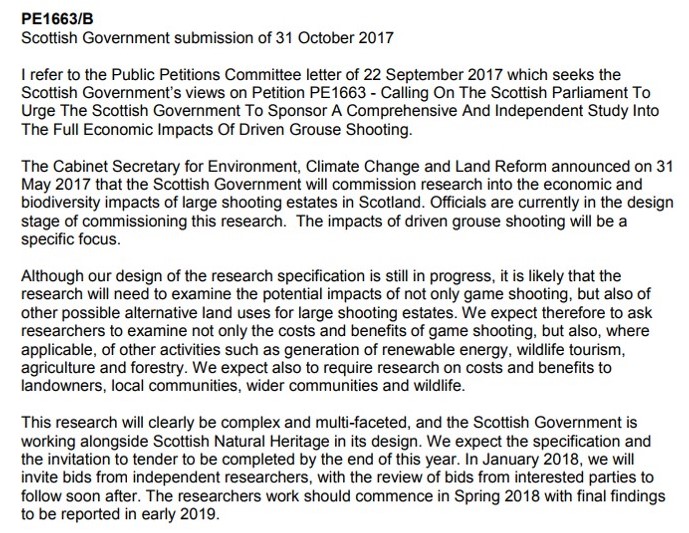
The Scottish Government has now responded to the Petitions Committee with this:

It’s our understanding that this commissioned research on the economic and biodiversity costs/benefits of driven grouse shooting (and other types of upland land use) is separate to the other main piece of work announced by Roseanna Cunningham five months ago in May 2017 – that being ‘to set up an independently-led group to look at the environmental impact of grouse moor management practices such as muirburn, the use of medicated grit and mountain hare culls, and to recommend options for regulation including licensing and other measures which could be put in place without new primary legislation‘.

We are expecting details of this independently-led environmental impact review group to be announced by Friday 10th November, as requested by the Scottish Parliament’s Environment Committee last month.

Scot Gov’s grouse moor management review: update due in 2 weeks

Earlier this month the Scottish Parliament’s Environment Committee met to discuss progress on the Scottish Raptor Study Group’s petition calling for licensing of all gamebird hunting.

The Committee agreed to write to Cabinet Secretary Roseanna Cunningham for a ‘detailed update’ on the proposals she announced back in May 2017, which included setting up an independently-led group to consider the environmental impact of grouse moor management techniques, and to recommend options for regulation, including licensing.

Since that announcement five months ago we’ve heard very little more about this, which is particularly disappointing given one of the proposals was to ‘Immediately review all available legal measures which could be used to target geographical areas of concern‘.

‘Immediate’ means occuring without delay. So has this immediate review of legal measures been completed? If not, why not? If yes, where is it?

In mid-September Roseanna Cunningham did tell the Scottish Parliament that “good progress is being made” on a number of the proposed measures and that she would “announce further details shortly“.

No further details have yet emerged.

The Environment Committee has now written to Roseanna for an update and has requested she responds by 10th November 2017.

Grouse moors are “centres of excellence” for mountain hares, claims deluded industry rep

You’ve got to hand it to Tim (Kim) Baynes, spokesman for the Scottish Moorland Group / Scottish Land & Estates / Gift of Grouse, his ability to spin even the worst of the grouse-shooting industry’s excesses is becoming legendary (e.g. see here, here, here). He’d probably even give Amanda Anderson (Moorland Association) a run for her money in the propaganda game.

In his latest offering, Tim (Kim) argues that managed grouse moors should be seen as a “Centre of Excellence” for mountain hares!

That’ll be the intensively-managed grouse moors that slaughter hundreds, no, thousands of so-called protected mountain hares, just to protect a ridiculously and artificially high number of red grouse which will later be used as live targets, shot for ‘sport’.

Here’s a ‘Centre of Excellence’ for mountain hares, photographed on an Angus Glens estate:

This “Centre of Excellence” nonsense is included in Tim’s (Kim’s) response to the Scottish Parliament’s Public Petitions Committee which is seeking stakeholder commentary on OneKind’s recent petition calling for greater protection of mountain hares.

Here’s Tim’s (Kim’s) submission, on behalf of the Scottish Moorland Group:

 Scottish Land & Estates_Petition PE1664_mountain hare_response

There are other gems within his submission, including an argument that from an animal welfare perspective, the culling of mountain hares is “not fundamentally different” to culling deer. Quite how he reaches this conclusion is a bit of a mystery – aren’t deer carefully stalked for hours and hours, with the shooting party quietly creeping up on a single deer to get close enough for a clean rifle shot without the deer knowing anything about it? Not sure how that equates with hundreds of mountain hares being forced to run uphill, probably terrified and racing for their lives, only to be shot in the face by a line of shotgun-toting ‘sportsmen’ when they reach the top.

As usual, Tim (Kim) misses the whole point of the argument, which isn’t necessarily about whether mountain hares should be managed, but is about the questionable sustainability of large-scale culls on intensively managed driven grouse moors. Nobody disputes that mounatin hares can do very well on these grouse moors – of course they do well, all their natural predators have been removed! But there’s no way that gamekeepers can know the impact of these large culls on the wider mountain hare population, despite Tim’s (Kim’s) unsupported claim that they can, and despite his unsupported claim that “estates have operated voluntary restraint for a long time”.

Nobody knows what impacts these culls are having because there isn’t yet an effective and approved counting method for estimating mountain hare abundance, although Dr Adam Watson’s long-term scientific research on mountain hare abundance on grouse moors in north east Scotland suggests there have been significant declines (his research is due to be submitted for peer-review publication shortly, we understand).

There is currently no requirement for gamekeepers to conduct counts either before or after these culls take place, and no requirement for cull returns to be submitted to SNH, even though SNH has a statutory duty to ensure that any management of this species is undertaken sustainably! At the moment, SNH is relying upon the word of the grouse-shooting industry to assess sustainability, which is astonishing given what is known about the industry’s untrustworthiness on other conservation issues.

Here’s a topical drawing sent in this week by Mr Carbo:

Green MSP lodges Parliamentary motion calling for moratorium on mountain hare culls

Following the news on Friday that ten conservation and outdoor organisations have renewed a joint call on the Scottish Government to provide greater protection for mountain hares (see here), Scottish Green Party MSP Alison Johnstone has now lodged a Parliamentary motion calling for ‘urgently required’ action:

Motion S5M-08225: Alison Johnstone, Scottish Green Party, Date lodged: 12/10/2017.

That the Parliament acknowledges the concerns of a coalition of 10 conservation and outdoor organisations regarding the poorly-known status of mountain hare in Scotland, which they believe is threatened by heavy culls on intensively-managed grouse moors, and considers that a moratorium on these culls is urgently required.

Parliamentary motions are used by MSPs as a device to initiate debate or propose a course of action. Other MSPs can sign up in support of lodged motions. Motions remain current for six weeks and in order to progress they require support by at least 30 supporters from more than two political parties.

For Scottish blog readers, please consider emailing your MSP to ask them to support this motion. If you’re not sure who your MSP is, you can find out here.

The pressure on the Scottish Government to act on this issue is not going away. Well done Alison Johnstone MSP, well done to those ten conservation/outdoor organisations who have asked, again, for a temporary ban on mountain hare culling, and well done to animal welfare charity OneKind whose petition calling for greater protection of mountain hares is still under consideration by the Parliament’s Petitions Committee.

Photo shows a pile of bloodied mountain hare corpses that were being used as a stink pit on an Angus Glens grouse shooting estate.

Gamebird shoot licensing: Environment Committee to review progress tomorrow

The Scottish Parliament’s Environment, Climate Change & Land Reform (ECCLR) Committee will meet tomorrow to discuss progress on the petition calling for the introduction of state-regulated licensing for gamebird hunting.

As you know, this petition was lodged with the Public Petitions Committee in the summer of 2016 by Logan Steele, on behalf of the Scottish Raptor Study Group (SRSG). The Petitions Committee took evidence in October 2016 from the SRSG and RSPB Scotland (see here) and then evidence from the Scottish Moorland Group and BASC in December 2016 (see here) before deciding to pass the petition to the Environment Committee for further consideration.

The Environment Committee first considered the petition in January 2017 (here) and then heard evidence from various organisations (SRSG, RSPB Scotland, SNH, SGA and SLE) in April 2017 (here).

On the basis of those evidence sessions, on 23 May 2017 the Environment Committee agreed to keep the petition open and to write to Environment Secretary Roseanna Cunningham (see letter here) to recommend that the Scottish Government explores the implementation of a licensing scheme for grouse moor shooting, much to the disappointment of the grouse shooting industry which doesn’t think licensing is necessary and basically just wants to maintain the status quo.

The following week, on 31 May 2017, the Environment Secretary announced a significant package of measures designed to protect raptors and to investigate the wider environmental and economic impacts of grouse moor management:

Since that announcement on 31 May 2017 we’ve heard very little more, although in mid-September Roseanna Cunningham told the Scottish Parliament that “good progress is being made” and that she will “announce further details shortly“.

Perhaps we’ll get an announcement this week? It’s good to see the Environment Committee isn’t letting this issue slide.

Tomorrow’s meeting will be available to watch live on Scottish Parliament TV (here) (Committee Room 1 from 10am) and we’ll post an archive of the video and the official transcript when available.

UPDATE 3 October 2017: Environment Committee to seek ‘detailed update’ on licensing petition (here)